S1: Permutations and Combinations
Order vs. No Order: The Ultimate Showdown! 🤯
Introduction
1. Introduction
Ever wondered how many ways you can arrange your playlist, or how many different teams can be picked from your class? Welcome to Permutations and Combinations, the part of S1 that's all about counting possibilities! It sounds simple, but it's a powerful tool for solving complex problems. We'll start by tackling permutations, where the order of things is super important (like a passcode). Then, we'll switch gears to combinations, where order doesn't matter at all (like picking toppings for a pizza). Finally, we'll level up by looking at arrangements with restrictions – the kind of tricky scenarios the examiners love, where you have special conditions to deal with. Let's get counting! 🚀
2. Permutations: The Mathematics of Ordering
Alright, let's get into permutations. The single most important thing to remember is that with permutations, order matters. Seriously, tattoo that on your brain. A permutation is just a fancy word for an arrangement or a specific sequence of objects. Think about your phone passcode: 1-2-3-4 is very different from 4-3-2-1. That's a permutation in action!
The foundational tool here is factorial notation. When you see (read 'n factorial'), it just means you multiply all the whole numbers from down to 1. So, . This tells you the number of ways to arrange distinct objects. If you have 5 different books, there are ways to arrange them on a shelf.
But what if you don't want to arrange all of them? What if you have 10 songs on a playlist but only want to choose and arrange the top 3? This is where the nPr formula comes in, written as . It calculates the number of ways to choose and arrange objects from a set of distinct objects. The formula you must know for your exam is: The in the denominator cleverly cancels out the objects you didn't pick.
The foundational tool here is factorial notation. When you see (read 'n factorial'), it just means you multiply all the whole numbers from down to 1. So, . This tells you the number of ways to arrange distinct objects. If you have 5 different books, there are ways to arrange them on a shelf.
But what if you don't want to arrange all of them? What if you have 10 songs on a playlist but only want to choose and arrange the top 3? This is where the nPr formula comes in, written as . It calculates the number of ways to choose and arrange objects from a set of distinct objects. The formula you must know for your exam is: The in the denominator cleverly cancels out the objects you didn't pick.
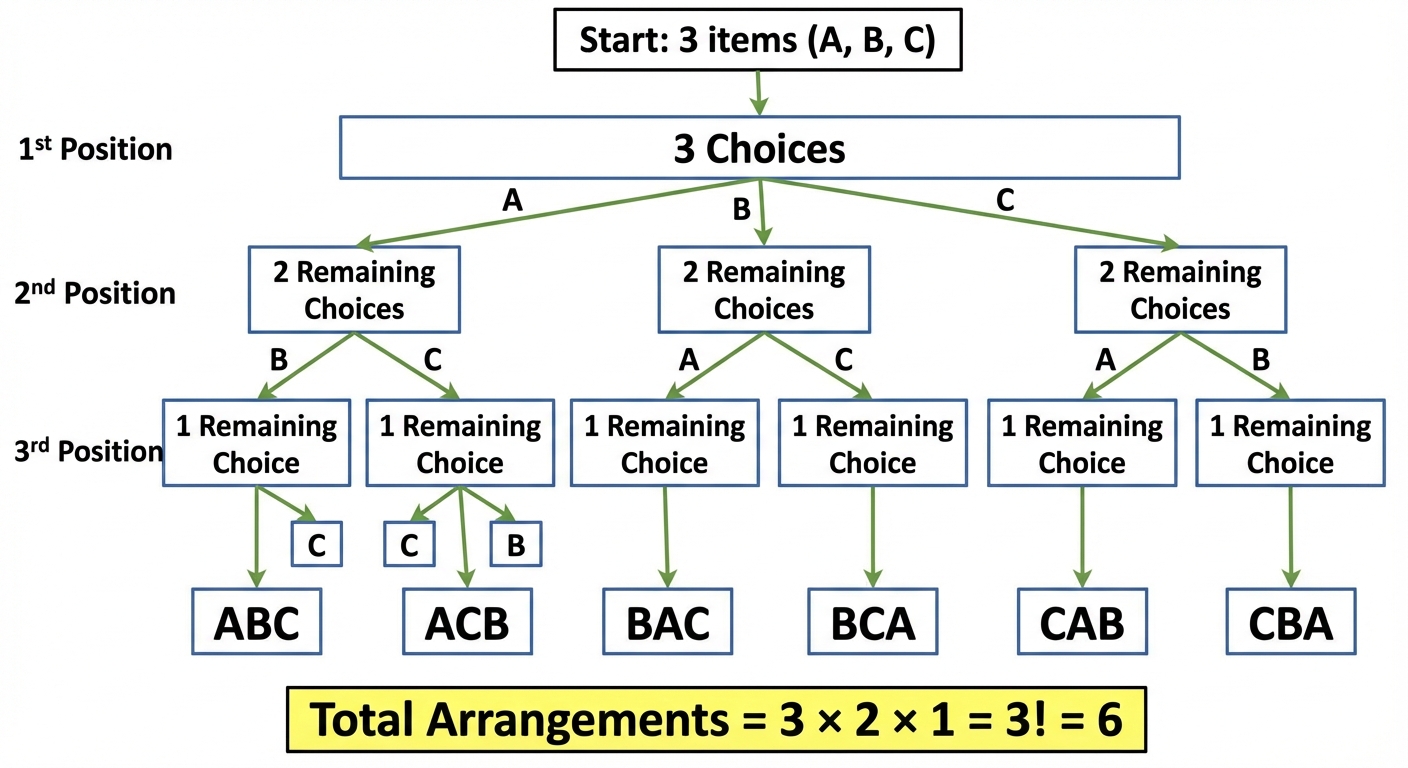
Now for the classic exam curveball: arrangements with repetition. What if some items are identical, like in the word 'MISSISSIPPI'? If you swap the first 'S' with the second 'S', the word doesn't change, but a simple factorial calculation would count it as a new arrangement. To fix this overcounting, we divide by the factorial of the count of each repeated item. For a set of objects with identical items of one type, of another, and so on, the number of distinct permutations is: This concept is huge in fields like cryptography and data science, where unique sequences are everything. So, master this – it’s a guaranteed mark-earner.
Worked example
Worked Example: Arranging Letters with Repetition
Let's Untangle This Word Problem! 🤯
A student is asked to find the number of distinct arrangements of the ten letters in the word 'STATISTICS'. How many are there?
- 1First, identify the total number of items (letters) we need to arrange. This will be the numerator in our formula. The word 'STATISTICS' has 10 letters.
- 2Next, we need to spot any repeated letters and count how many times each one appears. This is crucial for correcting the overcounting. In 'STATISTICS', we have:S appears 3 times ()
T appears 3 times ()
I appears 2 times ()
(A and C appear once, so we can ignore them in the denominator as ) - 3Now, we'll apply the formula for permutations with repetition. We take the factorial of the total number of letters and divide it by the product of the factorials of the counts of each repeated letter.
- 4Time to calculate! Let's expand the factorials and simplify. Remember your calculator has a factorial button which will save you a lot of time in the exam.
- 5Finally, perform the division to get our final answer. Always present your final answer clearly.
So, there are 50,400 distinct ways to arrange the letters of the word 'STATISTICS'.
Answer
So, there are 50,400 distinct ways to arrange the letters of the word 'STATISTICS'.
So, there are 50,400 distinct ways to arrange the letters of the word 'STATISTICS'.
3. Combinations: Selections Where Order Doesn't Matter
Alright, let's talk about combinations. Unlike its cousin, permutations, where the order of things is everything (like your phone's passcode), combinations are all about the group you end up with. The order in which you pick them is completely irrelevant. Think about choosing three friends to go to the movies with; it doesn't matter if you pick Sarah, then Ben, then Chloe, or Chloe, then Sarah, then Ben. The final group is the same. This concept of selection without regard to order is the absolute core of combinations.
The magic formula you need to know is , often written as . Here, '' is the total number of items you can choose from, and '' is the number of items you are choosing. The formula is: Now, don't just memorize it, let's understand it. The numerator and the in the denominator, , is just the permutations formula, . So why do we divide by an extra ? Because overcounts by arranging the chosen items. Since we don't care about the order of the items we've selected, we divide by the number of ways those items can be arranged amongst themselves, which is . This simple division is what strips the 'order' out of the equation, leaving us with pure selection.
The magic formula you need to know is , often written as . Here, '' is the total number of items you can choose from, and '' is the number of items you are choosing. The formula is: Now, don't just memorize it, let's understand it. The numerator and the in the denominator, , is just the permutations formula, . So why do we divide by an extra ? Because overcounts by arranging the chosen items. Since we don't care about the order of the items we've selected, we divide by the number of ways those items can be arranged amongst themselves, which is . This simple division is what strips the 'order' out of the equation, leaving us with pure selection.
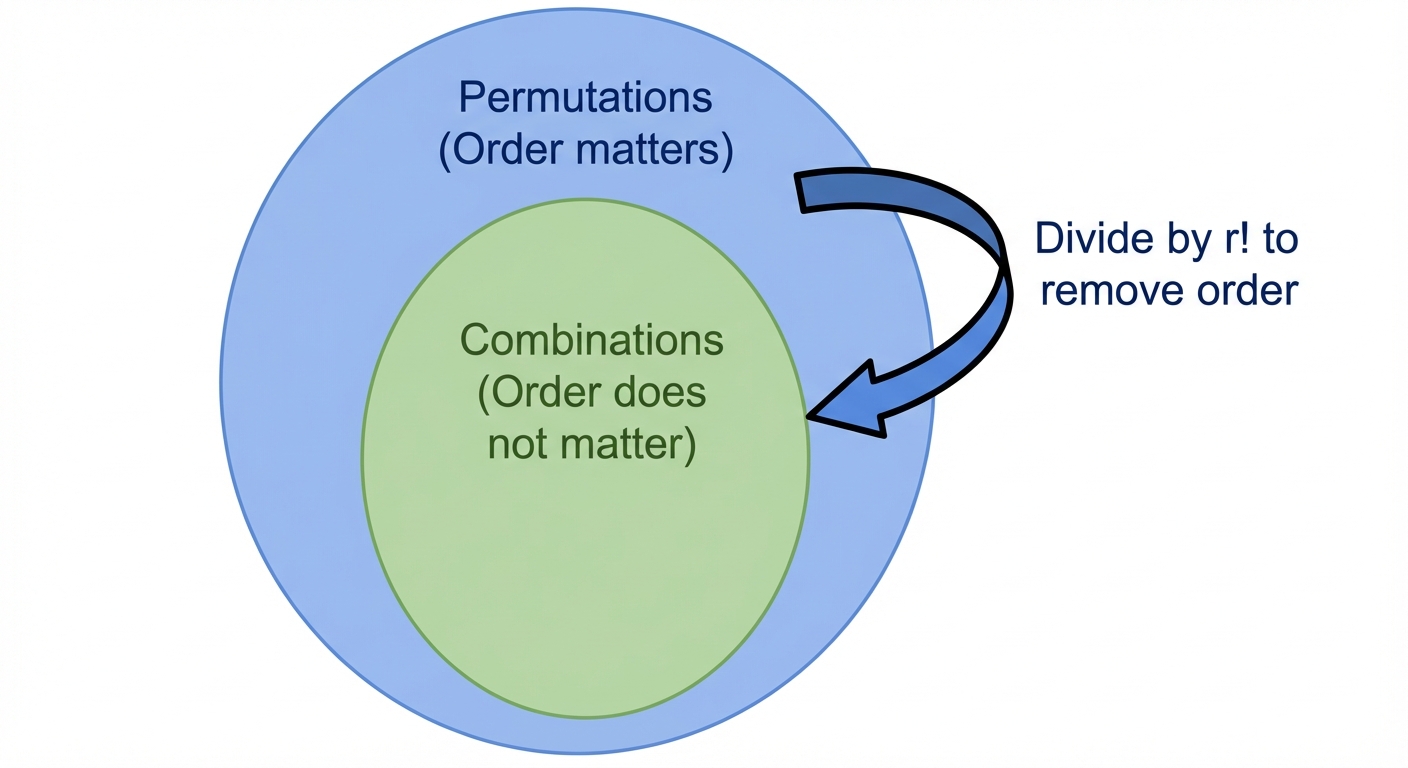
This often links with the Fundamental Counting Principle. If you need to choose 3 boys from a group of 10 and 2 girls from a group of 8, you'd calculate the combinations for each group separately ( and ) and then multiply the results. Mastering this is crucial for probability and statistics, forming the basis for sampling techniques you'll encounter in university courses like Economics, Engineering, and Data Science.
Worked example
Worked Example: Scholarship Candidate Selection
Building the Ultimate Project Team 🚀
A university is awarding scholarships to a team of 4 students. The candidates consist of 7 students from the Arts faculty and 10 students from the Science faculty. Find the number of different teams that can be selected if the team must have at least 3 students from the Science faculty.
- 1First, let's break down the condition 'at least 3 students from the Science faculty'. This creates two distinct, mutually exclusive cases that satisfy the requirement:
Case 1: Exactly 3 Science students and 1 Arts student.
Case 2: Exactly 4 Science students and 0 Arts students.
We need to calculate the number of combinations for each case and then add them together. - 2Calculate the combinations for Case 1. We need to select 3 Science students from 10 AND select 1 Arts student from 7. Since order doesn't matter for a team, we use combinations. The word 'AND' tells us to multiply the results.
- 3Now, let's calculate the combinations for Case 2. Here, we need to select 4 Science students from 10 AND select 0 Arts students from 7. Anything to the power of 0 is 1, and similarly, choosing 0 items from a group can only be done in 1 way.
- 4Finally, combine the results of the two cases. Since a team can either be formed as in Case 1 OR Case 2, we add the number of ways for each case to get the total number of possible teams.
- 5State the final answer clearly. This number represents every possible unique team of 4 that meets the 'at least 3 from Science' criteria.There are 1050 different ways to form the team.
Answer
There are 1050 different ways to form the team.
4. Arrangements with Restrictions: Adjacency and Grouping
Alright, let's level up and tackle arrangements with restrictions. This is where permutations get really interesting and are a guaranteed feature on your S1 paper. Think of it like this: you're trying to set up a playlist, but some songs must follow each other to create a vibe, while others absolutely cannot be played back-to-back. These are restrictions!
The first key technique is the Grouping Method, used when items must be adjacent. Imagine you have two items, A and B, that must be together. The trick is to metaphorically 'glue' them together, treating them as a single super-item, '(AB)'. Now, you arrange this '(AB)' block along with all the other items. But wait, there's a crucial second step! You also have to consider the arrangements within the block. It could be AB or BA. So, you calculate permutations of the main group (including your super-item) and multiply it by the permutations inside the super-item ( in this case).
The first key technique is the Grouping Method, used when items must be adjacent. Imagine you have two items, A and B, that must be together. The trick is to metaphorically 'glue' them together, treating them as a single super-item, '(AB)'. Now, you arrange this '(AB)' block along with all the other items. But wait, there's a crucial second step! You also have to consider the arrangements within the block. It could be AB or BA. So, you calculate permutations of the main group (including your super-item) and multiply it by the permutations inside the super-item ( in this case).
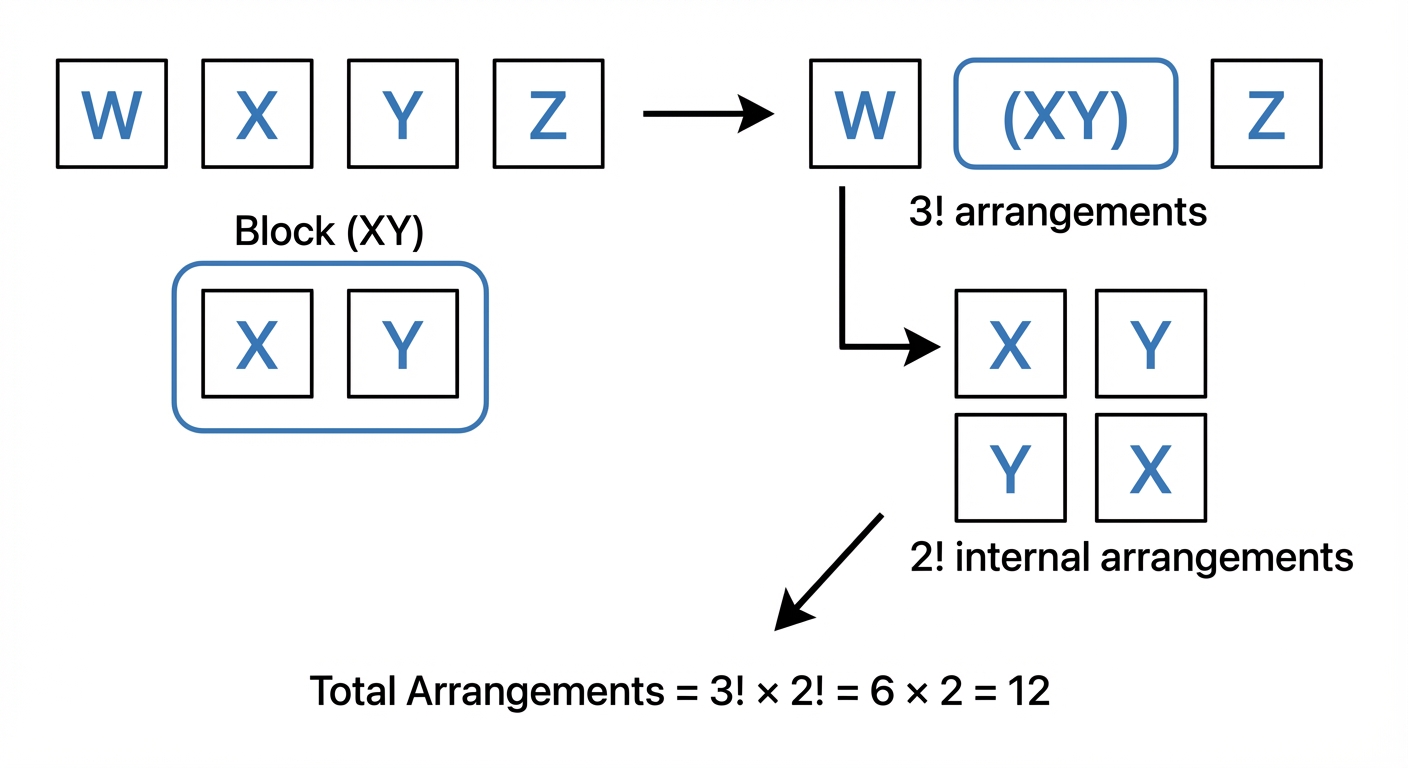
The second major strategy, often a lifesaver, is Complementary Counting. This is your go-to when items must not be adjacent. Trying to count all the valid arrangements directly can be a nightmare. Instead, it's way easier to calculate the total possible arrangements without any restrictions, and then subtract the unwanted arrangements (where they are adjacent). The formula is simply: Arrangements (not adjacent) = Total Arrangements - Arrangements (adjacent). This 'backdoor' method is incredibly powerful and efficient, a type of logical thinking that's essential for university-level problem-solving in fields like computer science (think algorithm design) and risk analysis.
Worked example
Worked Example: Arranging Letters with Adjacency Constraints
The 'PARALLEL' Problem 🤯
The word PARALLEL has 8 letters. Find the number of different arrangements of these letters if:
a) The two 'A's are adjacent.
b) The three 'L's are not all together.
a) The two 'A's are adjacent.
b) The three 'L's are not all together.
- 1Part (a) Strategy: Grouping. To ensure the two 'A's are always adjacent, we must 'glue' them together and treat them as a single block: (AA). This effectively reduces the number of items we need to arrange.Items to arrange: P, R, (AA), L, L, L, E
- 2Part (a) Calculation. We now arrange these 7 'items'. Remember to account for the 3 repeated 'L's by dividing by . The internal arrangement of (AA) is just 1 way since the letters are identical.
- 3Part (b) Strategy: Complementary Counting. Finding arrangements where the 'L's are not all together is complex. It's much simpler to find the total arrangements and subtract the arrangements where they are all together.
- 4Part (b) Total Arrangements. First, calculate the total unrestricted arrangements for PARALLEL. We have 8 letters in total, with 2 repeated 'A's and 3 repeated 'L's.
- 5Part (b) Unwanted Arrangements. Now, find the 'bad' arrangements where the three 'L's are grouped as (LLL). This gives us 6 'items' to arrange: P, A, A, R, E, (LLL). Don't forget the 2 repeated 'A's!
- 6Part (b) Final Answer. Finally, subtract the unwanted arrangements from the total to get the number of arrangements where the three 'L's are not all together.
Answer
Practice this in the app
Unlock the full chapter: practice questions, flashcards, mock papers and notes, free.
Continue revising