P3 - Numerical Solution of Equations
Locating Roots by Sign Change
1. Locating Roots by Sign Change
Alright, let's talk about finding roots. A 'root' of an equation like is just the fancy name for the x-value where the graph of crosses the x-axis. Think of it like the ground level in a video game. Sometimes your character is above it, sometimes you're in a secret cavern below it. To get from one to the other, you have to pass through ground level, right?
That's the whole vibe of the sign change rule. If you have a continuous function (basically, a graph you can draw without lifting your pen – no weird teleports or gaps like a character glitching across the map), and you find a point where the function is positive (like ) and another point where it's negative (like ), then you've just proven that the graph must cross the x-axis somewhere between and .
That's the whole vibe of the sign change rule. If you have a continuous function (basically, a graph you can draw without lifting your pen – no weird teleports or gaps like a character glitching across the map), and you find a point where the function is positive (like ) and another point where it's negative (like ), then you've just proven that the graph must cross the x-axis somewhere between and .
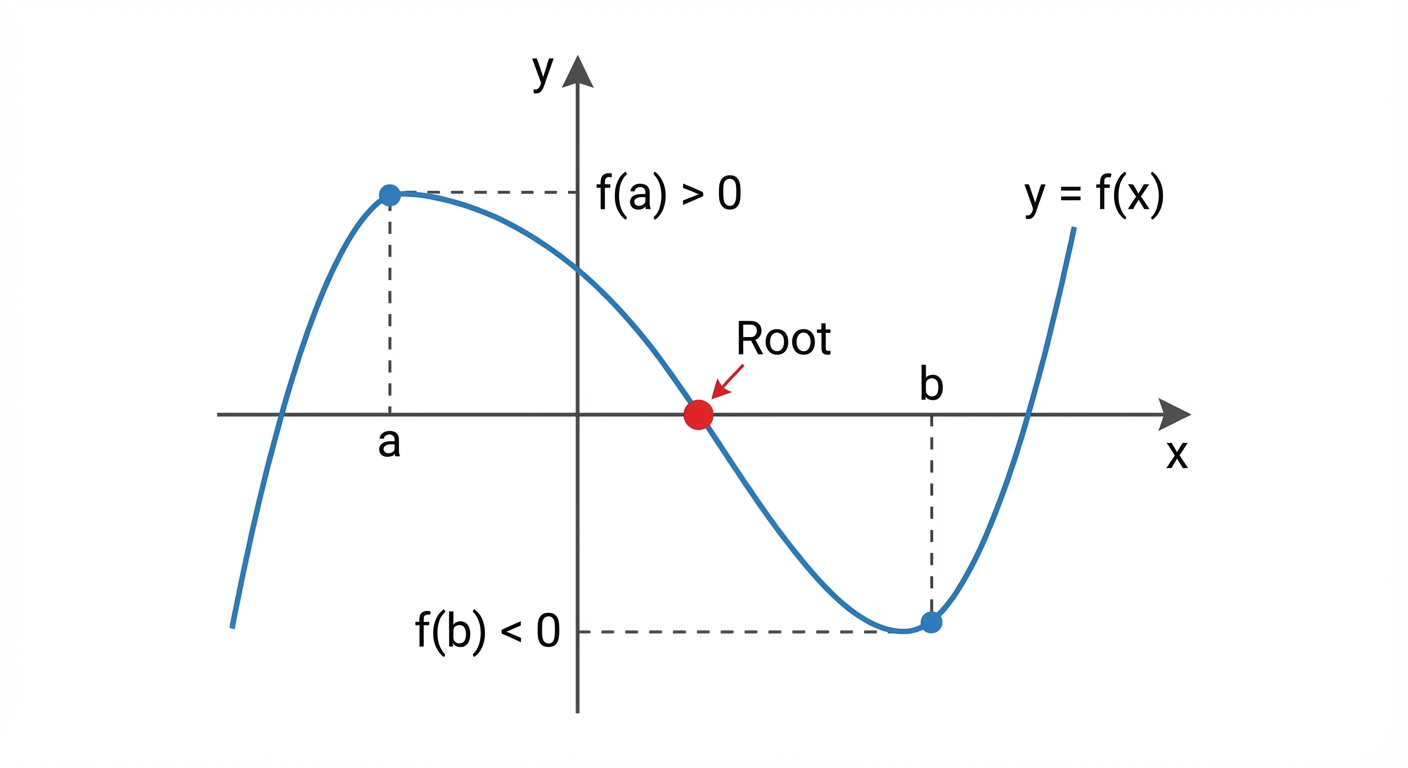
It's like your bank account balance after getting a part-time job. If you were at -£20 one day and +£50 the next after getting paid, you know at some point your balance hit exactly £0. That's our root! The key conditions are: 1) The function must be continuous on the interval , and 2) There must be a change of sign between and . This method is awesome for trapping a root in a specific interval, often between two consecutive integers like 1 and 2.
Worked example
Worked Example: Applying the Sign Change Rule
Let's Hunt for a Root! 🎯
The equation has a single root, . Show that lies in the interval .
- 1First up, we need to define our function based on the equation given. The goal is to show that when we plug in the interval's endpoints (2 and 3), the function's value changes sign from positive to negative, or vice versa.
- 2Now, let's test the lower bound of the interval, . We'll substitute this into our function and see what we get. Keep a few decimal places for accuracy.
- 3Okay, that one's negative. Now let's do the same for the upper bound, . We're hoping this gives a positive result to confirm the sign change.
- 4Success! We have a negative value and a positive value. We just need to write a concluding sentence that mentions the two key conditions: the sign change and the continuity of the function.
Answer
2. The Iterative Method: Using xₙ₊₁ = F(xₙ)
Alright, so you know how some equations are just impossible to solve perfectly? Like, you can't get on its own, no matter how hard you try. It's the math equivalent of trying to get a perfect screenshot of a specific moment on a Snapchat video. Frustrating, right? That's where iterative methods come in. Think of it as a 'get closer' machine. The core idea is the formula . It looks a bit wild, but it's actually simple. You start with an initial guess for the root, which we call . You plug this guess into the function , and it spits out a new, better guess, . Then you take , plug it back in, and get an even better guess, . You keep repeating this process – or iterating – and your values get closer and closer to the actual root. It's like when your GPS keeps recalculating to get you to your destination; each new route is a better approximation.
This process of getting closer is called convergence. If you were to graph it, you'd see the values either spiralling inwards (a 'cobweb' diagram) or stepping closer and closer (a 'staircase' diagram) to the point where the line crosses the curve .
This process of getting closer is called convergence. If you were to graph it, you'd see the values either spiralling inwards (a 'cobweb' diagram) or stepping closer and closer (a 'staircase' diagram) to the point where the line crosses the curve .
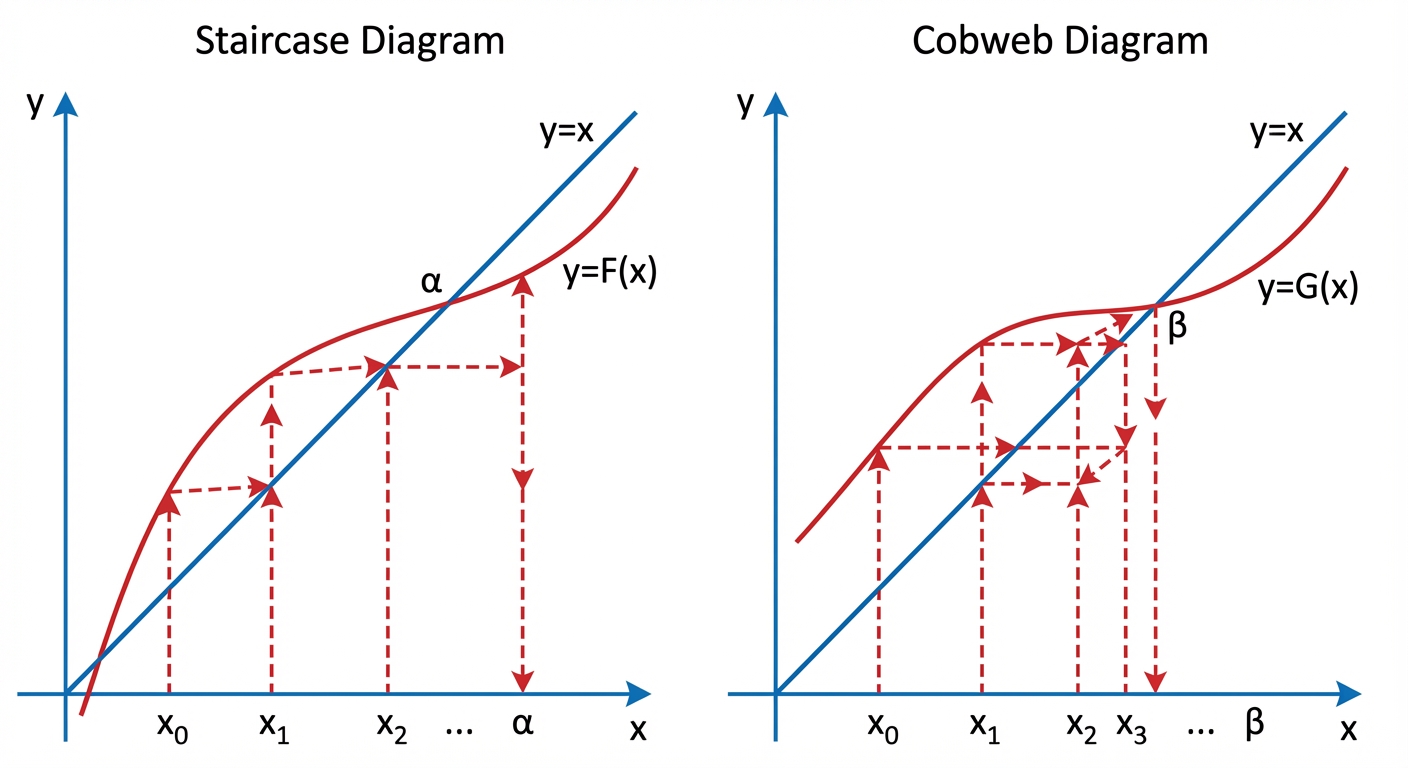
. So, when do you stop? The question will tell you the prescribed accuracy, like 'to 3 decimal places'. You keep hitting the equals button on your calculator until the numbers stop changing up to that decimal place. Once the value has settled, you've found your root to the required accuracy. Easy peasy.
Worked example
Worked Example: Applying an Iterative Formula
Let's Get This Bread (and this Root) 🍞
The equation has a root between and . Use the iterative formula with a starting value of to find the root correct to 3 decimal places.
- 1First, let's set up the calculator. This is a pro-gamer move to make life easier. Type your starting value, , into your calculator and press the '=' key. This stores as the most recent 'Ans'.
- 2Now, type the iterative formula into your calculator, but instead of using 'x', use the 'Ans' button. This will let you repeat the calculation super fast.
- 3Time to iterate! Press '=' repeatedly and write down the sequence of values. Keep all the decimal places from your calculator display for now to avoid rounding errors. We're looking for the point where the first three decimal places stop changing.
- 4Let's analyse the results. Notice how and both start with They are identical when rounded to 3 decimal places. This is our signal to stop. The value has converged.
- 5Finally, we state our answer clearly. Since the values have stabilized at 0.655 (when looking at more places) and round to 0.656, we can be confident in our answer. The question asks for the root correct to 3 decimal places.
Answer
Practice this in the app
Unlock the full chapter: practice questions, flashcards, mock papers and notes, free.
Continue revising