Mechanics 1: Energy, Work and Power
The Physics of Pushing, Pulling & Powering Up! 💪
Introduction
1. Introduction
Alright, let's dive into one of the most powerful (pun intended!) chapters in Mechanics: Energy, Work, and Power. Ever wondered about the physics behind pushing a heavy box across the floor, or why you feel tired after running up a flight of stairs? This chapter gives you the tools to calculate exactly what's going on.
We'll start by defining Work Done by a force – it's not just about effort, it's about moving something a distance. Then, we'll explore the fundamental Principle of Conservation of Energy, learning how kinetic and potential energy transform into one another. Finally, we'll crank it up a notch with Power, figuring out how fast work is being done. Mastering these three concepts is a game-changer for tackling complex mechanics problems, so let's get started! 🚀
We'll start by defining Work Done by a force – it's not just about effort, it's about moving something a distance. Then, we'll explore the fundamental Principle of Conservation of Energy, learning how kinetic and potential energy transform into one another. Finally, we'll crank it up a notch with Power, figuring out how fast work is being done. Mastering these three concepts is a game-changer for tackling complex mechanics problems, so let's get started! 🚀
2. The Principle of Work Done by a Constant Force
Alright, let's get into one of the most fundamental concepts in Mechanics: Work Done. In everyday life, 'work' means any kind of effort. In physics, it's much more specific. You only do work on an object when you apply a force that causes it to move a certain distance. Pushing against a solid brick wall for an hour? Zero work done, because the wall didn't move. Pushing a box across the room? Now we're talking!
The simplest case is when your force and the direction of movement are perfectly aligned. Then, Work Done () is just Force () times distance (), so . But life is rarely that simple. What if you're pulling a suitcase, and the handle is at an angle to the ground? You're pulling upwards and forwards, but the suitcase is only moving forwards. This is where the full formula comes in, and it's essential for your exams: Here, is the crucial part – it's the angle between the direction of the force and the direction of the displacement. The term basically finds the component of your force that is actually contributing to the motion. It's the 'useful' part of your effort.
The simplest case is when your force and the direction of movement are perfectly aligned. Then, Work Done () is just Force () times distance (), so . But life is rarely that simple. What if you're pulling a suitcase, and the handle is at an angle to the ground? You're pulling upwards and forwards, but the suitcase is only moving forwards. This is where the full formula comes in, and it's essential for your exams: Here, is the crucial part – it's the angle between the direction of the force and the direction of the displacement. The term basically finds the component of your force that is actually contributing to the motion. It's the 'useful' part of your effort.
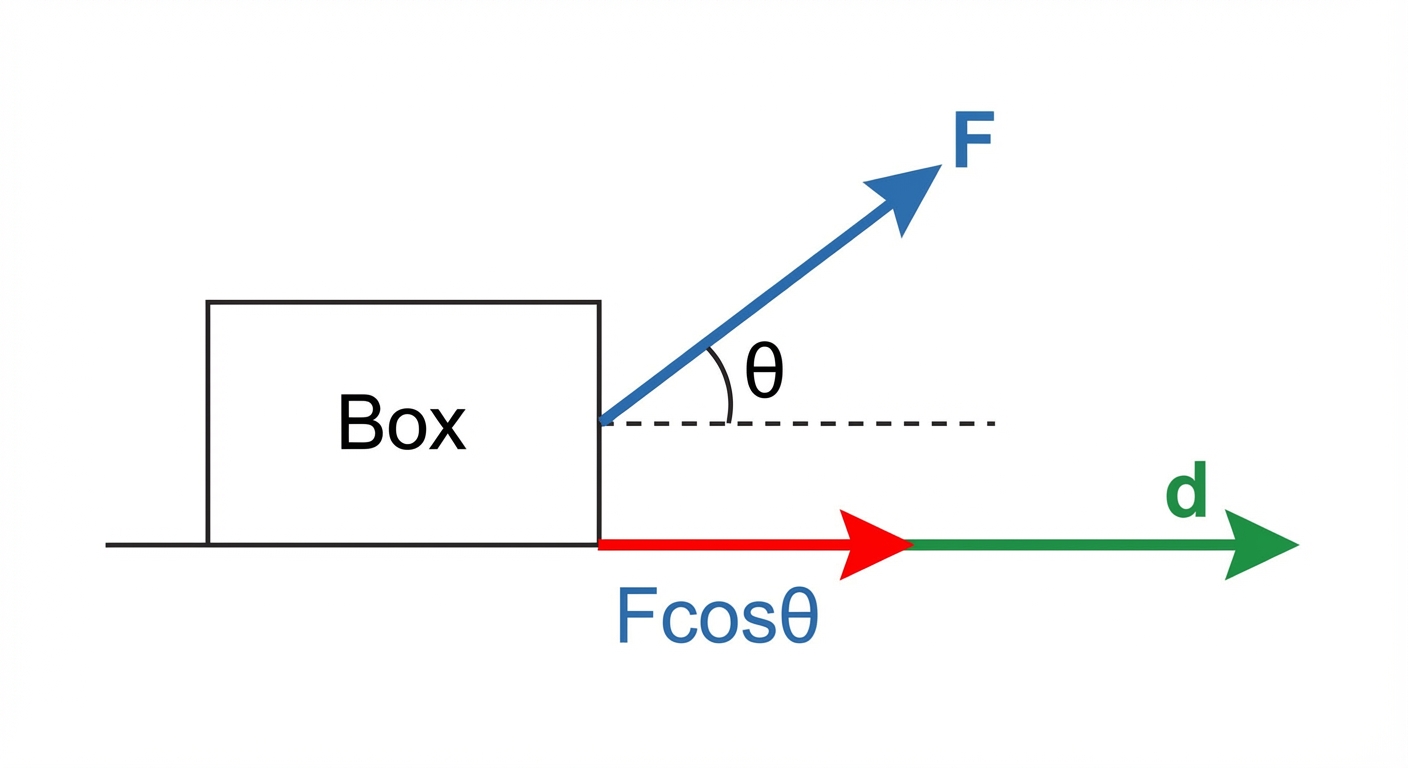
Think about the extremes: if your force is parallel to the motion (), , and you get the maximum work, . If your force is perpendicular to the motion (), like when you're carrying books and walking horizontally, , so the work done by your lifting force is zero in the horizontal direction! This is a classic exam trap. This concept isn't just for exams; it's the bedrock of engineering and physics, helping to calculate the energy efficiency of everything from car engines to robotic arms. Mastering this now is a huge step towards university-level physics and engineering courses.
Worked example
Worked Example: Calculating Work Done with an Angled Force
Let's Drag This Problem to a Solution! 💡
A student drags a heavy crate of lab equipment 15 m across a horizontal floor. The tension in the rope used to pull the crate is 120 N, and the rope makes an angle of 25° with the horizontal floor. Calculate the work done by the tension force.
- 1First, let's identify all the information given in the problem and state the formula we need. This helps to structure our answer clearly, which examiners love to see.Formula:
Given values:
Force, N
Distance, m
Angle, - 2The key insight here is that only the horizontal component of the tension is doing the work to move the crate along the floor. We use cosine to find this effective force.
- 3Now we can substitute our values directly into the work done formula. Make sure your calculator is set to Degrees mode – a classic mistake to avoid!
- 4Let's compute the final value. We'll give the answer to 3 significant figures, which is the standard for A-Level Mechanics unless specified otherwise. Don't forget the units!
Answer
3. The Principle of Conservation of Mechanical Energy
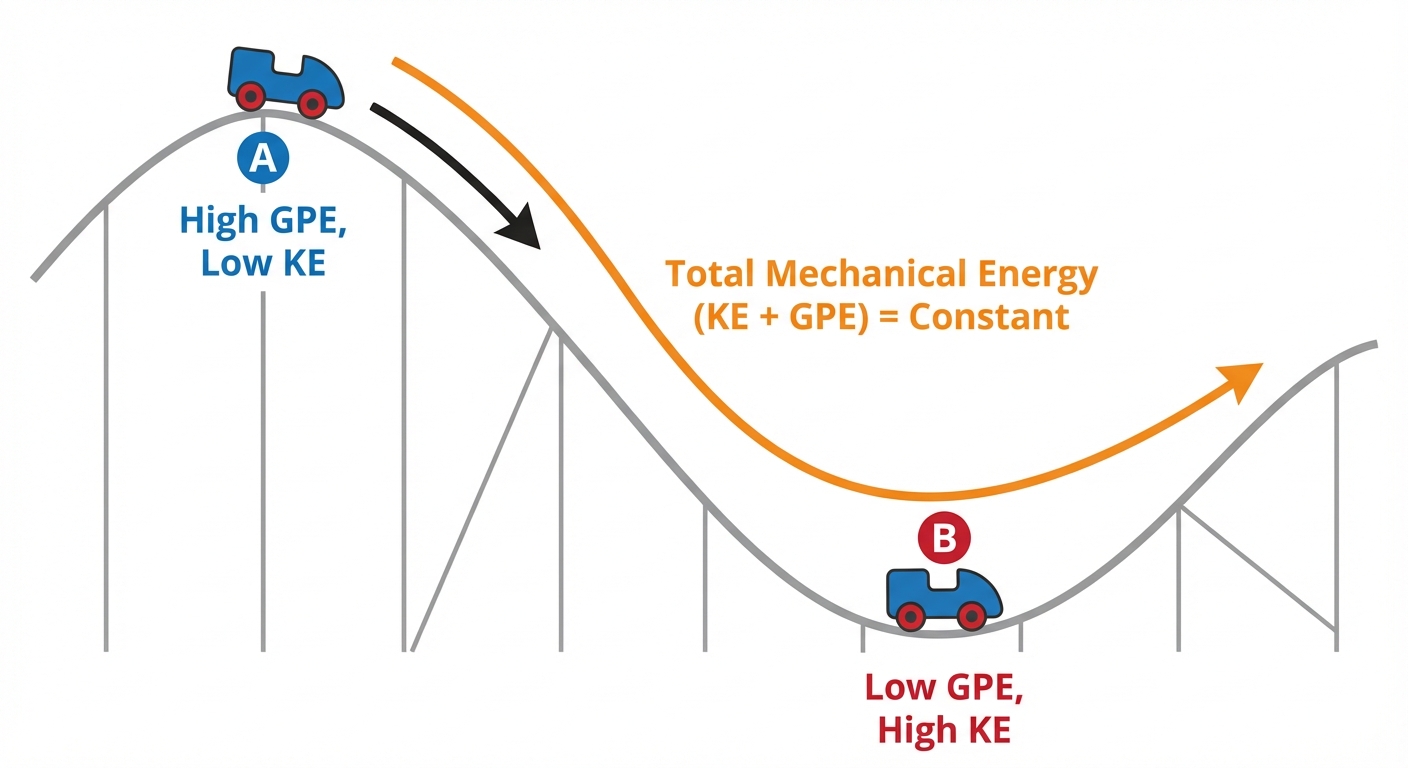
Alright, let's break down one of the most fundamental laws in all of physics, the Conservation of Energy. The core idea is simple but profound: energy cannot be created or destroyed, only converted from one form to another. For Mechanics, we're focused on mechanical energy, which is the sum of an object's Kinetic Energy (KE) and its Gravitational Potential Energy (PE). Think of it as the total 'motion and position' energy budget. In a perfect, frictionless, air-resistance-free universe (the kind you only see in exam questions!), the total mechanical energy of a system remains constant. This means . A classic example is a rollercoaster: at the top of a hill, you have maximum PE () and minimum KE. As you plummet downwards, that PE converts into KE (), making you go faster, but the total at any point is the same.
Now, let's get real. The world isn't perfect; we have external forces like friction, air resistance, and even engines doing work. This is where the concept gets its power for A-Level problems. When an external force does work, it changes the total mechanical energy of the system. The master equation you'll use is the Work-Energy Principle: the net work done on an object equals its change in mechanical energy. We write this as:
Here, is work done by forces that add energy (like an engine), and is work done against forces that remove energy (like friction, which dissipates energy as heat). Getting the signs right here is non-negotiable for acing exams. This principle is mission-critical in fields like mechanical engineering for designing efficient systems, or in aerospace for calculating flight paths. Mastering this isn't just about passing M1; it's about building a foundational understanding for university-level physics and engineering. 🚀
Worked example
Worked Example: Skier on a Rough Slope
Time to Hit the Slopes! ⛷️
A skier of mass 80 kg starts from rest at the top of a ski slope of length 120 m. The slope is inclined at an angle of to the horizontal. The skier experiences a constant resistive force of 150 N. By modelling the skier as a particle, calculate the speed of the skier at the bottom of the slope.
- 1First, let's set up our energy conservation equation. We know the total initial energy, plus or minus any work done, will equal the total final energy. Here, a resistive force is doing negative work, removing energy from the system. We'll set the bottom of the slope as our zero potential energy level ().
- 2Next, we calculate the initial potential energy. The skier starts from rest, so initial KE is zero. We need to find the initial vertical height () using trigonometry. The slope is the hypotenuse of a right-angled triangle.
- 3Now, let's calculate the work done against the resistive force. Work done is the force multiplied by the distance over which it acts. The resistive force acts along the entire length of the slope.
- 4Time to find the final energy. At the bottom of the slope, the height is zero, so the final potential energy is zero. The final kinetic energy is what we're trying to find, as it contains the final velocity, .
- 5Finally, we substitute all our calculated values back into the main equation from Step 1 and solve for the final speed, . This is the moment of truth!
Answer
4. The Relationship Between Power, Force and Velocity
Alright team, let's get into one of the most crucial formulas in M1: the link between Power, Force, and Velocity. You already know that power is the rate at which work is done, or energy is transferred. But how does that translate to a car speeding up on a motorway? This is where the equation comes in, and it's your new best friend.
Let's derive it super quickly so you see it's not just magic. Work Done = Force × distance (). Power is Work Done / time (). So, . Since velocity is distance / time (), we can substitute that in to get the elegant and powerful (pun intended) formula: Crucially, in the context of moving vehicles, represents the driving force (or tractive force) produced by the engine at that specific instant, not the net or resultant force. This is a classic exam trip-up! The engine provides the power, which generates the driving force to move the vehicle forward.
Let's derive it super quickly so you see it's not just magic. Work Done = Force × distance (). Power is Work Done / time (). So, . Since velocity is distance / time (), we can substitute that in to get the elegant and powerful (pun intended) formula: Crucially, in the context of moving vehicles, represents the driving force (or tractive force) produced by the engine at that specific instant, not the net or resultant force. This is a classic exam trip-up! The engine provides the power, which generates the driving force to move the vehicle forward.
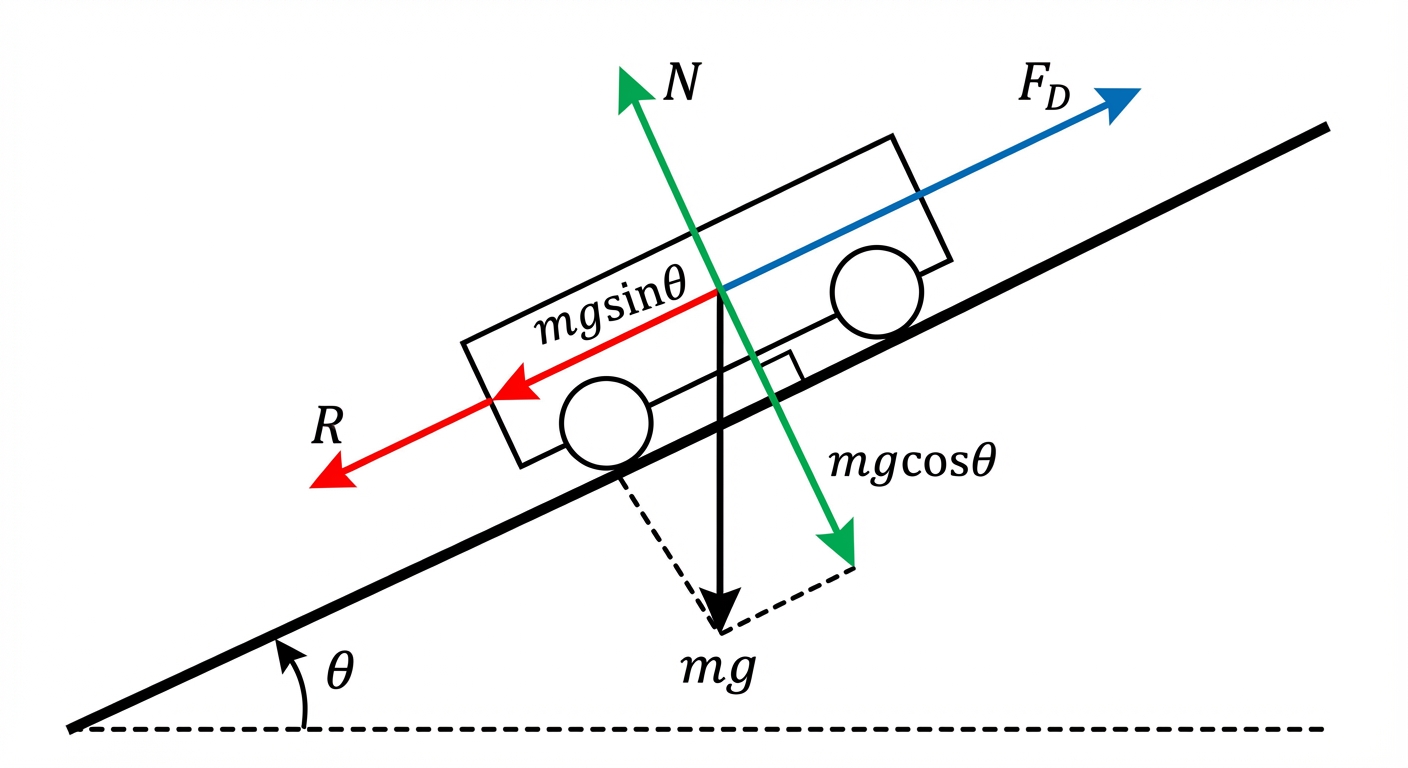
Here’s where it gets interesting for A-Level questions. If a vehicle is moving at a constant velocity, its acceleration is zero. By Newton's First Law, the forces are balanced. This means the driving force is exactly equal to the total resistive forces (like air resistance, friction, and the component of weight if on a slope). If the vehicle is accelerating, there's a resultant force. You'll use to find the instantaneous driving force, then plug that into Newton's Second Law () to find the instantaneous acceleration. This concept is fundamental in engineering, especially in automotive design, where calculating engine requirements for desired performance (like 0-60 mph times) is paramount. Understanding this sets you up nicely for university-level mechanics and physics courses.
Worked example
Worked Example: Vehicle on an Inclined Plane
Let's see this formula in action! 🚗💨
A car of mass 1500 kg is travelling up a straight road inclined at an angle to the horizontal, where . The engine of the car is working at a constant rate of 60 kW. The resistance to motion is a constant 800 N. Find:
(a) the maximum speed of the car.
(b) the instantaneous acceleration of the car when its speed is 20 m/s.
(a) the maximum speed of the car.
(b) the instantaneous acceleration of the car when its speed is 20 m/s.
- 1First things first, let's get our key values sorted and calculate the component of the car's weight acting down the slope. Always convert power from kW to W!
- 2For part (a), 'maximum speed' is the keyword. This implies the car is no longer accelerating, so . Therefore, the forces are in equilibrium. The driving force must exactly balance the resistance and the weight component down the slope.
- 3Now that we have the driving force required for maximum speed, we can use our star formula, , to find that speed, .
- 4For part (b), the car is not at maximum speed, so it must be accelerating. The engine power is constant at 60 kW, but the driving force will be different because the velocity is different. We use to find the new driving force at m/s.
- 5Finally, we apply Newton's Second Law, , to find the acceleration. The net force is the driving force we just found minus all the forces opposing the motion (the constant resistance and the weight component).
Answer
Practice this in the app
Unlock the full chapter: practice questions, flashcards, mock papers and notes, free.
Continue revising