P3 Trigonometry: Identities and Harmonic Form
Unlocking Trig's Secret Moves 🤸
Introduction
1. Introduction
Hey! Welcome back to the world of trigonometry. You've already mastered the basics of sine, cosine, and tangent, but now we're about to give your skills a serious upgrade. Think of this chapter as unlocking the 'expert level' of trig.
First, we'll introduce you to three new (but friendly!) reciprocal functions: secant, cosecant, and cotangent. Then, we'll dive into some awesome combo moves with the compound and double angle formulae, which let you break down or build up angles like or . Finally, we'll learn a super-powerful technique called the R-formula, which lets us combine two different trig waves into one neat, tidy sine or cosine wave. It's a game-changer for solving tricky equations and finding maximum or minimum values. Ready to level up? Let's go!
First, we'll introduce you to three new (but friendly!) reciprocal functions: secant, cosecant, and cotangent. Then, we'll dive into some awesome combo moves with the compound and double angle formulae, which let you break down or build up angles like or . Finally, we'll learn a super-powerful technique called the R-formula, which lets us combine two different trig waves into one neat, tidy sine or cosine wave. It's a game-changer for solving tricky equations and finding maximum or minimum values. Ready to level up? Let's go!
2. Reciprocal Trigonometric Functions and Identities
Alright, so you've mastered sin, cos, and tan. Think of them as the OG playlist for trigonometry. Now, it's time to drop the remix with their reciprocal functions: secant (sec), cosecant (cosec), and cotangent (cot). It's basically like finding the B-side to your favourite track – they're related, but have a totally different vibe. It's super simple: each one is just '1 over' one of the originals.
Here's the lineup:
- Secant is the reciprocal of cosine:
- Cosecant is the reciprocal of sine:
- Cotangent is the reciprocal of tangent:
A good way to remember the pairs is to look at the third letter: Sec goes with Cos, and Cosec goes with Sin. Tan and Cot are the obvious pair!
Here's the lineup:
- Secant is the reciprocal of cosine:
- Cosecant is the reciprocal of sine:
- Cotangent is the reciprocal of tangent:
A good way to remember the pairs is to look at the third letter: Sec goes with Cos, and Cosec goes with Sin. Tan and Cot are the obvious pair!
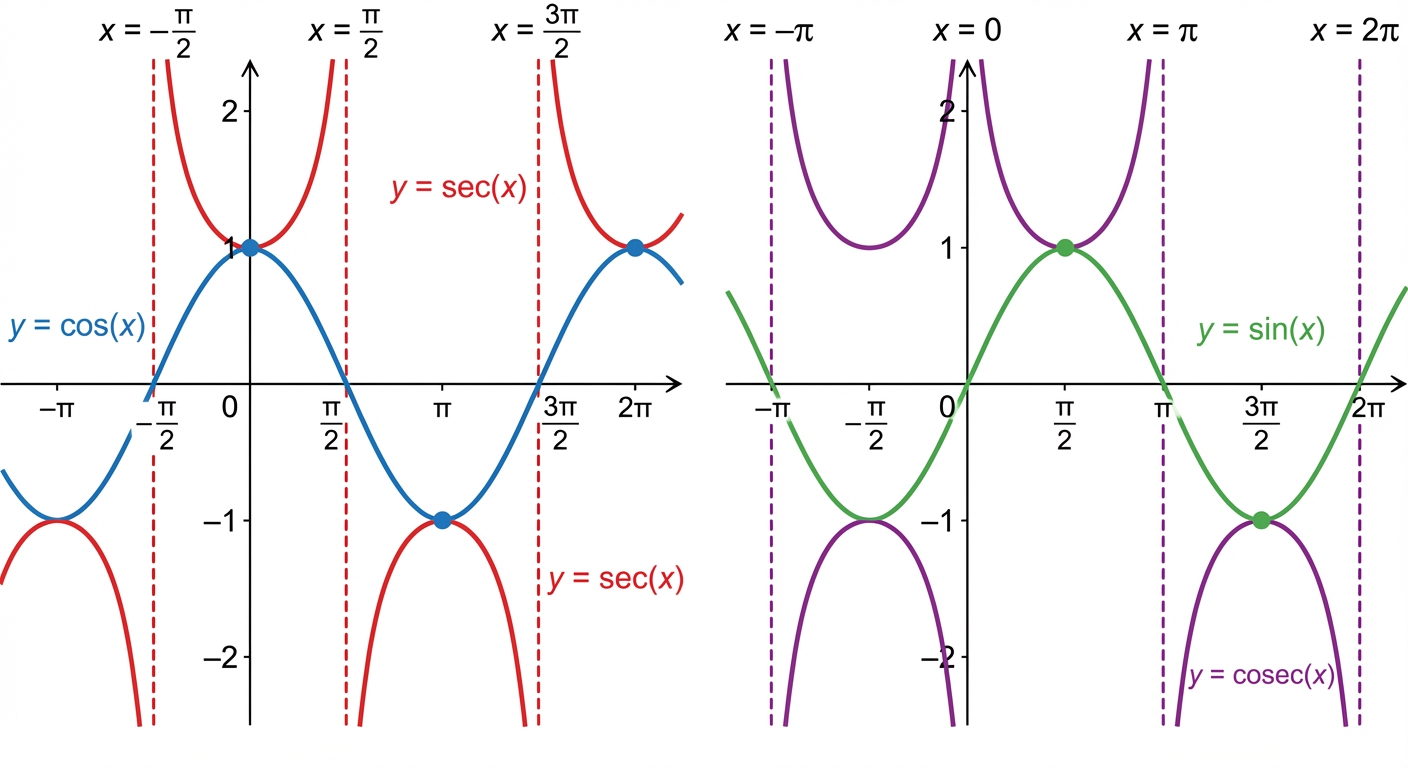
Now, why bother? Because these new functions help us unlock two powerful new identities, which are like cheat codes for solving tougher trig equations. They both come from our old friend, the Pythagorean identity .
1. If we divide every term by , we get , which simplifies to the awesome identity:
2. If we divide every term by instead, we get , which simplifies to its equally cool twin:
Mastering these is like leveling up your math skills. You'll use them to switch between functions and turn a messy equation into something you can actually solve. It's all about making your life easier in the long run! ✨
Worked example
Worked Example: Solving an Equation with Reciprocal Identities
Let's Crack This Trig Puzzle 🚀
Solve the equation for . Give your answers to one decimal place where appropriate.
- 1First up, we've got a mix of and . That's a red flag. We can't solve it like this, so we need to get everything in terms of one trig function. The perfect tool for this job is the identity , which we can rearrange to . Let's substitute this into the equation.
- 2Now we have an equation with only . Let's expand the brackets and move everything to one side to form a quadratic equation. Think of as just a variable, like 'y'. We're aiming for the classic format.
- 3Time to solve this quadratic. You can use the quadratic formula, but this one actually factors nicely. We're looking for two numbers that multiply to and add to . That's and .
- 4This gives us two possible solutions for . We just set each bracket to zero and solve.
- 5We can't just plug into our calculators, so let's flip it back to using the definition . Notice that is impossible, since cosine's range is from -1 to 1. So we can discard that solution. We only need to solve for .
- 6Finally, we find the angles for within the range . The principal value (from your calculator or memory) is . Since cosine is positive in the first and fourth quadrants, the other solution is .
Answer
3. Compound and Double Angle Formulae
Alright, let's get into one of the coolest parts of trig: Compound and Double Angle Formulae. Think of this like creating the perfect playlist. You know the vibe of individual songs (like 30°, 45°, 60°), but what happens when you combine them? That's what these formulae let us do—find the exact trig values for new angles by adding or subtracting angles we already know, like finding sin(75°) by combining 45° and 30°. It's the ultimate math collab!
First up, the Compound Angle Formulae. These are your bread and butter for combining two different angles, let's call them A and B. For sine, it's pretty straightforward: . Notice the sign in the middle stays the same—plus for plus, minus for minus. Easy. Cosine, however, likes to be a little dramatic: . See that? The sign flips! If you're adding the angles, you subtract in the formula, and vice-versa. It's the plot twist you didn't see coming. And for tan? It's just a mashup of the others: . The top sign matches, the bottom one flips.
First up, the Compound Angle Formulae. These are your bread and butter for combining two different angles, let's call them A and B. For sine, it's pretty straightforward: . Notice the sign in the middle stays the same—plus for plus, minus for minus. Easy. Cosine, however, likes to be a little dramatic: . See that? The sign flips! If you're adding the angles, you subtract in the formula, and vice-versa. It's the plot twist you didn't see coming. And for tan? It's just a mashup of the others: . The top sign matches, the bottom one flips.
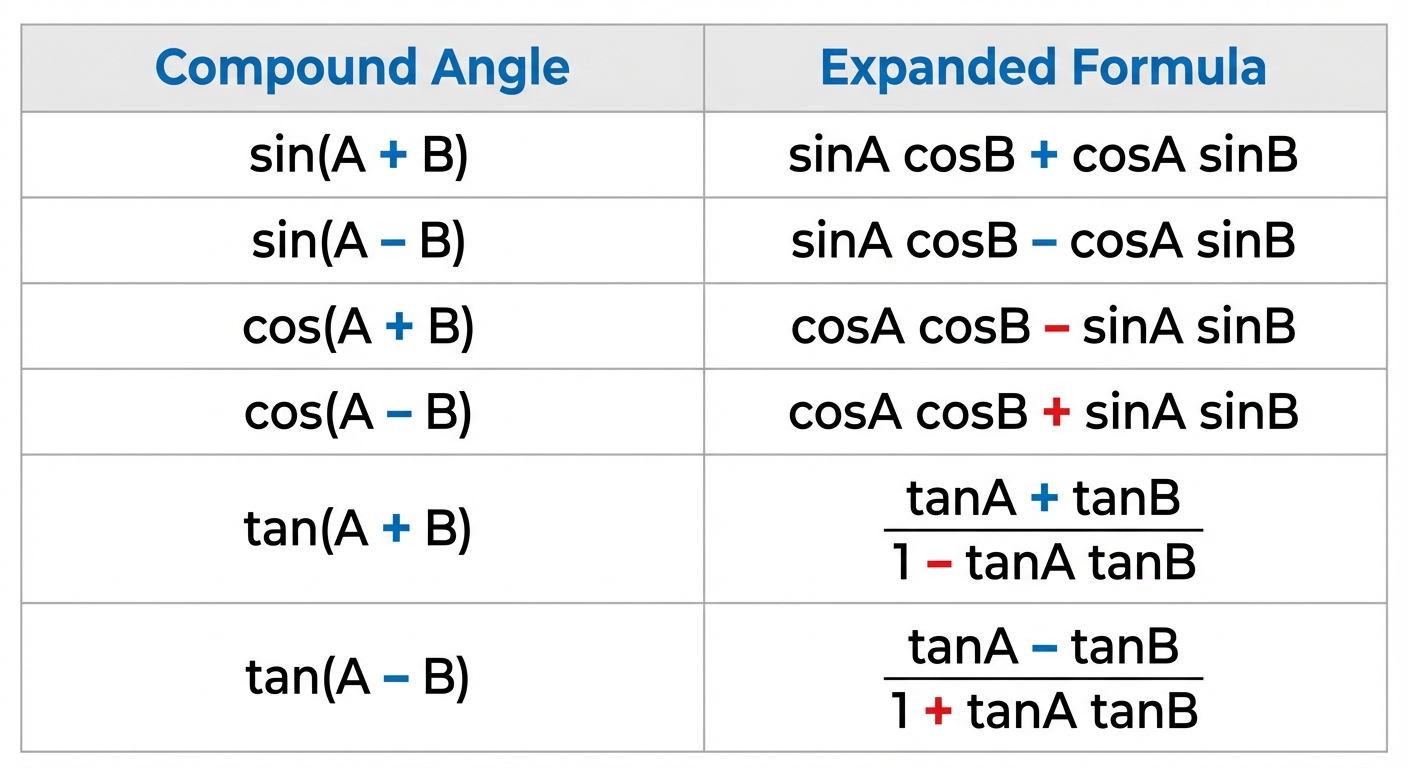
Now, what if the angles are the same? What if A = B? That's when we get the Double Angle Formulae, which are basically the solo project version. If we take and set B=A, we get . Super useful. The real MVP here is . Starting with , we get . But wait, there's more! Using the identity , we can morph this formula into two other forms: and . Choosing which version to use is a strategic move, like picking the right gear for a boss fight in a game. Finally, follows the same pattern, giving us . Mastering these is a massive level-up for solving trickier trig equations and proofs. You've got this! ✨
Worked example
Worked Example: Applying Compound Angle Formulae
Cracking the Code for sin(75°) 🕵️♀️
Without using a calculator, find the exact value of , expressing your answer in the form , where a, b, and c are integers.
- 1First things first, we can't just type this into a calculator. We need to express 75° as a sum or difference of 'special' angles we know the exact trig values for (like 30°, 45°, 60°). The most obvious combo here is . Let's set and .
- 2Since we're finding , we need the compound angle formula for . Let's write it down so we know what we're working with.
- 3Now we substitute our angles A and B into the formula. We need to recall the exact values for sin and cos of 45° and 30°. Remember that cheat sheet triangle? 😉
, , , . - 4Let's plug in those exact values and start simplifying. We'll multiply the fractions together first.
- 5We have a common denominator, so we can combine the terms into a single fraction to get our final answer. And look at that, it's in the exact form the question asked for. Job done!
Answer
4. Expressing a sinθ + b cosθ in Harmonic Form
Alright, let's talk about the R-Formula, or Harmonic Form. Think of the functions and as two different audio tracks. One's a sine wave, one's a cosine wave. They have different amplitudes (a and b) and are slightly out of sync. Trying to analyse them together is a mess. The R-Formula is like a DJ's mixing desk that lets you combine these two tracks into one clean, single sound wave. This new wave will have a new maximum volume (amplitude, ) and a time shift (phase angle, ).
The goal is to turn an expression like into something slicker like or . How? By using the compound angle formulas you already know! Let's say we want to express as . We know that . By matching this up with our original expression, we can see that and .
The goal is to turn an expression like into something slicker like or . How? By using the compound angle formulas you already know! Let's say we want to express as . We know that . By matching this up with our original expression, we can see that and .
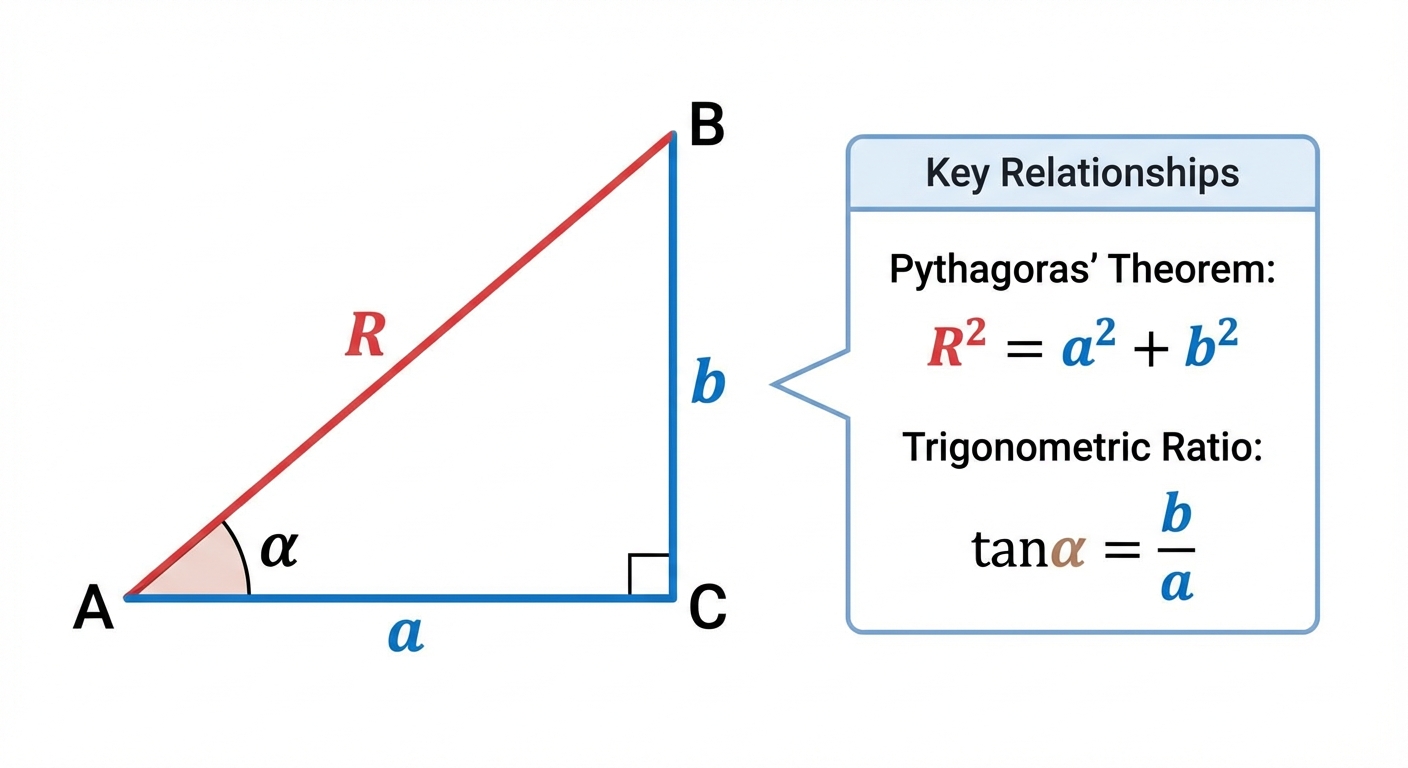
From here, finding and is a piece of cake. To find , we just use Pythagoras: . To find , we divide our two equations: . Easy! The coolest part is finding max/min values. The maximum value of any sine or cosine function is 1, so the max value of our new function is just . The minimum is . This also makes solving equations like way less of a headache. You just convert it to and solve it like a normal trig equation. It's a total game-changer. ✨
Worked example
Worked Example: Solving an Equation using R-Formula
Let's Beat This Boss Level 🚀
a) Express in the form , where and . Give the value of correct to 1 decimal place.
b) Hence, solve the equation for .
b) Hence, solve the equation for .
- 1First, let's set up our identity. We'll expand the target form using the compound angle formula and then match it to our expression.
- 2Now, we compare the coefficients of and on both sides. This gives us two equations to find and .
- 3Let's find by squaring and adding the two equations (or just using the formula ). Think Pythagoras!
- 4Next, we find by dividing the two equations. This creates a function which we can easily solve.
- 5Now we can rewrite the original equation using our R-form. This looks much simpler to solve!
- 6Let's solve for the angle. We find the principal value for , and then find all solutions in the range by considering the CAST diagram or graph for cosine. Remember to adjust the range for our new angle!
Answer
Practice this in the app
Unlock the full chapter: practice questions, flashcards, mock papers and notes, free.
Continue revising