Logarithmic and Exponential Functions
Unlocking Exponents with Logs! 🔑
Introduction
1. Introduction
Hey there! Welcome back to the world of functions. Remember how we worked with exponential curves in AS? Well, get ready to take it to the next level. In this chapter, we're going to become absolute masters of logarithms, the secret weapon for taming exponential equations.
First, we'll dive deep into the laws of logarithms – the rules that let us manipulate and simplify complex expressions. Then, we'll use these new skills to solve some seriously tricky exponential equations where the unknown is stuck up in the power. Finally, we'll learn a super clever technique called transforming to linear form, which is like a mathematical magic trick for turning curvy graphs into straight lines to make them easier to analyze. Let's get started! ✨
First, we'll dive deep into the laws of logarithms – the rules that let us manipulate and simplify complex expressions. Then, we'll use these new skills to solve some seriously tricky exponential equations where the unknown is stuck up in the power. Finally, we'll learn a super clever technique called transforming to linear form, which is like a mathematical magic trick for turning curvy graphs into straight lines to make them easier to analyze. Let's get started! ✨
2. Properties and Laws of Logarithms
Alright, let's talk about logarithms. Think of them as the 'undo' button for exponential functions. If your bank account balance grows exponentially (we wish!), a logarithm could tell you how long it would take to reach a million dollars. The rules that govern them are basically cheat codes that let you simplify complicated-looking expressions. There are three main laws you need to master.
First up, the Product Rule: . When two numbers are multiplied inside a log, you can split them into two logs being added. It’s like merging two of your Spotify playlists into one big one.
Next, the Quotient Rule: . When you're dividing inside a log, you can split it into two logs being subtracted. Think of it like calculating the net change in your Insta followers after a controversial post.
Finally, the most clutch rule of all, the Power Rule: . This lets you take an exponent from inside the log and drop it down as a multiplier in front. This is a total game-changer for solving equations where the unknown is a power.
First up, the Product Rule: . When two numbers are multiplied inside a log, you can split them into two logs being added. It’s like merging two of your Spotify playlists into one big one.
Next, the Quotient Rule: . When you're dividing inside a log, you can split it into two logs being subtracted. Think of it like calculating the net change in your Insta followers after a controversial post.
Finally, the most clutch rule of all, the Power Rule: . This lets you take an exponent from inside the log and drop it down as a multiplier in front. This is a total game-changer for solving equations where the unknown is a power.
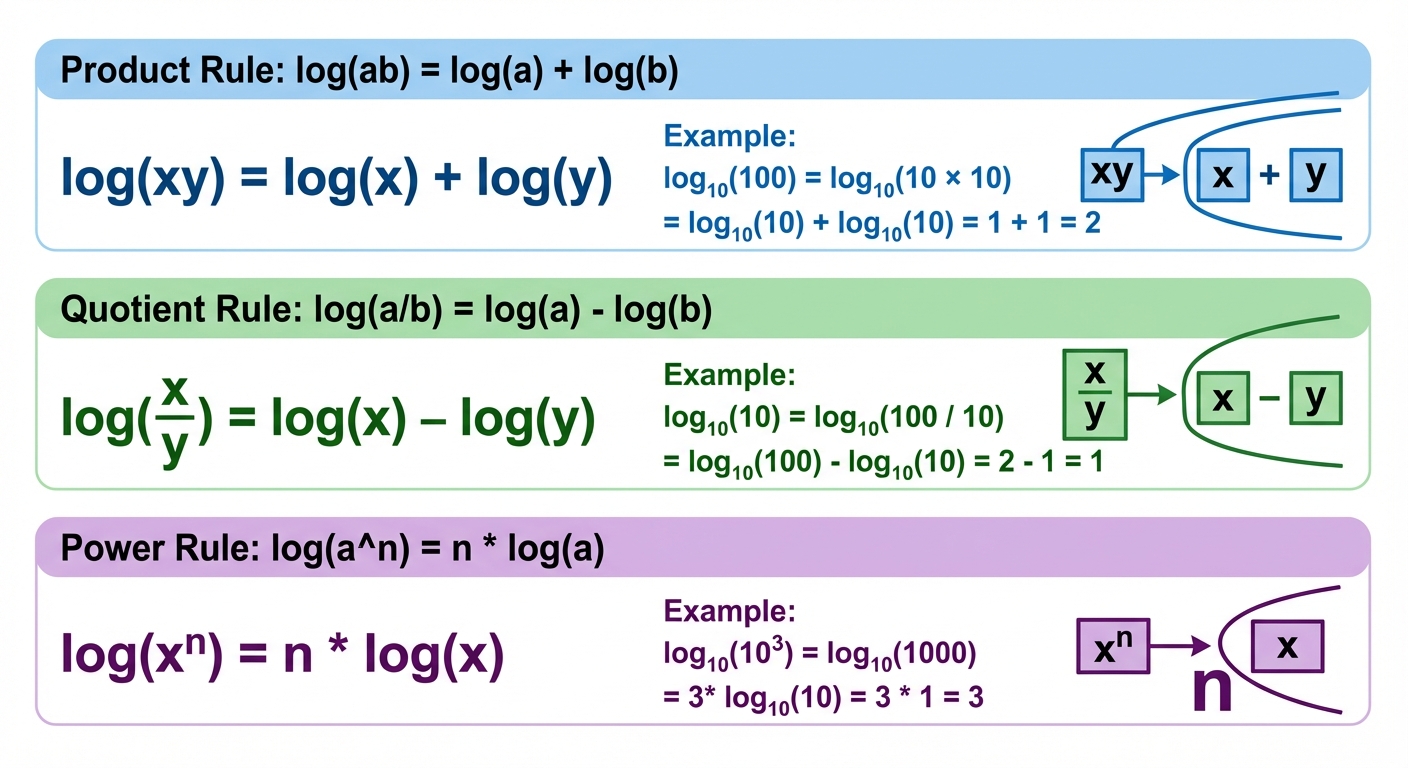
And what about 'ln'? That's just the 'natural logarithm', which is a fancy way of saying a log with a specific base called '' (which is roughly 2.718). It's like the VIP version of logs because it shows up everywhere in advanced maths and science. The good news? All the same rules apply. So, . Don't forget the basics either: (and so ) and (and so ). Mastering these rules is all about taking something that looks messy and making it simple enough to solve.
Worked example
Worked Example: Applying Logarithmic Laws to Solve an Equation
Let's Break This Problem Down 🚀
Given that , solve the equation .
- 1First things first, we can't solve this with two separate log terms. We need to combine them into a single logarithm. Let's use the Power Rule on the first term to bring the '2' up as an exponent.
- 2Now our equation is . We have one log subtracting another, which is the perfect setup for the Quotient Rule. Let's combine them into a single log where the arguments are divided.
- 3Okay, mission accomplished! We have a single log. Now we can get rid of it by converting the equation into its exponential form. Remember, is the same as . Here, our base 'a' is 2, 'c' is 3, and 'b' is that whole fraction.
- 4We've successfully eliminated the logs! Now it's just an algebra problem. Let's expand the brackets and rearrange everything to form a quadratic equation that we can solve.
- 5This quadratic doesn't factor nicely, so it's time for the quadratic formula: . Let's plug in our values ().
- 6Let's simplify that radical and find our two possible solutions. Remember the original problem stated that . We need to check if our answers satisfy this condition. The log arguments and must also be positive.
Answer
3. Solving Exponential Equations Using Logarithms
Alright, let's get into it. You've seen exponential equations before, where things grow ridiculously fast, kind of like a TikTok sound going viral overnight. The equations look like . The challenge? The unknown, , is stuck up in the exponent, like it's a VIP in the cloud. You can't just divide by 'a' to get it down. So, how do we solve for it? We need a special move, and that move is called logarithms. Think of logarithms as the inverse of exponentials, the same way subtraction is the inverse of addition. They're the only tool that can bring that exponent down to our level.
The main strategy is simple: take logs of both sides of the equation. As long as you do the same thing to both sides, the equation stays balanced. You can use any log base, but your calculator's best friends are the natural logarithm, (which is log base ), and the common log, (log base 10). We usually stick with in A-Levels because the number is a massive deal in maths. Once you take logs, you unleash the ultimate power-up: the power law of logs. This law says .
The main strategy is simple: take logs of both sides of the equation. As long as you do the same thing to both sides, the equation stays balanced. You can use any log base, but your calculator's best friends are the natural logarithm, (which is log base ), and the common log, (log base 10). We usually stick with in A-Levels because the number is a massive deal in maths. Once you take logs, you unleash the ultimate power-up: the power law of logs. This law says .
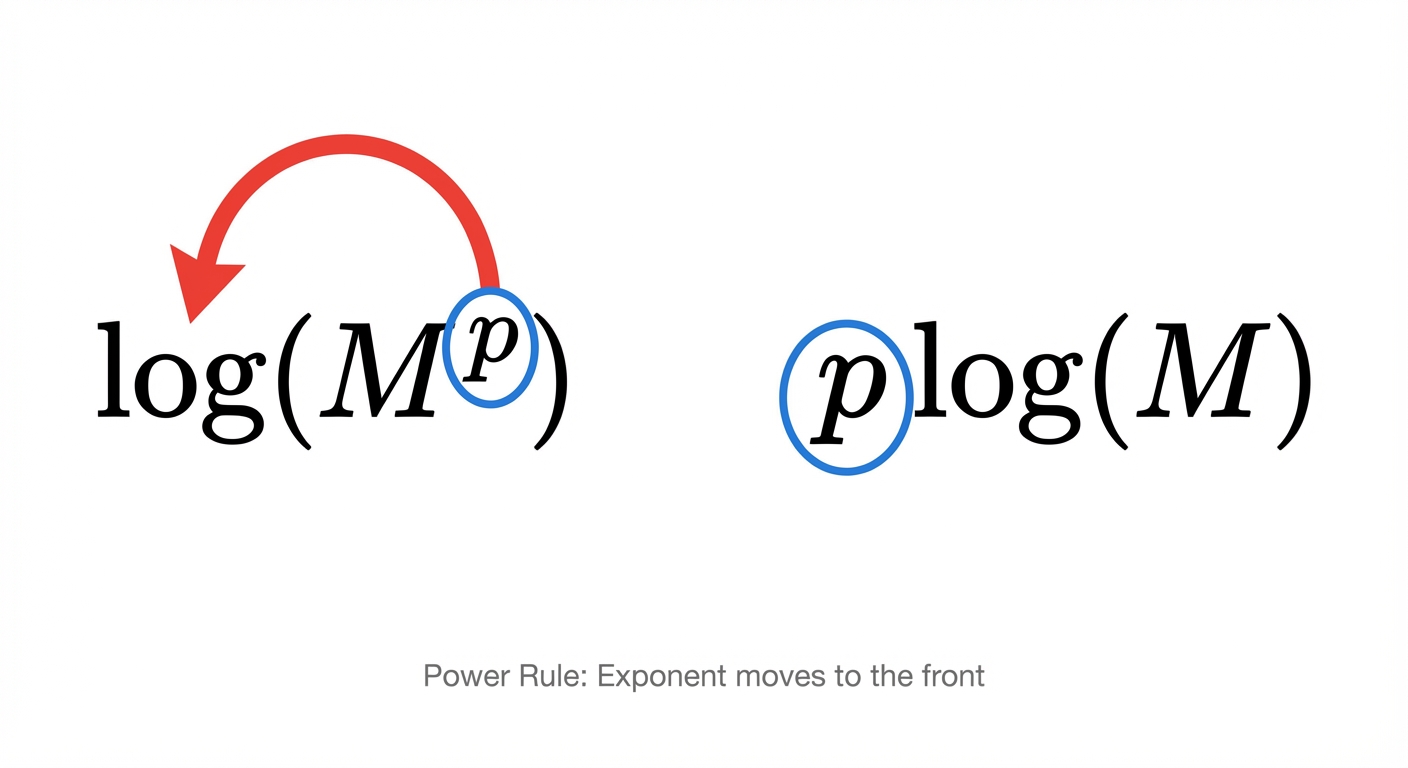
See what happened? The exponent is now a regular multiplier. Our equation becomes , and using the power law, it transforms into . Suddenly, it's just a simple linear equation you've been solving for years! Just divide by and you've got your answer: . The same idea applies to inequalities like . You solve it the same way, just be mindful that if you ever divide by a negative log (which happens if the base is between 0 and 1), you'd have to flip the inequality sign. It's your secret weapon for finding out exactly when your investment hits a target or how long a radioactive substance takes to decay.
Worked example
Worked Example: Solving an Exponential Equation
Let's Crack This Code 🕵️♀️
Your savings account for a new gaming PC grows according to the formula , where is the number of years. How many full years will it take for your savings to first exceed $1200? Give your answer as an integer.
- 1First, we set up the inequality. We want to find the time when the amount is greater than 1200. Then, we'll isolate the exponential part by dividing both sides by 800.
- 2Now the variable is stuck in the exponent. This is our cue to use logarithms! We'll take the natural logarithm (ln) of both sides to bring the power down.
- 3Time for the magic trick: apply the power law of logarithms, . This brings the down from the exponent, turning it into a coefficient.
- 4We can now solve for by dividing both sides by . Since , we know is a positive number, so we don't need to flip the inequality sign. Phew!
- 5Use your calculator to find the decimal value. Remember to keep a few extra decimal places for accuracy before the final rounding.
- 6The question asks for the number of full years it takes to first exceed tt$ that satisfies this is 9. So, it will take 9 full years.
Answer
4. Transforming Non-Linear Relationships to Linear Form
Alright, let's be real. Straight lines are predictable and easy to work with. You know the gradient, you know the intercept, life is good. It's like knowing exactly how much data your music streaming will use per hour. But a lot of relationships in science, finance, and even gaming aren't that simple. They're curves. Trying to analyze a curve directly is like trying to predict the next viral TikTok dance – chaotic and complicated. So, what's the hack? We give the equation a 'glow-up' and transform it into a linear one. This whole process is called linearisation, and it's a total game-changer.
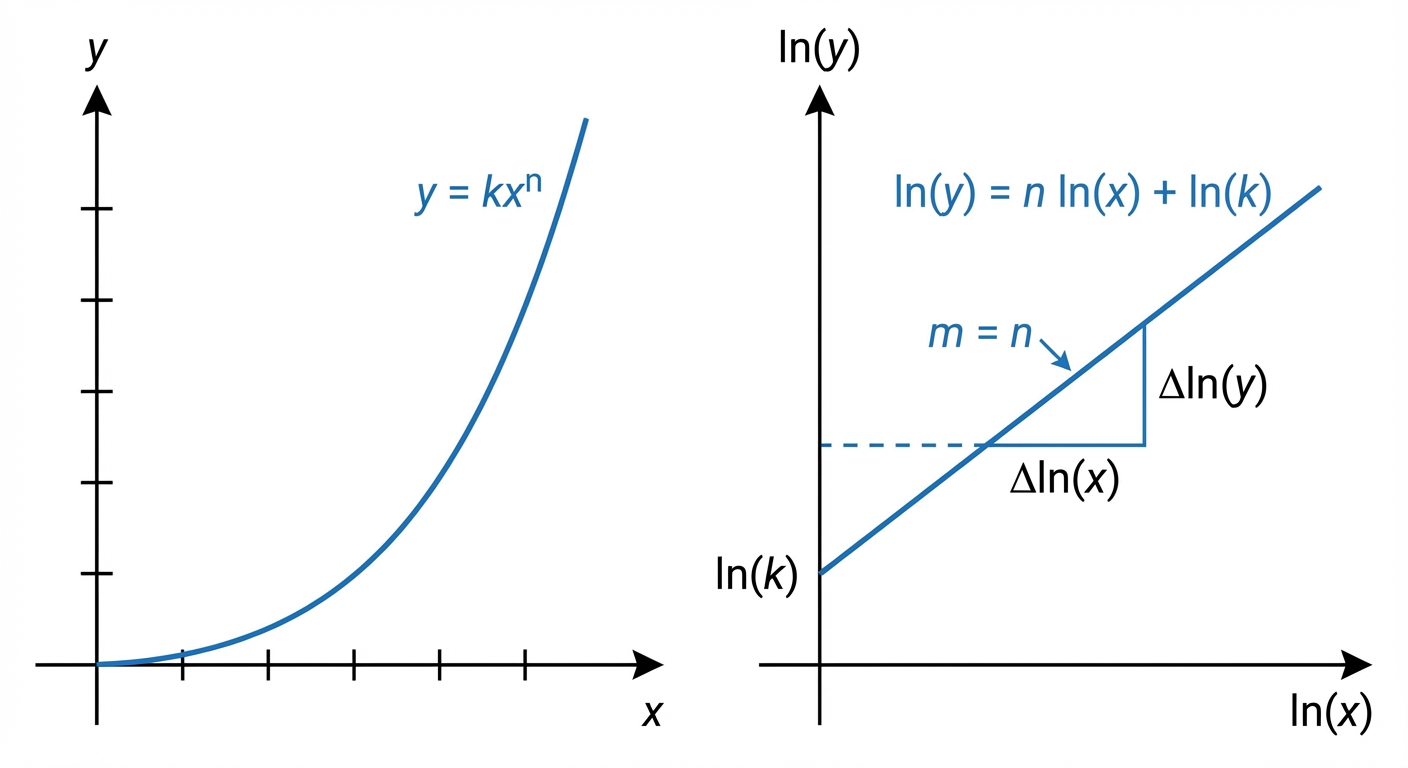
We focus on two main types of relationships. First, the power law form: . Think about something like the relationship between a car's speed and its stopping distance. To straighten this out, we take logs of both sides (you can use natural logs, , or logs to base 10, ). Let's use :
Using our log laws (remember those?), we can split this up:
And bring the power down:
Now, look closely. This looks exactly like the equation of a straight line, . We've just made a substitution! Here, , , the gradient , and the y-intercept . So if you plot a graph of against , you'll get a perfect straight line. From that graph, you can find the gradient and intercept, which lets you find the original secret constants, n and k!
We focus on two main types of relationships. First, the power law form: . Think about something like the relationship between a car's speed and its stopping distance. To straighten this out, we take logs of both sides (you can use natural logs, , or logs to base 10, ). Let's use :
Using our log laws (remember those?), we can split this up:
And bring the power down:
Now, look closely. This looks exactly like the equation of a straight line, . We've just made a substitution! Here, , , the gradient , and the y-intercept . So if you plot a graph of against , you'll get a perfect straight line. From that graph, you can find the gradient and intercept, which lets you find the original secret constants, n and k!
The second type is the exponential form: . This is huge for things like population growth or your savings account balance. The process is similar. Take logs of both sides:
Again, compare this to . This time, , but notice that (not !). The gradient is and the y-intercept is . So, by plotting against x, you can find the constants a and k. It's basically a clever way to 'un-curve' the data to reveal the simple straight-line relationship hidden inside.
Worked example
Worked Example: Determining Constants from Experimental Data
Cracking the Code: From Data to Equation 🕵️♀️
Two variables, and , are believed to be related by the equation , where and are constants. Experimental data is collected. A graph of against is plotted, resulting in a straight line that passes through the points and . Determine the values of and , correct to 3 significant figures.
- 1First, let's get our game plan. We need to linearise the given equation by taking natural logs. This will help us compare it to the standard straight-line equation, .
- 2By comparing our equation with , we can see that if we plot against , the gradient m will be equal to n, and the Y-intercept c will be equal to . Our first mission is to find the gradient of the line using the two points we're given.
- 3Nice! We've found the gradient, . Since we know that , we've already found our first constant.
- 4Now to find the Y-intercept, c. We can use the point-slope form of a line, , and sub in one of our points, let's use . Remember, is and is .
- 5From that equation, we can see the Y-intercept, , is . We also know that . So, to find k, we need to 'undo' the natural log by using the exponential function, .
- 6We've cracked it! We found both constants. Now we just write out the original equation with our values for k and n. Mission complete.
Answer
Practice this in the app
Unlock the full chapter: practice questions, flashcards, mock papers and notes, free.
Continue revising