P1 Chapter 3: Circular Measure
Getting Ahead of the Curve! 弧
Introduction
1. Introduction
Hey everyone, welcome to Circular Measure! You've probably spent your whole school life thinking about angles in degrees, but we're about to switch gears to radians. Think of it as the native language of circles in higher maths – it makes a lot of the formulas we're about to see way more elegant. First, we'll get comfortable converting between degrees and radians. Then, we'll use our new radian skills to unlock the simple formulas for arc length and sector area (basically, finding the length of a pizza crust and the area of a slice 🍕). Finally, we'll apply these tools to solve more complex, exam-style problems involving segments and composite shapes. It's all about breaking down diagrams into parts you know how to handle. Let's do this!
2. Defining and Converting Radian Measure
Alright, let's get into it. You've used degrees for years, and they're fine, but for A-Level and university-level mathematics, they're like using training wheels on a superbike. Radians are the native language of circles, especially when you get to calculus. Think of degrees as an arbitrary human invention—why 360? Radians are derived directly from the circle's own properties. So, what is a radian?
One radian is the angle created at the center of a circle by an arc whose length is equal to the circle's radius.
One radian is the angle created at the center of a circle by an arc whose length is equal to the circle's radius.
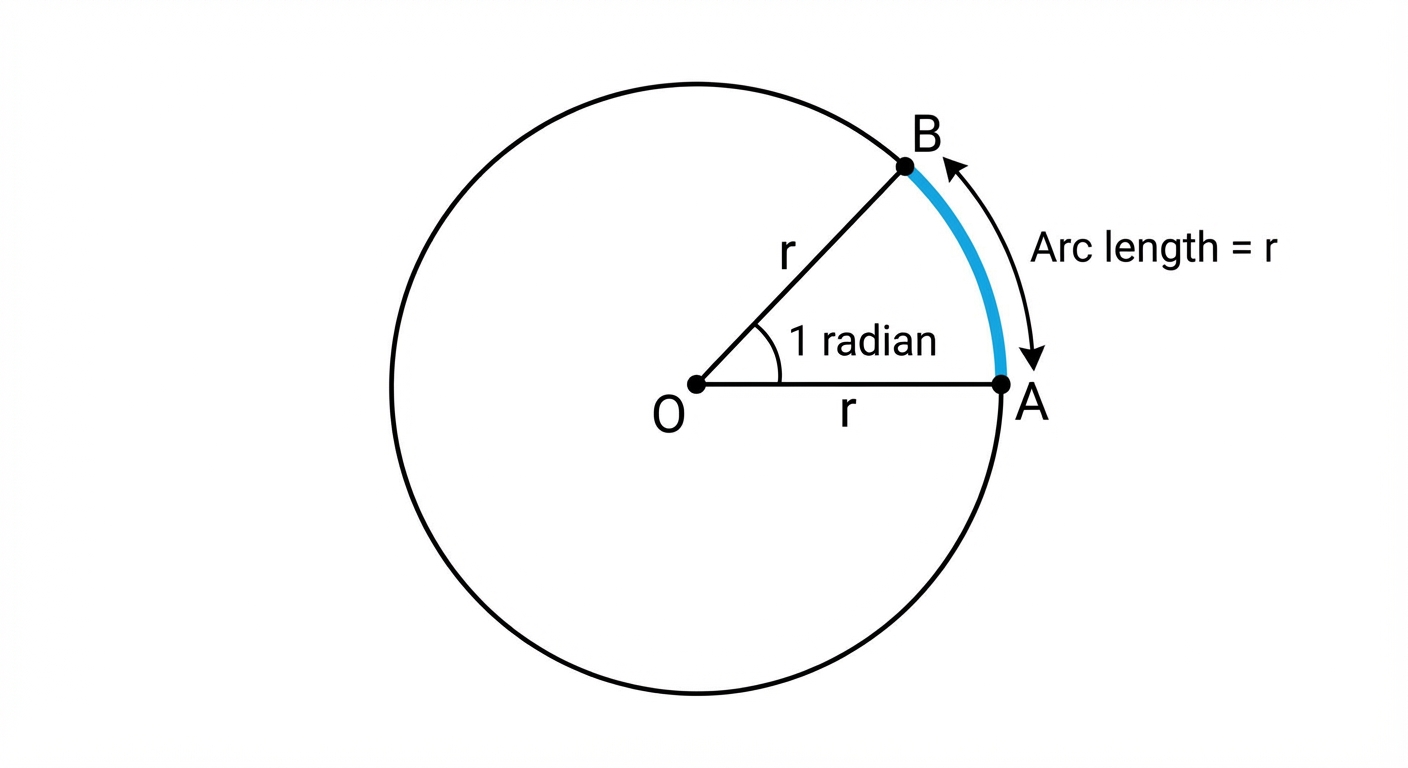
Since the total circumference of a circle is , it means we can fit exactly 'radius-lengths' around the outside. Therefore, a full rotation is equal to radians. This gives us our golden rule for conversion: Or, more simply, by dividing by 2: This single identity is your key to everything. To convert from degrees to radians, you multiply by . To convert from radians to degrees, you multiply by . It's just a unit conversion, like changing from centimeters to meters. Pro tip for exams: if an angle is given with no units (e.g., 'the angle '), you must assume it's in radians. Mastering this is non-negotiable for future topics and essential for anyone heading into engineering, physics, or any STEM field at university.
Worked example
Worked Example: Bidirectional Angular Conversion
Flipping Between Degrees and Radians Like a Pro 🥞
A satellite's solar panel is angled at relative to its main body. For a software update, this angle must be input in radians. (a) Convert to radians, giving your answer as a multiple of .
Later, a diagnostic tool reports an angular correction of radians. (b) Convert this value back to degrees.
Later, a diagnostic tool reports an angular correction of radians. (b) Convert this value back to degrees.
- 1For part (a), we need to convert from degrees to radians. Our magic conversion factor is . We'll multiply our degree value by this factor.
- 2Now we simplify the fraction. The degrees units cancel out. We can divide both 210 and 180 by their greatest common divisor, which is 30. This gives us the exact fractional value of that the question asks for.
- 3For part (b), we're reversing the process. We need to convert from radians to degrees. This time, we use the inverse conversion factor, which is .
- 4Let's clean this up. The in the numerator and denominator cancel out beautifully. Now we just have a numerical calculation to perform: .
Answer
3. Calculating Arc Length and Sector Area
Alright, let's get into the core toolkit for this chapter: arc length and sector area. Think of it like this: if you're designing a curved part for a high-performance engine or calculating the path of a satellite, you can't just use straight lines. This is where circular measure becomes your best friend. The two non-negotiable formulae you need to have locked in are for arc length, , and sector area, .
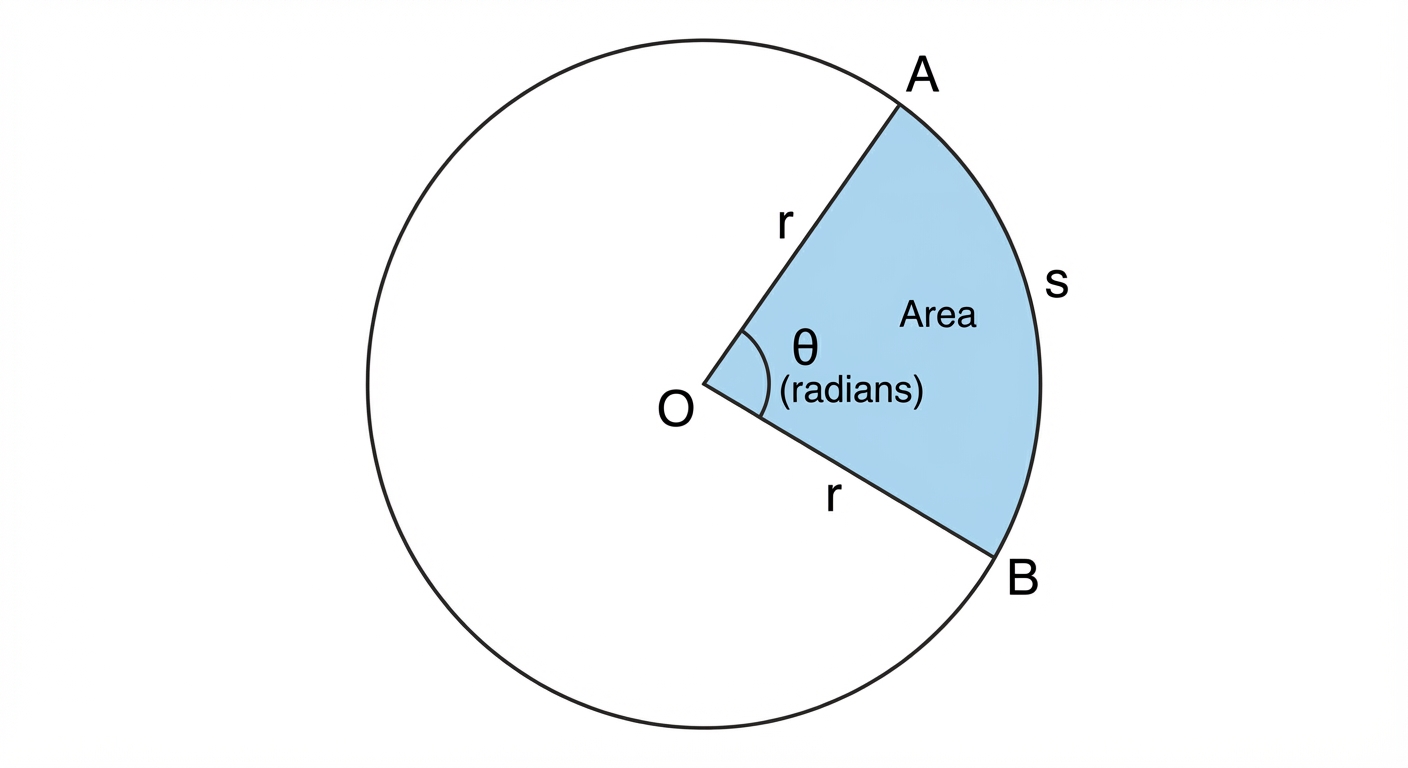
Now, here’s the golden rule, the one thing you absolutely cannot forget, especially under exam pressure: MUST be in radians. If they give you the angle in degrees, your first step, before you even think about the formulae, is to convert it to radians (remember, radians = 180°). Why? These formulae are derived directly from the definition of a radian, so they simply don't work with degrees. Think of it as trying to use a UK plug in a US socket – wrong system! The arc length, , is literally the 'crust' of your pizza slice (the sector). The formula is beautifully simple: it's just the radius scaled by the angle. The sector area, , is the whole pizza slice. The formula might look random, but it's just a fraction () of the total circle's area (). Mastering these isn't just about passing P1; it’s foundational for mechanics (circular motion) and further pure maths. Get this right, and you're building a solid base for university-level STEM courses. 🚀
Worked example
Application of Arc Length and Sector Area Formulae
The Case of the Windscreen Wiper 🚗
A car's windscreen wiper blade is 60 cm long and pivots from a point P. The blade sweeps through an angle of radians. The wiping part of the blade starts 15 cm away from the pivot point P. Calculate: (a) the perimeter of the region cleaned by the wiper, and (b) the exact area of the region it cleans.
- 1First, let's deconstruct the problem. The cleaned region is the area of a large sector minus a smaller, concentric sector. Let's define our variables: the outer radius is cm, the inner (uncleaned) radius is cm, and the angle for both is radians.
- 2For part (a), the perimeter is made of two arcs and two straight lines. We'll use for the arcs. The straight edges are the difference between the radii.
- 3Now we just sum the parts to find the total perimeter. Examiners love to see you keep things in exact form where possible.
- 4For part (b), we'll find the area of the large sector and subtract the area of the small one using . This is a classic exam technique for composite shapes.
- 5Finally, subtract the small area from the large area to find the exact area cleaned by the wiper. Leaving it in terms of is key!
Answer
4. Area and Perimeter of Segments and Composite Shapes
Alright, let's get into the final boss of this chapter: segments and composite shapes. It sounds complicated, but honestly, it's just like making a custom playlist or modding a game – you're just combining things you already know in cool new ways.
First up, the segment. Imagine you've got a pizza slice (a sector). The segment is just the crust part you'd get if you made a straight cut from one edge of the crust to the other. It's the area between the arc and the chord. To find its area, you just take the area of the whole sector and subtract the area of the triangle part. It's a classic takeaway move! The formula is a lifesaver: Which simplifies to the super-useful: Just remember, your calculator must be in radians mode, or you'll get some seriously weird answers. For the perimeter of a segment, you need the arc length () and the length of the chord. The chord length can be found using the cosine rule, or a slicker method: split the isosceles triangle in half to get two right-angled triangles, which gives you the formula .
First up, the segment. Imagine you've got a pizza slice (a sector). The segment is just the crust part you'd get if you made a straight cut from one edge of the crust to the other. It's the area between the arc and the chord. To find its area, you just take the area of the whole sector and subtract the area of the triangle part. It's a classic takeaway move! The formula is a lifesaver: Which simplifies to the super-useful: Just remember, your calculator must be in radians mode, or you'll get some seriously weird answers. For the perimeter of a segment, you need the arc length () and the length of the chord. The chord length can be found using the cosine rule, or a slicker method: split the isosceles triangle in half to get two right-angled triangles, which gives you the formula .
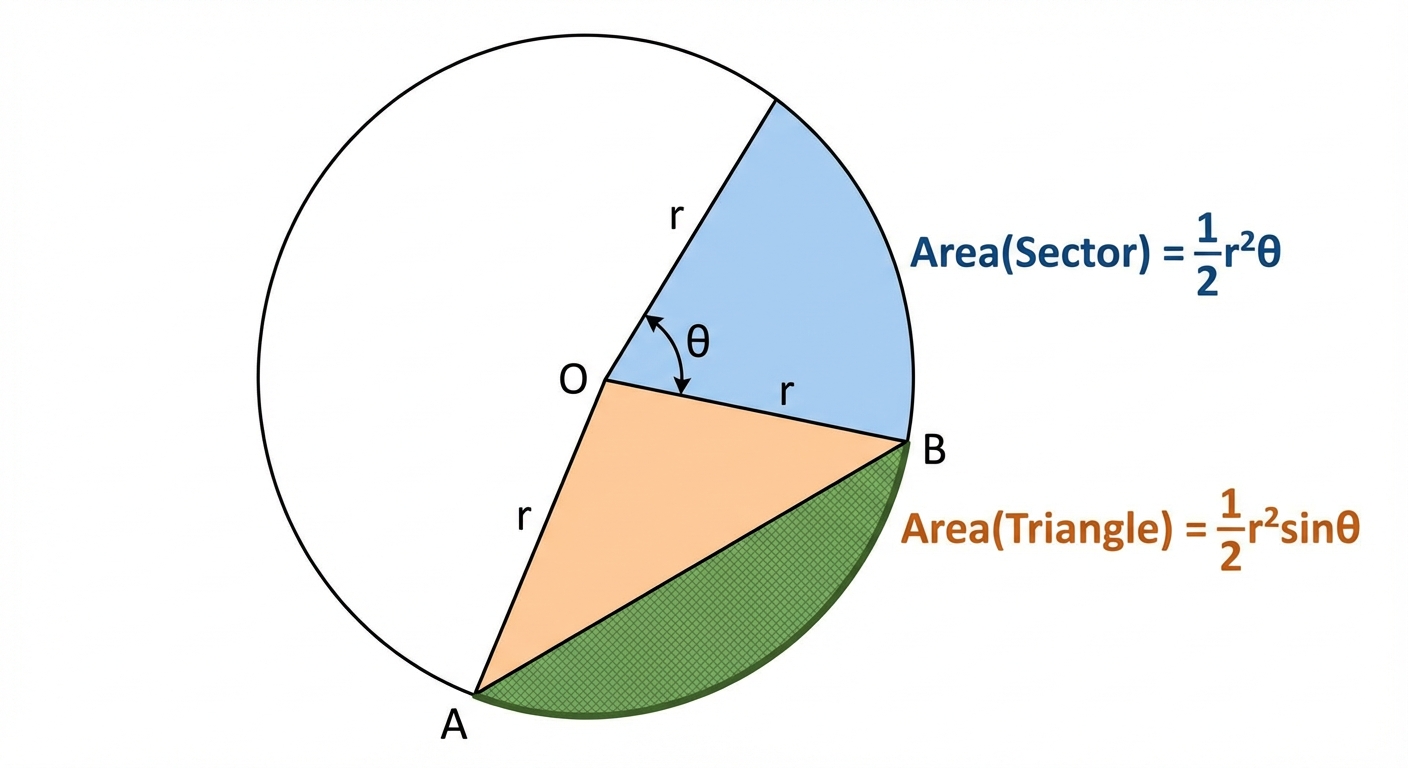
Now for composite shapes. These are just shapes made by sticking together or cutting out bits from simpler shapes like sectors, triangles, and rectangles. Think of a running track (a rectangle with two semicircles) or a custom car decal. The game plan is simple: dissect and conquer. Break the weird shape down into its basic components. Find the area or perimeter of each individual piece using the formulas you know, and then add (or subtract) them together. It's all about seeing the simple shapes hiding inside the complex one.
Worked example
Worked Example: Calculating the Area and Perimeter of a Segment
The Koi Pond Problem 🐟
A garden features a koi pond shaped like a segment of a circle. The radius of the circle is m and the central angle of the corresponding sector is radians. A decorative border is needed around the edge of the pond. Calculate:
a) The length of the decorative border (the perimeter of the segment).
b) The surface area of the pond.
a) The length of the decorative border (the perimeter of the segment).
b) The surface area of the pond.
- 1First, let's figure out the perimeter. The border has two parts: the curved edge (arc length) and the straight edge (chord length). We'll calculate the arc length first using .
- 2Next, we find the length of the straight edge (the chord). We'll use the formula . Make sure your calculator is in RAD mode!
- 3Now we can find the total perimeter by adding the arc length and the chord length together. This gives us the total length of the decorative border.
- 4For part (b), we need the area of the pond (the segment). We'll find the area of the whole sector first using .
- 5Next, we find the area of the triangle that we need to 'subtract' from the sector. The formula is .
- 6Finally, we subtract the triangle's area from the sector's area to get the area of the segment (the pond). You could also use the combined formula for a quicker result!
Answer
Practice this in the app
Unlock the full chapter: practice questions, flashcards, mock papers and notes, free.
Continue revising