Chapter 3: Advanced Differentiation Techniques
Unlocking Calculus Superpowers! 🚀
Introduction
1. Introduction
Hey there! Ready to take your calculus skills to the next level? In P1, you mastered the basics of finding gradients. Now, we're diving deeper into the world of differentiation. We'll start by adding some powerful new functions to our toolkit, like exponentials, logs, and trig functions. Then, we'll learn the Product Rule and Quotient Rule, which are essential for tackling more complex expressions. Finally, we'll explore two awesome techniques, Parametric and Implicit Differentiation, that let us find gradients for curves that aren't defined in the simple format. It's a game-changer, so let's get started!
2. Derivatives of Standard Functions and the Chain Rule
Alright, let's level up our differentiation game. In P1, you mastered polynomials. Now in P3, we're unlocking the 'DLC pack' of functions: exponentials, logs, and trig. Think of these as new character abilities for your calculus toolkit. First up, the easiest one ever: the derivative of is just... . Seriously, that's it. It's the chillest function, it doesn't change. But where it gets spicy is with the chain rule. If you have something like , its derivative is not just . Remember the chain rule? It's for composite functions – a function inside another function, like putting an Instagram filter (outer function) on a photo (inner function). To differentiate , you differentiate the 'outer' -function (which stays the same) and then multiply by the derivative of the 'inner' function, . So, .
The same logic applies to everything else. The derivative of is . So for , it becomes . For trig, you just have to memorize a few new rules: , , and . The final new one for your list is the inverse tan function: . Again, the chain rule is your MVP here. Differentiating ? You differentiate the outer `cos` part to get , then multiply by the derivative of the inner `` part, which is . The final answer is . It's all about identifying the outer and inner layers and differentiating one at a time.
The same logic applies to everything else. The derivative of is . So for , it becomes . For trig, you just have to memorize a few new rules: , , and . The final new one for your list is the inverse tan function: . Again, the chain rule is your MVP here. Differentiating ? You differentiate the outer `cos` part to get , then multiply by the derivative of the inner `` part, which is . The final answer is . It's all about identifying the outer and inner layers and differentiating one at a time.
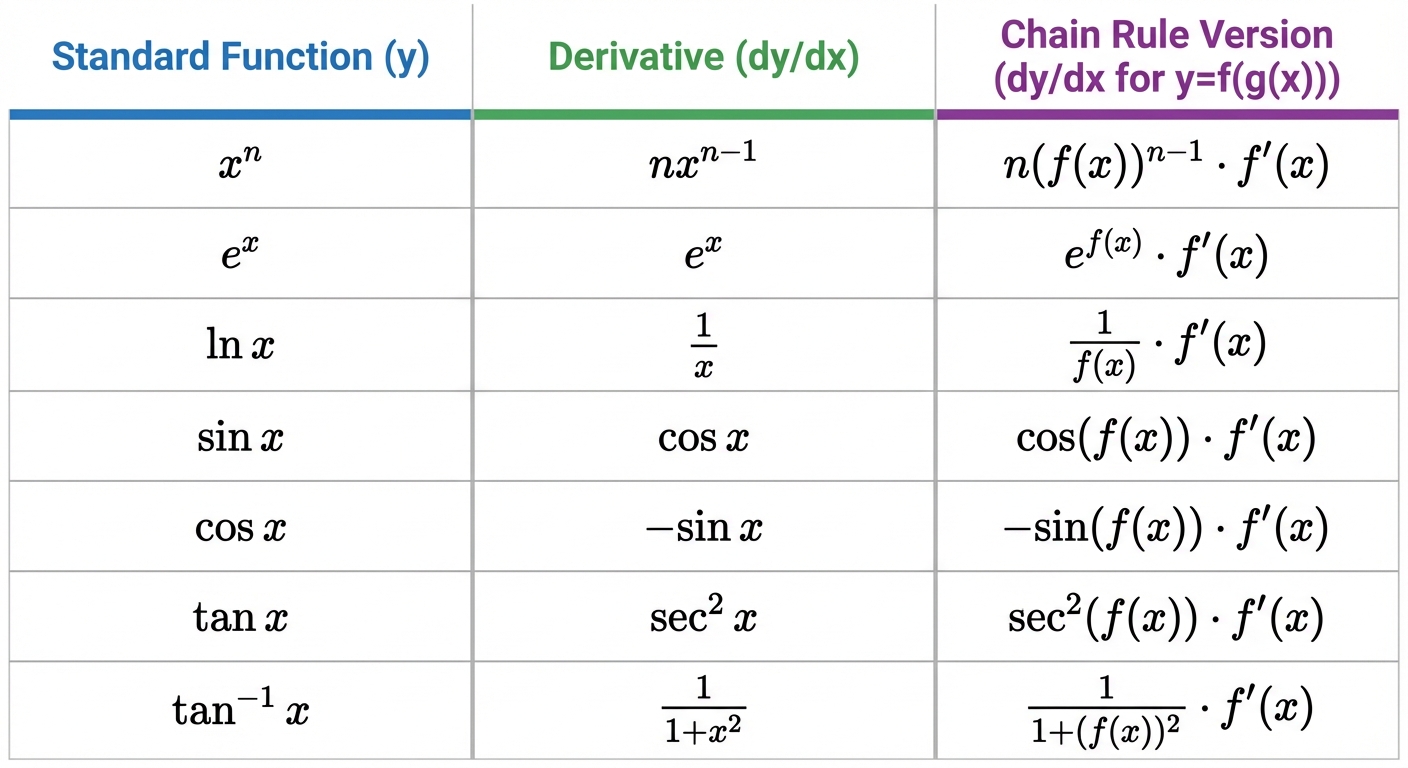
It's a pattern, and once you see it, you can apply it to any combination they throw at you. You've got this!
Worked example
Worked Example: Chain Rule with Exponential and Trigonometric Functions
Let's Solve This Thing 🚀
Given the function , find its derivative, .
- 1First, let's identify the 'layers' of this function. This is a classic composite function. The outer function is the exponential part, , and the inner function is the exponent, . But wait, the inner function also has an inner function! So we have layers: , , and . We'll use the chain rule twice.
- 2Let's differentiate the outermost layer, , with respect to its inner part, . The derivative of is just , so this part is straightforward. We'll substitute back in.
- 3Next, we differentiate the middle layer, , with respect to its inner part, . The derivative of is . We'll substitute back in.
- 4Finally, we differentiate the innermost layer, , with respect to . This is a simple one!
- 5Now for the magic! According to the chain rule, we multiply all these results together to get our final answer. Think of it as `(Derivative of Outer) (Derivative of Middle) (Derivative of Inner)`.
- 6Let's clean it up. We just need to rearrange the terms to write the final answer in the standard format, usually with the constant and polynomial/trig parts at the front.
Answer
3. Differentiation of Products and Quotients
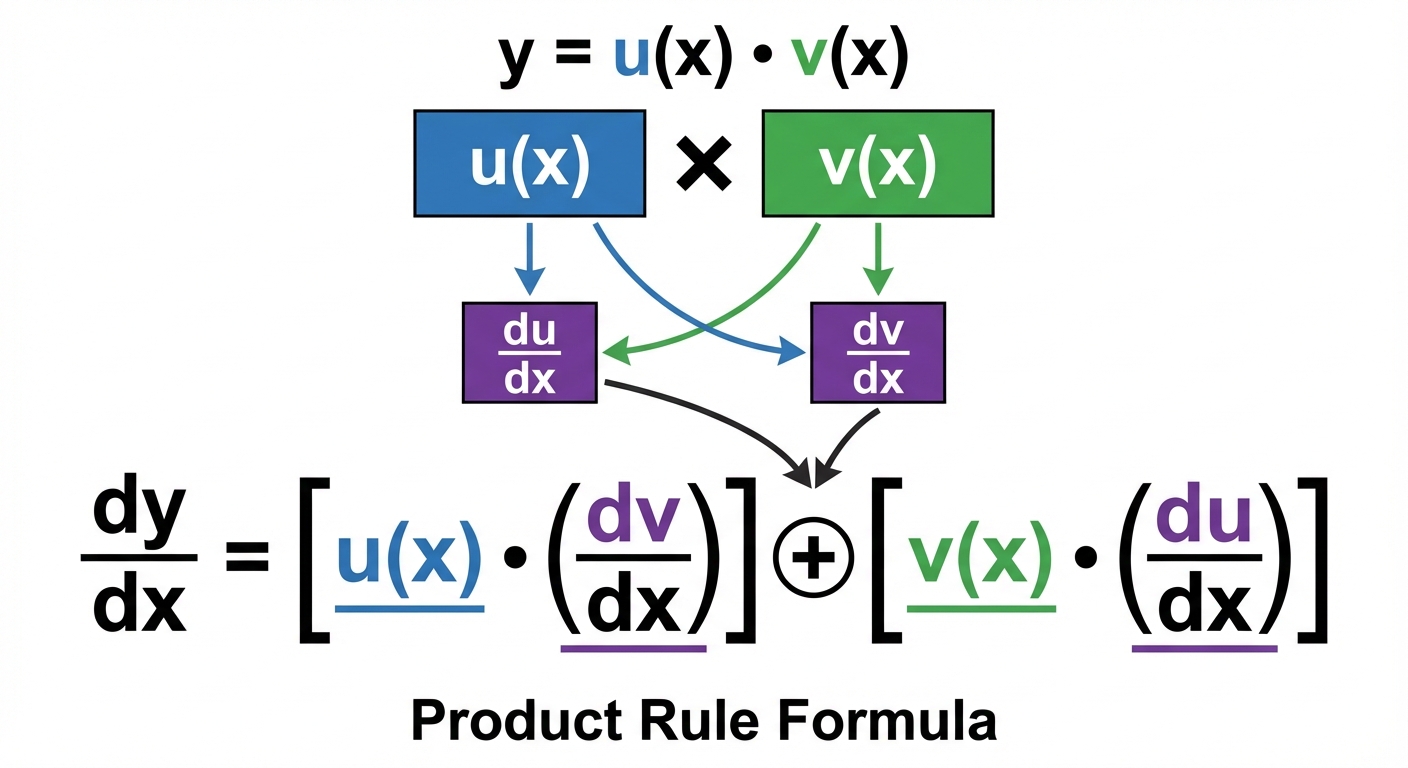
Alright, so you've mastered differentiating standard functions. But what happens when functions team up? Think of it like a Spotify playlist where two different artists drop a collab track. You can't just find the 'vibe' of each artist separately; you have to consider how they work together. That's where the Product Rule comes in. When you have two functions multiplied, say and , you can't just differentiate them individually and multiply the results. No way! The official rule is the Product Rule: In simple terms: 'the first function times the derivative of the second, PLUS the second function times the derivative of the first'. It's like a co-op game where each player gets a turn to take the lead.
Now, what about when functions are stacked on top of each other, like a fraction? This is less of a collab and more of a face-off. For this, we use the Quotient Rule. If you have a function , its derivative is: The key here is remembering the order and that minus sign! A classic way to remember it is: 'low d-high, minus high d-low, all over low-squared'. The function on the bottom () is 'low' and the one on top () is 'high'. The denominator always gets squared at the end, like it's the solid foundation of your answer. Mess up the order, and you'll get the sign wrong, so be super careful! Mastering these two rules is a massive level-up for your differentiation skills. 🚀
Worked example
Worked Example: Applying the Product Rule
Let's Differentiate This Combo! 🎮
Given the function , find the derivative .
- 1First, we need to identify our two functions that are being multiplied together. Think of them as Player 1 () and Player 2 (). This is clearly a Product Rule problem because we have an algebraic part () multiplied by an exponential part ().
- 2Next, we need to find the derivative of each player separately. We'll call these and . Remember to use the chain rule for !
- 3Now we assemble everything using the Product Rule formula: . We just substitute our four pieces () into the right spots.
- 4The final part is to tidy up our answer. It's good practice to simplify and, if possible, factorise. This makes the answer look clean and is often required for the next part of a question. We can see a common factor of and here.
Answer
4. Parametric and Implicit Differentiation
Alright, let's level up our differentiation game. So far, you've mostly dealt with functions where is neatly given in terms of , like . But what happens when the relationship is more... messy? That's where parametric and implicit differentiation come in. It's like going from a simple single-player campaign to a complex multiplayer raid.
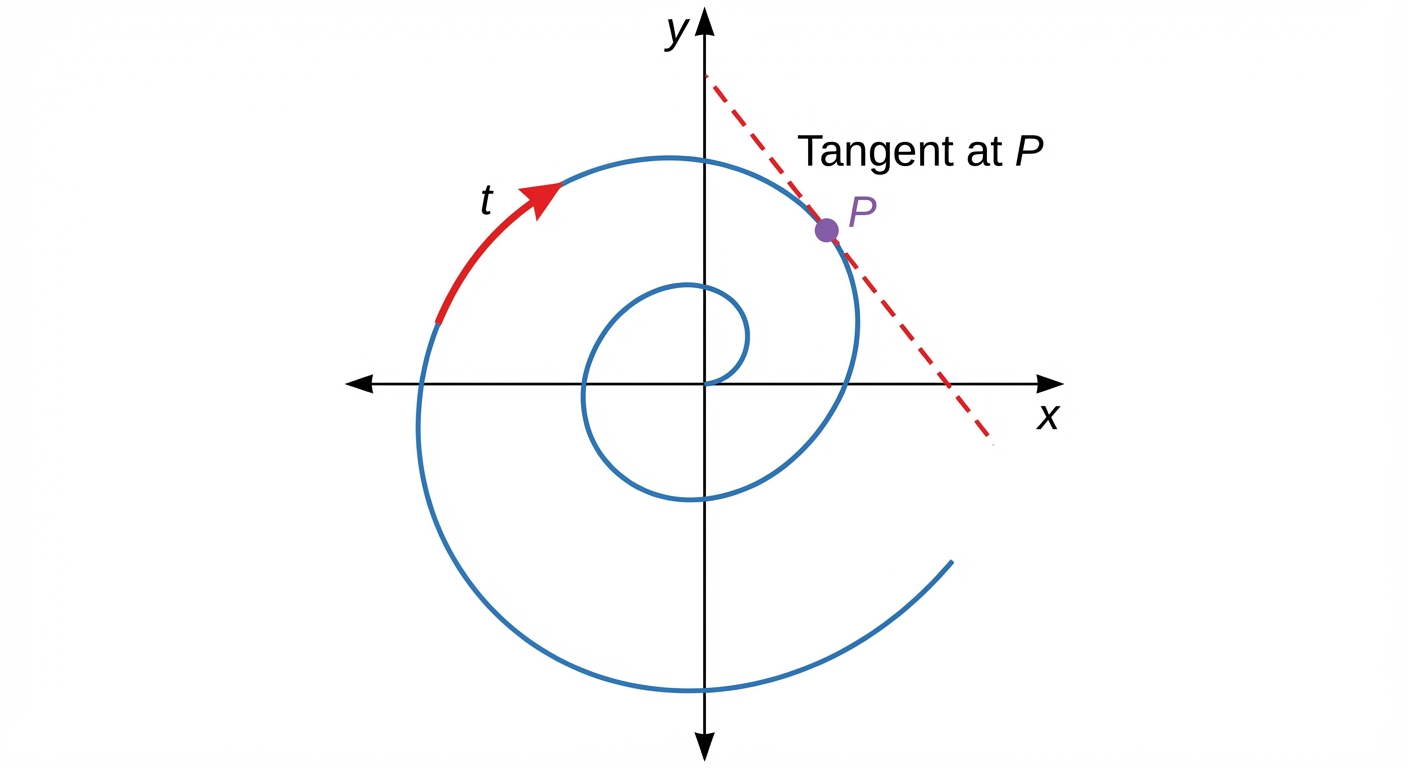
First up, Parametric Differentiation. Imagine you're tracking a character's movement in a game. Their position isn't described by how their y-coordinate depends on their x-coordinate. Instead, both their and positions depend on a third variable, usually time, . So you get two equations: and . Think of as the master variable controlling everything behind the scenes. To find the gradient , we can't just differentiate with respect to directly. We use a clever trick with the chain rule: . It’s like saying the rate of change of y with x is the rate y changes with time, divided by the rate x changes with time. Easy, right? You just find and separately and then divide them. This is super useful for finding the gradient of the tangent at a specific moment in time, .
First up, Parametric Differentiation. Imagine you're tracking a character's movement in a game. Their position isn't described by how their y-coordinate depends on their x-coordinate. Instead, both their and positions depend on a third variable, usually time, . So you get two equations: and . Think of as the master variable controlling everything behind the scenes. To find the gradient , we can't just differentiate with respect to directly. We use a clever trick with the chain rule: . It’s like saying the rate of change of y with x is the rate y changes with time, divided by the rate x changes with time. Easy, right? You just find and separately and then divide them. This is super useful for finding the gradient of the tangent at a specific moment in time, .
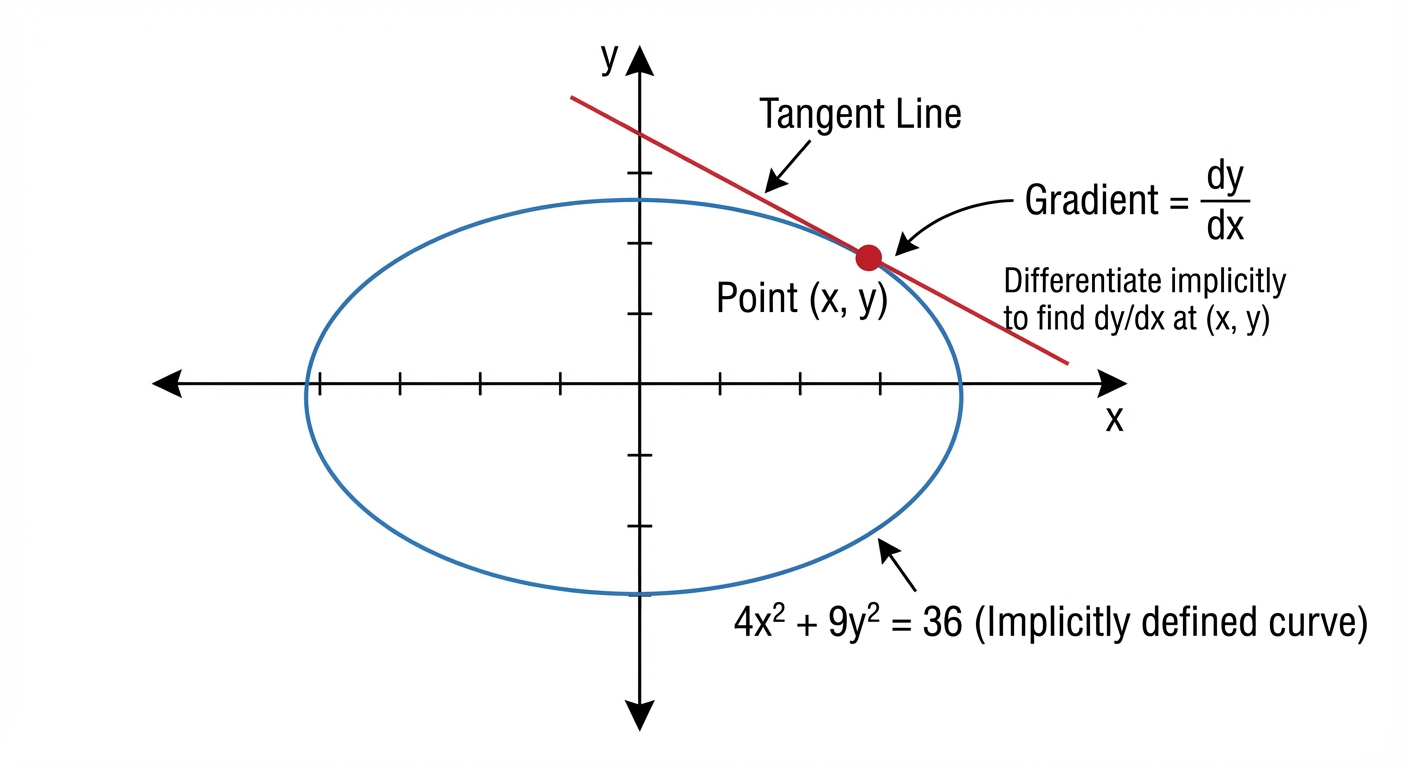
Next, we have Implicit Differentiation. This is for when and are all tangled up in one equation, and you can't easily isolate . Think of an equation for a circle, like . It's a nightmare to write this as (you'd need two separate functions!). So, we differentiate implicitly. The strategy is to differentiate the entire equation, term by term, with respect to . When you hit a term with just , you differentiate as normal. But here's the key move: when you differentiate a term with , you differentiate it with respect to first, and then multiply by . This is the chain rule in action again! For example, the derivative of with respect to is . After you've differentiated every term, you just do some algebraic shuffling to get by itself. This lets you find the gradient at any point on the curve, even for really complex shapes.
Worked example
Worked Example: Tangent to a Parametric Curve
Let's Find That Gradient! 🚀
A curve is defined by the parametric equations and for . Find the equation of the tangent to the curve at the point where .
- 1First, we need the building blocks for our gradient formula. Let's differentiate both and with respect to the parameter, .
- 2Now we can find the gradient function, , by dividing our two results using the parametric differentiation rule: .
- 3The problem asks for the tangent at a specific point, where . So, we'll substitute into our expression for to find the numerical gradient, .
- 4We have the gradient, but we also need the coordinates of the point of tangency. We get these by plugging back into the original parametric equations.
- 5Finally, we have a point and a gradient . We can now use the straight-line equation formula, , to find the equation of the tangent.
Answer
Practice this in the app
Unlock the full chapter: practice questions, flashcards, mock papers and notes, free.
Continue revising