Chapter 3: Advanced Algebraic Methods
Let's Break Down Fractions, Expand Everything, and Be Absolutely Sure! 😎
Introduction
1. Introduction
Hey there! Ready to level up your algebra skills? In this chapter, we're diving into some seriously powerful techniques that will become your new best friends in A2 Maths. First, we'll master Partial Fractions, a clever way to break down complicated algebraic fractions into simpler, bite-sized pieces. Then, we'll take the Binomial Expansion to a whole new level, learning how to handle fractional and negative powers – it's not as scary as it sounds, I promise! Finally, we'll tackle Modulus Functions, exploring the world of absolute value and how to solve equations and inequalities with it. These tools are fundamental for what's to come, so let's get started and crush it! 💪
2. Decomposition of Rational Functions into Partial Fractions
Alright, let's talk about partial fractions. Think of it like this: you know how you can take two separate tracks, like a vocal and a beat, and mix them into one song? Partial fractions is the reverse. We're given the final mixed song (a single, chunky algebraic fraction) and our job is to 'un-mix' it back into its original, simpler tracks (the partial fractions). Why bother? Because these simpler fractions are way easier to work with later on, especially for integration. It's like breaking down a massive gaming quest into smaller, manageable side-quests.
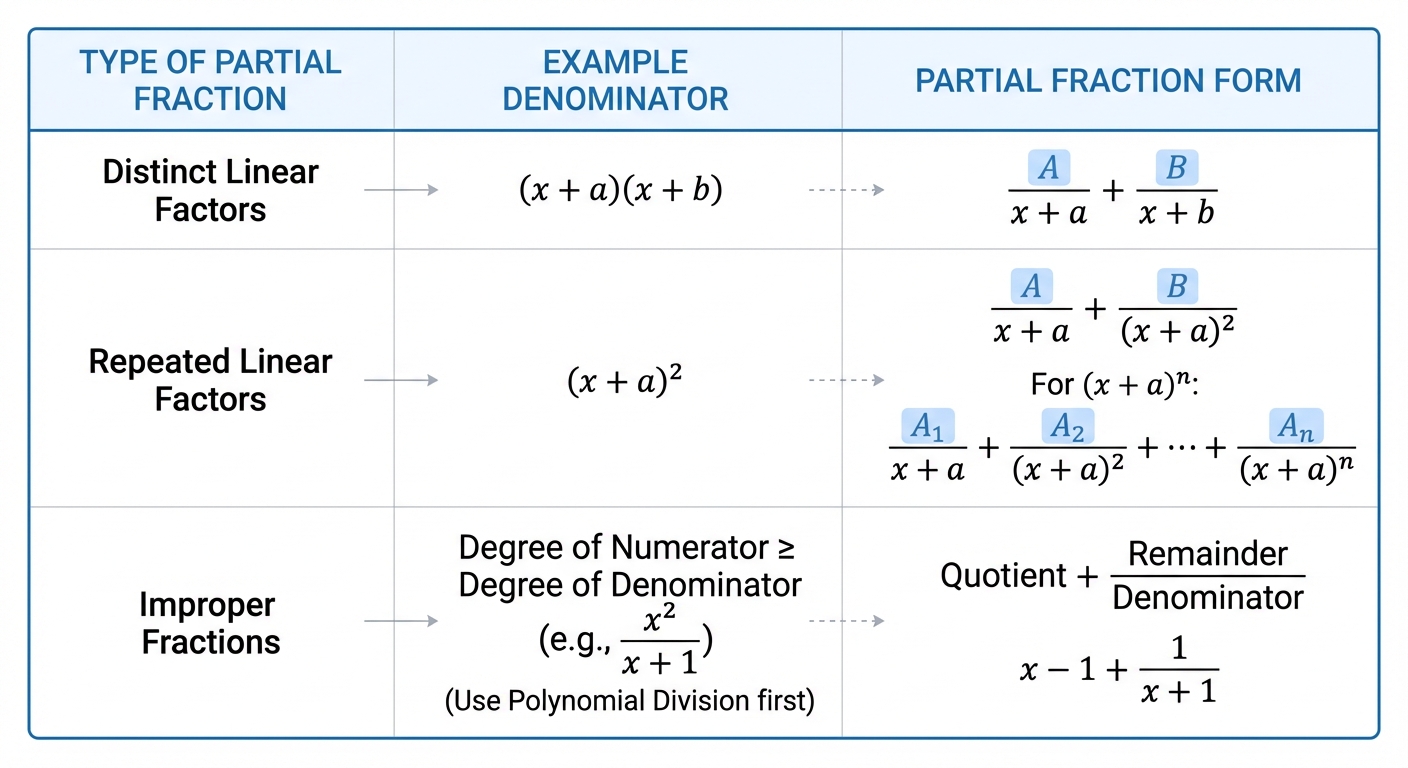
There are three main scenarios you'll see, all based on the denominator of your fraction:
1. Distinct Linear Factors: This is the most common case. The denominator is a product of unique linear factors, like . You split it into one fraction for each factor: . Easy peasy.
2. Repeated Linear Factors: This is when a factor is squared or cubed, like . This is a bit extra. You have to create a fraction for each power of that factor, from 1 up to the highest power. So, in the denominator becomes . It's like leveling up in a game; you have to account for both Level 1 and Level 2.
3. Improper Fractions: This is when the degree of the numerator is the same as or bigger than the degree of the denominator (e.g., ). This fraction is top-heavy, like carrying too many textbooks. Before you can do anything else, you MUST use algebraic long division. This will split it into a polynomial (which might just be a number) and a proper fraction. Then, you can break down that new proper fraction using the rules above. Don't skip the division, or you'll get the whole thing wrong!
There are three main scenarios you'll see, all based on the denominator of your fraction:
1. Distinct Linear Factors: This is the most common case. The denominator is a product of unique linear factors, like . You split it into one fraction for each factor: . Easy peasy.
2. Repeated Linear Factors: This is when a factor is squared or cubed, like . This is a bit extra. You have to create a fraction for each power of that factor, from 1 up to the highest power. So, in the denominator becomes . It's like leveling up in a game; you have to account for both Level 1 and Level 2.
3. Improper Fractions: This is when the degree of the numerator is the same as or bigger than the degree of the denominator (e.g., ). This fraction is top-heavy, like carrying too many textbooks. Before you can do anything else, you MUST use algebraic long division. This will split it into a polynomial (which might just be a number) and a proper fraction. Then, you can break down that new proper fraction using the rules above. Don't skip the division, or you'll get the whole thing wrong!
Worked example
Worked Example: Decomposition with Repeated Linear Factors
Let's Solve This Thing 🚀
Express in partial fractions.
- 1First, let's set up the structure. We have one distinct linear factor, , and one repeated linear factor, . So, we need three fractions: one for , one for , and one for .
- 2Now, we get rid of the denominators by multiplying both sides by . This gives us a much cleaner polynomial equation to work with.
- 3Time for the substitution 'cheat code' to find A and C. Let's pick values of that make terms disappear. If we let , the A and B terms become zero, letting us solve for C.
- 4Let's do that again to find A. If we let , the B and C terms will become zero. Perfect!
- 5We can't use a simple substitution to find B. So, we'll switch to equating coefficients. Let's look at the terms on both sides. On the left, it's . On the right, we get from and from .
Since we know , we have: - 6We've got all our constants! Now we just put it all together for the final answer. Mic drop.
Answer
3. Binomial Expansion for Rational Exponents
Alright, so you've mastered the binomial expansion from AS-Level, where 'n' was a nice, positive whole number. That expansion was finite, like a Snapchat story – it had a clear beginning and end. Now, we're taking it to the A2 level. Welcome to the world where 'n' can be any rational number – that means negative integers and fractions are now in the game!
The core formula looks familiar, but with a twist: The big deal here is the '...' at the end. Because 'n' isn't a positive integer, the part will never hit zero. This means the expansion is an infinite series. It's like an endless TikTok feed, it just keeps going! Because it's infinite, we have to talk about its validity. This expansion is only a good approximation of the original function if x is small enough. The rule for the standard form is that the expansion is valid for , which is the same as saying . Think of it like the Wi-Fi range for your PS5; get too far away (x gets too big), and the connection drops. Outside this range, the approximation is totally useless.
The core formula looks familiar, but with a twist: The big deal here is the '...' at the end. Because 'n' isn't a positive integer, the part will never hit zero. This means the expansion is an infinite series. It's like an endless TikTok feed, it just keeps going! Because it's infinite, we have to talk about its validity. This expansion is only a good approximation of the original function if x is small enough. The rule for the standard form is that the expansion is valid for , which is the same as saying . Think of it like the Wi-Fi range for your PS5; get too far away (x gets too big), and the connection drops. Outside this range, the approximation is totally useless.
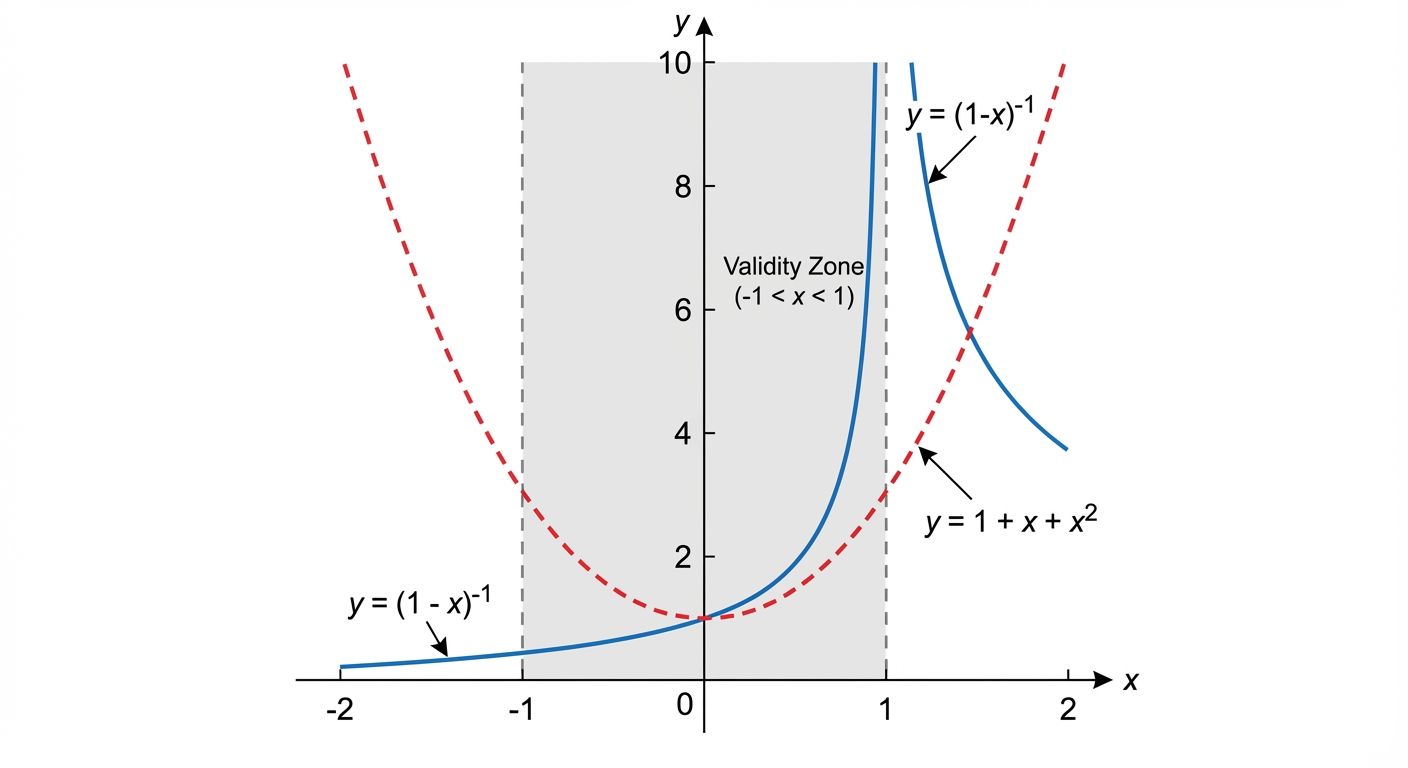
Often, you won't get a perfect . You'll get something sneaky like . The trick is to force it into the right format. You factor out the 'a' term like this: . Now you can expand the bracket part using our formula, just replacing 'x' with ''. But be careful! This changes the validity range. Since our new 'x' term is , the condition becomes . You'll need to solve that for x to get the new range. It's a key step they love to test!
Worked example
Worked Example: Expansion of a Root Function
Let's Crack This Square Root Thingy 💪
Find the first three terms in the expansion of in ascending powers of x. State the range of values of x for which the expansion is valid.
- 1First, we gotta get this into the standard form. The '4' is blocking us. So, we'll factor it out of the bracket. Remember to apply the power (which is for a square root) to the 4 we're pulling out.
- 2Now we can use the binomial formula on the bracket part. Here, our 'n' is and our 'x' is replaced by . We'll expand up to the term as requested.
- 3Time to tidy this up. Calculate the coefficients and simplify the powers. Don't rush this part; it's easy to make a small error with the fractions.
- 4We're not done yet! Remember the '2' we factored out at the very beginning? It's been waiting patiently. Let's multiply our three terms by it to get the final expansion.
- 5Finally, the validity. The rule is that the absolute value of the term in the 'x' position must be less than 1. For our expansion, that term was . So we set up the inequality and solve.
Answer
4. Modulus Functions and Equations
Alright, let's break down the modulus function. Think of it as a 'positivity filter' for numbers. Whatever you put in, it only cares about the size or magnitude, not whether it's positive or negative. It's like distance – you can't drive -5 km to your part-time job; the distance is just 5 km. The notation for this is , and it means the absolute value of . So, and . Easy, right?
Now, let's talk graphs. The graph of a modulus function like has a super distinctive V-shape. To sketch it, you first draw the regular line . Then, any part of that line that dips below the x-axis (where the y-values are negative) gets reflected upwards. It's like flipping a bad Snap story into a good one. The point where the 'V' touches the x-axis is the vertex.
Now, let's talk graphs. The graph of a modulus function like has a super distinctive V-shape. To sketch it, you first draw the regular line . Then, any part of that line that dips below the x-axis (where the y-values are negative) gets reflected upwards. It's like flipping a bad Snap story into a good one. The point where the 'V' touches the x-axis is the vertex.
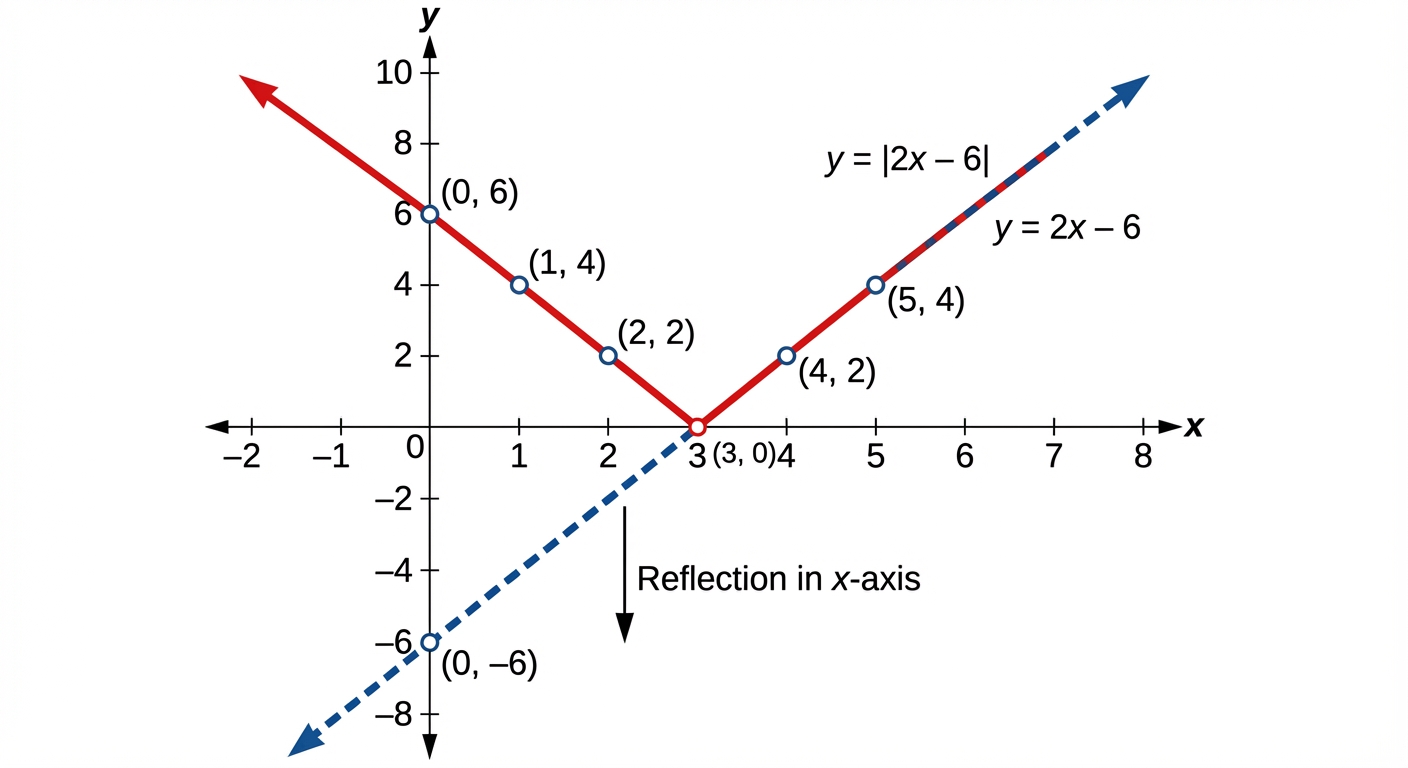
Solving equations like is where it gets interesting. Since the modulus function strips away the sign, the stuff inside, , could have been either or to begin with. This means you split the problem into two separate, simpler equations: and . Solve both, and you've got your two possible answers. Another pro-gamer move is the squaring method. Since squaring a negative number makes it positive, you can square both sides to kill the modulus sign, like this: . This is a powerful technique, especially for more complex inequalities, but be warned: it can sometimes give you 'imposter' solutions that don't actually work, so always sub your answers back into the original equation to check!
Worked example
Worked Example: Solving a Modulus Equation
Let's Solve This Thing 🚀
Find the set of values for for which .
- 1The first thing we need to recognize is that the expression inside the modulus, , can be equal to either 8 or -8 for its absolute value to be 8. So, we'll set up two separate linear equations.3x + 2 = 8 \quad \text{or} \quad 3x + 2 = -8
- 2Now, let's solve the first equation for . We'll subtract 2 from both sides and then divide by 3.
- 3Next, we solve the second equation for . Again, we subtract 2 from both sides and then divide by 3.
- 4We've found our two possible values for . It's always a good idea to quickly check them in the original equation. Both work, so we can state our final answer.The solutions are and .
Answer
The solutions are and .
Practice this in the app
Unlock the full chapter: practice questions, flashcards, mock papers and notes, free.
Continue revising