P3: Differential Equations
The Secret Language of Change 🤫
Introduction
1. Introduction
Welcome to one of the coolest topics in A-Level Maths! Ever wondered how we can mathematically describe things that are constantly changing, like a cooling cup of coffee or a growing population? That's where differential equations come in. They're basically equations that involve rates of change (hello, derivatives!). In this chapter, we're going to learn three key skills. First, we'll learn how to form these special equations by translating real-world scenarios into the language of calculus. Then, we'll master a powerful technique called separation of variables to solve them. Finally, we'll see how to find particular solutions – the one specific answer that fits a given situation. It might sound complex, but you'll soon see it's a logical and super useful process. Let's get started!
2. Forming Differential Equations from Context
Alright, let's get into one of the coolest parts of A-Level Maths: forming differential equations. Seriously! This is where math stops being just numbers on a page and starts describing the world around us. Think of it like this: you're a translator, but instead of translating Spanish to English, you're translating real-world situations (like your phone battery dying, a meme going viral, or even how fast you're saving for a new gaming console) into the language of calculus.
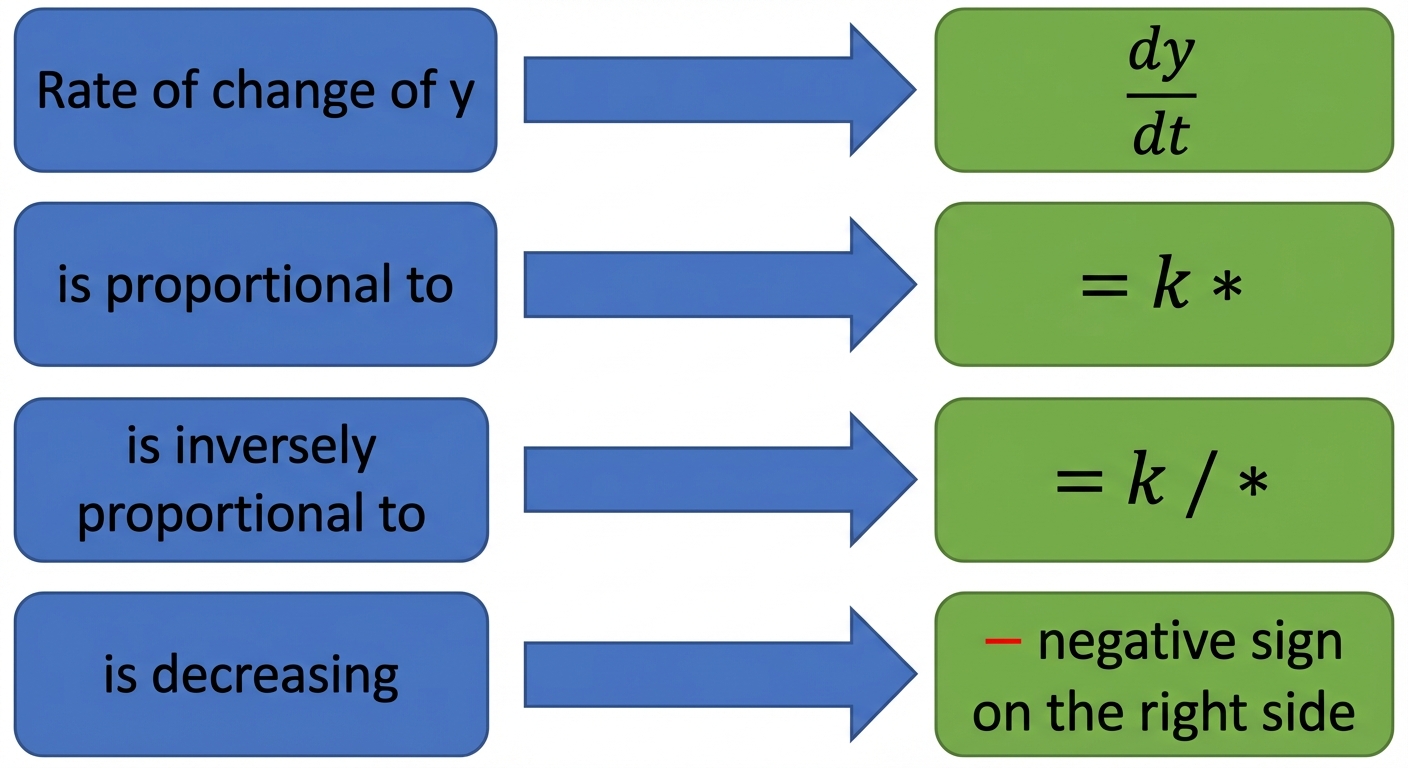
The key is to spot the 'rate of change' phrases. Whenever you see 'the rate of increase of y', 'how fast x is changing', or 'the decay of z', your brain should immediately think: derivative! This is your or . It's just describing how one variable changes with respect to another (usually time, ).
The next big clue is the phrase 'is proportional to'. This is your signal to use the proportionality constant, . It's the secret sauce that connects the rate of change to the variables in the situation. If a population grows at a rate proportional to its current size, you write , which translates to . If something is decreasing or decaying, like the number of followers you have after posting a cringe take, the rate is negative. So you'd write . The negative sign is super important – it shows the quantity is getting smaller. This whole process is called modelling, and you're essentially creating a mathematical snapshot of a dynamic situation.
The key is to spot the 'rate of change' phrases. Whenever you see 'the rate of increase of y', 'how fast x is changing', or 'the decay of z', your brain should immediately think: derivative! This is your or . It's just describing how one variable changes with respect to another (usually time, ).
The next big clue is the phrase 'is proportional to'. This is your signal to use the proportionality constant, . It's the secret sauce that connects the rate of change to the variables in the situation. If a population grows at a rate proportional to its current size, you write , which translates to . If something is decreasing or decaying, like the number of followers you have after posting a cringe take, the rate is negative. So you'd write . The negative sign is super important – it shows the quantity is getting smaller. This whole process is called modelling, and you're essentially creating a mathematical snapshot of a dynamic situation.
Worked example
Worked Example: Newton's Law of Cooling
Your Pizza Getting Cold, But Make It Math 🍕
You've just taken a pizza out of the oven. The rate at which the pizza cools is proportional to the difference between its temperature, (in °C), and the constant room temperature, which is 25°C. Form a differential equation to model the temperature of the pizza over time, (in minutes).
- 1First, let's identify the 'rate of change'. The problem states 'The rate at which the pizza cools'. This is the change in temperature () with respect to time (). So, we write this as a derivative.
- 2Next, we find the relationship. The magic words are 'is proportional to'. This tells us we're going to set our rate equal to some constant, , multiplied by something else.
- 3Now, what is it proportional to? The problem says it's 'the difference between its temperature, , and the room temperature, 25°C'. The difference is simply .
- 4Let's put it all together. We combine the parts from the previous steps to form our initial equation.
- 5Here's the final, crucial check! Is the pizza's temperature increasing or decreasing? It's cooling, so its temperature is decreasing. This means the rate, , must be negative. Since the pizza is hotter than the room, is positive. For the whole right side to be negative, our constant must be negative. To make this clear, we often replace with (where is now a positive constant). This is the standard convention.
Answer
3. Solving First-Order Differential Equations by Separation of Variables
Alright, let's break down one of the coolest tools in your calculus toolkit: Separation of Variables. First off, what's a differential equation (DE)? Think of it as an equation that's got a derivative, like , chilling in it. It's basically a recipe for a curve, telling you the gradient at any point. Our job is to work backwards from the gradient recipe to find the actual equation of the curve, .
The 'separation of variables' method is your go-to move for a specific type of DE called a 'separable' equation. The name gives it away: it's an equation where you can literally separate all the stuff from all the stuff. It's like when you're at a party and you tell your friends, 'Okay, everyone who wants to game in this room, everyone who wants to scroll TikTok in that room.' You're putting all the terms (including the ) on one side of the equals sign, and all the terms (including the ) on the other.
The 'separation of variables' method is your go-to move for a specific type of DE called a 'separable' equation. The name gives it away: it's an equation where you can literally separate all the stuff from all the stuff. It's like when you're at a party and you tell your friends, 'Okay, everyone who wants to game in this room, everyone who wants to scroll TikTok in that room.' You're putting all the terms (including the ) on one side of the equals sign, and all the terms (including the ) on the other.
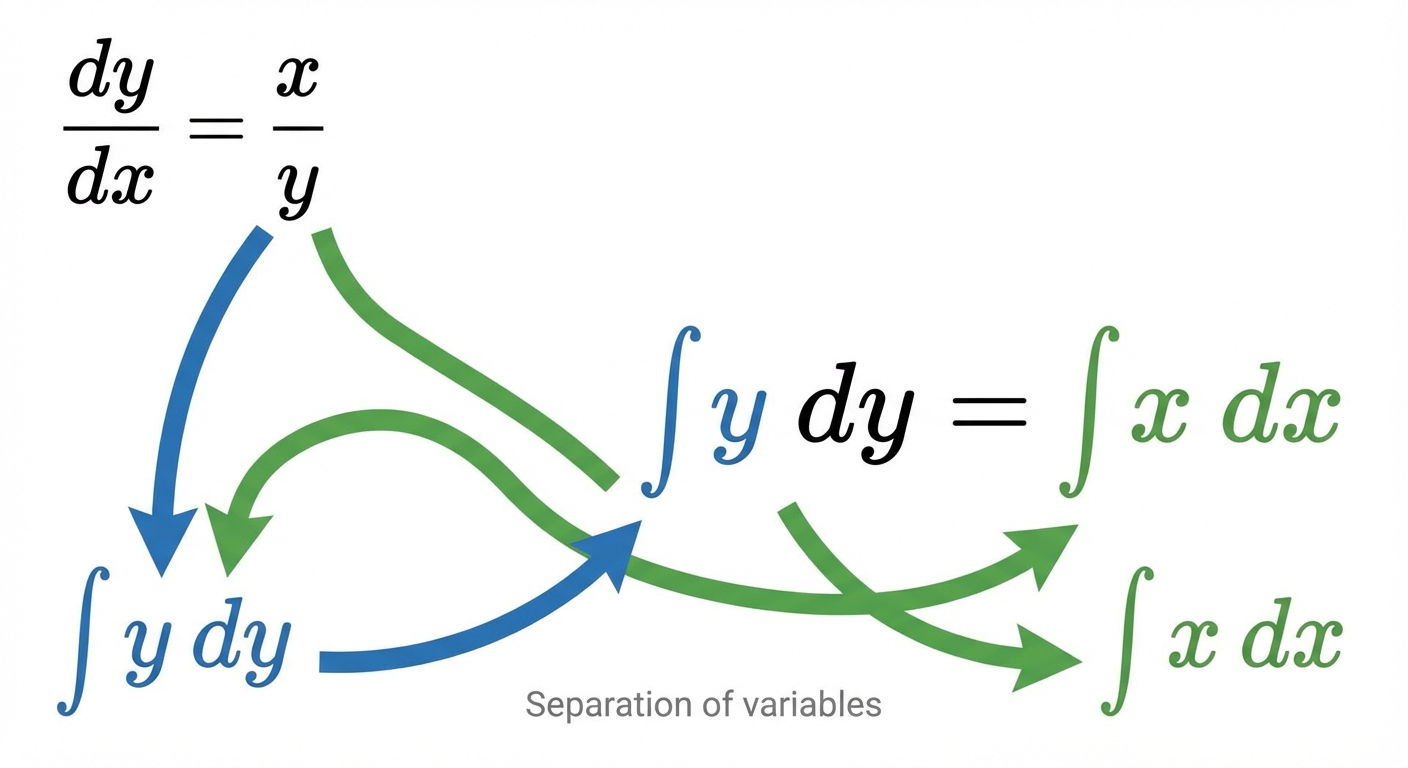
Once they're separated, the magic happens: you integrate both sides. Slap an integral sign on the left and on the right, and work your integration magic. Remember all those techniques from P1? They're back! After integrating, don't forget the VIP of this whole process: the constant of integration, . Forgetting it is like forgetting to save your game progress – a total disaster. This equation you get, with the still in it, is called the general solution. It's 'general' because that could be any number, meaning you've actually found a whole family of curves that fit the original DE. It's like a character template before you customize the details.
Worked example
Worked Example: Finding a General Solution
Let's Solve This Thing 🚀
Find the general solution of the differential equation .
- 1First things first, we need to separate the variables. The goal is to get everything with a 'y' on the left side with , and everything with an 'x' on the right side with . We can do this with some simple algebraic rearranging, basically cross-multiplication.
- 2Now that the variables are successfully separated, it's time to integrate both sides. We just put an integral sign in front of each expression. This is the core step that turns our derivative equation into a regular function.
- 3Let's actually compute the integrals. The integral of with respect to is just . For the right side, we use the power rule for integration. And critically, we add our constant of integration, , to one side (usually the side is tidiest).
- 4We have the general solution, but it's good practice to make the subject of the formula if possible. To get out of the exponent on , we need to take the natural logarithm (ln) of both sides. This gives us our final answer in explicit form.
Answer
4. Finding Particular Solutions to Differential Equations
Alright, so you've mastered separating variables and integrating to find a general solution to a differential equation. That solution always has a cheeky little '+ C' tagging along at the end, right? Think of that general solution like a generic playlist on Spotify called 'Chill Vibes'. It has the right structure, but there are infinite variations. The constant 'C' is like a slider that changes the whole playlist – shifting it up or down, making it totally different each time.
This means a single differential equation actually represents an entire family of solution curves.
This means a single differential equation actually represents an entire family of solution curves.
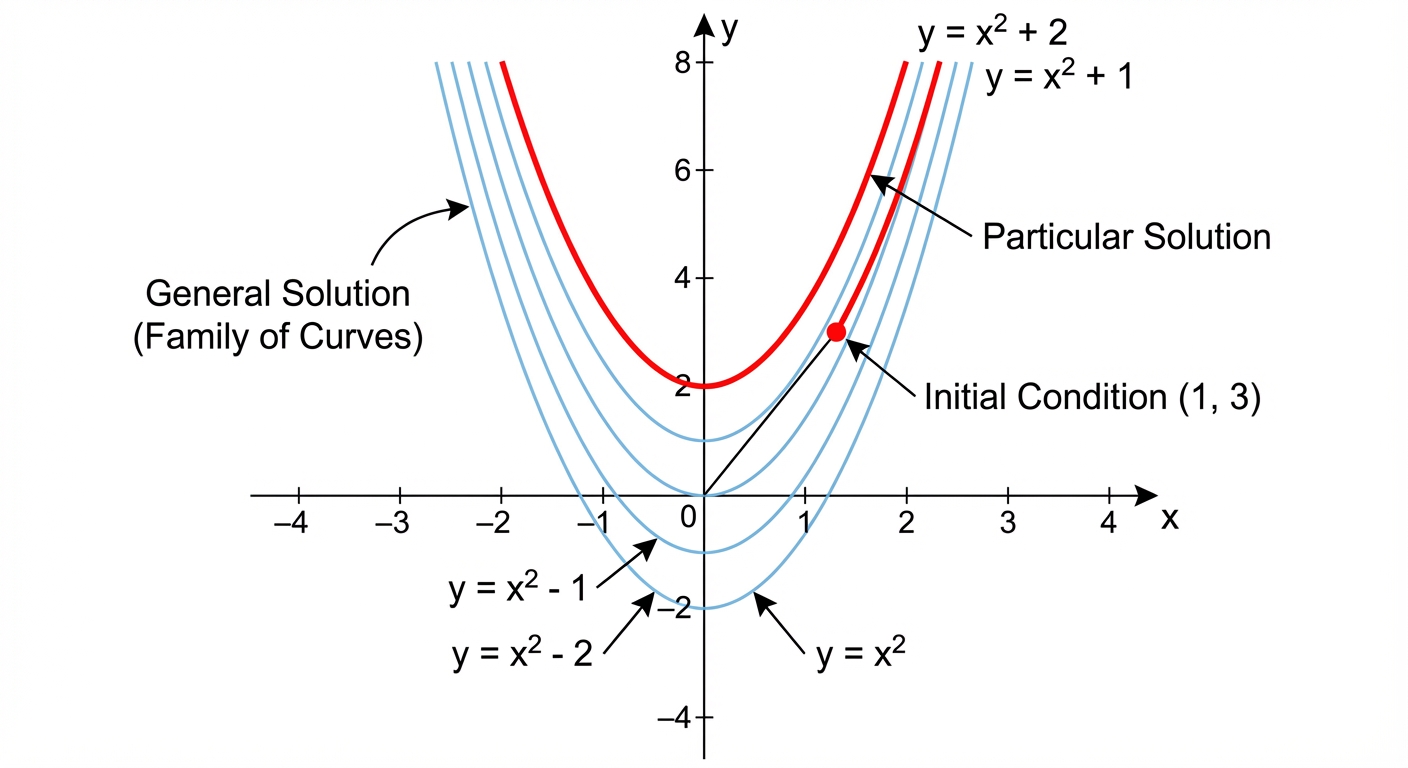
A particular solution, on the other hand, is when we find the one specific curve from that infinite family that solves our problem. It's like finding your friend's exact 'Chill Vibes' playlist out of thousands of others. How do we do it? We use a clue, known as an 'initial condition' or a 'boundary condition'. This is just a specific point that your solution must pass through. It's the secret code that unlocks the value of C.
The process is super straightforward: 1. Find your general solution with the '+ C'. 2. Plug the x and y values from your given initial condition into the general solution. 3. Solve the simple equation that's left to find the exact value of C. 4. Sub this value of C back into your general solution. Boom. You've gone from an infinite family of possibilities to one unique, particular solution that fits the specific scenario, whether it's the exact path of a rocket or the cooling of your specific cup of coffee. You've found 'the one'. 😉
The process is super straightforward: 1. Find your general solution with the '+ C'. 2. Plug the x and y values from your given initial condition into the general solution. 3. Solve the simple equation that's left to find the exact value of C. 4. Sub this value of C back into your general solution. Boom. You've gone from an infinite family of possibilities to one unique, particular solution that fits the specific scenario, whether it's the exact path of a rocket or the cooling of your specific cup of coffee. You've found 'the one'. 😉
Worked example
Worked Example: Finding a Curve Through a Specific Point
Let's Pinpoint This Solution! 📍
The gradient of a curve is given by the differential equation . Find the equation of the specific curve that passes through the point .
- 1First up, we need to find the general solution. This means we need to integrate the differential equation to get an equation for . We'll separate the variables (which is already done for us here) and integrate both sides. The integral on the right looks perfect for a substitution.
- 2Let's solve that integral. Let , so , which means . We can rewrite our integral in terms of and solve. Don't forget the constant of integration, !
- 3Now, we substitute back in to get our general solution in terms of and . This equation represents the whole family of possible curves.
- 4Time to find our particular solution! We use the given initial condition, which is the point . We substitute and into our general solution to find the specific value of C.
- 5Let's simplify and solve for C. This is the key to unlocking our unique answer.
- 6Finally, we write our particular solution by substituting our calculated value of back into the general solution. This is the one and only curve that satisfies both the differential equation and the initial condition.
Answer
Practice this in the app
Unlock the full chapter: practice questions, flashcards, mock papers and notes, free.
Continue revising