P1 Chapter 4: Series
Unpacking Patterns & Infinite Sums! 🤯
Introduction
1. Introduction
Alright, let's dive into the world of Series! This chapter is all about spotting and using patterns, which is a massive skill in maths and beyond. We'll start with Binomial Expansion, a powerful tool that lets you expand expressions like without multiplying it out the long way – a true exam time-saver. Then, we'll get into Progressions. You'll master Arithmetic Progressions, where you add a fixed number each time (think of your savings growing steadily), and Geometric Progressions, where you multiply by a fixed number (like a video going viral). Finally, we'll tackle the mind-bending concept of Convergence and the Sum to Infinity. Yep, you'll learn how to add up an infinite list of numbers and get a single, finite answer. It sounds impossible, but you've got this! Let's break it down.
2. Binomial Expansion for Positive Integer Exponents
Alright, let's talk Binomial Expansion. You've probably spent ages manually expanding things like or maybe even . It's tedious, right? Well, the Binomial Theorem is basically the ultimate cheat code for expanding for any positive integer . Forget endless FOIL-ing; this is your fast track. The core idea is that there's a beautiful, predictable pattern. For , the powers of 'a' descend from down to 0, while the powers of 'b' ascend from 0 up to . The sum of the powers in any term always equals .
So, what about the numbers in front of each term – the coefficients? For small values of , you can use Pascal's Triangle. Each number is the sum of the two directly above it, and the row gives you the coefficients for an expansion to the power of .
So, what about the numbers in front of each term – the coefficients? For small values of , you can use Pascal's Triangle. Each number is the sum of the two directly above it, and the row gives you the coefficients for an expansion to the power of .
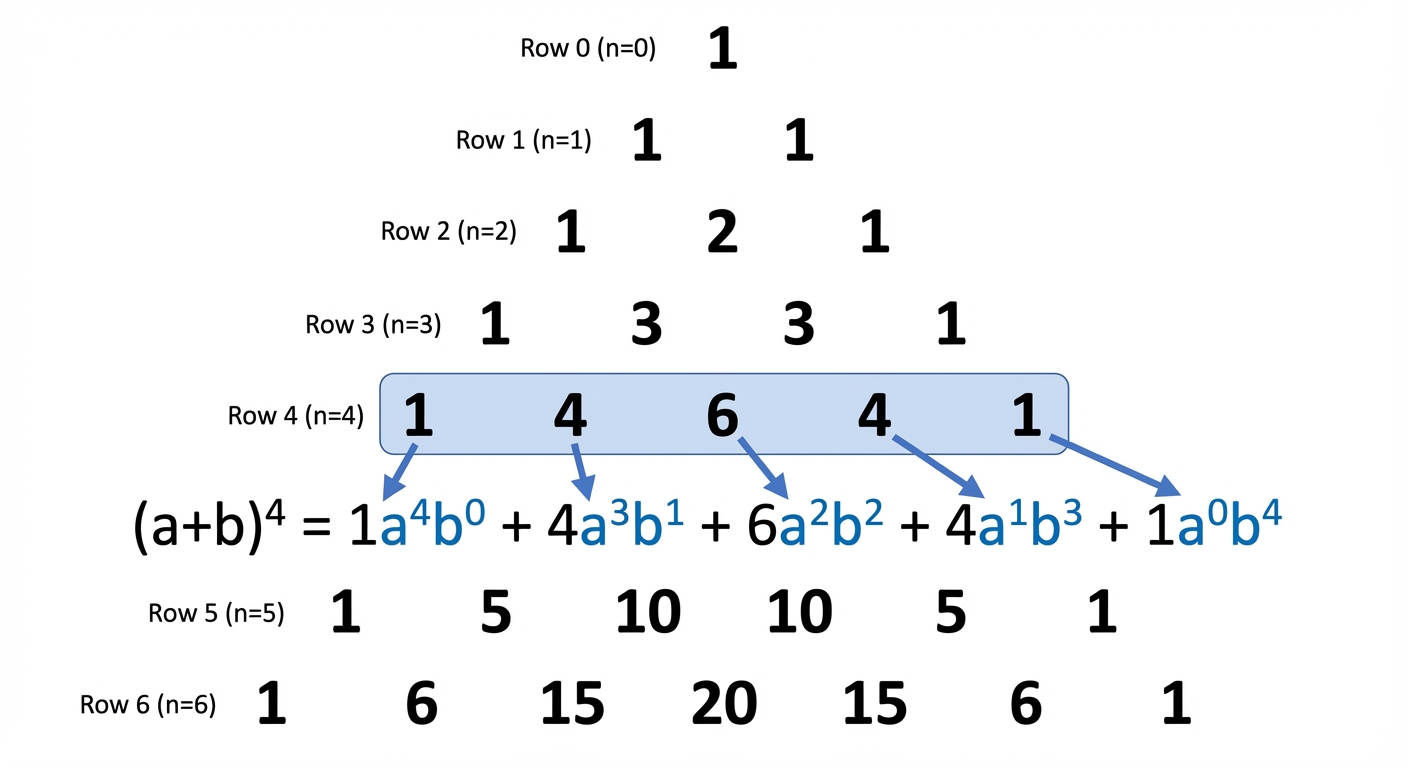
But for larger powers like , Pascal's Triangle becomes impractical. That's where we bring in the big guns: the binomial coefficient, written as or . This tells you 'the number of ways to choose r items from a set of n'. It's calculated using factorials (where ) with the formula: Luckily, your calculator has a dedicated nCr button, which is a lifesaver in exams. The full Binomial Theorem is: The term in the expansion is given by . Mastering this isn't just about passing P1; this concept is foundational in probability theory (Binomial Distribution in S1), statistics, and even finance for modeling asset prices. It's a key tool you'll see again in university-level calculus and discrete mathematics, so getting it locked down now is a major advantage.
Worked example
Worked Example: Expansion with Negative and Fractional Terms
Let's Wreck This Bracket Expansion! 💥
Find the first four terms in the expansion of in ascending powers of .
- 1First, let's identify our key players: , , and . In the general form , we compare it to our expression. Be super careful with the sign for !
- 2The general formula for a term is . We need the first four terms, which correspond to and . Let's set up the structure for each term.
- 3Now, let's evaluate the binomial coefficients using our calculator's nCr function. It's much faster and safer than using the factorial formula under exam pressure.
- 4Time to substitute these coefficients back in and simplify each term one by one. Watch your signs and indices like a hawk – this is where most mistakes happen!
- 5Finally, assemble the simplified terms to present your answer. We've got our first four terms in ascending powers of , just as the question asked. Job done!
Answer
3. Arithmetic Progressions: Structure and Summation
Alright, let's break down Arithmetic Progressions (APs). Think of an AP as the mathematical equivalent of leveling up in a video game where you gain the exact same amount of XP for every level. It's a sequence of numbers where the difference between consecutive terms is constant. This constant value is your secret weapon, the common difference, denoted by . The first term is always called . So, a sequence like 5, 8, 11, 14... is an AP because you're consistently adding 3. Here, and .
In your exam, you'll need two key formulas. The first finds any term in the sequence, the nth term (). The formula is . It's super intuitive: to get to the nth term, you start at and add the common difference times. Why ? Because you don't add to get to the first term, you start there!
In your exam, you'll need two key formulas. The first finds any term in the sequence, the nth term (). The formula is . It's super intuitive: to get to the nth term, you start at and add the common difference times. Why ? Because you don't add to get to the first term, you start there!
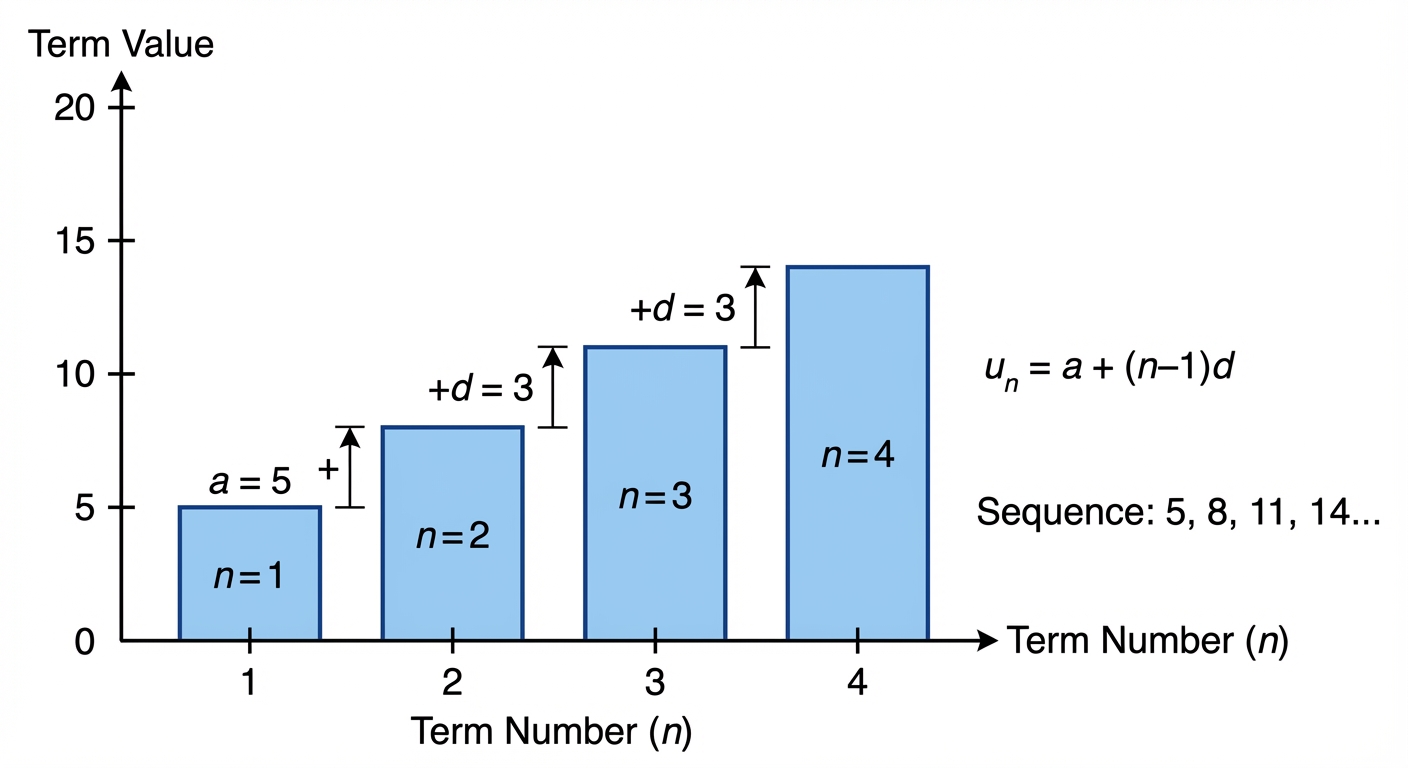
The second formula is for the sum of the first n terms, . This is crucial for problems asking for a total amount over a period. The main formula is . A handy alternative, if you know the last term (), is . Mastering these is not just for your P1 paper; this concept of linear growth is fundamental in fields like finance for simple interest calculations, physics for motion with uniform acceleration, and even computer science for analysing algorithm efficiency. Exam questions often won't just ask you to plug in numbers; they'll give you two pieces of information (e.g., the 5th term and the sum of the first 20 terms) and expect you to form and solve simultaneous equations to find and . That's where the real skill lies!
Worked example
Worked Example: Solving for Unknowns in an AP
Time to put the theory into practice 🕵️♀️
The fourth term of an arithmetic progression is 13 and the tenth term is 31. Find the first term (), the common difference (), and the sum of the first 30 terms of the progression.
- 1First, we need to translate the given information into equations using the nth term formula, . We have two unknowns, and , so we'll need two equations.For the 4th term (): --- (1)
For the 10th term (): --- (2) - 2Now we have a classic pair of simultaneous equations. The easiest way to solve this is by elimination. Let's subtract equation (1) from equation (2) to eliminate and solve for .
- 3With our value for , we can substitute it back into either of the original equations to find . Let's use equation (1) as it has smaller numbers.
- 4Great! We've found our core components: the first term is and the common difference is . Now we can tackle the final part of the question: finding the sum of the first 30 terms, .The first term is .
The common difference is . - 5We'll use the sum formula , plugging in our values: , , and .
- 6Finally, we just need to compute the result to get our final answer. Remember to show your working clearly in an exam situation.
Answer
4. Geometric Progressions: Formulas and Applications
Alright, let's dive into Geometric Progressions (GPs). Unlike their more predictable cousin, the Arithmetic Progression, which just adds a fixed amount each time, GPs are all about multiplication. Think of a viral social media post: it gets 1000 likes in the first hour, then the likes triple every hour after that. That explosive, runaway growth? That's a GP in action, and understanding it is key for A-Level success and beyond.
The two absolute essentials you need to know are the first term, , and the common ratio, . The common ratio is the constant factor you multiply by to get from one term to the next. You can always find it by dividing any term by the one before it: . To find a specific term way down the line (e.g., the likes in the 10th hour), you don't need to multiply it out nine times. Just use the nth term formula: Pay close attention to that exponent – it's a classic exam trip-up because the first term, , hasn't been multiplied by yet.
The two absolute essentials you need to know are the first term, , and the common ratio, . The common ratio is the constant factor you multiply by to get from one term to the next. You can always find it by dividing any term by the one before it: . To find a specific term way down the line (e.g., the likes in the 10th hour), you don't need to multiply it out nine times. Just use the nth term formula: Pay close attention to that exponent – it's a classic exam trip-up because the first term, , hasn't been multiplied by yet.
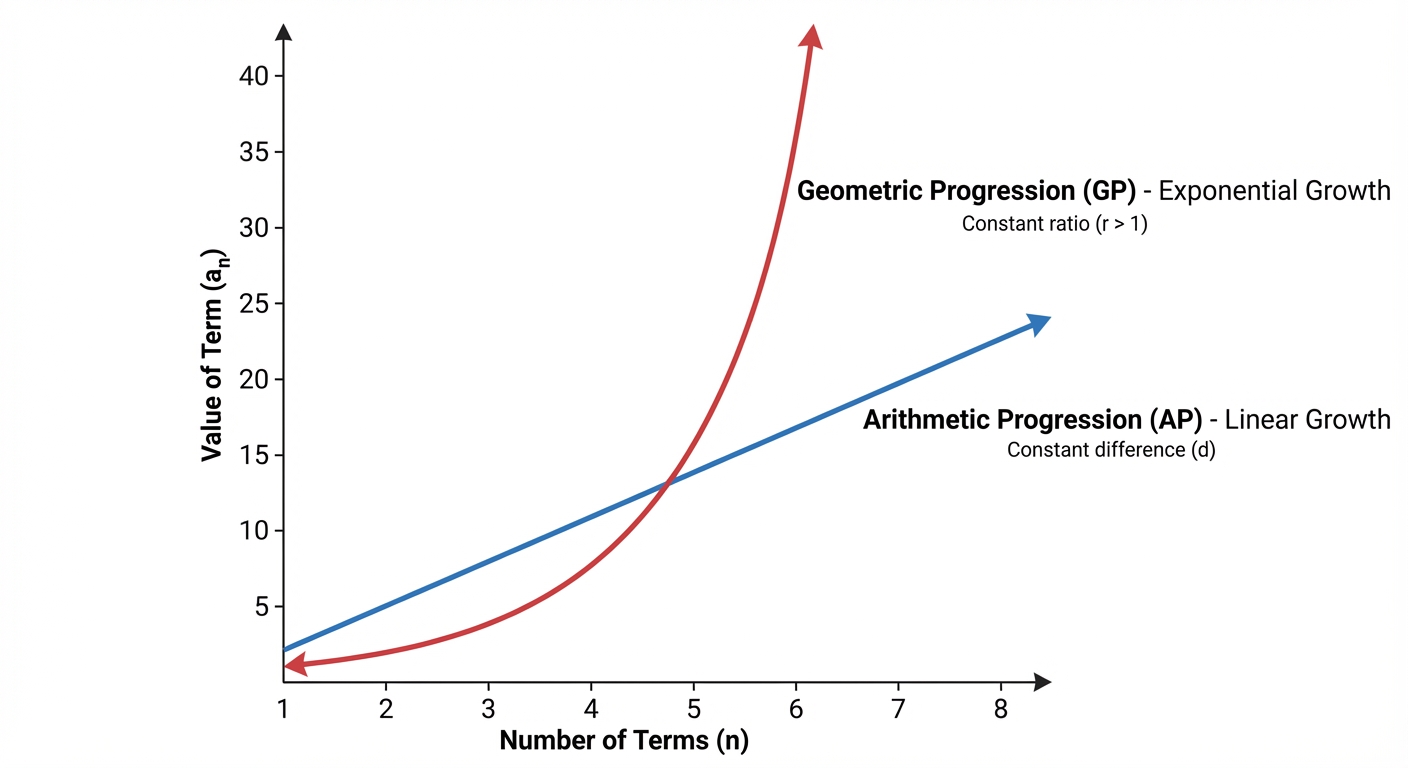
Now, what if you need the total likes after 12 hours? That's where the sum formula comes in. Since in our example, we'd use . If your ratio is a fraction where (like in radioactive decay), it's cleaner to use the alternative form to avoid negative denominators. They're mathematically identical, but choosing the right one reduces errors under pressure. Mastering GPs is vital for university courses in finance (compound interest), biology (population dynamics), and even computer science (algorithmic complexity). It's a concept that truly multiplies in value. 😉
Worked example
Worked Example: Modelling Company Profit Growth
Let's Get This (Exponential) Bread 💰
A tech startup's annual profits are modelled as a geometric progression. In its first year of operation, the profit was 96,000.
(a) Find the common ratio for the company's profit growth.
(b) Calculate the predicted profit in the 6th year.
(c) Calculate the total predicted profit for the first 8 years of operation, giving your answer to the nearest dollar.
(a) Find the common ratio for the company's profit growth.
(b) Calculate the predicted profit in the 6th year.
(c) Calculate the total predicted profit for the first 8 years of operation, giving your answer to the nearest dollar.
- 1First, we need to identify our key parameters. The first term, , is the profit in year 1. The common ratio, , is found by dividing the second term () by the first term (). This confirms the constant multiplicative factor.
- 2For part (b), we need to find the profit in the 6th year, which is the 6th term, . We'll use the nth term formula, , with our known values of , , and .
- 3The predicted profit in the 6th year is r = 1.2S_n = \frac{a(r^n-1)}{r-1}$ to keep the denominator positive.
- 4Now we just need to carefully evaluate this expression. This is a calculator-heavy step, so pay attention to the order of operations (BIDMAS/PEMDAS).
- 5Finally, we interpret our result and round as requested by the question. The total predicted profit over the first 8 years is $1,319,930 to the nearest dollar. This demonstrates how powerful consistent percentage growth can be, a core principle in finance and business forecasting.
Answer
5. Convergence and the Sum to Infinity for a Geometric Progression
Alright, let's tackle one of the most fascinating concepts in series: the sum to infinity. It sounds like a paradox, right? How can you add up an infinite number of terms and get a specific, finite answer? This is the core idea behind a convergent series. A geometric series converges if, as you keep adding more and more terms, the total sum gets closer and closer to a particular value, which we call the 'limit' or the 'sum to infinity' ().
The absolute key to this is the common ratio, . For a GP to converge, the magnitude of the common ratio must be less than 1. In mathematical terms, the condition for convergence is (which is the same as ). Think about why this makes sense: if you're multiplying by a fraction between -1 and 1 each time, every subsequent term will be smaller than the one before it. Eventually, the terms become so incredibly tiny that they add virtually nothing to the sum. The sum effectively 'settles down'.
The absolute key to this is the common ratio, . For a GP to converge, the magnitude of the common ratio must be less than 1. In mathematical terms, the condition for convergence is (which is the same as ). Think about why this makes sense: if you're multiplying by a fraction between -1 and 1 each time, every subsequent term will be smaller than the one before it. Eventually, the terms become so incredibly tiny that they add virtually nothing to the sum. The sum effectively 'settles down'.
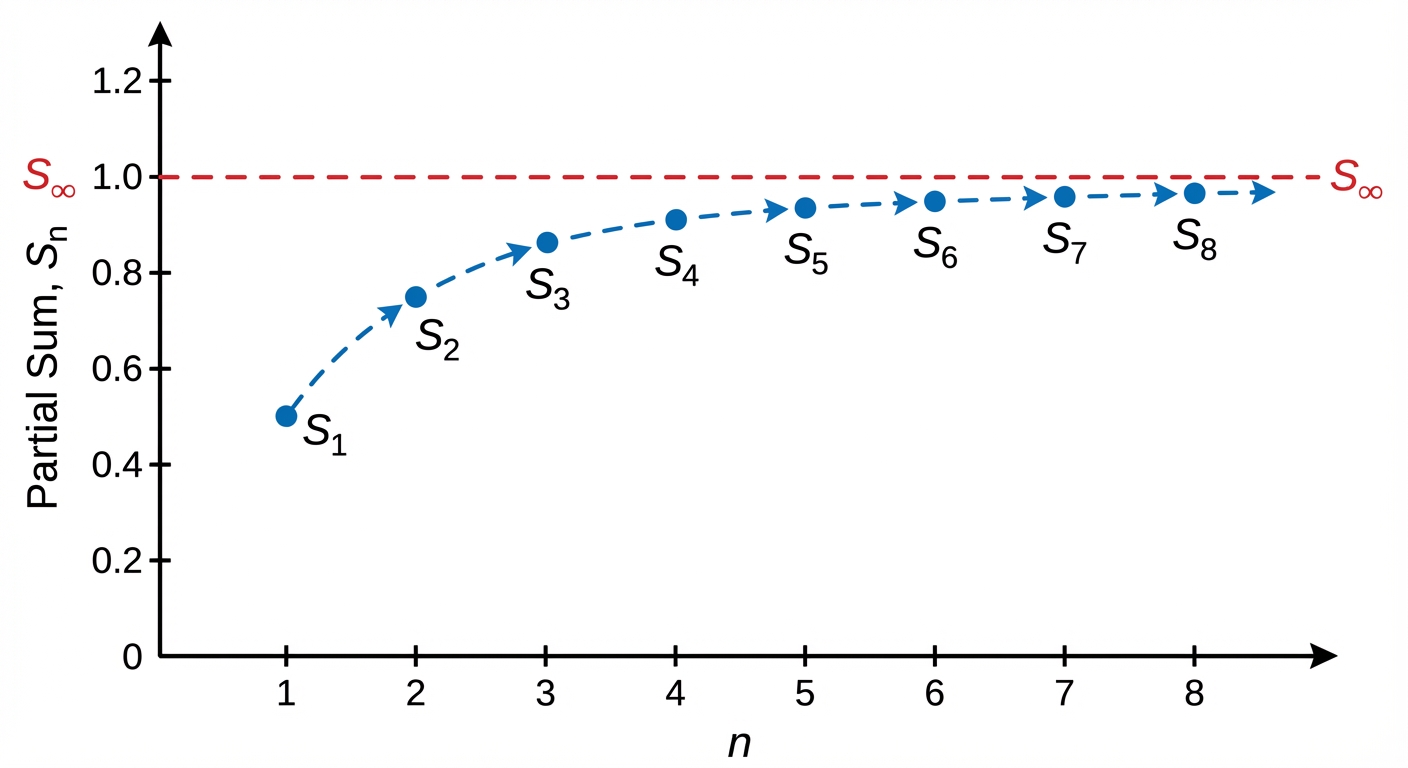
If , the terms either stay the same size or get bigger, and the sum will just keep growing without bound (or oscillate) – we call this a divergent series. For any convergent GP, we can calculate its ultimate sum using this beautifully simple formula: This formula is derived from the standard formula by considering what happens as approaches infinity. For , the term approaches zero, leaving us with this elegant result. Mastering this is crucial for your exams and provides a foundation for university-level calculus, which is vital in fields like engineering, economics (e.g., the economic multiplier), and physics.
Worked example
Worked Example: Finding the Sum to Infinity
Solving the Infinite... Step-by-Step 🚀
The second term of a geometric progression is 8 and the fifth term is 1. All the terms are positive. Find the sum to infinity of the progression.
- 1First, we need to find our key variables: the first term () and the common ratio (). We'll set up two simultaneous equations using the formula for the nth term, .Given: and .
Equation 1:
Equation 2: - 2Now, let's solve these equations. The easiest way is to divide Equation 2 by Equation 1. This will eliminate and let us solve for .
- 3With found, we can substitute it back into either equation to find . Let's use Equation 1 as it's simpler.
- 4Crucial exam step! Before we calculate the sum to infinity, we must state and check the condition for convergence.The condition for convergence is .
Our value is , and .
Since the condition is met, the series converges and a sum to infinity exists. - 5Finally, we can use the sum to infinity formula, , and substitute our values for and to get the final answer.
Answer
Practice this in the app
Unlock the full chapter: practice questions, flashcards, mock papers and notes, free.
Continue revising