P3 Chapter 3: Complex Numbers
Level Up Your Number System! 🚀
Introduction
1. Introduction
Hey! Ever been told an equation like has 'no solution'? Well, that's not the whole story. Welcome to the world of complex numbers, where we introduce the imaginary unit, , where . It's a total game-changer! In this chapter, we're going to dive deep into this fascinating new system. First, we'll get the basics down with complex arithmetic—adding, subtracting, multiplying, and dividing these new numbers. Then, we'll learn how to represent them visually on an Argand diagram and measure their size (the modulus) and direction (the argument). After that, we'll tackle something that seemed impossible before: finding the square roots of complex numbers. Finally, we'll bring it all together by sketching loci, which are just sets of points that follow specific rules. It sounds like a lot, but you'll see how it all connects beautifully. Let's get started!
2. Arithmetic Operations with Complex Numbers
Alright, let's get into the mechanics of complex numbers. Think of it like learning the controls for a new character in a video game. The basic moves are addition, subtraction, multiplication, and division. For any complex number , '' is the real part, written as , and '' is the imaginary part, .
Addition and subtraction are super chill – it's basically just collecting like terms. You add (or subtract) the real parts together and the imaginary parts together, keeping them separate. It's like sorting your Spotify playlist: you wouldn't mix your chill lofi beats with your heavy metal tracks, right? So, . Easy.
Multiplication is where it gets interesting. It's just like expanding double brackets in algebra (remember FOIL?). You just have to remember the golden rule: . This is the ultimate power-up that changes everything. So, expands out, and whenever you see an , you swap it for a and simplify.
Now for the boss level: division. To divide complex numbers, like , we need a secret weapon called the complex conjugate. The conjugate of is just . You just flip the sign of the imaginary part. To divide, you multiply the top and bottom of the fraction by the conjugate of the denominator.
Addition and subtraction are super chill – it's basically just collecting like terms. You add (or subtract) the real parts together and the imaginary parts together, keeping them separate. It's like sorting your Spotify playlist: you wouldn't mix your chill lofi beats with your heavy metal tracks, right? So, . Easy.
Multiplication is where it gets interesting. It's just like expanding double brackets in algebra (remember FOIL?). You just have to remember the golden rule: . This is the ultimate power-up that changes everything. So, expands out, and whenever you see an , you swap it for a and simplify.
Now for the boss level: division. To divide complex numbers, like , we need a secret weapon called the complex conjugate. The conjugate of is just . You just flip the sign of the imaginary part. To divide, you multiply the top and bottom of the fraction by the conjugate of the denominator.
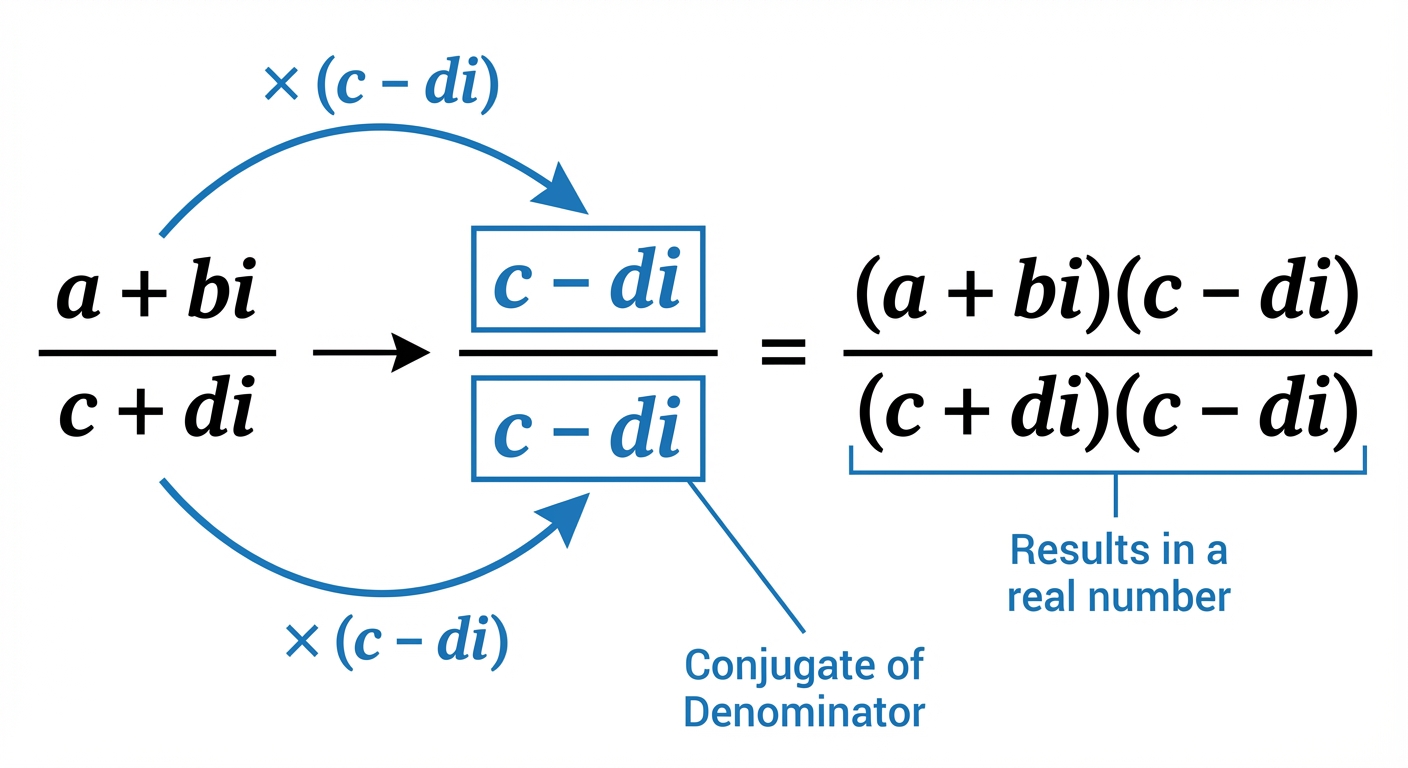
This move magically turns the denominator into a real number (because ), making the whole thing way easier to simplify into the standard form. It's the ultimate cheat code for division!
Worked example
Worked Example: Division of Complex Numbers
Solving the Final Boss: Complex Division ⚔️
Let and . Express the quotient in the Cartesian form , where and are real numbers.
- 1First up, to handle division, we need to make the denominator a real number. We do this by multiplying the numerator and denominator by the complex conjugate of the denominator. The conjugate of is .
- 2Now, let's expand the numerator using the FOIL method. Don't forget the golden rule: !
- 3Next, expand the denominator. Pro tip: multiplying a complex number by its conjugate, , always gives . This is a massive time-saver!
- 4Let's put our new numerator and denominator back together into a single fraction. We're almost there!
- 5Finally, to get it into the required form, we just split the fraction into its real and imaginary parts. Mission complete! ✅
Answer
3. Modulus-Argument Form and Operations
Alright, so you've been dealing with complex numbers like . Think of this as giving directions like 'go 3 blocks east, then 4 blocks north'. It works, but sometimes it's clunky. Polar form, or Modulus-Argument form, is like using GPS: it gives a straight-line distance and a direction. So much slicker!
The modulus, written as or , is just the distance of the complex number from the origin on an Argand diagram. It's its magnitude, its length, its vibe level. You calculate it using Pythagoras: . Easy. The argument, written as or , is the angle this line makes with the positive real axis, measured counter-clockwise. It's the direction. You find it with , but BE CAREFUL! Always check which quadrant your point is in, just like you'd double-check your location tag on Instagram. An angle in the first quadrant is totally different from one in the third!
The modulus, written as or , is just the distance of the complex number from the origin on an Argand diagram. It's its magnitude, its length, its vibe level. You calculate it using Pythagoras: . Easy. The argument, written as or , is the angle this line makes with the positive real axis, measured counter-clockwise. It's the direction. You find it with , but BE CAREFUL! Always check which quadrant your point is in, just like you'd double-check your location tag on Instagram. An angle in the first quadrant is totally different from one in the third!
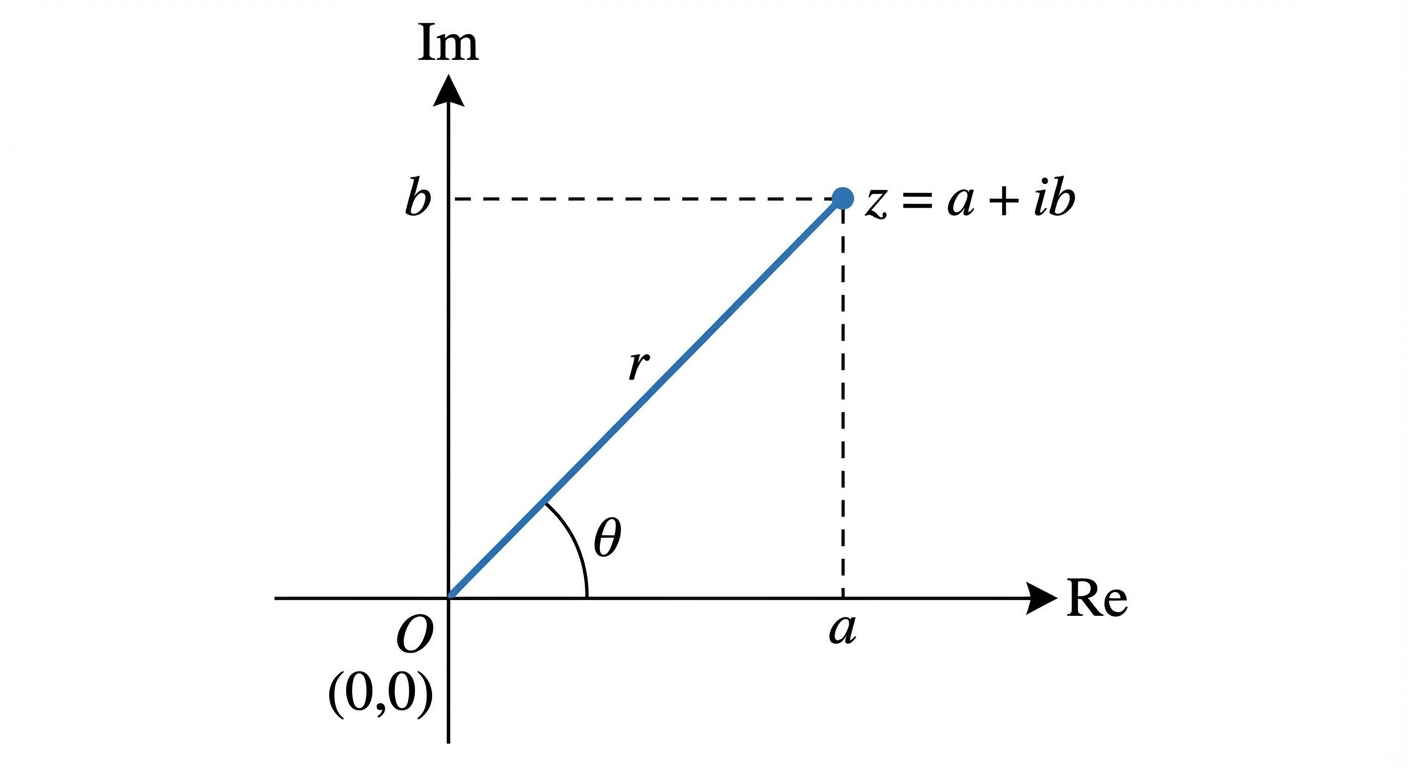
Now, here’s the magic. When you multiply two complex numbers, and , their polar forms make it a breeze. It's like a collab between two artists – their influences combine.
To get the new modulus, you just multiply the original moduli: .
To get the new argument, you just add the original arguments: .
Multiplying complex numbers becomes a simple case of stretching the length and rotating the angle. It’s a total game-changer, way faster than expanding double brackets in Cartesian form!
Worked example
Worked Example: Multiplication using Modulus-Argument Properties
Let's See This Power-Up in Action! ✨
Given the complex numbers and , find the modulus and argument of the product .
- 1First, let's find the 'stats' for . We need its magnitude (modulus) and its direction (argument). Both the real and imaginary parts are positive, so we're in the first quadrant.
- 2Now we do the exact same thing for . Find its modulus and argument. Again, it's in the first quadrant, so the calculator angle is the one we want.
- 3Time for the combo move! To find the modulus of the product, we just multiply the individual moduli we found. This is our rule: .
- 4And for the argument of the product, we add the individual arguments. This is the second rule: .
- 5And we're done! We've found the final magnitude and direction of the product. Let's state the answer clearly.The modulus of is 4, and the argument is .
Answer
The modulus of is 4, and the argument is .
4. Finding the Square Roots of a Complex Number in Cartesian Form
Alright, let's dive into finding the square root of a complex number. It sounds intimidating, but trust me, it's a systematic process, kind of like following a guide to beat a tricky boss level in a game. So, imagine we need to find the square root of a complex number . We're looking for another complex number, let's call it , that when squared, gives us .
So, we set up our starting equation:
First thing's first, let's expand the left side. Remember gives us . Since , this simplifies to . Now our equation looks like this:
This is the crucial moment! It's like matching your playlist to your mood. The real parts on both sides must match, and the imaginary parts must match. This technique is called equating real and imaginary parts, and you'll use it all the time. This gives us two simultaneous equations:
1. Real parts:
2. Imaginary parts:
Now, solving these directly can get messy. So, we bring in a powerful sidekick: the modulus. We know that if two complex numbers are equal, their moduli must be equal too. So, . A key property is that , which means we get . We know that and . So, our modulus equation becomes:
So, we set up our starting equation:
First thing's first, let's expand the left side. Remember gives us . Since , this simplifies to . Now our equation looks like this:
This is the crucial moment! It's like matching your playlist to your mood. The real parts on both sides must match, and the imaginary parts must match. This technique is called equating real and imaginary parts, and you'll use it all the time. This gives us two simultaneous equations:
1. Real parts:
2. Imaginary parts:
Now, solving these directly can get messy. So, we bring in a powerful sidekick: the modulus. We know that if two complex numbers are equal, their moduli must be equal too. So, . A key property is that , which means we get . We know that and . So, our modulus equation becomes:
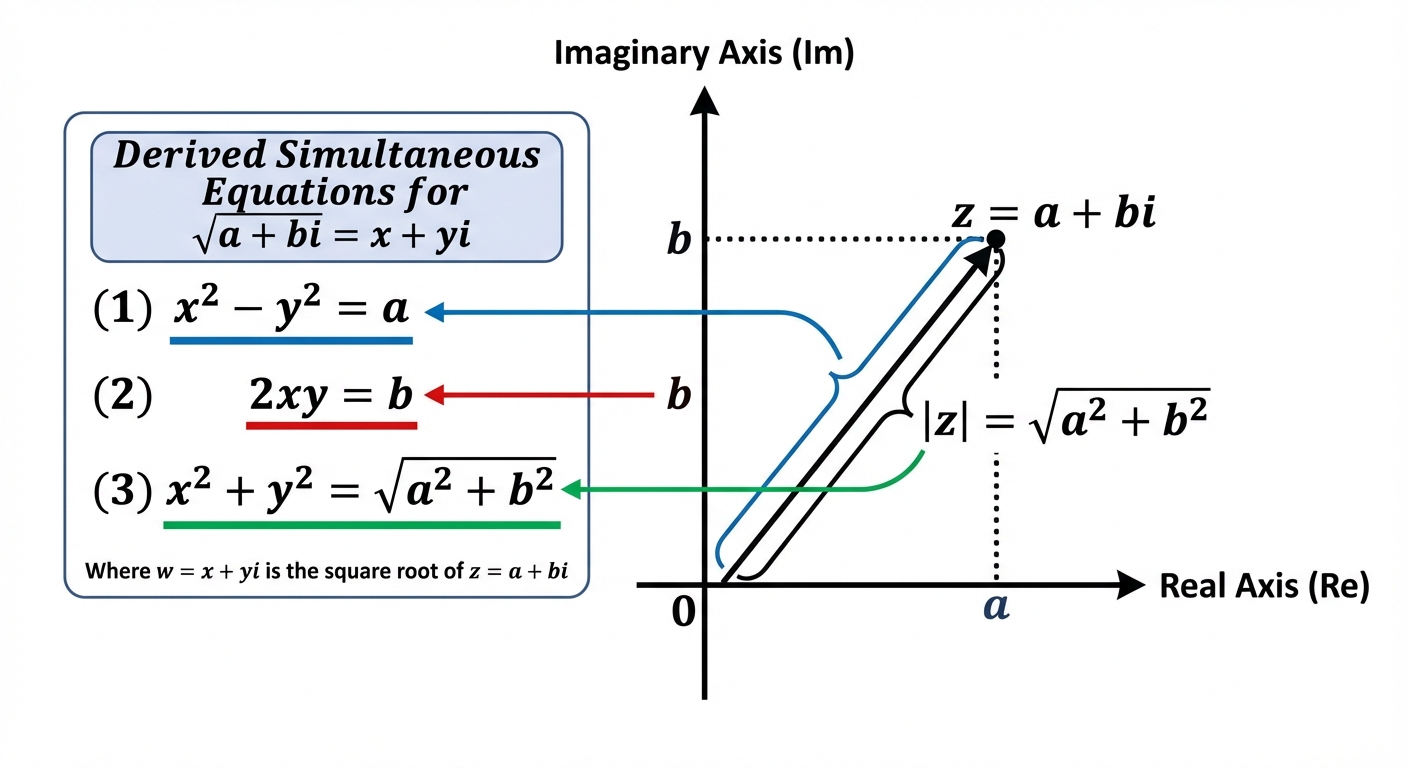
This gives us a much friendlier third equation. Now we can easily solve equations (1) and (3) together to find and . Once you have the values for and (remembering the signs!), you use equation (2) as a final check to see which signs go together. If is positive, and have the same sign. If is negative, they have opposite signs. It's like making sure your text goes to the right person – that final check is super important! And that's it, you'll have found the two square roots. ✨
Worked example
Worked Example: Finding the Square Roots of 5 + 12i
Let's Crack This Code! 💻
Find the square roots of the complex number in the form , where and are real numbers.
- 1First, we set up our main equation. We assume the square root is and set its square equal to . Then, we expand the left side.
- 2Now, we equate the real and imaginary parts. The real part on the left, , must equal the real part on the right, . The imaginary part, , must equal .
- 3To get a third, more helpful equation, we use the modulus. We equate the moduli of both sides. Remember .
- 4We now have a simple system of simultaneous equations. Let's add Equation 1 and Equation 3 to eliminate and solve for .
- 5Next, we find . We can substitute back into Equation 3.
- 6Final check! We use Equation 2 () to figure out the correct sign pairings. Since is positive, and must have the same sign. So, if , . If , .
Answer
5. Loci in the Argand Diagram
Alright, let's talk about loci. The word 'locus' sounds super complicated, but it's just a fancy math term for a path or a set of points that follow a specific rule. Think of it like a mission objective in a game: 'Stay within 50m of the safe zone' or 'Walk exactly halfway between the two towers'. In the Argand diagram, our variable point is the complex number .
First up, we have circles: . This literally translates to 'the distance between point and point is always '. If your friend 'a' is at a point, say , and you have to stay exactly 5 units away (), you'd trace a perfect circle around them. So, is a circle with center and radius 5. If it's an inequality like , it means you're inside the circle (like being connected to the WiFi router 'a'). If it's , you're outside the circle.
Next, the perpendicular bisector: . This rule means 'the distance from to is always equal to the distance from to '. Imagine you're deciding between two bubble tea shops, 'a' and 'b'. Any point on the line where you're equally torn between them forms the locus. This locus is the perpendicular bisector of the line segment connecting points 'a' and 'b'. It's the ultimate 'friend zone' line, keeping equal distance from two points.
First up, we have circles: . This literally translates to 'the distance between point and point is always '. If your friend 'a' is at a point, say , and you have to stay exactly 5 units away (), you'd trace a perfect circle around them. So, is a circle with center and radius 5. If it's an inequality like , it means you're inside the circle (like being connected to the WiFi router 'a'). If it's , you're outside the circle.
Next, the perpendicular bisector: . This rule means 'the distance from to is always equal to the distance from to '. Imagine you're deciding between two bubble tea shops, 'a' and 'b'. Any point on the line where you're equally torn between them forms the locus. This locus is the perpendicular bisector of the line segment connecting points 'a' and 'b'. It's the ultimate 'friend zone' line, keeping equal distance from two points.
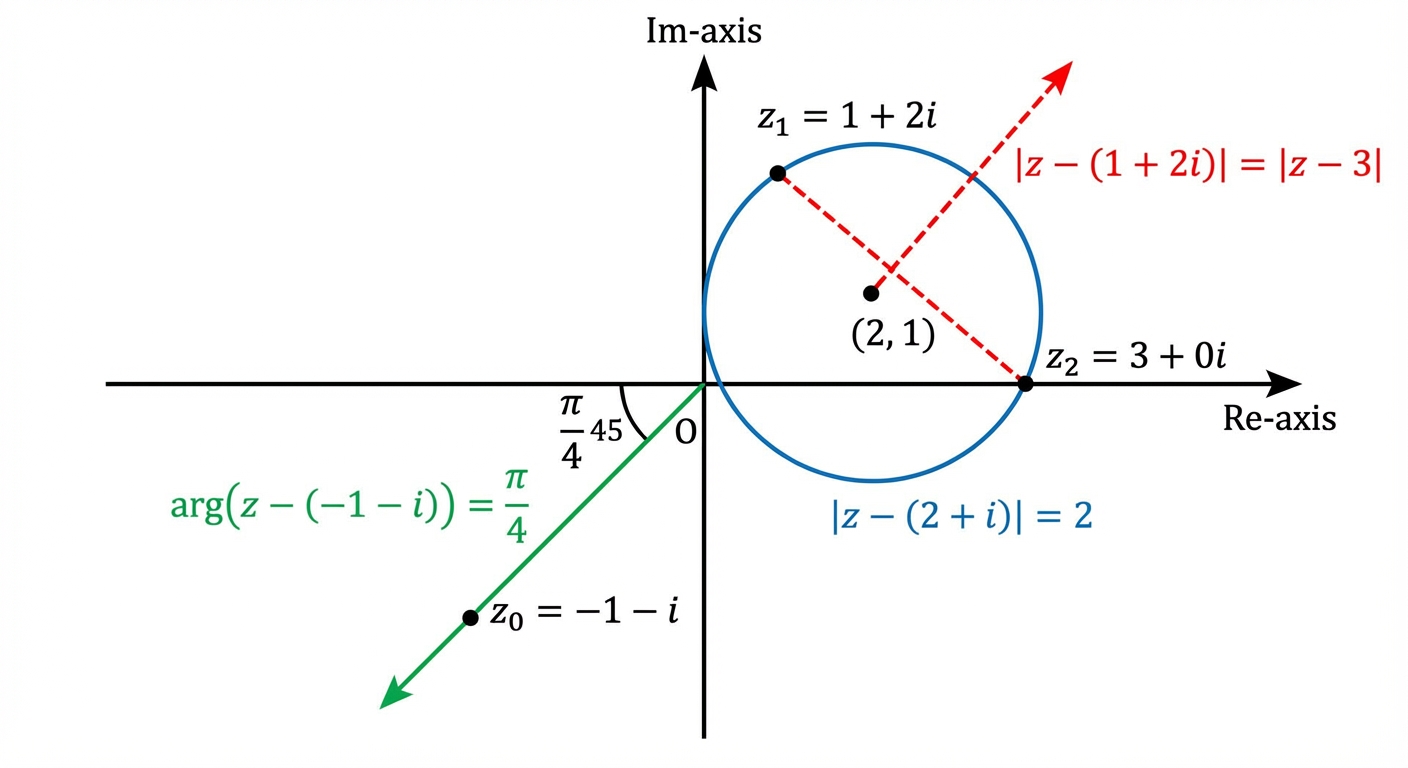
Finally, the half-line (or ray): . This one's all about direction. It means 'the angle of the line connecting point 'a' to point 'z' is always '. Think of point 'a' as your starting position. If you set a fixed direction (the angle ) and walk straight, you trace out a half-line. It starts at 'a' (but doesn't include it, usually shown with an open circle) and goes on forever. It's like aiming a laser pointer from point 'a' at an angle .
Worked example
Worked Example: Intersection of a Circle and a Half-Line
When Your Loci Cross Paths... ✨
On an Argand diagram, sketch the locus of points representing complex numbers satisfying . Then, sketch the locus for . Hence, find the complex number represented by the point of intersection of these two loci.
- 1First, decode the circle equation. The expression describes all points that are a distance of from the point . This is a circle with its center at and a radius of .Locus 1: Circle
Center:
Radius: - 2Now for the second condition. The expression describes a half-line. It starts from the point corresponding to the complex number , which is , and extends outwards at a fixed angle of (or 45°) to the positive real axis.Locus 2: Half-line
Starts at:
Angle: - 3Let's sketch this out. Draw the Argand diagram with real (x) and imaginary (y) axes. Plot the center and draw a circle of radius . Then, from the point , draw a half-line going up and to the right at a 45° angle. From the sketch, the half-line appears to just touch the circle at a single point — this is the intersection we need to find. [IMAGE_PLACEHOLDER_2: An Argand Diagram showing a circle centered at (4,2) with radius √2, and a half-line starting from (4,0) at an angle of pi/4. The line is tangent to the circle at a single point, clearly marked.]The half-line appears to be tangent to the circle. We need to find the point of tangency.
- 4Let's find the algebraic equation of the half-line. Since the argument is , the gradient is , and the line passes through . So the half-line's equation is for . Now substitute this into the circle's Cartesian equation .Line:
Substitute into circle:
Let : - 5Expand and simplify the quadratic in . If the discriminant is zero, the line is tangent to the circle (one repeated solution). Otherwise we'd get two distinct points. Solve for , then find , , and finally the complex number .
So , which means , giving .
Then .
The point of intersection is , so .
Answer
So , which means , giving .
Then .
The point of intersection is , so .
So , which means , giving .
Then .
The point of intersection is , so .
Practice this in the app
Unlock the full chapter: practice questions, flashcards, mock papers and notes, free.
Continue revising