Chapter P3: Vectors
Navigating 3D Space Like a Pro! 🚀
Introduction
1. Introduction
Hey! Welcome back to the world of vectors. If you've ever wondered how GPS works or how game designers create realistic 3D environments, you're in the right place. In this chapter, we're going to level up your skills by exploring three core ideas.
First, we'll master vector equations of lines, learning how to describe any straight path in 3D space. Then, we'll dive into the scalar product, a super useful tool for finding the angle between two vectors (and checking if they're perpendicular). Finally, we'll put it all together to tackle intersection and perpendicularity problems – think of it as solving 3D puzzles, like finding exactly where two paths cross or the shortest distance from a point to a line. It's going to be a fun ride, so let's get started!
First, we'll master vector equations of lines, learning how to describe any straight path in 3D space. Then, we'll dive into the scalar product, a super useful tool for finding the angle between two vectors (and checking if they're perpendicular). Finally, we'll put it all together to tackle intersection and perpendicularity problems – think of it as solving 3D puzzles, like finding exactly where two paths cross or the shortest distance from a point to a line. It's going to be a fun ride, so let's get started!
2. The Scalar Product and Angles
Alright, let's talk about the scalar product, also known as the dot product. Think of it as a special way to 'multiply' two vectors. Unlike your usual multiplication that gives you a bigger number, the scalar product gives you a scalar – just a plain old number, not another vector. It's like asking your music streaming service for the 'vibe' between two songs and it just gives you a rating out of 10. The MVP formula you need to tattoo on your brain is:
Let's break it down. is the dot product itself, which you calculate by multiplying corresponding components and adding them up (e.g., ). and are the magnitudes (lengths) of the vectors – basically, how far a character moves in a game. And is the angle between the two vectors when they are placed tail-to-tail.
Let's break it down. is the dot product itself, which you calculate by multiplying corresponding components and adding them up (e.g., ). and are the magnitudes (lengths) of the vectors – basically, how far a character moves in a game. And is the angle between the two vectors when they are placed tail-to-tail.
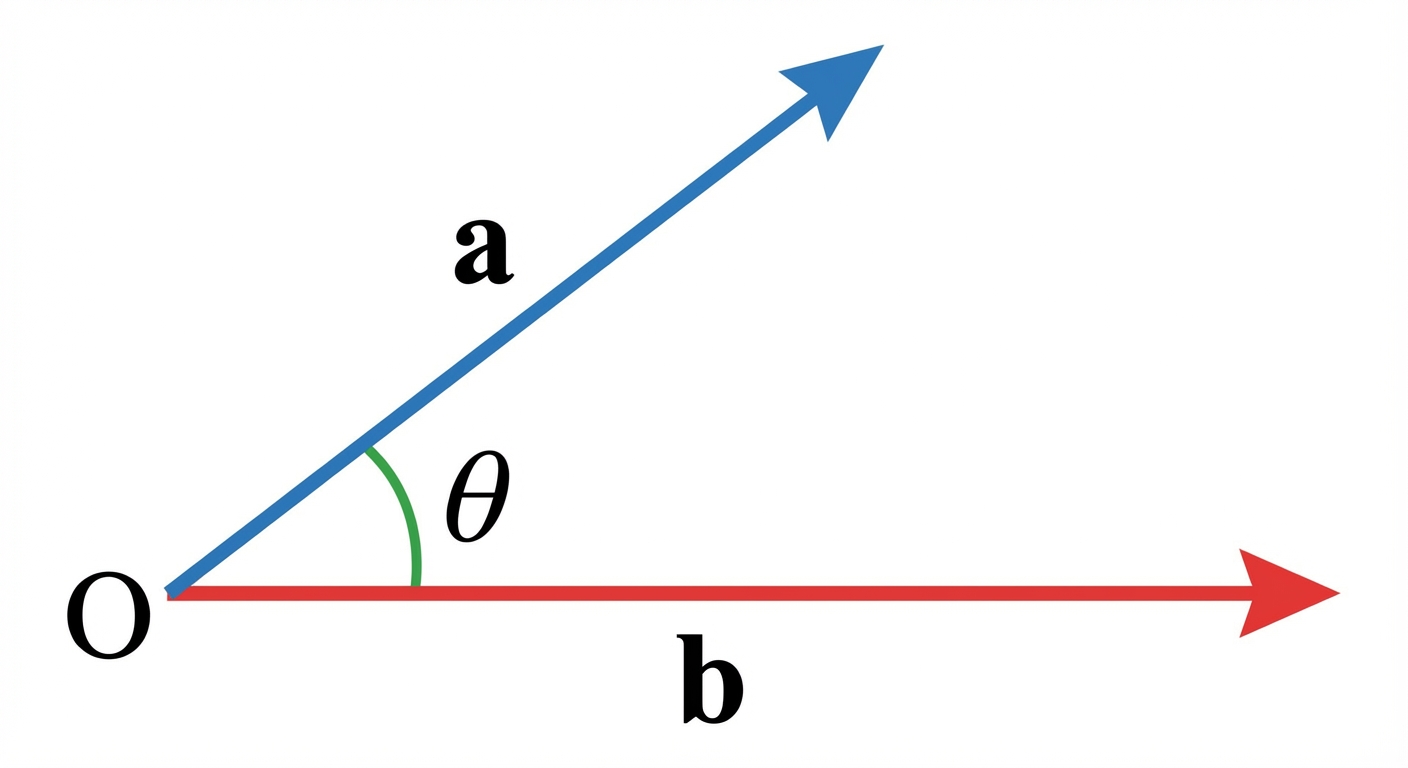
So, why do we care? Because we can rearrange this formula to find the angle between two vectors! This is its superpower. Just make it . This is huge for finding the angle between two intersecting lines – you just grab their direction vectors and use this formula.
Now for a pro-gamer move: what if two vectors are perpendicular? That means the angle between them is . What's ? It's ZERO! So, if , the vectors are perpendicular. No need to calculate the full angle. It's a super quick way to check for right angles, which pops up all the time. If someone DMs you two vectors and asks if they're perpendicular, you can find the dot product in seconds and look like a genius. This simple concept is your key to levelling up in vector problems. 💪
Worked example
Worked Example: Finding the Angle Between Two Vectors
Let's Solve This Thing 🚀
Given the position vectors and , find the angle between them to one decimal place.
- 1First, let's state our game plan. We need to find the angle , so we'll rearrange the scalar product formula. This is our main quest objective.
- 2Now, let's calculate the scalar product, . We multiply the , , and components together and then add them all up.
- 3Wait a second... the dot product is 0! 🤯 This is that special case we talked about. When the dot product is zero, the vectors are perpendicular.
- 4Since the dot product is 0, the numerator in our formula is 0. This means . We don't even need to calculate the magnitudes! We can just solve for .
- 5The angle whose cosine is 0 is . So, the vectors are perpendicular. Job done! This shortcut saved us a bunch of work.
Answer
3. Line Relationships and Perpendiculars in 3D Space
Alright, let's level up your vector skills. Imagine you're tracking two objects in 3D space – maybe two players in a game or two planes on a radar. Their paths are straight lines. The big question is: what's their relationship? There are four possibilities, just like relationship statuses on social media.
1. Parallel Lines: This is the easiest one. Their direction vectors are scalar multiples of each other. Think of two friends driving in adjacent lanes on the motorway; they're going in the same direction, just at different starting points. Their direction vectors and will satisfy for some scalar .
2. Intersecting Lines: Their paths cross at a single point. To check for this, you set their vector equations equal to each other, . This gives you three simultaneous equations (for , , and ). If you can find a unique pair of parameter values (say, and ) that works for all three equations, then congrats, they intersect! It's like you and your friend arranging to meet at a specific spot at a specific time – the coordinates and the 'time' parameter have to match up perfectly.
3. Skew Lines: This is the tricky one that only happens in 3D. The lines are not parallel, but they also never meet. Think of one car driving on a bridge while another drives on the road underneath. From a bird's-eye view (a 2D projection), their paths cross, but they're at different heights.
1. Parallel Lines: This is the easiest one. Their direction vectors are scalar multiples of each other. Think of two friends driving in adjacent lanes on the motorway; they're going in the same direction, just at different starting points. Their direction vectors and will satisfy for some scalar .
2. Intersecting Lines: Their paths cross at a single point. To check for this, you set their vector equations equal to each other, . This gives you three simultaneous equations (for , , and ). If you can find a unique pair of parameter values (say, and ) that works for all three equations, then congrats, they intersect! It's like you and your friend arranging to meet at a specific spot at a specific time – the coordinates and the 'time' parameter have to match up perfectly.
3. Skew Lines: This is the tricky one that only happens in 3D. The lines are not parallel, but they also never meet. Think of one car driving on a bridge while another drives on the road underneath. From a bird's-eye view (a 2D projection), their paths cross, but they're at different heights.
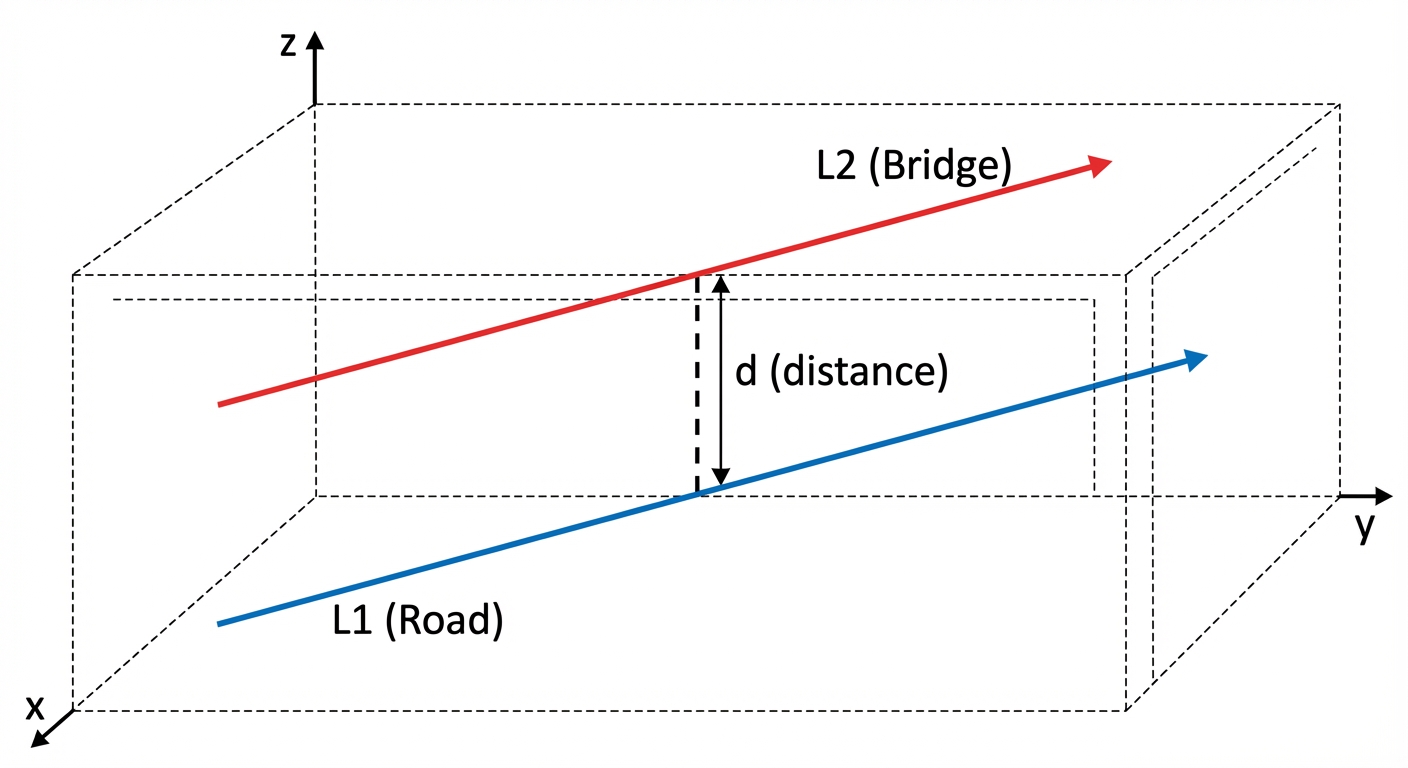
When you try to solve their equations, you'll find values for and that work for two of the component equations, but they'll fail in the third one. That's the tell-tale sign of a 'near miss'.
4. Foot of the Perpendicular: This is about finding the shortest distance from a point to a line. Imagine you're standing at a point and there's a straight road (the line ). The shortest path from you to the road is a straight line that hits the road at a 90-degree angle. The point where it hits, let's call it , is the 'foot of the perpendicular'. The key move here is that the vector is perpendicular to the direction vector of the line . And what do we know about perpendicular vectors? Their scalar product is zero! So, . This gives you an equation to solve for the parameter, which in turn gives you the exact coordinates of . Super useful stuff!
4. Foot of the Perpendicular: This is about finding the shortest distance from a point to a line. Imagine you're standing at a point and there's a straight road (the line ). The shortest path from you to the road is a straight line that hits the road at a 90-degree angle. The point where it hits, let's call it , is the 'foot of the perpendicular'. The key move here is that the vector is perpendicular to the direction vector of the line . And what do we know about perpendicular vectors? Their scalar product is zero! So, . This gives you an equation to solve for the parameter, which in turn gives you the exact coordinates of . Super useful stuff!
Worked example
Worked Example: Determining if Lines Intersect or are Skew
The Ultimate 'Will They, Won't They' Problem
Two lines, and , have vector equations:
Determine whether the lines intersect or are skew. If they intersect, find the coordinates of the point of intersection.
Determine whether the lines intersect or are skew. If they intersect, find the coordinates of the point of intersection.
- 1First, we check if the lines are parallel. We do this by looking at their direction vectors. If one is a multiple of the other, they're parallel.
- 2Since they're not parallel, they either intersect or are skew. We assume they intersect and set the equations equal to each other. This will give us three simultaneous equations, one for each component (i, j, k).
- 3Now we play detective and solve two of the equations to find potential values for and . The easiest pair to use here are (1) and (2). Let's substitute (2) into (1).
- 4This is the moment of truth! We need to check if these values for and also work in our third equation. If they do, the lines intersect. If they don't, they're skew.
- 5Because our values for and failed the check in the third equation, we can confidently conclude that the lines do not intersect. Since they are not parallel and do not intersect, they must be skew lines. No intersection point to find here!
Answer
4. The Vector Equation of a Line
Alright, let's talk about describing a straight line in 3D space. It's not as simple as anymore, because we're in the big leagues of 3D now! Think of it like giving someone directions on a map. You need two key things: a starting point and a direction to travel in.
That's exactly what the vector equation of a line, , gives us. Let's break it down:
1. The Position Vector (): This is your fixed starting point. It's a vector from the origin (0,0,0) to any known point on the line. Think of it as your spawn point in a game or the location of your friend's house you're starting from. It locks the line to a specific place in space.
2. The Direction Vector (): This vector defines the 'slope' or direction of the line. It's the road you're walking on. Any vector that is parallel to the line can be its direction vector. It tells you how many units to move in the x, y, and z directions to stay on the path.
3. The Parameter (): This is a scalar (just a number) that tells you how far to travel along the direction vector. Think of it as a slider. If , you've moved one full 'direction vector' length from your start point. If , you've moved two lengths. If , you've moved one length backwards. As changes, you trace out every single point on the infinite line.
That's exactly what the vector equation of a line, , gives us. Let's break it down:
1. The Position Vector (): This is your fixed starting point. It's a vector from the origin (0,0,0) to any known point on the line. Think of it as your spawn point in a game or the location of your friend's house you're starting from. It locks the line to a specific place in space.
2. The Direction Vector (): This vector defines the 'slope' or direction of the line. It's the road you're walking on. Any vector that is parallel to the line can be its direction vector. It tells you how many units to move in the x, y, and z directions to stay on the path.
3. The Parameter (): This is a scalar (just a number) that tells you how far to travel along the direction vector. Think of it as a slider. If , you've moved one full 'direction vector' length from your start point. If , you've moved two lengths. If , you've moved one length backwards. As changes, you trace out every single point on the infinite line.
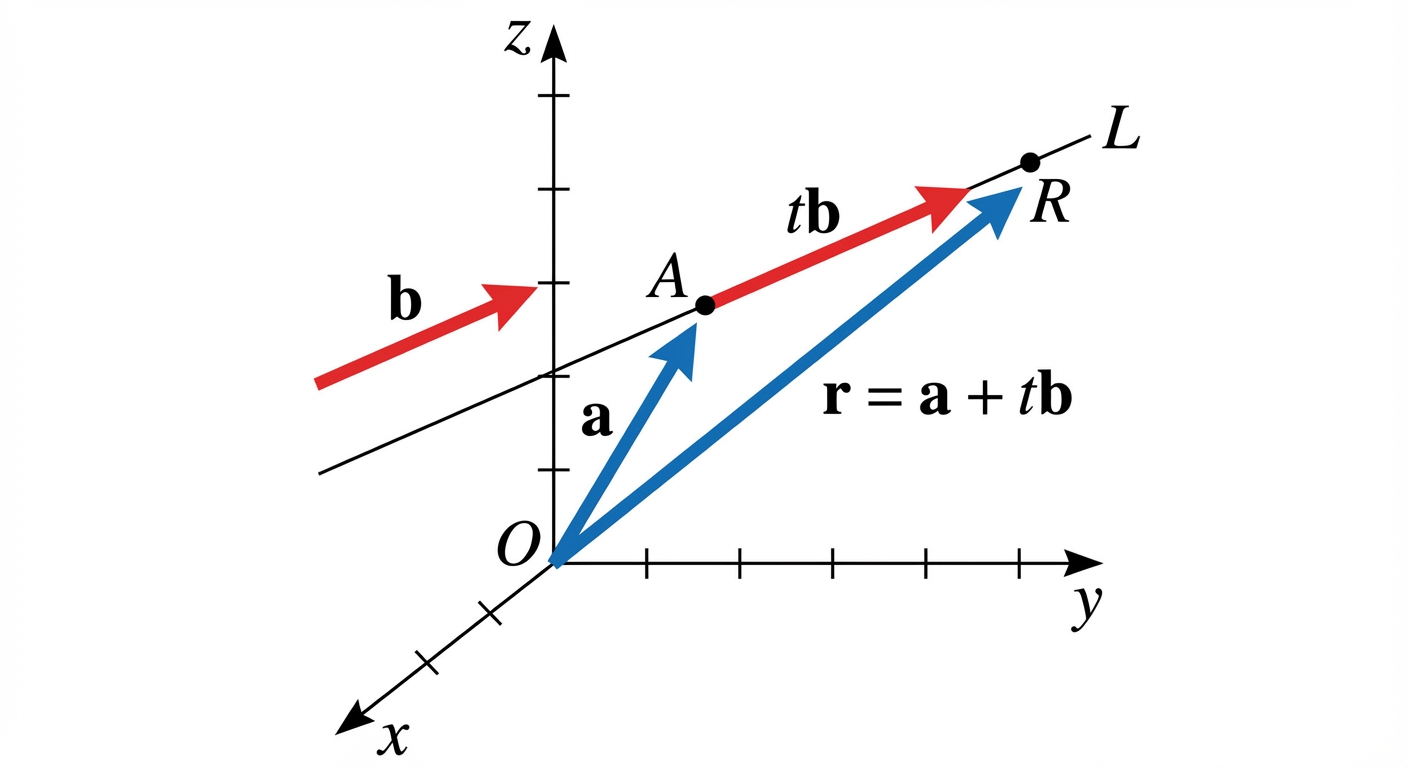
So, the vector is the position vector of any general point on the line. By plugging in different values for , you can find the coordinates of every single point on that line. It's basically a cheat code to generate an entire line! 🚀
Worked example
Worked Example: Finding the Equation of a Line Through Two Points
Let's Build a Line from Scratch 🛠️
Find the vector equation of the straight line that passes through the points and .
- 1First, we need a starting point for our line. This is our position vector, . We can use the coordinates of either P or Q. Let's pick P. So, our position vector is the vector from the origin to P, which we write as .
- 2Next, we need the direction of the line. This is our direction vector, . We can find this by calculating the vector that takes us from point P to point Q. This is the vector .
- 3Let's do the subtraction to find our direction vector . Remember to subtract the corresponding components (top from top, middle from middle, etc.).
- 4Now we have all the pieces! We have our starting position and our direction . We just need to assemble them into the standard form . And that's our final answer!
Answer
Practice this in the app
Unlock the full chapter: practice questions, flashcards, mock papers and notes, free.
Continue revising