Chapter 3: Advanced Integration Techniques
Integration Level Up! 🚀
Introduction
1. Introduction
Hey there! Ready to take your integration skills to the next level? You've mastered the basics in P1, but now we're diving into the really powerful stuff. In this chapter, we'll explore four key techniques that will help you tackle almost any integral that comes your way in A-Level Maths. First, we'll learn Integration by Parts, a clever trick for integrating products of functions (think ). Then, we'll master Integration by Substitution, which is like a secret weapon for simplifying messy-looking integrals. We'll also revisit an old friend, Partial Fractions, and see how it helps us break down and integrate complex rational functions. Finally, we'll uncover a neat shortcut for integrals in the form of , which almost always involve logarithms. It might seem like a lot, but we'll take it step-by-step. Let's get started! 💪
2. Integration by Substitution
Alright, let's talk about Integration by Substitution. Think of it like using a filter on Snapchat or a mod in a game. You take something that looks complicated and messy, apply a 'substitution filter', and it suddenly becomes way simpler and easier to handle. We use this technique when we spot a function nested inside another one, and crucially, its derivative (or something very close to it) is also part of the integral. It's the reverse of the Chain Rule for differentiation.
The game plan is this: we pick the 'inside' function and call it . This is our substitution. For example, in something like , the is clearly the annoying inside part, so we'd set . Next, we find its derivative, , and rearrange it to get an expression for . In our example, , so . Now for the magic: we swap everything from the original integral into 'u-world'. The becomes , and becomes . The integral transforms into . See how the terms cancel out? Chef's kiss! We're left with the super easy .
For indefinite integrals, once you integrate with respect to , you have to sub the original x-expression back in to get your final answer (plus the legendary '+ C'). It's like taking the filter off before you post.
But for definite integrals, it's even cooler. When you substitute, you must also change the limits of integration. The original limits are x-values; you need to convert them into u-values using your equation.
The game plan is this: we pick the 'inside' function and call it . This is our substitution. For example, in something like , the is clearly the annoying inside part, so we'd set . Next, we find its derivative, , and rearrange it to get an expression for . In our example, , so . Now for the magic: we swap everything from the original integral into 'u-world'. The becomes , and becomes . The integral transforms into . See how the terms cancel out? Chef's kiss! We're left with the super easy .
For indefinite integrals, once you integrate with respect to , you have to sub the original x-expression back in to get your final answer (plus the legendary '+ C'). It's like taking the filter off before you post.
But for definite integrals, it's even cooler. When you substitute, you must also change the limits of integration. The original limits are x-values; you need to convert them into u-values using your equation.
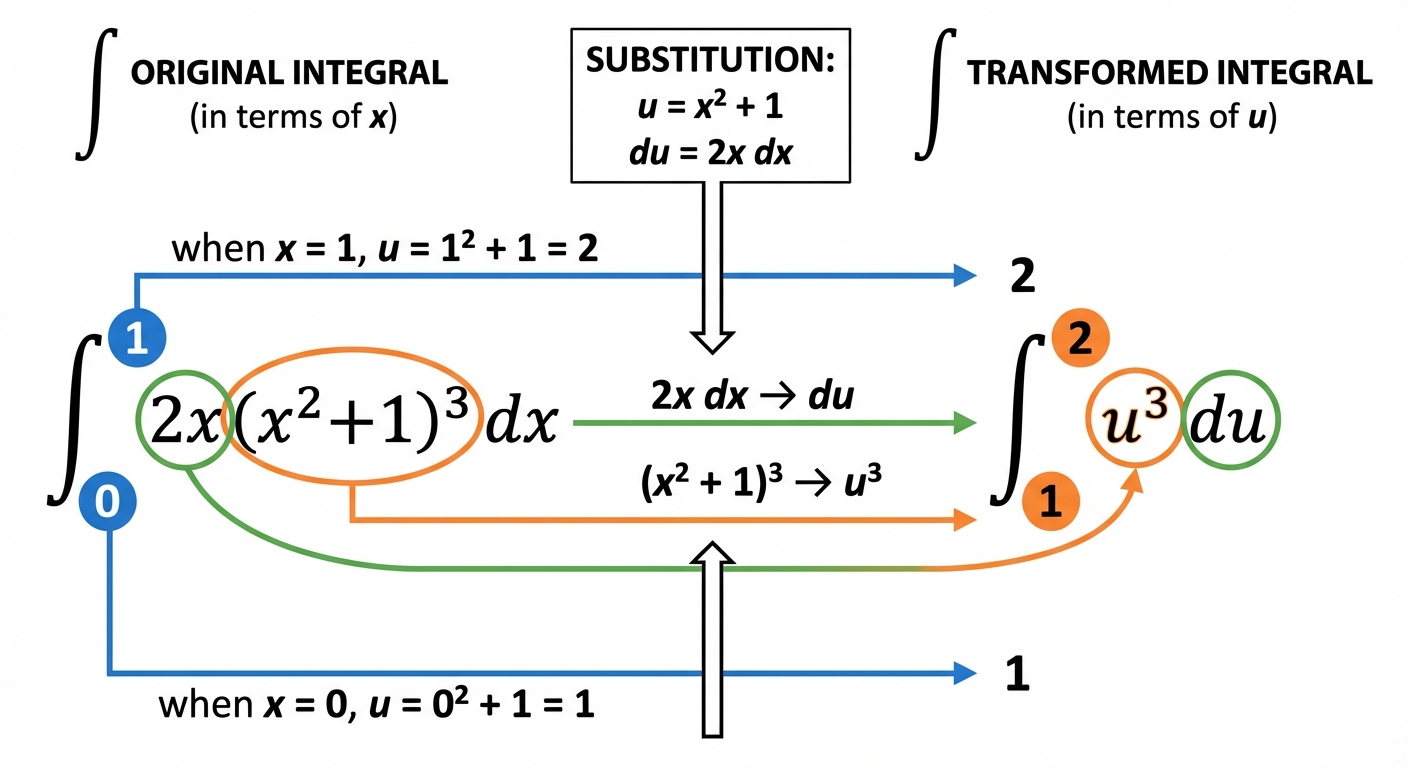
The massive win here is that once you integrate, you use these new u-limits to evaluate. You never have to go back to x-world. It's a huge time-saver in exams! This method works like a charm for trig functions too, like when you have – just set and you're golden.
Worked example
Worked Example: Definite Integral with Substitution
Let's Crush This Problem 🚀
Calculate the exact value of the definite integral
- 1First, we need to pick our substitution. We look for the 'inside function' whose derivative is also hanging around. Here, is inside the power, and its derivative is , which is right there! So, let's set our substitution, .
- 2Now, we differentiate our substitution with respect to to find . Then we'll rearrange the equation to find an expression for that we can substitute into the integral.
- 3This is a definite integral, so we can't forget to change the limits! The original limits are for . We need to find the corresponding limits for using our substitution equation, .
- 4Time for the main event. We substitute , the expression for , and our new limits into the original integral. Everything should convert perfectly into 'u-world', and the terms should cancel out beautifully.
- 5Look at that simple integral! Now we just integrate with respect to and evaluate it using our new u-limits. We don't need to substitute back to at all. This is the final answer.
Answer
3. Integration Using Partial Fractions
Alright, let's talk about Integration using Partial Fractions. Think of it like this: you've got a super complicated Spotify playlist with a bunch of different genres mixed together, and you need to split it into smaller, simpler playlists to actually enjoy it. That's what we're doing to algebraic fractions. Sometimes, you get these chunky, awkward fractions like that look impossible to integrate directly. It's like trying to beat a final boss on the hardest difficulty with starter gear – not happening.
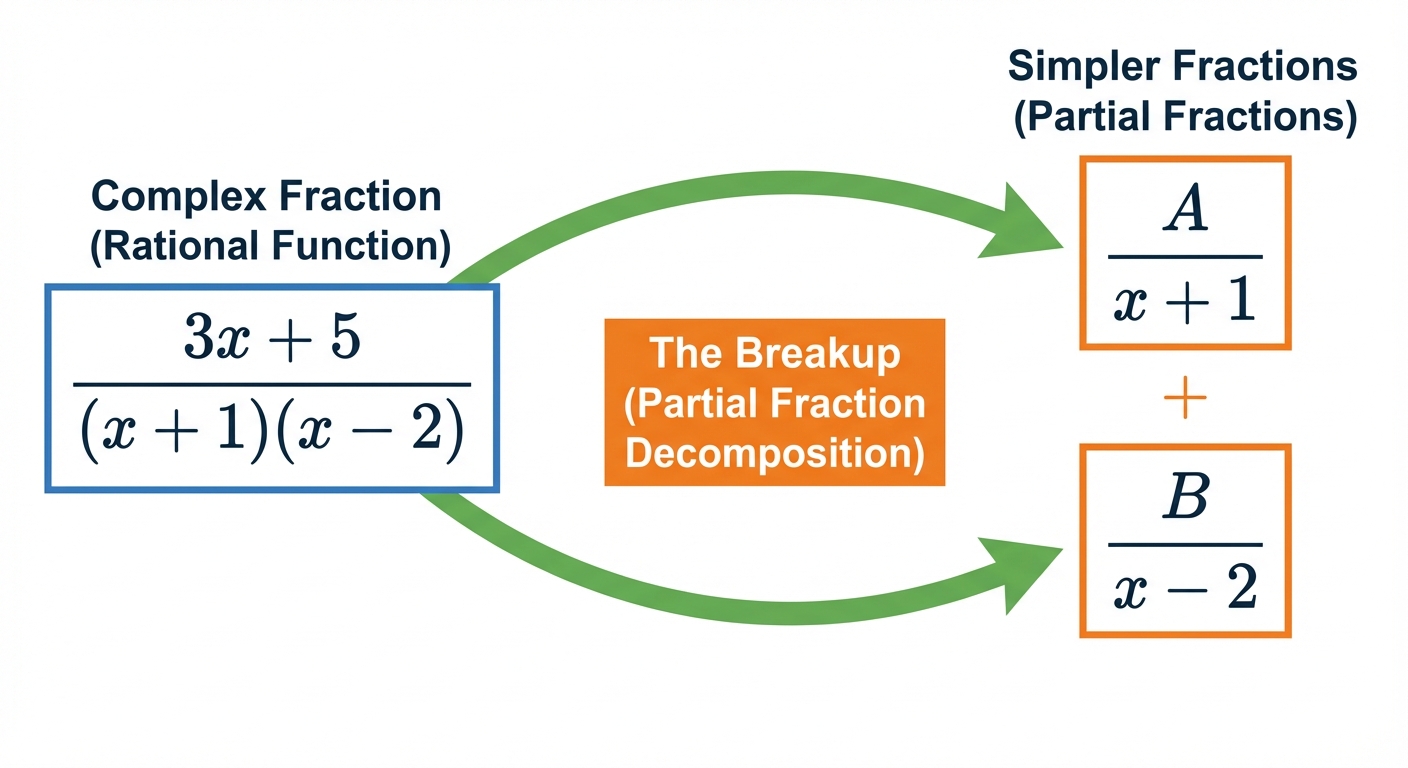
. The magic trick is to 'decompose' it, breaking it back into the simpler fractions that were originally added together, like . Once you've split them up (we'll cover finding A and B in the example), integrating becomes a breeze! Why? Because each little fraction usually turns into a natural logarithm. Remember how ? Well, the same vibe applies here: just becomes . It's a total game-changer. And if you're dealing with a definite integral (the one with the limits), you do the exact same process and just plug in the limits at the very end to get a final value. Easy peasy. 😎
Worked example
Worked Example: Definite Integral of a Rational Function
Let's Actually Solve This Thing! 🚀
Find the exact value of the definite integral
- 1First up, we can't integrate this fraction as it is. We need to break it down into its simpler 'partial' fractions. It's like separating the different parts of a Snapchat filter to see how it works.
- 2Now we play detective and find the values of A and B. We'll multiply everything by the original denominator, , to get rid of the fractions. Then, we can substitute clever values for x to make terms disappear.
- 3Awesome, we found A=1 and B=5! Now we can rewrite our original integral using these much friendlier fractions. This is the glow-up we were waiting for.
- 4Time to integrate. Each term is in a form that integrates to a natural logarithm. The integral of is . Here, a=1 for both, so it's straightforward.
- 5This is the final step! We substitute the upper limit (4), then subtract what we get when we substitute the lower limit (3). Use your log rules ( and ) to simplify for the 'exact value'.
Answer
4. Integration of the Form ∫ kf'(x)/f(x) dx
Alright, let's talk about one of the coolest shortcuts in integration. Think of it like a pattern you spot on your TikTok 'For You' page – once you see it, you can't unsee it, and it makes everything make sense. We're looking for integrals that are fractions, specifically where the numerator looks suspiciously like the derivative of the denominator. The official form is . When you spot this exact setup, the answer is always . That's it! The natural log of the absolute value of the bottom function. Why the absolute value bars? Because you can't take the log of a negative number, and this keeps everything mathematically legal, like having a valid driver's license.
Now, what if it's not a perfect match? What if you have something like ? This is like your Spotify playlist being perfect except for one song that's slightly too loud. The 'k' is just a constant multiplier, a volume knob. If the numerator is a constant multiple of the derivative of the denominator, you can just pull that constant out front and integrate. This recognition technique is clutch because it lets you solve these integrals instantly without needing a full-blown Integration by Substitution.
Now, what if it's not a perfect match? What if you have something like ? This is like your Spotify playlist being perfect except for one song that's slightly too loud. The 'k' is just a constant multiplier, a volume knob. If the numerator is a constant multiple of the derivative of the denominator, you can just pull that constant out front and integrate. This recognition technique is clutch because it lets you solve these integrals instantly without needing a full-blown Integration by Substitution.
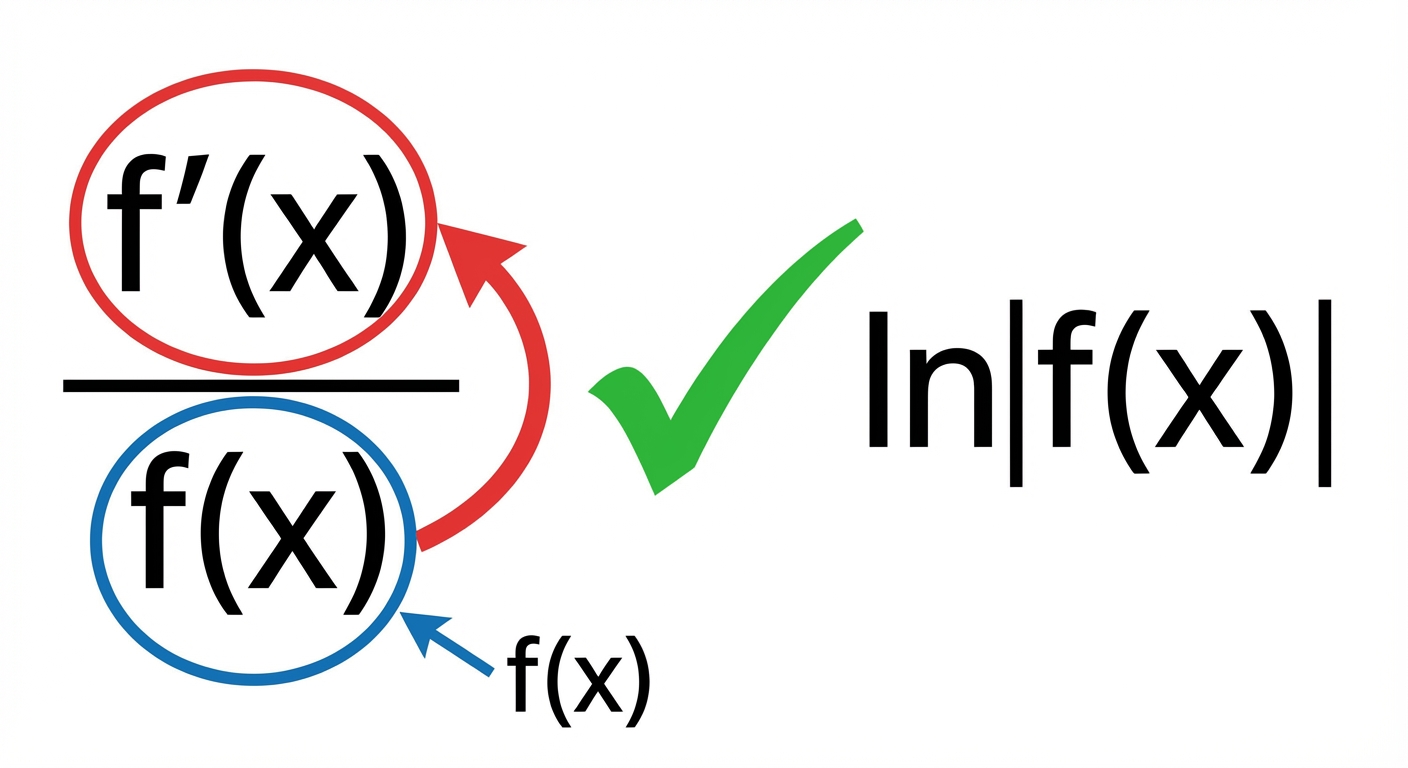
A classic example you have to know is integrating . It doesn't look like a fraction at first, but we know . Let's check our pattern. If we set , then its derivative is . Look at the numerator! We have , but we need . We're just off by a factor of -1. So, we can rewrite the integral and get the answer . Mastering this pattern is a massive level-up for your integration skills.
Worked example
Worked Example: Integration using the ln|f(x)| form
Let's Solve This Thing 🚀
Find the integral of .
- 1First, we play detective. Let's inspect the fraction. Our prime suspect for is always the denominator. So, let's set .
- 2Now, let's find the derivative of our suspect, . This will tell us what we hope to see in the numerator.
- 3Time for the big reveal! We compare our calculated with the actual numerator of the integral. Our is and the numerator is... also ! It's a perfect match. This is the best-case scenario.
- 4Since the integral is perfectly in the form , we can use our cheat code rule. The answer is simply . Just sub back in our expression for .
- 5And we're done! Always remember to add the constant of integration, . Forgetting it is like winning a game but forgetting to save. Don't lose your progress!
Answer
5. Integration by Parts
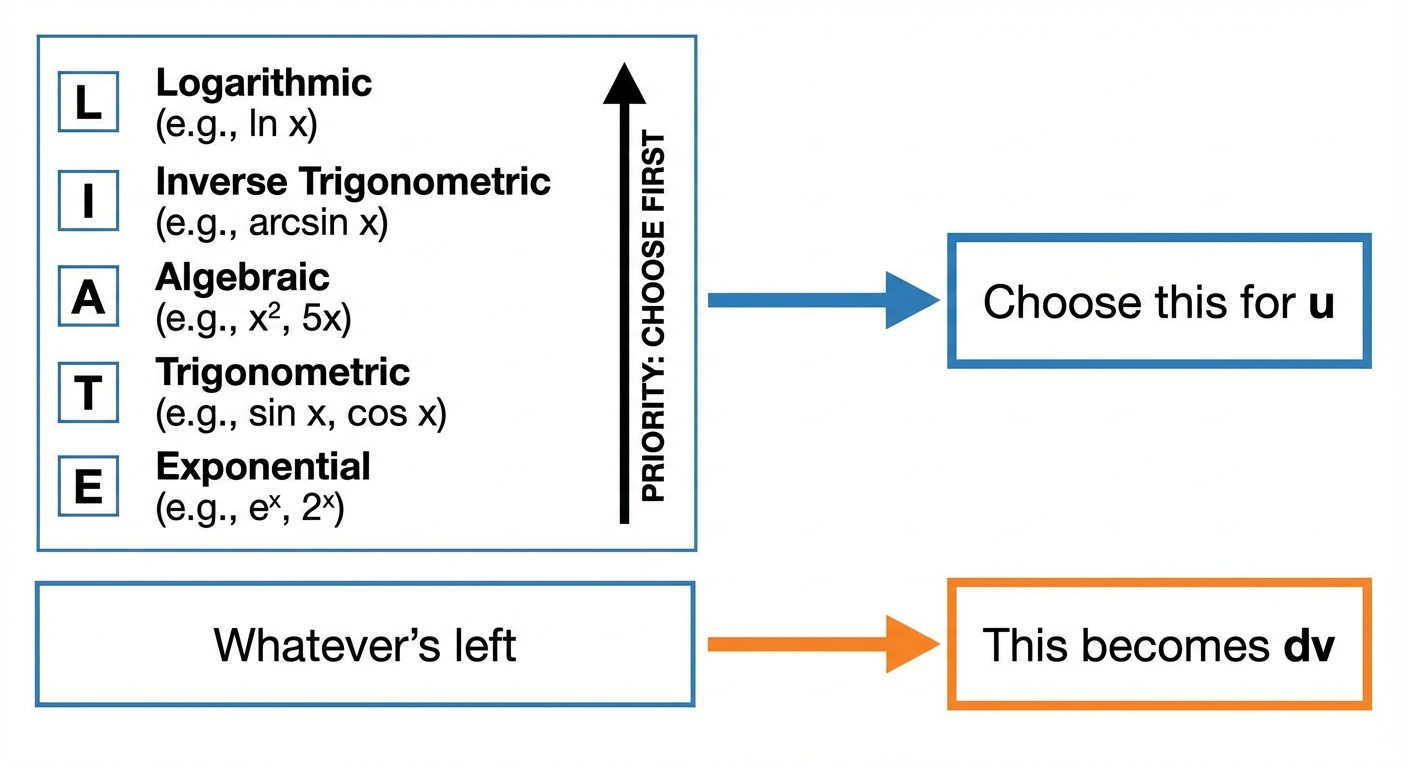
Alright, so you've mastered basic integration, but what happens when you're asked to integrate a product of two different types of functions, like ? You can't just integrate them separately. This is where Integration by Parts comes in – it's basically the reverse of the Product Rule for differentiation, and it's your new secret weapon. The magic formula is: Or, written a bit more cleanly: The whole game is to pick one part of your integral to be '' and the other part to be ''. The goal is to choose them so that the new integral, , is easier to solve than the original. It's like trading a difficult level in a game for a much simpler one.
So how do you choose? We use a priority list, often remembered by the acronym LIATE:
L - Logarithmic functions (e.g., )
I - Inverse Trig functions (e.g., )
A - Algebraic functions (e.g., , )
T - Trigonometric functions (e.g., , )
E - Exponential functions (e.g., , )
You pick your '' based on whatever function type appears first in this list. The rest becomes your ''.
So how do you choose? We use a priority list, often remembered by the acronym LIATE:
L - Logarithmic functions (e.g., )
I - Inverse Trig functions (e.g., )
A - Algebraic functions (e.g., , )
T - Trigonometric functions (e.g., , )
E - Exponential functions (e.g., , )
You pick your '' based on whatever function type appears first in this list. The rest becomes your ''.
Sometimes, the new integral is still a product that needs this technique. Don't sweat it! This is called repeated integration by parts. You just apply the formula a second time. Think of it like a multi-stage boss fight – you beat the first form, then you just use the same strategy again on the second. It's all about turning a complicated problem into a series of simpler ones. You got this!
Worked example
Worked Example: Integrating an Algebraic and Trigonometric Product
Let's Solve This Thing 🚀
Find the integral of with respect to . That is, evaluate
- 1First, we need to choose our '' and ''. We'll use the LIATE rule. We have an Algebraic term () and a Trigonometric term (). Since 'A' comes before 'T' in LIATE, we pick . Everything else becomes .Let
Let - 2Now, we need to find the other two pieces of our formula: and . We differentiate to get , and we integrate to get .
- 3We have all four parts: , , , and . Let's substitute them into the integration by parts formula: .
- 4Time to simplify and solve the new, much easier integral. The integral of is just .
- 5Finally, clean up the expression and don't forget the constant of integration, ! It's like forgetting to save your progress – all that hard work could be for nothing.
Answer
Practice this in the app
Unlock the full chapter: practice questions, flashcards, mock papers and notes, free.
Continue revising