S1 Probability: Fundamental Concepts and Rules
Rolling the Dice on Probability! 🎲
Introduction
1. Introduction
Alright, let's dive into the world of probability! It might seem like it's all about luck and chance, but it's actually a super powerful branch of maths for making sense of uncertainty. Think about it – from weather forecasts to game strategies, probability is everywhere. In this chapter, we're going to build your skills from the ground up. We'll start with the basics of calculating probabilities, then move on to the essential Addition and Multiplication Rules for combining events. Next, we'll tackle Conditional Probability, which is all about how one event can change the likelihood of another. Finally, we'll clear up the difference between Independent and Mutually Exclusive Events, two key concepts that will make solving complex problems a whole lot easier. Ready to become a pro at predicting outcomes? Let's get started! 💪
2. Calculating Probability using Enumeration, Permutations, and Combinations
Alright, let's get into the core of probability calculations. At its heart, the probability of an event A happening is a simple fraction: , or more formally, . This beautiful formula works perfectly, but only when all outcomes in the sample space are equiprobable – meaning they're all equally likely to happen, like getting a 'heads' or a 'tails' on a fair coin. The real challenge, and where the marks are won or lost, is finding and , especially when the numbers get big. This is where your counting skills come into play.
We have three main tools in our arsenal:
1. Enumeration (or Listing): This is the most basic method. You literally list out every single possible outcome. Think of a sample space diagram for rolling two dice. It's great for simple problems, but try listing all possible lottery combinations and you'll be there all year. It's your starting point, but we need more powerful tools for A-Level questions.
2. Permutations (): Use this when order matters. Think 'Permutation = Position'. If you're arranging people for a photo, awarding 1st, 2nd, and 3rd place medals, or creating a password, the order of the items is crucial. The formula tells you how many ways you can arrange r items from a set of n.
3. Combinations (): Use this when order doesn't matter. Think 'Combination = Committee'. If you're choosing a team of 5 players from a squad of 11, it doesn't matter if you were picked first or last – you're on the team. The formula tells you how many ways you can choose r items from a set of n.
We have three main tools in our arsenal:
1. Enumeration (or Listing): This is the most basic method. You literally list out every single possible outcome. Think of a sample space diagram for rolling two dice. It's great for simple problems, but try listing all possible lottery combinations and you'll be there all year. It's your starting point, but we need more powerful tools for A-Level questions.
2. Permutations (): Use this when order matters. Think 'Permutation = Position'. If you're arranging people for a photo, awarding 1st, 2nd, and 3rd place medals, or creating a password, the order of the items is crucial. The formula tells you how many ways you can arrange r items from a set of n.
3. Combinations (): Use this when order doesn't matter. Think 'Combination = Committee'. If you're choosing a team of 5 players from a squad of 11, it doesn't matter if you were picked first or last – you're on the team. The formula tells you how many ways you can choose r items from a set of n.
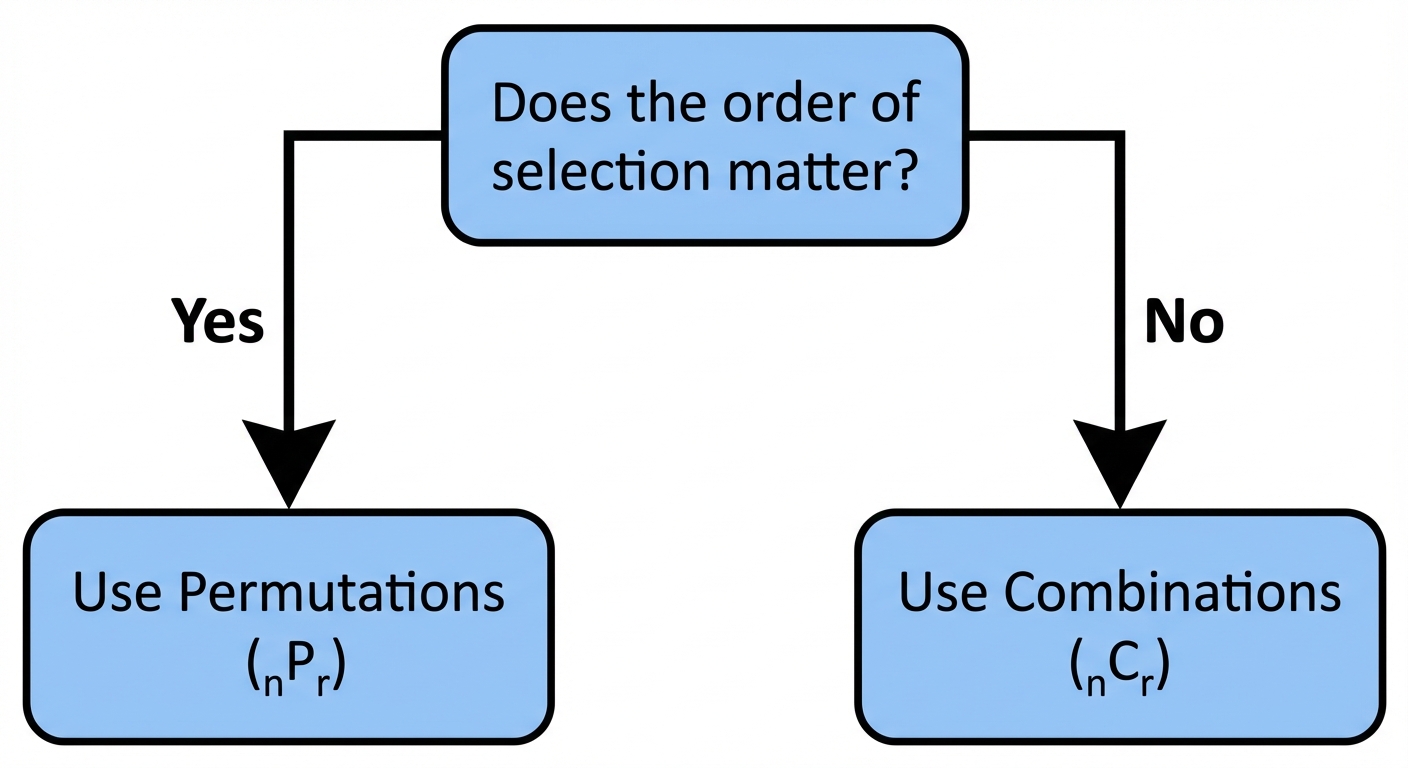
Your success hinges on one question you must ask yourself every time: 'Does the order of selection matter?' Get that right, and you've unlocked the problem. Mastering this isn't just about exams; it's fundamental to fields like data science, cryptography, and risk analysis in finance. So, let's get this locked down.
Worked example
Worked Example: Probability with Combinations
Assembling the Dream Committee 🏆
A committee of 4 people is to be chosen at random from a group of 7 men and 5 women. Find the probability that the committee consists of exactly 2 men and 2 women.
- 1First, we need to find the total number of possible outcomes, . This is the total number of ways to choose a committee of 4 from the 12 people available (7 men + 5 women). Since the order in which people are chosen for a committee doesn't matter, we use combinations.
- 2Next, let's find the number of favourable outcomes, , which is the number of ways to form a committee with exactly 2 men and 2 women. We need to choose 2 men from the 7 available AND choose 2 women from the 5 available. The word 'AND' is our cue to multiply the two results.
- 3Now, let's calculate each part of that expression. Again, we're using combinations because the order of selection doesn't matter.
- 4Multiply these two values together to get the total number of favourable outcomes, .
- 5Finally, we calculate the probability by dividing the number of favourable outcomes by the total number of outcomes. Always remember to simplify your fraction if possible!
Answer
3. The General Addition and Multiplication Rules for Probability
Alright, let's get into the core logic of combining probabilities. Think of this as your toolkit for tackling more complex S1 problems, especially those involving multiple events. It all boils down to two key questions: are we interested in event A OR event B happening, or event A AND event B happening?
First up, the Addition Rule, which is all about 'OR' scenarios. The general formula you absolutely need to know is: This formula calculates the probability of A or B (or both) occurring. The symbol means 'union', which is the fancy math term for 'or'. The crucial part is subtracting , which is the probability of both A and B happening (the 'intersection' or overlap). Why do we subtract it? To avoid double-counting! Think of a deck of cards. If A is 'drawing a King' and B is 'drawing a Heart', the King of Hearts fits both categories. If you just add , you've counted the King of Hearts twice. Subtracting the overlap fixes this.
First up, the Addition Rule, which is all about 'OR' scenarios. The general formula you absolutely need to know is: This formula calculates the probability of A or B (or both) occurring. The symbol means 'union', which is the fancy math term for 'or'. The crucial part is subtracting , which is the probability of both A and B happening (the 'intersection' or overlap). Why do we subtract it? To avoid double-counting! Think of a deck of cards. If A is 'drawing a King' and B is 'drawing a Heart', the King of Hearts fits both categories. If you just add , you've counted the King of Hearts twice. Subtracting the overlap fixes this.
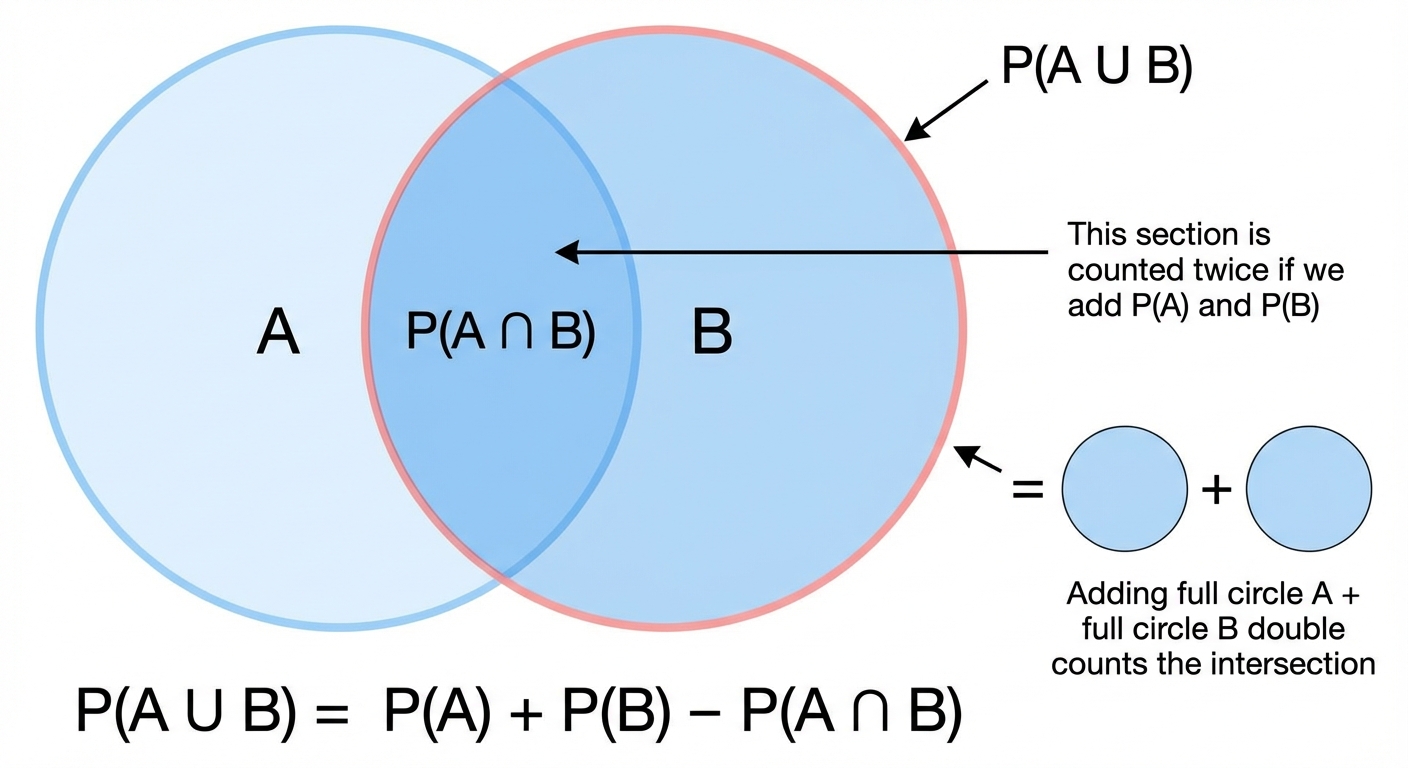
Now, what about mutually exclusive events? These are events that cannot happen at the same time, like turning left and turning right. For these, the overlap is zero. So, the Addition Rule simplifies to a much friendlier version: . Always check if events can happen together before you decide which formula to use!
Next, the Multiplication Rule, used for 'AND' scenarios when events are independent. Independent events are those where the outcome of one doesn't affect the outcome of the other (e.g., flipping a coin and then rolling a die). The rule is beautifully simple: This is your go-to for problems asking for the probability of a sequence of independent events occurring. Getting this distinction between 'OR' (add, watch for overlap) and 'AND' (multiply, for independent events) is fundamental for acing your S1 paper and is a logic skill you'll use in university courses from computer science to economics.
Worked example
Worked Example: Applying the General Addition Rule
The University Offer Dilemma 🎓
A student has applied to two universities. The probability of receiving an offer from University A is . The probability of receiving an offer from University B is . The probability of receiving offers from both universities is . What is the probability that the student receives an offer from at least one university?
- 1First, let's identify what the question is asking. 'At least one university' is the key phrase. This means we want the probability of getting an offer from University A OR University B (or both). In probability notation, this is .
- 2The events are not mutually exclusive because the student can receive offers from both universities (we're given ). Therefore, we must use the General Addition Rule to account for this overlap.
- 3Now, we substitute the given probabilities from the problem directly into our formula. This is a straightforward plug-and-play step, but double-check your values to avoid simple errors.
- 4Finally, perform the calculation to get the final answer. This gives us the total probability of the student having a successful outcome from at least one of their applications.
Answer
4. Conditional Probability and Dependent Events
Alright, let's get into one of the most important ideas in S1 Probability: Conditional Probability. Think of it like this: the probability of you bringing an umbrella to school is one thing. But the probability of you bringing an umbrella given that the forecast predicts a thunderstorm? That's a whole different story! The new information (the forecast) changes the probability. That's the core of conditional probability.
The official notation is , which we read as 'the probability of A occurring, given that B has already occurred'. The vertical bar '|' literally means 'given'. The key thing to grasp is that the sample space has shrunk. We're no longer looking at all possible outcomes; we're only looking at the outcomes where B happened. The formula you absolutely need to know is: This says the probability of A given B is the probability of both A and B happening, divided by the probability of the 'given' event B. It's like we're re-scaling our world to only include outcomes in B.
This leads us to the super useful multiplication rule for dependent events: . This is the logic you'll use when building tree diagrams, which are your best friend for these problems. The first set of branches shows the initial probabilities, and the second set of branches always shows the conditional probabilities.
The official notation is , which we read as 'the probability of A occurring, given that B has already occurred'. The vertical bar '|' literally means 'given'. The key thing to grasp is that the sample space has shrunk. We're no longer looking at all possible outcomes; we're only looking at the outcomes where B happened. The formula you absolutely need to know is: This says the probability of A given B is the probability of both A and B happening, divided by the probability of the 'given' event B. It's like we're re-scaling our world to only include outcomes in B.
This leads us to the super useful multiplication rule for dependent events: . This is the logic you'll use when building tree diagrams, which are your best friend for these problems. The first set of branches shows the initial probabilities, and the second set of branches always shows the conditional probabilities.
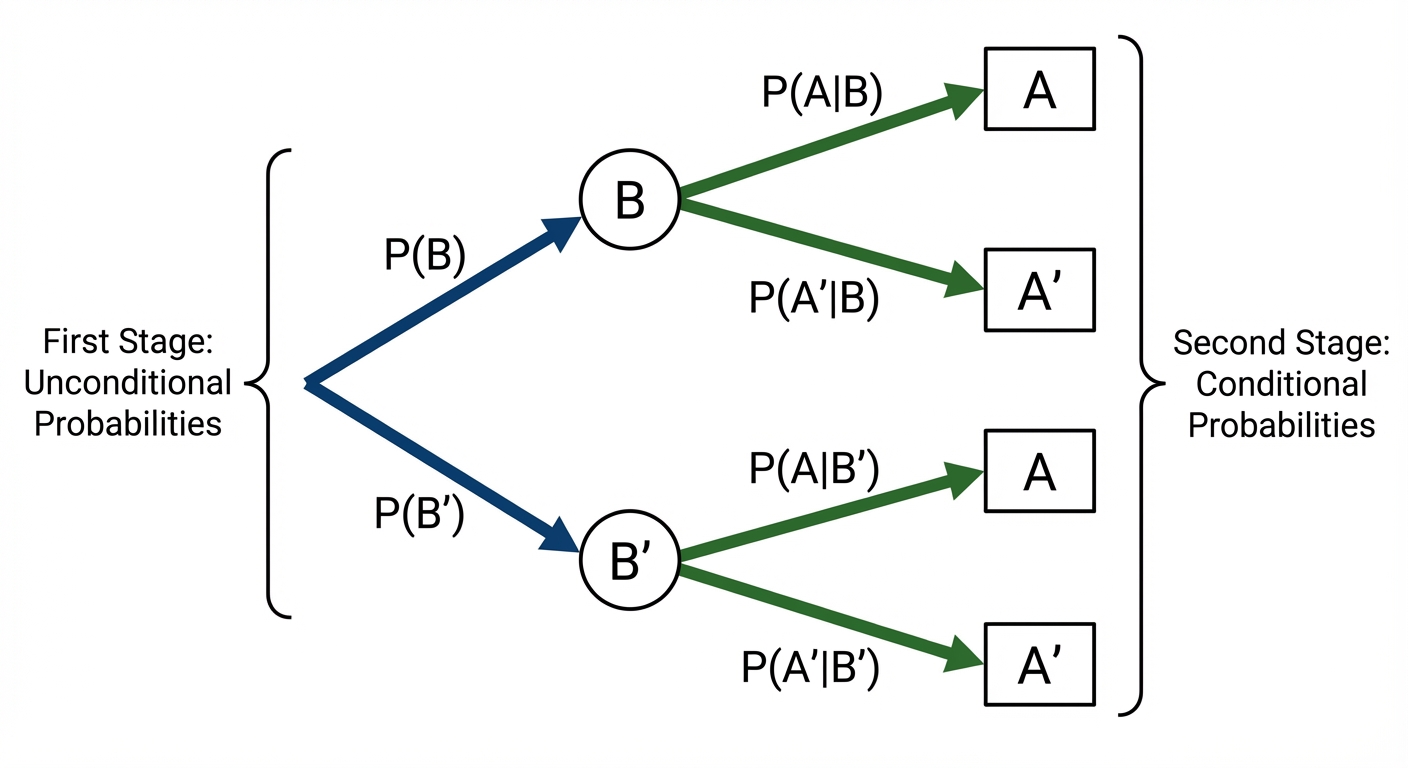
Mastering this sets you up for some clever 'Bayes-style' reasoning, where you might know but need to find . This is a common exam curveball and a huge concept in fields like data science and medical diagnostics. So, let's nail it down!
Worked example
Worked Example: Medical Diagnostic Testing
Let's Diagnose This Probability Problem 🩺
A new medical test is developed to detect a rare disease. The disease affects 1 in 500 people in a population (). The test is fairly accurate: it correctly identifies 99% of people who have the disease (true positive), but it has a 5% false positive rate (meaning it incorrectly indicates the disease in 5% of healthy people). A person is selected at random and tests positive. What is the probability that they actually have the disease?
- 1First things first, let's define our events and lay out the probabilities. This helps us structure the problem. Let 'D' be the event that a person has the disease, and 'P' be the event that they test positive. A tree diagram is perfect for visualizing this.Given information:
(since 1 in 500)
(True Positive Rate)
(False Positive Rate) - 2The question asks for the probability that a person has the disease given that they tested positive. This is a classic 'reverse' conditional probability problem. We need to find .We need to find .
- 3Let's bring out our main formula for conditional probability: . In the context of our problem, this translates to finding the probability of having the disease AND testing positive, divided by the total probability of testing positive.
- 4Let's calculate the numerator, . This is the probability of the sequence of events 'Has Disease' followed by 'Tests Positive'. We find this by multiplying along the corresponding branches of our tree diagram.
- 5Now for the denominator, . A person can test positive in two ways: they have the disease and test positive (which we just calculated), OR they don't have the disease but get a false positive. We need to find the probability of both scenarios and add them together (the Law of Total Probability).
- 6Finally, we plug our numerator and denominator back into the formula to get our answer. Notice how even with a positive test, the probability of having the disease is still surprisingly low! This is a famous result in statistics and shows why understanding conditional probability is so critical in real-world applications.So, there is only about a 3.82% chance the person actually has the disease.
Answer
So, there is only about a 3.82% chance the person actually has the disease.
5. Independent and Mutually Exclusive Events
Alright, let's clear up one of the most common mix-ups in S1 Probability: the difference between independent and mutually exclusive events. Think of it like your social life. Independent events are like you deciding to watch a Netflix series and your best friend deciding to go for a run. Your decision has absolutely no impact on theirs. The outcome of one doesn't influence the probability of the other. The crucial exam test for independence is the multiplication rule: two events, A and B, are independent if and only if . You absolutely must memorise this formula. It's your go-to tool for proving independence.
Now, mutually exclusive events are the total opposite. They can't happen at the same time. It's like trying to be at a party and studying in the library simultaneously – impossible. If event A happens, event B cannot. For mutually exclusive events, the probability of them both happening is zero, so .
Now, mutually exclusive events are the total opposite. They can't happen at the same time. It's like trying to be at a party and studying in the library simultaneously – impossible. If event A happens, event B cannot. For mutually exclusive events, the probability of them both happening is zero, so .
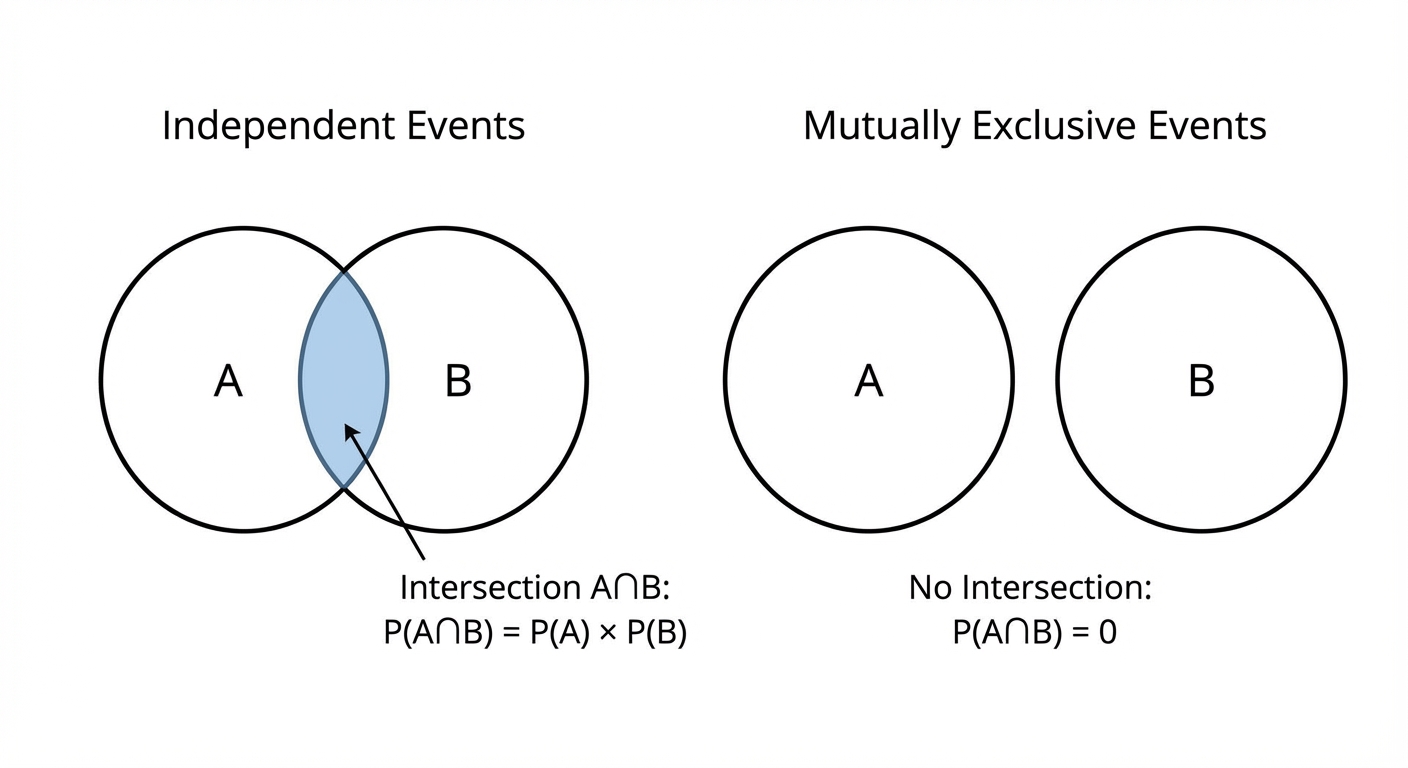
A classic example of mutually exclusive events are complementary events, like passing an exam () and not passing it (). You can't do both, and one of them must occur. Don't fall into the trap of thinking exclusive events are independent; if knowing A happened tells you B definitely didn't happen, they are heavily dependent on each other!
Worked example
Worked Example: Testing for Independence
The University Offer Dilemma 🎓
A student applies for courses in Medicine and Engineering. The probability of receiving an offer for Medicine, , is 0.3. The probability of receiving an offer for Engineering, , is 0.8. The probability of receiving offers for both courses is 0.24. Determine whether the events of receiving an offer for Medicine and receiving an offer for Engineering are independent.
- 1First, let's clearly define our events and list the probabilities given in the problem. This helps us organise our thoughts before we jump into the calculation.Let be the event of receiving an offer for Medicine.
Let be the event of receiving an offer for Engineering.
Given probabilities: - 2Now, we state the mathematical condition that must be met for two events to be independent. This is the core formula we need to test.For events and to be independent, the following must be true:
- 3Let's calculate the right-hand side of the independence formula, , using the given probabilities.
- 4The final step is to compare our calculated product from Step 3 with the given probability of the intersection, . If they are equal, the events are independent. If not, they are dependent.From the problem, we are given that .
From our calculation, .
Since , the condition for independence is met. - 5We must write a clear concluding statement that answers the original question. It's crucial to state why you've reached your conclusion, referencing the test you performed.Conclusion: Since , the events of receiving an offer for Medicine and receiving an offer for Engineering are statistically independent. This means that receiving an offer from one faculty has no bearing on the probability of receiving an offer from the other.
Answer
Conclusion: Since , the events of receiving an offer for Medicine and receiving an offer for Engineering are statistically independent. This means that receiving an offer from one faculty has no bearing on the probability of receiving an offer from the other.
Practice this in the app
Unlock the full chapter: practice questions, flashcards, mock papers and notes, free.
Continue revising