M1: Kinematics of Motion in a Straight Line
Mastering Motion: Graphs, SUVAT & Calculus! 🚀
Introduction
1. Introduction
Hey! Ready to get your head around motion? Kinematics might sound intense, but it's basically the science of how things move. In this chapter, we're going to build your ultimate toolkit for tackling any motion problem.
First, we'll become visual masters with Displacement-Time and Velocity-Time graphs, learning how to read the story of a journey just by looking at its shape. Then, we'll unlock the five 'magic' SUVAT equations, your go-to for any situation where acceleration is constant. Finally, for those trickier problems where acceleration changes, we'll unleash the power of Calculus to differentiate and integrate our way to the answer. Let's get moving!
First, we'll become visual masters with Displacement-Time and Velocity-Time graphs, learning how to read the story of a journey just by looking at its shape. Then, we'll unlock the five 'magic' SUVAT equations, your go-to for any situation where acceleration is constant. Finally, for those trickier problems where acceleration changes, we'll unleash the power of Calculus to differentiate and integrate our way to the answer. Let's get moving!
2. Interpreting Kinematic Graphs: Displacement-Time and Velocity-Time
Alright, let's decode these kinematic graphs. Think of them as the story of an object's journey.
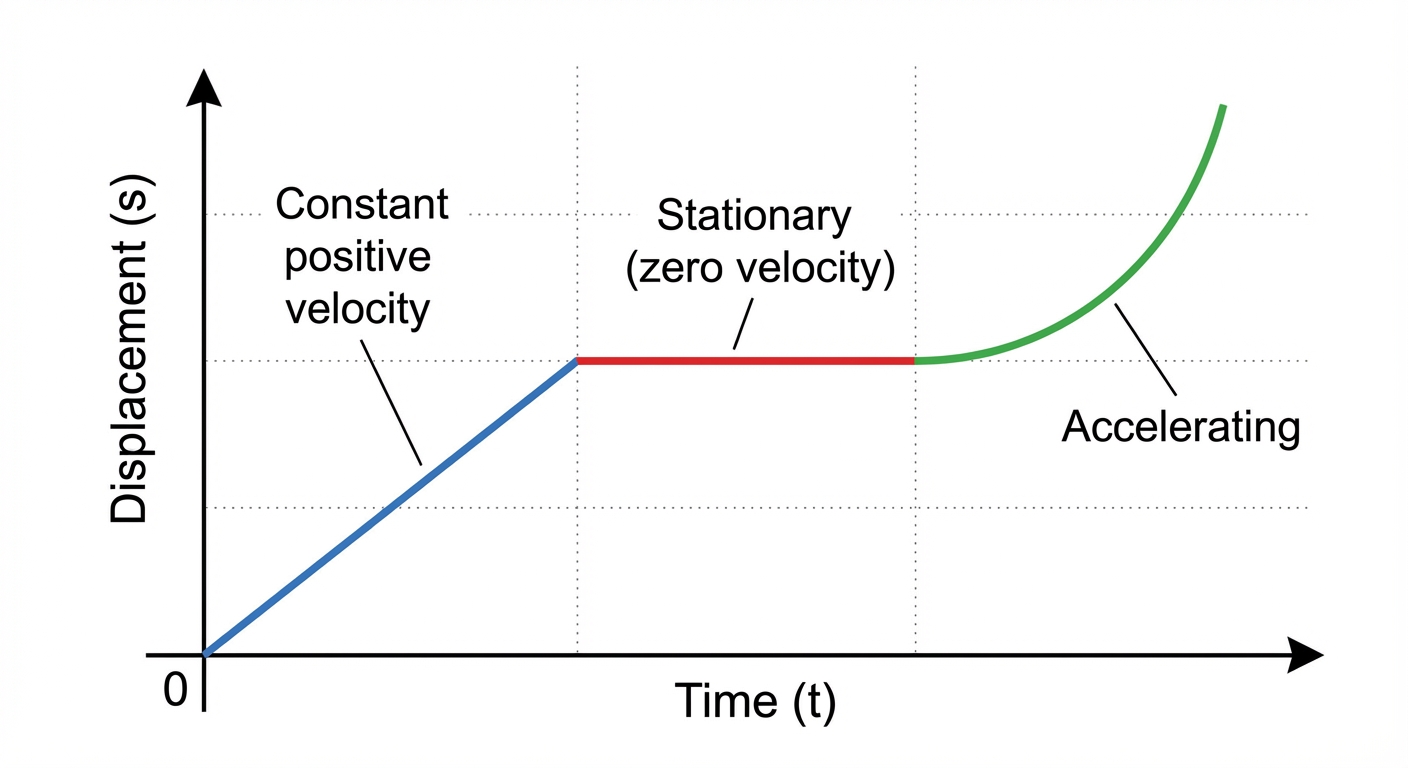
First up, the Displacement-Time (s-t) graph. This graph plots displacement () against time (). The single most important takeaway here is: the gradient is velocity. Remember, gradient is 'rise over run', or , which is literally the definition of velocity (). A steep line? You're moving fast. A flat, horizontal line? You're stationary (zero velocity), probably scrolling on your phone. A line with a negative gradient means you're moving back towards your starting point. A curve means your velocity is changing, which means you're accelerating!
First up, the Displacement-Time (s-t) graph. This graph plots displacement () against time (). The single most important takeaway here is: the gradient is velocity. Remember, gradient is 'rise over run', or , which is literally the definition of velocity (). A steep line? You're moving fast. A flat, horizontal line? You're stationary (zero velocity), probably scrolling on your phone. A line with a negative gradient means you're moving back towards your starting point. A curve means your velocity is changing, which means you're accelerating!
Now for the main event: the Velocity-Time (v-t) graph. This is where the real magic happens. Here, the y-axis is velocity () and the x-axis is time (). Two key things to remember:
1. The gradient is acceleration. Again, think 'rise over run': . A positive gradient means the velocity is increasing, a negative gradient means it is decreasing, and a horizontal line means constant velocity (zero acceleration).
2. The area under the graph is displacement. This is huge. To find how far something has travelled, you just calculate the area between the line and the t-axis, usually by splitting it into triangles, rectangles and trapeziums. If part of the graph is below the t-axis, the velocity is negative (moving in the opposite direction), and that area represents negative displacement. To find total distance, you add the magnitudes of all the areas (treat them all as positive). To find total displacement, you add the areas, remembering that areas below the axis are negative. 😉
Worked example
Worked Example: Multi-Stage Journey Analysis
Let's Solve a Motion Mystery! 🕵️♂️
A cyclist accelerates uniformly from rest to a speed of in seconds. She then travels at this constant speed for seconds, before decelerating uniformly to rest in a further seconds. Find:
(a) the acceleration in the first 10 seconds,
(b) the total distance travelled, and
(c) the deceleration in the final 16 seconds.
(a) the acceleration in the first 10 seconds,
(b) the total distance travelled, and
(c) the deceleration in the final 16 seconds.
- 1First things first, let's sketch the v-t graph. This is a critical problem-solving tool that helps you visualize the entire journey. We have three distinct phases: acceleration (a straight line from (0,0) to (10,8)), constant velocity (a horizontal line from (10,8) to (30,8)), and deceleration (a straight line from (30,8) down to (46,0)). The total time is seconds.Sketch: a trapezium with vertices at , , and ; time in s across, velocity in m s⁻¹ up.
- 2For part (a), we need to find the initial acceleration. Remember, acceleration is simply the gradient of the v-t graph. For the first 10 seconds, we're looking at the gradient of the first line segment.
- 3For part (b), we need the total distance travelled. This is the total area under the v-t graph. We can split the shape into a triangle, a rectangle, and a final triangle, then sum their areas. This is often the safest method to avoid errors.
- 4Finally, for part (c), we calculate the deceleration. This is the gradient of the final line segment. We expect a negative value for acceleration, and deceleration is the positive magnitude of this value.
The negative sign confirms it's a deceleration. Therefore, the deceleration is .
Answer
The negative sign confirms it's a deceleration. Therefore, the deceleration is .
The negative sign confirms it's a deceleration. Therefore, the deceleration is .
3. Calculus Applications in Kinematics: Variable Acceleration
Alright, let's level up from the SUVAT equations. SUVAT is awesome, but it has one major limitation: it only works for constant acceleration. In the real world, things rarely move like that. Think about a car in city traffic, it's constantly speeding up and slowing down. That's variable acceleration, and to handle it, we need the power of calculus. It's the key to describing motion that isn't perfectly uniform, which is crucial for fields like engineering, robotics, and even astrophysics.
The whole concept boils down to a beautiful, logical hierarchy. Displacement (), velocity (), and acceleration () are all linked by differentiation and integration. Think of it like a ladder. To go down the ladder from displacement to velocity, and then from velocity to acceleration, we differentiate with respect to time ().
Velocity is the rate of change of displacement:
Acceleration is the rate of change of velocity:
So, if you're given an equation for displacement like , you can find the velocity and acceleration at any instant just by differentiating. Easy points in an exam!
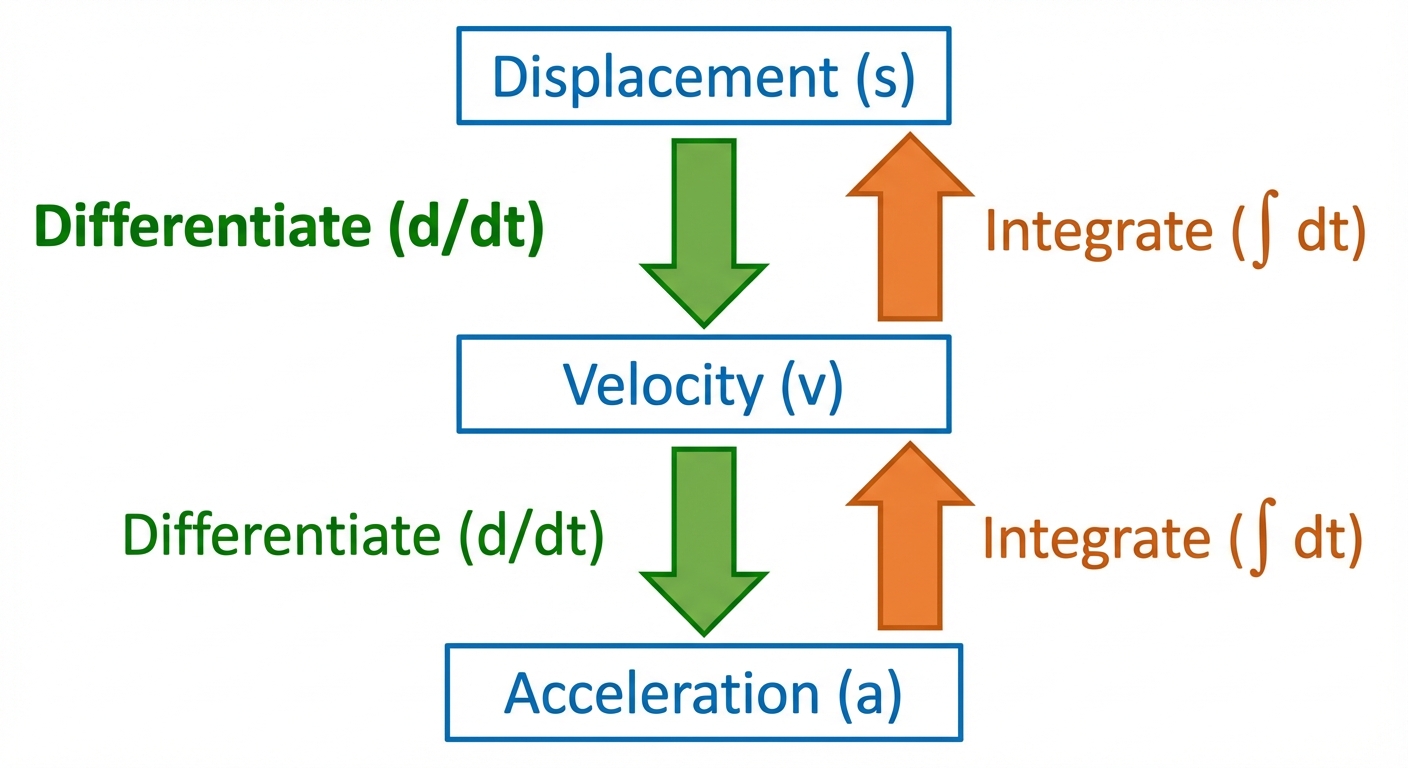
Now, what about going up the ladder? If you have acceleration and want to find velocity, or have velocity and want to find displacement, you integrate. It's the reverse process. The one thing you absolutely cannot forget here is the constant of integration, `+ C`. This little guy is a classic exam trap! 🚨 You'll always be given some initial conditions in the problem, like 'the particle starts from rest at the origin'. You use this information (e.g., at , and ) to find the specific value of 'C' for that scenario. Master this, and you're well on your way to acing these kinematics questions.
Worked example
Worked Example: Motion with Variable Acceleration
Let's Solve a Tricky One! 🧠
A particle P moves along a straight line. At time seconds, its velocity, m/s, is given by .
(a) Find the acceleration of the particle when .
(b) Find the values of for which the particle is instantaneously at rest.
(c) Given that the particle is at the origin when , find the displacement of the particle from the origin when .
(a) Find the acceleration of the particle when .
(b) Find the values of for which the particle is instantaneously at rest.
(c) Given that the particle is at the origin when , find the displacement of the particle from the origin when .
- 1Part (a): To get acceleration from velocity, we need to differentiate the velocity function with respect to time, . Remember, .
Now, we just substitute into our new acceleration equation: - 2Part (b): The phrase 'instantaneously at rest' is a key trigger. It means the velocity is zero, so we set and solve the resulting quadratic equation for .
Divide by 2 to simplify:
Factorise the quadratic: - 3Part (c): To find displacement () from velocity (), we must integrate the velocity function. This is where we go 'up' the ladder. Don't forget the constant of integration, `+ C`!
- 4Now we find the value of C. The problem states that the particle is at the origin () when . We substitute these values into our displacement equation to solve for C.
So, our specific equation for displacement is: - 5Finally, we can answer the question. We need to find the displacement when . We simply substitute into our complete displacement equation.
Answer
4. Using Constant Acceleration Formulae
Alright, let's talk about the SUVAT equations. Think of them as the ultimate cheat codes for solving motion problems, but like, totally legit ones your examiner wants you to use. This only works for a specific scenario, though: when an object is moving with constant acceleration. If the acceleration is changing, these are a no-go. It’s like trying to use a Wi-Fi password for a different network, it just won't connect.
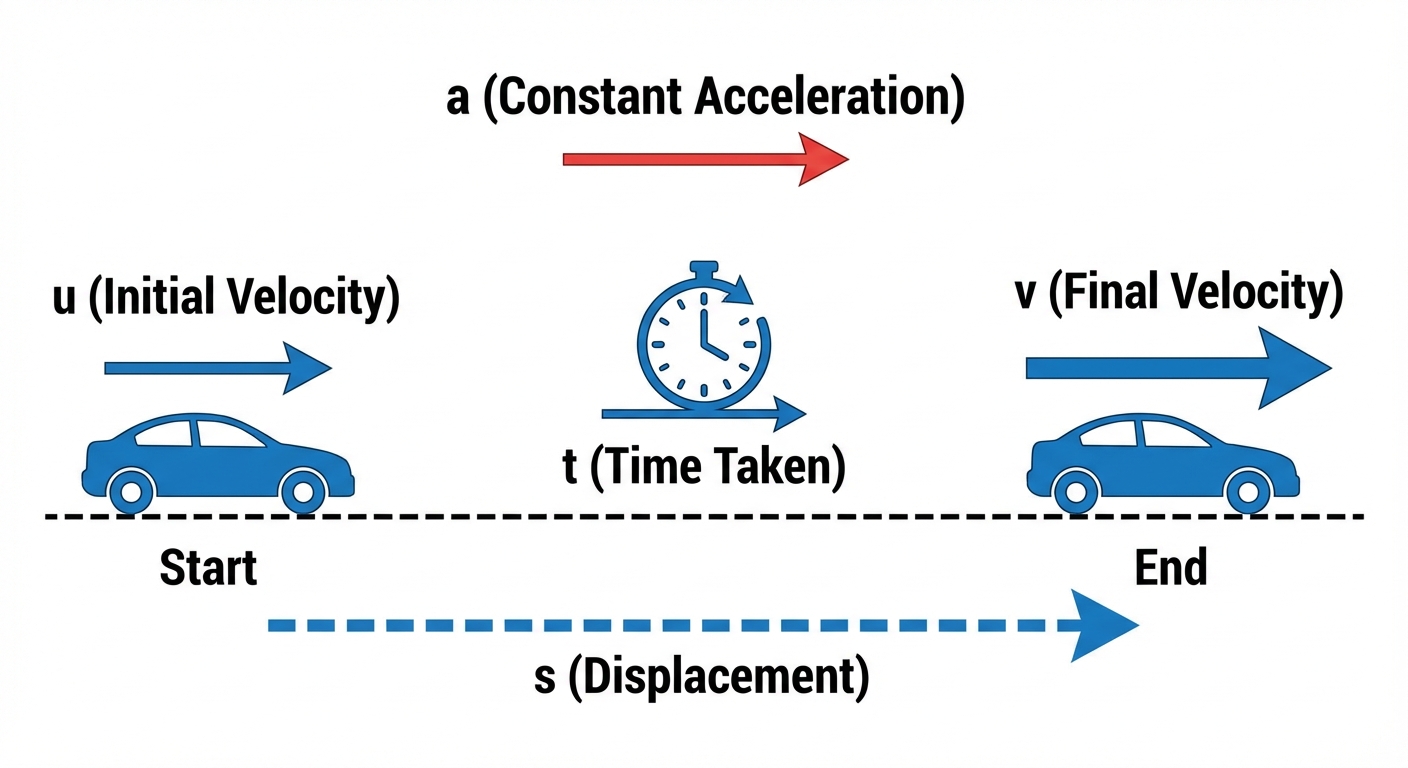
So, what does SUVAT even stand for? It's an acronym for the five variables we use to describe motion:
= displacement (how far you are from the start, with direction)
= initial velocity (your speed at the start)
= final velocity (your speed at the end)
= acceleration (how quickly your velocity changes)
= time
The magic is that if you know any three of these, you can find the other two using a set of special formulae. It's like a group chat where if three people have seen the message, you can figure out what the other two are up to.
Here are the five formulae. Each one leaves out exactly one of the five variables:
1. (no )
2. (no )
3. (no )
4. (no )
5. (no )
The MF19 formula list prints the first four; the fifth is not printed, so know it.
Your main skill here is playing detective: read the problem, choose a positive direction, list out your known SUVAT values, identify the unknown you need to find, and then pick the formula that leaves out the variable you neither know nor want. For motion straight up or down (ignoring air resistance), the acceleration is downwards the whole time. Paper 4 uses m s⁻², not . Get this down, and you'll be flying through kinematics questions.
Worked example
Worked Example: Applying SUVAT to Vertical Motion
The 'Oops, I Dropped My Phone' Moment 📱
You're standing on a bridge 30 m above a river. You accidentally drop your phone (don't worry, it has a waterproof case!). Assuming it's dropped from rest and that air resistance is negligible, find the speed at which the phone hits the water. Take .
- 1First, let's be detectives and list our SUVAT variables. It's crucial to define a positive direction: let's say downwards is positive.
m (it travels 30m down)
('dropped from rest' is the key phrase)
(this is what we want to find!)
(gravity acts downwards, our positive direction)
: not known, and not asked for - 2Now we pick our weapon... I mean, equation. We have values for , , and , and we need to find . The variable that's missing and not needed is . The only SUVAT equation that doesn't involve time is our go-to choice here.
- 3Time to sub in the numbers and do the math. We're just plugging in the values we listed in Step 1. Remember that since , the calculation is a bit simpler.
- 4We're almost there! The question asks for the speed (), not . So, the final move is to take the square root. Always finish by stating your answer clearly with the correct units, usually rounded to 3 significant figures.
Answer
Practice this in the app
Unlock the full chapter: practice questions, flashcards, mock papers and notes, free.
Continue revising