P1 Chapter 1: Functions
Functions: Your Ultimate Math Toolkit 🛠️
Introduction
1. Introduction
Alright, let's dive into one of the most fundamental ideas in A-Level Maths: Functions. Think of them as well-behaved mathematical machines: you put a number in (the input), and you get a specific number out (the output). In this chapter, we're going to build your entire toolkit for dealing with them. First, we'll master Domain and Range – figuring out exactly what numbers can go in and what can come out. Then, we'll get creative by plugging one function machine into another with Composite Functions. After that, we'll learn how to run the machine backwards by finding Inverse Functions. And finally, we'll become graph wizards with Graph Transformations, learning how to shift, stretch, and flip any function's graph. By the end of this, you'll be able to manipulate and understand functions like a pro. Let's get this done!
2. Defining the Domain and Range of a Function
Alright, let's get into one of the most fundamental concepts in functions: domain and range. Think of a function, , as an exclusive event. The domain is the VIP guest list – it's the complete set of all possible input values (-values) that are allowed to enter the 'function party'. If an -value isn't on the list, it gets rejected at the door! So, what gets a value blacklisted? Two main culprits in AS Maths:
1. Division by zero: The denominator of a fraction can't be zero. For , the value causes chaos, so the domain is all real numbers except 2, written as .
2. Square roots of negatives: We can't take the square root of a negative number in the real number system. For , the expression must be zero or positive. So, , which means the domain is .
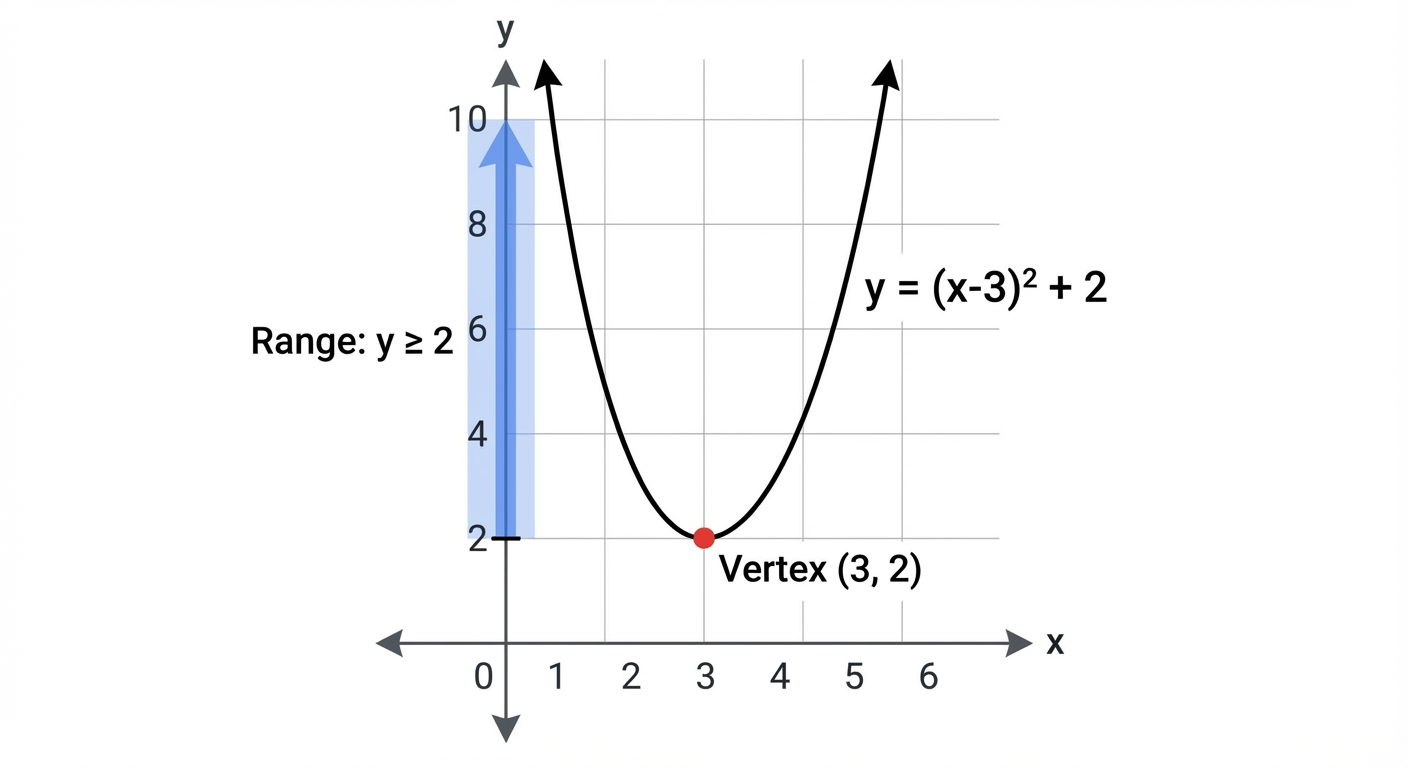
The range is the result of the party – it's the complete set of all possible output values ( or -values) that the function can produce from the allowed inputs. To figure out the range, you need to think about the function's behaviour. What's the highest or lowest value it can hit? For a quadratic like , the vertex is at , which is the minimum point. The function can go up forever but never dips below 2. So, its range is .
1. Division by zero: The denominator of a fraction can't be zero. For , the value causes chaos, so the domain is all real numbers except 2, written as .
2. Square roots of negatives: We can't take the square root of a negative number in the real number system. For , the expression must be zero or positive. So, , which means the domain is .
The range is the result of the party – it's the complete set of all possible output values ( or -values) that the function can produce from the allowed inputs. To figure out the range, you need to think about the function's behaviour. What's the highest or lowest value it can hit? For a quadratic like , the vertex is at , which is the minimum point. The function can go up forever but never dips below 2. So, its range is .
Mastering domain and range is non-negotiable for university-level calculus, where you'll analyze complex functions in engineering, economics, and computer science. It’s the absolute bedrock.
Worked example
Worked Example: Domain and Range of a Radical Function
Let's Dissect This Function 🧐
Given the function , determine its domain and range.
- 1First, let's tackle the domain. We need to identify any values of that would 'break' the function. The only potential issue here is the square root. The expression inside a square root cannot be negative.
- 2Solving this simple inequality gives us the complete set of allowed -values. This is our domain.
- 3Now for the range. Let's build the function up, starting from the square root part. We know that the output of a basic square root function is always non-negative.
- 4Our function has , not just . When we multiply an inequality by a negative number, we must flip the inequality sign. Think of it as reversing the direction on the number line.
- 5The final step is to add the 5 to complete the function. This shifts all our possible output values up by 5. This gives us the final boundary for our range.
- 6Since , we have found our range. The function's output can be 5 or any value less than 5. We state this formally using function notation.
Answer
3. Composite Functions: Structure and Existence
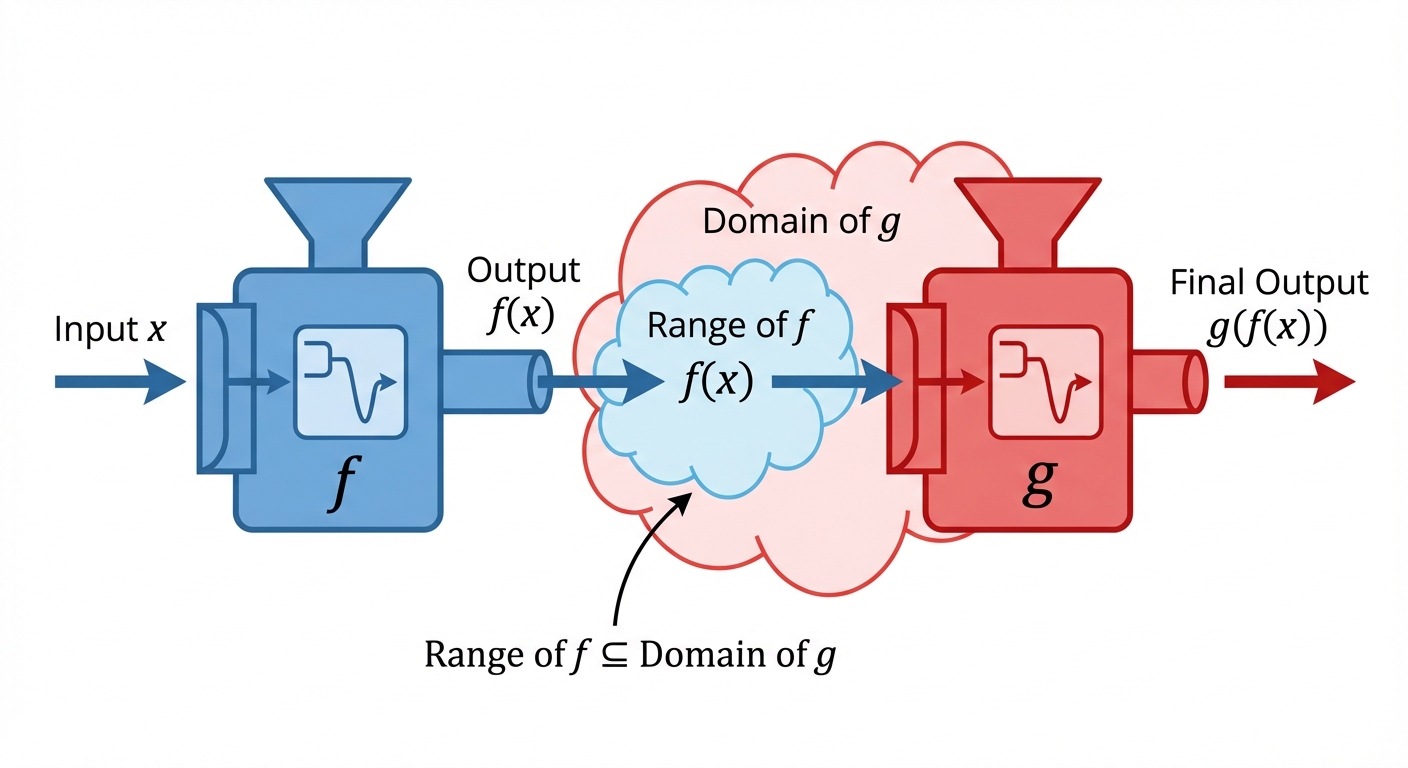
Alright, let's break down composite functions. Imagine you're editing a video. First, you use an app to add a slow-mo effect (that's function ), and then you upload that result to another app to add music (that's function ). The final video is the result of a composite function, written as . The notation is key: actually means . You always apply the function closest to the first. So, we work from the inside out: goes into , and the result, , goes into .
To find the algebraic expression for , you literally substitute the entire expression for into every instance of in the function . But here's the crucial part, and a classic exam question: the composite function doesn't always exist. For to be valid, the output of the first function () must be a valid input for the second function (). In technical terms, the range of must be a subset of the domain of . Think of it like plugging a USB-C cable (the range of ) into a laptop port (the domain of ). If the laptop only has old USB-A ports, it's not going to work!
To find the algebraic expression for , you literally substitute the entire expression for into every instance of in the function . But here's the crucial part, and a classic exam question: the composite function doesn't always exist. For to be valid, the output of the first function () must be a valid input for the second function (). In technical terms, the range of must be a subset of the domain of . Think of it like plugging a USB-C cable (the range of ) into a laptop port (the domain of ). If the laptop only has old USB-A ports, it's not going to work!
This concept is more than just an exam hurdle; it's the foundation of the Chain Rule in calculus (A2 topic alert!) and fundamental to computer science, where you constantly 'pipe' the output of one function into another. Understanding this 'compatibility check' is vital for modelling any multi-step process, from financial models to physics simulations.
Worked example
Worked Example: Forming a Composite Function and its Domain
Time to Put the Theory into Practice! 🚀
The functions and are defined as follows:
for
for
Find the composite function and state its domain and range.
for
for
Find the composite function and state its domain and range.
- 1First, let's identify the order of operations for . This means we apply first, then . To check if can even exist, we must verify that the range of the first function () is compatible with the domain of the second function ().Range of is .
Domain of is .
Since the range of () is a subset of the domain of (), the function exists. ✅ - 2Now that we know it exists, we can find the expression for . We do this by substituting the entire expression for into the variable in the function .
- 3This is a critical step that many students miss. The domain of a composite function is always the same as the domain of the first function that was applied, which in this case is . Don't be fooled by the simple final expression!The domain of is .
Therefore, the domain of is also . - 4Finally, to find the range of the composite function , we consider what output values are produced when we apply its domain () to its expression ().We have with a domain of .
The minimum value will occur at the minimum input, .
.
As increases, increases. Therefore, the range of is .
Answer
We have with a domain of .
The minimum value will occur at the minimum input, .
.
As increases, increases. Therefore, the range of is .
The minimum value will occur at the minimum input, .
.
As increases, increases. Therefore, the range of is .
4. Inverse Functions and their Properties
Alright, let's talk about inverse functions. Think of a function as a process, like putting on your shoes. The inverse function, denoted (and be careful, that '-1' is not a power, it's just notation!), is the reverse process: taking your shoes off. If , then . Simple, right?
The absolute deal-breaker for an inverse to exist is that the original function must be one-to-one. This means every output has a unique input. A function like is many-to-one because both and give the output 4. If you tried to 'undo' 4, where would you go? Back to 2 or -2? An inverse can't have this ambiguity. To fix this, we often restrict the domain. For , if we say it only applies for , it becomes one-to-one, and its inverse is . This is a classic exam trick!
Graphically, an inverse function is a reflection of the original function in the line . This is a massive visual cue for you in an exam. If you sketch and on the same axes, they should be perfect mirror images across that diagonal line.
The absolute deal-breaker for an inverse to exist is that the original function must be one-to-one. This means every output has a unique input. A function like is many-to-one because both and give the output 4. If you tried to 'undo' 4, where would you go? Back to 2 or -2? An inverse can't have this ambiguity. To fix this, we often restrict the domain. For , if we say it only applies for , it becomes one-to-one, and its inverse is . This is a classic exam trick!
Graphically, an inverse function is a reflection of the original function in the line . This is a massive visual cue for you in an exam. If you sketch and on the same axes, they should be perfect mirror images across that diagonal line.
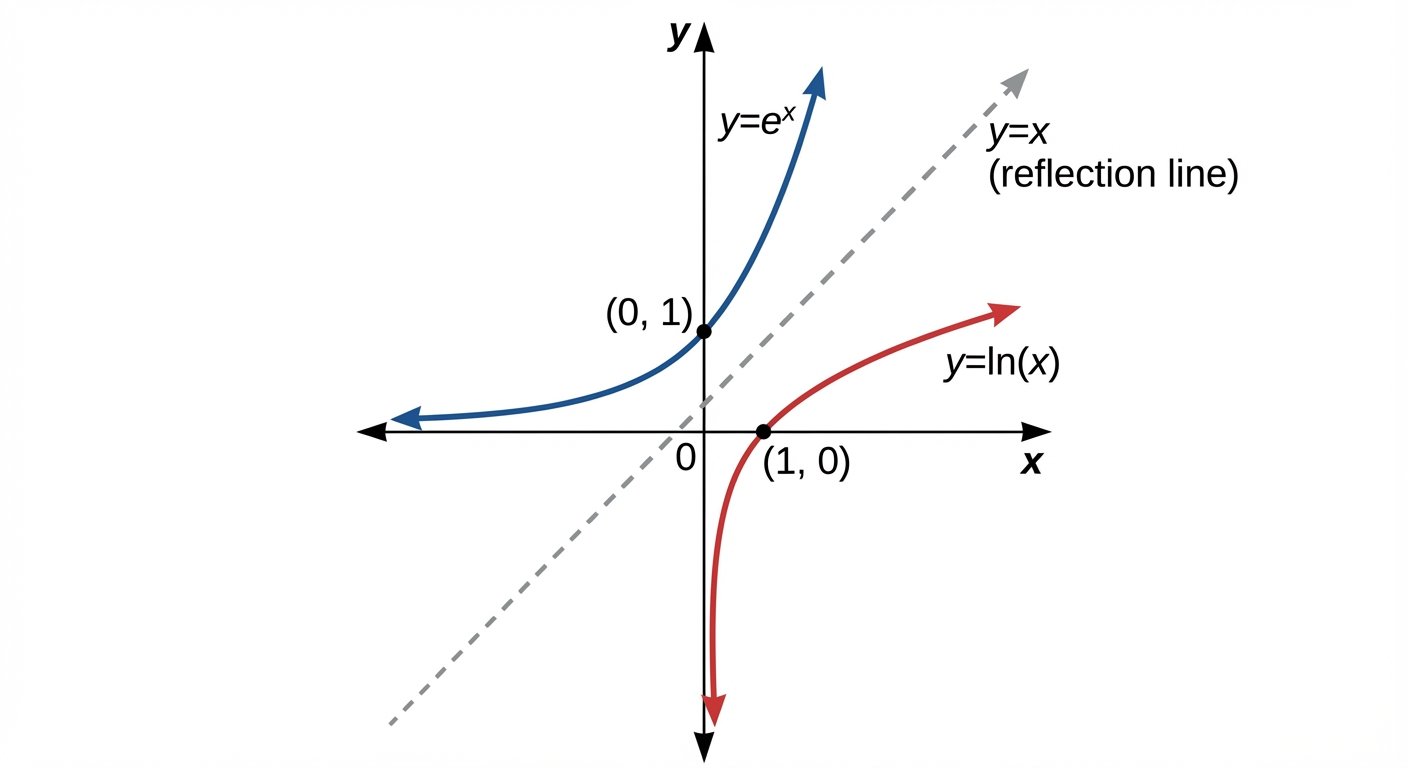
This reflection visually represents the core property of inverses: the inputs and outputs swap. Consequently, the domain of becomes the range of , and the range of becomes the domain of . This relationship is your key to solving a huge range of problems, especially those asking for the domain or range of an inverse. Understanding this concept is not just for passing P1; it's foundational for logarithms, trigonometry, and is used extensively in computer science for algorithms and in cryptography for encryption/decryption keys.
Worked example
Worked Example: Finding the Inverse of a Function with a Restricted Domain
Let's Reverse-Engineer This Function ⚙️
The function is defined by for .
(i) Find an expression for .
(ii) State the domain of .
(i) Find an expression for .
(ii) State the domain of .
- 1First up, we set the function equal to . This just makes the algebraic manipulation cleaner.Let
- 2This is the crucial step for finding any inverse. We literally swap the roles of input () and output () by swapping the variables in the equation.
- 3Now, we need to perform algebraic gymnastics to make the subject of this new equation. This will give us the formula for our inverse function.Self-check: We take the positive square root because the original domain was . This means the range of must be . Our expression satisfies this, whereas would not.
- 4We're almost there! Just replace with the formal notation to present the final answer for part (i).
- 5For part (ii), we use the core principle: the domain of the inverse is the range of the original function. Let's find the range of for .The vertex of the parabola is at . Since the domain is , the function starts at its minimum point and increases. Therefore, the range of is .
This means the domain of is .
Answer
The vertex of the parabola is at . Since the domain is , the function starts at its minimum point and increases. Therefore, the range of is .
This means the domain of is .
This means the domain of is .
5. Transformations of Functions
Alright, let's get into graph transformations. Think of this as the ultimate editing tool for functions. Mastering this isn't just about passing P1; it's a fundamental concept in fields like computer graphics (think animating characters in a game), engineering, and physics for modelling wave behaviour. We're dealing with four main types of transformations which can be combined. Let's break it down:
1. Vertical Translation:
This is the most straightforward. If is positive, the whole graph shifts up by units. If is negative, it shifts down. Imagine your graph is in an elevator; adding 'a' just changes which floor it's on. The shape doesn't change at all.
2. Horizontal Translation:
Heads up, this one feels a bit backwards! If you see , the graph actually shifts left by units. If you see , it shifts right. Why the reverse psychology? Think about what value of gets you back to the original input. For , you need to put in to get . So, the point that was at has moved to .
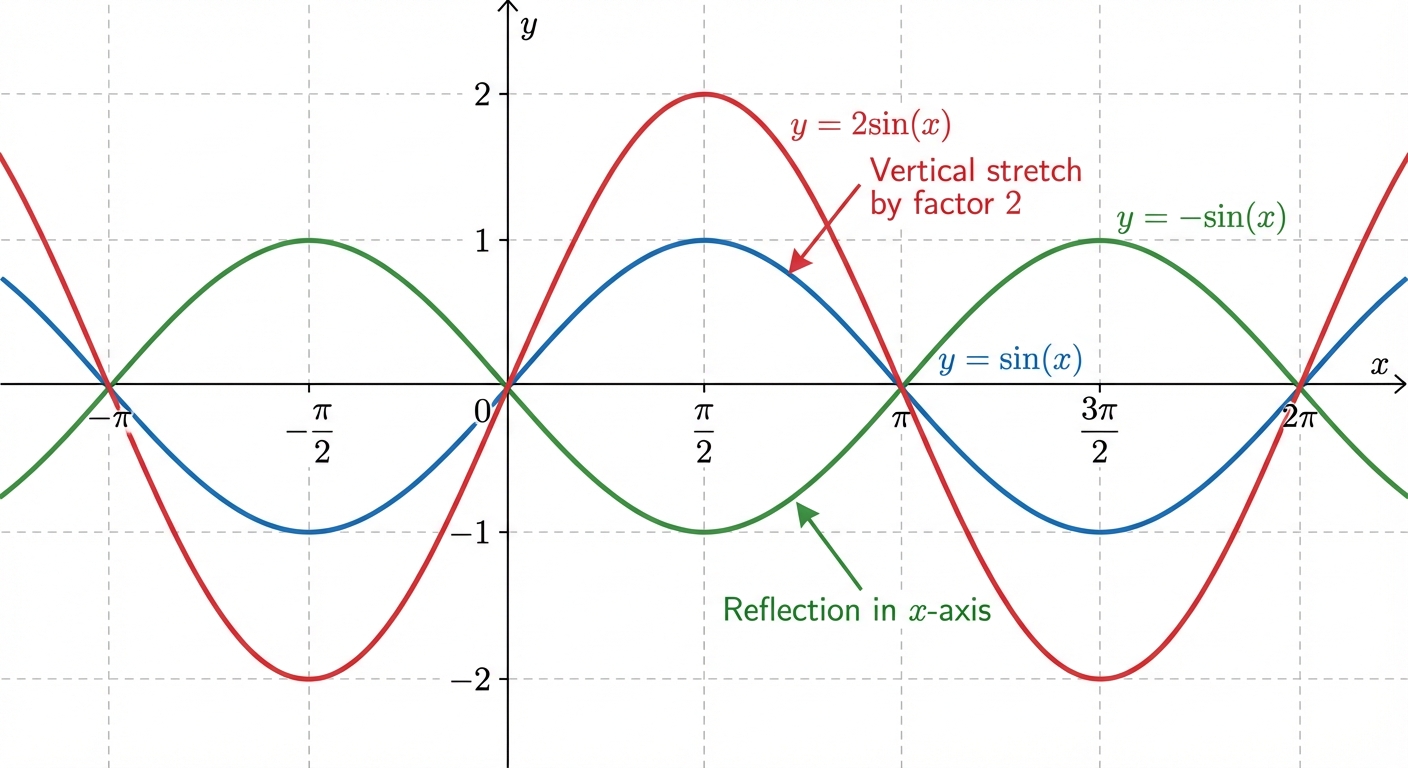
3. Vertical Stretch/Compression:
Here, we're stretching or squashing the graph vertically. The graph is stretched parallel to the y-axis by a factor of . Every y-coordinate gets multiplied by . If , it's a stretch. If , it's a compression (a squash). If is negative, it's a stretch/compression and a reflection in the x-axis. All the positive y-values become negative and vice versa.
1. Vertical Translation:
This is the most straightforward. If is positive, the whole graph shifts up by units. If is negative, it shifts down. Imagine your graph is in an elevator; adding 'a' just changes which floor it's on. The shape doesn't change at all.
2. Horizontal Translation:
Heads up, this one feels a bit backwards! If you see , the graph actually shifts left by units. If you see , it shifts right. Why the reverse psychology? Think about what value of gets you back to the original input. For , you need to put in to get . So, the point that was at has moved to .
3. Vertical Stretch/Compression:
Here, we're stretching or squashing the graph vertically. The graph is stretched parallel to the y-axis by a factor of . Every y-coordinate gets multiplied by . If , it's a stretch. If , it's a compression (a squash). If is negative, it's a stretch/compression and a reflection in the x-axis. All the positive y-values become negative and vice versa.
4. Horizontal Stretch/Compression:
Like the horizontal shift, this one is also counter-intuitive. The graph is stretched parallel to the x-axis by a factor of . If , it's a compression (it gets squashed inwards). If , it's a stretch. If is negative, you get a stretch/compression and a reflection in the y-axis.
When you combine these, the order matters. A golden rule for your exams: deal with stretches/reflections first, then translations. Think of it like getting ready: you put on your clothes (stretch/reflect) before you put on your coat and leave the house (translate).
Worked example
Worked Example: Applying a Sequence of Transformations
The Ultimate Graph Glow-Up Challenge 💅
The graph of is a parabola with vertex at and roots at and . Sketch the graph of , stating the coordinates of the vertex and the roots of the transformed function.
- 1First, let's identify the transformations and the correct order. The function is . Remember, stretches/reflections before translations. So, the order is:
1. Horizontal stretch ().
2. Reflection in the x-axis ().
3. Vertical translation ().Transformation 1: Horizontal stretch, parallel to x-axis, scale factor 2. .
Transformation 2: Reflection in the x-axis. .
Transformation 3: Vertical translation, 3 units up. . - 2Now, let's list our key points from the original graph, . We have the vertex and the two roots.Original points:
Root 1:
Root 2:
Vertex: - 3Apply the first transformation: the horizontal stretch by a factor of 2. We multiply each x-coordinate by 2.
- 4Next, apply the reflection in the x-axis to our new points. We negate each y-coordinate.
- 5Finally, apply the vertical translation. We add 3 to each of the y-coordinates from the previous step.
- 6We've done it! The original parabola which opened upwards with a minimum at is now a parabola that opens downwards with a maximum point (the new vertex) at . The points that were roots are now at and . We can now sketch this transformed graph.Final Coordinates:
New Vertex:
Transformed 'Roots': and
The transformed graph does not have roots on the x-axis since its maximum point is above the axis and it opens downwards.
Answer
Final Coordinates:
New Vertex:
Transformed 'Roots': and
The transformed graph does not have roots on the x-axis since its maximum point is above the axis and it opens downwards.
New Vertex:
Transformed 'Roots': and
The transformed graph does not have roots on the x-axis since its maximum point is above the axis and it opens downwards.
Practice this in the app
Unlock the full chapter: practice questions, flashcards, mock papers and notes, free.
Continue revising