Quadratics
More Than Just a Smiley Face! 😊
Introduction
1. Introduction
Hey there! Ready to level up your algebra game? You've met quadratics before, those familiar expressions that give us beautiful parabolas. But now, we're going to dive deeper and uncover their real power. In this chapter, we'll master some seriously cool techniques. We'll start by learning how to complete the square, a powerful method that helps us find the vertex of any parabola with ease. Then, we'll meet the discriminant, a tiny part of the quadratic formula that tells us a big story about the number of solutions an equation has—without even solving it! 🕵️♂️ After that, we'll tackle quadratic inequalities, figuring out where a parabola is above or below the x-axis. We'll also see what happens when a straight line meets a curve by solving linear-quadratic simultaneous equations. Finally, we'll get clever and learn how to spot 'hidden' quadratics in more complex equations, transforming them into problems you already know how to solve. Let's get started!
2. Expressing Quadratics in Completed Square Form
Alright, let's talk about 'Completing the Square'. It sounds intense, but honestly, it's just giving a standard quadratic equation, , a major glow-up. Think of it like a character's ultimate ability in a game – it unlocks new info. We're rewriting it into the form . Why bother? Because this new form instantly tells you the vertex, or turning point, of the parabola. That's the minimum or maximum point, kind of like the peak score in a game or the lowest point your bank account hits before payday. 😩
The magic trick is to focus on the and terms. We want to force them into a perfect square bracket, like . To do this, we take the coefficient of , which is , halve it (), and then square it (). We then add and subtract this value. It's like sending a Snap and then deleting it – the net effect is zero, but you've achieved something in the process. This move lets us factorise the first part into a perfect square.
The magic trick is to focus on the and terms. We want to force them into a perfect square bracket, like . To do this, we take the coefficient of , which is , halve it (), and then square it (). We then add and subtract this value. It's like sending a Snap and then deleting it – the net effect is zero, but you've achieved something in the process. This move lets us factorise the first part into a perfect square.
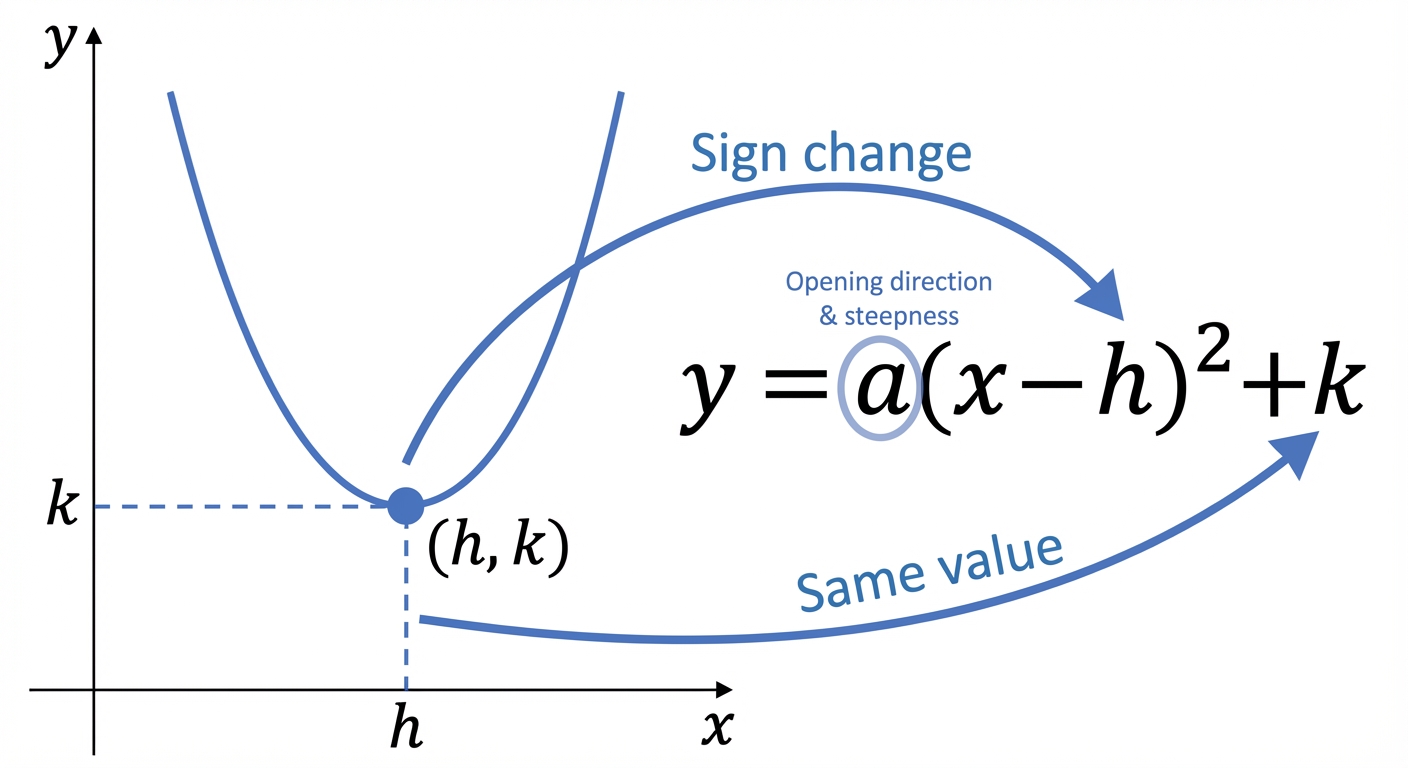
. Once you have it in the form , the vertex is right there at . Notice the sign flip for the x-coordinate! This is the ultimate cheat code for sketching parabolas and solving optimization problems.
Worked example
Worked Example: Finding the Vertex by Completing the Square
Let's Solve This Thing 🚀
Express in the form . Hence, state the coordinates of the vertex of the parabola.
- 1First up, the coefficient of isn't 1. We need to handle that by factoring out the 2 from the first two terms only. We'll let the `+5` just chill on the outside for a moment.
- 2Now, focus inside the bracket: . Take the coefficient of (which is -6), halve it to get -3, and square it to get 9. We'll now add and subtract this 9 inside the main bracket.
- 3The first three terms inside the bracket, , are now a perfect square. It's the moment we've been waiting for! This factorises neatly into .
- 4We need to get the `-9` out of the main bracket. To do that, we have to multiply it by the 2 on the outside. It's like it has to pay an exit fee. So, .
- 5We're on the home stretch. Just tidy up the constant terms at the end by combining them. . This is our final, polished completed square form.
- 6Now for the big reveal. We compare our result to . The vertex is . For us, that means we flip the sign of the number in the bracket (-3 becomes 3) and take the number on the end as is (-13). That's our vertex!
Answer
3. Using the Discriminant to Determine the Nature of Roots
Alright, let's talk about one of the coolest shortcuts in quadratics: the discriminant. You know the quadratic formula you have to memorize, ? Well, the part living inside the square root, , is the VIP. We call it the discriminant, and its job is to give you the lowdown on the 'nature of the roots' without you having to solve the whole thing. It's like checking the trailer before watching a whole movie – you get the vibe instantly.
Here's the breakdown:
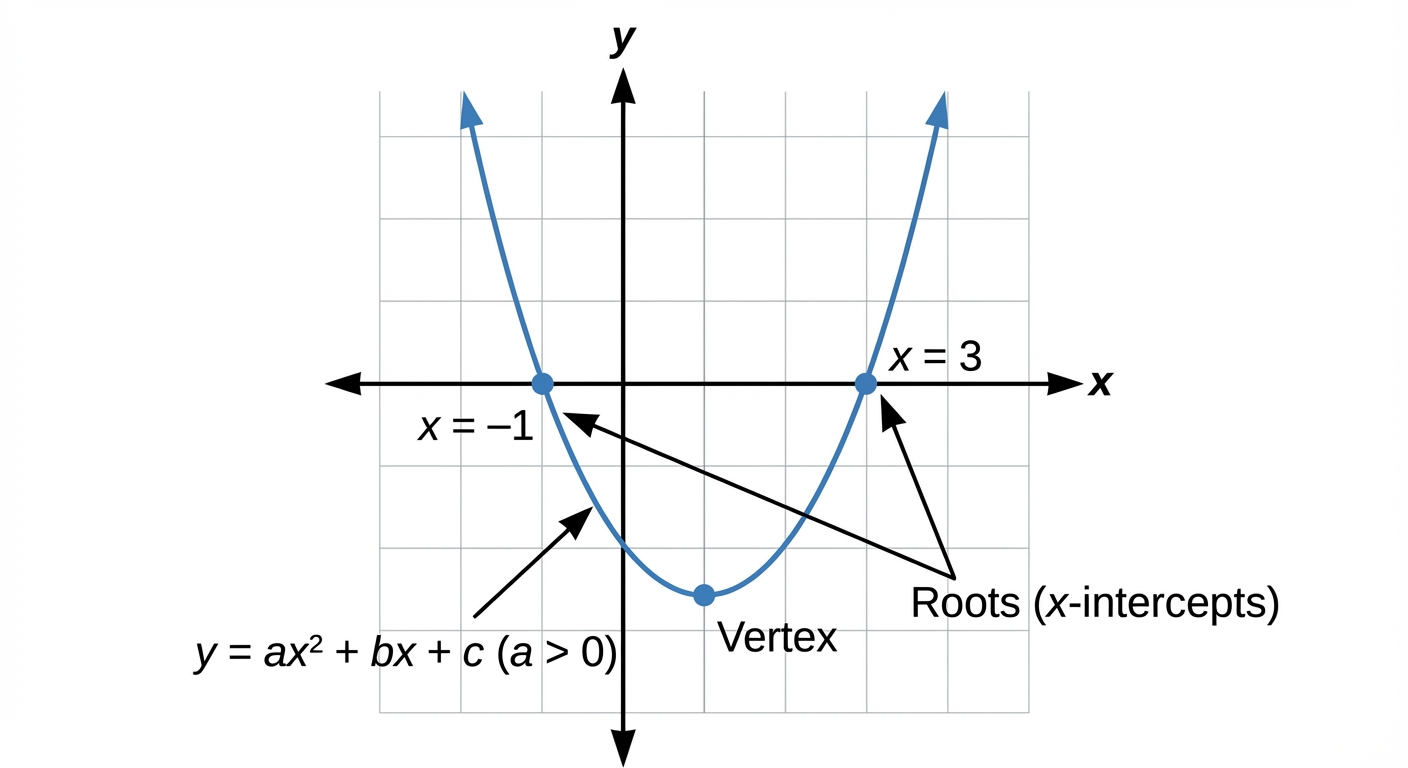
1. If : The discriminant is positive. This means you'll be square-rooting a positive number, and the sign will give you two different answers. So, you get two distinct real roots. The parabola graph for this equation will slice through the x-axis at two separate points. Think of it like getting two different party invites for Saturday night – you have options!
Here's the breakdown:
1. If : The discriminant is positive. This means you'll be square-rooting a positive number, and the sign will give you two different answers. So, you get two distinct real roots. The parabola graph for this equation will slice through the x-axis at two separate points. Think of it like getting two different party invites for Saturday night – you have options!
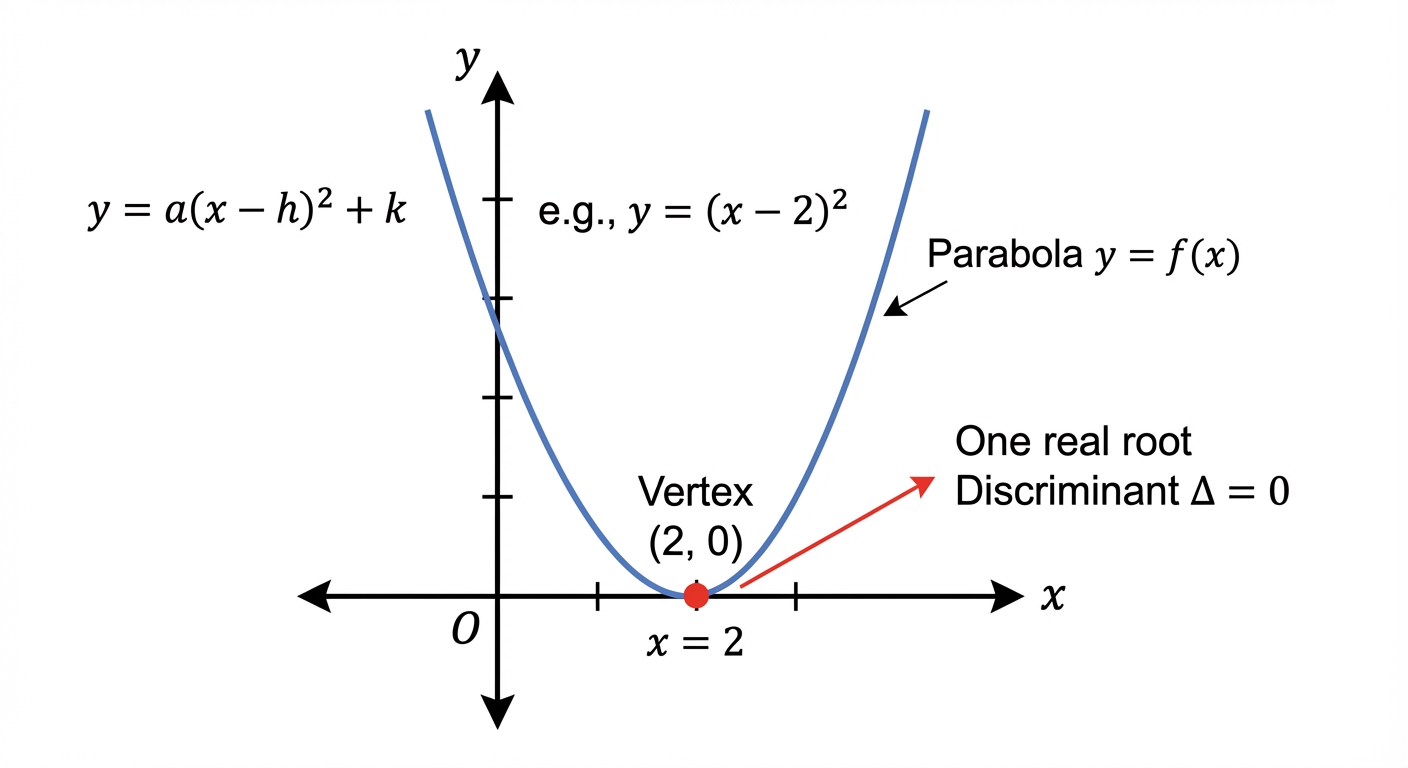
2. If : The discriminant is zero. The square root of zero is just zero, so the part of the formula vanishes. You're left with just one solution, . This is called one repeated real root. On a graph, the parabola just kisses the x-axis at its vertex. This is the critical condition for tangency. If a line is tangent to a curve, they meet at exactly one point, meaning the discriminant of their combined equation is zero. It's like your music stream getting stuck on repeat – same outcome every time.
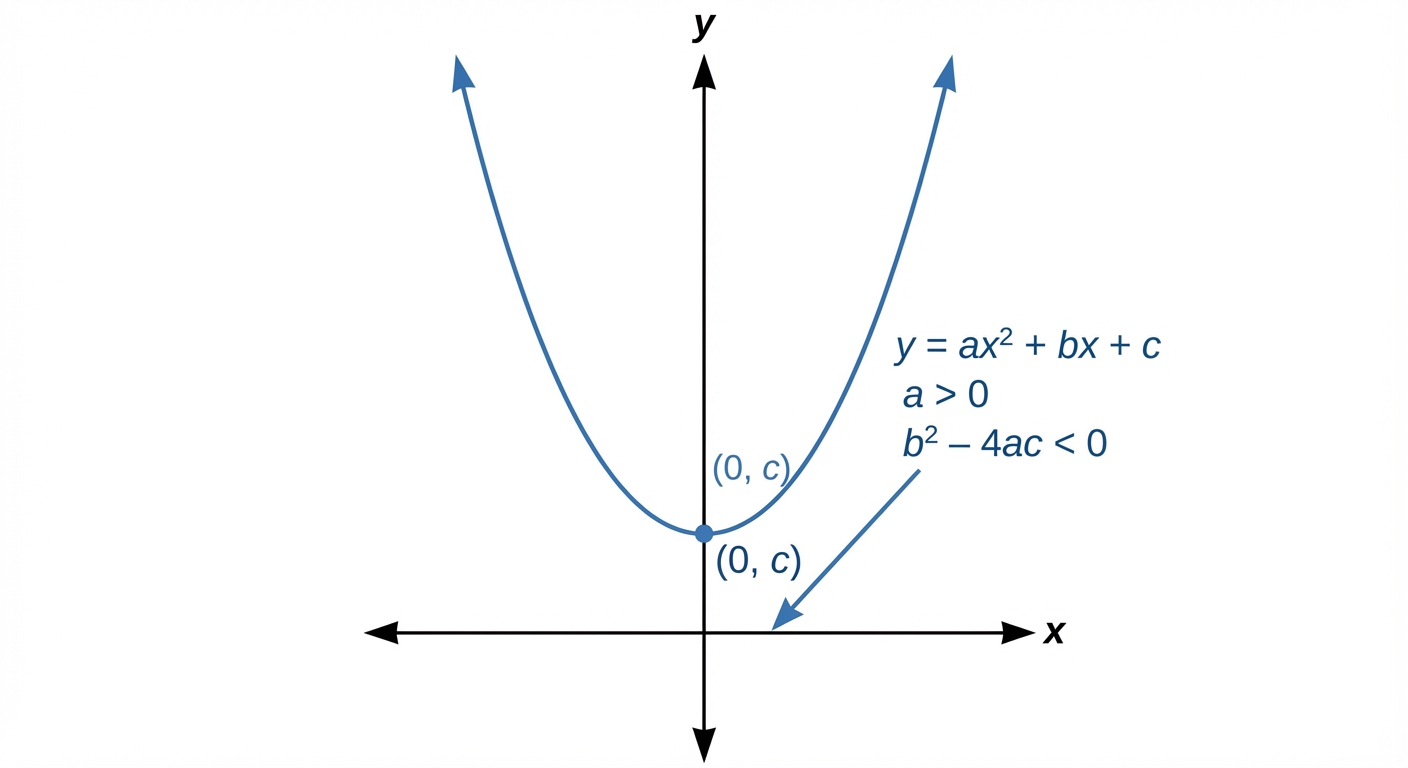
3. If : The discriminant is negative. Uh oh. You can't square root a negative number and get a real answer, right? It's like trying to find a parking spot at the mall five minutes before it closes – impossible. This means there are no real roots. The parabola graph will float entirely above or below the x-axis, never touching it. No solution, no intersection.
So, before you dive into solving, a quick check of can save you a ton of time and tell you exactly what kind of answer to expect. It’s a total game-changer, especially for those tricky 'find the value of k' problems.
Worked example
Worked Example: Finding Values for a Condition of Tangency
When a Line and a Curve Just Barely Touch 🤝
The line is tangent to the curve . Find the possible values of the constant .
- 1First up, let's unpack the word 'tangent'. It's a huge clue! It means the line and the curve meet at exactly one point. To find intersection points, we always set the equations equal to each other. This will create a new quadratic, which must have exactly one repeated root.
- 2Now, we need to shuffle everything over to one side to get it into the classic format. Be careful when you're combining the terms with .
- 3Since there's only one root (tangency!), we know the discriminant must be zero. Let's identify our and from the equation we just made. Here, , , and .
- 4Time to substitute these values into the discriminant equation. Don't forget that squaring the negative term will make it positive.
- 5Let's simplify and solve this new equation for . It's a simple quadratic in terms of .
- 6Now, we just need to take the square root of both sides to find the possible values for . Remember the ! The answer can be left in surd form unless specified otherwise.
Answer
4. Solving Quadratic Inequalities
Alright, let's level up from solving regular quadratic equations. With inequalities, we're not just looking for a couple of specific answers; we're finding a whole range of values where the condition is true. Think of it like finding the exact time window when your favorite artist's new track is in the top 10—it's a range, not just a single moment.
The game plan is simple but you've got to be precise. First, get everything onto one side of the inequality, so you have something like or . This sets the stage. Next, find the critical values. This is a key term, and it just means you solve the related equation, , to find the roots. These critical values are the points where the quadratic graph crosses the x-axis—they're the boundaries of your 'winning zone'.
Now for the most important part: deciding which side of the boundaries is the solution. The most reliable way to do this is to sketch the parabola. Seriously, don't skip this step! First, check the term. Is the coefficient 'a' positive? Then you've got a 'happy' U-shaped parabola. Is 'a' negative? It's a 'sad' n-shaped parabola.
The game plan is simple but you've got to be precise. First, get everything onto one side of the inequality, so you have something like or . This sets the stage. Next, find the critical values. This is a key term, and it just means you solve the related equation, , to find the roots. These critical values are the points where the quadratic graph crosses the x-axis—they're the boundaries of your 'winning zone'.
Now for the most important part: deciding which side of the boundaries is the solution. The most reliable way to do this is to sketch the parabola. Seriously, don't skip this step! First, check the term. Is the coefficient 'a' positive? Then you've got a 'happy' U-shaped parabola. Is 'a' negative? It's a 'sad' n-shaped parabola.
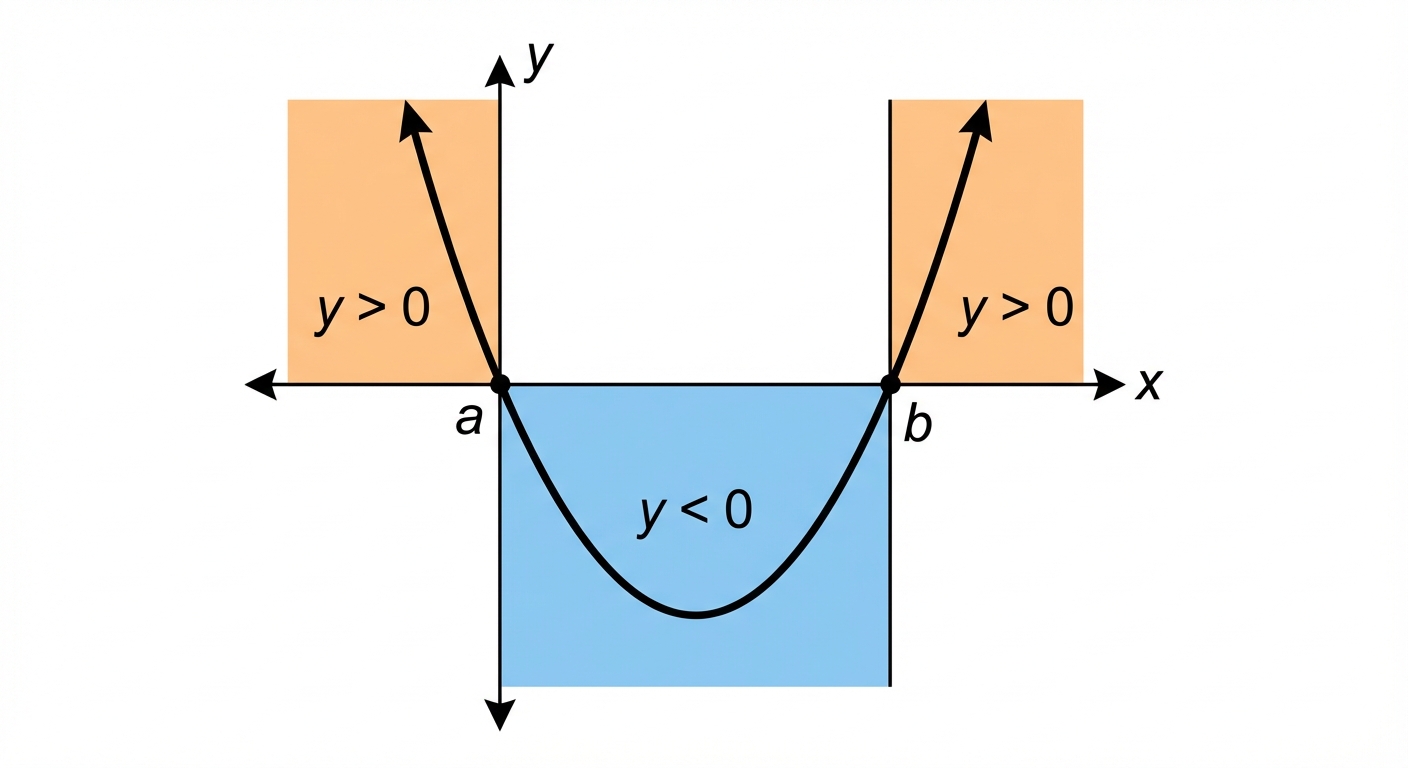
Mark your critical values on the x-axis and draw the correct shape passing through them. If your inequality was , you want the parts of the graph that are above the x-axis. If it was , you're looking for the part below the x-axis. This visual check tells you if your answer should be a single range between the critical values (like ) or two separate regions shooting outwards (like or ). Getting this right is the difference between passing the level and starting over. 😉
Worked example
Worked Example: Solving a Quadratic Inequality
Let's Crack This Code
Find the set of values of for which .
- 1First up, we need to find the 'critical values'. To do this, we pretend the inequality is an equation and solve it to find the x-intercepts.
- 2Let's factorize the quadratic to find the roots. We're looking for two numbers that multiply to -12 and add to -1.
- 3Now, we sketch the graph of . Since the coefficient of is positive (it's 1), we know it's a U-shaped ('happy') parabola that crosses the x-axis at -3 and 4.\text{Visual aid: Imagine a U-shaped curve passing through x = -3 and x = 4.}
- 4The original inequality was . The '> 0' part means we want to find where the graph is above the x-axis. Looking at our sketch, this happens in two separate regions: to the left of -3 and to the right of 4.\text{Regions identified on the sketch are where y > 0.}
- 5Finally, we write this down as our solution. Remember to use 'or' because x can't be in both places at once. It's either in one zone or the other. This is the final answer format the examiners are looking for!
Answer
5. Solving Simultaneous Linear and Quadratic Equations
Alright, let's talk about simultaneous equations. You've seen them before with two linear equations, where you find the one spot two straight lines cross. But what happens when one of them decides to be extra and curve? That's where a linear-quadratic system comes in. Think of it like this: you're walking in a straight line to your part-time job (that's your linear equation, ), and your friend is practicing a kickflip on a skateboard, moving in a parabolic arc (your quadratic equation, ). The points where you could high-five are the solutions! These are literally the points of intersection on a graph.
The game plan is all about substitution. It's like taking a piece of info from one friend's message (the linear equation) and pasting it into a group chat (the quadratic equation) to make sense of everything. Your goal is to mash the two equations together to create a single quadratic equation with only one variable. The easiest way is to rearrange the linear equation to get 'y' by itself (or 'x', whatever's simpler) and then substitute that expression into the 'y' spot in the quadratic equation.
The game plan is all about substitution. It's like taking a piece of info from one friend's message (the linear equation) and pasting it into a group chat (the quadratic equation) to make sense of everything. Your goal is to mash the two equations together to create a single quadratic equation with only one variable. The easiest way is to rearrange the linear equation to get 'y' by itself (or 'x', whatever's simpler) and then substitute that expression into the 'y' spot in the quadratic equation.
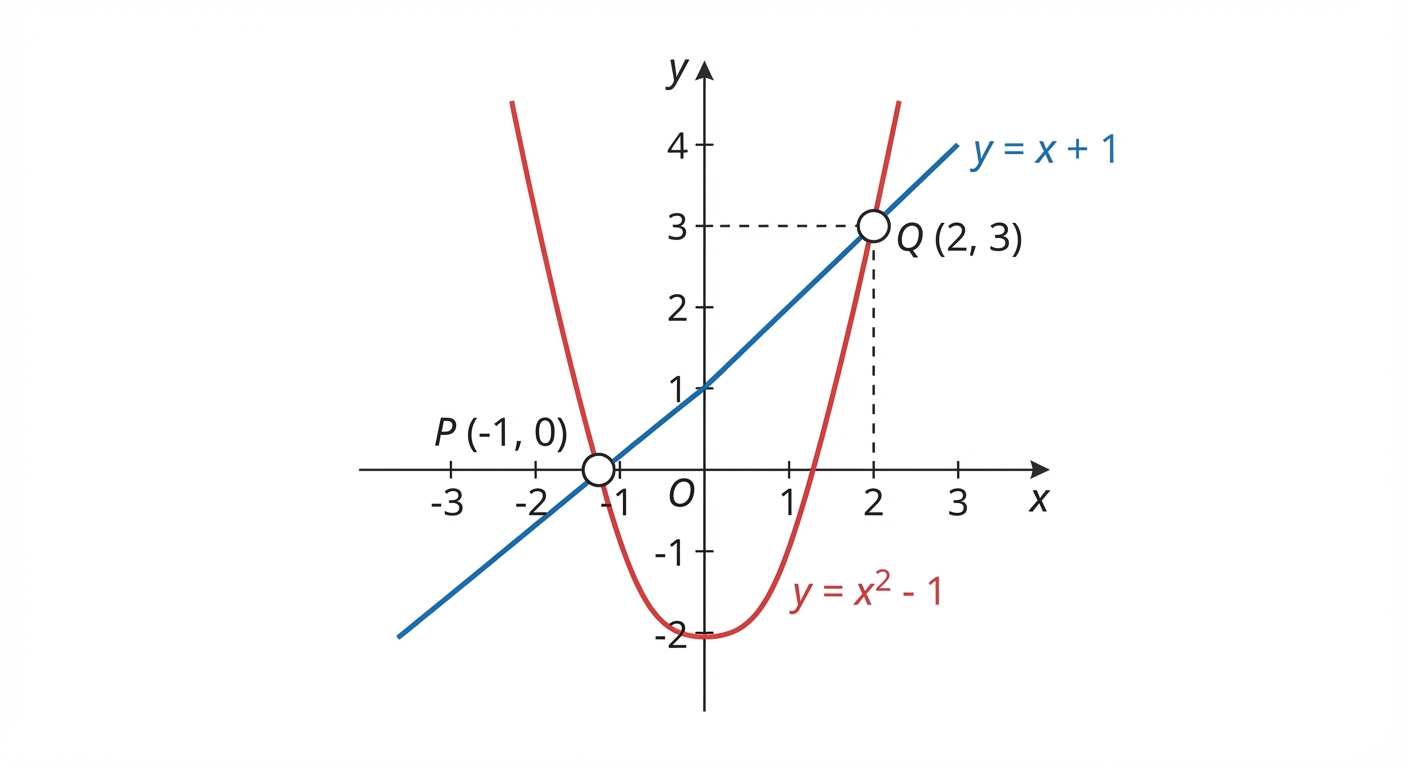
Once you've done the substitution, you'll have a standard quadratic equation to solve. You can factorise it, use the quadratic formula – whatever your go-to move is. Solving this will give you the x-coordinate(s) of the intersection points. But wait, don't forget their partners! Each x-value has a corresponding y-value. To find them, sub your x-values back into the original linear equation (trust me, it's way easier). You might get two solutions, one solution (if the line just grazes the curve, like a tangent), or no real solutions (they completely miss each other). And that's it – you've found the exact coordinates where the line and the curve meet. 🎯
Worked example
Worked Example: Intersection of a Line and a Parabola
Let's Find Where They Meet Up ✨
Find the coordinates of the points of intersection of the line and the curve .
- 1First up, we need to get one variable by itself in the linear equation so we can substitute. Rearranging is super easy. Let's just move the over.
- 2Now for the main event: substitution. We're going to replace the 'y' in the quadratic equation with the expression we just found (). This combines the two equations into one that only has 'x' in it.
- 3Time to tidy this up. Let's move everything to one side to get a classic quadratic equation in the form .
- 4Solve for ! This quadratic looks nice and clean. We can factorise it. Notice that it's a perfect square.
- 5We only got one x-value, which means the line is a tangent to the curve (it touches at exactly one point). Now, don't ghost the y-value! Sub back into our easy linear equation () to find its partner.
- 6And we're done! State the final answer as a coordinate pair. This is the single point where the line and the curve touch.
Answer
6. Equations Reducible to Quadratic Form
Alright, let's talk about equations that are basically catfishing you. They show up looking all complicated and scary, like some insane higher-power polynomial, but underneath it all, they're just a simple quadratic in disguise. This is what we call 'Equations Reducible to Quadratic Form'. Think of it like this: you see an equation with terms like and , or maybe even and . The key is to spot a pattern. The power of one variable term is exactly double the power of another. For example, in , you can see that the power is double the power . This is our signal!
When you spot this, your secret weapon is substitution. It's like creating a custom character in a game to simplify a quest. We introduce a new variable, usually , to stand in for the 'middle' term. So, for the equation above, we'd say, 'Let '. If we do that, what does become? Well, , so it becomes . Suddenly, our intimidating equation transforms into a familiar friend: . Easy, right?
When you spot this, your secret weapon is substitution. It's like creating a custom character in a game to simplify a quest. We introduce a new variable, usually , to stand in for the 'middle' term. So, for the equation above, we'd say, 'Let '. If we do that, what does become? Well, , so it becomes . Suddenly, our intimidating equation transforms into a familiar friend: . Easy, right?
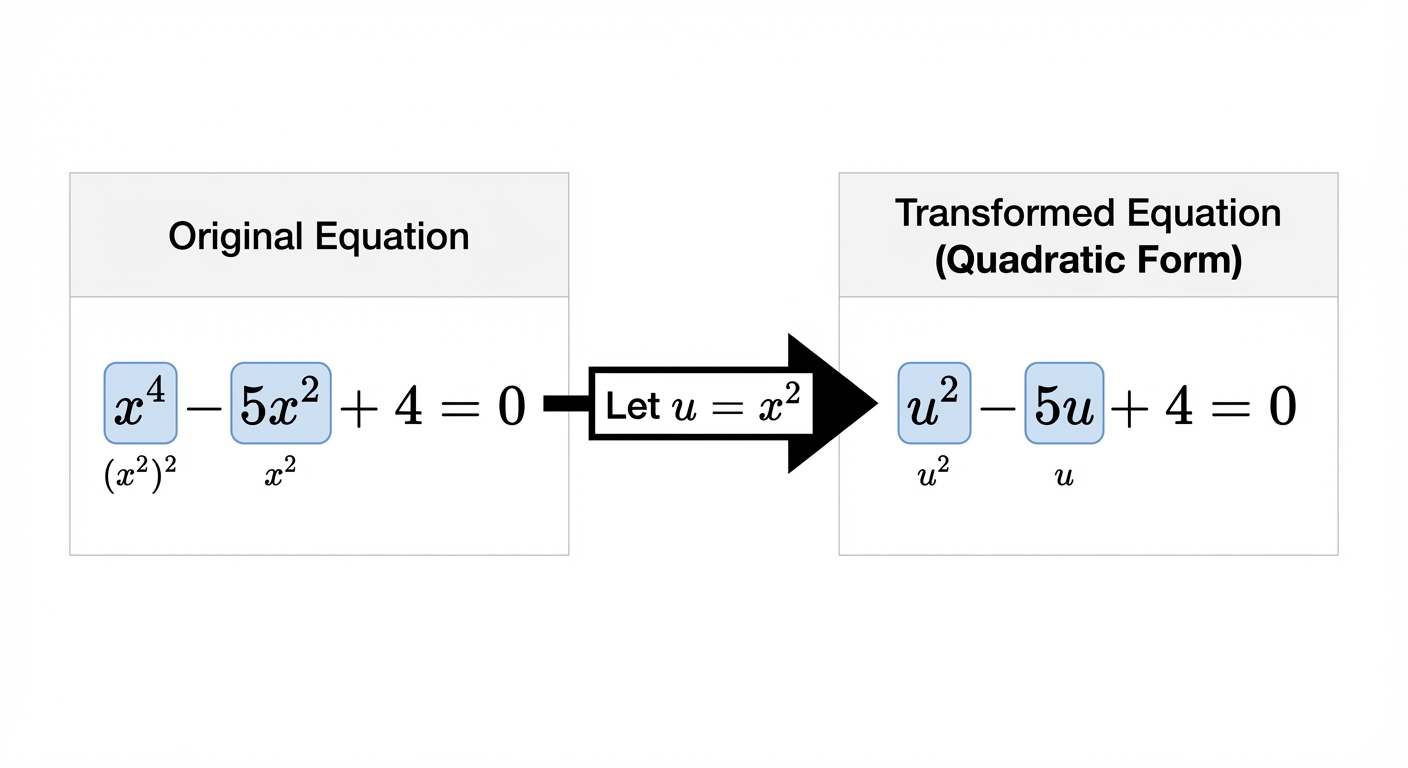
From here, you just solve for like any normal quadratic. But—and this is super important, don't scroll past this part like it's a T&Cs update—you're not done yet! You found , but the original question wants . So, you have to substitute back. If you found , you have to go back to your original substitution () and solve . This gives you . Always remember to go back and find the original variable. Forgetting this step is like winning the game but forgetting to save. 😅
Worked example
Worked Example: Solving a Quartic Equation via Substitution
Unmasking the Impostor Equation 🕵️♀️
Solve the equation .
- 1Recognise the quadratic form. Notice that the power of the first term () is double the power of the second term (). This is our clue that we can use a substitution. It's basically a quadratic hiding in a trench coat.
- 2Introduce a substitution. Let's use the variable to simplify things. We'll set equal to the middle variable term, . Then we rewrite the entire equation using .
- 3Solve the new quadratic equation for . We can solve this by factoring. We're looking for two numbers that multiply to and add to . That's and .
- 4Substitute back to find . This is the final boss level! We found the values for , but we need to find . We use our original substitution, , for each value of we found. Don't forget the when you square root!
- 5State the final solutions. We've found four possible values for . It's always a good idea to list them all out clearly. And that's it, you've unmasked the quadratic!
Answer
7. Transforming Quadratic Expressions by Completing the Square
Alright, let's talk about one of the most powerful tools in your quadratic toolkit: Completing the Square. It sounds a bit like a weird DIY project, but it's actually a slick algebraic move that transforms a standard quadratic into the much more revealing vertex form, . Why is this form so great? Because it literally hands you the coordinates of the vertex (the turning point) on a silver platter: . This is mission-critical for sketching graphs, solving optimization problems (like finding the maximum height of a projectile), and is a gateway concept for more advanced topics like conic sections you'll see later.
So, how do we do this 'glow-up'? For a simple case like (where ), the trick is to create a perfect square. You take half of the coefficient, , square it, and then add and subtract it so you don't actually change the expression's value. This gives you plus some leftover constant. When , there's just one extra step at the start: factor out of the first two terms, , and then complete the square inside the bracket.
So, how do we do this 'glow-up'? For a simple case like (where ), the trick is to create a perfect square. You take half of the coefficient, , square it, and then add and subtract it so you don't actually change the expression's value. This gives you plus some leftover constant. When , there's just one extra step at the start: factor out of the first two terms, , and then complete the square inside the bracket.
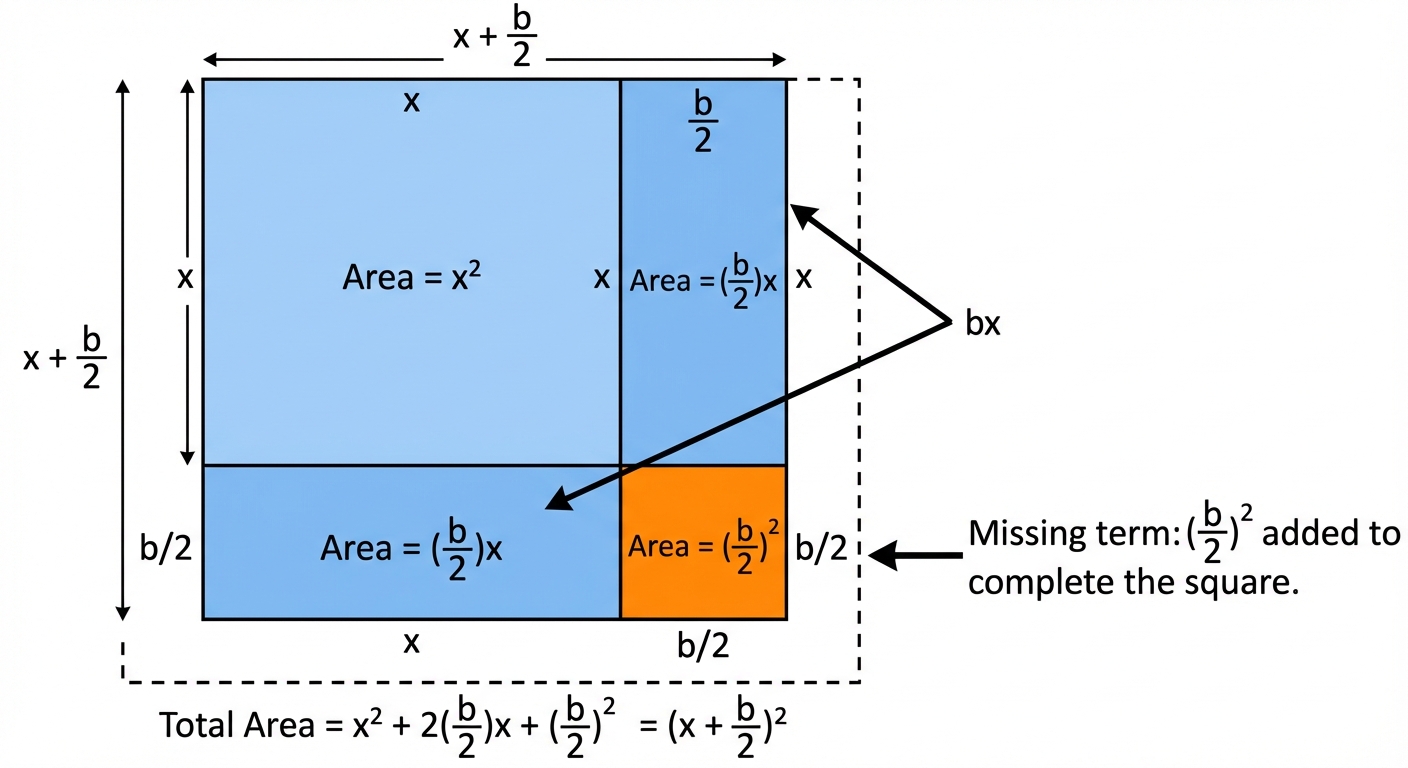
Remember, the sign of 'a' tells you everything about the parabola's mood: if , it's a happy U-shape with a minimum point; if , it's a sad n-shape with a maximum point. Mastering this isn't just about passing P1; it's a fundamental skill that underpins the quadratic formula and will pop up again in university-level calculus and engineering. It’s your algebraic superpower. 🦸♂️
Worked example
Worked Example: Finding the Vertex and Nature of a Quadratic Function
Let's Wrestle This Quadratic Into Shape 💪
Express the function in the form . Hence, state the coordinates of the vertex and determine whether it is a minimum or maximum point.
- 1First, we need to isolate the term. We do this by factoring the coefficient of (which is 3) out of the first two terms only. Leave the constant term alone for now.
- 2Now, focus inside the bracket. To complete the square for , we take half the coefficient of (which is ) and square it to get . We then add and subtract this value inside the bracket to keep the expression balanced.
- 3The first three terms inside the bracket now form a perfect square. We can factorise this. The '-4' term needs to be moved outside the main bracket, but don't forget to multiply it by the 3 we factored out in step 1. This is the most common mistake!
- 4Finally, simplify the constant terms outside the bracket to get our final completed square form.
- 5By comparing our result to the form , we can identify the vertex and its nature. Be careful with the sign of . Since is positive, the parabola is a 'U' shape, meaning the vertex is a minimum point.
Answer
8. The Discriminant and the Nature of Roots
Alright, let's dive into one of the most elegant concepts in P1: the discriminant. Think of it as a high-level diagnostic tool for any quadratic equation in the form . Before you even start the heavy lifting of solving it, the discriminant tells you the nature of the roots—that is, how many real solutions you can expect. This is a massive shortcut and shows a deeper understanding of quadratic behaviour.
The discriminant is the expression found under the square root in the quadratic formula: . Its value determines everything because we can't get a real number by square-rooting a negative. This simple fact is the key to it all.
Here's the official breakdown you need for your exams:
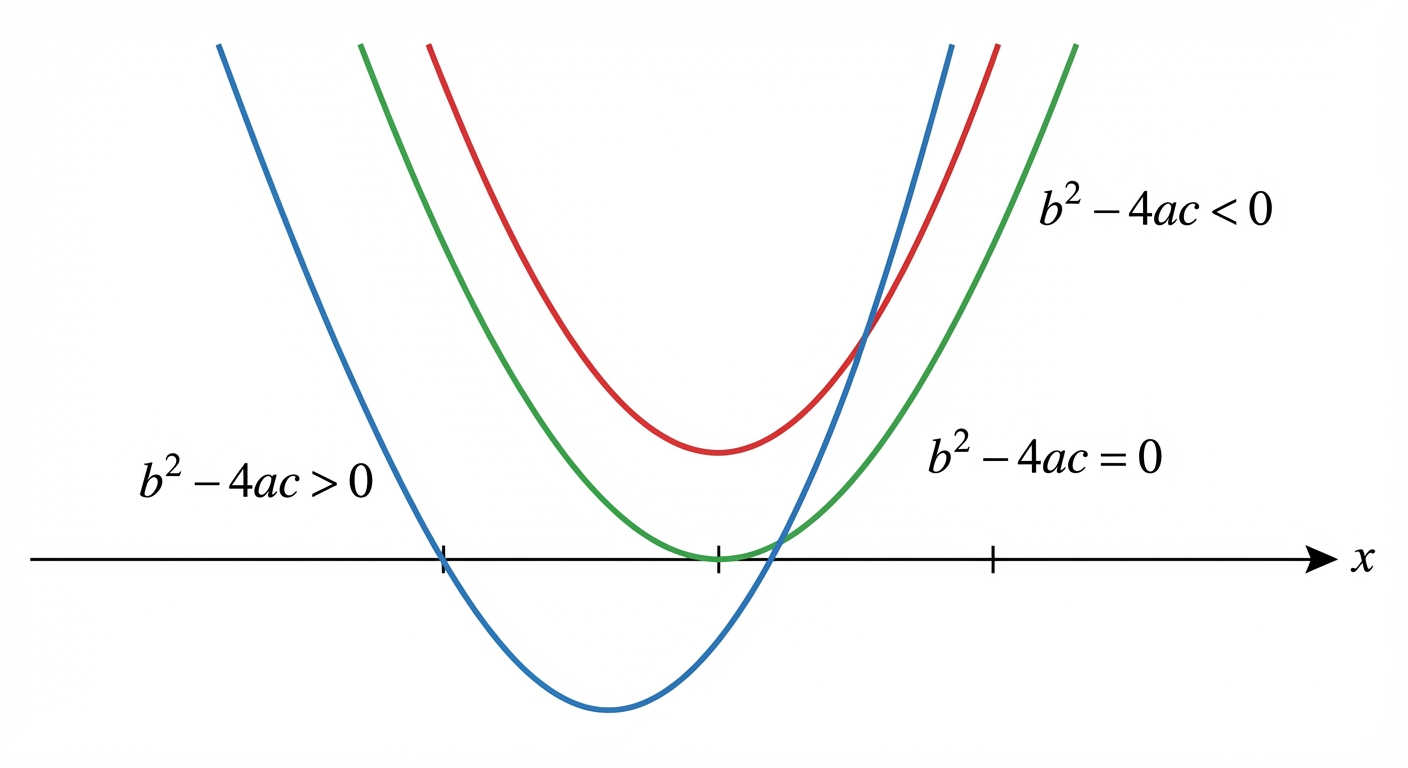
1. If : The value under the square root is positive, so you'll get a real number. The '' in the quadratic formula ensures you get two distinct real roots. Graphically, this means the parabola intersects the x-axis at two separate points.
2. If : The square root term is zero. Adding or subtracting zero doesn't change anything, so you get one repeated real root. This is the critical condition for tangency, where a line just touches a curve at a single point (the vertex of the parabola lies on the x-axis). This concept is fundamental in mechanics and optimisation problems you'll encounter at university.
3. If : You're trying to square root a negative, which yields no real solutions. This means there are no real roots. The parabola completely misses the x-axis, floating either entirely above or entirely below it.
The discriminant is the expression found under the square root in the quadratic formula: . Its value determines everything because we can't get a real number by square-rooting a negative. This simple fact is the key to it all.
Here's the official breakdown you need for your exams:
1. If : The value under the square root is positive, so you'll get a real number. The '' in the quadratic formula ensures you get two distinct real roots. Graphically, this means the parabola intersects the x-axis at two separate points.
2. If : The square root term is zero. Adding or subtracting zero doesn't change anything, so you get one repeated real root. This is the critical condition for tangency, where a line just touches a curve at a single point (the vertex of the parabola lies on the x-axis). This concept is fundamental in mechanics and optimisation problems you'll encounter at university.
3. If : You're trying to square root a negative, which yields no real solutions. This means there are no real roots. The parabola completely misses the x-axis, floating either entirely above or entirely below it.
Understanding the discriminant isn't just about solving for x; it's about analysing the structure of an equation, a core skill for any future mathematician, engineer, or economist.
Worked example
Worked Example: Determining Tangency Conditions
Solving the Mystery of the Unknown Constant 'k' 🕵️♀️
The line is a tangent to the curve . Find the possible values of .
- 1To find where the line and curve meet, we equate their -values. This combines them into a single equation whose solutions represent the x-coordinates of their intersection points.
- 2The discriminant only works for quadratics in the standard form . So, we need to rearrange our equation by moving all terms to one side. Pay close attention to grouping the terms with .
- 3Now we can clearly identify our coefficients , , and . Notice that the coefficient 'b' now contains our unknown constant, .
- 4Here's the crucial insight. The word 'tangent' implies there is exactly one point of intersection. For a quadratic equation, this means there is one repeated real root. The condition for this is that the discriminant must be equal to zero.
- 5Substitute the expressions for , , and into the discriminant equation. This creates a new equation that we can solve to find the required values of .
- 6Solve the resulting equation for . This is a difference of two squares, or you can square root both sides. Remember to consider both the positive and negative square roots!
Answer
9. Solving Quadratic Inequalities
Alright, let's level up from quadratic equations to quadratic inequalities. With an equation like , you're finding the exact points where the parabola hits the x-axis. With an inequality like , you're finding the entire range or set of values for where the parabola is above the x-axis. Think of it as finding all the x-coordinates where a rollercoaster is above ground level, not just where it enters a tunnel.
The absolute golden rule here is: you cannot solve this like a simple linear inequality. The most reliable, exam-proof method involves three steps. First, find the critical values by temporarily treating the inequality as an equation and solving for its roots (using factorisation or the quadratic formula). These values are the boundaries of your solution regions. Second, and this is non-negotiable for getting full marks, sketch the parabola. Is the coefficient of positive? Then it's a U-shaped 'happy' parabola. Is it negative? Then it's an n-shaped 'sad' parabola. Mark your critical values on the x-axis and draw the curve passing through them.
The absolute golden rule here is: you cannot solve this like a simple linear inequality. The most reliable, exam-proof method involves three steps. First, find the critical values by temporarily treating the inequality as an equation and solving for its roots (using factorisation or the quadratic formula). These values are the boundaries of your solution regions. Second, and this is non-negotiable for getting full marks, sketch the parabola. Is the coefficient of positive? Then it's a U-shaped 'happy' parabola. Is it negative? Then it's an n-shaped 'sad' parabola. Mark your critical values on the x-axis and draw the curve passing through them.
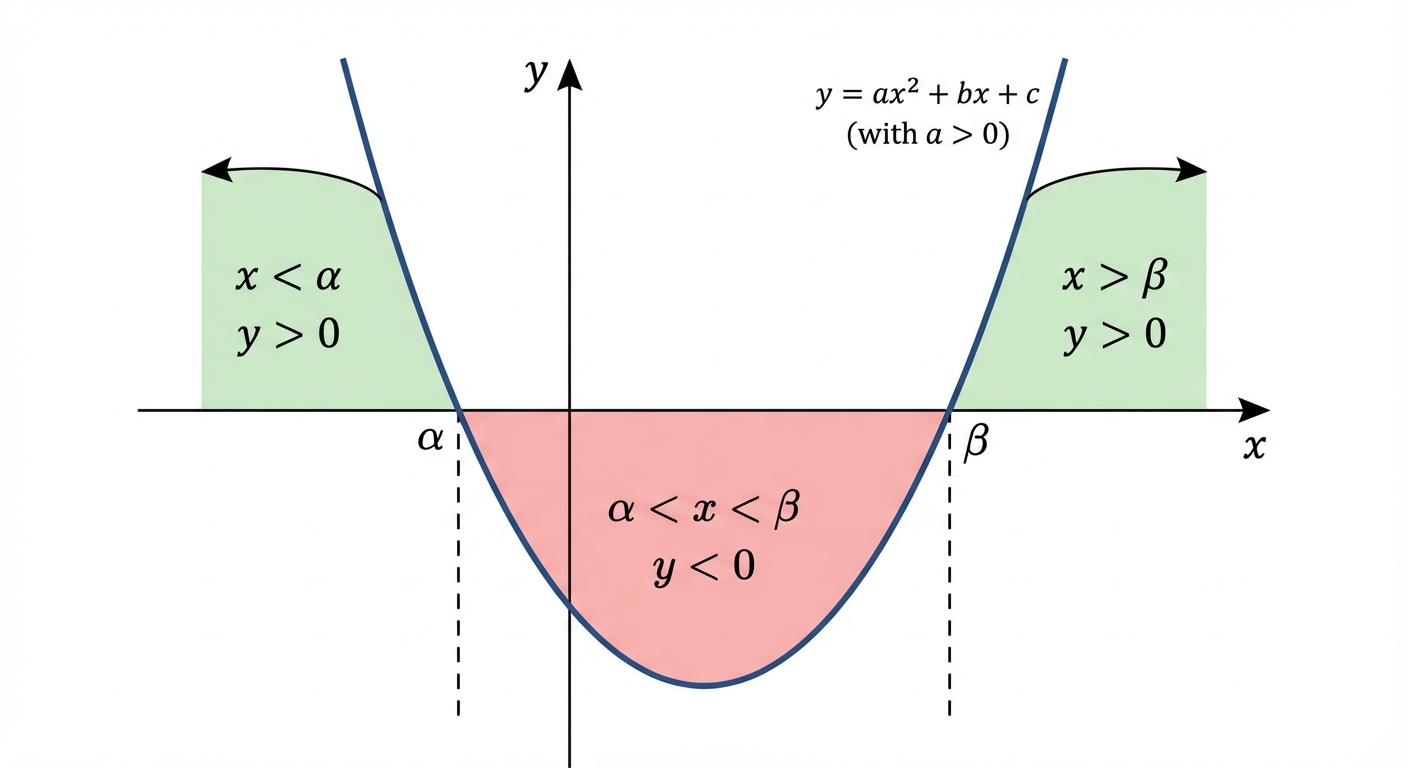
Third, use your sketch to identify the correct region. If your inequality is 0 or 0, you're looking for where the curve is above or on the x-axis. If it's 0 or 0, you need the part below or on the axis. This visual method is far superior to just 'testing values' as it gives you a clear picture of the solution, which is a skill essential for further calculus and function analysis at university.
Worked example
Worked Example: Solving a Quadratic Inequality
Let's put the theory into practice! 💪
Find the set of values of for which .
- 1First, we need to find the critical values. To do this, we solve the corresponding equation . We can try to factorise this.
- 2Next, we sketch the graph of . The coefficient of is 2, which is positive, so we have a U-shaped 'happy' parabola. It will cross the x-axis at our critical values.[IMAGE_PLACEHOLDER_2: A simple sketch of a U-shaped parabola. It is shown crossing the x-axis at x=-4 on the left and x=1.5 on the right.]
- 3Now we consult the original inequality, which was . The '< 0' means we are interested in the region where the parabola is below the x-axis. Looking at our sketch, this is the single region between our two critical values.
- 4Finally, we write down our solution as a single inequality. Since the solution is the region between the critical values, we express it as a compound inequality. This is the final set of values that satisfies the condition.
Answer
10. Solving Simultaneous Linear and Quadratic Equations
Alright, let's get into one of the foundational concepts you'll use constantly. Solving simultaneous linear and quadratic equations is essentially the algebraic method for finding out where a straight line and a parabola intersect on a graph. Think of it as finding the exact coordinates where their paths cross. This is crucial not just for your P1 exam, but for future studies in engineering, physics, and economics, where you'll model the interaction between different systems (e.g., a projectile's trajectory meeting a flat surface).
The game plan is almost always substitution. You're given two equations, one linear (like ) and one quadratic (like ). The strategy is to rearrange the linear equation to make one variable the subject (usually , as it's often the easiest). Then, you substitute this linear expression into the quadratic equation in place of that variable. This clever move eliminates one variable, leaving you with a single quadratic equation in terms of the other (e.g., all in ).
Once you have that new quadratic, you solve it just like any other. The solutions for represent the x-coordinates of the intersection points. But don't stop there! A common mistake is forgetting to find the corresponding y-coordinates. You must substitute each x-value back into the original linear equation (it's simpler and less prone to errors) to find its partner -value. The number of solutions you get for tells you how the line and curve interact:
The game plan is almost always substitution. You're given two equations, one linear (like ) and one quadratic (like ). The strategy is to rearrange the linear equation to make one variable the subject (usually , as it's often the easiest). Then, you substitute this linear expression into the quadratic equation in place of that variable. This clever move eliminates one variable, leaving you with a single quadratic equation in terms of the other (e.g., all in ).
Once you have that new quadratic, you solve it just like any other. The solutions for represent the x-coordinates of the intersection points. But don't stop there! A common mistake is forgetting to find the corresponding y-coordinates. You must substitute each x-value back into the original linear equation (it's simpler and less prone to errors) to find its partner -value. The number of solutions you get for tells you how the line and curve interact:
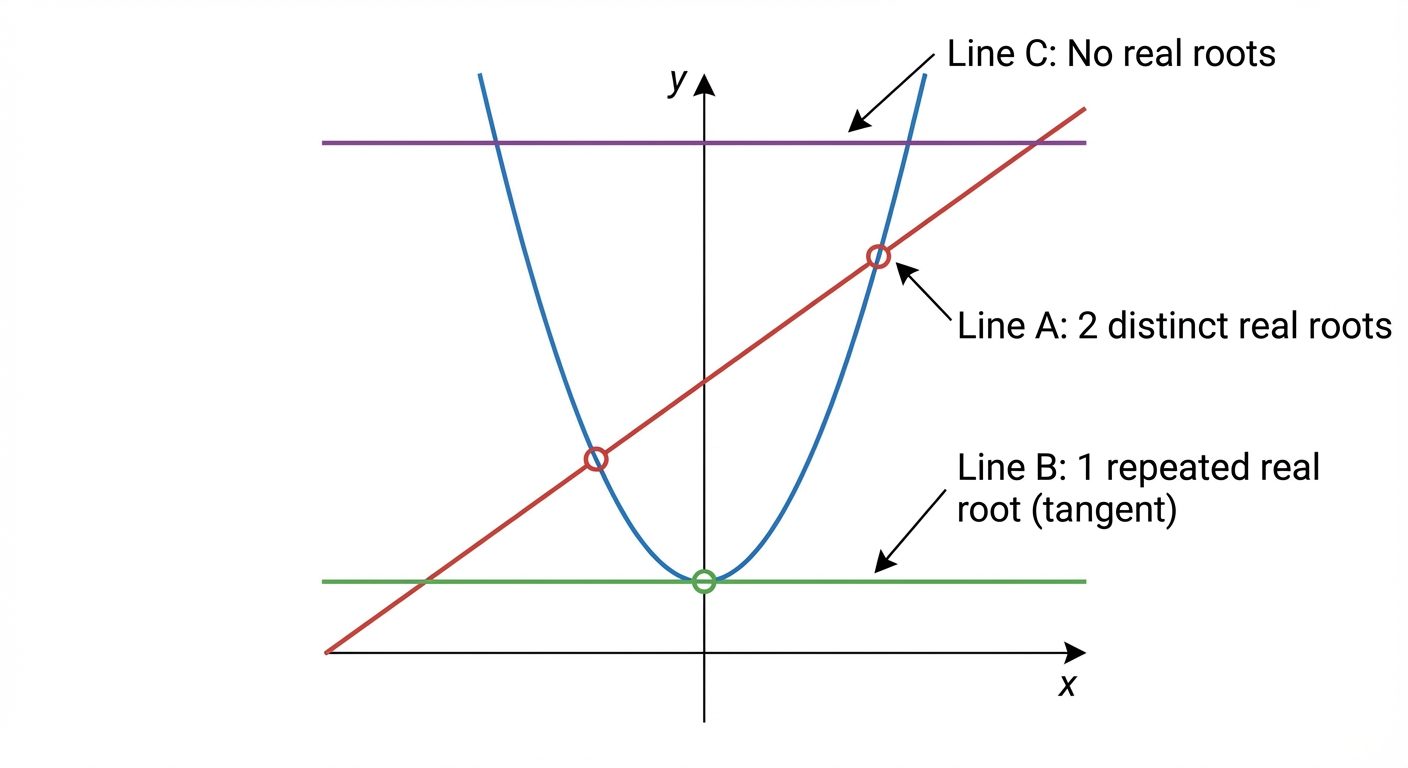
So, to recap the process: 1. Isolate a variable in the linear equation. 2. Substitute into the quadratic equation. 3. Solve the resulting quadratic. 4. Find the corresponding coordinates. Master this, and you've got a key skill locked down for your exams and beyond.
Worked example
Worked Example: Finding Points of Intersection
Let's Get These Coordinates! 🚀
Find the coordinates of the points of intersection of the line and the curve .
- 1First, we identify our two equations. Since both are already in the form , we can set the right-hand sides equal to each other. We are essentially substituting the expression for from the linear equation into the quadratic equation.
- 2Now, we need to rearrange this equation into the standard quadratic form . We do this by moving all the terms to one side, leaving zero on the other.
- 3Solve the resulting quadratic equation for . This one looks like it can be factorised easily. We need two numbers that multiply to and add to . That would be and .
- 4We're not done yet! These are just the x-coordinates. We need to find the corresponding y-coordinates for each value of . We substitute them back into the original linear equation () because it's much simpler.
- 5Finally, state your answer clearly as coordinate pairs. These are the two points where the line and the parabola intersect.
Answer
11. Equations Reducible to Quadratic Form
Alright, let's talk about one of the coolest tricks in your P1 toolkit: spotting and solving equations that are secretly quadratics. Think of it like recognizing a superhero's alter ego – the equation looks different, but underneath it has the classic structure. The official term is 'reducible to quadratic form', which means we can perform a clever substitution to transform a scary-looking equation into a familiar, solvable quadratic. The key is to look for a pattern where one term is the square of another. For example, in an equation with and , you can see that . Or in an equation with and , you can see that .
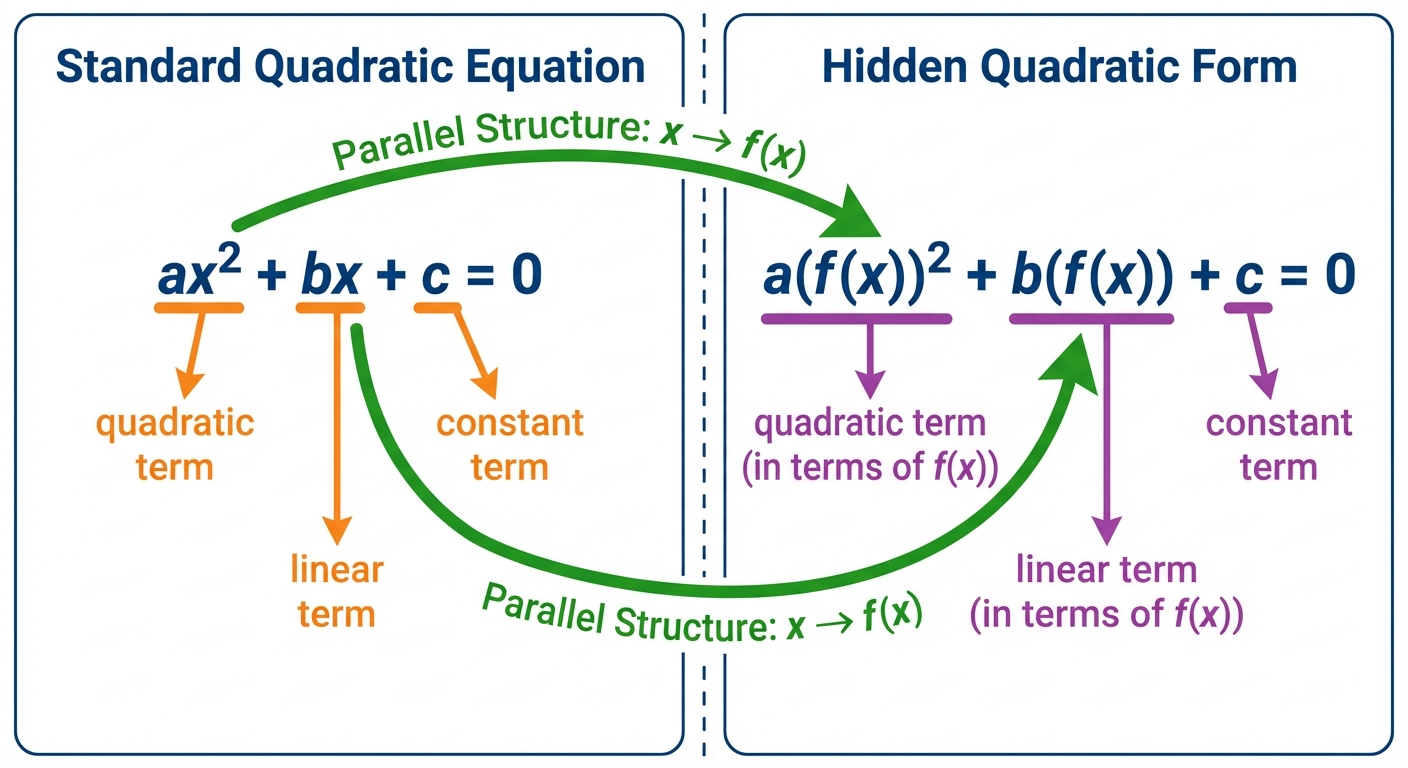
Once you spot this relationship, you introduce a temporary variable, often , to stand in for the 'base' function. So, if you have , you'd let and rewrite it as the much friendlier . You then solve for , but don't forget the final, crucial step: you must substitute back to find the values for the original variable, . This skill is a gateway to solving more complex problems in mechanics, further pure maths, and even university-level engineering, where complex systems often simplify down to these fundamental patterns.
Worked example
Worked Example: Solving a Quartic Equation via Substitution
Unmasking the Imposter Equation 🕵️♀️
Solve the equation .
- 1First, we need to spot the 'disguise'. Notice that the power of the first term () is double the power of the second term (). This is our big clue! We can write as . This structure allows us to make a substitution to simplify the equation.
- 2Now, we rewrite the entire original equation using our new variable, . This transforms the intimidating quartic equation (degree 4) into a standard quadratic equation that we know exactly how to solve.
- 3Solve this new quadratic for . We can try to factorise it. We're looking for two numbers that multiply to and add to . That would be and .
- 4This is the crucial final stage that many people forget! We've found the values for , but the original question asked for . We must substitute back using our initial definition, .
- 5Finally, we solve for from the valid case(s). Remember to include both the positive and negative square roots. This is a common place to lose a mark in an exam.
Answer
Practice this in the app
Unlock the full chapter: practice questions, flashcards, mock papers and notes, free.
Continue revising