M1: Forces and Equilibrium
The Art of Staying Still: Mastering Forces ⚖️
Introduction
1. Introduction
Welcome to the world of Mechanics! Ever wondered how a bridge stays up or why an object on a slope doesn't always slide down? It's all about forces. In this chapter, we're going to dive into the core principles that govern how objects interact. We'll start by learning how to break down forces into manageable pieces by resolving them. Then, we'll see what happens when all these forces perfectly balance out, a state we call Equilibrium. Of course, the real world isn't frictionless, so we'll tackle the gritty details of Friction and the crucial concept of Limiting Equilibrium. Finally, we'll wrap up with one of the most fundamental laws of physics: Newton's Third Law, which explains the 'action-reaction' pairs you see everywhere. Let's get this done!
2. Resolving Forces into Perpendicular Components
Alright, let's get into one of the most crucial skills in Mechanics: resolving forces. Think of it this way: a force acting at a weird angle is like trying to convince your parents to let you go to a festival by listing 10 different reasons all at once – it's messy and hard to see the main point. Resolving a force is like breaking down your argument into two clear, powerful points: 'It's safe' and 'It's a great experience'. In physics, we do the same by splitting a single diagonal force, , into two separate, perpendicular components, usually horizontal () and vertical (). Why? Because forces acting at right angles to each other don't interfere with one another, making calculations so much easier. It's the ultimate 'divide and conquer' strategy for complex problems.
The magic behind this lies in basic trigonometry (your old friend SOH CAH TOA). If a force acts at an angle to the horizontal, you can imagine it as the hypotenuse of a right-angled triangle.
The magic behind this lies in basic trigonometry (your old friend SOH CAH TOA). If a force acts at an angle to the horizontal, you can imagine it as the hypotenuse of a right-angled triangle.
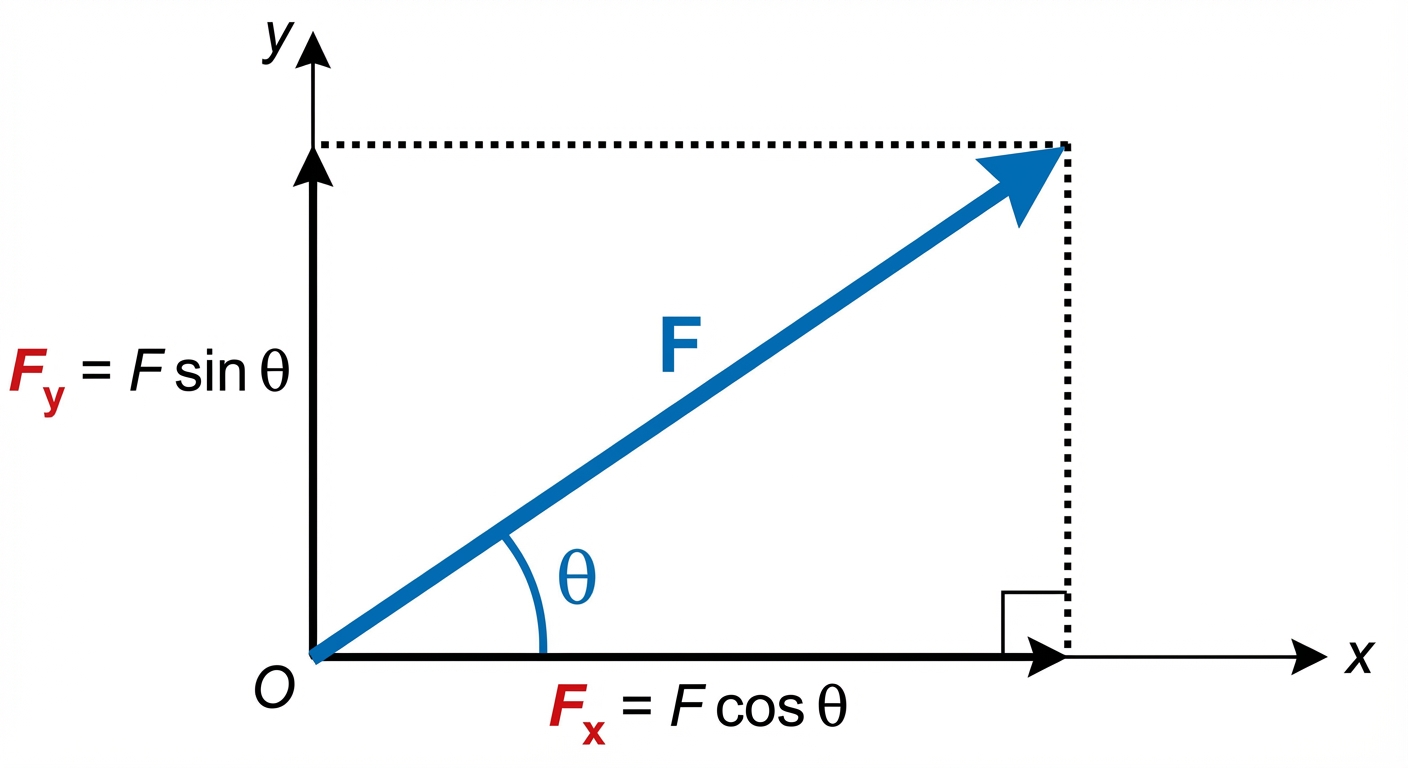
The horizontal component, , is the side adjacent to the angle, so we use cosine: . The vertical component, , is opposite the angle, so we use sine: . By breaking every single force in a system down into its x and y components, you can then simply add up all the x's and add up all the y's to find the resultant force – the single force that represents the net effect of all the others. This skill is non-negotiable for any future in engineering, physics, or even architecture. Mastering this now sets you up for success in your exams and beyond.
Worked example
Worked Example: Calculating the Resultant of Two Forces
Let's Find Out Where This Thing is *Actually* Going... 🧭
A particle is acted upon by two forces, and . has a magnitude of 12 N and acts at an angle of 20° above the positive x-axis. has a magnitude of 15 N and acts at an angle of 110° from the positive x-axis (i.e., in the second quadrant). Calculate the magnitude of the resultant force, R, and the angle it makes with the positive x-axis.
- 1First things first, we need to break each force down into its horizontal (x) and vertical (y) components. This is our core strategy. Always draw a quick sketch to visualize the forces!
- 2Now, let's get the decimal values for these components. Remember to keep a few decimal places for accuracy during the calculation. Your calculator should be in degrees mode! Notice that will be negative, which makes sense as it's pointing into the second quadrant.
- 3To find the components of the resultant force, R, we simply add the corresponding components of and . Add the x-components together and the y-components together.
- 4Now that we have the perpendicular components of the resultant force ( and ), we can find its magnitude using Pythagoras' theorem. Think of and as the two shorter sides of a right-angled triangle, with the magnitude as the hypotenuse.
- 5Finally, we find the direction. We can use trigonometry (tan is usually best) to find the angle, , that the resultant force makes with the positive x-axis. Since both and are positive, we know the angle is in the first quadrant.
- 6Always finish with a clear, concluding statement, quoting your answers to an appropriate degree of accuracy (usually 3 s.f. in exams).The resultant force has a magnitude of 19.2 N and acts at an angle of 71.3° to the positive x-axis.
Answer
The resultant force has a magnitude of 19.2 N and acts at an angle of 71.3° to the positive x-axis.
3. Equilibrium of a Particle under Coplanar Forces
Alright, let's talk about 'Equilibrium'. Think of it as the ultimate state of chill for a particle. If a particle is in equilibrium, it means it's either completely stationary or moving with a constant velocity. For AS Mechanics, we're almost always dealing with the stationary case. The big idea here comes from Newton's First Law: the net force acting on the particle is zero. This is the golden rule! Mathematically, we say the vector sum of all forces is zero: .
Now, a vector being zero is a powerful statement. It means the particle isn't being pushed or pulled more in any one direction than any other. It’s like a perfectly balanced tug-of-war. To make this useful for solving problems, we break it down. If the overall force vector is zero, then its components in any direction must also sum to zero. We usually choose two convenient perpendicular directions, like horizontal (x-axis) and vertical (y-axis).
Now, a vector being zero is a powerful statement. It means the particle isn't being pushed or pulled more in any one direction than any other. It’s like a perfectly balanced tug-of-war. To make this useful for solving problems, we break it down. If the overall force vector is zero, then its components in any direction must also sum to zero. We usually choose two convenient perpendicular directions, like horizontal (x-axis) and vertical (y-axis).
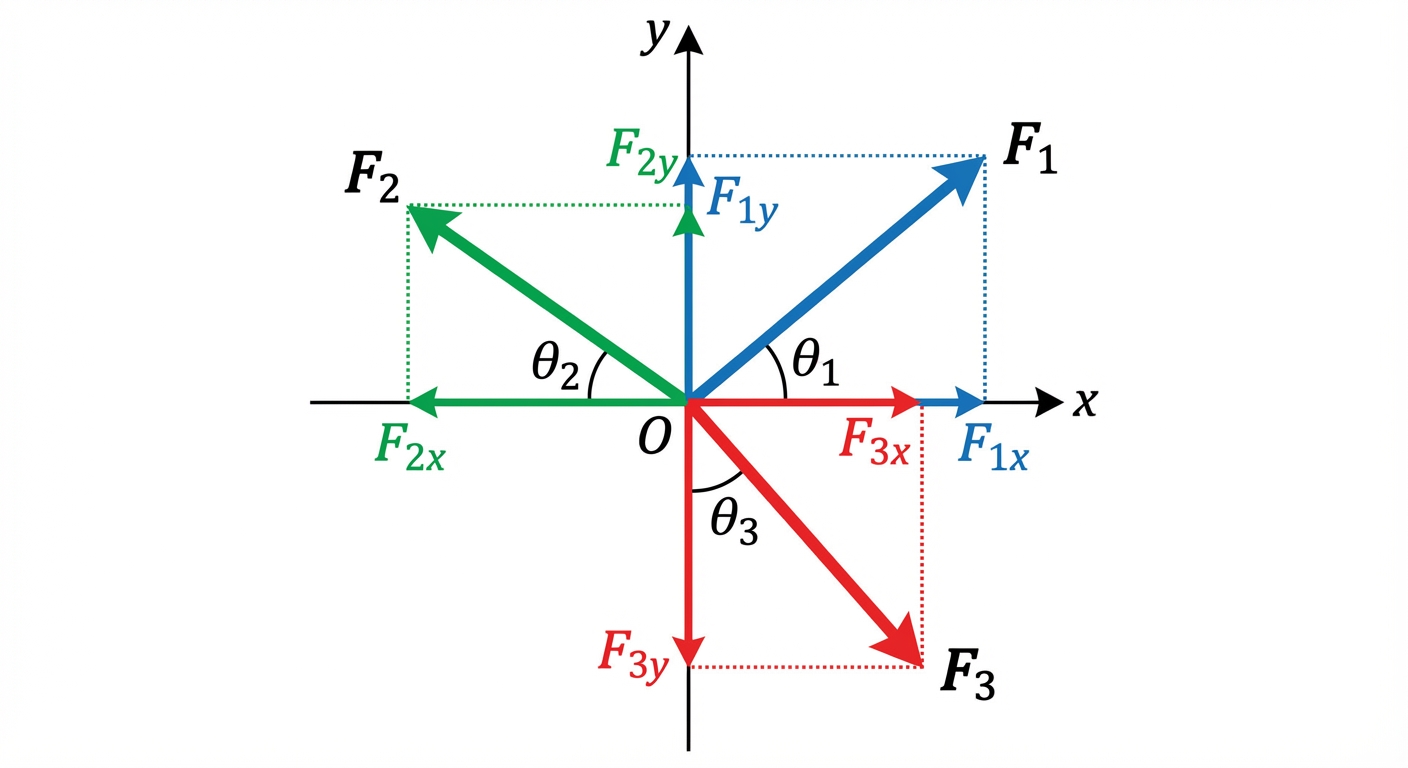
So, the single vector equation splits into two simpler scalar equations:
1. Sum of horizontal components = 0 (i.e., forces to the right = forces to the left)
2. Sum of vertical components = 0 (i.e., forces up = forces down)
This technique, resolving forces, is your primary tool. Mastering this is non-negotiable for acing this topic and is fundamental for university-level physics and engineering, where you'll be analysing everything from bridge trusses to aircraft wings. Get this down, and you've built a solid foundation. 💪
1. Sum of horizontal components = 0 (i.e., forces to the right = forces to the left)
2. Sum of vertical components = 0 (i.e., forces up = forces down)
This technique, resolving forces, is your primary tool. Mastering this is non-negotiable for acing this topic and is fundamental for university-level physics and engineering, where you'll be analysing everything from bridge trusses to aircraft wings. Get this down, and you've built a solid foundation. 💪
Worked example
Worked Example: Particle Suspended by Two Strings
Solving the Classic 'Hanging Object' Puzzle 🧐
A particle of mass 8 kg is suspended in equilibrium by two light, inextensible strings. The strings make angles of and with the horizontal ceiling to which they are attached. Calculate the tensions, and , in the two strings. (Take )
- 1First things first, let's get a visual. We need to draw a clear force diagram showing all the forces acting on the particle. The forces are the particle's weight acting downwards (), and the two tensions, and , acting upwards along the strings. The weight is .
- 2The particle is in equilibrium, so the net force is zero. We'll apply this condition by resolving all forces horizontally. The horizontal component of pulls left, and the horizontal component of pulls right. Since they must balance, their magnitudes are equal.
- 3Next, we do the same for the vertical direction. Both strings have upward vertical components, which together must balance the downward force of the weight.
- 4Now we have a system of two simultaneous equations. Let's rearrange the horizontal equation from Step 2 to express in terms of . Remember your trig values: and .
- 5Substitute this expression for into our vertical equation from Step 3 and solve for . Note that and .
- 6Finally, substitute the value of back into our equation from Step 4 to find . We'll give our final answers to 3 significant figures, as is standard practice.
Answer
4. Friction and the Conditions for Equilibrium
Alright, let's get real about friction. In an ideal world (and in earlier physics problems), surfaces are 'smooth', which is code for 'ignore friction'. But in reality, surfaces are rough. Friction is that sneaky force that always opposes motion or intended motion. Think of it as the universe's way of saying 'not so fast!'.
The force of friction, , is directly linked to the normal reaction force, . The 'grippiness' between two surfaces is quantified by the coefficient of friction, (mu). This is a dimensionless value, unique to the pair of materials in contact (e.g., rubber on tarmac has a high , while ice on steel has a very low one).
Now for the key distinction that will save you marks. As long as an object is stationary, the frictional force just matches whatever force is trying to move it. This is static friction, and it has a limit. This relationship is given by . The friction can be anything from zero up to its maximum possible value.
The force of friction, , is directly linked to the normal reaction force, . The 'grippiness' between two surfaces is quantified by the coefficient of friction, (mu). This is a dimensionless value, unique to the pair of materials in contact (e.g., rubber on tarmac has a high , while ice on steel has a very low one).
Now for the key distinction that will save you marks. As long as an object is stationary, the frictional force just matches whatever force is trying to move it. This is static friction, and it has a limit. This relationship is given by . The friction can be anything from zero up to its maximum possible value.
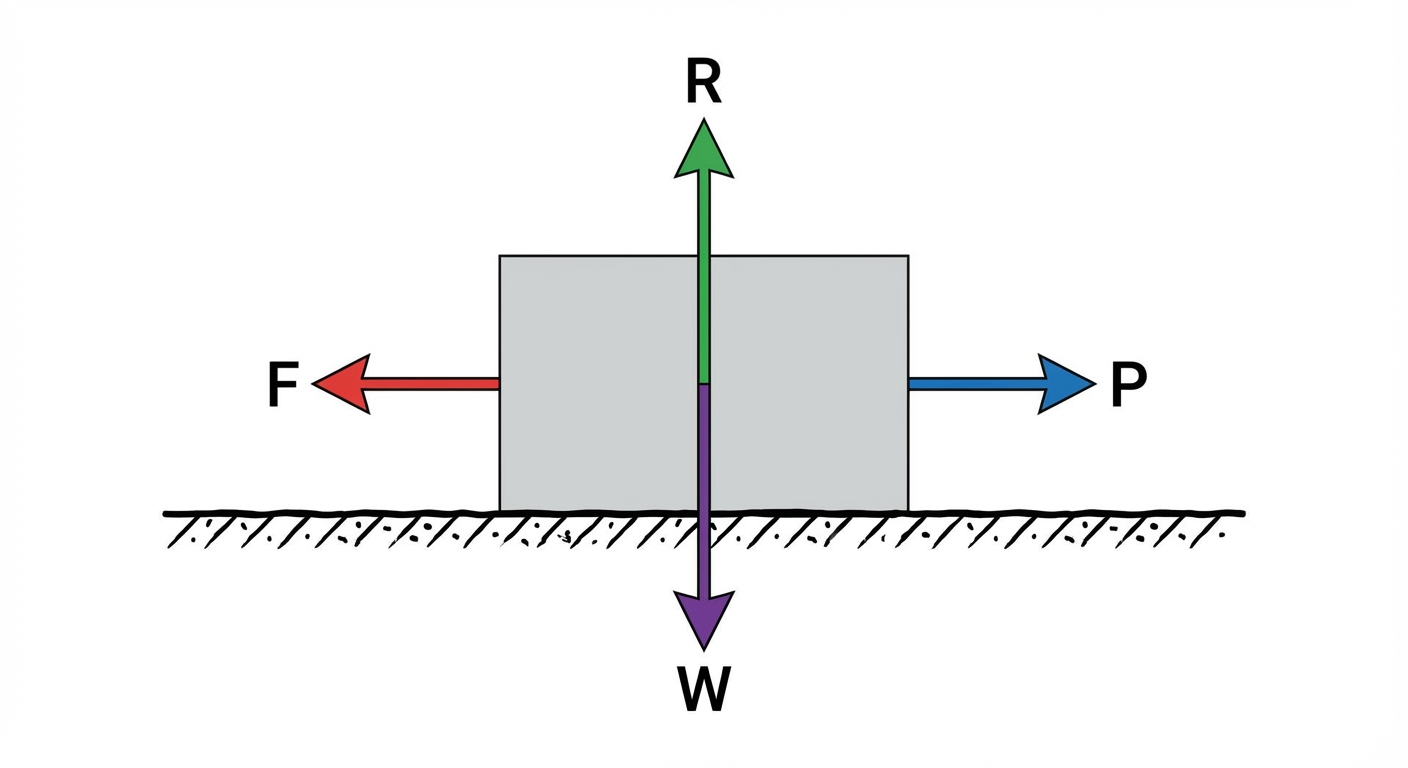
The moment the object is on the verge of moving, we've reached the maximum possible static friction. This critical point is called limiting equilibrium. At this exact point, and only at this point, the friction is maxed out, and we can use the equation . Understanding when to use the inequality versus the equality is crucial for solving equilibrium problems and is a concept frequently tested in exams. This is fundamental for engineering and design, from calculating the grip of car tires to designing safe braking systems.
Worked example
Worked Example: Equilibrium of a Particle on a Rough Inclined Plane
The One Where the Box Won't Budge 📦
A block of mass 10 kg rests on a rough plane inclined at an angle of to the horizontal. The coefficient of friction between the block and the plane is . A force of magnitude N acts on the block, parallel to a line of greatest slope of the plane. Find the range of possible values of for which the block remains in equilibrium. Take .
- 1First things first, let's draw a free-body diagram and resolve forces perpendicular to the plane to find the normal reaction, . The block is not accelerating into or away from the plane, so these forces are balanced. Weight is N.
- 2Now, let's find the maximum possible frictional force, . This occurs when the block is in limiting equilibrium. We use the formula . This value is our friction 'budget'.
- 3To find the minimum value of , we consider the case where the block is about to slide down the plane. In this scenario, the frictional force acts up the plane to prevent this motion. The system is in limiting equilibrium.
- 4To find the maximum value of , we consider the opposite case: the block is about to be pushed up the plane. Now, the frictional force opposes this and acts down the plane, again at its maximum value.
- 5Finally, we combine our results to state the range of values for that will keep the block in equilibrium. As long as is between these two limiting values, the friction will adjust to maintain equilibrium ().
Answer
5. Newton's Third Law: Action-Reaction Pairs in Contact
Alright, let's break down one of the most fundamental laws in mechanics, but also one that's surprisingly easy to misinterpret. You've probably heard the phrase a million times: 'For every action, there is an equal and opposite reaction.' Simple, right? But the devil is in the details, especially for M1 problems. The absolute, non-negotiable key is this: the 'action' and 'reaction' forces always act on different objects. They never act on the same body. Think about it: if you push a wall, you exert a force on the wall. The wall, in turn, pushes back on you with a force of the exact same magnitude but in the opposite direction. The forces are a pair, but one is on the wall, and the other is on you. This is crucial for your university-level physics and engineering courses, where Free Body Diagrams are everything.
In the context of this chapter, we're focusing on contact forces. Let's take a classic example: a crate of mass resting on the floor. The crate exerts a contact force on the floor (due to its weight). According to Newton's Third Law, the floor must exert an equal and opposite contact force on the crate. This upward force from the floor is what we call the Normal Reaction Force, often labelled or . It's 'normal' because it always acts perpendicular (at a normal) to the surface of contact.
In the context of this chapter, we're focusing on contact forces. Let's take a classic example: a crate of mass resting on the floor. The crate exerts a contact force on the floor (due to its weight). According to Newton's Third Law, the floor must exert an equal and opposite contact force on the crate. This upward force from the floor is what we call the Normal Reaction Force, often labelled or . It's 'normal' because it always acts perpendicular (at a normal) to the surface of contact.
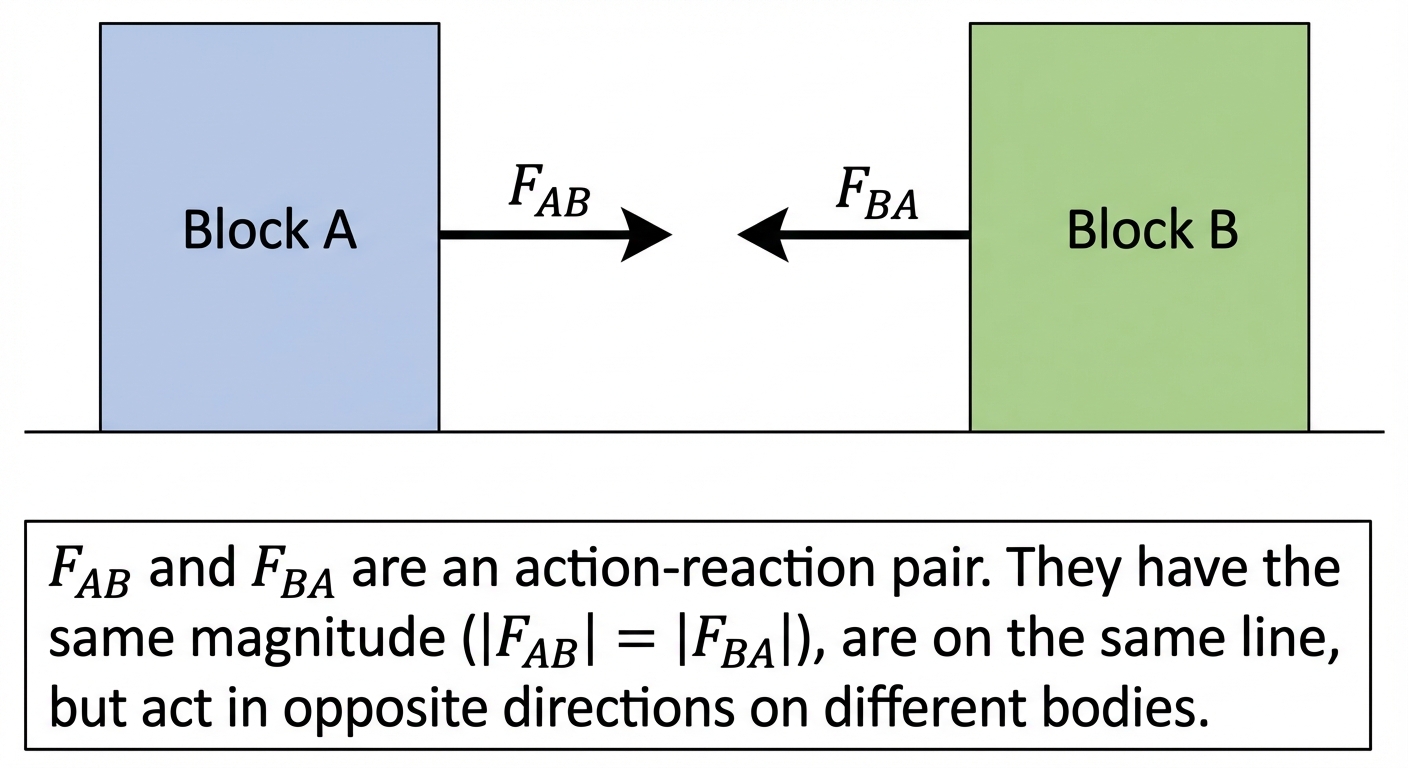
So, when you see two objects pushed together, or a block on a table, remember that the force A exerts on B is perfectly mirrored by the force B exerts on A. Understanding how to identify these pairs and isolate each body to apply is a top-tier skill for acing equilibrium and dynamics problems. Get this down, and you're building a solid foundation for more complex mechanics.
Worked example
Worked Example: Interacting Blocks on a Smooth Surface
Let's see this in action... literally! 🚀
Two blocks, P and Q, with masses kg and kg respectively, are in contact and at rest on a smooth horizontal surface. A horizontal force of N is applied to block P, pushing it towards block Q. Find the acceleration of the system and the magnitude of the contact force between the blocks.
- 1First, since the blocks are in contact and move together, we can treat them as a single system to find the overall acceleration, . The total mass is . The only external horizontal force is . We'll apply Newton's Second Law, .
- 2Now, to find the internal contact force, we must isolate one of the blocks. Let's isolate block Q. The only horizontal force acting on Q is the contact force from P, let's call it . This force is what causes Q to accelerate.[IMAGE_PLACEHOLDER_2: Free Body Diagram of Block Q. A single horizontal arrow points right, labelled 'R'. The mass '6 kg' is shown inside the block.]
- 3Apply Newton's Second Law to block Q alone. The net force on Q is just , and we know its mass and acceleration. This allows us to calculate the magnitude of the contact force.
- 4Let's double-check our work using Newton's Third Law by considering block P. The forces acting on P are the applied force (to the right) and the reaction force from Q (to the left), which also has magnitude . The net force on P causes it to accelerate.
- 5The results match! This confirms our acceleration is correct and demonstrates the action-reaction pair beautifully. The force P exerts on Q is 24 N, and the force Q exerts back on P is also 24 N. You've successfully analysed the system. Nicely done!
Answer
Practice this in the app
Unlock the full chapter: practice questions, flashcards, mock papers and notes, free.
Continue revising