Chapter M1: Momentum
The Physics of Collisions 🚗💥
Introduction
1. Introduction
Alright, let's dive into one of the most fundamental concepts in Mechanics: Momentum! Ever wondered what makes a bowling ball so much more effective than a tennis ball at knocking over pins, even if you threw them at the same speed? That's momentum in action. In this chapter, we're going to break it all down. First, we'll get to grips with Linear Momentum itself – what it is and how to calculate it (). Then, we'll explore the super-important Principle of Conservation of Momentum, which is the key to solving pretty much any problem involving collisions or explosions. By the end of this, you'll be able to predict the outcome of collisions like a pro. Let's get started!
2. Definition and Vector Nature of Linear Momentum
Alright, let's dive into Linear Momentum. Think of it as the 'quantity of motion' an object has, or its 'oomph'. It's not just about how fast something is going, but also how heavy it is. A bowling ball rolling slowly can have the same momentum as a tennis ball moving super fast. The formula is beautifully simple: , where is momentum, is mass, and is velocity.
Now, here’s the crucial part for your A-Level exams: momentum is a vector. This means it has both magnitude (its size) and direction. Because velocity () is a vector, and mass () is a scalar, the momentum vector () will always point in the exact same direction as the velocity vector.
Now, here’s the crucial part for your A-Level exams: momentum is a vector. This means it has both magnitude (its size) and direction. Because velocity () is a vector, and mass () is a scalar, the momentum vector () will always point in the exact same direction as the velocity vector.
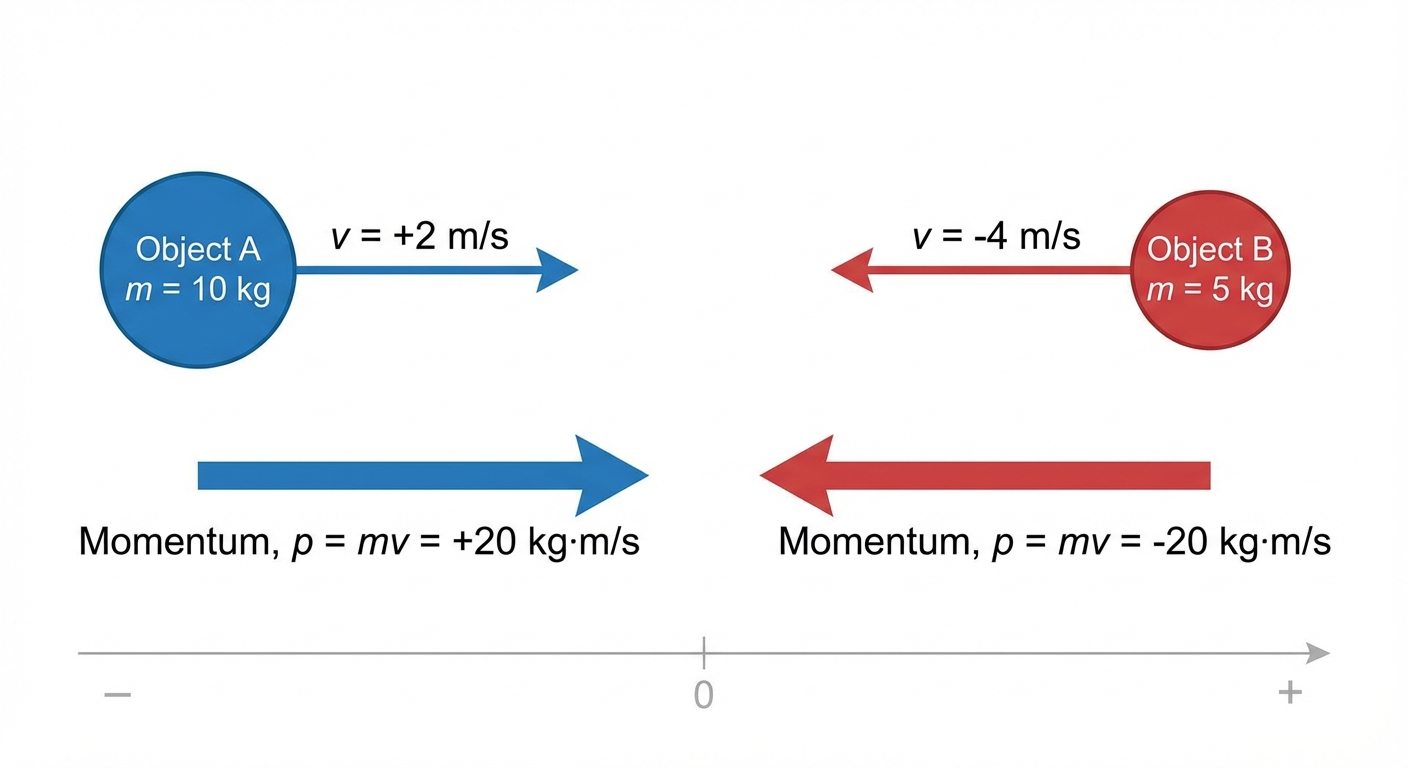
So, if we define 'right' as the positive direction, an object moving left has a negative velocity and therefore a negative momentum. This is a game-changer for collision problems later on! The standard unit for momentum is the kilogram-metre per second, written as kg m s⁻¹. You might also see it as Newton-seconds (N s), which is equivalent. Understanding this concept is massive for fields like aerospace engineering (calculating rocket thrust) and automotive safety design (designing crumple zones to change a car's momentum over a longer time, reducing the impact force). So, mastering this isn't just about passing M1; it's a foundational concept in physics and engineering.
Worked example
Worked Example: Calculating Momentum in Two Dimensions
Let's Crunch Some Momentum Numbers 🔢
A remote-controlled drone of mass 1.5 kg has a velocity vector of m s⁻¹. Calculate the momentum of the drone as a vector and find the magnitude of its momentum.
- 1First, let's identify what we're given and what we need to find. We have the mass () and the velocity vector (). Our go-to formula is .
- 2Now, we'll substitute our values into the formula. Since mass is a scalar, we just multiply it by each component of the velocity vector.
- 3Great, that's the momentum vector. To find the magnitude (the overall size of the momentum), we use Pythagoras' theorem on its components, just like finding the magnitude of any vector. We denote magnitude with vertical bars: .
- 4Finally, we calculate the square root and state our final answer clearly, making sure to include the correct units. Don't lose easy marks by forgetting units!
Answer
3. The Principle of Conservation of Linear Momentum
Alright, let's get into one of the most fundamental laws in all of mechanics – the Conservation of Momentum. Think of it as the universe's way of keeping things fair in a collision. The core idea is this: in an isolated system, the total momentum before a collision is equal to the total momentum after the collision. An 'isolated system' is our ideal M1 world where we ignore pesky external forces like friction or air resistance. So, what you start with, you must end with.
Mathematically, for two particles A and B in a direct impact (meaning they collide head-on along a straight line), we express this as:
Here, is mass, is the initial velocity, and is the final velocity. The most common mistake people make is forgetting that velocity is a vector. Direction is everything! Your first step in any problem should be to define a positive direction (e.g., to the right). Any velocity going in the opposite direction must be given a negative sign. Get this right, and you're halfway to the solution.
Mathematically, for two particles A and B in a direct impact (meaning they collide head-on along a straight line), we express this as:
Here, is mass, is the initial velocity, and is the final velocity. The most common mistake people make is forgetting that velocity is a vector. Direction is everything! Your first step in any problem should be to define a positive direction (e.g., to the right). Any velocity going in the opposite direction must be given a negative sign. Get this right, and you're halfway to the solution.
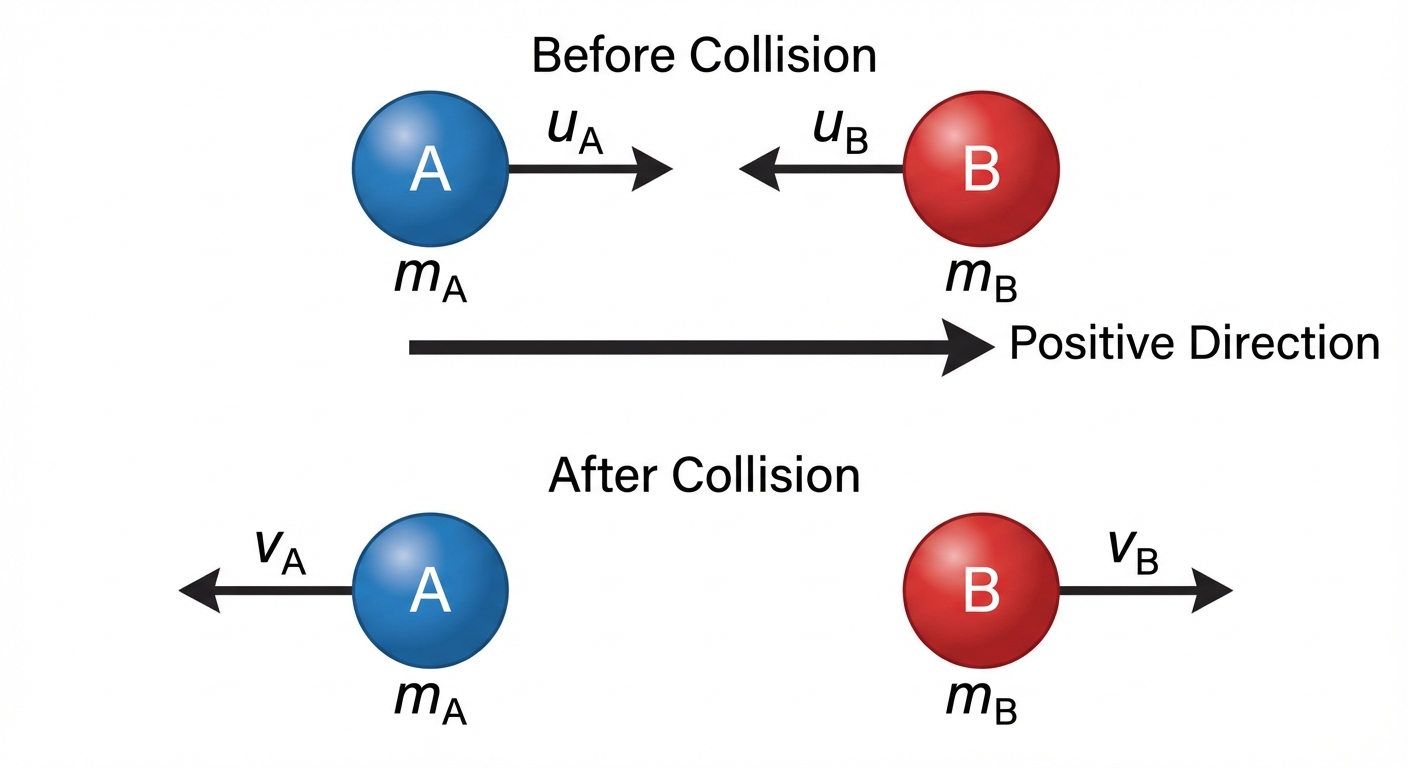
A special case you'll see is coalescence. This is a fancy word for when the particles stick together after impact, like two pieces of clay smooshing into one. They move off with a single, common final velocity, which we'll call . This actually simplifies our equation to:
Understanding this principle is non-negotiable for acing M1, and it's a cornerstone concept in fields like engineering (designing car safety systems) and astrophysics (analysing galactic collisions). Master this, and you've got a powerful tool in your physics arsenal.
Worked example
Worked Example: Direct Impact with Coalescence
The 'We're Sticking Together' Problem 🥰
A particle A of mass is moving with a velocity of on a smooth horizontal surface. It collides directly with a particle B of mass which is moving in the opposite direction with a velocity of . After the collision, the two particles coalesce to form a single particle. Find the velocity of the combined particle after the collision.
- 1First things first, let's set up our system. We must define a positive direction. Let's take the initial direction of particle A (to the right) as positive. This means any velocity in the opposite direction will be negative.Positive direction:
For Particle A: ,
For Particle B: , - 2The problem states the particles coalesce, so we'll use the specific version of the conservation of momentum formula for this scenario. This shows the examiner you've correctly identified the type of collision.
- 3Now, we substitute our known values into the equation. Be super careful with the signs – this is where mistakes happen!
- 4Time to simplify and solve for , the common final velocity. This is just algebra from here on out.
- 5Finally, we state our answer clearly with units and interpret the result. Since our value for is positive (), the combined particle moves in the direction we initially defined as positive (the original direction of particle A).The velocity of the combined particle is in the original direction of motion of particle A.
Answer
The velocity of the combined particle is in the original direction of motion of particle A.
Practice this in the app
Unlock the full chapter: practice questions, flashcards, mock papers and notes, free.
Continue revising