P2 Algebra: Polynomials and Modulus Functions
Algebra: The Glow-Up ✨
Introduction
1. Introduction
Alright, let's dive into some powerful P2 Algebra! This chapter is all about adding some essential tools to your problem-solving arsenal, which will be crucial for your exams. First up, we'll tackle modulus functions – you'll learn how to handle those absolute value bars in equations and sketch their distinctive 'V' shaped graphs. Next, we'll get into the mechanics of polynomial division, a skill that lets you break down complex expressions into simpler parts. Finally, we'll unlock two massive time-savers: the Factor and Remainder Theorems. Think of these as clever shortcuts to find factors and remainders without the lengthy division. By the end of this, you'll be manipulating polynomials with total confidence. Let's get started!
2. Solving Equations and Inequalities with Modulus Functions
Alright, let's get into one of the coolest tools in your algebra toolkit: the modulus function. Think of it as the ultimate positivity filter. Whatever you put into it, it spits out the non-negative version. Mathematically, the modulus of a number $x$, written as $|x|$, is its absolute value or its distance from zero on the number line. So, $|5| = 5$ and $|-5| = 5$. Simple, right?
In A-Levels, we deal with functions like $y = |ax+b|$. Graphically, this creates a distinct 'V' shape. To sketch it, you first draw the line $y = ax+b$. Any part of the line that dips below the x-axis gets reflected back up. The 'point' of the V, or the vertex, is at the x-intercept of the original line, which is where $ax+b=0$.
In A-Levels, we deal with functions like $y = |ax+b|$. Graphically, this creates a distinct 'V' shape. To sketch it, you first draw the line $y = ax+b$. Any part of the line that dips below the x-axis gets reflected back up. The 'point' of the V, or the vertex, is at the x-intercept of the original line, which is where $ax+b=0$.
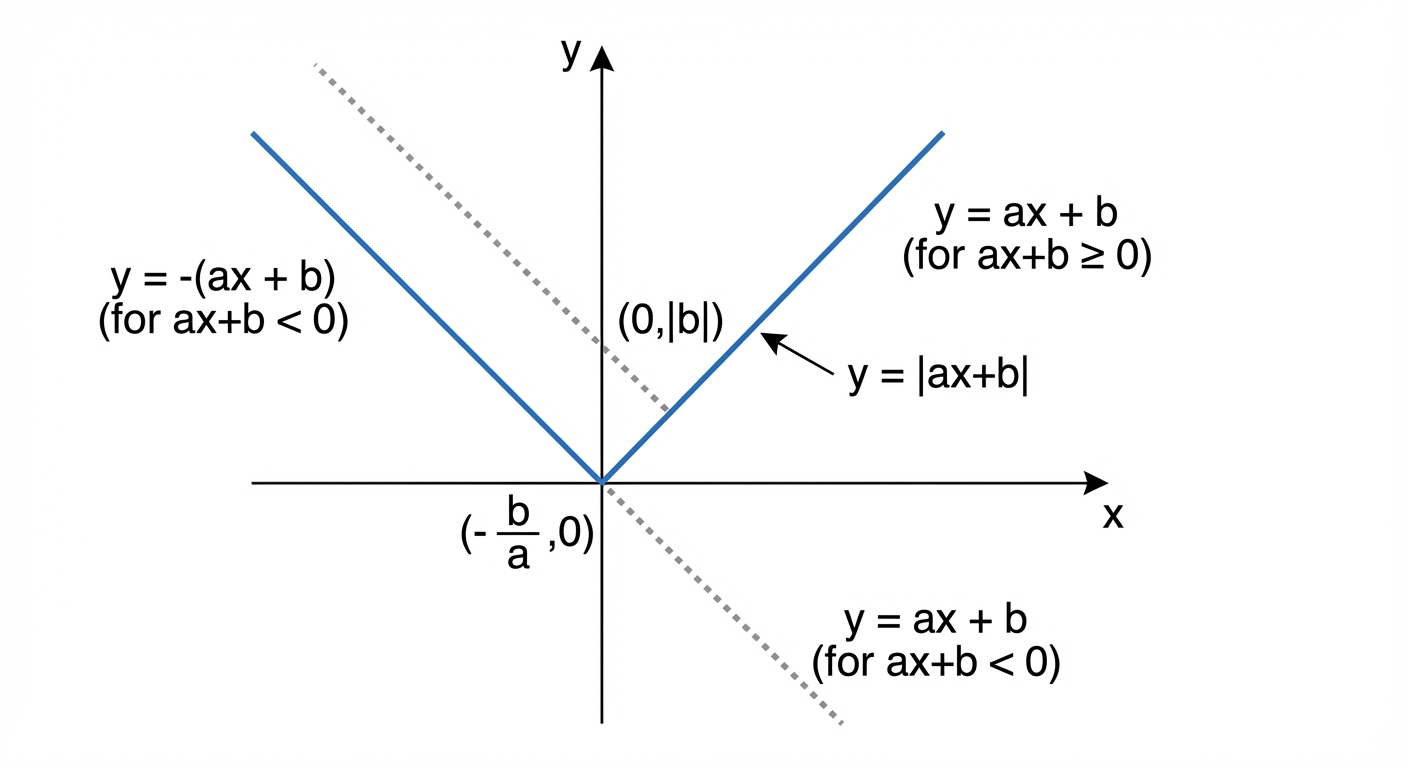
Now for the main event: solving equations and inequalities. For an equation like $|ax+b| = c$ (where $c \ge 0$), you have two possibilities. The expression inside the modulus was either already positive, or it was negative. So, we solve two separate linear equations: $ax+b = c$ and $ax+b = -c$.
For inequalities, things get more interesting. You can use a graphical approach (sketching both sides and seeing which function is 'higher' or 'lower'), but the most robust algebraic method for your exams is squaring both sides. For an equation or inequality involving a modulus, squaring is a safe bet because $|f(x)|^2$ is always the same as $(f(x))^2$. This transforms the problem into a standard quadratic inequality, which you're already a pro at solving. This technique is especially vital when you have variables on both sides, like $|ax+b| > cx+d$. Mastering this isn't just about passing P2; it's fundamental for university-level calculus, physics (think magnitudes of vectors), and even computer science algorithms involving error calculation. It’s a core concept that shows you can handle non-linear situations with logical precision.
Worked example
Worked Example: Solving a Modulus Inequality
Let's Solve This Thing: Modulus vs. Linear Function Showdown! 🥊
Solve the inequality $|3x + 2| > x + 4$.
- 1We have a variable on both sides, so the safest and most systematic method is to square both sides. This eliminates the modulus sign and allows us to work with a standard quadratic. Since both sides of the original inequality are non-negative for the solution to be valid, squaring preserves the inequality direction.$(|3x + 2|)^2 > (x + 4)^2$
- 2Now, expand both sides. Remember that $|A|^2 = A^2$. Be careful with your expansion, especially the middle terms. A common slip-up is forgetting the '2ab' part of $(a+b)^2$.$(3x + 2)^2 > (x + 4)^2 \\ (9x^2 + 12x + 4) > (x^2 + 8x + 16)$
- 3Our goal is to solve a quadratic inequality, so we need to get everything onto one side to create an expression of the form $ax^2 + bx + c > 0$.$9x^2 - x^2 + 12x - 8x + 4 - 16 > 0 \\ 8x^2 + 4x - 12 > 0$
- 4This quadratic looks a bit chunky. Let's simplify it by dividing by the highest common factor, which is 4. This makes finding the roots much easier.$2x^2 + x - 3 > 0$
- 5Now, find the 'critical values' by solving the equation $2x^2 + x - 3 = 0$. We can do this by factorising. Think of two numbers that multiply to $2 \times -3 = -6$ and add to $+1$. That's $+3$ and $-2$.$(2x+3)(x-1) = 0 \\ \text{Critical values are } x = 1 \text{ and } x = -\frac{3}{2}$
- 6Finally, we determine the solution region. We have a positive quadratic ($2x^2...$) which is a U-shaped parabola. We want to find where this parabola is greater than 0 (i.e., above the x-axis). This occurs outside the roots.$x < -\frac{3}{2} \quad \text{or} \quad x > 1$
Answer
$x < -\frac{3}{2} \quad \text{or} \quad x > 1$
3. Division of Polynomials
Alright, let's tackle polynomial division. Think of it as the big sibling to the long division you did back in primary school, but instead of just numbers, we're wrestling with algebraic expressions. Seriously, the algorithm is almost identical! The main goal is to take a polynomial (the dividend), say $P(x)$, and divide it by another polynomial of a smaller degree (the divisor), $D(x)$. The result gives you two key components: a quotient, $Q(x)$, and a remainder, $R(x)$. The relationship is always: $P(x) = D(x) \times Q(x) + R(x)$. This formula is your new best friend – it’s crucial for exam questions where you need to express your final answer in a specific form.
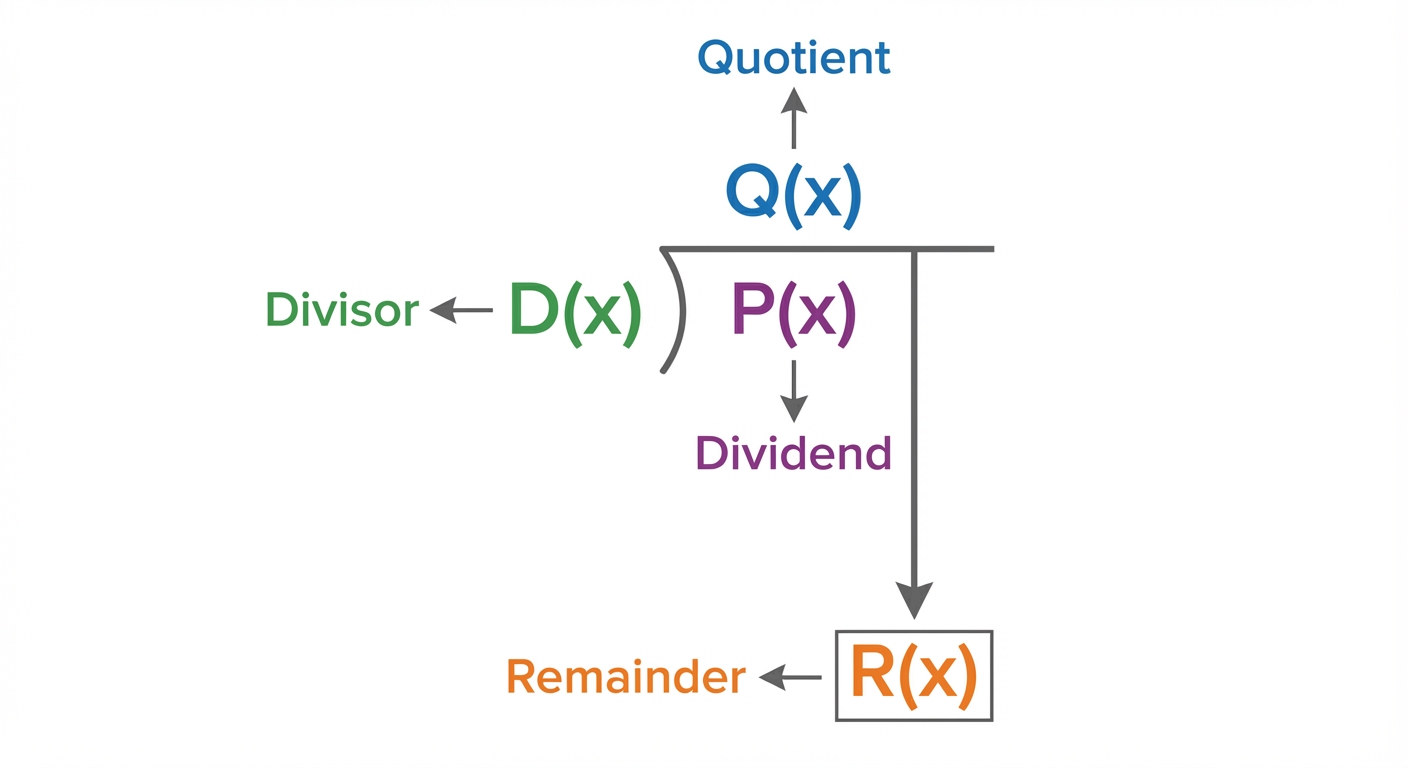
The process is iterative: you focus only on the leading term of what you're currently dividing and the leading term of the divisor. Divide them, multiply the result back by the entire divisor, subtract, and bring down the next term. Rinse and repeat until you can't divide anymore (i.e., the degree of what's left is less than the degree of the divisor). This skill is a gateway to more advanced topics; in university-level calculus, you'll use it to find oblique asymptotes of rational functions, and it's a fundamental concept in fields like cryptography and coding theory. So, mastering this isn't just about passing P2; it's about building a solid foundation for your future STEM studies. Let's get this done! 💪
Worked example
Application of Polynomial Long Division
Let's Solve This Beast! 🐉
Find the quotient and remainder when the polynomial $P(x) = 2x^3 - 5x^2 + 8x - 7$ is divided by $D(x) = x - 2$.
- 1First, set up the long division framework. Write the dividend inside the bracket and the divisor outside. Ensure the terms in the dividend are in descending powers of $x$. If a power was missing, we'd add it with a coefficient of 0 as a placeholder, but we're all good here.$x - 2 \overline{) 2x^3 - 5x^2 + 8x - 7}$
- 2Divide the first term of the dividend ($2x^3$) by the first term of the divisor ($x$). The result is $2x^2$. Write this above the line. Now, multiply this $2x^2$ by the entire divisor $(x - 2)$ to get $2x^3 - 4x^2$. Write this result underneath the dividend and subtract.$ \begin{array}{r} 2x^2 \phantom{xxxxxxxxx} \\ x - 2 \overline{) 2x^3 - 5x^2 + 8x - 7} \\ - (2x^3 - 4x^2) \phantom{xxxxxx} \\ \hline -x^2 \phantom{xxxxxx} \end{array} $
- 3Bring down the next term from the dividend ($+8x$) to form the new polynomial to be divided. Now, repeat the process: divide the new leading term ($-x^2$) by the divisor's leading term ($x$) to get $-x$. Add this to our answer on top. Multiply $-x$ by $(x-2)$ to get $-x^2+2x$ and subtract.$ \begin{array}{r} 2x^2 - x \phantom{xxxxxx} \\ x - 2 \overline{) 2x^3 - 5x^2 + 8x - 7} \\ \dots \phantom{xxxxxxxxxx} \\ \hline -x^2 + 8x \phantom{xx} \\ - (-x^2 + 2x) \phantom{xx} \\ \hline 6x \phantom{xx} \end{array} $
- 4Bring down the final term ($-7$). Repeat the process one last time. Divide the new leading term ($6x$) by the divisor's leading term ($x$) to get $+6$. Write this on top. Multiply $6$ by $(x-2)$ to get $6x-12$ and subtract.$ \begin{array}{r} 2x^2 - x + 6 \\ x - 2 \overline{) 2x^3 - 5x^2 + 8x - 7} \\ \dots \phantom{xxxxxxxxxx} \\ \hline 6x - 7 \\ - (6x - 12) \\ \hline 5 \end{array} $
- 5The process stops because the result of the subtraction (5) has a degree (0) which is less than the degree of the divisor (1). The polynomial on top is our quotient, and the final number is our remainder.$\text{Quotient, } Q(x) = 2x^2 - x + 6 <br> \text{Remainder, } R(x) = 5$
Answer
$\text{Quotient, } Q(x) = 2x^2 - x + 6 <br> \text{Remainder, } R(x) = 5$
4. The Factor and Remainder Theorems
Alright, let's talk about one of the most clutch time-savers in A-Level Algebra: the Factor and Remainder Theorems. Think of them as a cheat code for dealing with polynomials, saving you from the grind of long division. First up, the Remainder Theorem. It states that if you divide a polynomial, let's call it $P(x)$, by a linear expression like $(x-a)$, the remainder is simply the value you get when you plug $a$ into the polynomial, i.e., $P(a)$. It's that simple. So, if you need the remainder when dividing $x^3 + 2x - 5$ by $(x-3)$, you just calculate $P(3) = 3^3 + 2(3) - 5 = 28$. The remainder is 28. No long division needed! Why does this work? Any polynomial can be expressed as $P(x) = (x-a)Q(x) + R$, where $Q(x)$ is the quotient and $R$ is the remainder. If you substitute $x=a$ into this equation, the $(x-a)$ term becomes zero, wiping out the whole $Q(x)$ part and leaving you with just $P(a) = R$. Genius, right?
The Factor Theorem is just a special case of this. What if the remainder is zero? That means the division was perfect, and $(x-a)$ is a factor of $P(x)$. So, the Factor Theorem says: if $P(a) = 0$, then $(x-a)$ is a factor of $P(x)$. This is your go-to tool for finding linear factors of cubics or quartics. You test simple integer values (like 1, -1, 2, -2...) that are factors of the constant term until you find one that makes the polynomial equal zero.
The Factor Theorem is just a special case of this. What if the remainder is zero? That means the division was perfect, and $(x-a)$ is a factor of $P(x)$. So, the Factor Theorem says: if $P(a) = 0$, then $(x-a)$ is a factor of $P(x)$. This is your go-to tool for finding linear factors of cubics or quartics. You test simple integer values (like 1, -1, 2, -2...) that are factors of the constant term until you find one that makes the polynomial equal zero.
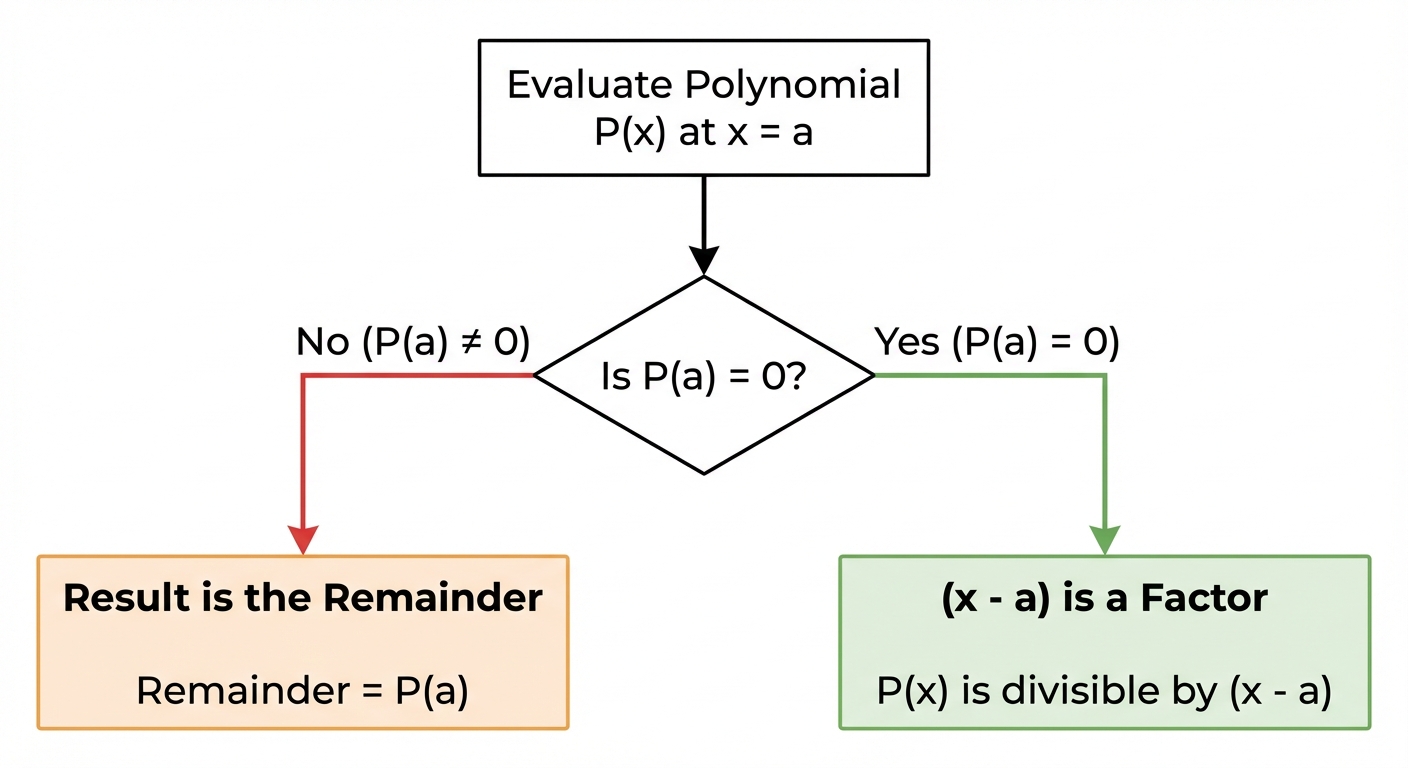
For your exams and future university courses in STEM, this isn't just a trick; it's a fundamental concept for solving higher-order equations and analysing function behaviour. We often use these theorems to find unknown coefficients by setting up simultaneous equations based on given factors or remainders.
Worked example
Worked Example: Finding Unknown Coefficients and Factors
Let's Crack This Polynomial's Code 🕵️♀️
The polynomial $P(x) = 2x^3 + ax^2 + bx - 12$ has a factor of $(x-2)$. When $P(x)$ is divided by $(x+1)$, the remainder is $-30$. Find the values of the constants $a$ and $b$, and hence factorise $P(x)$ completely.
- 1First, we use the Factor Theorem. We are told $(x-2)$ is a factor, which means that when we substitute $x=2$ into the polynomial, the result must be zero. This will give us our first equation involving $a$ and $b$.$P(2) = 2(2)^3 + a(2)^2 + b(2) - 12 = 0 \\ 16 + 4a + 2b - 12 = 0 \\ 4a + 2b = -4 \\ 2a + b = -2 \quad \textit{(Equation 1)}$
- 2Next, we use the Remainder Theorem. We know that dividing $P(x)$ by $(x+1)$ gives a remainder of $-30$. This means $P(-1) = -30$. Let's substitute $x=-1$ to get our second equation.$P(-1) = 2(-1)^3 + a(-1)^2 + b(-1) - 12 = -30 \\ -2 + a - b - 12 = -30 \\ a - b = -16 \quad \textit{(Equation 2)}$
- 3Now we have a system of two linear simultaneous equations. We can solve these to find $a$ and $b$. Adding Equation 1 and Equation 2 is a quick way to eliminate $b$.$(2a + b) + (a - b) = -2 + (-16) \\ 3a = -18 \\ a = -6 \\ \text{Substitute } a=-6 \text{ into Equation 2:} \\ -6 - b = -16 \\ b = 10$
- 4With $a=-6$ and $b=10$, we can write the full polynomial. Our job now is to factorise it completely. We already know one factor is $(x-2)$.$P(x) = 2x^3 - 6x^2 + 10x - 12$
- 5We can find the remaining quadratic factor by comparing coefficients or by polynomial division. Let's use inspection. We know $2x^3 - 6x^2 + 10x - 12 = (x-2)(cx^2 + dx + e)$. By comparing the $x^3$ term, $c$ must be 2. By comparing the constant term, $-2e = -12$, so $e$ must be 6. The quadratic is $(2x^2+dx+6)$. To find $d$, we can compare the $x^2$ coefficients: $-6x^2 = (-2)(2x^2) + d(x^2)$, so $-6 = -4 + d$, which gives $d=-2$.$P(x) = (x-2)(2x^2 - 2x + 6) \\ P(x) = 2(x-2)(x^2 - x + 3)$
- 6Finally, we check if the quadratic factor $x^2 - x + 3$ can be factorised further. We check its discriminant, $b^2 - 4ac = (-1)^2 - 4(1)(3) = 1 - 12 = -11$. Since the discriminant is negative, there are no real roots, and it cannot be factorised further over real numbers. So, we have our final answer.$\text{Fully factorised form: } P(x) = 2(x-2)(x^2 - x + 3)$
Answer
$\text{Fully factorised form: } P(x) = 2(x-2)(x^2 - x + 3)$
Practice this in the app
Unlock the full chapter: practice questions, flashcards, mock papers and notes, free.
Continue revising