P2 Chapter 2: Advanced Trigonometry
Solving Trig Puzzles Like a Pro 🧩
Introduction
1. Introduction
Alright, so you've mastered the basics of sine, cosine, and tangent from P1. But what happens when the problems get more complex? That's exactly what this chapter is about – upgrading your trig toolkit for the big leagues. First, we'll meet the 'reciprocal' family: , , and . They might seem a bit extra at first, but they're essential for simplifying tricky expressions and solving new types of equations. Then, we'll dive into the compound and double angle formulae. These are your secret weapons for breaking down complex angles like or dealing with expressions like . Finally, we'll master the incredibly powerful R-formula, which lets us combine sine and cosine waves into a single, neat function. This is a total game-changer for solving equations like and finding maximum/minimum values. It's a packed chapter, but by the end, you'll be equipped to handle almost any trig problem the exam throws at you. Let's get into it!
2. Reciprocal Trigonometric Functions and Identities
Alright, let's level up our trig game. You've mastered sin, cos, and tan, but now it's time to meet their lesser-known, but equally important, relatives: the reciprocal functions. Think of them as the 'upside-down' versions of our main trio. We have secant (sec), cosecant (cosec), and cotangent (cot). Their definitions are straightforward but crucial for your exams:
A simple way to remember which pairs up with which: look at the third letter. Secant goes with cosine, and cosecant goes with sine.
A simple way to remember which pairs up with which: look at the third letter. Secant goes with cosine, and cosecant goes with sine.
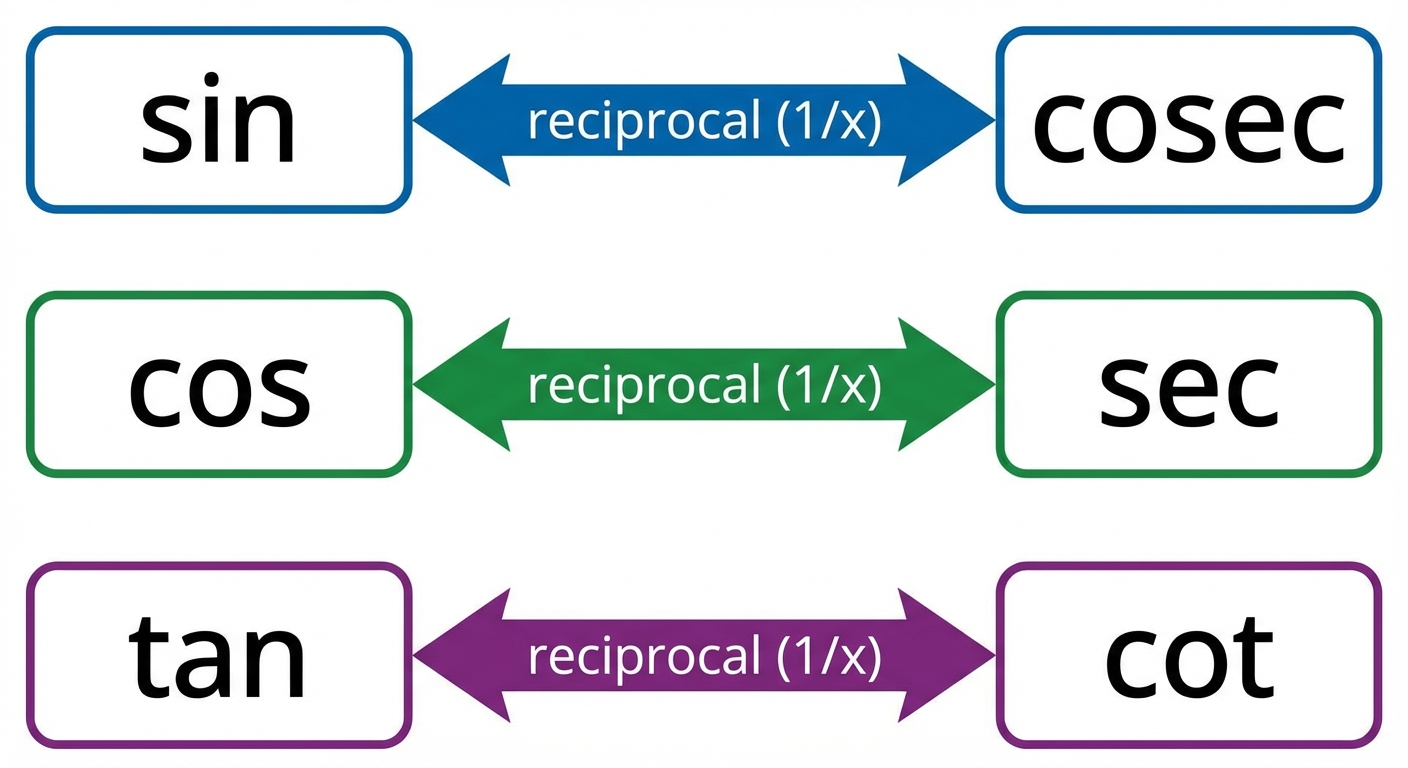
Now, why do we care? Because these functions unlock two powerful new identities that are absolute staples in exam questions. They both stem from our old friend .
1. Divide everything by : you get , which simplifies beautifully to:
2. Divide everything by : you get , which gives us:
These aren't just for show; they are your primary tools for solving equations that mix different trig functions. Mastering these is non-negotiable for university-level STEM courses, especially in calculus where integrals of secant and cosecant are common. Get these locked in!
Worked example
Solving Equations with Reciprocal Identities
Time to put the theory into practice! 🚀
Solve the equation for .
- 1First, notice the equation mixes and . Our goal is to convert it into an equation with only one type of trig function. The identity linking and is our key: . We'll rearrange it to substitute for .
- 2Now, substitute this expression for into the original equation. This move is crucial as it turns the problem into a quadratic equation in terms of .
- 3Expand the brackets and rearrange the equation into the standard quadratic form , where our variable is .
- 4Solve this quadratic equation for . We can factorise it just like a regular quadratic.
- 5Our calculator doesn't have a button, so we need to convert back to the primary function, , by taking the reciprocal. Remember, .
- 6Finally, find all the angles for in the range . For , the solution is straightforward. For , we find the principal value and then use the CAST diagram to find the second solution in the required range.
Answer
3. Compound and Double Angle Formulae
Alright, let's level up our trig game. You've mastered SOHCAHTOA and the unit circle, but what happens when you need to find the sine of two angles added together, like ? Spoiler: it's not ! That's a classic exam trap. Instead, we use the Compound Angle Formulae. Think of them as the specific rules for how trig functions 'distribute' over addition or subtraction. These are your new best friends, so get them on a flashcard ASAP:
(Notice the sign flip for cosine!)
From these, we can derive the formula for tangent. By using the identity , we get: .
Now, what if the two angles are the same? What if we want ? This brings us to the Double Angle Formulae, which are just a special case of the compound ones where .
is the real MVP because it has three variations. The main one is . Using the Pythagorean identity , we can also write it as or . Choosing the right version is a key strategic skill for solving equations and proofs. Finally, we have .
(Notice the sign flip for cosine!)
From these, we can derive the formula for tangent. By using the identity , we get: .
Now, what if the two angles are the same? What if we want ? This brings us to the Double Angle Formulae, which are just a special case of the compound ones where .
is the real MVP because it has three variations. The main one is . Using the Pythagorean identity , we can also write it as or . Choosing the right version is a key strategic skill for solving equations and proofs. Finally, we have .
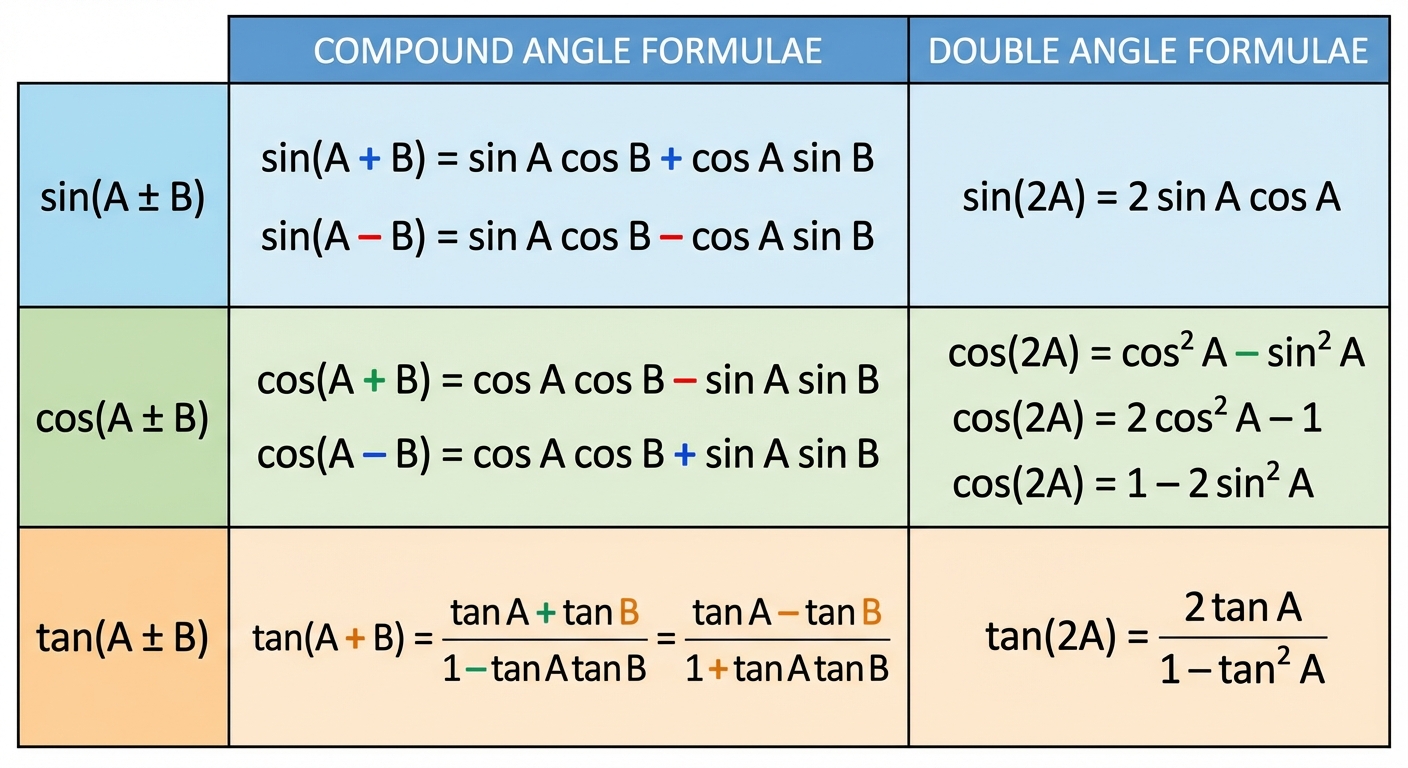
Why care? This isn't just abstract math. In physics, these formulae are essential for analysing wave interference and superposition. In engineering, they're used in signal processing. And if you're heading into computer science or graphics, understanding how to manipulate angles like this is fundamental. Mastering these sets you up for success in your exams and in many STEM fields at university. 💪
Worked example
Worked Example: Proving a Trigonometric Identity
Let's Untangle This Trig Puzzle 🧩
Given that is an angle such that , prove the identity .
- 1First things first, let's deal with those fractions. The most direct approach is to combine them into a single fraction by finding a common denominator, which is . It's like adding .
- 2Now, look closely at that new numerator: . Does it look familiar? It perfectly matches the pattern for the compound angle formula , where and .
- 3Let's substitute this simplified expression back into our main fraction. We've made the numerator much cleaner, which is a huge win.
- 4We're almost there! The expression now involves a and single angles. The goal is to make everything consistent. We can use the double angle formula for sine, , to expand the numerator.
- 5The final step is pure satisfaction. The term appears on both the top and bottom, so we can cancel them out, leaving us with our target value. Mission complete!
Answer
4. Expressing asinθ + bcosθ in Harmonic Form
Alright, let's tackle one of the most powerful tools in your P2 arsenal: the R-Formula, or Harmonic Form. Think of it like a DJ mixing two separate, slightly chaotic sine and cosine tracks, and , into one clean, predictable sine (or cosine) wave. This single wave is much easier to analyse and solve. The goal is to convert an expression like into the form or . Why bother? Because this trick is a gateway to solving complex equations and finding maximum/minimum values, which is not just an exam favourite, but fundamental in fields like physics (wave mechanics) and electrical engineering (analysing AC circuits).
So how do we do it? Let's take and aim for . We start by expanding using the compound angle formula you already know: Now, we just play a game of 'match the coefficients' with our original expression, . By comparing them, we can see that we need and . This is the key insight!
So how do we do it? Let's take and aim for . We start by expanding using the compound angle formula you already know: Now, we just play a game of 'match the coefficients' with our original expression, . By comparing them, we can see that we need and . This is the key insight!
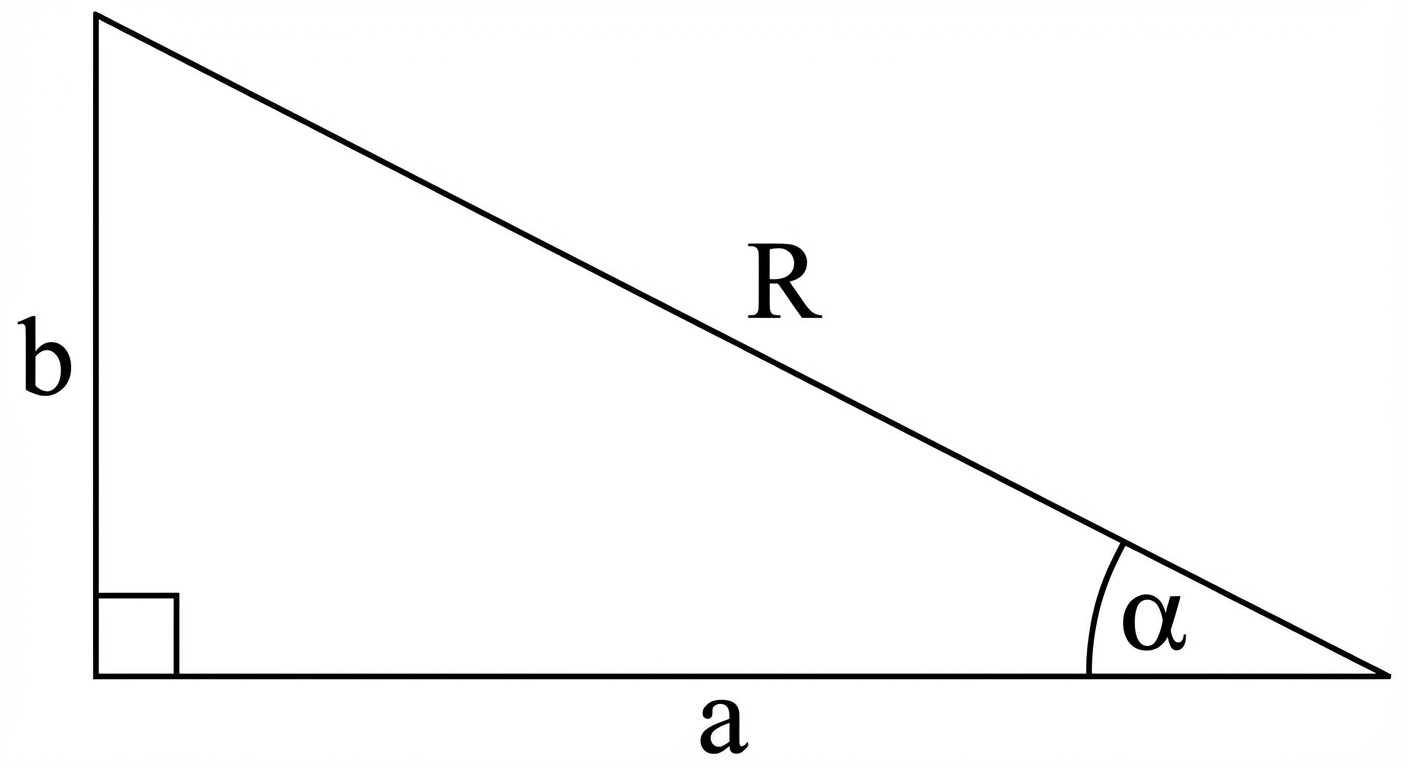
This setup allows us to find and . To find , we use Pythagoras' Theorem: , which simplifies to , so . Remember, is an amplitude, so it's always positive. To find , we can divide our two equations: , which gives us . Once you've converted your expression to , finding the maximum value is a piece of cake – it's just (since the max value of sine is 1). Solving an equation like becomes as simple as solving . This is a massive upgrade in efficiency and a critical skill for your exams and beyond. 💪
Worked example
Worked Example: Application of the R-Formula
Let's Solve This Thing! 🚀
(a) Express in the form , where and , giving the value of correct to 2 decimal places.
(b) Hence, solve the equation for .
(b) Hence, solve the equation for .
- 1First, we expand the target form using the compound angle formula and then compare the coefficients with our given expression, .
Comparing with , we get: - 2Now we can find the values of and . We use Pythagoras' theorem for and the tangent ratio for .
So, - 3For part (b), we substitute our new harmonic form into the equation. This makes it a much simpler equation to handle.
- 4We find the principal value for the angle by taking the inverse cosine. Let's call our new angle .
- 5The cosine function is positive in the first and fourth quadrants. We need to find all solutions for within the adjusted range for . The original range is , so the new range for is .
Notice that is outside our adjusted range. The other 4th quadrant angle is , which is in our range. So our two solutions for are and . - 6Finally, we convert our solutions for back to using and round to 1 decimal place as is standard practice.
Final answers:
Answer
Final answers:
Final answers:
Practice this in the app
Unlock the full chapter: practice questions, flashcards, mock papers and notes, free.
Continue revising