Trigonometry: 2D and 3D Applications
Unlocking the Angles: From SOHCAHTOA to Sine Waves 📐✨
Introduction
1. Introduction
Alright, let's talk about Trigonometry. It might sound intense, but honestly, it's like a cheat code for understanding the world around you. Think about the physics in your favorite video game, the angles in an epic photo, or even how sound waves work when you're streaming music. This chapter is your level-up guide.
We'll start with the basics you might remember: SOHCAHTOA for right-angled triangles. Then, we'll go off-road and tackle any triangle using the powerful Sine and Cosine Rules. After that, we'll zoom out and see how trig functions create repeating patterns, like the waves in a song, and solve equations with them. Finally, we'll take everything into the third dimension, figuring out angles and distances in 3D shapes – basically, applying math to the world you see on your screen and IRL. Let's get this.
We'll start with the basics you might remember: SOHCAHTOA for right-angled triangles. Then, we'll go off-road and tackle any triangle using the powerful Sine and Cosine Rules. After that, we'll zoom out and see how trig functions create repeating patterns, like the waves in a song, and solve equations with them. Finally, we'll take everything into the third dimension, figuring out angles and distances in 3D shapes – basically, applying math to the world you see on your screen and IRL. Let's get this.
2. Right-Angled Triangle Trigonometry
Alright, let's break down right-angled triangles. Think of them as the foundation level in the 'Trigonometry' game – master this, and the next levels become way easier. First up, our OG tool: Pythagoras' Theorem. You've definitely seen before. It's the ultimate cheat code for finding a missing side when you already know two sides of a right-angled triangle. Super important: 'c' is always the hypotenuse – the longest side, the one opposite the right angle. The other two sides, 'a' and 'b', are the legs.
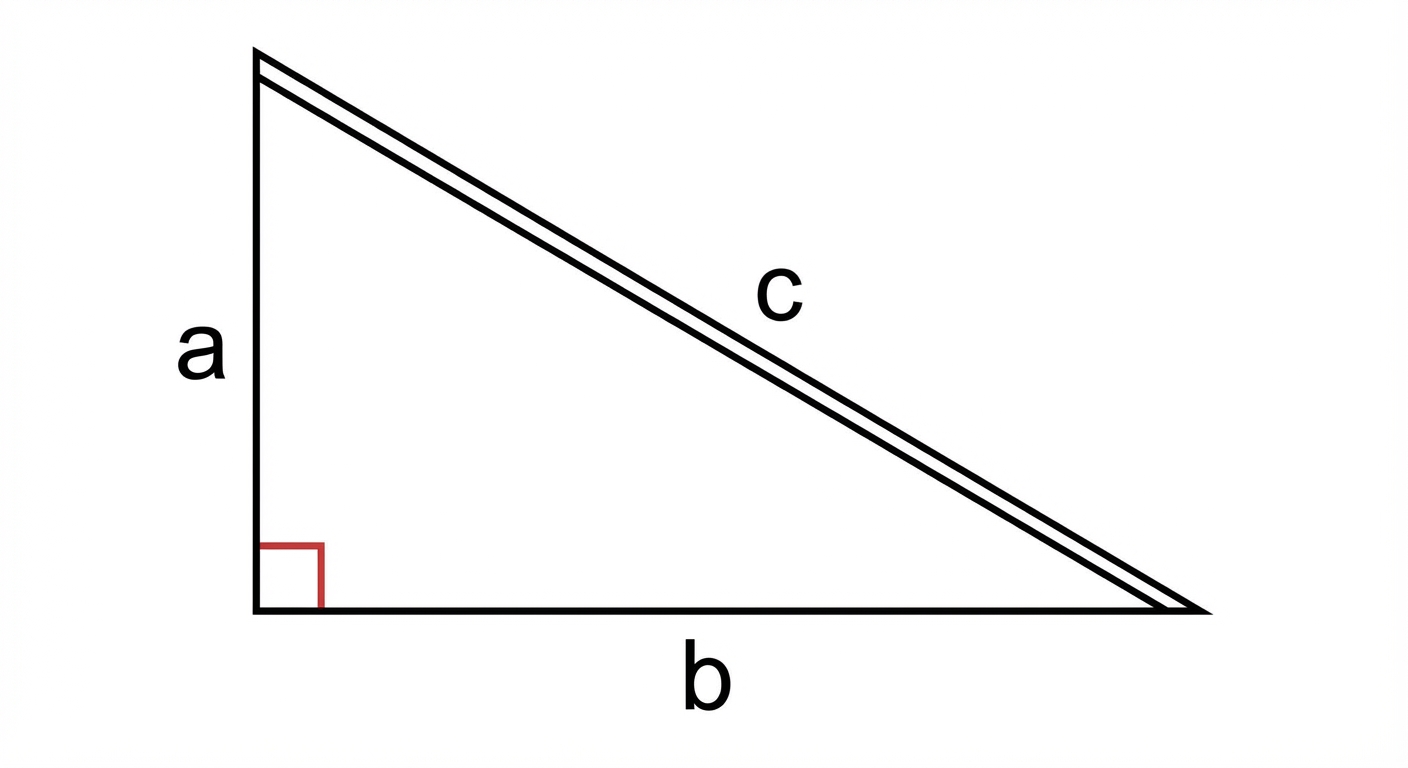
But what if you have a side and an angle, and you need to find another side? Or you know two sides and need an angle? That's when our new squad rolls in: SOHCAHTOA. It’s not a magic spell, but it might as well be! It helps us remember the three main trig ratios: Sine, Cosine, and Tangent. It all depends on your perspective from a specific angle, let's call it . The 'Opposite' side is straight across from , the 'Adjacent' is next to it (but not the hypotenuse), and the 'Hypotenuse' is always the longest side. So, we get:
SOH:
CAH:
TOA:
To find a missing angle, you just use the inverse functions on your calculator – think of it like hitting 'rewind' on a song. They look like , , and . Finally, let's talk real-world angles. The angle of elevation is when you look up from the horizontal line of sight – like spotting a drone. The angle of depression is when you look down – like checking your phone while on a balcony.
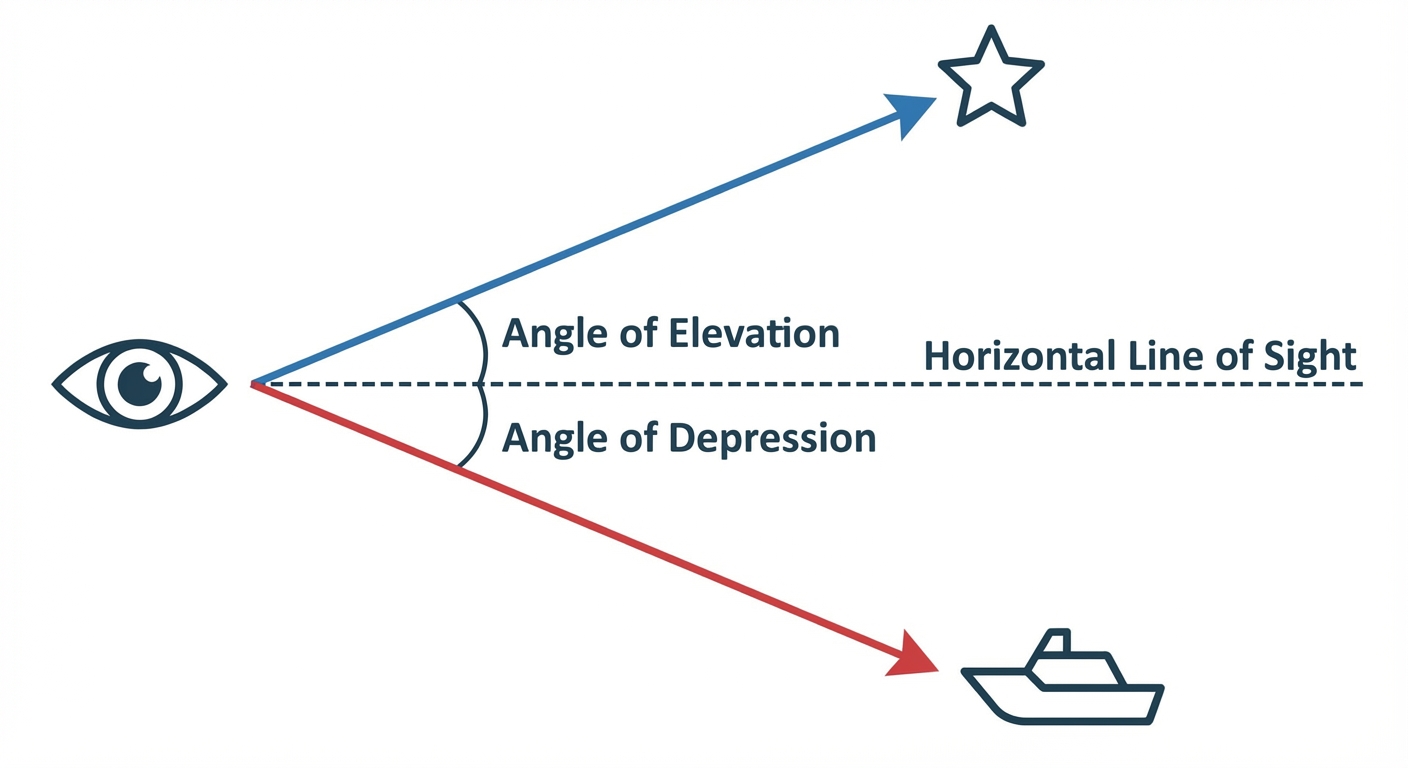
These are just angles inside a right-angled triangle disguised in a word problem. That's it! Pythagoras for 2 sides, SOHCAHTOA for an angle and a side. You've got this. 💪
Worked example
Worked Example: Application of SOHCAHTOA and Pythagoras' Theorem
The Ladder Problem: Don't Slip! 🪜
You're leaning a 3.5-meter ladder against a wall. For safety, the base of the ladder must be 1.2 meters away from the wall. (a) What is the angle the ladder makes with the ground? (b) How high up the wall does the ladder reach?
- 1First, let's sketch this out. The ladder, wall, and ground form a right-angled triangle. The ladder is the hypotenuse (3.5 m). The distance from the wall is the side adjacent to the angle on the ground (1.2 m). We need to find the angle with the ground () and the height up the wall (the opposite side).Hypotenuse = 3.5 m
Adjacent = 1.2 m
Find: Angle and Opposite side . - 2To find the angle (part a), we look at what we know: the Adjacent side and the Hypotenuse. Checking SOHCAHTOA, the ratio that connects these is Cosine (CAH). So, we'll use the cosine ratio.
- 3Now, plug in the values and solve for . To get the angle by itself, we need to use the inverse cosine function () on our calculator.
- 4For part (b), we need the height, . We could use Sine with the angle we just found, but it's often more accurate to use the original numbers. Since we know two sides (1.2 m and 3.5 m) and need the third, Pythagoras' theorem () is perfect.
- 5Let's solve for . Square the numbers, rearrange the equation to get on its own, and then take the square root.
Answer
3. Trigonometry for Non-Right-Angled Triangles
Alright, so you've mastered SOH CAH TOA for right-angled triangles. That's like playing the tutorial level. Now, we're diving into the main game: any triangle. Forget the need for a neat corner; these new tools work on all of them, whether they're acute or obtuse.
Meet your new squad: the Sine Rule, the Cosine Rule, and a slick Area Formula. These are your ultimate power-ups, and even better, they're given to you on the formula sheet! Your mission is to know which one to deploy.
First up, the Sine Rule: This is your go-to when you have a 'matching pair' – an angle and its opposite side. If you have a pair and one other piece of info (another side or angle), you can find pretty much anything else. But watch out for the ambiguous case! 🤯 It's a rare plot twist that can happen when you're given two sides and a non-included angle (SSA). Sometimes, two different triangles can be drawn with that info. Your calculator will give you one angle, but you have to check if an obtuse version () could also work. Think of it like a Snapchat filter that creates two slightly different versions of you.
Meet your new squad: the Sine Rule, the Cosine Rule, and a slick Area Formula. These are your ultimate power-ups, and even better, they're given to you on the formula sheet! Your mission is to know which one to deploy.
First up, the Sine Rule: This is your go-to when you have a 'matching pair' – an angle and its opposite side. If you have a pair and one other piece of info (another side or angle), you can find pretty much anything else. But watch out for the ambiguous case! 🤯 It's a rare plot twist that can happen when you're given two sides and a non-included angle (SSA). Sometimes, two different triangles can be drawn with that info. Your calculator will give you one angle, but you have to check if an obtuse version () could also work. Think of it like a Snapchat filter that creates two slightly different versions of you.
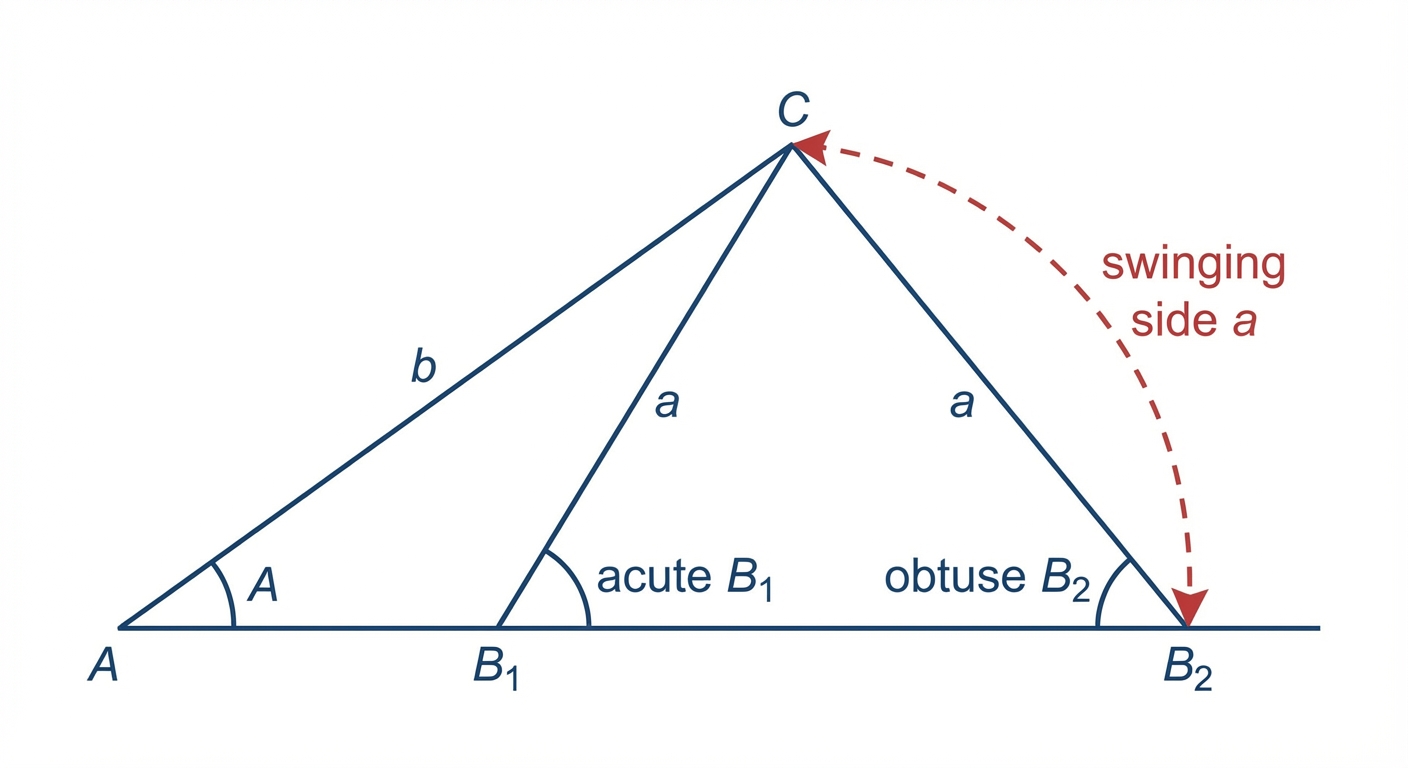
Next, the Cosine Rule: This is the heavy-hitter you call in when the Sine Rule won't work. It's perfect for two situations: 1) You know two sides and the angle squished between them (SAS) and you need the third side. 2) You know all three sides (SSS) and need to find an angle. It kind of looks like Pythagoras's Theorem went to the gym and got buff, right?
Finally, the Area Formula: Say goodbye to the basic . This is the upgrade. If you know two sides and the angle between them (SAS, sound familiar?), you can find the area instantly without needing the perpendicular height. It's a total lifesaver and makes calculating the area of any weirdly shaped triangular field or room a breeze.
Worked example
Worked Example: Applying the Sine and Area Rules
The Drone Flight Path Problem 🤔
You and your friend are flying a drone. You are standing at point and your friend is at point , meters apart. You both spot the drone, . The angle of elevation from you to the drone () is . The angle at your friend's position () is .
a) Calculate the distance from you to the drone ().
b) Calculate the area of the triangular patch of ground directly under the drone's flight path ().
a) Calculate the distance from you to the drone ().
b) Calculate the area of the triangular patch of ground directly under the drone's flight path ().
- 1First, let's sketch this out. We have a triangle . We know two angles, so we can easily find the third angle at the drone's position, . This will give us a crucial 'matching pair' for the Sine Rule.
- 2Now we can find your distance to the drone, which is side . We have the side opposite (which is m) and we want the side opposite (which is ). This is a perfect setup for the Sine Rule!
- 3Let's rearrange the formula to make the subject and solve. Just multiply both sides by . Time to use the calculator.
- 4For part (b), we need the area of triangle . We know two sides ( m and m) and the angle between them (). This is exactly what the area formula is for. Let's plug in our values.
- 5Calculate the final answer and don't forget the units! The area will be in square meters (). Mission complete! ✅
Answer
4. Exact Trigonometric Values
Alright, let's talk about leveling up your trig game. So far, you've probably been punching angles into your calculator and getting back a long string of decimals. That's cool, but in the big leagues, we use exact values. Think of it like streaming music: your calculator gives you the 128kbps MP3 version, but exact values are the lossless, high-res audio file. They're precise, clean, and show you really know your stuff.
So, how do we get these? We don't need to memorize a million values, just a few key ones for the 'special' angles: 0°, 30°, 45°, 60°, and 90°. Most of these come from two legendary triangles. First up, the Isosceles Right-Angled Triangle, which gives us the values for 45°. Imagine its two shorter sides are length 1. Using Pythagoras, the hypotenuse is . From this, we get (or ), (or ), and .
The second hero is the 30-60-90 triangle. This is basically an equilateral triangle of side length 2, chopped in half. This gives us a triangle with sides 1, , and hypotenuse 2.
So, how do we get these? We don't need to memorize a million values, just a few key ones for the 'special' angles: 0°, 30°, 45°, 60°, and 90°. Most of these come from two legendary triangles. First up, the Isosceles Right-Angled Triangle, which gives us the values for 45°. Imagine its two shorter sides are length 1. Using Pythagoras, the hypotenuse is . From this, we get (or ), (or ), and .
The second hero is the 30-60-90 triangle. This is basically an equilateral triangle of side length 2, chopped in half. This gives us a triangle with sides 1, , and hypotenuse 2.
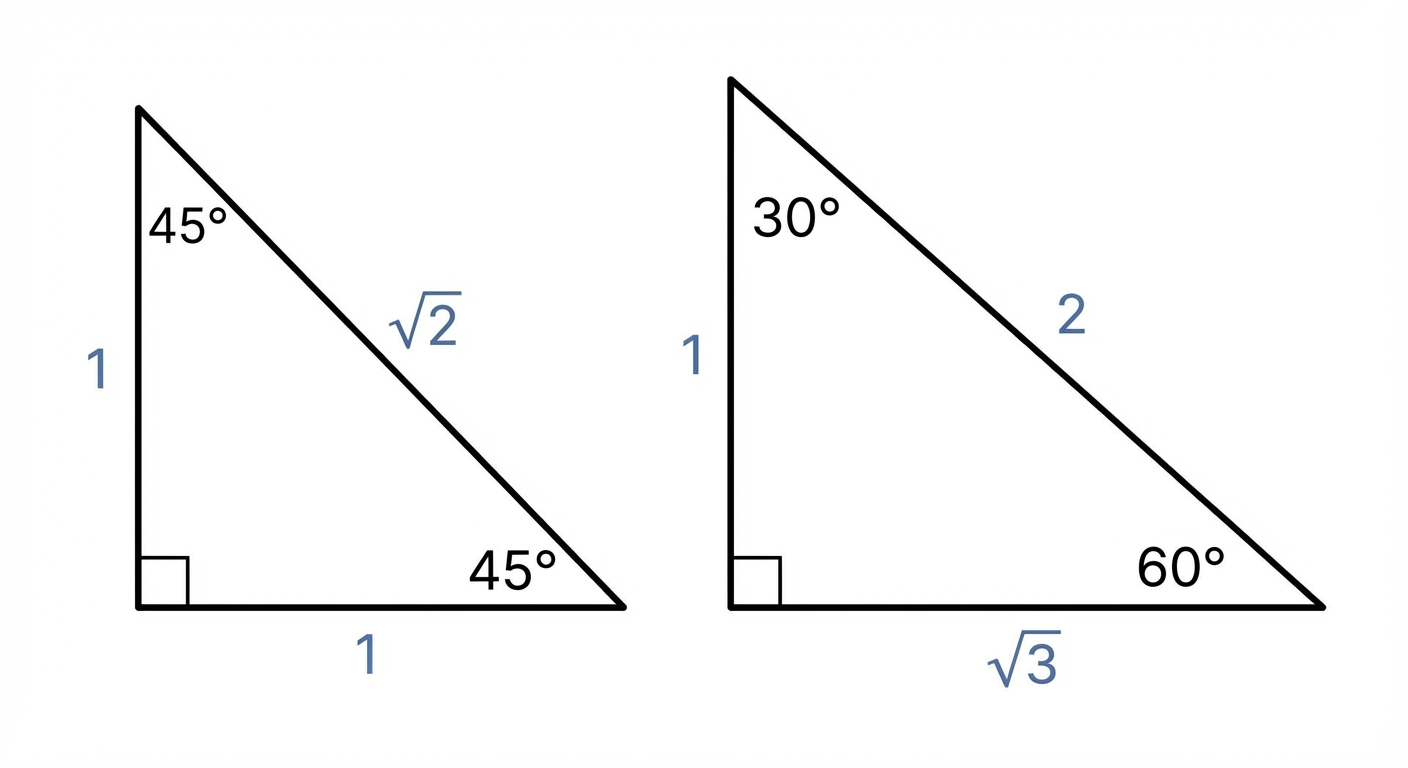
From this single triangle, we can derive the values for both 30° and 60°. For example, , while . See how they're connected? You just have to remember SOH CAH TOA and which side is opposite which angle. The values for 0° and 90° are a bit different – just remember , , and on the flip side, and . Knowing these values by heart is a superpower for non-calculator exam questions. No cap.
Worked example
Worked Example: Calculating Exact Area
Putting Those VIP Values to Work 👷♀️
A triangular garden plot has two sides of length 12m and 10m. The angle between these two sides is 60°. Calculate the exact area of the garden.
- 1First, we need to pick the right tool for the job. Since we have two sides and the angle between them (the 'included angle'), we'll use the area formula for a non-right-angled triangle. Let's call the sides and , and the angle .
- 2Now, let's substitute the values from the problem into our formula. It's just like tagging your friends in a photo – put the right value in the right spot.
- 3Here's the key move! The question asks for the exact area, which is our cue to use an exact trig value, not the decimal from our calculator. We know from our special triangles that the exact value of is . Let's sub that in.
- 4Time to simplify and get our final answer. We can multiply the numbers together. Don't touch the square root – it's what keeps our answer exact and beautiful.
- 5Finally, don't forget the units! Since the lengths were in meters, the area will be in square meters. And that's it – a perfect, exact answer. Mission complete.
Answer
5. Applications of Trigonometry in Three Dimensions
Alright, let's talk 3D Trig. Don't let the '3D' part freak you out. This isn't some brand new, complicated math; it's just you applying your existing skills—Pythagoras' theorem and SOH CAH TOA—in a cooler, three-dimensional world. Think of it like upgrading from a 2D side-scroller game to a massive open-world RPG. The controls are the same, but the environment is way more immersive.
The absolute golden rule of 3D trig is to find the 2D triangle hidden within the 3D shape. Every single 3D problem can be flattened out into one or more simple triangles. Your mission, should you choose to accept it, is to spot them. For example, finding the longest diagonal inside a shoebox (a cuboid) is a two-step Pythagoras problem: first, you find the diagonal of the base, then you use that length and the box's height to form a new right-angled triangle and find the space diagonal.
Now for the tricky stuff. Finding the angle between a line and a plane sounds wild, but it's like finding the angle a straw makes with the table it's sticking through. To solve it, you find the 'shadow' of the line on the plane (its projection) and form a right-angled triangle between the line, its shadow, and the vertical height.
The absolute golden rule of 3D trig is to find the 2D triangle hidden within the 3D shape. Every single 3D problem can be flattened out into one or more simple triangles. Your mission, should you choose to accept it, is to spot them. For example, finding the longest diagonal inside a shoebox (a cuboid) is a two-step Pythagoras problem: first, you find the diagonal of the base, then you use that length and the box's height to form a new right-angled triangle and find the space diagonal.
Now for the tricky stuff. Finding the angle between a line and a plane sounds wild, but it's like finding the angle a straw makes with the table it's sticking through. To solve it, you find the 'shadow' of the line on the plane (its projection) and form a right-angled triangle between the line, its shadow, and the vertical height.
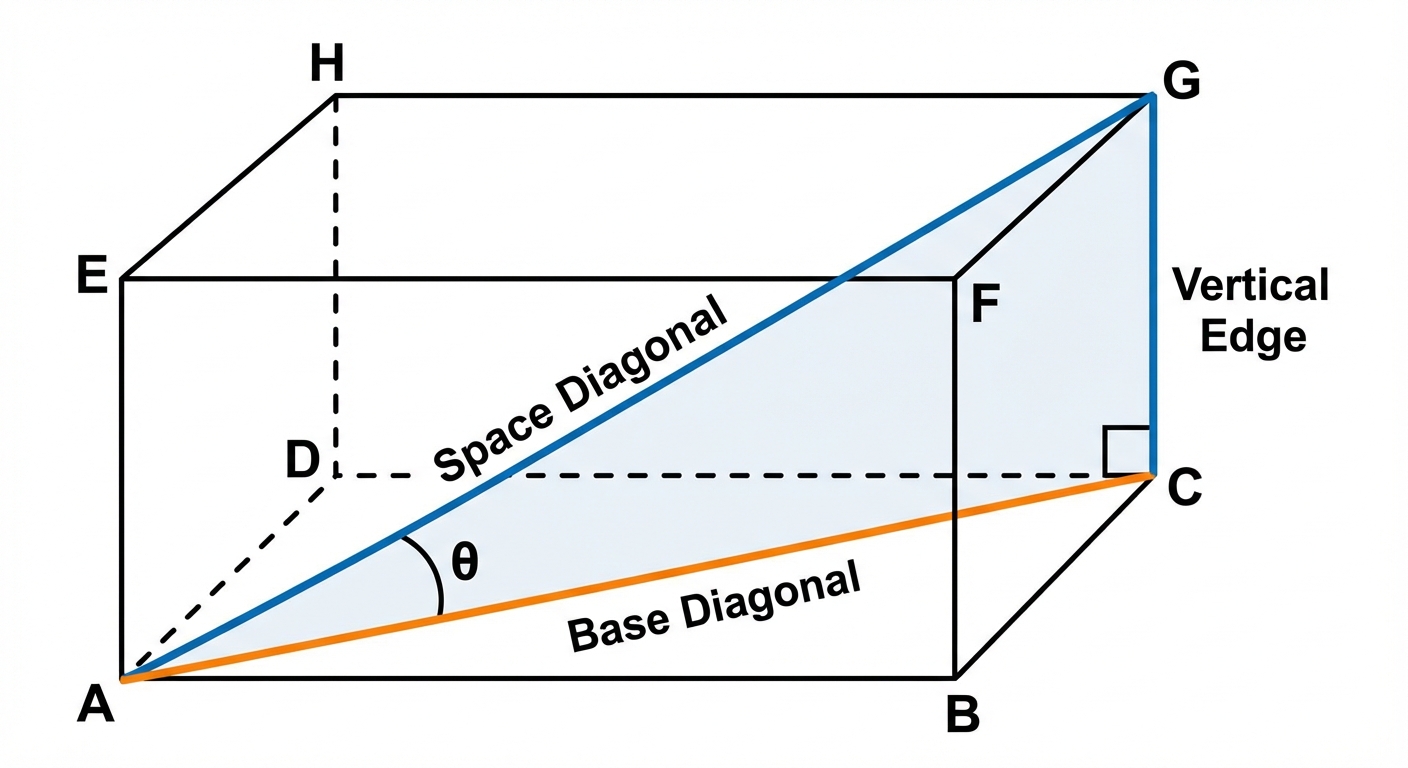
The angle you want is the one between the line and its shadow. It's almost always a SOH CAH TOA problem once you've found that triangle. Trust the process!
Worked example
Worked Example: Calculating the Angle Between a Line and a Plane
Let's Solve a 3D Puzzle 🧩
A cuboid ABCDEFGH has length AB = 15 cm, width BC = 8 cm, and height CG = 10 cm. Calculate the angle between the space diagonal AG and the base plane EFGH.
- 1First, we identify the hidden 2D right-angled triangle. The space diagonal is AG. Its 'shadow' on the base plane EFGH is the base diagonal EG. The vertical edge AE is perpendicular to the base, so we have right triangle AEG with the right angle at E. The angle between line AG and the plane EFGH is the angle between AG and its shadow EG, which is .[IMAGE_PLACEHOLDER_2: A diagram of the cuboid with the triangle AEG highlighted, showing the right angle at E and the angle to be found, ∠AGE.]
- 2We know the length of the 'opposite' side of our angle, which is the height AE = 10 cm. To use trigonometry, we need one more side of triangle AEG. Let's find the length of the 'adjacent' side, EG, which is the diagonal of the base rectangle EFGH.In triangle EFG, using Pythagoras' theorem:
- 3Now we find the length of EG by taking the square root.
- 4Okay, back to our main triangle, AEG. We have the Opposite side (AE = 10 cm) and the Adjacent side (EG = 17 cm) relative to the angle we want (∠AGE). This means we need to use the Tangent ratio from SOH CAH TOA.
- 5To find the angle itself, we use the inverse tangent function () on our calculator. Make sure your calculator is in degrees mode!
- 6Finally, we round our answer to a sensible degree of accuracy, like one decimal place or three significant figures as per IGCSE standard.
Answer
Worked example
Worked Example: Sine Rule for a Missing Side
In triangle , , , side cm (opposite ). Find side (opposite ) to s.f. 📐 (Formula sheet: .)
- 1Sine rule: side over its opposite angle's sine equals the same for any other side. Match each side to its angle.
- 2Sub the known values. Solve for by multiplying both sides by .
- 3Plug into the calculator in one go (don't round mid-way).
- 4Round to 3 s.f. with units.
Answer
Worked example
Worked Example: Cosine Rule for a Missing Angle
Triangle has sides , , (where are the sides opposite the corresponding vertices). Find to d.p. 🎯 (Formula sheet: .)
- 1Use the cosine rule rearranged for the angle. The angle you want sits opposite the side on the LHS.
- 2Sub the values.
- 3Simplify, then take the inverse cosine.
- 4Round to 1 d.p. (angles convention).
Answer
Worked example
Worked Example: Bearings Combined with Trigonometry
From point , the bearing of point is and km. From , the bearing of point is and km. Find the distance , to s.f. 🧭
- 1Sketch this. At the angle from to is (because both bearings are measured from the same north line at ).
- 2Triangle has two known sides (, ) and the included angle (). That's the cosine-rule setup.
- 3Sub in. exactly — nice clean numbers.
- 4Take the square root. Lucky — .
Answer
6. 3D Trigonometry
Three dimensional trigonometry sounds scary, but here is the secret: there is no new formula to learn. Every 3D problem is solved by spotting a flat right-angled triangle hidden inside the solid, then using Pythagoras' theorem and SOHCAHTOA on it, exactly as you already do in two dimensions. The whole skill is drawing the right triangle. Start by sketching the solid and marking the two points you care about. Then ask which flat triangle joins them. In a cuboid, the space diagonal (corner to opposite corner) is found in two steps. First use Pythagoras on the rectangular base to get the base diagonal, then use Pythagoras again on the upright triangle formed by that base diagonal and the vertical height. So for a cuboid with base by and height , the base diagonal is and the space diagonal is .
The other classic 3D task is the angle between a line and a plane. Picture a stick leaning so one end touches a flat floor. The angle it makes with the floor is measured to the line's shadow on that plane, the point directly below the top end. To find it, drop a perpendicular from the high point straight down to the plane, join the foot of that perpendicular to the base point, and you have a right-angled triangle standing upright. The vertical drop is the opposite side, the shadow on the plane is the adjacent side, so . Always name your triangle's three vertices before you reach for the calculator, and check the side you call the hypotenuse really is the longest, sloping one. Master those two moves, the space diagonal and the angle to a plane, and every 3D trigonometry question in the exam becomes a two dimensional one you have already met. 💪
Worked example
Worked Example: The Space Diagonal of a Cuboid
Two Pythagoras steps, corner to corner 📐
A cuboid has a rectangular base measuring cm by cm, and a vertical height of cm. Vertex sits directly above vertex . Calculate the length of the space diagonal , from the bottom corner side up to the opposite top corner , correct to significant figures.
- 1First find the diagonal across the base rectangle. The base is cm by cm, so its diagonal is the hypotenuse of a right-angled triangle with legs and . Use Pythagoras' theorem.
- 2Now stand a new right-angled triangle upright. Its base is the diagonal cm you just found, its height is the vertical edge cm, and its hypotenuse is the space diagonal you want. Apply Pythagoras again.
- 3Evaluate the square root and round to significant figures. Notice this is the same as the one-line formula , which just combines the two steps.
Answer
Worked example
Worked Example: The Angle Between a Line and a Plane
Find the shadow, then use tan 🔦
For the same cuboid, with base measuring cm by cm and height cm, calculate the angle that the space diagonal makes with the base plane , correct to decimal place.
- 1Identify the right-angled triangle that carries the angle. The line is . Its shadow on the base is (the base diagonal), because is directly above . The angle between the line and the plane is the angle , at , between and its shadow .Triangle : vertical side cm (opposite the angle), base side cm (adjacent to the angle).
- 2You know the opposite and adjacent sides for the angle at , so choose the tangent ratio from SOHCAHTOA.
- 3Take the inverse tangent to find the angle, then round to decimal place.
Answer
Practice this in the app
Unlock the full chapter: practice questions, flashcards, mock papers and notes, free.
Continue revising