Chapter 8: Transformations and Vectors
Slide, Flip, & Point Your Way to Victory 🏆
Introduction
1. Introduction
Ever wonder how your character moves so smoothly across the screen in a game, or how a Snapchat filter perfectly scales to your face? It's all about transformations and vectors! In this chapter, we're ditching the abstract and getting into the code behind the graphics. First, we'll master transformations – the art of sliding, flipping, rotating, and resizing shapes on a grid. Then, we'll jump into vectors, which are basically instructions for movement, like giving your mate directions with both distance and direction. You'll learn the rules of vector arithmetic (adding and subtracting them), and finally, we'll put it all together to solve some tricky vector geometry problems, proving you're a strategic thinker. Let's get this level cleared!
2. The Four Fundamental Transformations
Alright, let's talk transformations! Think of them like applying a filter on Instagram or moving your character in a game. You're taking an original shape (the 'object') and changing its position or size to create a new shape (the 'image'). There are four main types you need to master.
First up is Translation, which is basically just sliding a shape around. No spinning, no flipping, no resizing. It's described by a column vector, like . The top number tells you how far to move horizontally (positive for right, negative for left), and the bottom number is for vertical movement (positive for up, negative for down). Super straightforward.
Next is Reflection, the ultimate mirror selfie. You flip a shape across a 'mirror line' (like the x-axis, y-axis, or even diagonal lines like ). Every point on the new shape is the same distance from the mirror line as the original point, just on the opposite side. Pro tip: for a reflection in the line , you just swap the coordinates to . Easy peasy.
Then we have Rotation. This is a turn around a fixed point called the centre of rotation. To describe it fully, you need three things: the centre, the angle (e.g., ), and the direction (clockwise or anticlockwise). Using tracing paper is the GOAT method here – trace the shape, put your pencil on the centre, and spin the paper. It's practically foolproof.
Finally, there's Enlargement, which is your zoom tool. It changes the size of a shape from a centre of enlargement. The size change is controlled by a scale factor. If the scale factor is 3, the new shape's sides are 3 times longer. If it's 0.5, it's half the size. But here's the spicy part: negative scale factors! A negative scale factor flips the shape through the centre of enlargement and then resizes it. It's like the shape goes to the upside down.
First up is Translation, which is basically just sliding a shape around. No spinning, no flipping, no resizing. It's described by a column vector, like . The top number tells you how far to move horizontally (positive for right, negative for left), and the bottom number is for vertical movement (positive for up, negative for down). Super straightforward.
Next is Reflection, the ultimate mirror selfie. You flip a shape across a 'mirror line' (like the x-axis, y-axis, or even diagonal lines like ). Every point on the new shape is the same distance from the mirror line as the original point, just on the opposite side. Pro tip: for a reflection in the line , you just swap the coordinates to . Easy peasy.
Then we have Rotation. This is a turn around a fixed point called the centre of rotation. To describe it fully, you need three things: the centre, the angle (e.g., ), and the direction (clockwise or anticlockwise). Using tracing paper is the GOAT method here – trace the shape, put your pencil on the centre, and spin the paper. It's practically foolproof.
Finally, there's Enlargement, which is your zoom tool. It changes the size of a shape from a centre of enlargement. The size change is controlled by a scale factor. If the scale factor is 3, the new shape's sides are 3 times longer. If it's 0.5, it's half the size. But here's the spicy part: negative scale factors! A negative scale factor flips the shape through the centre of enlargement and then resizes it. It's like the shape goes to the upside down.
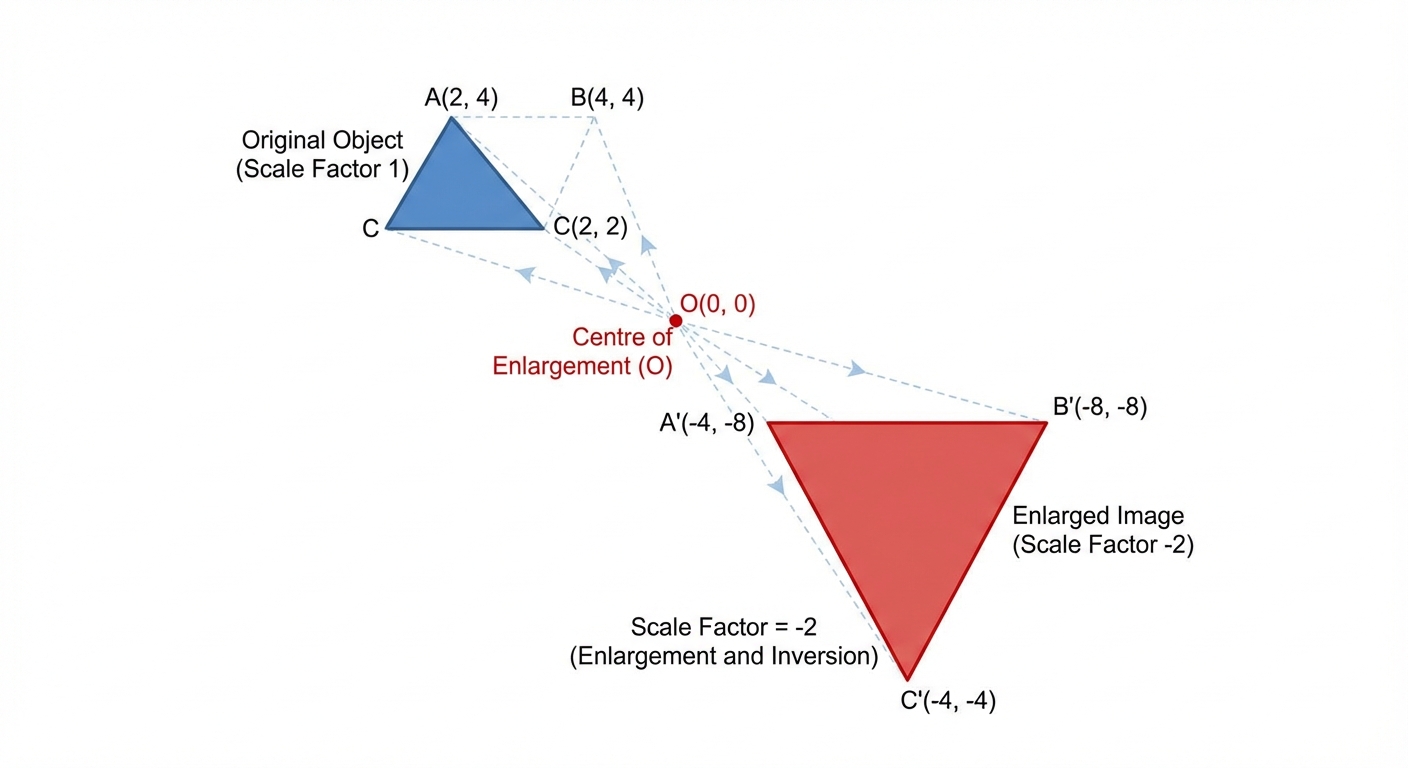
Sometimes you'll do a combination, like a reflection followed by a translation. Just take it one step at a time, and you'll nail it!
Worked example
Worked Example: Combination of Transformations
Let's Get This Triangle Transformed 🚀
Triangle has vertices at , , and .
(a) Reflect triangle in the line to get triangle .
(b) Translate triangle by the vector to get triangle .
State the coordinates of the vertices of .
(a) Reflect triangle in the line to get triangle .
(b) Translate triangle by the vector to get triangle .
State the coordinates of the vertices of .
- 1First, let's handle the reflection. We need to reflect points A, B, and C in the horizontal line . A good way to do this is to count how far each point is from the mirror line and then go the same distance on the other side.Point A(2, 1) is 2 units above the line . So, A' will be 2 units below it. A' is .
Point B(4, 1) is 2 units above the line . So, B' will be 2 units below it. B' is .
Point C(2, 4) is 5 units above the line . So, C' will be 5 units below it. C' is . - 2Nice! We've got the coordinates for triangle . Now we need to apply the translation vector to each of these new points. This means we subtract 5 from each x-coordinate and add 2 to each y-coordinate.
- 3Let's do the same calculation for the other two points, B' and C', to find their final positions in triangle .
- 4And we're done! We've performed both transformations. The final step is to clearly state the coordinates of the vertices of the final triangle, . Always double-check your arithmetic – it's so easy to make a small slip-up with the negatives.The final coordinates for triangle are , , and .
Answer
The final coordinates for triangle are , , and .
3. Vector Arithmetic Operations
Alright, let's talk about vector arithmetic. Think of a vector like a cheat code for movement in a video game. A column vector like is just a set of instructions: 'move 3 units to the right (x-direction) and 4 units up (y-direction)'. Simple, right? Now, what if you want to combine moves? That's where vector arithmetic comes in, and it's way easier than it sounds.
Adding and Subtracting Vectors: This is like creating a playlist of movements. If your trip from home to your part-time job is vector and from your job to your friend's house is vector , the total trip from home to your friend's is just . To do the math, you just add the top numbers (the x-components) together and the bottom numbers (the y-components) together. Subtraction works the same way but finds the direct path between two endpoints. If is the vector to point A and is the vector to point B, then the vector from A to B is . Easy peasy.
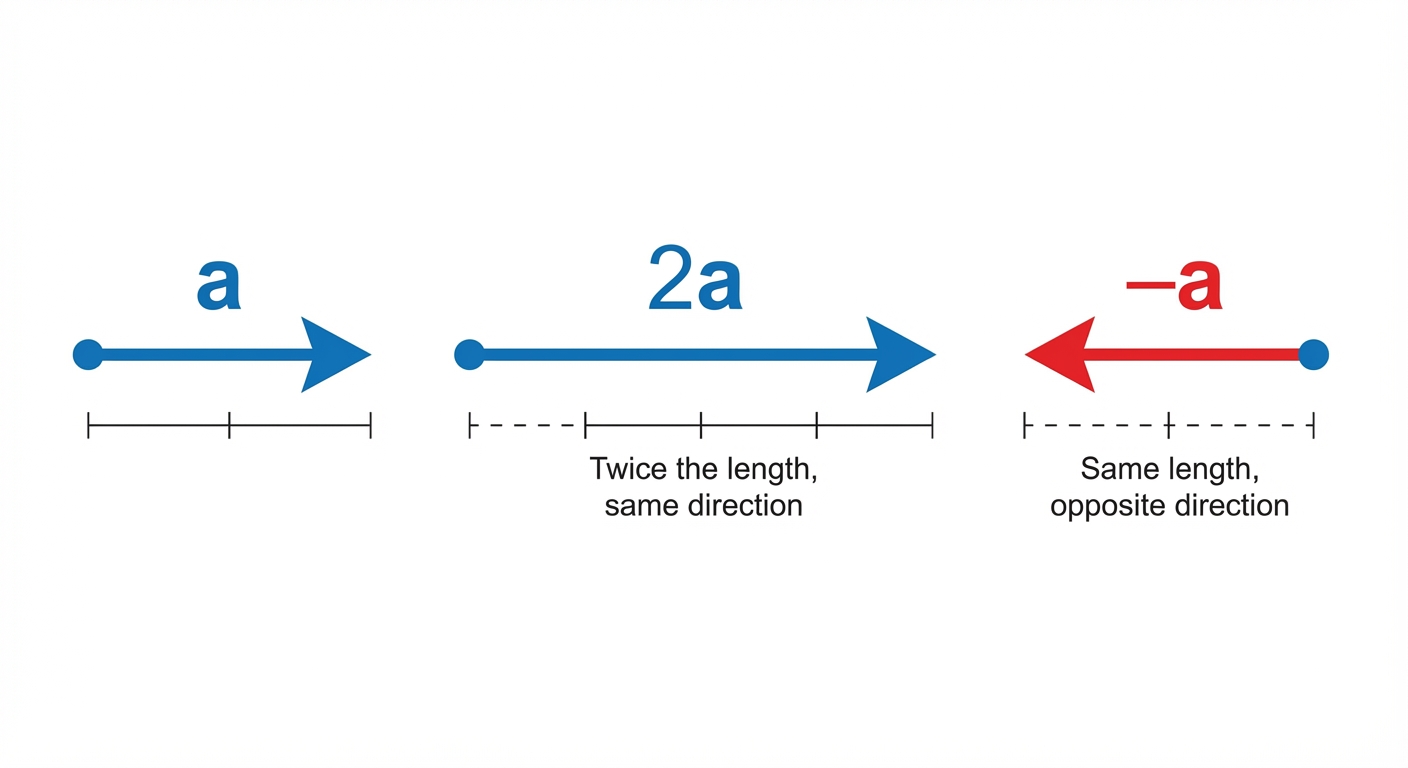
Scalar Multiplication: A 'scalar' is just a fancy name for a regular number. Multiplying a vector by a scalar is like hitting the fast-forward button or changing the volume. If your vector to the local shop is , then means you go twice as far in the same direction. Multiplying by a negative scalar, like , flips the vector's direction completely—like an instant 180° turn while driving.
Adding and Subtracting Vectors: This is like creating a playlist of movements. If your trip from home to your part-time job is vector and from your job to your friend's house is vector , the total trip from home to your friend's is just . To do the math, you just add the top numbers (the x-components) together and the bottom numbers (the y-components) together. Subtraction works the same way but finds the direct path between two endpoints. If is the vector to point A and is the vector to point B, then the vector from A to B is . Easy peasy.
Scalar Multiplication: A 'scalar' is just a fancy name for a regular number. Multiplying a vector by a scalar is like hitting the fast-forward button or changing the volume. If your vector to the local shop is , then means you go twice as far in the same direction. Multiplying by a negative scalar, like , flips the vector's direction completely—like an instant 180° turn while driving.
Magnitude (Modulus): Sometimes you don't care about the direction, you just want to know the distance or length of the vector. This is called the magnitude, written as . It's basically just finding the hypotenuse of the triangle the vector makes, using Pythagoras' Theorem. For a vector , the magnitude is . It’s the straight-line distance, no detours!
Worked example
Worked Example: Combining Vector Operations
Let's Get This Bread (Mathematically) 🍞
You are given two vectors, and .
Calculate:
(a) The vector
(b) The magnitude of the vector , written as .
Calculate:
(a) The vector
(b) The magnitude of the vector , written as .
- 1First, let's tackle part (a). Before we can add, we need to handle the scalar multiplication. We need to find what is. We do this by multiplying both the x and y components of by 2.
- 2Now that we have , we can add it to . Remember, just add the top numbers together and the bottom numbers together.
- 3On to part (b)! First, we need to find the resultant vector from the subtraction, . Be careful with the negative signs here—subtracting a negative is the same as adding.
- 4Finally, we calculate the magnitude (or length) of this new vector using the formula . Here, our is 5 and our is -10.
- 5Don't forget to simplify the square root if you can, or give the decimal answer to 3 significant figures as is standard in IGCSE. Let's give both!
Answer
4. Application of Vectors in Geometry
Alright, let's level up our vector game! Think of Vector Geometry as the ultimate strategy guide for solving geometric puzzles. Instead of just adding and subtracting vectors, we're now using them to navigate shapes and prove things about them. The foundation is the position vector. Imagine the origin (0,0) is your home base or spawn point in a game. A position vector, like , is the direct path from home (O) to a point (A).
Now, what if you need the path from your friend's house (A) to the cinema (B)? You don't go directly. You use your position vectors: you'd go from A back to home O (which is ), and then from home O to B (). So, the path . This simple trick is the key to everything! We can express any vector path by piecing together other known vectors, like creating a custom playlist by dragging and dropping tracks.
Now, what if you need the path from your friend's house (A) to the cinema (B)? You don't go directly. You use your position vectors: you'd go from A back to home O (which is ), and then from home O to B (). So, the path . This simple trick is the key to everything! We can express any vector path by piecing together other known vectors, like creating a custom playlist by dragging and dropping tracks.
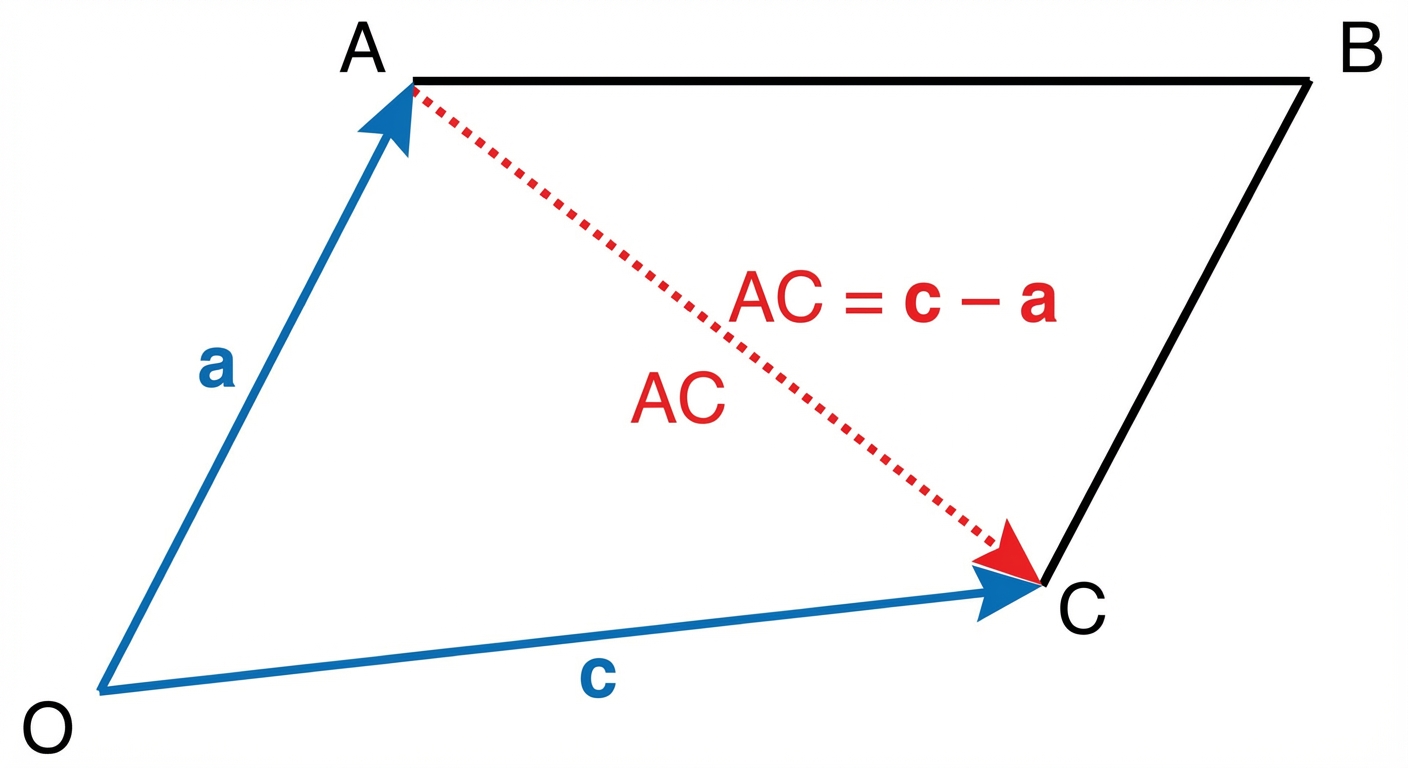
With this, we can become geometry detectives. Want to prove two lines are parallel? Easy. Show that one vector is just a scaled-up version of the other, like , where is just a number (a scalar). It means they're pointing in the exact same or opposite direction, just with a different magnitude – think of it as the same meme format, but one has been screenshotted a few more times. To prove three points A, B, and C are collinear (all on a single straight line), you need to do two things: 1) Show the vector is parallel to (e.g., ), and 2) confirm they share a common point (which is B, obviously!). This proves they're not just on parallel tracks, but on the exact same track. We'll also use this to solve problems with ratios, like finding a point that's two-thirds of the way along a line segment. It's all about breaking down the journey into a series of known vector steps. You got this! 💪
Worked example
Worked Example: Proving Collinearity with Ratios
Let's Solve This Geometry Puzzle 🕵️♀️
In the diagram, OABC is a parallelogram. and . The point M divides the line AC in the ratio 2:1. The point N is the midpoint of BC. Prove that O, M, and N are collinear (lie on a straight line).
- 1First, let's find the vector path from O to M. We can't go there directly, so we'll go from O to A, and then part of the way along AC. Since M divides AC in the ratio 2:1, we need to travel of the way along .
- 2Next up, we need to find the vector path from O to N. We'll find a route using our base vectors and . A good path is O -> C -> N. Since N is the midpoint of BC, is half of . In a parallelogram, is the same as , which is .
- 3Now we have expressions for and . To prove O, M, and N are collinear, we need to show that one vector is a multiple of the other. Let's see if we can factor something out of our expression for to make it look like .
- 4Look at that! The part in the brackets is exactly our expression for . We've just shown that is a scalar multiple of . This is the condition for the vectors being parallel.
- 5We've shown the vectors are parallel ( with ). Both vectors also start from the same common point, O. A shared point and parallel direction means they must be on the same straight line. Mission complete!
Answer
Worked example
Worked Example: Combination of Two Transformations
Triangle has vertices . (a) Reflect in the -axis to get . (b) Then translate by the vector to get . State the vertices of and describe the single transformation that maps onto . 🔄
- 1Reflection in the -axis flips the sign of every -coordinate. Rule: .
- 2Translation by shifts every point left and up. Rule: .
- 3Single transformation from to ? Check original vs final: , , . The shape rotated — compare orientation. In fact, is the image of under a rotation of anticlockwise about . Check: itself is at and stays put under this rotation... wait, is , not . So the centre isn't . Try the fixed-point method instead: find coordinates such that rotating each -vertex anticlockwise about gives the corresponding -vertex. The standard test: ? That flips about centre giving . Try so ; so . Check . Not . So the combined move is genuinely two steps and a single-transformation description is complicated — for the exam answer, state the vertices and note: 'the combination is equivalent to a rotation, which can be determined by finding the fixed point geometrically'.
- 4Key exam takeaway: for any 'describe the combination' question, apply the transformations in order first, then compare original and final shapes to work out what single move matches — usually a reflection, rotation or glide reflection. Don't guess — check all three vertices.
Answer
Worked example
Worked Example: Enlargement with a Negative Scale Factor
Triangle has vertices . Enlarge by scale factor , centre . State the vertices of the image . 🔁
- 1A negative scale factor flips the shape through the centre and scales it by the positive magnitude. Rule from centre origin: , where . The image ends up on the opposite side of the centre.
- 2Apply to each vertex.
- 3Sanity check: the image triangle should be twice as big (area , lengths ) and in the opposite quadrant from the original. ✅
Answer
Worked example
Worked Example: Magnitude of a Vector
The vector . Find the magnitude , giving an exact answer and also a decimal to s.f. 📏
- 1Magnitude of a vector is basically Pythagoras. . Lock it in.
- 2Squaring kills the negative — . Add the squares.
- 3exactly. Nice clean number — lucky vector. 😎
Answer
Worked example
Worked Example: Collinearity Using Position Vectors
Points , , have position vectors , , . Show that , and are collinear (lie on the same straight line) and find the ratio . 📍
- 1Collinear = all on one straight line. Check by finding and ; if one is a scalar multiple of the other, they share a direction and the three points line up.
- 2Is a scalar multiple of ? . Yes — same direction.
- 3Since they share direction and share the point , the three points are collinear. The ratio is set by the scalar — is twice as long as .
Answer
Practice this in the app
Unlock the full chapter: practice questions, flashcards, mock papers and notes, free.
Continue revising