Coordinate Geometry: Lines, Lengths, and Midpoints
Level Up Your Graphing Game 🎮✨
Introduction
1. Introduction
Alright, let's talk Coordinate Geometry. It might sound a bit intense, but honestly, it's just the maths version of a video game map or your phone's GPS. It's all about figuring out where things are, how far apart they are, and how to get from one point to another. Whether you're finding the quickest route to your friend's house or calculating the trajectory of a perfect shot in your favourite game, you're using the core ideas of coordinate geometry. We're going to break it all down so you can navigate these graphs like a pro. Let's get this bread! 🥖
2. Finding the Equation of a Straight Line
Every straight line has a unique 'signature' or 'vibe', and in maths, we write this as the equation . Think of it like a line's profile page. The '' is the gradient – it tells you how steep the line is. A big positive is like a hardcore uphill climb, while a negative is a speedy downhill slide. The '' is the y-intercept – it's where the line crosses the vertical y-axis, kind of like its starting point. To find a line's equation, you just need two things: its gradient () and any single point it passes through. First, we find the gradient using two points and with the formula: Once you have your gradient, you just plug it and one of the points back into to find your missing ''. Easy!
Worked example
Worked Example: Deriving a Line's Equation
Worked Example: The Line's 'Playlist' 🎧
Find the equation of the straight line that passes through the points A(2, 5) and B(4, 11).
- 1First, let's find the gradient (). We'll use our formula . Let A be and B be .
- 2Now we know the line's equation looks like . To find , we can substitute the coordinates of either point into the equation. Let's use point A(2, 5), so and .
- 3Solve for .
- 4We've got our gradient () and our y-intercept (). Now just write the final equation.
Answer
3. Calculating the Length of a Line Segment
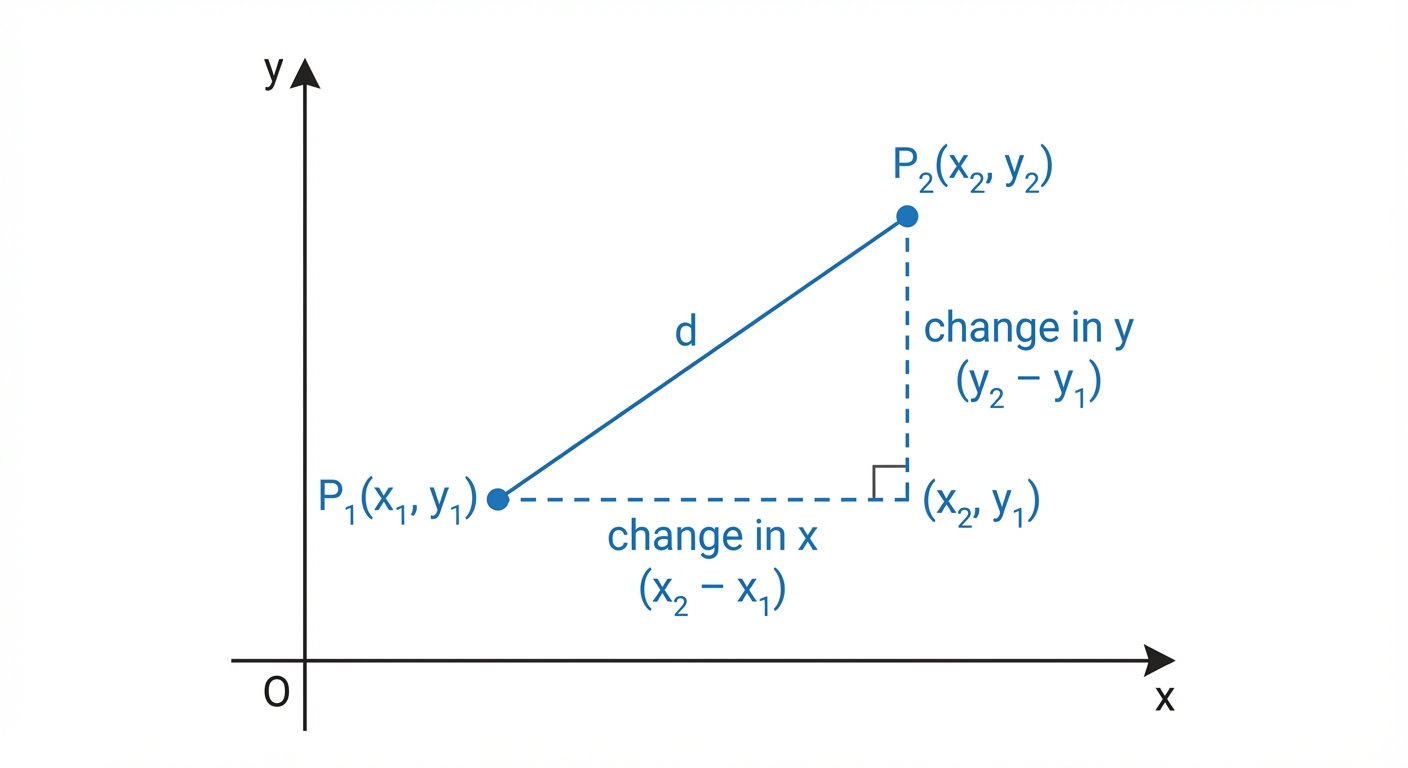
Ever needed to know the exact distance between you and an opponent in a game? That's exactly what this is. Calculating the length of a line segment is just a fancy way of saying 'find the distance between two points'. The secret? It's just the Pythagorean theorem () in disguise! Imagine the line segment is the hypotenuse of a right-angled triangle. The other two sides are the horizontal distance ('change in x') and the vertical distance ('change in y'). This gives us the distance formula:
Don't let it scare you. You're just finding the difference in the x's, squaring it, finding the difference in the y's, squaring it, adding them together, and taking the square root. Done.🎯
Don't let it scare you. You're just finding the difference in the x's, squaring it, finding the difference in the y's, squaring it, adding them together, and taking the square root. Done.🎯
Worked example
Worked Example: Calculating Segment Length
Worked Example: The Distance Drop 📍
Calculate the length of the line segment between point C(-1, 3) and point D(5, -2).
- 1Let's label our points: C is so . D is so . Now plug these into the distance formula.
- 2Be careful with the negative numbers! is , and .
- 3Now, square both numbers inside the square root. Remember, a negative number squared becomes positive.
- 4The question doesn't ask for a decimal, so leaving it as a square root (a 'surd') is often the most accurate answer. If you need to, you can calculate the decimal value.
Answer
4. Finding the Coordinates of the Midpoint
This is probably the chillest concept in the whole chapter. Finding the midpoint of a line segment is literally just finding the average of the coordinates. To find the middle of your journey between your house and your part-time job, you'd go halfway on the x-axis and halfway on the y-axis. To find the average of two numbers, you add them together and divide by two, right? We do exactly that for the x-coordinates and then again for the y-coordinates. The formula is as simple as it looks: No tricks, that's it.
Worked example
Worked Example: Finding the Midpoint
Worked Example: The Halfway Hangout Spot ☕
Find the coordinates of the midpoint of the line segment joining P(-2, -4) and Q(6, 10).
- 1Let's identify our coordinates. For P, and . For Q, and .
- 2Now, just calculate the value for each coordinate separately.
- 3Simplify the fractions to get the final coordinates of the midpoint.
Answer
5. Finding the Equation of a Perpendicular Bisector
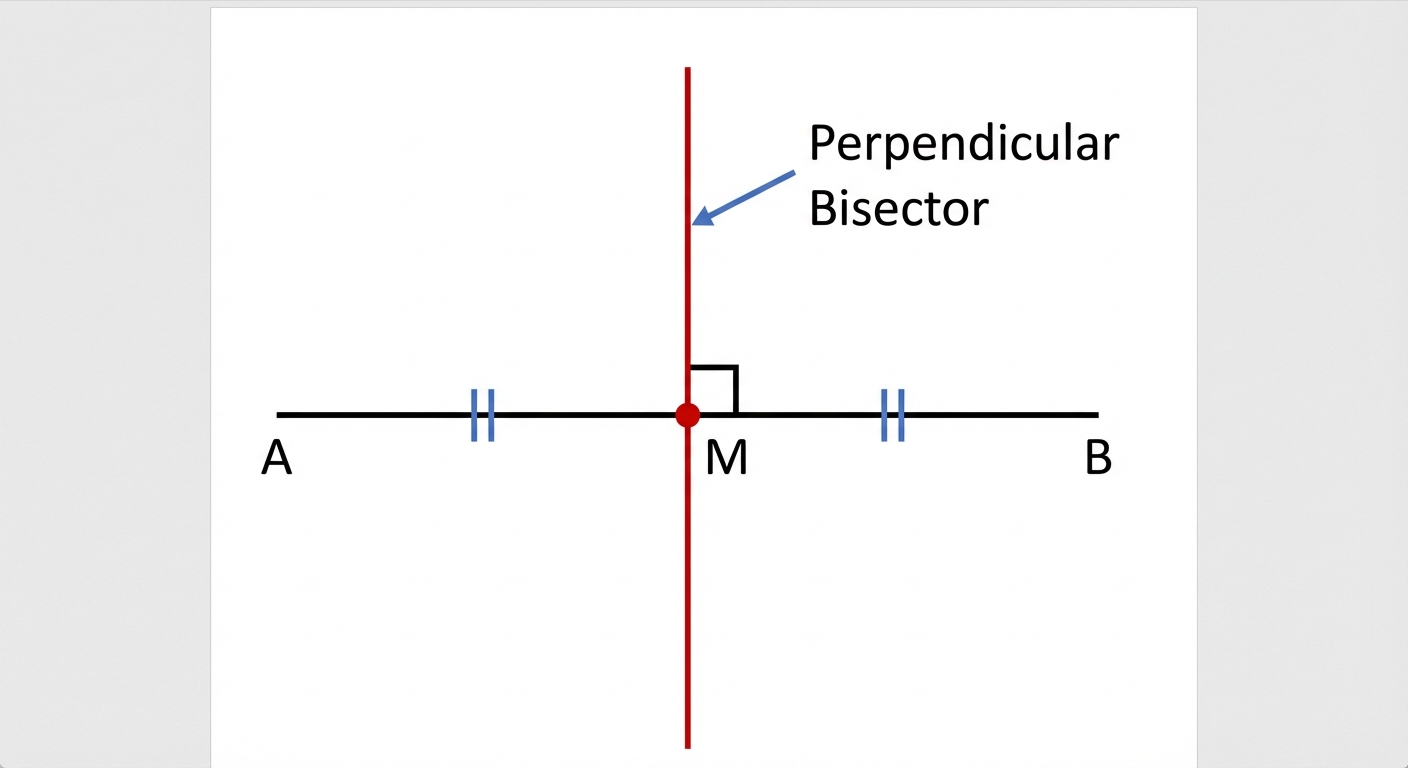
Okay, this is the final boss of the level. It sounds complicated, but it's just putting together all the skills we've just learned. Let's break down the name. 'Bisector' means it cuts a line segment in half – so it passes through the midpoint. 'Perpendicular' means it meets the original line at a perfect 90-degree angle. The gradients of perpendicular lines have a special relationship: they are negative reciprocals. That means if one gradient is , the perpendicular one is . You just flip the fraction and switch the sign! So, the game plan is:
1. Find the midpoint of the original line segment.
2. Find the gradient of the original line segment.
3. Calculate the perpendicular gradient (flip and switch!).
4. Use this new gradient and the midpoint to find the equation of the line, just like we did in the first section.
1. Find the midpoint of the original line segment.
2. Find the gradient of the original line segment.
3. Calculate the perpendicular gradient (flip and switch!).
4. Use this new gradient and the midpoint to find the equation of the line, just like we did in the first section.
Worked example
Worked Example: Equation of a Perpendicular Bisector
Worked Example: The Final Boss Battle ⚔️
Find the equation of the perpendicular bisector of the line segment joining points A(1, 2) and B(5, 10).
- 1Step 1: Find the midpoint of AB. We need this point because the bisector passes through it.
- 2Step 2: Find the gradient of the line segment AB.
- 3Step 3: Find the perpendicular gradient. We flip the gradient of AB and switch the sign. The gradient of AB is 2 (or ).
- 4Step 4: Now we have the gradient of our new line () and a point it passes through (the midpoint, (3, 6)). We use to find .
- 5Finally, write the equation of the perpendicular bisector using our new gradient and new y-intercept.
Answer
6. Gradients of Parallel and Perpendicular Lines
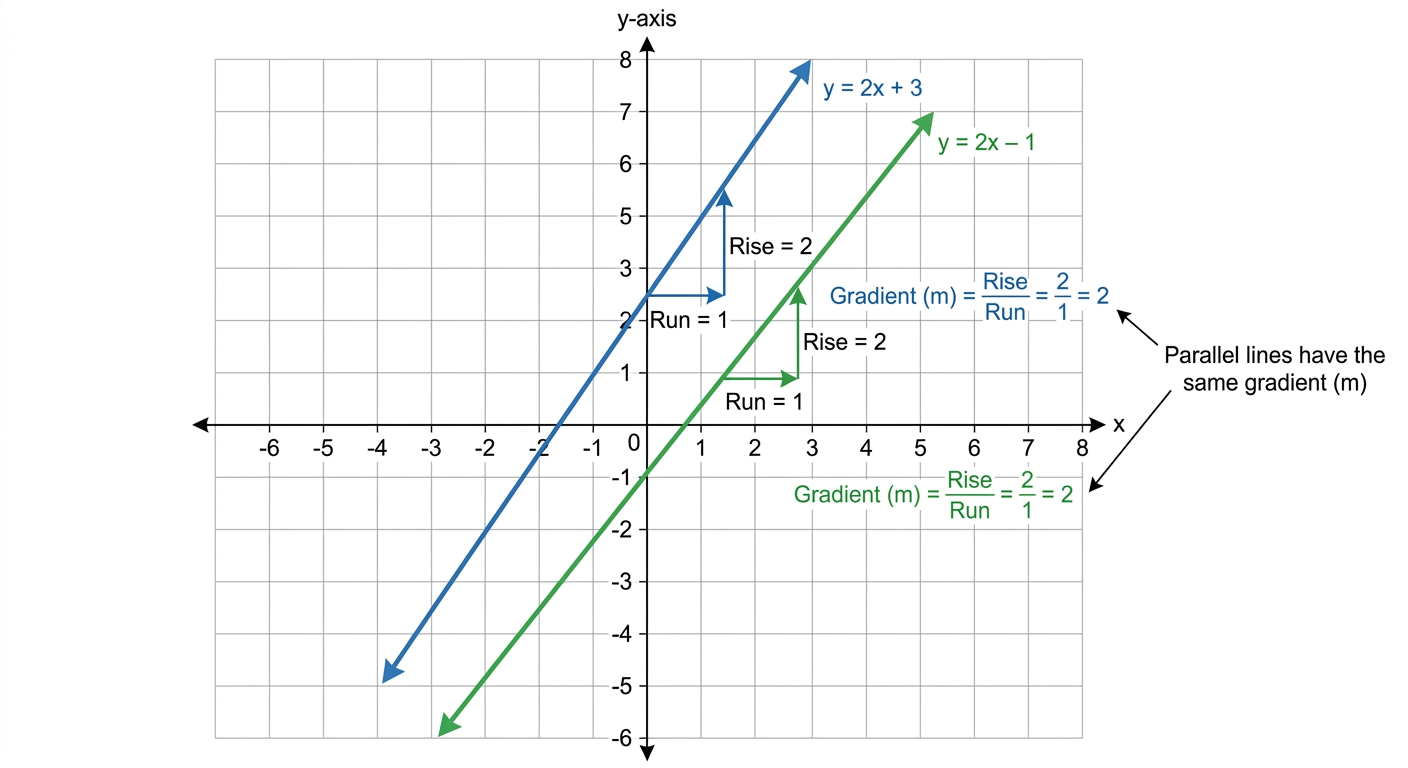
Okay, let's break down parallel and perpendicular lines. Think of parallel lines like two players in a co-op game, running in the exact same direction. They never cross paths. In math, this means they have the exact same gradient (). So, if one line's equation is , its gradient is . Any line parallel to it will also have a gradient of . Simple as that.
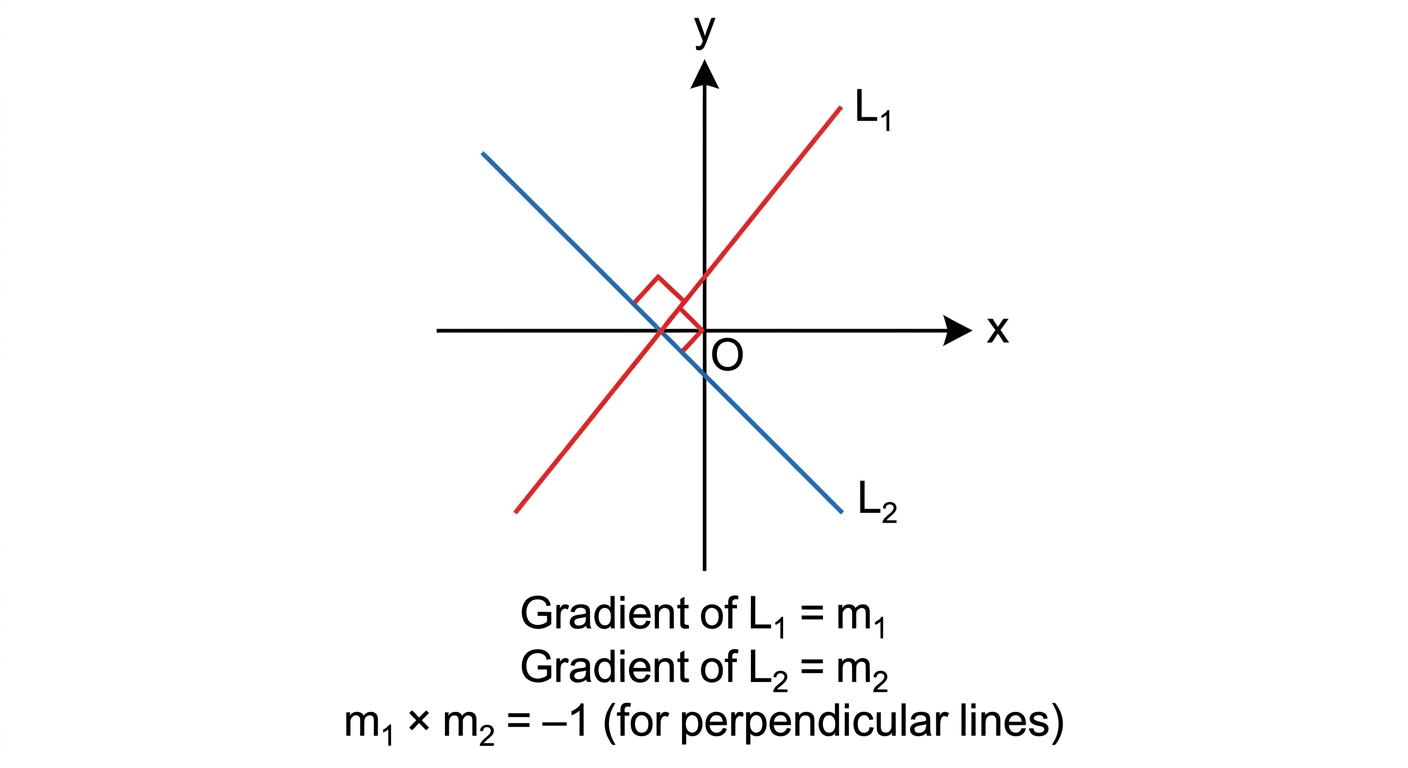
Now, perpendicular lines are the total opposite; they intersect at a perfect 90-degree angle, like the crosshairs in a first-person shooter. Their gradients have a 'negative reciprocal' relationship, which is a fancy way of saying you 'flip the fraction and change the sign'. The rule is . For example, if a line has a gradient of , its perpendicular gradient is .
This leads us to the perpendicular bisector – the ultimate combo move. It's a line that's both perpendicular to a line segment AND cuts it exactly in half (at the midpoint). To find its equation, you'll find the midpoint of the segment, find the segment's gradient, calculate the negative reciprocal gradient, and then build the new line's equation. It's a multi-step mission, but you've got this! 💪
Worked example
Worked Example: Equation of a Perpendicular Bisector
Let's Solve It: The Perpendicular Bisector Boss Level 👾
The coordinates of two points are A(-2, 1) and B(4, 3). Find the equation of the perpendicular bisector of the line segment AB.
- 1First, we need to find the dead center of the line AB. This midpoint is the one point we know for sure is on our perpendicular bisector. We'll use the midpoint formula.
- 2Next, let's figure out the slope of the original line segment AB. This tells us the 'direction' we need to be perpendicular to.
- 3Our bisector is perpendicular to AB, so its gradient is the negative reciprocal of AB's gradient. Time to flip the fraction and switch the sign!
- 4We have our perpendicular gradient () and a point on the line (the midpoint ). Let's plug these into to find our y-intercept.
- 5We've got our gradient and our y-intercept. Mission complete! Let's write out the final equation for the perpendicular bisector.
Answer
7. Equation of a Straight Line
Alright, let's decode the 'DNA' of a straight line: its equation. The most common format, and your new best friend, is the gradient-intercept form: . Think of it like a subscription plan. The '' is your fixed monthly fee – it's the y-intercept, the point where the line crosses the vertical y-axis. It's your starting value before anything else happens. The '' is the cost per gigabyte – it's the gradient, which tells you the steepness or the rate of change. A positive means the line is going uphill (like your follower count after a viral post), and a negative means it's going downhill (like your battery life).
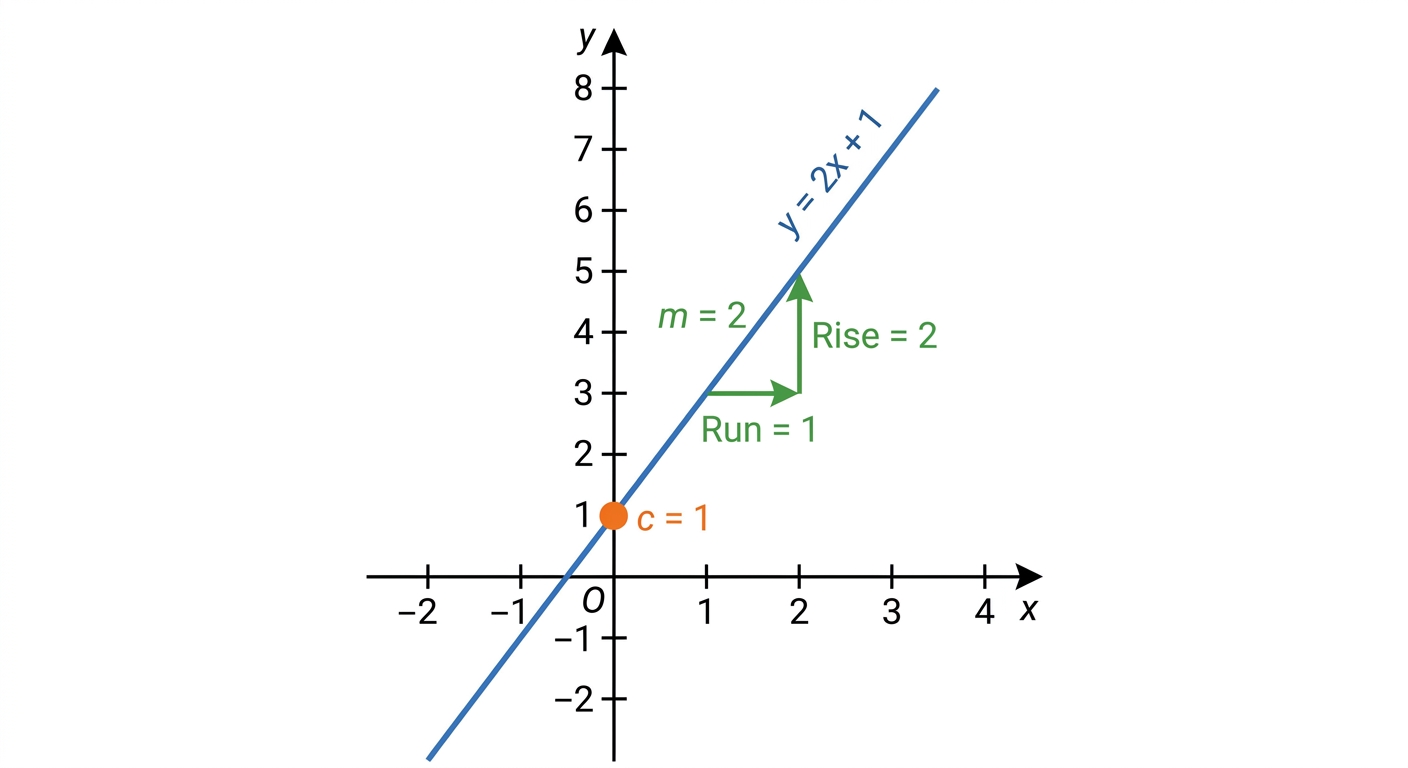
So, how do we find this equation? If you're given the gradient () and one point (), you just substitute these values into to find the one missing piece: . If you're given two points, it's a two-step mission. First, use the gradient formula to find your . Then, pick one of the points and do the substitution just like before. Sometimes, the exam will try to throw you off with an equation that looks like a messy Snapchat story, like . Don't panic! Your goal is to rearrange it to make the star of the show. Just use your algebra skills to isolate on one side, and you'll get it back into the familiar form, letting you easily spot the gradient and y-intercept. Remember to always give your final equation in its simplest form!
Worked example
Worked Example: Finding the Equation from Two Points
Let's Build This Equation from Scratch 🛠️
A straight line passes through the points and . Find the equation of the line in the form .
- 1First, we need to find the gradient (). Think of this as figuring out the difficulty setting. We'll use the gradient formula and label our points and .
- 2Now we have the gradient, . Our equation looks like . To find , we can substitute the coordinates of either point A or B into the equation. Let's use point B(4, 10), so we'll sub in and .
- 3Solve the equation for . This is the final puzzle piece we need.
- 4We've got our gradient () and our y-intercept (). Now we just assemble them into the final form . Mission complete!
Answer
8. Gradient of a Straight Line
Alright, let's break down the gradient of a line. Think of it as the line's 'steepness' or its 'vibe'. It tells us exactly how quickly something is changing. Imagine you're driving up a hill; a super steep hill has a high gradient, while a gentle slope has a low one. In maths, we measure this with 'rise over run'. The 'rise' is the vertical change (how much you go up or down, the change in ), and the 'run' is the horizontal change (how much you go across, the change in ).
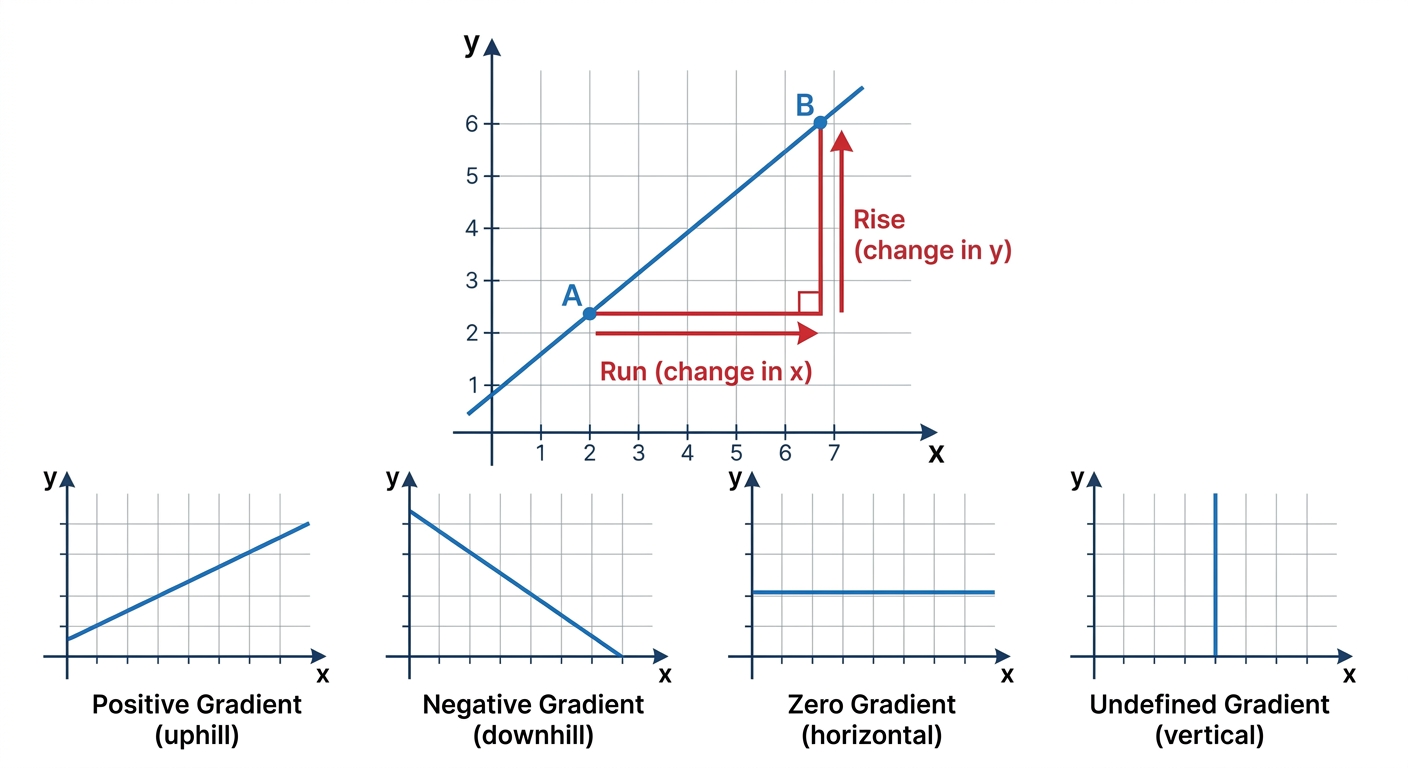
If you're given a graph, you can just count the squares to find the rise and run. But what if you only have two points, say Point A and Point B ? No sweat. You can use the ultimate gradient formula: A positive gradient () means the line goes uphill from left to right, like your follower count when a video goes viral. A negative gradient () goes downhill, like your phone battery during a long gaming session. A zero gradient () is a perfectly horizontal line – totally flat. And an undefined gradient? That's a straight-up vertical line. The 'run' is zero, and you can't divide by zero, so it's the 'Error 404' of gradients. 😉
Worked example
Worked Example: Calculating Gradient from Two Coordinates
From Game Levels to Gradients 🎮
You're tracking your progress in a new game. After 2 hours of playing, you're at level 5. After 6 hours of non-stop grinding, you've hit level 17. Assuming your progress is a straight line, what is the gradient?
- 1First, let's identify our two points from the problem. We can treat time as our -coordinate and the game level as our -coordinate. So, our two points are and . Let's label them to avoid any mix-ups.
- 2Next, we'll write down the gradient formula. This is our key tool for solving the problem. Always a good idea to write it down first to get it locked in your brain.
- 3Now, we just substitute our values into the formula. Make sure the -values are on top in the numerator and the corresponding -values are on the bottom in the denominator.
- 4Time for the easy part – do the subtraction on the top and bottom to simplify the fraction.
- 5Finally, we calculate the final value. This number represents the gradient. So, what does it actually mean in this context?
This means for every 1 hour you play, you gain 3 levels. That's a solid rate of progress!
Answer
This means for every 1 hour you play, you gain 3 levels. That's a solid rate of progress!
This means for every 1 hour you play, you gain 3 levels. That's a solid rate of progress!
9. Coordinates, Midpoint, and Length of a Line Segment
Alright, let's get into it. Think of the Cartesian coordinate plane like a map in your favourite game or the geo-tag on an Instagram post. Every single point has a unique address, an coordinate, that tells you exactly where it is. Now, what if you have two points, say your house and your friend's house , and you want to find some useful info?
First up: the Midpoint. This is literally the halfway point. If you were to meet up, this is the spot that's perfectly fair for both of you to travel to. Finding it is super chill – you just average the x-coordinates and average the y-coordinates. The formula is . It’s that simple. You're just finding the middle ground, like deciding which music to stream in the car.
Next, the Length or Distance between those two points. How far is it from your house to your friend's in a straight line? This might look intimidating, but it's secretly just Pythagoras's Theorem wearing a disguise. Seriously! If you draw a right-angled triangle with the line segment AB as the hypotenuse, the other two sides are just the change in x and the change in y.
First up: the Midpoint. This is literally the halfway point. If you were to meet up, this is the spot that's perfectly fair for both of you to travel to. Finding it is super chill – you just average the x-coordinates and average the y-coordinates. The formula is . It’s that simple. You're just finding the middle ground, like deciding which music to stream in the car.
Next, the Length or Distance between those two points. How far is it from your house to your friend's in a straight line? This might look intimidating, but it's secretly just Pythagoras's Theorem wearing a disguise. Seriously! If you draw a right-angled triangle with the line segment AB as the hypotenuse, the other two sides are just the change in x and the change in y.
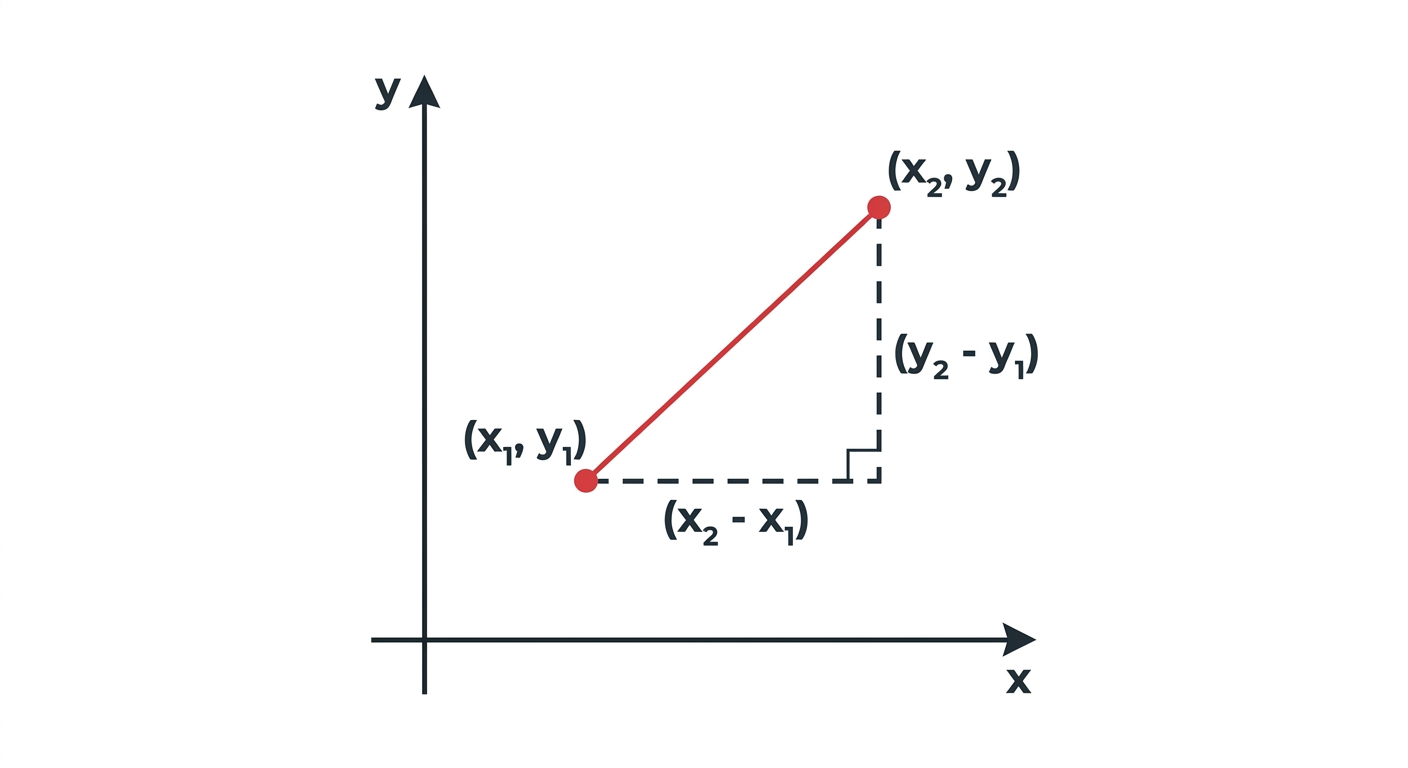
. So, from , we get the distance formula: . Just plug in your numbers, and you've got the exact distance. It's the ultimate tool for figuring out distances on any 2D map. ✨
Worked example
Worked Example: Midpoint and Distance Calculation
The Quest for the Halfway Point 🤝
You and your friend are planning a road trip. Your starting point is Town A, located at coordinates on a map. Your destination is Town B, at . You want to stop for snacks at a service station exactly halfway between the two towns.
a) Find the coordinates of the halfway service station.
b) Calculate the total straight-line distance of your trip from Town A to Town B.
a) Find the coordinates of the halfway service station.
b) Calculate the total straight-line distance of your trip from Town A to Town B.
- 1First, let's identify our coordinates so we don't mix them up. It doesn't matter which point is 1 or 2, as long as you're consistent. Let's set Town A as and Town B as .Let
Let - 2For part (a), we need to find the midpoint. We'll use the midpoint formula by plugging in our x and y values. This gives us the exact coordinates of that snack stop!
- 3So, the service station is at coordinates . Now for part (b), we need the total distance. We'll use the distance formula, which is just Pythagoras in disguise. Let's plug our coordinates into it.
- 4Be careful with the double negatives! 'Minus a negative' becomes a positive. Now we simplify the brackets, square the results, add them, and finally take the square root.
- 5The final step is to calculate the square root to get our answer. This gives us the total distance of the trip.
The total distance is 13 units.
Answer
The total distance is 13 units.
The total distance is 13 units.
10. Drawing Linear Graphs from an Equation
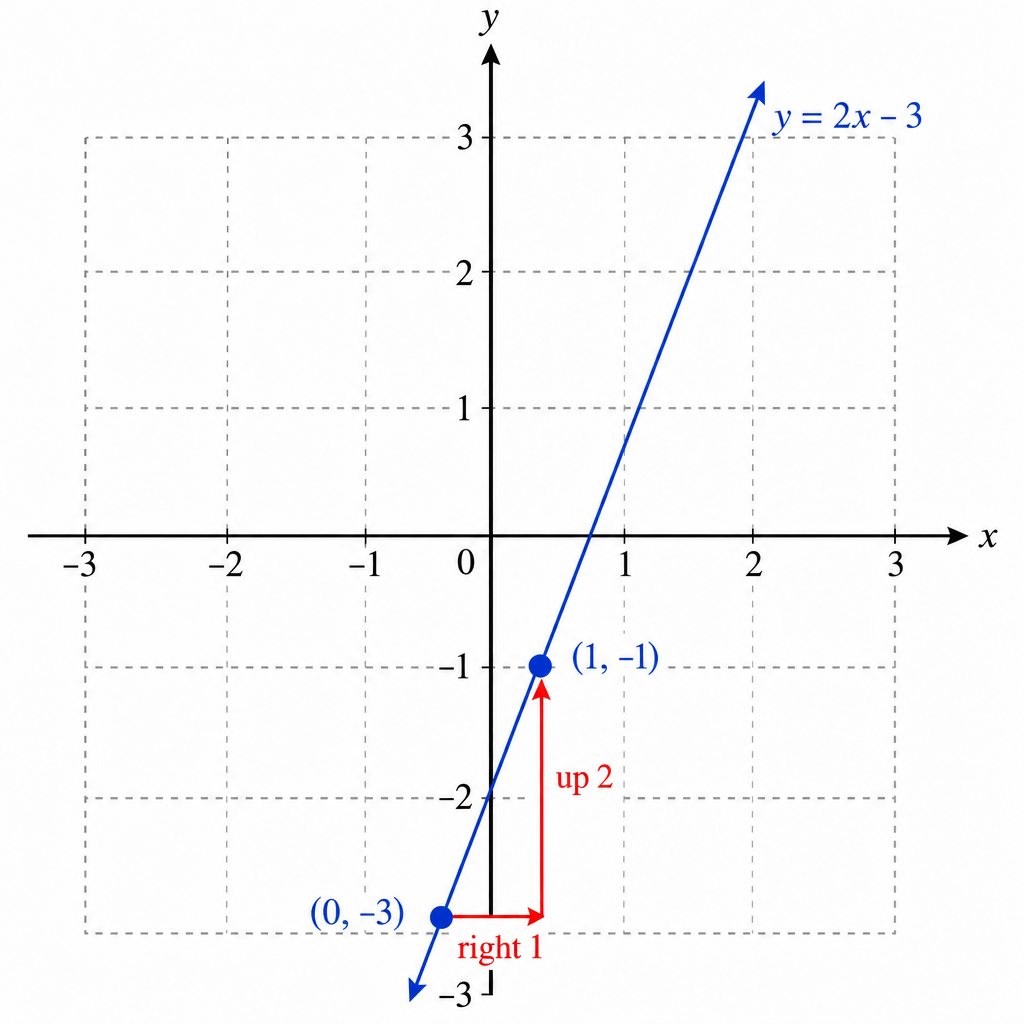
Given , you've got two clean ways to draw the line on a grid. Pick whichever vibes.
Method 1 — Table of values. Pick at least three -values (a fourth is a safety net), compute for each, plot, rule a line through them.
| | | | | |
| :---: | :---: | :---: | :---: | :---: |
| | | | | |
Method 2 — Gradient and -intercept. In :
• = -intercept → mark first.
• = gradient → from that point, step right 1, up . Plot second point. Rule a line. Done. 🎯
For : start at . Gradient means right 1, up 2. Next point . Connect.
Method 1 — Table of values. Pick at least three -values (a fourth is a safety net), compute for each, plot, rule a line through them.
| | | | | |
| :---: | :---: | :---: | :---: | :---: |
| | | | | |
Method 2 — Gradient and -intercept. In :
• = -intercept → mark first.
• = gradient → from that point, step right 1, up . Plot second point. Rule a line. Done. 🎯
For : start at . Gradient means right 1, up 2. Next point . Connect.
Special cases:
• Equations like → vertical line, parallel to the -axis.
• Equations like → horizontal line, parallel to the -axis.
Exam-ready tips: always use a ruler (no freehand — it looks wobbly and you lose accuracy marks), always plot at least three points (two can hide an arithmetic slip), and extend the line across the full visible grid unless told otherwise. 📏
Worked example
Worked Example: Plotting from a Table
Complete a table of values for using , then describe the line by giving its gradient and -intercept.
- 1Substitute each into the equation. Fill the table.
- 2Check the pattern: every time goes up by , goes down by . That's the gradient as rise over run.
- 3The -intercept is just the -value when — grab it from the table.
- 4Plot the five points, rule the line, write the summary. 🎯
Answer
Practice this in the app
Unlock the full chapter: practice questions, flashcards, mock papers and notes, free.
Continue revising