Chapter 2: Algebra and Graphs
From X to Y: Your Ultimate Guide to Acing Algebra 📈
Introduction
1. Introduction
Alright, let's talk Algebra and Graphs. It sounds heavy, but honestly, this is the secret code behind so much of the world around you – from how your game's physics engine works to how Snapchat filters map to your face. In this chapter, we're going to level up your skills big time. We'll start with Algebraic Manipulation, which is basically learning the cheat codes to simplify any messy equation. Then we'll use those skills for Solving Equations and Inequalities to find that mystery 'x', whether it's figuring out your pay from a part-time job or the limits on your car's speed. We'll spot patterns like a viral TikTok trend with Sequences, and understand how things relate with Proportion – super useful for everything from cooking to currency exchange. We'll then become data storytellers with Graphs, and even get into Kinematics to understand the math behind a car's acceleration. We'll dip our toes into Calculus to find the exact rate of change at a single instant (which is mind-blowing!), and wrap it all up with Functions, the powerful 'if this, then that' machines that run pretty much all modern tech. Ready to unlock this new level? Let's do it.
2. Algebraic Manipulation
Alright, let's talk about Algebraic Manipulation. Think of it as the art of tidying up and restyling mathematical expressions to make them simpler or more useful, kind of like sorting your gaming loadout for the perfect match. First up is simplifying. This is just about collecting 'like terms'. Imagine you've got a pile of cash from your part-time job – you'd group all the £10 notes together and all the £5 notes together, right? Same deal here: in , the terms stick together and the terms stick together. Easy win.
Next, we have expanding. This is where we remove brackets, like dropping a message in a group chat that everyone has to react to. For something like , you use the FOIL method (First, Outer, Inner, Last). You multiply every term in the first bracket by every term in the second.
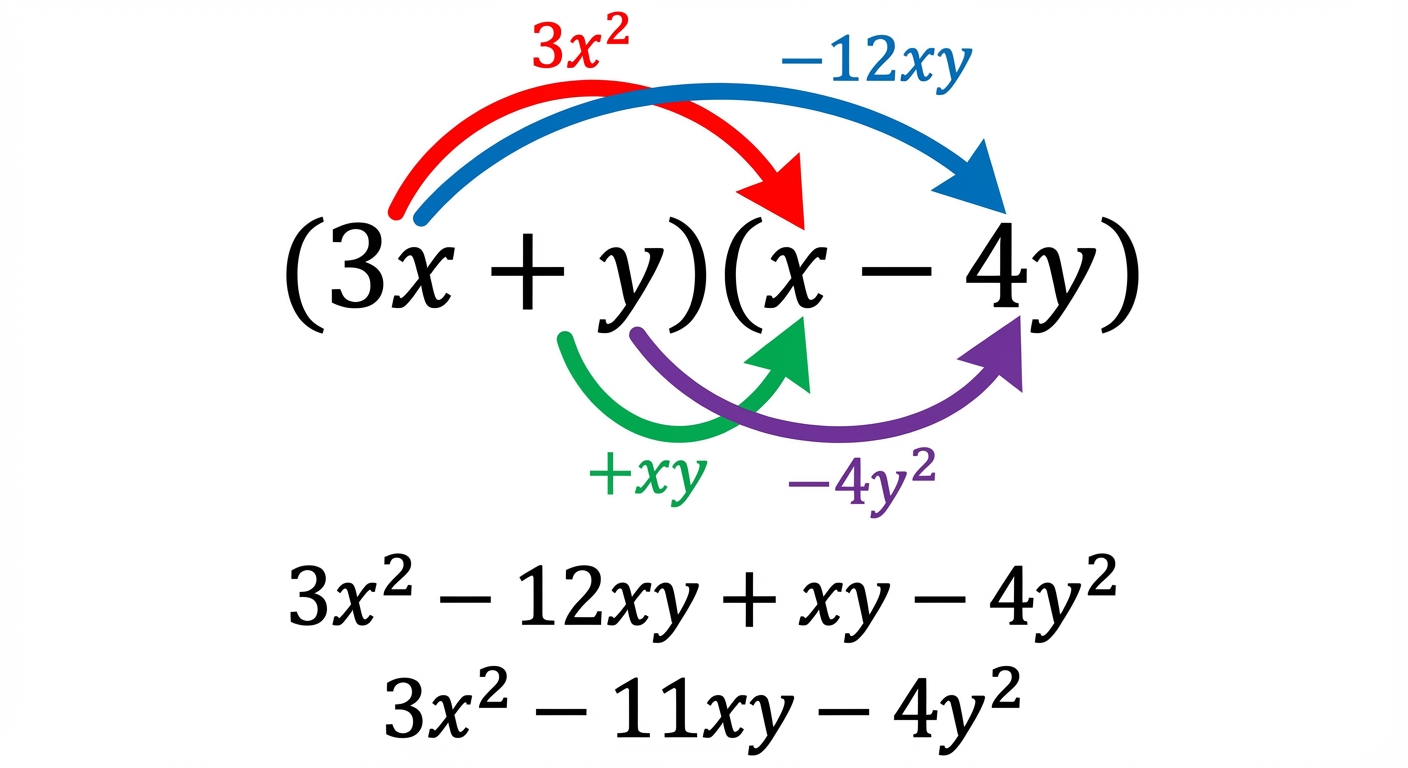
For expressions with three brackets, like , just expand two of them first, then multiply that result by the third one. It's a bit of a grind, but totally manageable.
Factorising is the complete opposite – it's putting expressions back into brackets. Always check for a common factor first, like in , where you can pull out to get . For quadratics like , you're looking for two numbers that multiply to give and add to give . You'll also need to spot special patterns like the Difference of Two Squares, , which is a massive shortcut. Then there's completing the square, which sounds intense but is just a way to rewrite a quadratic like into the form . This form is clutch because it tells you the vertex (min/max point) of the parabola instantly – super useful for graphs! Finally, all these skills come together when simplifying algebraic fractions. You just factorise the top and bottom and then cancel any common factors, just like simplifying to . It's the final boss level of this topic, bringing all your new skills together.
Factorising is the complete opposite – it's putting expressions back into brackets. Always check for a common factor first, like in , where you can pull out to get . For quadratics like , you're looking for two numbers that multiply to give and add to give . You'll also need to spot special patterns like the Difference of Two Squares, , which is a massive shortcut. Then there's completing the square, which sounds intense but is just a way to rewrite a quadratic like into the form . This form is clutch because it tells you the vertex (min/max point) of the parabola instantly – super useful for graphs! Finally, all these skills come together when simplifying algebraic fractions. You just factorise the top and bottom and then cancel any common factors, just like simplifying to . It's the final boss level of this topic, bringing all your new skills together.
Worked example
Worked Example: Simplifying an Algebraic Fraction
Let's Cancel This Fraction Like a Bad Subscription ✂️
Simplify the following expression fully:
- 1Okay, our mission is to simplify this fraction. The only way to do that is to see if the top (numerator) and bottom (denominator) share any common factors. So, our first move is to factorise both expressions.Goal: Factorise and .
- 2Let's start with the numerator, . This is a standard quadratic. We need two numbers that multiply to make -8 and add to make +2. Let's think... +4 and -2 work! ( and ).
- 3Now for the denominator, . You should immediately spot this as a classic 'Difference of Two Squares' pattern (). Here, and (since ). This factorises into .
- 4Now we can rewrite the whole fraction using our new factorised versions. Look for any identical brackets on the top and bottom that we can cancel out. It looks like we have an on both!
- 5After cancelling the common factor, we're left with our final, simplified answer. Way cleaner than what we started with! Job done.
Answer
3. Methods for Solving Algebraic Equations
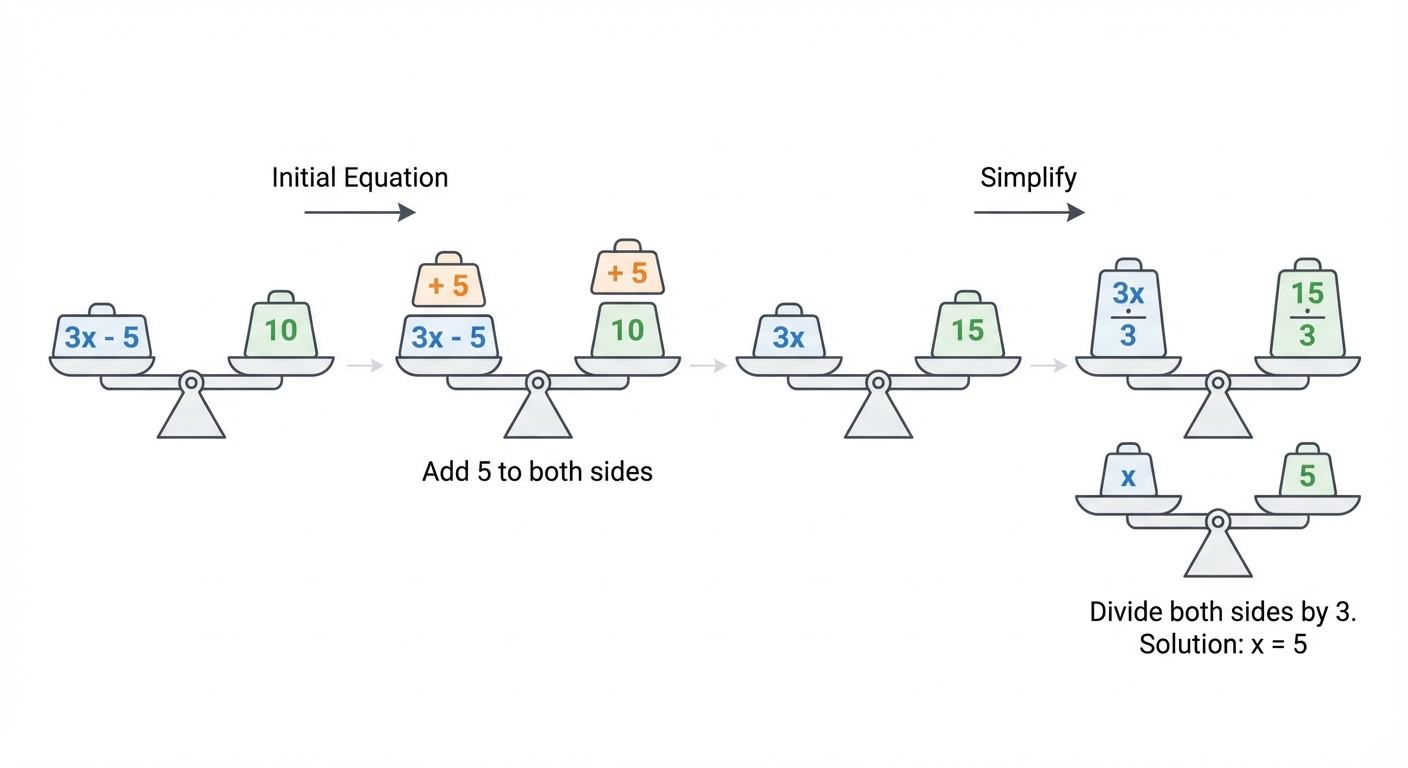
Alright, let's decode the world of equations! Think of it like this: an equation is just a puzzle where 'x' (or another letter) is the missing piece. Our job is to find its value. For simple linear equations like , it's all about isolating 'x'. Imagine it's a balancing scale: whatever you do to one side, you must do to the other to keep it level.
Things get spicier with fractional equations like . Don't panic! The goal is to eliminate the denominators. The easiest way is often to cross-multiply, turning it into a linear equation you already know how to solve.
What if you're juggling two variables at once? Welcome to simultaneous equations. For two linear equations, you can use elimination (stacking them and adding/subtracting to cancel a variable) or substitution (solving one for x or y and plugging it into the other). It's like trying to figure out your friend's new crush using clues from two different Snapchat stories. But what happens when a straight line meets a curve? That's a linear and non-linear simultaneous equation. Here, substitution is your best friend. You'll usually sub the linear equation into the non-linear one, which creates a quadratic equation.
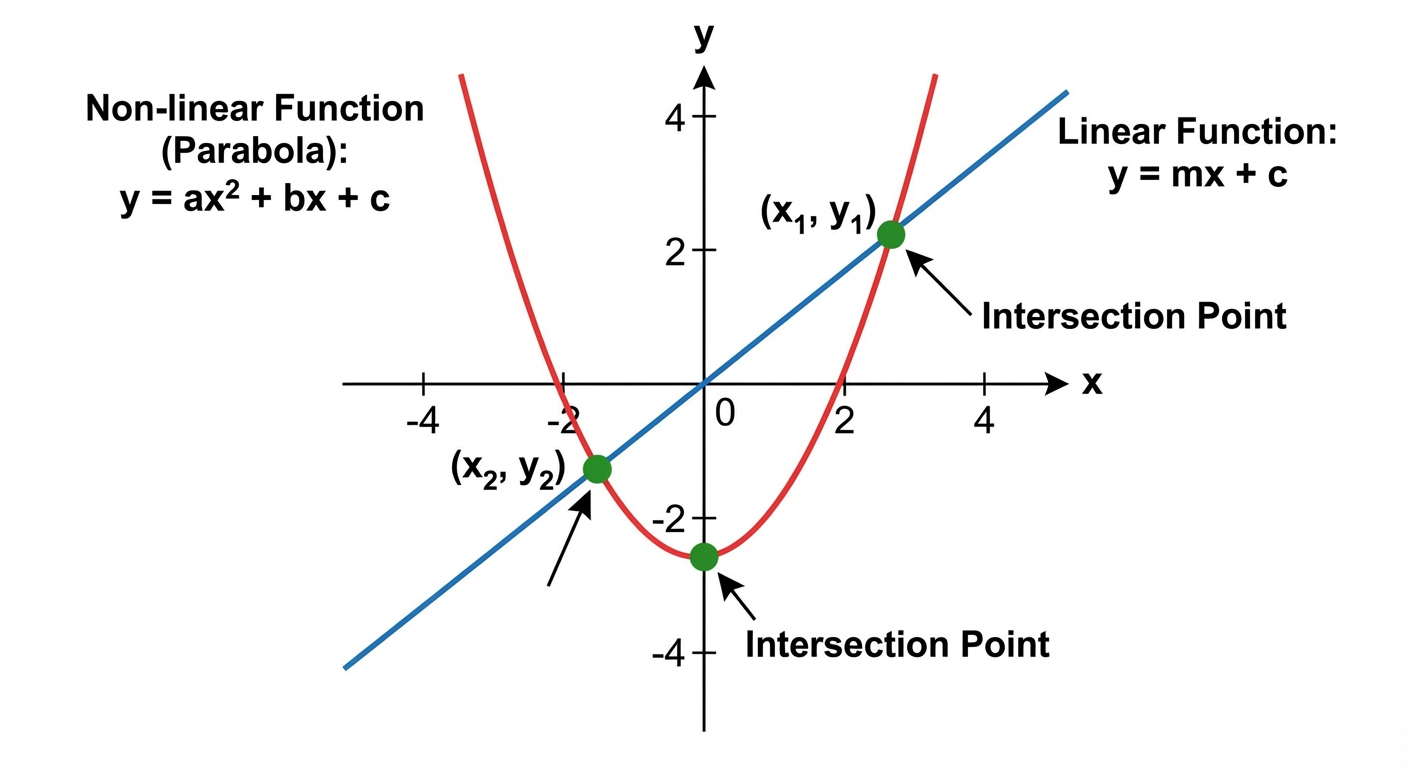
Speaking of quadratics (), you have three main weapons:
1. Factorisation: The quickest, like finding the two numbers that multiply to 'c' and add to 'b'.
2. Completing the Square: A powerful technique to rewrite the quadratic into form. It's super useful for finding the turning point of a graph.
3. The Quadratic Formula: Your ultimate cheat code, . It works every single time, especially when the answers are messy surds. This formula is on your exam sheet, so just master using it!
Finally, we have changing the subject. This is like rearranging your Spotify playlists. You're just isolating a different variable to be the 'star' of the formula. Remember to use inverse operations – squaring to undo a square root, for example. You've got this! ✨
Worked example
Worked Example: Solving Simultaneous Equations (Linear and Non-Linear)
When a Line & a Parabola Go on a Date... 💘
Solve the simultaneous equations:
- 1Both equations are equal to 'y', so we can set them equal to each other. This is the substitution method. We're basically mashing the two equations together to eliminate 'y' and focus on finding 'x'.
- 2Now, we need to rearrange this into a standard quadratic equation (). Let's move everything from the right side over to the left by subtracting 'x' and '3' from both sides.
- 3Time to solve this quadratic! Factorisation looks like the easiest method here. We need two numbers that multiply to give -5 and add to give +4. Those numbers are +5 and -1.
- 4We're not done! We have the x-coordinates, but we need the matching y-coordinates for our intersection points. Let's substitute each x-value back into the easiest equation, which is the linear one ().
- 5Finally, write down your solutions as coordinate pairs. These are the two points where the line and the parabola intersect on a graph. Job done!
Answer
4. Solving and Representing Linear Inequalities
Alright, let's talk about inequalities. If equations are about finding one specific answer, inequalities are about defining a whole range of possibilities. Think of it like your data plan: you must use less than 20GB. That's an inequality! . Or earning money at your part-time job: you want to make at least 50. That is .
Solving them is 99% the same as solving regular equations – you can add, subtract, multiply, and divide to get the variable by itself. The one HUGE, game-changing rule you must remember is this: if you multiply or divide both sides by a negative number, you have to FLIP the inequality sign. So becomes , and becomes . It's a total vibe shift for the equation. 🤯
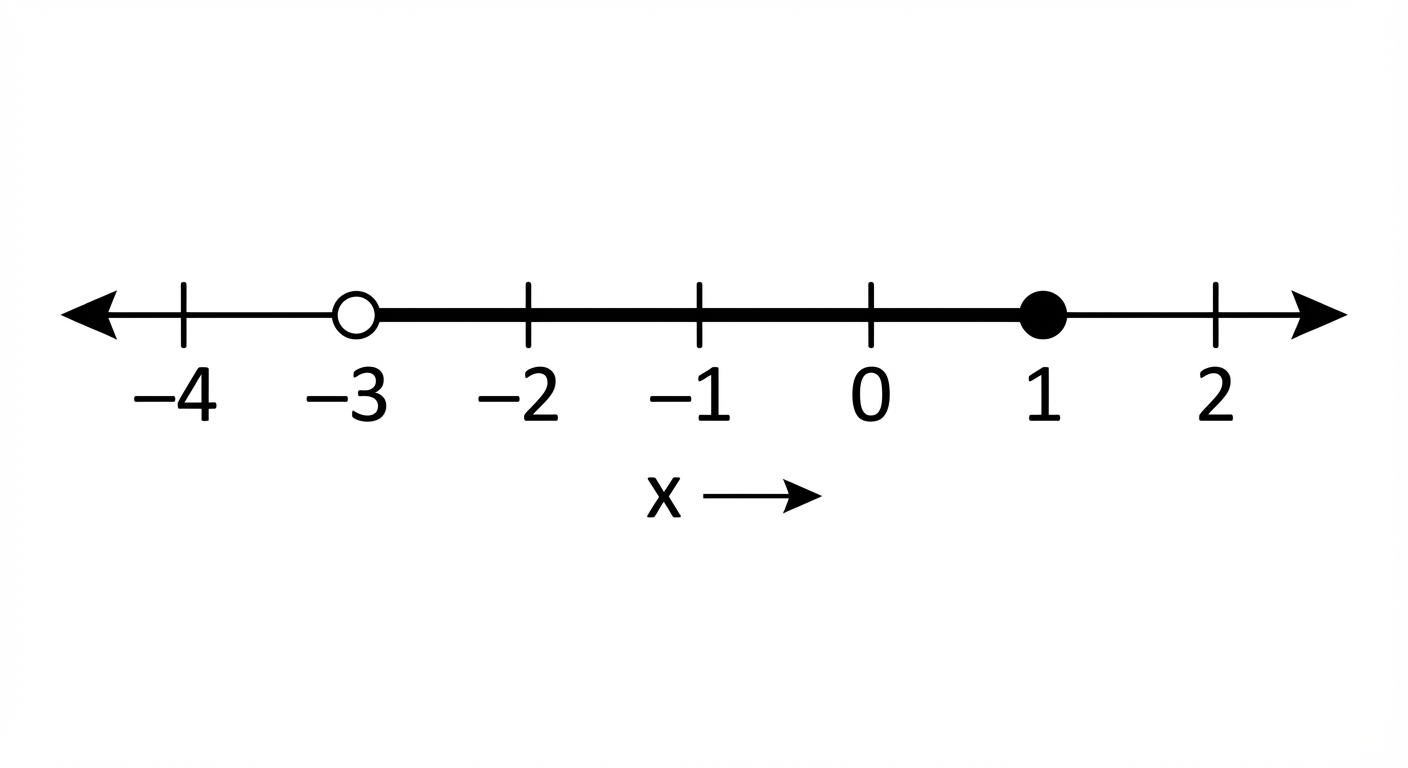
Once you've solved an inequality like , we can show this on a number line. We use a closed circle at -2 (because it includes -2, think 'equal to') and an arrow pointing right for all the numbers greater than it. For a strict inequality like , we'd use an open circle, like you can get infinitely close to -2, but never actually land on it.
But what about two variables, like on a graph? This is where it gets cool. An inequality like doesn't represent a line; it represents an entire region. First, you draw the boundary line . Since it's a strict inequality (), we draw a broken or dashed line. If it were or , we'd use a solid line. Then, the IGCSE way is to shade the region you don't want. It’s like unfollowing accounts you're not interested in to keep your feed clean. The clean, unshaded area is your answer, often labelled 'R' for Region. So for , you'd shade everything below the line, leaving the area above it as the solution. This skill is key for when you're given a graph and have to work backwards to list the inequalities that define the accepted zone.
Worked example
Worked Example: Graphing Multiple Inequalities
Defining Your Weekend Grind Zone 🎮📚
You're planning your weekend. You have a maximum of 8 hours to split between gaming () and studying (). You must study for at least 2 hours, and you want to spend more time gaming than studying. Show the region representing your possible time allocation by finding the inequalities and graphing them.
- 1First, let's translate the rules into three inequalities. 'Maximum of 8 hours total' means is less than or equal to 8. 'At least 2 hours studying' means is greater than or equal to 2. 'More time gaming than studying' means is greater than .
- 2Next, we'll draw the boundary lines for each inequality. We'll treat them as equations for now: , , and . The first two will be solid lines because they are inclusive (), but will be a dashed line because it's a strict inequality ().
[IMAGE_PLACEHOLDER_2: A Cartesian graph with the x-axis labelled 'Gaming Hours (x)' and y-axis labelled 'Studying Hours (y)'. The three lines y=2, x=y, and x+y=8 are drawn. y=2 is a horizontal solid line. x=y is a diagonal dashed line. x+y=8 is a diagonal solid line.](See graph above) - 3Now for the shading! We shade the unwanted region for each line.
👉 For , we want the area below the line, so we shade everything above it.
👉 For , we want the area above the line, so we shade everything below it.
👉 For , we want the area where x-coordinates are bigger (to the right/below the line ), so we shade the region above it.Test a point like (4,3) to check. (True). (True). (True). So the point (4,3) should be in our final unshaded region. - 4The area left unshaded is the solution region. It's a small triangle where all three conditions are met. We'll label this region 'R'. Any coordinate pair inside this triangle is a valid combination of gaming and study hours for your weekend. Go you! ✅
[IMAGE_PLACEHOLDER_3: The same graph as before, but now with the unwanted regions shaded. The region above x+y=8 is shaded. The region below y=2 is shaded. The region above and to the left of y=x is shaded. A clear, unshaded triangle is left in the middle, which is labelled 'R'.](See graph above)
Answer
(See graph above)
5. Properties and Rules of Number Sequences
Okay, let's break down sequences. Think of a sequence like a curated playlist – each song (or number) follows the last one in a specific order. The simplest pattern is the term-to-term rule, like your Snapchat streak just adding one each day. But what if you need to find the 100th term? You don't want to list them all out! That's where the nth term () comes in. It's a master formula that lets you find any term in the sequence just by plugging in its position, 'n'.
We've got a few types on our playlist. Linear sequences are the most straightforward; they go up or down by the same amount each time (the common difference). The nth term is . Then we have Quadratic sequences, where the second difference is constant. It's a pattern within a pattern!
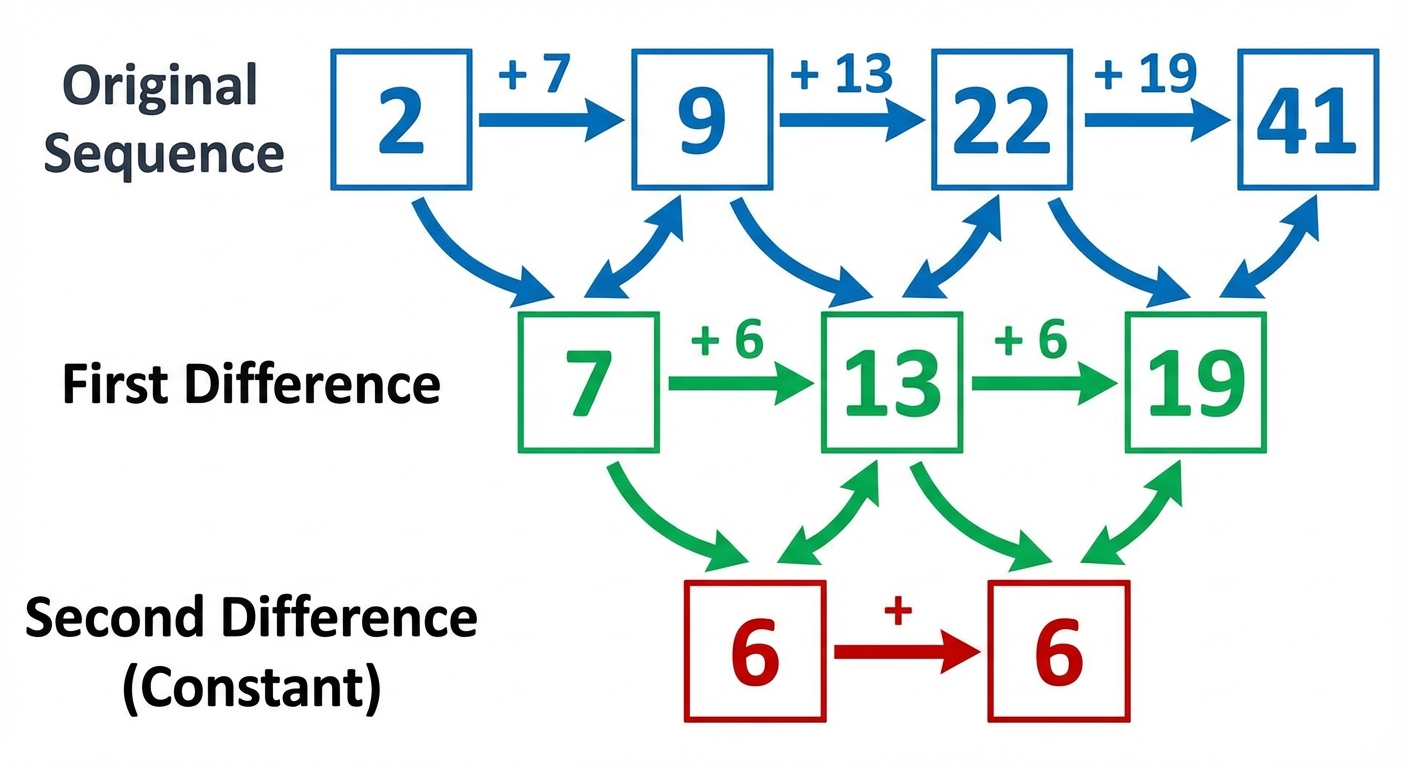
The general rule is . Cubic sequences are the next level, where the third difference is constant. Finally, there are Exponential sequences. These grow super fast, like a viral video. Instead of adding, you multiply by the same number each time. The key is to spot the pattern by finding the differences first. That tells you what kind of sequence you're dealing with and how to find its unique nth term formula.
Worked example
Worked Example: Finding the nth Term of a Quadratic Sequence
Let's Level Up: Boss Battle with a Quadratic Sequence 🎮
A sequence of numbers is given by 4, 15, 32, 55, 84... Find the formula for the nth term, .
- 1First, we find the first differences between the terms to see if it's a linear sequence. If the differences aren't the same, we know we're dealing with something more complex.
- 2Since the first differences (11, 17, 23, 29) are not constant, we find the second differences. A constant second difference is the signature move of a quadratic sequence.
- 3The second difference is 6. For any quadratic sequence , the second difference is always equal to . We use this to find our 'a' value.
- 4Now we know the sequence involves . We'll subtract the values of from our original terms () to see what's left over. This will reveal a simpler, linear sequence.
- 5The remaining sequence is 1, 3, 5... This is a simple linear sequence. It goes up by 2 each time, so its rule is . To get from to our sequence (e.g., for n=1, , but we need 1), we subtract 1. So, the rule is .
- 6Finally, we combine the quadratic part and the linear part to get our complete formula. Always a good idea to test it with a term to make sure you've nailed it!
Answer
6. Direct and Inverse Proportion
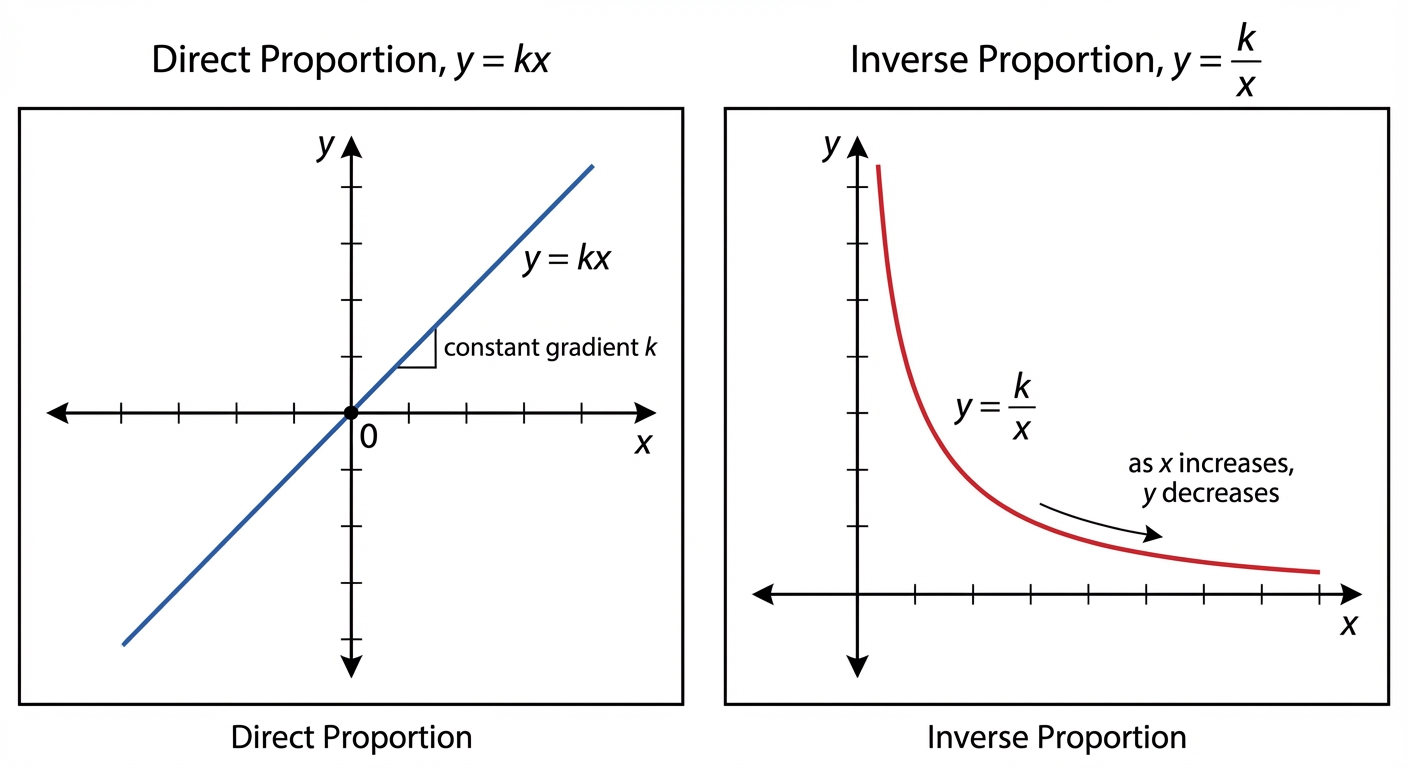
Alright, let's break down proportion. You already get this intuitively. Think about your phone's data plan: the more hours you spend streaming music, the more data you use. That's direct proportion. As one thing goes up, the other goes up by the same factor. We write this using the 'proportional to' symbol, . So, if Data Used () is proportional to Time (), we write . To turn this into a usable equation, we introduce a 'constant of proportionality', which we call . It's basically the secret multiplier that connects the two variables. So, .
Now, what about when you and your friends share a massive pizza? The more friends () that show up, the smaller the slice () each person gets. That's inverse proportion. As one thing goes up, the other goes down. We write this as , which becomes the equation . Simple, right? But IGCSE Extended wants you to level up. The relationship isn't always linear. Sometimes it involves powers or roots. For example, the gravitational force between two objects is inversely proportional to the square of the distance between them (an inverse square law). Or the volume of a sphere is directly proportional to the cube of its radius. So you'll see things like , , or . The game is always the same: 1) Write the proportion, 2) turn it into an equation with , 3) use a given set of values to find your constant , and 4) use your new formula to solve for whatever they ask.
Worked example
Worked Example: Inverse Square Proportion
Solving a Gaming Headset Problem 🎧
The volume () you hear from your gaming headset is inversely proportional to the square of the distance () from your ear to the speaker. When the speaker is 2 cm away, the volume is 90 decibels. What is the volume when the speaker is 6 cm away?
- 1First, we need to translate the sentence into math. 'Volume is inversely proportional to the square of the distance' becomes an algebraic relationship. Then, we introduce our trusty constant of proportionality, , to make it a full equation.
- 2Now we need to find the value of . We do this by plugging in the pair of values we already know: when . This will lock in the specific relationship for this headset.
- 3We've found our constant! Now we can write the complete formula that connects volume and distance for this specific situation. This is our rule for solving the rest of the problem.
- 4Finally, we use our formula to answer the question. We want to find the volume () when the distance is 6 cm. Just substitute into our equation and solve.
- 5State the final answer clearly with its units. The volume is 10 decibels. This makes sense – the distance tripled, so the volume dropped significantly because of the inverse square relationship.The volume is 10 decibels.
Answer
The volume is 10 decibels.
7. Graphs in Practical Situations: Kinematics
Alright, let's decode the story that graphs tell, especially when it comes to moving objects. This is kinematics, and it's way more interesting than it sounds! Think of it like watching a replay of a race in a game, but with maths.
We have two main types of graphs here. First, the Distance-Time graph. The gradient (remember, ) of this graph is literally the speed. A super steep line means you're moving fast, like when you're about to miss your bus. A flat, horizontal line means you're not moving at all – maybe you're paused, waiting for your friend to reply on Snapchat. A line sloping down means you're heading back to your starting point.
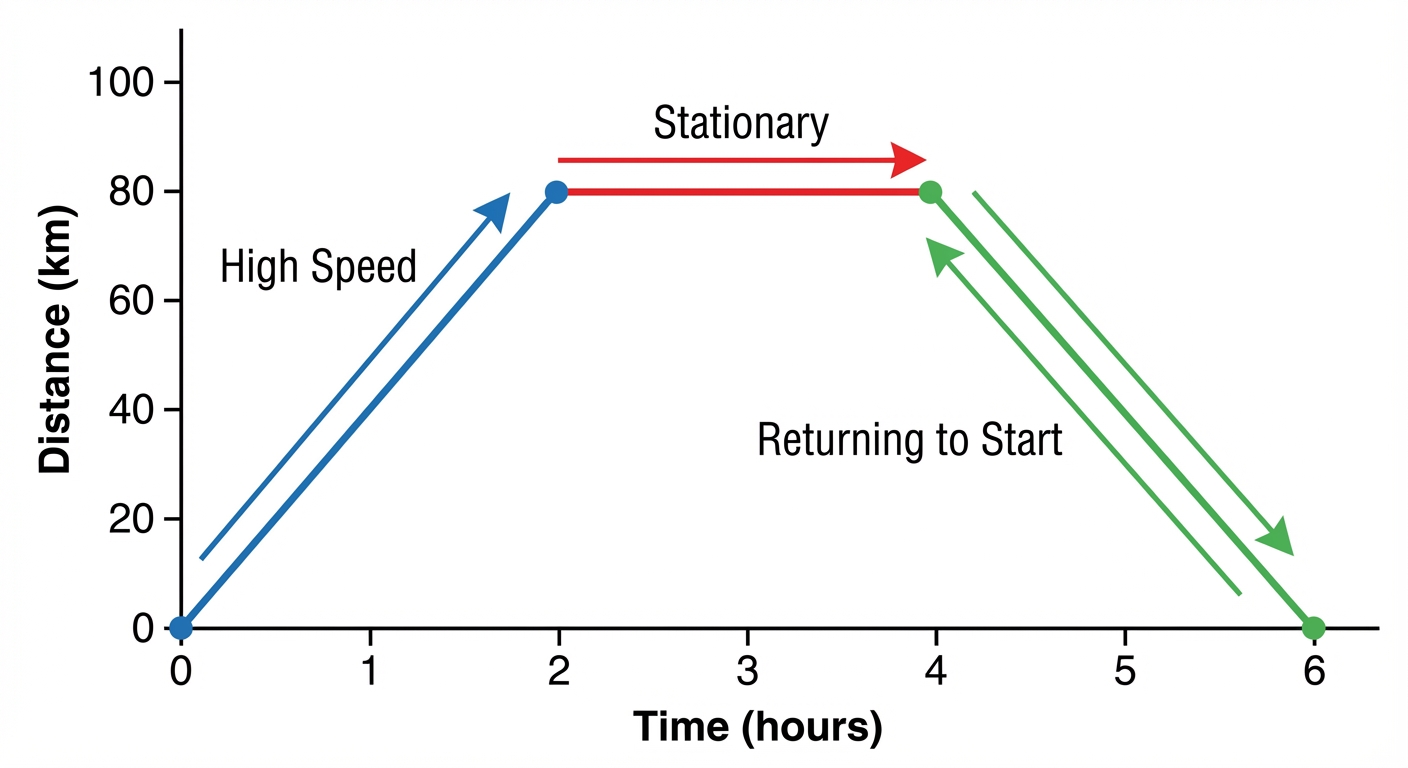
Next, we level up to the Speed-Time graph, which is the real MVP for IGCSE. Here, the gradient tells you the acceleration (how quickly your speed is changing). A positive gradient means you're accelerating – pedal to the metal! A negative gradient means you're decelerating, or slowing down. A flat line means a constant speed, like using cruise control on a long drive.
But here's the ultimate hack: the area under a speed-time graph gives you the total distance travelled. For your exams, the graphs will have straight line sections, so you can easily break the area down into simple shapes like triangles and rectangles. Just find the area of each shape and add them up to get the total distance. It's like calculating your total data usage by adding up the usage from streaming music, watching TikToks, and gaming. Easy peasy! 💪
Worked example
Worked Example: Analysing a Speed-Time Graph
Let's Break Down This Journey 🚗💨
A train leaves a station and accelerates uniformly from rest for 20 seconds, reaching a speed of 30 m/s. It maintains this speed for 2 minutes, and then decelerates uniformly, coming to a stop in 30 seconds.
a) Calculate the acceleration in the first 20 seconds.
b) Calculate the total distance travelled by the train.
a) Calculate the acceleration in the first 20 seconds.
b) Calculate the total distance travelled by the train.
- 1First, let's find the acceleration. On a speed-time graph, acceleration is the gradient of the line. We need to calculate the 'rise over run' for the first section of the journey.
- 2Next, we need the total distance. Remember, distance is the total area under the speed-time graph. The graph forms a trapezium. Before we calculate, let's make sure all our time units are the same. The middle section is 2 minutes, which is seconds.
- 3We can now find the area of the trapezium. The parallel sides are the top flat section (the time at constant speed, 120s) and the bottom section (the total time, 170s). The height is the maximum speed (30 m/s). The formula for the area of a trapezium is .
- 4Let's finish the calculation to get our final answer. Don't forget the units!
Answer
8. Calculus: Finding Gradients and Stationary Points
Alright, let's talk about curves. Think about a graph showing your gaming skill level over time, or the popularity of a TikTok trend. It's not a straight line, right? It has peaks and dips. Calculus, specifically differentiation, is the cheat code to analyze these curves precisely. Before, you might have drawn a tangent line to a curve to estimate its steepness, or gradient. That's like trying to guess your car's speed from a blurry Snapchat video – you're in the right ballpark, but it's not exact. Differentiation gives you the exact gradient at any single point on the curve.
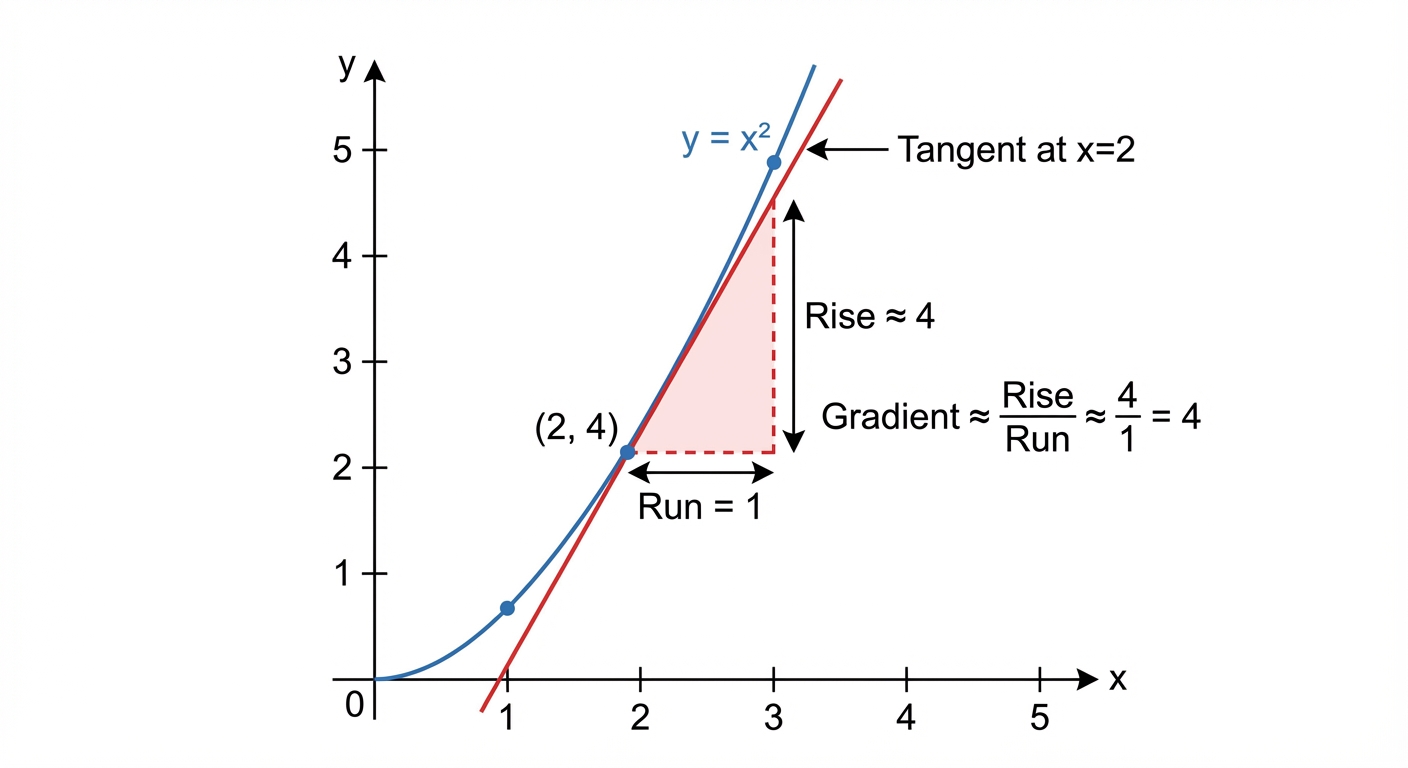
The magic rule for any term that looks like is simple: you find its derivative by calculating . Just bring the power () down to multiply the front number (), then reduce the power by one. The special notation we use for this gradient function is .
So, where does this get really useful? In finding stationary points. These are the flat spots on the curve where the gradient is zero – the very top of a hill (a maximum) or the bottom of a valley (a minimum). Think of them as the peak of your Spotify streams for that one banger you released, or the lowest point of your bank account before payday. To find these points, you just set your gradient function to zero: , and solve for . Once you have the -coordinate, you can find the full coordinate by plugging it back into the original equation. But is it a max or a min? We need to classify it. You can do this by checking the gradient's sign just before and after the point. For a maximum, the gradient goes from positive (+) to zero (0) to negative (-). For a minimum, it goes from negative (-) to zero (0) to positive (+).
So, where does this get really useful? In finding stationary points. These are the flat spots on the curve where the gradient is zero – the very top of a hill (a maximum) or the bottom of a valley (a minimum). Think of them as the peak of your Spotify streams for that one banger you released, or the lowest point of your bank account before payday. To find these points, you just set your gradient function to zero: , and solve for . Once you have the -coordinate, you can find the full coordinate by plugging it back into the original equation. But is it a max or a min? We need to classify it. You can do this by checking the gradient's sign just before and after the point. For a maximum, the gradient goes from positive (+) to zero (0) to negative (-). For a minimum, it goes from negative (-) to zero (0) to positive (+).
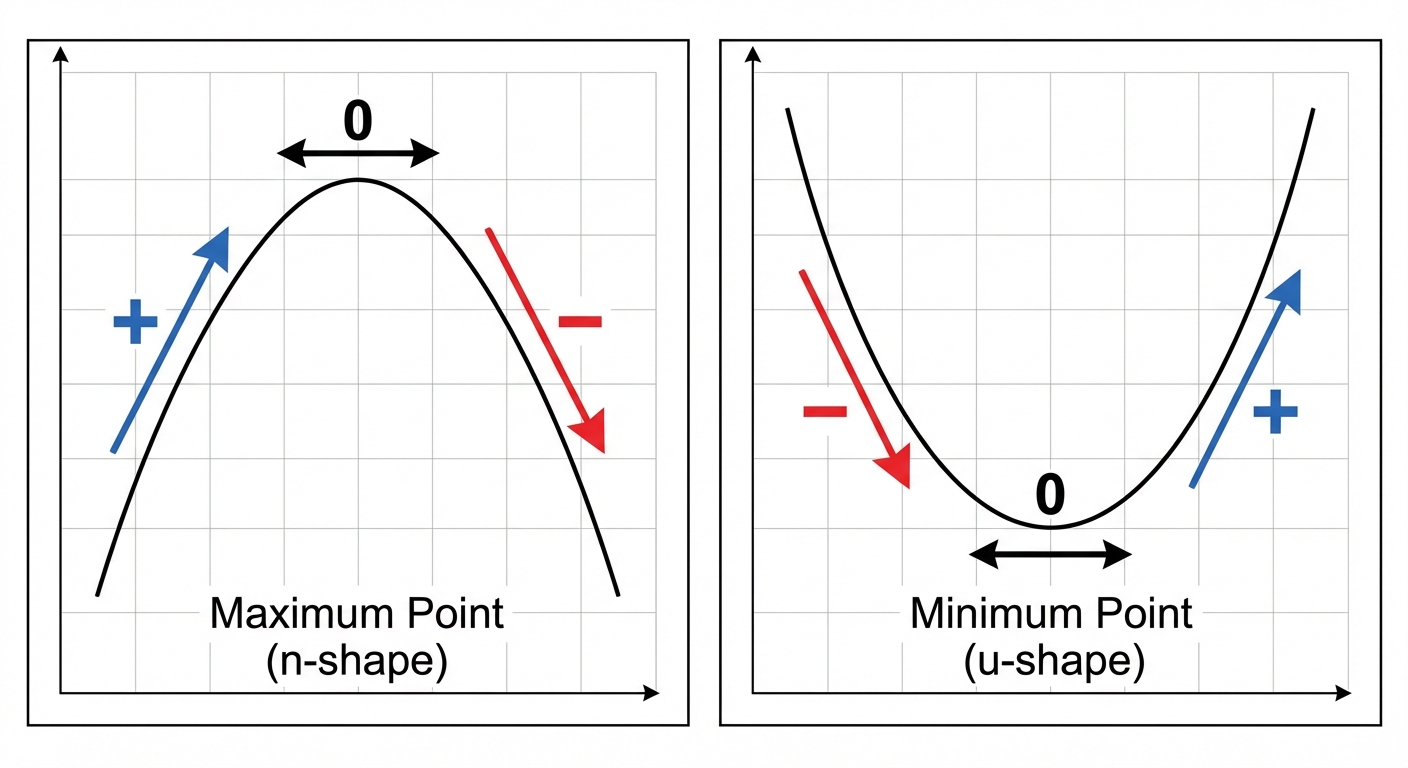
A faster way is the 'second derivative test'. You just differentiate again to get . If the result is positive at your point, it’s a minimum (think positive vibes = smiley face = U-shape). If it’s negative, it’s a maximum (negative vibes = frowny face = n-shape). It's a powerful tool to understand the entire story of a function, not just a single point.
Worked example
Worked Example: Finding and Classifying Stationary Points
Let's Find Those Turning Points! 🚀
A curve is defined by the equation . Find the coordinates of its stationary points and determine their nature (whether they are a maximum or a minimum).
- 1First, we need the 'gradient formula' for our curve. We get this by differentiating the equation for with respect to . We'll apply the rule to each term.
- 2Stationary points occur where the gradient is zero. So, we set our derivative equal to 0 and solve the resulting quadratic equation for .
Divide by 3 to simplify:
Factorise the quadratic:
This gives us two solutions: - 3Now we have the x-coordinates, but we need the full coordinates. We find the corresponding y-values by substituting our x-values back into the original equation for .For :
So one point is .
For :
So the other point is . - 4Time to classify them! Are they hills or valleys? We'll use the second derivative test. We differentiate our first derivative, , to find the second derivative, .
- 5Finally, we substitute our x-coordinates into the second derivative. If , it's a maximum. If , it's a minimum.At :
Since , the point is a maximum.
At :
Since , the point is a minimum.
Answer
At :
Since , the point is a maximum.
At :
Since , the point is a minimum.
Since , the point is a maximum.
At :
Since , the point is a minimum.
9. Understanding Functions, Inverses, and Composites
Alright, let's break down functions. Think of a function like a filter on Instagram or a specific command in a video game. It's a rule that takes an input (a number, we'll call it ) and spits out a very specific output (another number, which we call ). For every one input, you get exactly one output. No exceptions. The function is a simple rule: whatever number you feed it, it adds 5. Simple.
Now, let's talk lingo. The Domain is the set of all possible inputs you're allowed to use for . Think of it as the list of songs on your Spotify playlist you can actually play. The Range is the set of all possible outputs you can get. It's the vibe your playlist gives off – you can't get a heavy metal vibe from a lo-fi playlist.
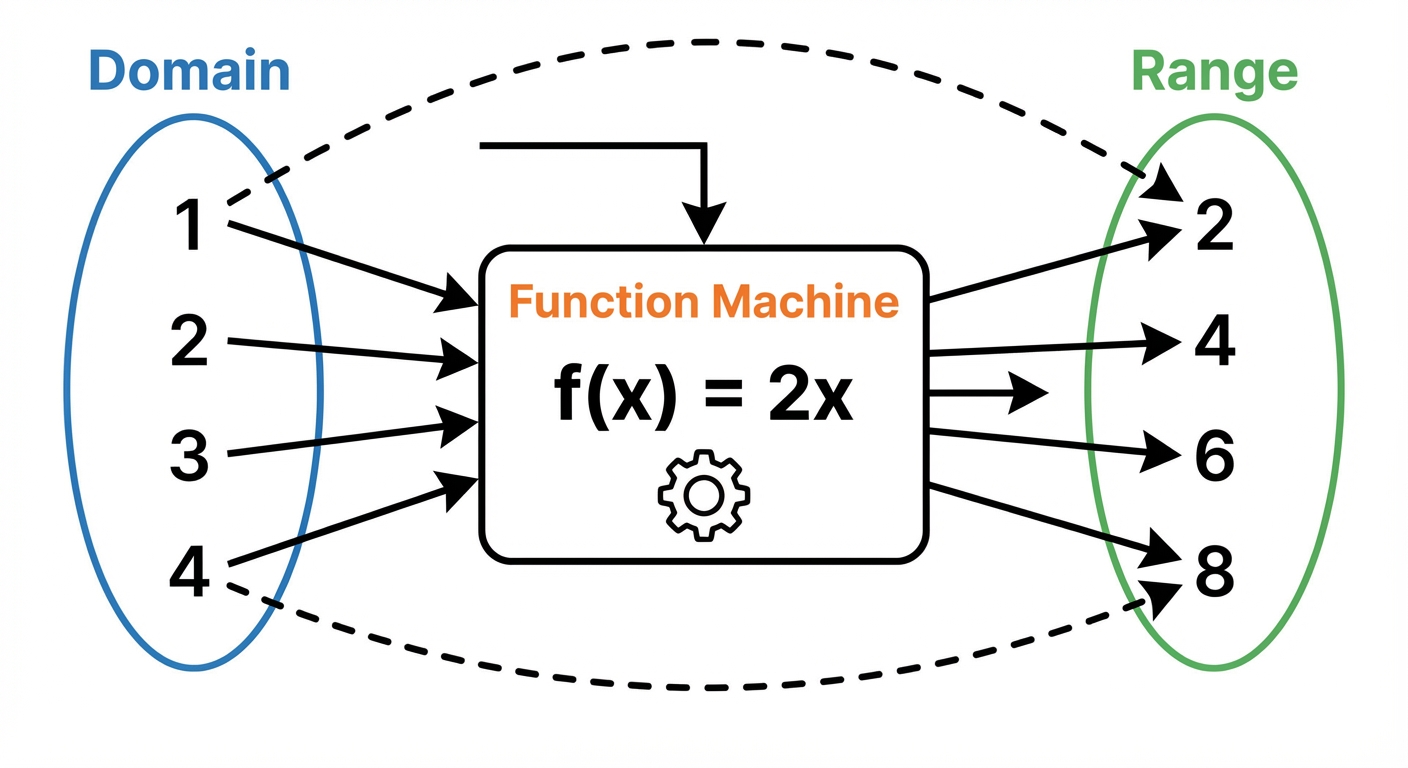
Things get spicy with Composite Functions, like . This looks weird, but it just means you're applying two functions back-to-back. You always work from the inside out. First, you find the output of , and then you use that entire result as the new input for the function. It’s like saving a TikTok, then uploading it to Instagram to add another filter. The order matters! is totally different from .
Finally, we have the Inverse Function, written as . This is basically the 'undo' button. If turns your hours worked into your paycheck, would take your paycheck amount and tell you how many hours you had to work to earn it. It reverses the process. To find it, you just set the function equal to , swap the and variables, and then solve the equation for the new . You got this!
Worked example
Worked Example: Composite and Inverse Functions
Let's Get This Bread: A Function Mash-Up 🍞
Let's say we have two functions: and .
a) Find the value of .
b) Find the composite function .
c) Find the inverse function .
a) Find the value of .
b) Find the composite function .
c) Find the inverse function .
- 1For part (a), we just need to find . This is a simple substitution. We're plugging the number 5 into the 'x' slot of our function .
- 2For part (b), we're finding the composite function , which means . We take the entire expression for , which is , and substitute it into the 'x' in the function.
- 3Finally, for part (c), we need to find the inverse of . We'll follow the three-step process: 1. Set to y, 2. Swap x and y, 3. Solve for the new y.
Answer
10. Introduction to Algebra: Letters, Expressions and Substitution
Okay, so algebra seems extra at first, but it's actually the opposite — it's a shortcut. Instead of writing maths rules for one specific number, we use a letter that stands in for any number. Same vibe as using a profile pic before someone knows your face.
Three words to know the difference between:
• Expression — a mix of numbers, letters and operations, like . No equals sign. You can simplify it or plug numbers in, but you can't solve it. (It's a recipe, not a dish.)
• Equation — an expression with an equals sign, like . Solve these to find the letter. (Dish served.)
• Formula — a rule connecting variables, like or . Plug values in to find an unknown.
Substitution is the move: swap the letter for a number, evaluate. If and , , , then . ✅
Golden rule: always wrap negatives in brackets when substituting. but . That tiny bracket is the difference between a tick and a cross. 🎯
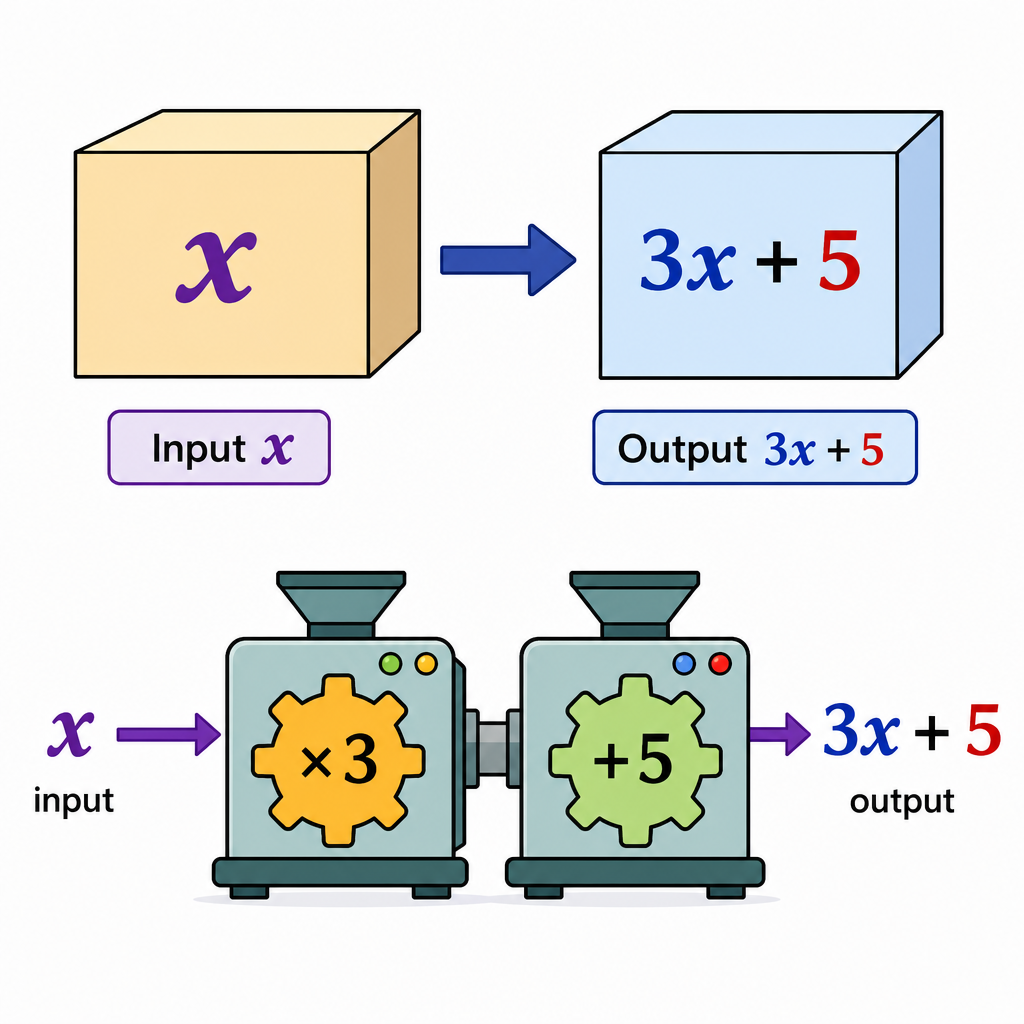
Like terms can be combined: (same letter, same power). But and can't be combined — different letters. Neither can and — same letter, different power. Stay in your lane. 🛑
Worked example
Worked Example: Constructing and Substituting into a Formula
The cost in dollars of hiring a scooter is a fixed fee of plus per hour . (a) Build the formula for in terms of . (b) Find the cost of a -hour hire. (c) If , evaluate .
- 1For (a), spot the fixed bit () and the per-hour bit ( per hour, so ). Stick them together.
- 2For (b), sub in. Don't rush — BODMAS: multiply first, then add.
- 3For (c), bracket the negative before squaring. This is where marks get lost.
- 4BODMAS again — multiplication before subtraction.
Answer
11. Indices II: Fractional, Negative and Zero Powers
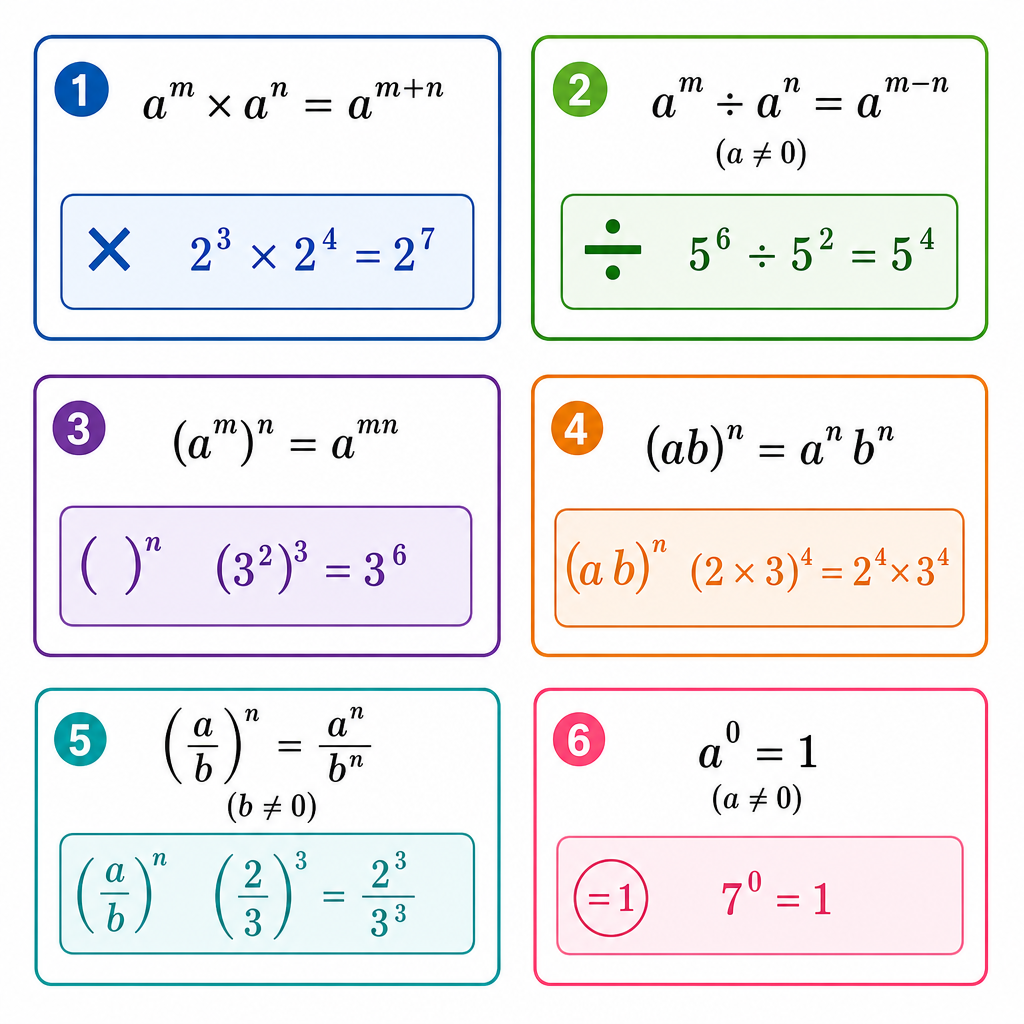
In Core you worked with positive, zero and negative integer powers. Extended hands you the full toolkit — fractional powers and index equations. Learn these six rules and you're set. 💯
• Multiply same base:
• Divide same base:
• Power of a power:
• Zero power: (for any non-zero — not , that's a weird exception)
• Negative power = flip: . The minus sign literally means 'put me downstairs'.
• Fractional power = root: , and — bottom is the root, top is the power.
Quick flex examples:
✅
✅
✅
• Multiply same base:
• Divide same base:
• Power of a power:
• Zero power: (for any non-zero — not , that's a weird exception)
• Negative power = flip: . The minus sign literally means 'put me downstairs'.
• Fractional power = root: , and — bottom is the root, top is the power.
Quick flex examples:
✅
✅
✅
Index equations like are solved by rewriting both sides to the same base. , so , so . Same base = same exponent. Too easy. 🎯
For : spot , so , so . 🔥
Worked example
Worked Example: Fractional Indices and an Index Equation
Without a calculator, evaluate (a) , (b) , and (c) solve .
- 1For (a), use . Take the root first (smaller numbers = fewer mistakes), then raise.
- 2For (b), the negative flips the fraction upside down, the half means square root. Do the flip first.
- 3For (c), get the RHS to the same base as the LHS. Spot .
- 4Same base means the exponents must be equal. Solve the mini linear equation.
Answer
Worked example
Worked Example: Simplifying an Algebraic Fraction with Quadratics
Simplify as far as possible. (Hint: factorise top and bottom first — algebra version of cancelling.)
- 1Top is a difference of two squares: . Here , .
- 2Bottom is a quadratic. Find two numbers that multiply to and add to . Those are and .
- 3Now cancel the common factor . Same energy as cancelling a from .
- 4That's fully simplified. Note the implicit restriction (or we'd have divided by zero).
Answer
Worked example
Worked Example: Solving a Quadratic with the Quadratic Formula
Solve using the quadratic formula. Give answers to s.f. (Formula sheet: .) 🎯
- 1Identify the coefficients. The quadratic is in the form .
- 2Sub into the formula. Watch the signs — wrap that in brackets so the becomes .
- 3Simplify under the root. doesn't simplify nicely, so keep as a decimal.
- 4Two solutions — one with , one with . Round each to 3 s.f. at the end.
Answer
Worked example
Worked Example: Turning Point via Differentiation
A curve has equation . (a) Find . (b) Find the coordinates of the two stationary points and state whether each is a maximum or minimum. 📈
- 1Differentiate term by term using . Constants vanish.
- 2Stationary points happen where the gradient is zero. Set the derivative to zero and solve.
- 3Find the -coordinate at each by subbing back into the original equation.
- 4Classify by checking gradient just before and after each point. At : gradient at is (positive), at is (negative). Sign change means maximum. At : gradient at is , at is (positive). Sign change means minimum.
Answer
Worked example
Worked Example: Composite Function and Inverse
Given and . (a) Find . (b) Find the composite . (c) Find . 🔄
- 1For (a), means — apply first, then . Read it right-to-left.
- 2For (b), . Sub into .
- 3For (c), to invert : write , swap and , solve for .
- 4Write the inverse using the right notation.
Answer
Practice this in the app
Unlock the full chapter: practice questions, flashcards, mock papers and notes, free.
Continue revising