Number: Core Concepts and Applications
Unlocking the Numberverse 🌌
Introduction
1. Introduction
Hey! Ready to dive into the world of numbers? It might seem basic, but trust me, this chapter is the foundation for everything else we'll do. It's like learning the controls before you can dominate in a game. We'll start with the different types of numbers you'll encounter, then see how to group them using Set Theory – think of it like organizing your Spotify playlists. We'll level up with powers and indices, which explain how things go viral, and get practical with fractions, decimals, and percentages for figuring out sale discounts or your grade on the next test. We'll also tackle Standard Form to handle crazy big or tiny numbers (like the number of views on a trending video or the size of a microchip). Then we'll get into real-world skills like estimation and bounds – perfect for figuring out if you have enough cash for a shopping trip. We'll master ratios for everything from mixing the perfect drink to getting the aspect ratio right on your Instagram story, and look at rates like your pay per hour or your car's speed. Finally, we'll even meet some cool but weird numbers called surds. Let's get this bread! 🥖
2. Classification and Properties of Numbers
Alright, let's break down the world of numbers. Think of it like a character roster in a massive game – each number type has its own stats and abilities. First up, we have Natural Numbers (), which are your basic counting numbers: 1, 2, 3... like counting your Snapchat streak. Add zero and all the negatives, and you get Integers (), which are perfect for tracking your bank balance – positive when your part-time job pays, negative after buying new trainers. Then there are the VIPs: Prime Numbers. These are numbers greater than 1 that are only divisible by 1 and themselves (e.g., 2, 3, 5, 7, 11...). They're the unique, fundamental building blocks of all other integers. Speaking of building, Square Numbers () and Cube Numbers () are what you get when you multiply a number by itself once () or twice ().
Most numbers you use, like or , are Rational Numbers because they can be written as a fraction. But some numbers are rebels – Irrational Numbers like or have decimal parts that go on forever without repeating. They just can't be contained in a simple fraction! Every number also has a reciprocal – just flip it! The reciprocal of 5 is .
Now, let's talk relationships. Factors are numbers that divide evenly into another number (the factors of 12 are 1, 2, 3, 4, 6, 12). Multiples are what you get from a number's times table (multiples of 12 are 12, 24, 36...). The coolest trick is breaking any number down into its unique code of prime factors, called prime factorisation. For example, .
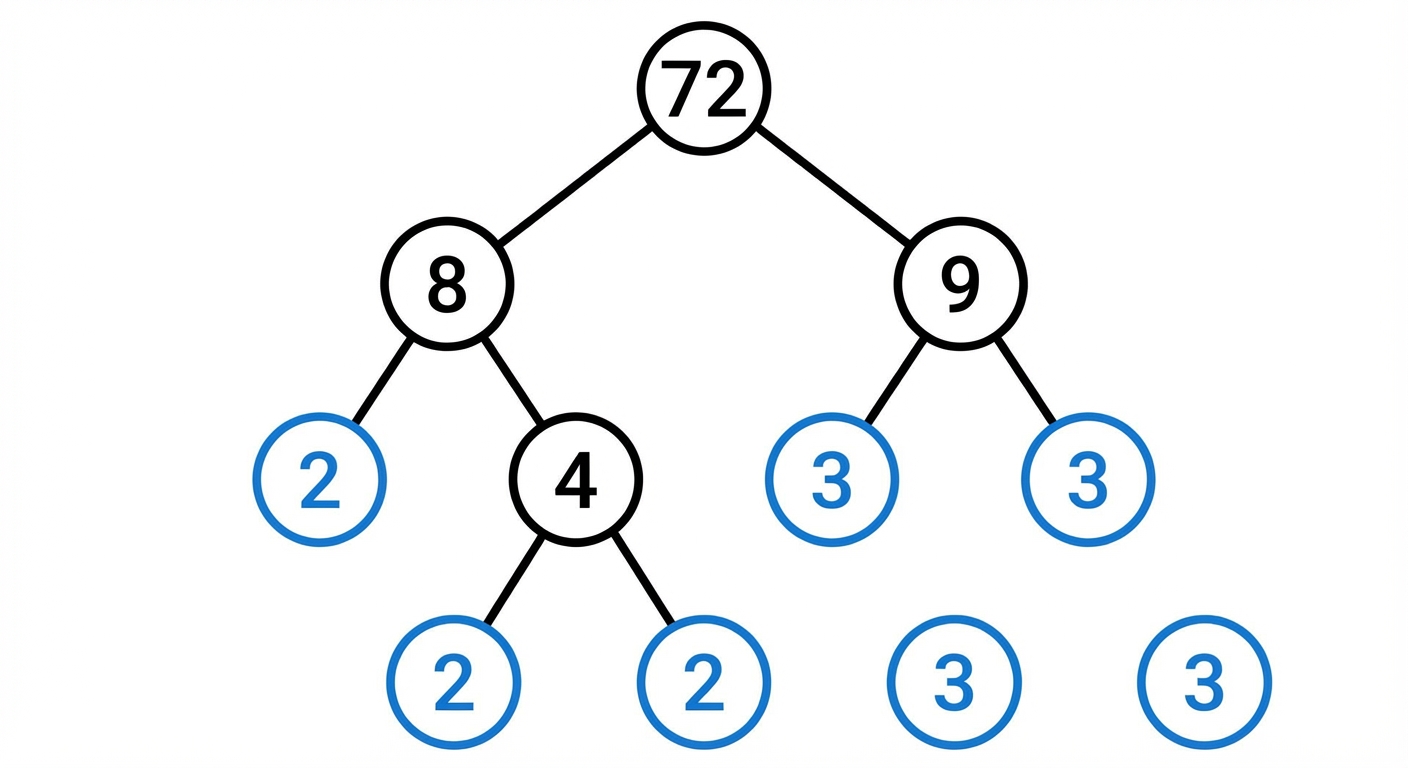
This is super useful for finding the Highest Common Factor (HCF) – the biggest factor two numbers share – and the Lowest Common Multiple (LCM) – the smallest number that's a multiple of both. Think of HCF as finding the biggest possible group size for a project, and LCM as figuring out when your and your friend's streaming subscriptions will renew on the same day. Mastering these types and properties is like having the ultimate cheat sheet for the Number chapter. You got this! 💪
Worked example
Application of Prime Factorisation, HCF, and LCM
Solving Puzzles with Number DNA 🧬
You're packing goody bags for a party. You have 108 glow sticks and 72 bags of sweets. You want to make identical goody bags using all the items, with none left over.
a) What is the greatest number of identical goody bags you can make?
b) Two party lights are turned on at the same time. One flashes every 72 seconds, and the other flashes every 108 seconds. After how many minutes will they flash together again?
a) What is the greatest number of identical goody bags you can make?
b) Two party lights are turned on at the same time. One flashes every 72 seconds, and the other flashes every 108 seconds. After how many minutes will they flash together again?
- 1First, we need to find the 'DNA' of our numbers by breaking them down into their prime factors. This is the key to unlocking both the HCF and LCM. Let's use factor trees.
- 2For part (a), the greatest number of identical bags means we need the Highest Common Factor (HCF). We find this by multiplying the common prime factors raised to their lowest powers.Common factors are 2 and 3. So, you can make 36 identical goody bags.
- 3Just to be thorough, we can figure out what's in each bag. Divide the total items by the number of bags (the HCF).
- 4For part (b), we need to find the next time the lights flash together, which means we're looking for the Lowest Common Multiple (LCM). We find this by multiplying all the prime factors from both numbers, raised to their highest powers.They will flash together after 216 seconds.
- 5The question asks for the answer in minutes, so we need to do a final conversion. Don't get caught out!(This is 3 minutes and 0.6 x 60 = 36 seconds).
Answer
(This is 3 minutes and 0.6 x 60 = 36 seconds).
3. Fractions, Decimals, and Percentages: Equivalence and Conversion
Alright, let's break this down. Think of fractions, decimals, and percentages as three different outfits for the same number. They all represent the same value, just like you're the same person whether you're in your school uniform, your gaming sweats, or dressed up for a party. The IGCSE expects you to be a master stylist, able to switch between these looks effortlessly.
First up, the basics. A proper fraction is like the chill part of a playlist, where the top number (numerator) is smaller than the bottom (denominator), like . An improper fraction is where the numerator is the main character and is bigger, like . A mixed number is the combo deal, like . Converting between them is key. To get from a fraction to a decimal, just divide the top by the bottom. To go from a decimal to a percentage, slide that decimal point two places to the right (multiply by 100). Easy.
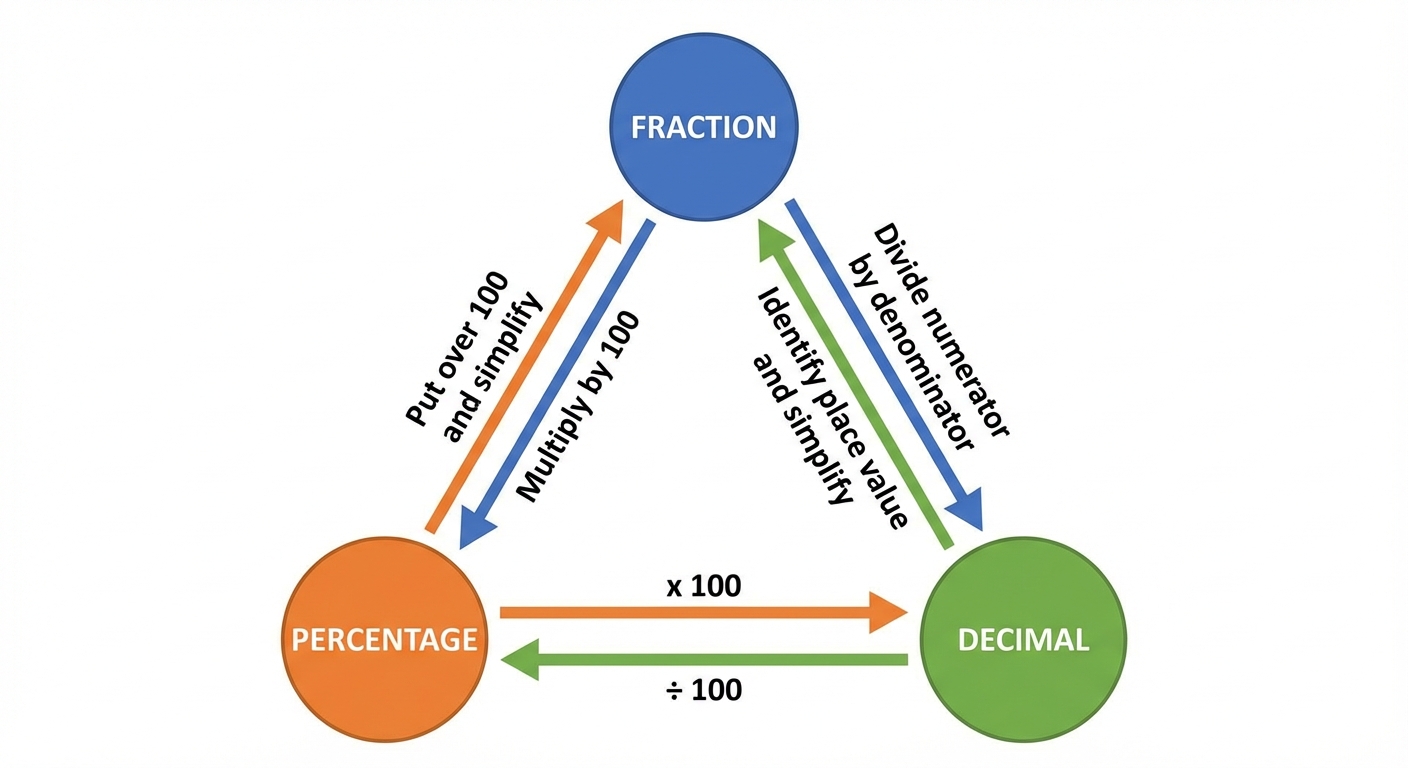
Now for the spicy level: recurring decimals. These are the decimals that go on forever, like that one friend's Snapchat story. We use dot notation to show the part that repeats. For example, is written as , and is . The real boss move is converting these back into fractions. Let's say we need to convert . We multiply by a power of 10 to shift the repeating part. Here, since two digits repeat, we'll use 100. So, . Now, subtract the original: . This gives us . A little algebra later, , which simplifies to . Boom, you've tamed the infinite decimal. Mastering this is a total power-up for your exam. 🚀
Worked example
Worked Example: Reverse Percentages
That 'Sale Price' Is Hiding Something... 😉
You've been saving up for a new pair of trainers. They're in a sale with a 15% discount, and the sale price is . What was the original price before the discount?
- 1First, figure out what percentage of the original price you're actually paying. A 15% discount means you're paying 100% - 15%.
- 2So, the sale price of is equal to 85% of the original price. Let's call the original price 'P'. We can set this up as an equation, converting the percentage to a decimal.
- 3Now we just need to do some algebra to find 'P'. To get 'P' by itself, we need to divide both sides of the equation by 0.85. This is the 'reverse' part of the calculation.
- 4Whip out your calculator and solve it. This gives you the full, original price before that tempting discount was applied.
- 5Quick sanity check! Does a 15% discount on give you ? Let's see: 15% of is . So, . Perfect! The original price was .
Answer
4. Standard Form and Scientific Notation
Alright, let's talk about standard form. Honestly, it's just a super slick way to handle ridiculously massive or incredibly tiny numbers without getting a headache or filling your entire page with zeros. Think about the number of views on a viral TikTok or the size of a single atom – standard form is your best friend for these.
The basic rule is to write any number in the format . Now, this isn't a free-for-all; there are two key rules you must follow:
1. The 'A' part has to be a number between 1 and 10. So, . It can be 1, it can be 9.999, but it can't be 10 or 0.5.
2. The 'n' part, the power, has to be a whole number (an integer), and it can be positive or negative.
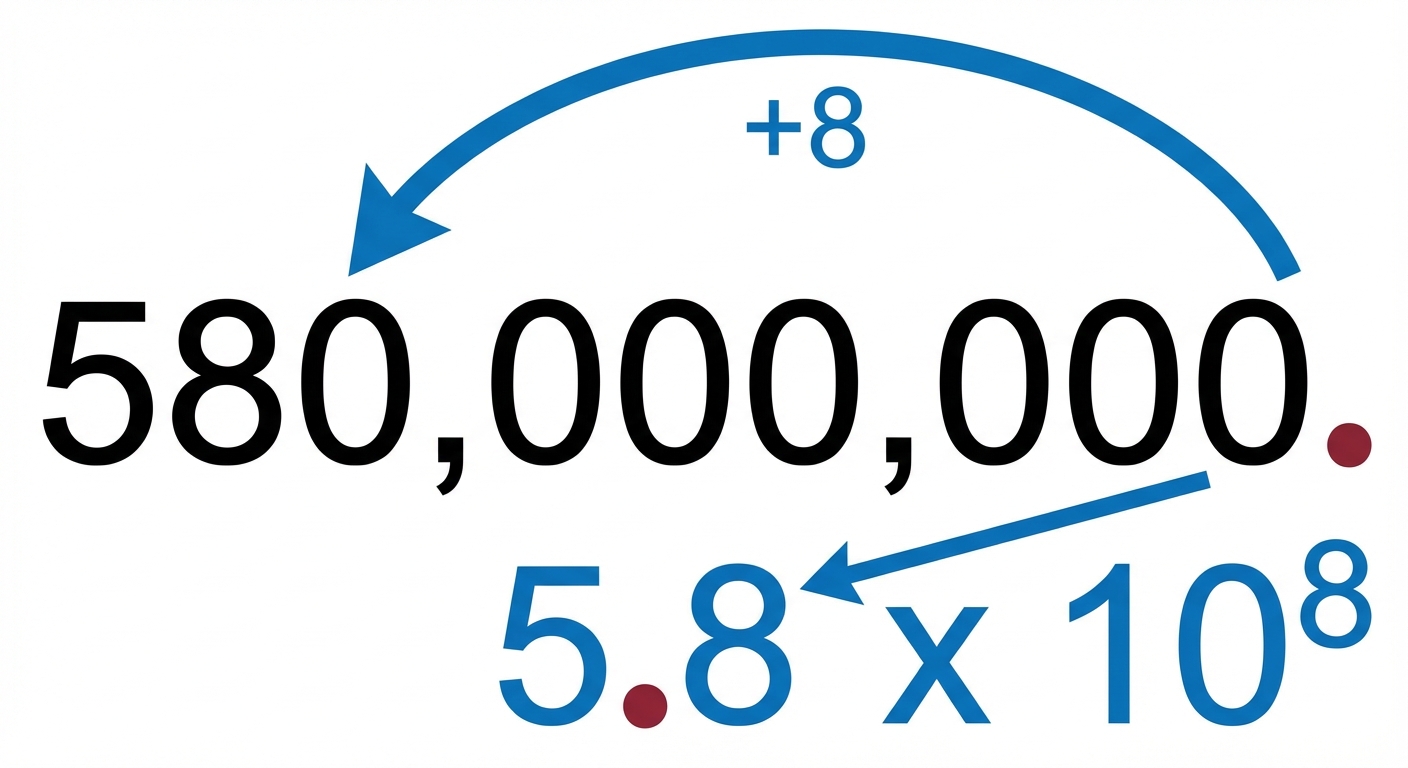
So, how do we convert? Imagine you're trying to write the number of plays on your favorite Spotify track, say 580,000,000. To get 'A', you slide the decimal point from the end until you're left with a number between 1 and 10. That would be 5.8. How many places did you slide it? 8 places to the left. So, your standard form is . A positive power 'n' means you're dealing with a big number.
What about tiny numbers, like the width of a microchip component, 0.000025m? Same idea, but you slide the decimal point to the right to get 2.5. You moved it 5 places. Since you started with a small number, the power is negative. So, it's . A negative 'n' is your clue that the number is less than 1.
When it comes to calculations, it's a game-changer. For multiplication and division, you deal with the 'A' parts and the powers of 10 separately. For example, to multiply , you just do and . Using your index laws, that's . Easy, right? For adding and subtracting, you first have to make the powers of 10 the same, which is a bit like making sure you and your friend are on the same server before joining a game. Once the powers match, you can just add or subtract the 'A' parts.
Worked example
Worked Example: Calculations with Standard Form
Let's Crunch Some Cosmic Numbers ✨
The mass of the Sun is approximately kg, and the mass of the Earth is kg. How many times more massive is the Sun than the Earth? Give your answer in standard form, correct to 3 significant figures.
- 1First, we need to figure out what the question is asking. 'How many times more massive' means we need to divide the Sun's mass by the Earth's mass. Let's set up the division.
- 2Now, let's split the calculation into two parts: we'll divide the decimal numbers ('A' parts) and then divide the powers of 10. It makes the whole thing way less intimidating.
- 3Let's grab our calculator for the first part. Remember the question asks for 3 significant figures in the final answer, so let's keep a few extra decimal places for now to be safe.
- 4For the powers of 10, we use our index laws. When you divide powers with the same base, you subtract the exponents. So, it's .
- 5Now we combine our two results. We get . But wait! This isn't proper standard form because the 'A' part (0.333...) is not between 1 and 10. We need to adjust it.
- 6Finally, we combine the powers of 10 and round our 'A' part to 3 significant figures as requested. This gives us our final, properly formatted answer.
Answer
5. Approximation and Estimation
Alright, let's talk about estimation. Think of it as the 'quick maths' you do in your head before committing to something, like figuring out if you have enough cash for snacks or if your phone battery will last through a gaming session. It’s not about finding the exact answer, but getting a sensible, close-enough value super fast. The main tool in our estimation toolkit is rounding. You're already a pro at rounding to decimal places, but for estimation, the MVP is rounding to one significant figure (1 s.f.). This is the golden rule! Why? Because it turns messy numbers like or into simple, single-digit numbers like and that you can easily multiply or divide without reaching for a calculator.
Here's the game plan: when a question asks you to 'estimate' a calculation, you take every single number in the problem and round it to 1 s.f. before you do anything else. Don't you dare start multiplying or dividing the original numbers! Round first, then calculate.
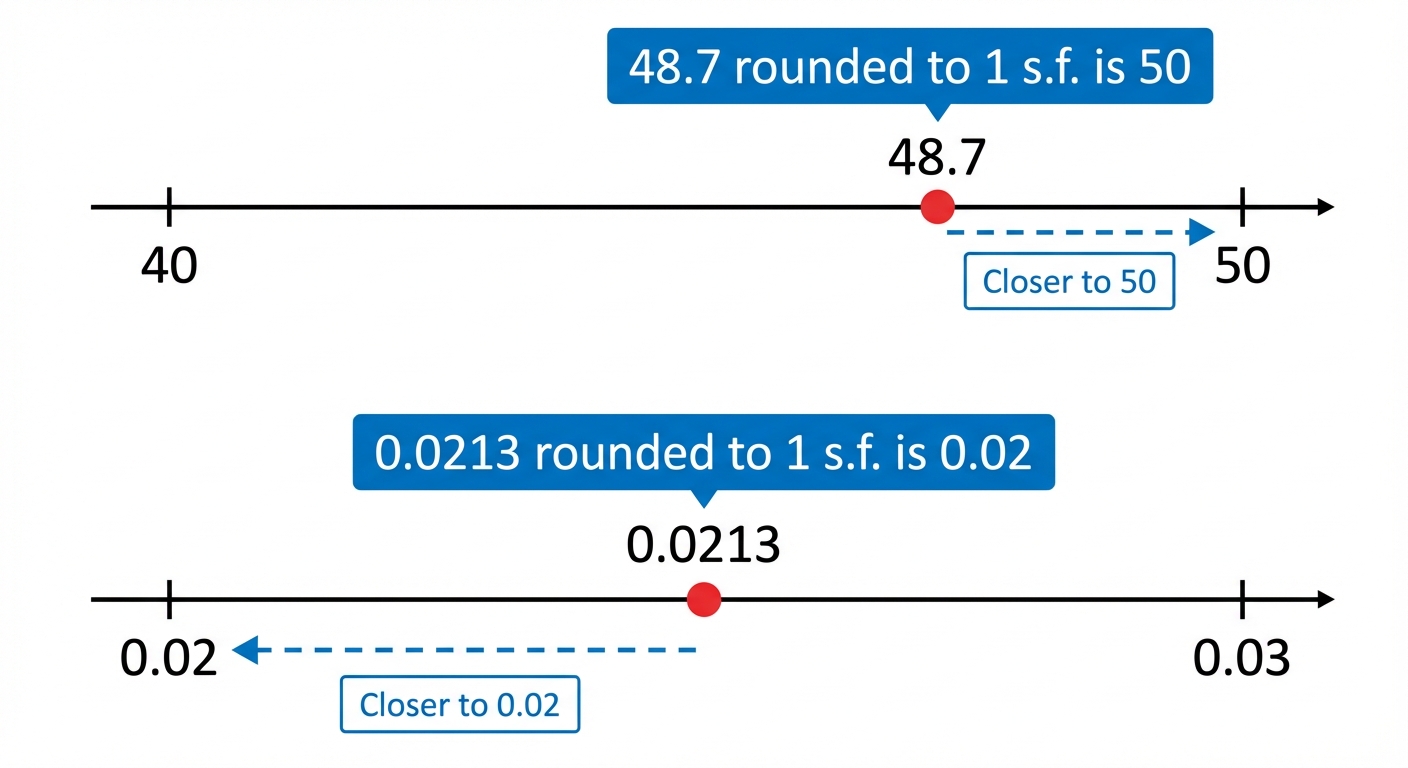
This skill is clutch for checking if your calculator answer is in the right ballpark. If you estimate an answer to be around 20 and your calculator spits out 2,045, you know you've probably typed something wrong. It’s your built-in error checker, making sure your final answer is reasonable in the context of the problem.
Worked example
Worked Example: Estimating a Calculation
Solving it without breaking a sweat 💪
By writing each number correct to 1 significant figure, estimate the value of .
- 1First up, we follow the golden rule: round every number in the expression to 1 significant figure. This makes the calculation way easier.
- 2Now, substitute these new, friendly numbers back into the original expression. It's like swapping out difficult opponents in a video game for easier ones.
- 3Solve the numerator (top part) and the denominator (bottom part) of the fraction separately. This keeps our working clean and easy to follow.
- 4Finally, perform the last division to get our estimated answer. See? No calculator needed for this boss battle!
Answer
6. Ratio and Proportion
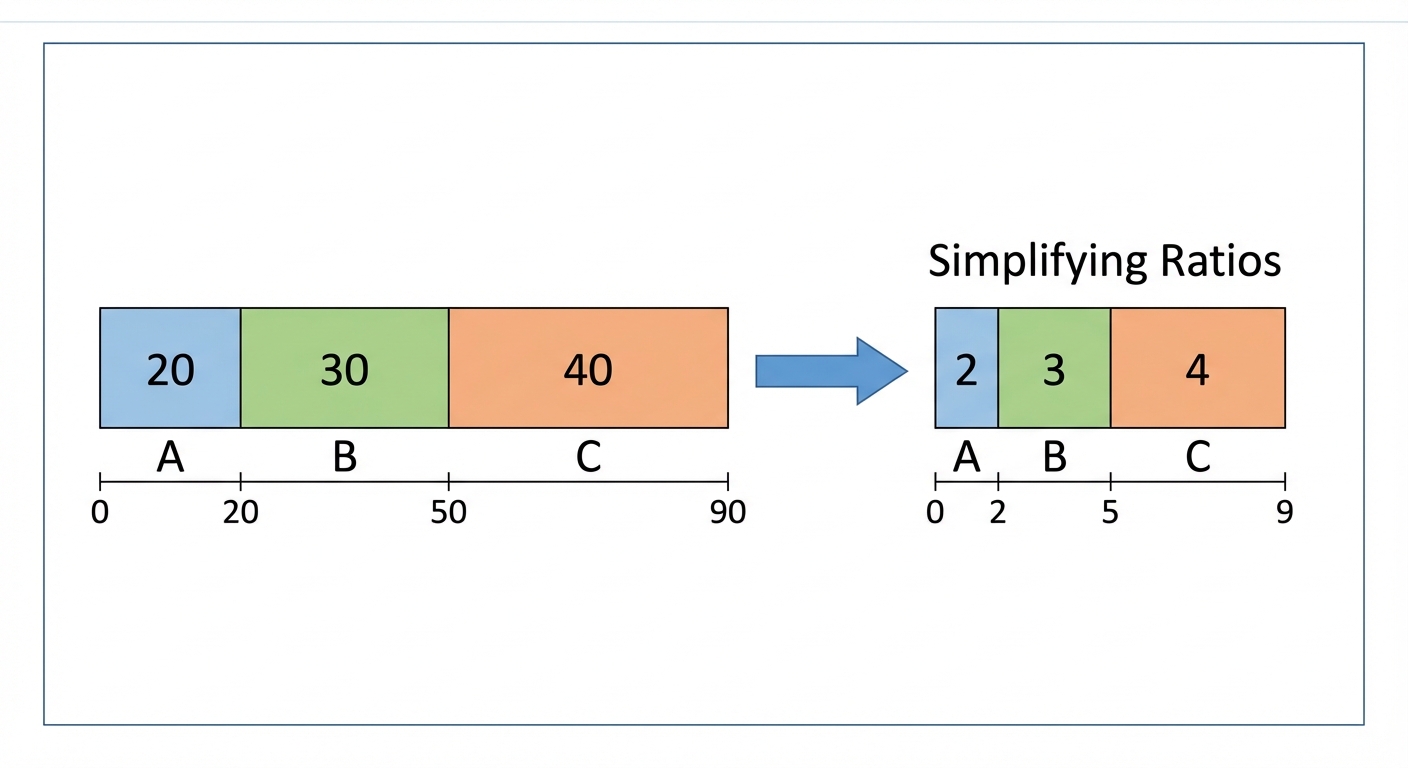
Alright, let's break down ratios. Think of a ratio as a way to compare stuff—like comparing your TikTok followers to your friend's, or the win-loss ratio of your favourite esports team. It's written with a colon, like . The most important first step is often simplifying. If you and your friends make a playlist with 20 rap songs, 30 pop songs, and 40 afrobeats songs, the ratio is . To simplify, you find the highest common factor (HCF), which is 10 here, and divide each part by it. Boom, you get . It's the same proportion, just neater.
Now for the fun part: dividing a quantity. Let's say you and a friend get paid for a job and you agree to split it in the ratio . This is how you do it: 1) Add the parts of the ratio: total 'parts'. 2) Divide the total amount by the number of parts to find what one part is worth: . 3) Multiply this value by each person's share: Your share is , and your friend's is . This method is clutch for everything from splitting bills to mixing ingredients. It's also the key to proportional reasoning in contexts like map scales. A map scale of means 1 cm on the map is 50,000 cm (or 500m) in real life. It helps you figure out if that 'short walk' is actually a massive hike. 🗺️
Worked example
Worked Example: Dividing a Quantity in a Given Ratio
The Part-Time Job Payout Problem 💸
You, Alex, and Ben work at a weekend festival and earn a total of . You worked for 8 hours, Alex worked for 5 hours, and Ben worked for 3 hours. You agree to split the money in the ratio of the hours you each worked. How much does each person receive?
- 1First, let's write down the ratio of the hours worked. This represents how we're going to 'share' the money.
- 2Next, we need to find the total number of 'parts' or 'shares' in our ratio. We just add the numbers together.
- 3Now, we figure out how much money one single 'part' is worth. We do this by dividing the total earnings by the total number of parts.
- 4Time to distribute the cash! We multiply the value of one part (£30) by each person's share in the ratio.
- 5Always do a final check to make sure you haven't messed up! Add your answers together to see if they equal the original total.
Answer
7. Calculations Involving Rates
Alright, let's break down 'rates'. Honestly, you use them all the time without even thinking about it. A rate is just a way of comparing two different quantities. The key word you're looking for is per. How many miles per hour? How much do you get paid per hour at your job? How many texts can you send per minute? That 'per' is your signal that we're dividing one thing by another.
The most common rate you'll see is speed. This is the rate of change of distance over time. We use the legendary formula triangle for this.
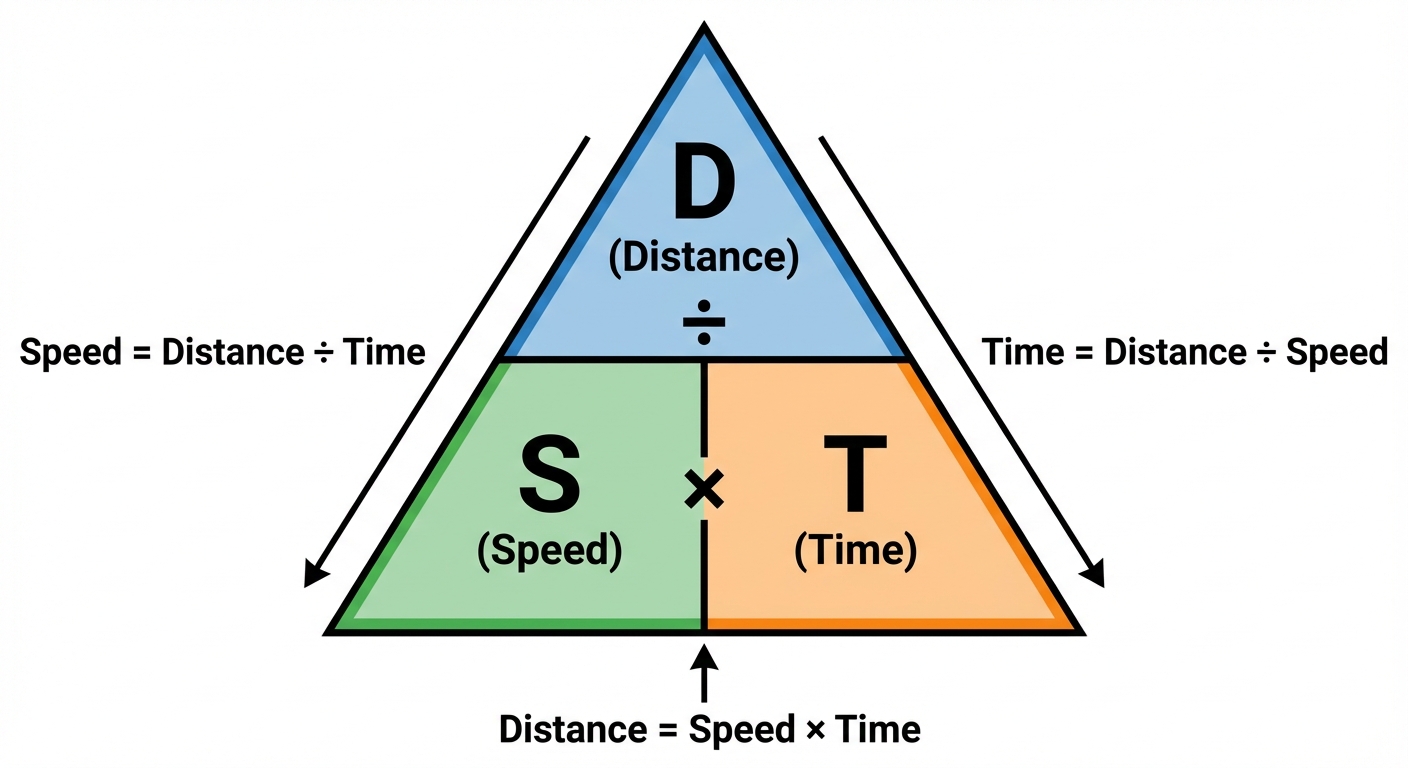
The formulas are , , and . Just remember the units have to match! If your speed is in km/h, your time must be in hours.
But it's not just about speed. We have other cool rates. Density is a big one, telling us how 'packed' a substance is. It's the mass per unit volume (), with units like g/cm³. Think of it like this: a tiny, dense piece of metal might weigh the same as a huge, fluffy pillow. Other rates include flow rates (like how many litres of water flow out of a tap per second), currency exchange rates (how many Euros you get per Pound Sterling 💸), and hourly pay rates. The IGCSE syllabus loves these real-world examples, so get comfortable with them. The principle is always the same: it's one quantity divided by another. Just identify what's being measured, what the 'per' unit is, and you're golden.
But it's not just about speed. We have other cool rates. Density is a big one, telling us how 'packed' a substance is. It's the mass per unit volume (), with units like g/cm³. Think of it like this: a tiny, dense piece of metal might weigh the same as a huge, fluffy pillow. Other rates include flow rates (like how many litres of water flow out of a tap per second), currency exchange rates (how many Euros you get per Pound Sterling 💸), and hourly pay rates. The IGCSE syllabus loves these real-world examples, so get comfortable with them. The principle is always the same: it's one quantity divided by another. Just identify what's being measured, what the 'per' unit is, and you're golden.
Worked example
Worked Example: Average Speed Calculation
That Tricky Time Conversion Problem 🚴♀️
A Deliveroo rider cycles 21 km to deliver an order. The journey takes 1 hour and 15 minutes. Calculate their average speed in km/h.
- 1First, let's identify what we've been given. We have the distance () and the total time (). The goal is to find the average speed ().
Distance = 21 km
Time = 1 hour 15 minutes - 2Hold up! The speed needs to be in km/h, but our time is in hours and minutes. We need to convert the entire time into just hours. There are 60 minutes in an hour, so we can convert 15 minutes to hours by dividing by 60.
- 3Now we can find the total time in hours by adding the hour part and the decimal part we just calculated.
- 4Great, we're ready to use the average speed formula. Remember, it's Speed = Distance / Time.
- 5Finally, substitute our values into the formula and solve. Don't forget to include the correct units in your final answer!
Answer
8. Manipulating and Simplifying Surds
Alright, let's talk about surds. You know how some numbers are super neat, like 5, -10, or (rational numbers), and others are just... messy, like or ? They have decimal expansions that go on forever without repeating. These are the irrational numbers. A surd is just a way to write an irrational root, like or , perfectly. Think of it like a RAW photo file versus a compressed JPEG – the surd is the original, high-quality version, no rounding, no messy decimals. The most important skill is simplifying them. The key rule is . Your mission is to find the largest square number that's a factor of the number inside the root. For example, to simplify , you look for square number factors (4, 9, 16...). Hey, 4 is a factor! So, we rewrite it: . Boom, simplified.
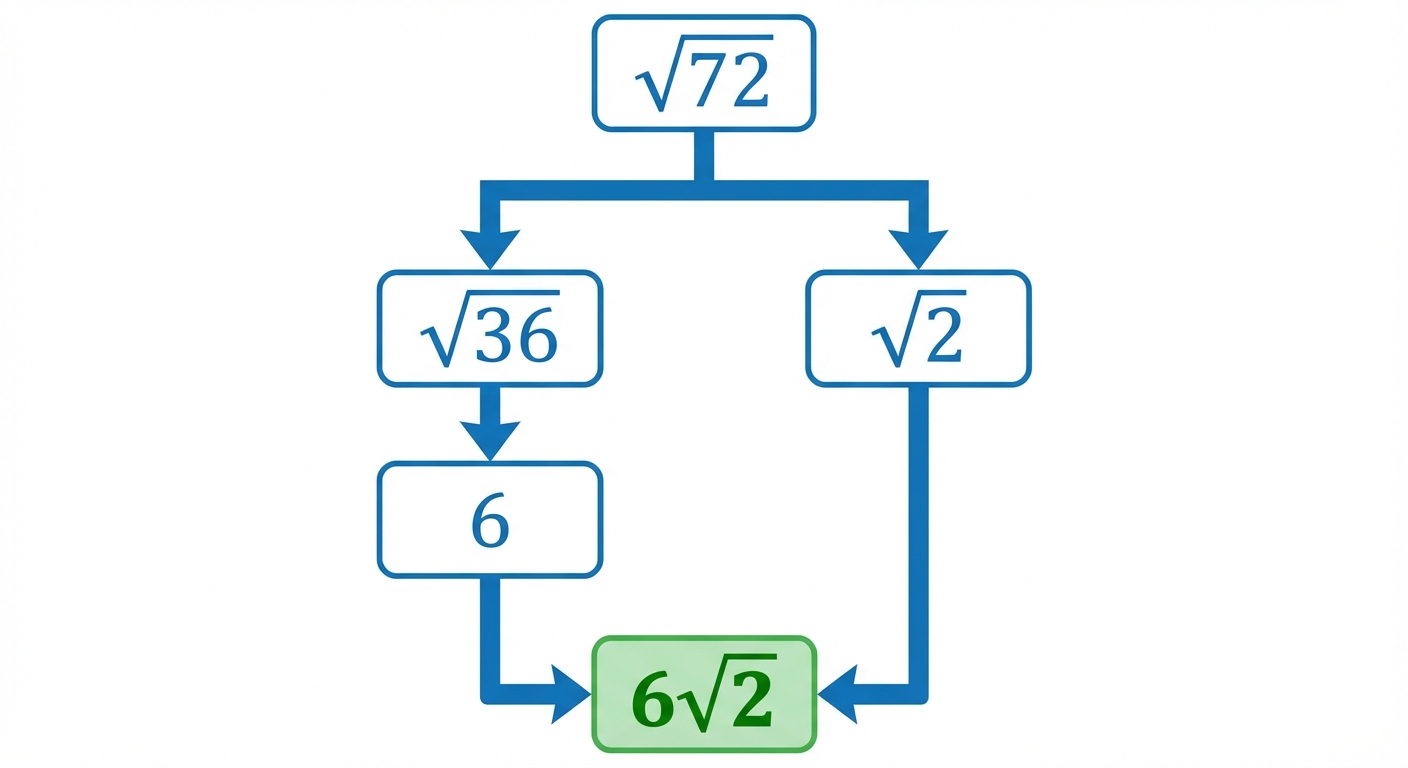
Now for the calculations. Adding and subtracting surds is like combining like terms in algebra. You can only combine them if the number inside the root is the same. So, (easy!), but is stuck. You can't simplify it further. This is why simplifying first is crucial. Take . It looks impossible, but simplify them first: and . Now it's just . The final boss move is rationalising the denominator. It's basically maths etiquette; we don't like having a surd on the bottom of a fraction. If you have , you just multiply the top and bottom by that surd: . If the denominator is more complex, like , you use its 'conjugate' (just flip the sign in the middle). So, we multiply top and bottom by . This uses the difference of two squares rule, , to magically eliminate the surd on the bottom. It's a neat trick that cleans up your expressions, making you look like a total pro. ✨
Worked example
Worked Example: Rationalising a Binomial Denominator
Kicking that Surd Out of the Basement 👇
Rationalise the denominator and simplify the expression:
- 1First up, we need to get rid of the surd in the denominator, . We do this by multiplying by its conjugate. The conjugate is the same expression but with the sign flipped. So, the conjugate of is .
- 2Now, we multiply the entire fraction by a 'fancy version of 1', which is the conjugate over itself. This keeps the value of the fraction the same while changing how it looks.
- 3Let's handle the numerators and denominators separately. For the numerator, we multiply 12 by the whole bracket . For the denominator, we use the difference of two squares trick: .
- 4Time to simplify the denominator. Squaring 5 gives 25, and squaring just gives 2. The surd is gone! Mission accomplished.
- 5Finally, put the simplified numerator and denominator back together. We check if the fraction can be simplified further, but since 23 is a prime number and doesn't go into 60 or 12, this is our final answer. Looking sharp!
Answer
9. Set Notation and Venn Diagrams
Alright, let's break down Set Theory. Think of it as the maths behind sorting things into groups, like how Spotify sorts your music into playlists or how you have different group chats for different friends. A set is just a collection of distinct things, which we call elements. The whole universe of things we're talking about (e.g., all students in your year group) is the universal set, written as .
Now for the notation, which looks way scarier than it is. is simply the number of elements in set A, like the number of followers you have. If 'you' are in a set A (your gaming squad), we'd write . If not, . The complement, , is everything not in set A (so, everyone in your year who isn't in your squad). A set with zero elements is the empty set, – like the set of people who enjoy exam season. 😉
Relationships between sets are key. If your 'close friends' list (set B) is made up entirely of people from your main friend group (set A), then B is a subset of A, written as . The union () is everything in set A or set B or both – it's like merging two playlists. The intersection () is only what's in both sets – the songs that appear on both of your playlists. We use Venn diagrams to visualise this.
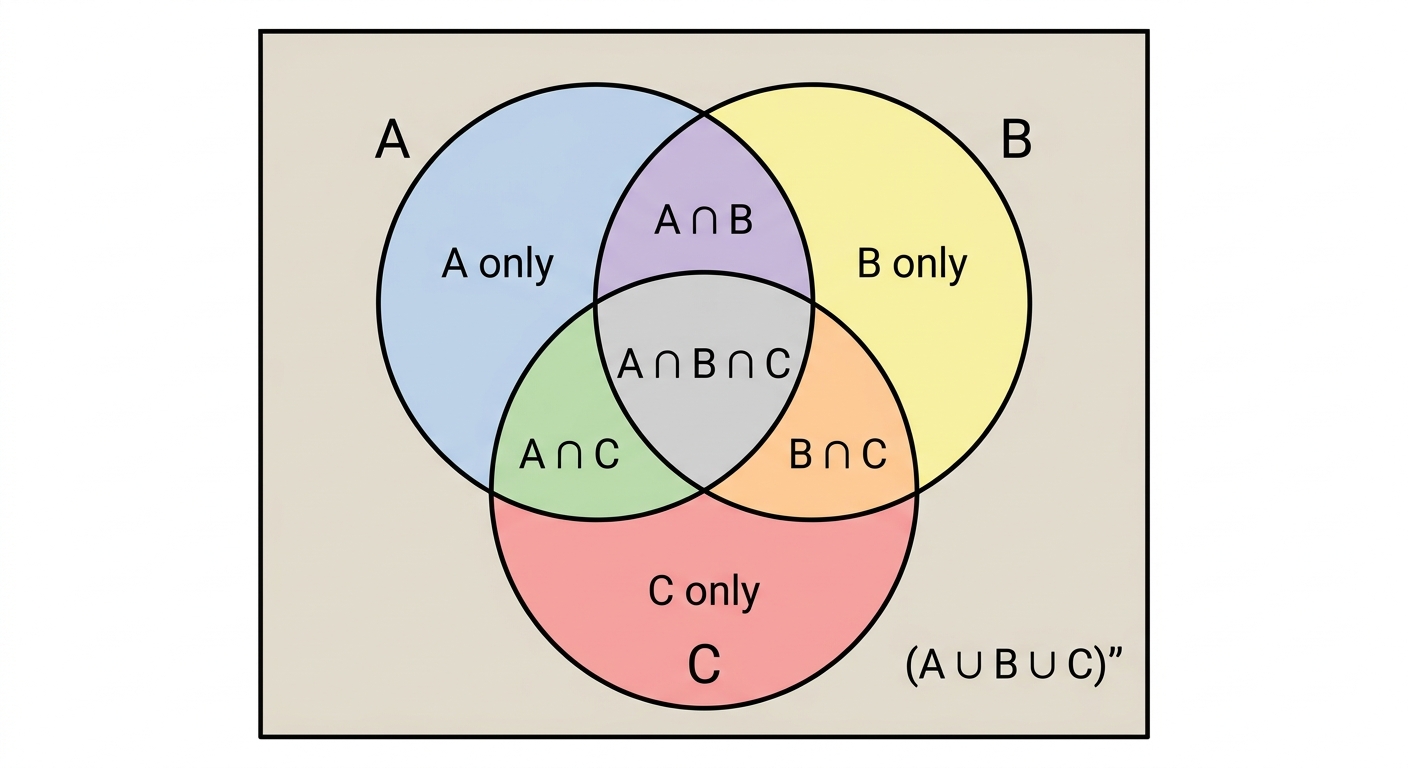
. They show how different groups overlap, making it super easy to solve problems by seeing who fits where.
Worked example
Worked Example: Problem Solving with a Three-Set Venn Diagram
The Ultimate Social Media Showdown 📱
A survey of 80 students in a year group asked which social media apps they use. The results were:
- 30 use Instagram (I)
- 35 use Snapchat (S)
- 42 use TikTok (T)
- 12 use Instagram and Snapchat
- 15 use Snapchat and TikTok
- 10 use Instagram and TikTok
- 4 use all three apps.
How many students in the year group use none of these apps?
- 30 use Instagram (I)
- 35 use Snapchat (S)
- 42 use TikTok (T)
- 12 use Instagram and Snapchat
- 15 use Snapchat and TikTok
- 10 use Instagram and TikTok
- 4 use all three apps.
How many students in the year group use none of these apps?
- 1First, draw a Venn diagram with three overlapping circles for Instagram, Snapchat, and TikTok. The golden rule is to always start from the inside and work your way out. The very middle represents the students who use all three apps.
- 2Now, let's fill in the regions where two sets intersect. Remember to subtract the middle part! For example, 12 students use I and S, but 4 of those also use T. So, the number who use only I and S is...
- 3Next, we find the number of students who use only one app. For each circle, take the total for that app and subtract the three intersection parts we've already filled in.
- 4Let's find the total number of students who use at least one of the apps. We just add up every number we've placed inside the circles.
- 5The final step! The question asks for the number of students who use none of the apps. We take the total number of students in the survey (our universal set, ) and subtract the number of students who use at least one app.
Answer
10. Calculations with Powers and Roots
Alright, let's talk about powers and roots. Think of it like this: a power is like a number's 'glow up'. When you see something like , it's not . Instead, it's telling you to multiply the base number (3) by itself 4 times: . The small number is called the power, index, or exponent. The most common ones you'll see are squares () and cubes (). Squaring a number is like finding the area of a square with that side length, and cubing is like finding the volume of a cube.
For your IGCSE exams, there are some key values you just have to know, like having the ultimate cheat codes for a game. You need to memorize the squares of all numbers from 1 to 15 (e.g., , ) and the cubes of 1, 2, 3, 4, 5, and 10 (e.g., , ). Seriously, lock these in. It'll save you so much time.
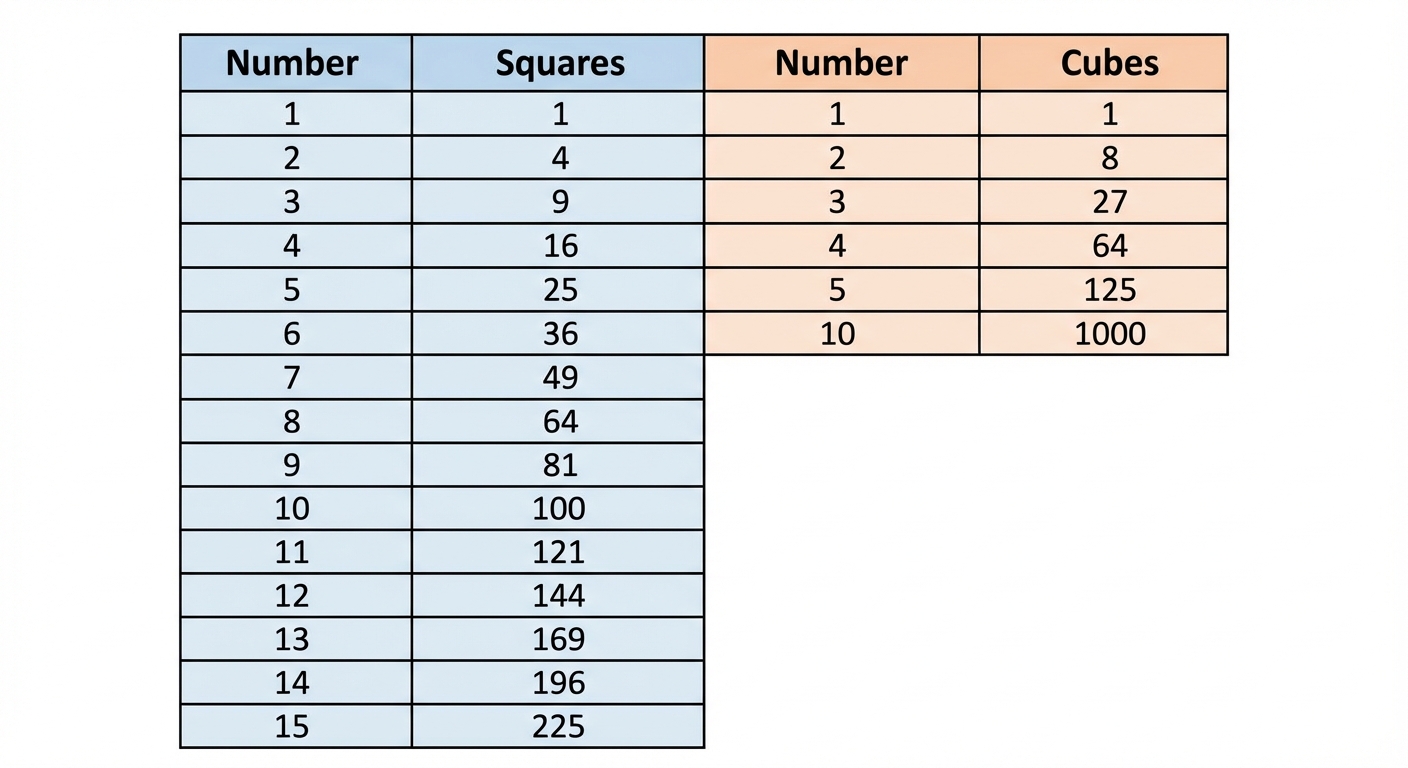
The chart has a title like 'Exam Cheat Codes: Squares & Cubes'.
Now, what about roots? They're the opposite – the 'undo' button. The square root () asks: 'What number, when multiplied by itself, gives me ?' So, is 13 because . The cube root () asks: 'What number, when cubed, gives me ?' So, is 5 because . You'll often have to combine these operations, like calculating . Just solve each part first () and then combine them to get your final answer (50). Easy peasy. 😎
Now, what about roots? They're the opposite – the 'undo' button. The square root () asks: 'What number, when multiplied by itself, gives me ?' So, is 13 because . The cube root () asks: 'What number, when cubed, gives me ?' So, is 5 because . You'll often have to combine these operations, like calculating . Just solve each part first () and then combine them to get your final answer (50). Easy peasy. 😎
Worked example
Worked Example: Combining Powers and Roots
Let's Solve This Thing 🧠
Without using a calculator, find the value of .
- 1First, let's break down the problem. We have three separate parts to calculate before we can do the addition and subtraction: a power (), a square root (), and a cube root (). We need to deal with these first, just like following the order of operations (BIDMAS/PEMDAS).
- 2Let's calculate the power. means . This is one of the cubes you should have memorized!
- 3Next up, the roots. These are straight from our 'must-know' list. The square root of 121 is 11, and the cube root of 125 is 5.
- 4Now we substitute these values back into our original expression. It's looking way simpler now, right?
- 5Finally, we just work from left to right with the addition and subtraction to get our final answer. You got this!
Answer
11. Exponential Growth and Decay
Okay, so compound interest is cool, but exponential growth and decay is that same energy turned up to 100. This is what's happening whenever something changes by a fixed percentage every round — bacteria doubling, your Instagram follower count snowballing, a new iPhone losing half its value the second you open the box. Same vibe.
The master formula is literally the same one you used for compound interest:
where is the starting value, is the percentage per period, and is the number of periods. Lock that in.
• For growth, is positive — like a population growing at a year, so use . 📈
• For decay, is negative — like your phone dropping a year, so use . 📉
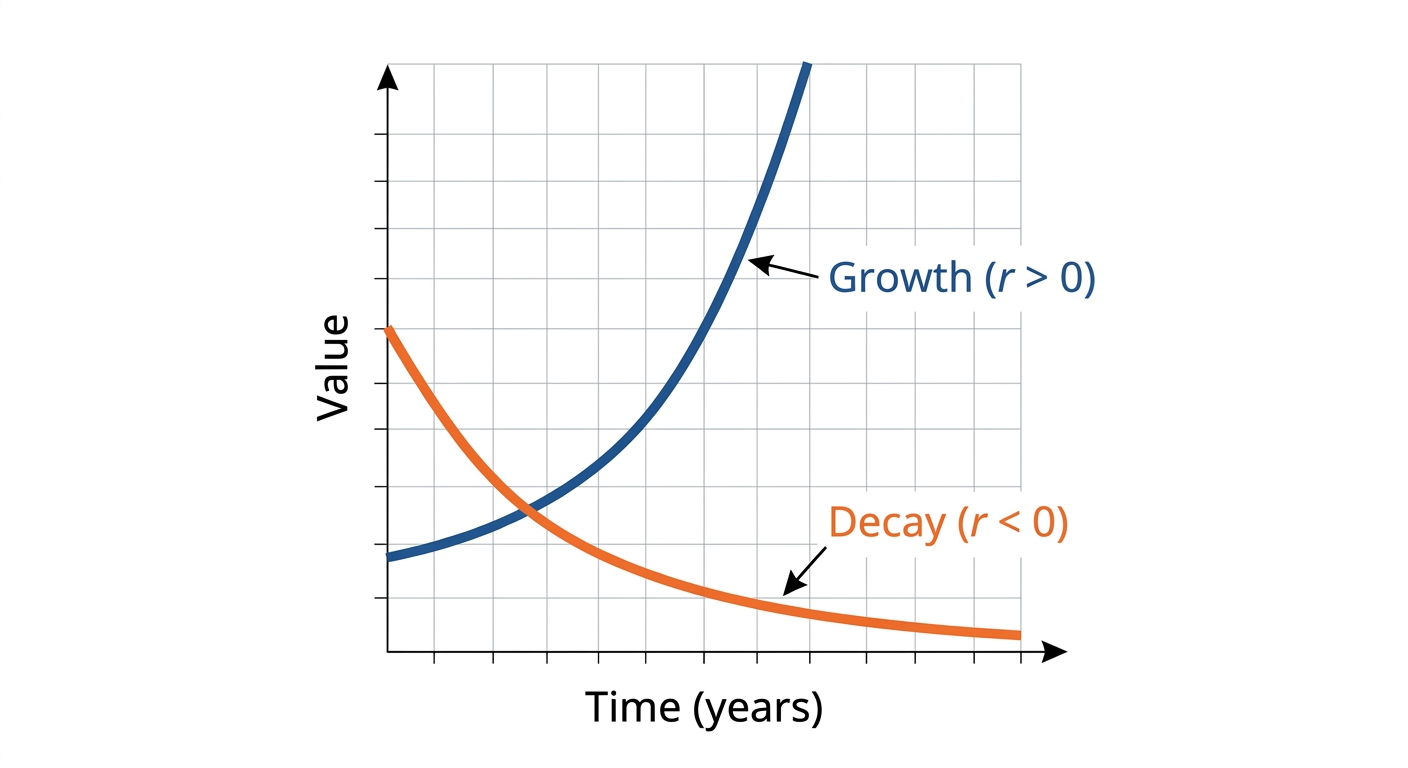
Two traps examiners love to catch you on:
1. Don't write as . It's . That's free marks lost. 😭
2. Check the period — is it per year, per month, per hour? Mix those up and the whole answer goes sideways. 🎯
Worked example
Worked Example: Bacteria Population and Car Depreciation
(a) A bacteria colony starts with 500 cells and levels up by every hour. How many cells after hours? (b) Your cousin buys a car for that depreciates (losing value 😢) at per year. What's it worth after years? Both answers to the nearest whole number.
- 1For (a), grab the ingredients: , rate , periods . Multiplier per hour is .
- 2Type it into the calculator in one go — don't round mid-way, that's how you lose marks.
- 3Round to the nearest whole cell because you can't have half a bacterium.
- 4For (b), decay mode: , , . Multiplier is . (Resist the urge to use !)
- 5Evaluate and round to the nearest dollar. That car lost in four years. Brutal. 💸
Answer
12. Using a Calculator Effectively
Your scientific calculator in Paper
4 can save you serious time, but only if you use it properly. The one rule that beats all others: never round mid-calculation. Rounding early is the #1 way students lose marks on otherwise-correct working. Keep the messy decimal and only round at the very end. 🎯
Stuff you gotta know:
• Brackets are your best friend. For type it as `(a+b)/(c-d)`. Without brackets the calculator goes full rogue and does . Same energy as when autocorrect ruins your texts.
• Use `Ans` and memory. `Ans` plugs your last answer straight into the next calculation. `STO M` saves a messy decimal and `RCL M` pulls it back — way safer than scribbling it down and retyping (where typos live).
• Time on a calculator. The degree button (often `°’”`) lets you punch in h min as . Or just type (because 30 min is half an hour). Don't type — that's hours min. Total scam energy.
• Money display. If the screen shows in a money answer, that's — always round money to 2 d.p. No exceptions.
• Powers and roots. Use `^` for any power and the shifted root key for cube roots etc. For , type `5^(-2)` with brackets around the negative.
Reading the display: `1.234E-3` or `1.234×10⁻³` is just standard form — don't panic, and don't copy the `E` into your written answer. Write it as . That's the maths way. ✍️
Worked example
Worked Example: Calculator Use with Fractions, Time, and Brackets
Using a calculator, work out (a) , (b) the number of minutes in hours, and (c) to significant figures.
- 1For (a), bracket both top and bottom so the calculator knows what to do. Watch the difference when you forget brackets — it's chaos.
- 2For (b), hours = h plus of an hour. The part is min. Total in minutes is just the original .
- 3For (c), handle the fraction under the root first. Bracket it so the root applies to the whole thing: `√((24^2+10^2)/13)`.
- 4Now take the square root and round to 3 sig fig. Don't round before — that 7.2111... is your working value. 🎯
Answer
13. Ordering Numbers and Inequality Symbols
Ordering means lining up quantities smallest-to-biggest (or the other way). You also need to be fluent in the comparison symbols — they're basically the DMs of maths.
• equal
• not equal
• strictly greater than
• strictly less than
• greater than or equal to
• less than or equal to
The pointy end of and always bites the smaller number. Like a hungry alligator. 🐊
• equal
• not equal
• strictly greater than
• strictly less than
• greater than or equal to
• less than or equal to
The pointy end of and always bites the smaller number. Like a hungry alligator. 🐊
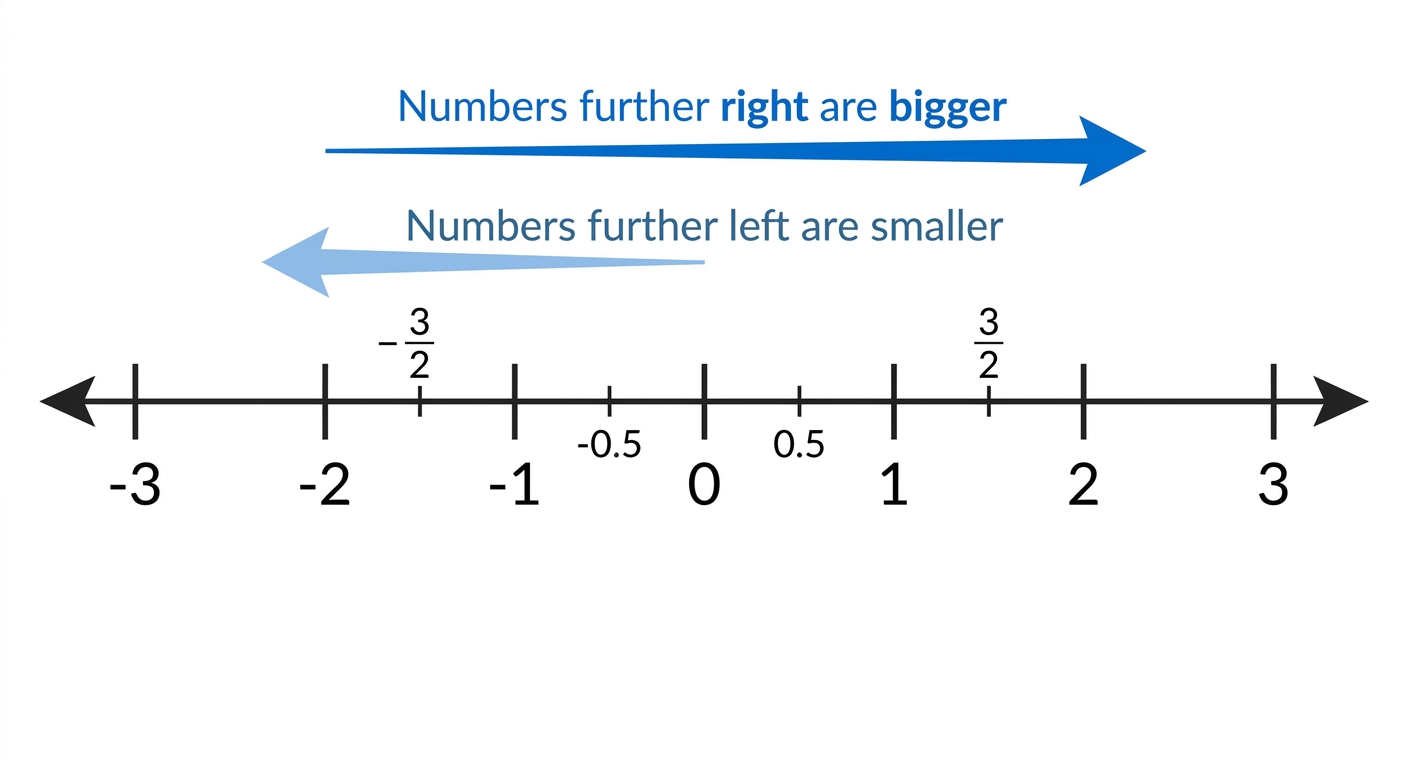
Trap 1 — negatives. is less than because it's further left on the number line. Size of digit ≠ size of number. Think temperature: is way colder than . ❄️
Trap 2 — mixed forms. If the question throws fractions, decimals and percentages at you, convert them all to the same form first — decimals are usually easiest. Example: order , , .
, ,
Ascending: . Easy once they're in one language. 💯
Worked example
Worked Example: Ordering Mixed Numbers, Fractions, Decimals and Percentages
Arrange these in ascending order (smallest first): , , , .
- 1Convert everything to decimals (4 d.p. gives enough precision). Same language = easy comparison.
- 2Line them up on a mental number line from smallest to biggest. Note (same number, different clothes).
- 3Write the final ordering using the original forms — that's what the question asked for.
Answer
14. The Four Operations with Negatives, Fractions and Decimals
By now you can +, −, × and ÷ whole numbers in your sleep. Extended just asks you to do the same with negatives, fractions, and decimals — same BODMAS rules, more number types. No cap, most errors here come from rushing.
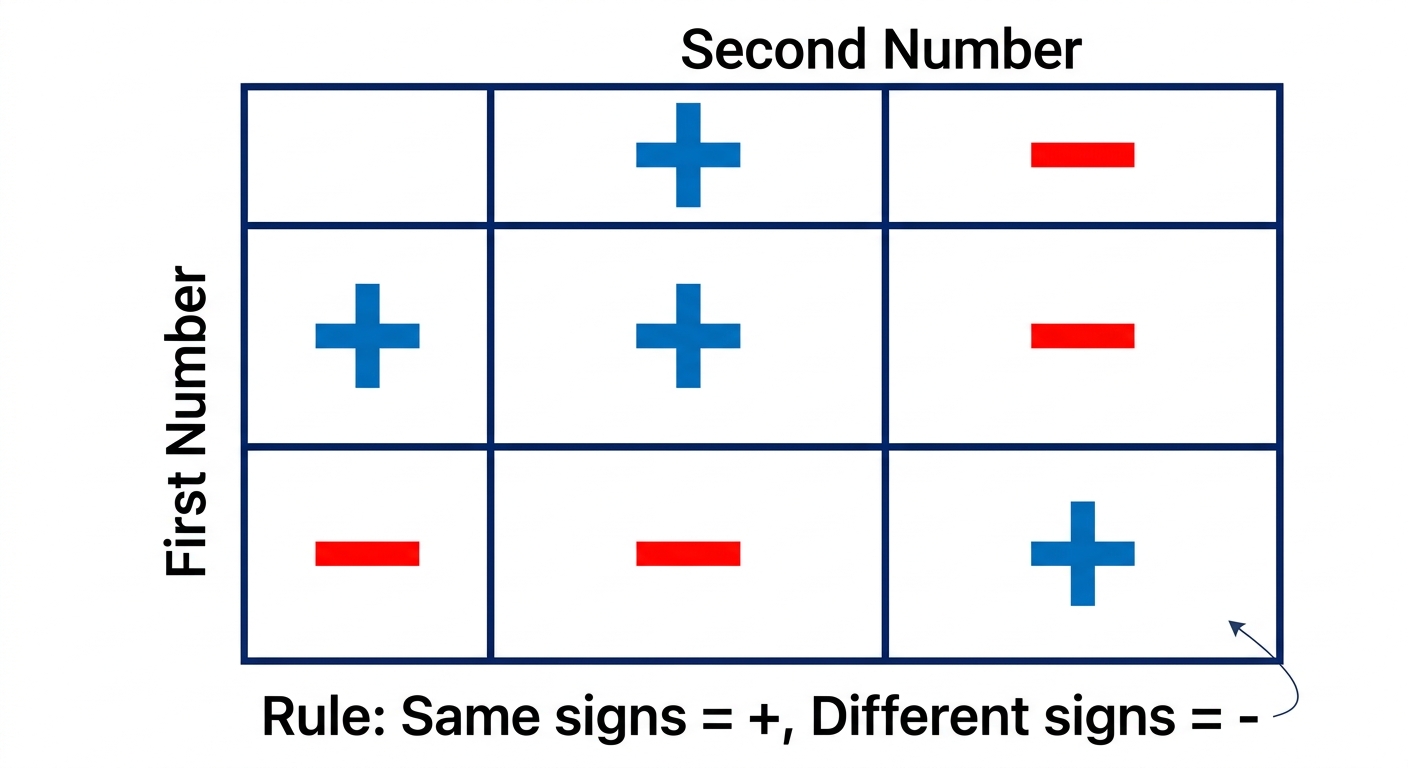
• same signs → positive: ,
• different signs → negative: ,
• Subtracting a negative flips to adding: . (Two negatives cancel out — same energy as a double cross-out.)
• To or → common denominator first (no shortcuts).
• To → numerators times, denominators times, simplify.
• To → keep, flip, change: .
• For mixed numbers like , convert to improper () before multiplying or dividing. Trust. 🔥
• and → line up the decimal points.
• → count the total decimal places in both numbers, answer has the same total. (one d.p. + two d.p. = three d.p.).
• → shift both decimals the same way until the divisor is a whole number, then just divide normally.
Sign rules (× and ÷):
• same signs → positive: ,
• different signs → negative: ,
• Subtracting a negative flips to adding: . (Two negatives cancel out — same energy as a double cross-out.)
Fractions:
• To or → common denominator first (no shortcuts).
• To → numerators times, denominators times, simplify.
• To → keep, flip, change: .
• For mixed numbers like , convert to improper () before multiplying or dividing. Trust. 🔥
Decimals:
• and → line up the decimal points.
• → count the total decimal places in both numbers, answer has the same total. (one d.p. + two d.p. = three d.p.).
• → shift both decimals the same way until the divisor is a whole number, then just divide normally.
Worked example
Worked Example: Four Operations with Mixed Numbers, Decimals and Negatives
Without a calculator, evaluate (a) , (b) , (c) .
- 1For (a), convert both mixed numbers to improper fractions first. This is not optional.
- 2Keep-flip-change: division becomes multiplication by the reciprocal. Then simplify.
- 3For (b), BODMAS says multiplication before subtraction. . Then .
- 4For (c), has 1 d.p. and has 2 d.p., so the answer has 3 d.p. Multiply the digits: . Then place the decimal.
Answer
15. Calculations with Time
Time is not decimal. Minutes and seconds run in base , hours in base . That mismatch is exactly where most errors happen. Respect the system.
Key conversions to just know: sec min, min h, h day, days week. Use days year (leap years ignored unless the question says otherwise).
• a.m. = in 24-hour
• p.m. =
• Midnight = , noon =
Decimal-to-time trap. hours = h min (because half an hour is 30 min). But h min is h, not h. If you treat 15 min as 0.15 h, you're cooked. 🔥
Subtracting times — borrow in base 60. To do , you can't do . So rewrite as (borrow 1 hour = 60 min). Then . Done.
Key conversions to just know: sec min, min h, h day, days week. Use days year (leap years ignored unless the question says otherwise).
12-hour vs 24-hour clock:
• a.m. = in 24-hour
• p.m. =
• Midnight = , noon =
Decimal-to-time trap. hours = h min (because half an hour is 30 min). But h min is h, not h. If you treat 15 min as 0.15 h, you're cooked. 🔥
Subtracting times — borrow in base 60. To do , you can't do . So rewrite as (borrow 1 hour = 60 min). Then . Done.
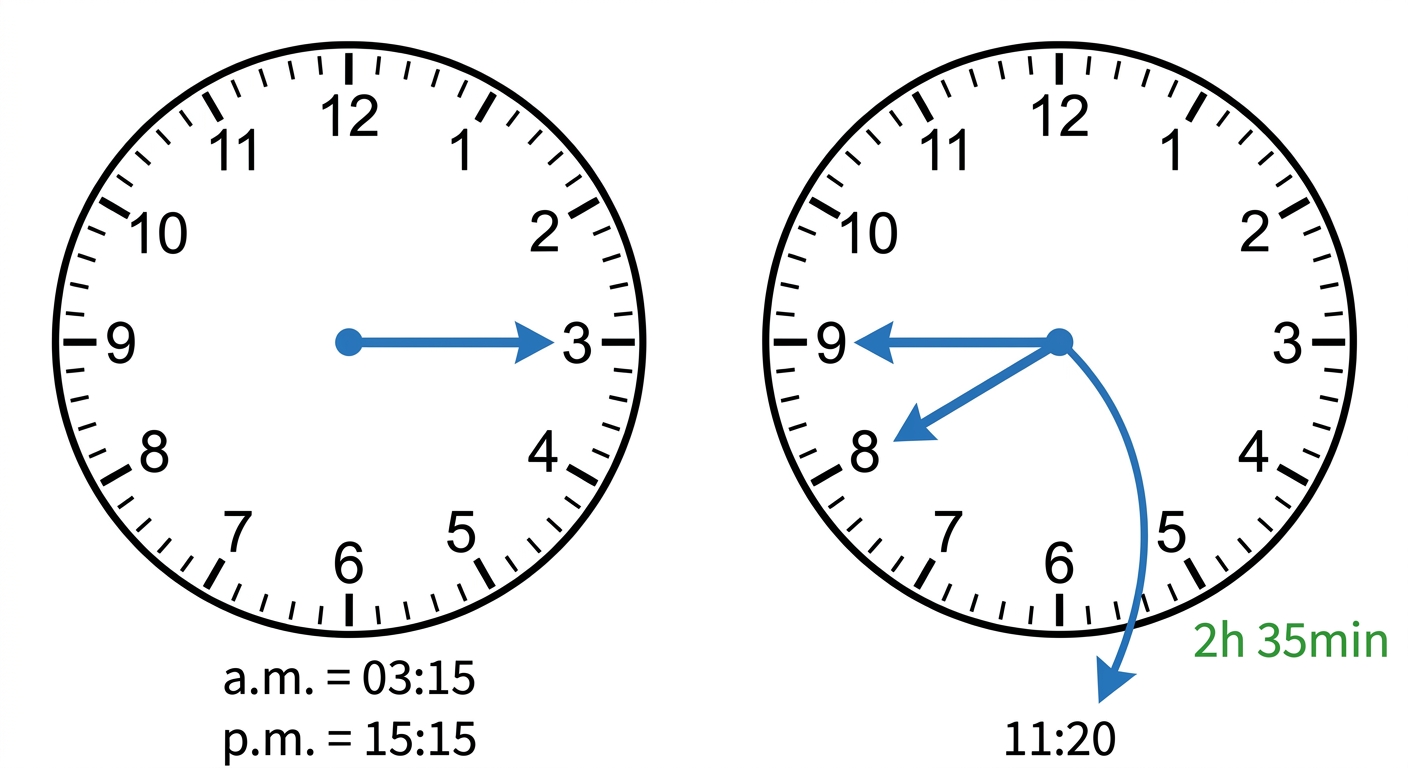
Time zones: if a city is h ahead, add h to your local time to get theirs; if behind, subtract. Late-night gaming with international friends has taught you this already. 🎮
Worked example
Worked Example: Time Calculations Across Timetable and Time Zones
A flight leaves London (GMT) at on Monday. Flight time is h min. Cairo is hours of GMT. What's the local time and day when the plane lands in Cairo? ✈️
- 1Add the flight time to the GMT departure.
- 2is past midnight. Subtract (one full day) and roll the day forward.
- 3Cairo is h, so add hours for local time. That's the answer the question wants.
Answer
16. Money and Currency Conversion
Money answers come with two non-negotiable rules:
1. Always 2 decimal places — , never . That's just how money is written. Think of it like capitalising the first letter of a sentence.
2. Exchange rates are ratios. If , one dollar buys euros. That's the only sentence you need to remember.
• : multiply by (each dollar makes euros).
• $\text{€} → \$: divide by (because you're undoing the multiplication).
Sanity check: after converting, if the new currency's unit is worth less, your number should be bigger. If it's worth more, your number should be smaller. If that's not happening, you've probably ×/÷ the wrong way. 🔄
1. Always 2 decimal places — , never . That's just how money is written. Think of it like capitalising the first letter of a sentence.
2. Exchange rates are ratios. If , one dollar buys euros. That's the only sentence you need to remember.
Converting:
• : multiply by (each dollar makes euros).
• $\text{€} → \$: divide by (because you're undoing the multiplication).
Sanity check: after converting, if the new currency's unit is worth less, your number should be bigger. If it's worth more, your number should be smaller. If that's not happening, you've probably ×/÷ the wrong way. 🔄
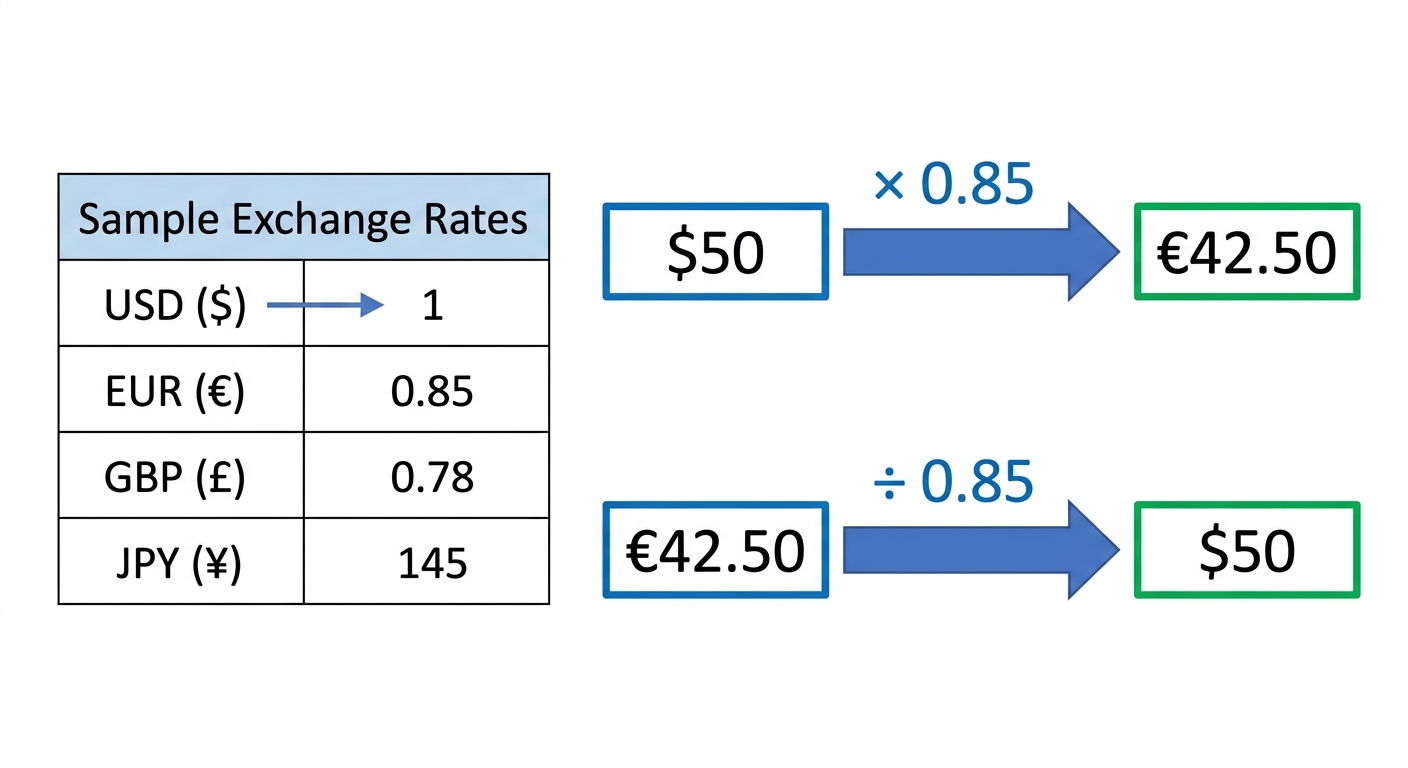
Commission / fees: sometimes a question sneaks in a percentage commission on the exchange. Usually you apply it after converting (unless the question clearly says otherwise). Read carefully. 🧐
Worked example
Worked Example: Currency Conversion with Rounding
Exchange rate: . (a) Convert to euros for your holiday. (b) Convert € back to dollars, to the nearest cent.
- 1For (a), dollars → euros: multiply by the rate.
- 2For (b), euros → dollars: divide by the rate.
- 3Round to 2 d.p. (the nearest cent) and slap on the dollar sign. Money presented like a pro. 💸
Answer
Practice this in the app
Unlock the full chapter: practice questions, flashcards, mock papers and notes, free.
Continue revising