Mensuration: Area, Surface Area, and Volume
Shape Shifters: Mastering Area & Volume 📐
Introduction
1. Introduction
Ever wondered how game developers calculate the size of a map, or how much paint you'd actually need to redecorate your room? That's all mensuration! It’s the maths of measurement, and it's way more useful than you think. In this chapter, we're going to start with the basics: finding the perimeter and area of 2D shapes – think figuring out the perfect dimensions for your next Instagram post. Then, we'll level up to 3D solids, calculating their surface area and volume, so you'll know exactly how much wrapping paper you need for a gift or how much soda is in your can. Finally, we'll tackle the boss level: compound shapes. We'll learn how to break down complex objects, like a swimming pool or a custom-built speaker, into simple parts to find their measurements. Let's get this sorted.
2. Perimeter and Area of 2D Polygons
Alright, let's break down perimeter and area. Think of it like this: perimeter is the total distance you'd walk around the edge of a shape. It's like the border on a Snapchat filter or the length of fencing you'd need for a festival. For any polygon, you just add up the lengths of all the outside edges. Simple as that.
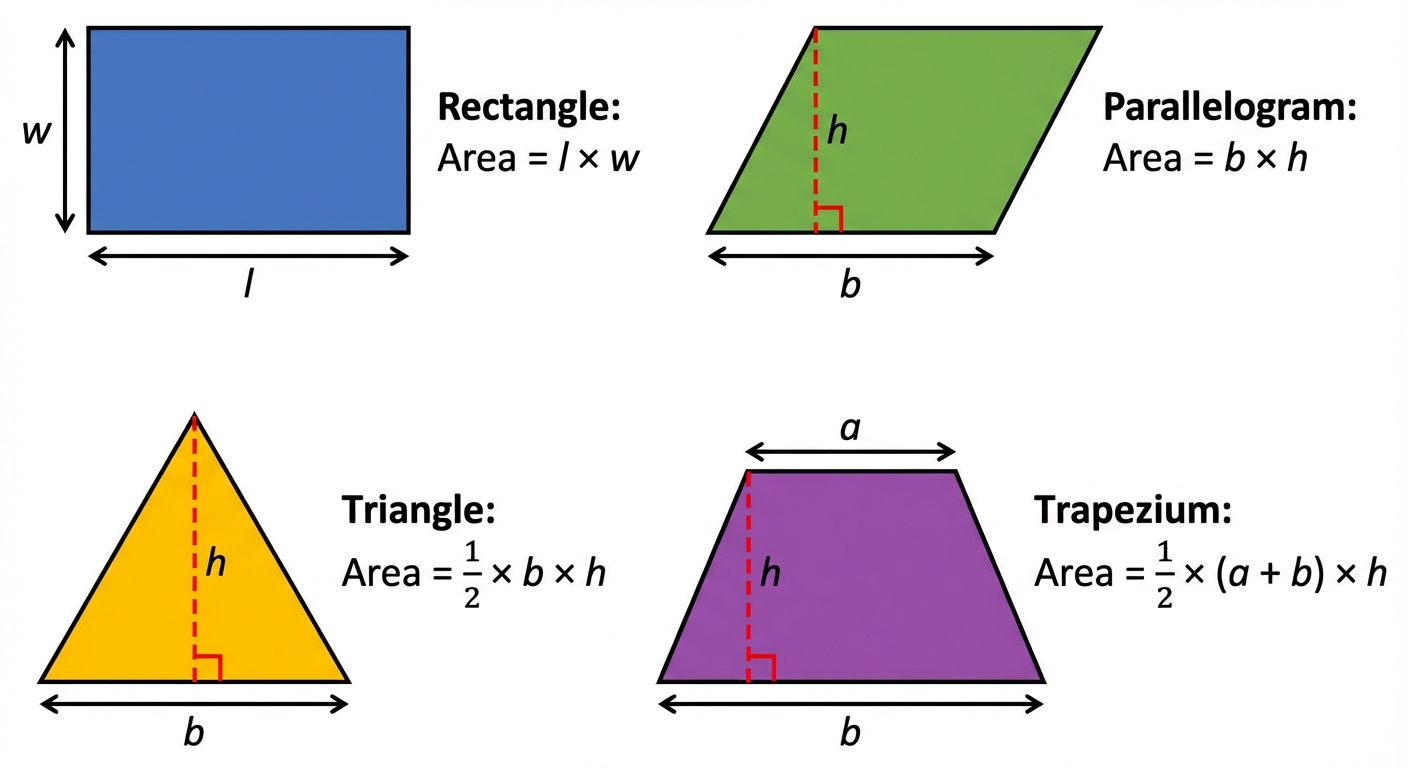
Area is the space inside the shape – the amount of turf on a football pitch in a game, or the screen space your favourite TikTok takes up. This is where the formulas come in, and you've gotta know them. The exam only gives you the triangle formula, so the rest are on you to memorize! Let's run through them:
• Rectangle: The OG. Area is just length times width, .
• Parallelogram: This is basically a tilted rectangle. The key is to not use the slanted side length for the area! You need the base and the perpendicular height (the straight-up height). So, the formula is .
• Triangle: You're given in the exam, which is a lifesaver. It's literally half a rectangle or parallelogram. Again, 'h' is the perpendicular height, not the slanted side.
• Trapezium: This one looks a bit extra, but it's cool. It has one pair of parallel sides. To find its area, you average the two parallel sides (let's call them 'a' and 'b') and multiply by the height: .
Area is the space inside the shape – the amount of turf on a football pitch in a game, or the screen space your favourite TikTok takes up. This is where the formulas come in, and you've gotta know them. The exam only gives you the triangle formula, so the rest are on you to memorize! Let's run through them:
• Rectangle: The OG. Area is just length times width, .
• Parallelogram: This is basically a tilted rectangle. The key is to not use the slanted side length for the area! You need the base and the perpendicular height (the straight-up height). So, the formula is .
• Triangle: You're given in the exam, which is a lifesaver. It's literally half a rectangle or parallelogram. Again, 'h' is the perpendicular height, not the slanted side.
• Trapezium: This one looks a bit extra, but it's cool. It has one pair of parallel sides. To find its area, you average the two parallel sides (let's call them 'a' and 'b') and multiply by the height: .
Worked example
Worked Example: Area and Perimeter of a Compound Shape
The Weird Backyard Problem 🏡
Your part-time job is landscaping. A client has a backyard shaped like the diagram below, which consists of a rectangle and a trapezium. The rectangular part is 10m by 6m. The trapezium part shares the 6m side with the rectangle, has a top parallel side of 4m, and a perpendicular height of 5m. The two slanted sides of the trapezium are both 5.5m. Calculate: a) The total area of the backyard to lay down new grass. b) The perimeter of the backyard to build a new fence.
- 1First, let's break this down. The total area is the area of the rectangle plus the area of the trapezium. We'll calculate them separately and then add them up.
- 2Calculate the area of the rectangular section. The formula is length times width.
- 3Now, let's get the area of the trapezium. The parallel sides ('a' and 'b') are 6m and 4m, and the height ('h') is 5m. We'll plug these into the formula.
- 4For the total area, we just add our two results together. This tells us how much grass to buy.
- 5Time for the perimeter. This is for the fence, so we only add the outside edges. We walk around the entire shape. Be careful not to include the 6m side that's inside the yard, connecting the two shapes!
Answer
3. Surface Area and Volume of 3D Solids
Alright, let's dive into the world of 3D shapes! Think of it this way: Volume is how much stuff you can fit inside something, like how much drink your water bottle holds or the data capacity on your gaming console. Surface Area is the total area of the outside skin, like the amount of wrapping paper you'd need for a gift. The IGCSE exam gives you a bunch of formulas, which is awesome, but the real skill is knowing which one to use and when. Let's break it down.
First up, prisms. A prism is any shape that has the same cross-section all the way through. Imagine a Toblerone bar – every slice is a triangle. That's a triangular prism. A cylinder, like a can of Pringles, is just a circular prism. The volume is super intuitive: just find the area of the face (the cross-section) and multiply it by the length or height. So, . For its surface area, you just add up the area of every single face.
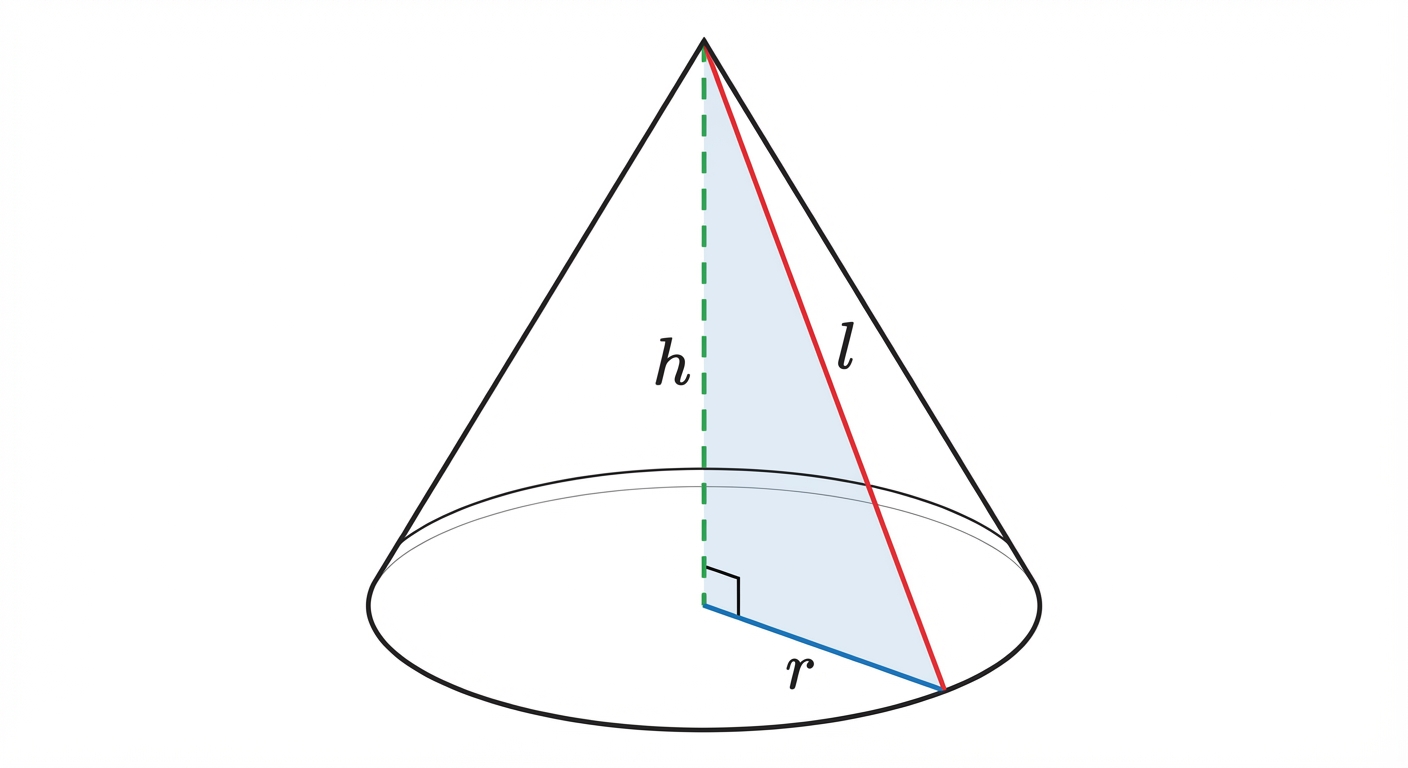
Now for the pointy crew: pyramids and cones. Think Egyptian pyramids or an ice cream cone. Their volume is exactly one-third of the prism or cylinder that would fit around them. So, the volume is always . For the surface area of a cone, you'll need the area of the circular base () plus the curved part, which has the formula . That '' is the slant height – the distance from the tip down the side, not the perpendicular height.
First up, prisms. A prism is any shape that has the same cross-section all the way through. Imagine a Toblerone bar – every slice is a triangle. That's a triangular prism. A cylinder, like a can of Pringles, is just a circular prism. The volume is super intuitive: just find the area of the face (the cross-section) and multiply it by the length or height. So, . For its surface area, you just add up the area of every single face.
Now for the pointy crew: pyramids and cones. Think Egyptian pyramids or an ice cream cone. Their volume is exactly one-third of the prism or cylinder that would fit around them. So, the volume is always . For the surface area of a cone, you'll need the area of the circular base () plus the curved part, which has the formula . That '' is the slant height – the distance from the tip down the side, not the perpendicular height.
Finally, the sphere – like a football or a planet. It's perfectly symmetrical. Its formulas are a bit different and you just have to know them: Surface Area is and Volume is . A classic exam question might ask you to leave your answer 'in terms of ', which just means don't hit the button on your calculator – treat it like a variable. Easy peasy! So, whether you're calculating the paint needed for a room or the amount of soda in a can, you've got the tools. Let's go! 💪
Worked example
Worked Example: Volume and Surface Area of a Composite Solid
The Grain Silo Challenge 🚜
A grain silo is formed by a cylinder with a cone on top. The cylinder has a radius of m and a height of m. The cone has the same radius and a slant height of m.
(a) Calculate the total volume of the silo.
(b) Calculate the external surface area to be painted (including the base).
Give both answers correct to 3 significant figures.
(a) Calculate the total volume of the silo.
(b) Calculate the external surface area to be painted (including the base).
Give both answers correct to 3 significant figures.
- 1First, we need the cone's perpendicular height () for its volume formula. We have the slant height () and radius (), which form a right-angled triangle. Time for Pythagoras!
- 2Now we can find the volumes of the two parts separately. We'll use for the cylinder and for the cone.
- 3For the total volume, we just add them together. Simple as that.
- 4For the surface area, think about what you would actually paint. You'd paint the circular floor, the curved wall of the cylinder, and the curved roof of the cone. You wouldn't paint the circle where they join because it's inside.
- 5Let's calculate those three areas using the formulas: Area of circle (), Curved surface area of cylinder (), and Curved surface area of cone ().
- 6Finally, add them all up to get the total area to be painted and round to 3 significant figures. Job done!
Answer
4. Perimeter, Area, Surface Area, and Volume of Compound Shapes
Alright, let's talk about compound shapes. Think of them like a playlist mashup or a custom character build in a game. You're not dealing with one basic shape anymore; you're combining several simple ones (rectangles, circles, cylinders, cones) to create something more complex and interesting. The key to absolutely crushing these problems is to see the simple shapes hiding inside the complex one. It's like finding the secret level—once you see it, you can't unsee it.
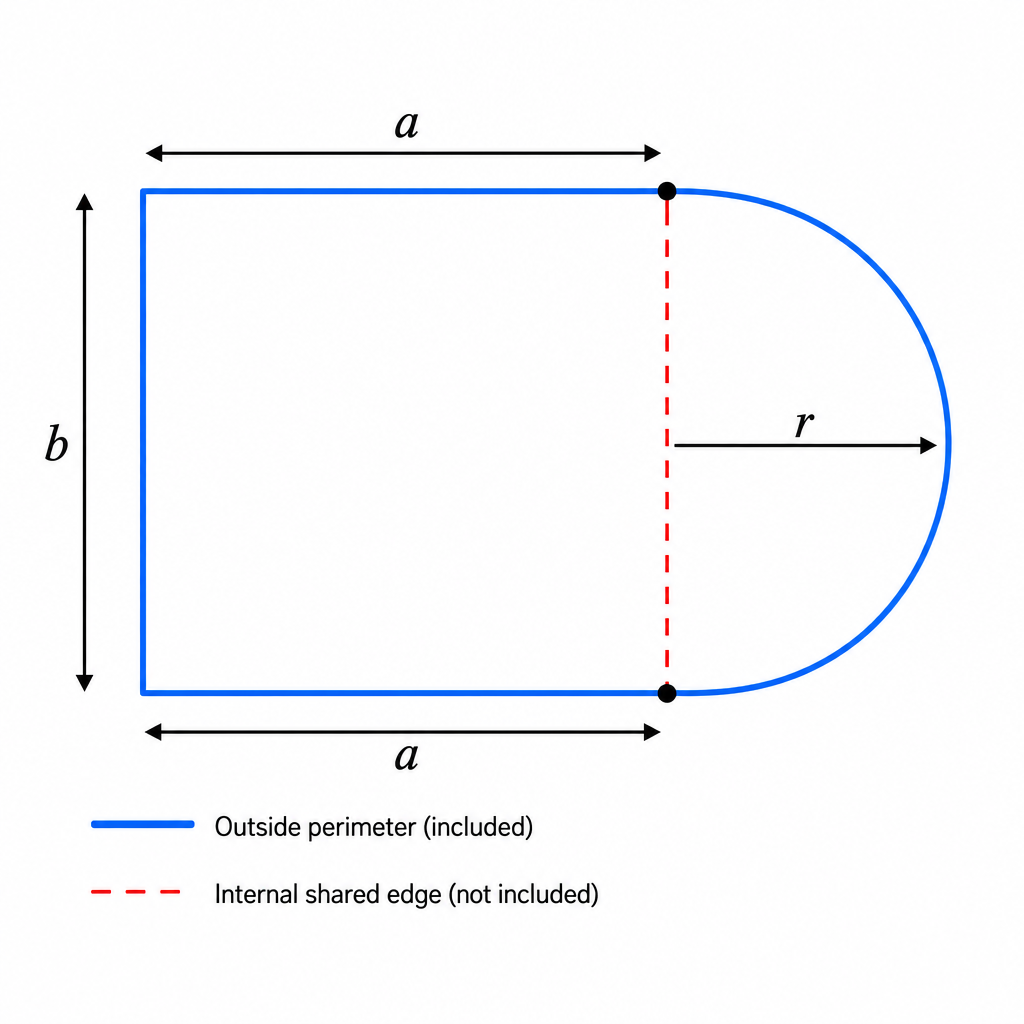
For 2D compound shapes, we have two missions: find the perimeter and the area. For perimeter, imagine you're walking around the absolute edge of the shape. Don't fall into the trap of adding up all the individual perimeters! If you join a rectangle and a semi-circle to make an ice-rink shape, the shared edge disappears from the perimeter calculation. You're only walking on the outside track.
For 2D compound shapes, we have two missions: find the perimeter and the area. For perimeter, imagine you're walking around the absolute edge of the shape. Don't fall into the trap of adding up all the individual perimeters! If you join a rectangle and a semi-circle to make an ice-rink shape, the shared edge disappears from the perimeter calculation. You're only walking on the outside track.
For area, it's usually much simpler: you just calculate the area of each component shape and add them together. Sometimes, you might have to subtract, like finding the area of a donut by calculating the area of the big circle and subtracting the area of the hole.
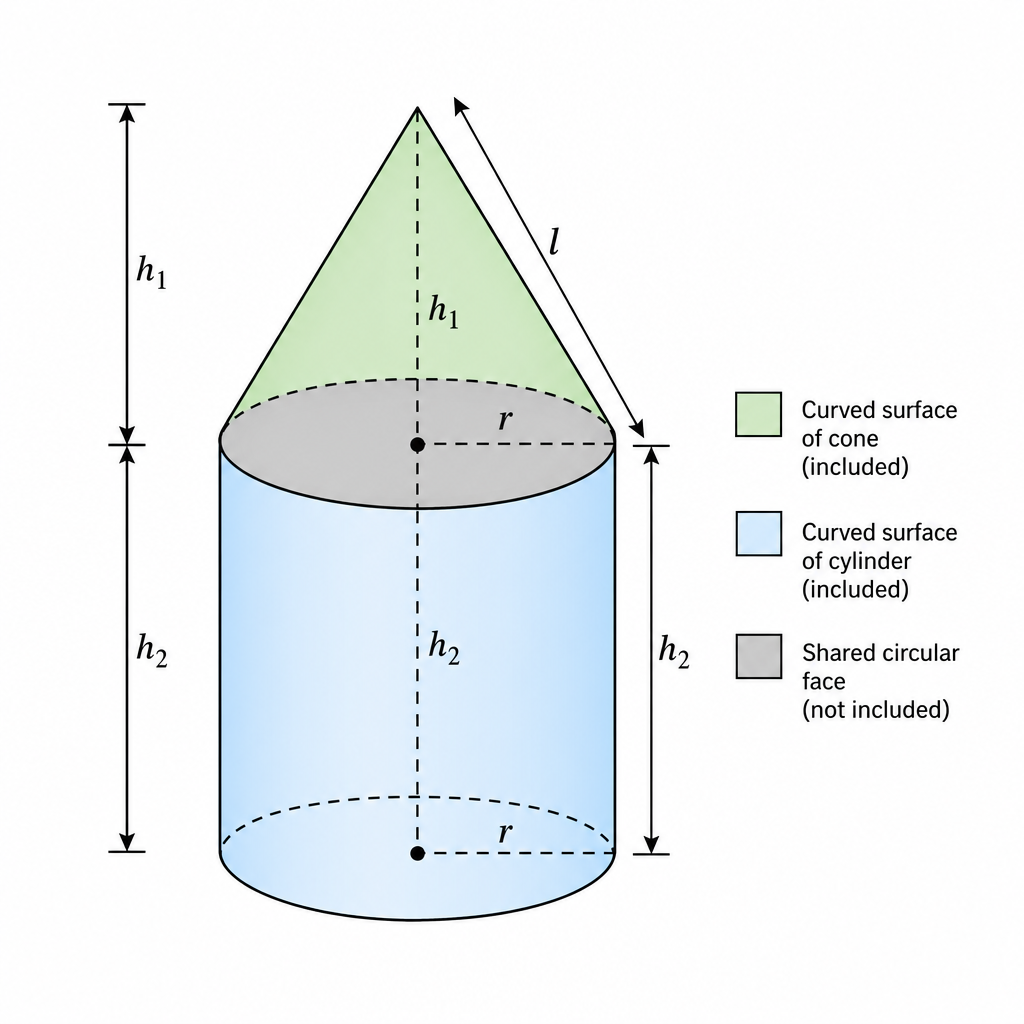
Now, let's go 3D. When we're calculating the volume of a compound solid (like a silo made from a cylinder and a hemisphere), it's just like the 2D area—you find the volume of the cylinder, the volume of the hemisphere, and add them up. Easy. But surface area is where you have to be slick. Just like with perimeter, the surfaces that are stuck together don't count. If you put a cone on top of a cylinder, the circular base where they join is now internal, not on the surface. So, you'd calculate the curved area of the cone and the curved area of the cylinder, plus the area of the bottom circular base.
Now, let's go 3D. When we're calculating the volume of a compound solid (like a silo made from a cylinder and a hemisphere), it's just like the 2D area—you find the volume of the cylinder, the volume of the hemisphere, and add them up. Easy. But surface area is where you have to be slick. Just like with perimeter, the surfaces that are stuck together don't count. If you put a cone on top of a cylinder, the circular base where they join is now internal, not on the surface. So, you'd calculate the curved area of the cone and the curved area of the cylinder, plus the area of the bottom circular base.
Finally, let's meet the 'final boss' of this topic: the frustum. A frustum is basically a cone that's had its pointy top chopped off, leaving you with something that looks like a bucket or a lampshade. To solve these, think 'big cone minus small cone'. You'll calculate the volume (or surface area) of the original, complete cone and then subtract the volume (or surface area) of the little cone you chopped off. The trick is often finding the dimensions of that little cone, which usually involves a bit of similar triangles magic. It's a classic exam question, so mastering this makes you look like a total pro. And remember, sometimes they'll ask you to leave your answer in terms of , which is great because it means less calculator work! 😉
Worked example
Worked Example: Volume and Surface Area of a Compound Solid
The Ultimate Ice Cream Cone Challenge 🍦
A waffle cone has a height of cm and a radius of cm. It is topped with a perfect hemisphere of ice cream with the same radius. Calculate:
a) The total volume of the cone and ice cream.
b) The total external surface area of the treat.
Give your answers in terms of .
a) The total volume of the cone and ice cream.
b) The total external surface area of the treat.
Give your answers in terms of .
- 1First, let's break this down. We have two shapes: a cone and a hemisphere. For part (a), the total volume is simply the volume of the cone plus the volume of the hemisphere. Let's start with the cone's volume.
- 2Next, we find the volume of the hemisphere. The formula for a full sphere is , so we just need half of that.
- 3Now we add them together for the total volume. We can leave it as a fraction or convert to a mixed number, but a single fraction is usually tidier.
- 4For part (b), the surface area, we need the external surfaces. This means the curved surface area of the cone (the waffle part) and the surface area of the hemisphere (the ice cream). The circular part where they meet is covered! To find the cone's curved area (), we first need the slant height, , using Pythagoras' theorem.
- 5Now we can calculate the curved surface areas of both parts. The hemisphere's surface area is half of a full sphere's ().
- 6Finally, add the two surface areas together for the grand total. This is the total area you'd have to lick to eat all the ice cream off the outside. Done!
Answer
5. Units of Measure and Conversions
Get units right or drop marks on otherwise-perfect work. It hurts. The two golden rules:
Length (1D): mm cm, cm m, m km. Straight-up memorise these.
Area (2D): square the linear conversion. This is where students get cooked. 🔥
Volume (3D): cube the linear conversion. The trap gets deeper.
Volume ↔ Capacity: the one you will get tested on:
, , so . 💧
Mass: g kg, kg tonne.
Length (1D): mm cm, cm m, m km. Straight-up memorise these.
Area (2D): square the linear conversion. This is where students get cooked. 🔥
Volume (3D): cube the linear conversion. The trap gets deeper.
Volume ↔ Capacity: the one you will get tested on:
, , so . 💧
Mass: g kg, kg tonne.
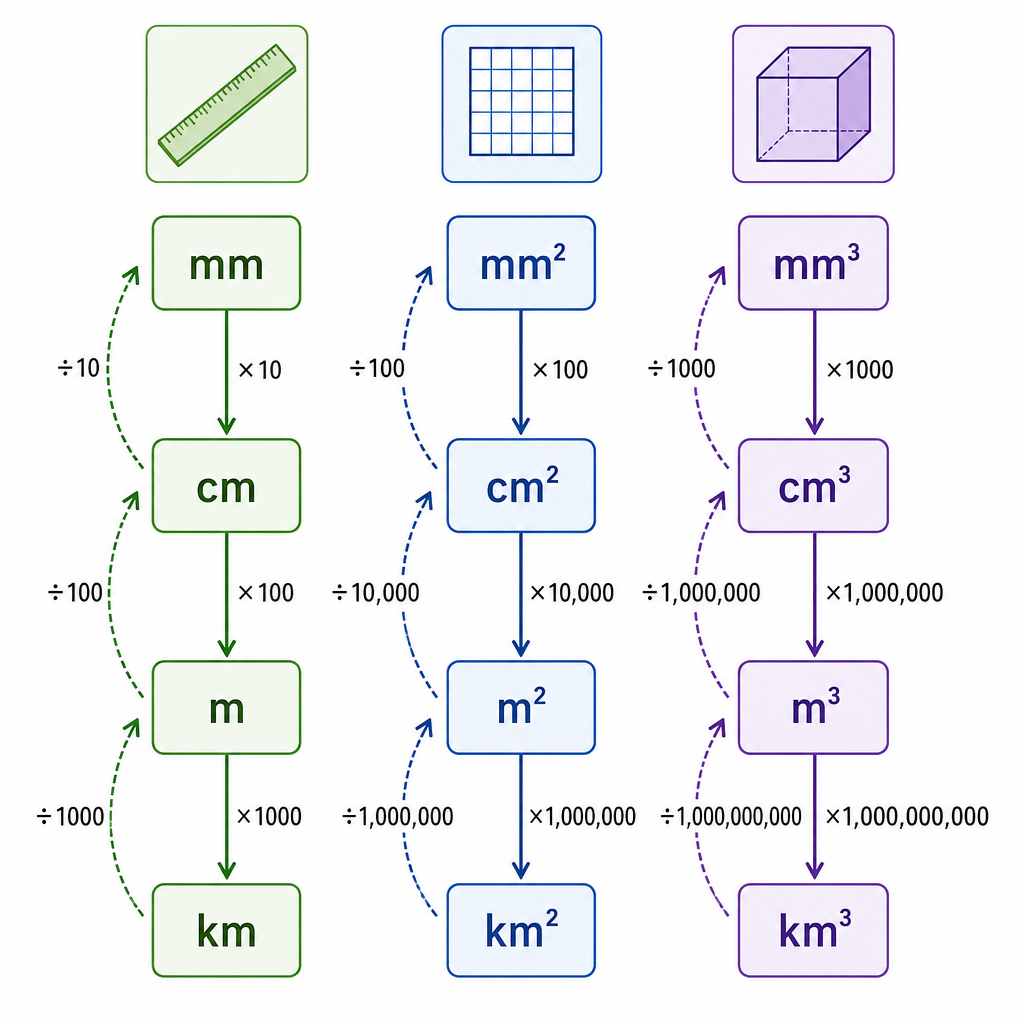
The trap to actually lose sleep over: students convert the length factor and forget to square/cube it for areas/volumes. is , not . Don't be that person. 😤
Worked example
Worked Example: Converting Areas, Volumes and Capacity
(a) A rectangular field has area km. What is this in m? (b) A fish tank holds litres of water. What's that in cm and in m? 🐟 (c) Convert mm into cm.
- 1For (a), km m, so square it: km m. Now multiply.
- 2For (b), litre cm.
- 3For m: m cm, so divide.
- 4For (c), cm mm, cubed is . So divide mm by to get cm.
Answer
Worked example
Worked Example: Arc Length of a Sector
A circular pizza of radius cm is cut into slices. One slice has a centre angle of . 🍕 Find the length of the curved edge (arc) of this slice, in terms of .
- 1Lock in the formula. Arc length is just a fraction of the full circumference, where the fraction is .
- 2Sub in and .
- 3Simplify the fraction first (), then multiply. Keep in the answer because the question asked for it.
Answer
Worked example
Worked Example: Sector Area
A windscreen wiper sweeps through an angle of . The wiper blade has length cm and is attached to a pivot. Find the area of windscreen the blade cleans, to s.f. 🚗
- 1The wiper's path is a sector — a pizza slice of a circle with radius equal to the blade length.
- 2Sub and cm.
- 3Evaluate. Don't round until the final step.
- 4Round to 3 s.f. and add the unit.
Answer
Worked example
Worked Example: Volume of a Sphere
A scoop of ice cream is modelled as a sphere of radius cm. 🍨 Find its volume to s.f. (The formula is given on the formula sheet.)
- 1Write the formula straight from the sheet.
- 2Sub . Compute first.
- 3Evaluate without rounding mid-way.
- 4Round to 3 s.f. with units.
Answer
Worked example
Worked Example: Total Surface Area of a Cone
A traffic cone has base radius cm and slant height cm. 🚧 Find the total surface area (curved surface + circular base) to s.f. (Formula sheet: curved surface area of a cone .)
- 1Two pieces: the curved surface and the flat circular base. Add them.
- 2Sub and .
- 3Combine then evaluate to 3 s.f.
Answer
Worked example
Worked Example: Volume of a Frustum
A coffee cup is shaped like a frustum of a cone. The top opening has radius cm, the bottom has radius cm, and the height is cm. ☕ Find the volume of coffee it can hold (when full) to the nearest cm. Use the strategy: 'big cone − small cone'.
- 1A frustum is a 'cone with the tip chopped off'. Volume = volume of complete (large) cone − volume of small (cut-off tip) cone. Use similar triangles to find the missing height.
- 2Let the height of the small (tip) cone be . The two cones are similar, so (matching radius-to-height ratios).
- 3Compute each cone's volume using . Large cone: , height . Small cone: , height .
- 4Subtract and evaluate. Round at the end.
Answer
Practice this in the app
Unlock the full chapter: practice questions, flashcards, mock papers and notes, free.
Continue revising