IGCSE Mathematics 0580: Geometry
Shapes, Angles & Where to Go Next 🧭✨
Introduction
1. Introduction
Alright, let's dive into Geometry! Forget dusty old textbooks – this is the stuff that powers everything from the graphics in your favorite video games to the filters on Instagram. We're going to crack the code of shapes and space.
First, we'll master the fundamental Angle Properties – the basic rules that govern every corner and line. Then, we'll unlock the secrets of circles with Circle Theorems, which are way cooler than they sound. Ever wondered how a Snapchat filter scales perfectly to your face? That's all about Similarity, and we'll figure out how it works. We'll also go old-school and learn Constructions, Loci, and Bearings – basically, how to navigate the world like an explorer with just a compass and a ruler. Finally, we'll look at Symmetry to understand what makes designs, logos, and patterns so satisfying to look at. Ready to see the world from a whole new angle? Let's do this!
First, we'll master the fundamental Angle Properties – the basic rules that govern every corner and line. Then, we'll unlock the secrets of circles with Circle Theorems, which are way cooler than they sound. Ever wondered how a Snapchat filter scales perfectly to your face? That's all about Similarity, and we'll figure out how it works. We'll also go old-school and learn Constructions, Loci, and Bearings – basically, how to navigate the world like an explorer with just a compass and a ruler. Finally, we'll look at Symmetry to understand what makes designs, logos, and patterns so satisfying to look at. Ready to see the world from a whole new angle? Let's do this!
2. Angle Properties in Geometry
Alright, let's break down angle properties. Think of them as the cheat codes for geometry – once you know them, you can solve almost any diagram puzzle. First up, the basics. An angle at a point, like a full 360° spin in a game, always adds up to . Angles on a straight line, like doing a 180° turn on a skateboard, sum to . When two straight lines cross, they form an 'X'. The angles opposite each other, called vertically opposite angles, are always equal – like a perfect mirror image.
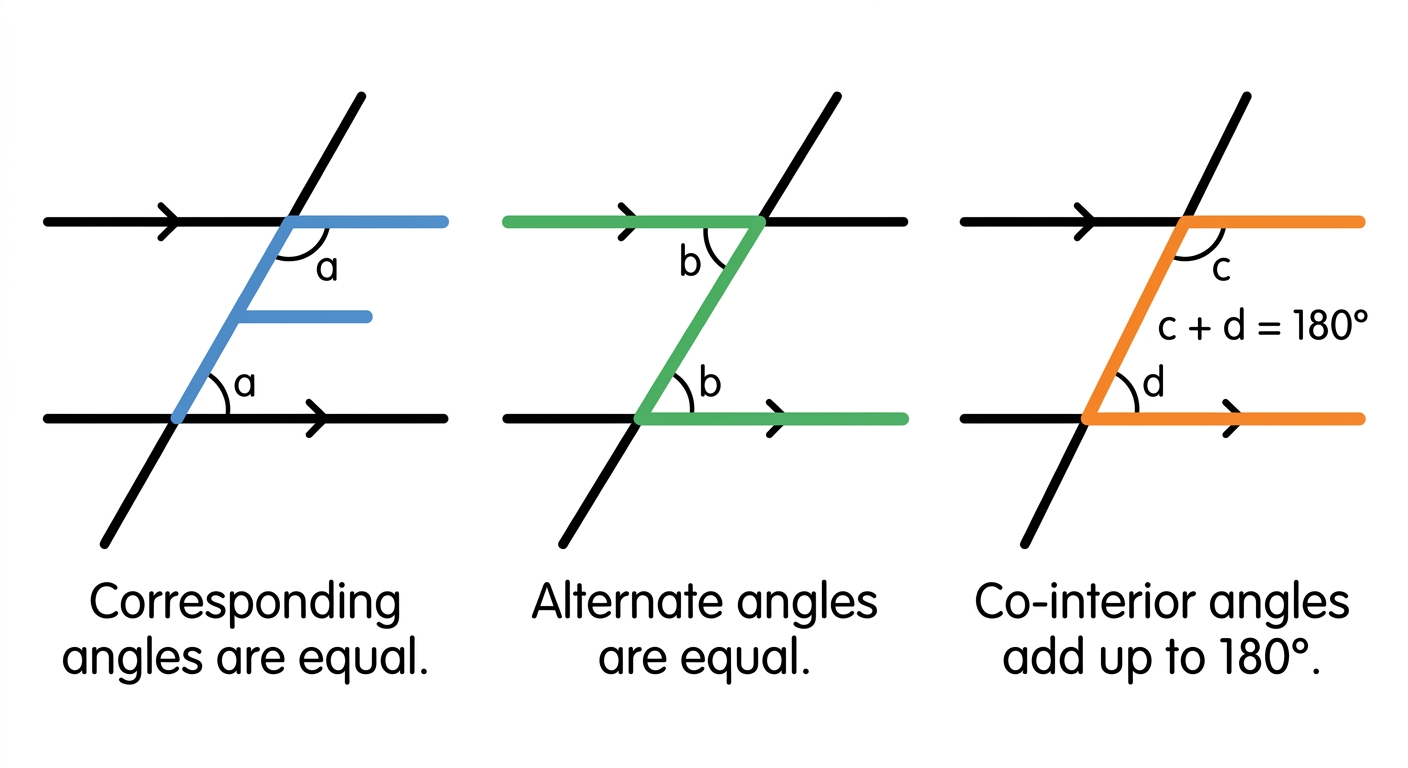
Now let's level up to parallel lines. Imagine two perfectly straight train tracks cut by another road (we call this a transversal). This creates a bunch of useful angle pairs. Alternate angles make a 'Z' shape and are always equal. Corresponding angles make an 'F' shape and are also equal. Finally, co-interior angles make a 'C' or 'U' shape and they add up to . Seriously, look for the letters F, Z, and C in diagrams – it’s a game-changer.
Now let's level up to parallel lines. Imagine two perfectly straight train tracks cut by another road (we call this a transversal). This creates a bunch of useful angle pairs. Alternate angles make a 'Z' shape and are always equal. Corresponding angles make an 'F' shape and are also equal. Finally, co-interior angles make a 'C' or 'U' shape and they add up to . Seriously, look for the letters F, Z, and C in diagrams – it’s a game-changer.
Finally, let's talk polygons – any shape with straight sides. You already know triangles add up to and quadrilaterals to . For any polygon with 'n' sides, the sum of all its interior angles is given by the formula . The exterior angles (the angle you'd turn at each corner if you were walking around the shape) are even easier: they always sum to , whether it's a triangle or a 100-sided beast. This is a super useful shortcut. Mastering these rules is like having the ultimate playlist; you just need to know which track to play for each problem. Let's get it! 💪
Worked example
Worked Example: Calculating Unknown Angles in a Composite Shape
Solving the Geometry Puzzle! 🧩
In the diagram, line AB is parallel to line CD. Line EF is a transversal that intersects the parallel lines. Point G is on the line CD. Given that and , find the value of angle ().
- 1First, find an angle of triangle HFG at point G. Since and lie on the straight line CD, they are supplementary (add up to ).
- 2Next, find the angle at H, . Since AB is parallel to CD with the transversal cutting through both lines, and are corresponding angles (an 'F' shape), so they are equal.
- 3Finally, apply the angle sum in triangle HFG. The three interior angles must add to , so we can solve for .
Answer
3. Applying Circle Theorems
Alright, let's get into circle theorems. Think of these not as boring rules, but as the ultimate cheat codes for geometry. Once you know them, you can solve complex angle puzzles that seem impossible at first. Let's break down the main players.
First up: Angle at the centre is twice the angle at the circumference. Imagine you're at a concert. The view from the centre stage () is twice as wide as the view from the back row (the circumference). So, , as long as they both come from the same arc AB. Next, Angles in the same segment are equal. This is the 'bowtie' rule. If you have a chord, any angles you make from its ends to the circumference, in the same segment, are identical. They're all watching the same show from the same section, so they have the same viewing angle.
First up: Angle at the centre is twice the angle at the circumference. Imagine you're at a concert. The view from the centre stage () is twice as wide as the view from the back row (the circumference). So, , as long as they both come from the same arc AB. Next, Angles in the same segment are equal. This is the 'bowtie' rule. If you have a chord, any angles you make from its ends to the circumference, in the same segment, are identical. They're all watching the same show from the same section, so they have the same viewing angle.
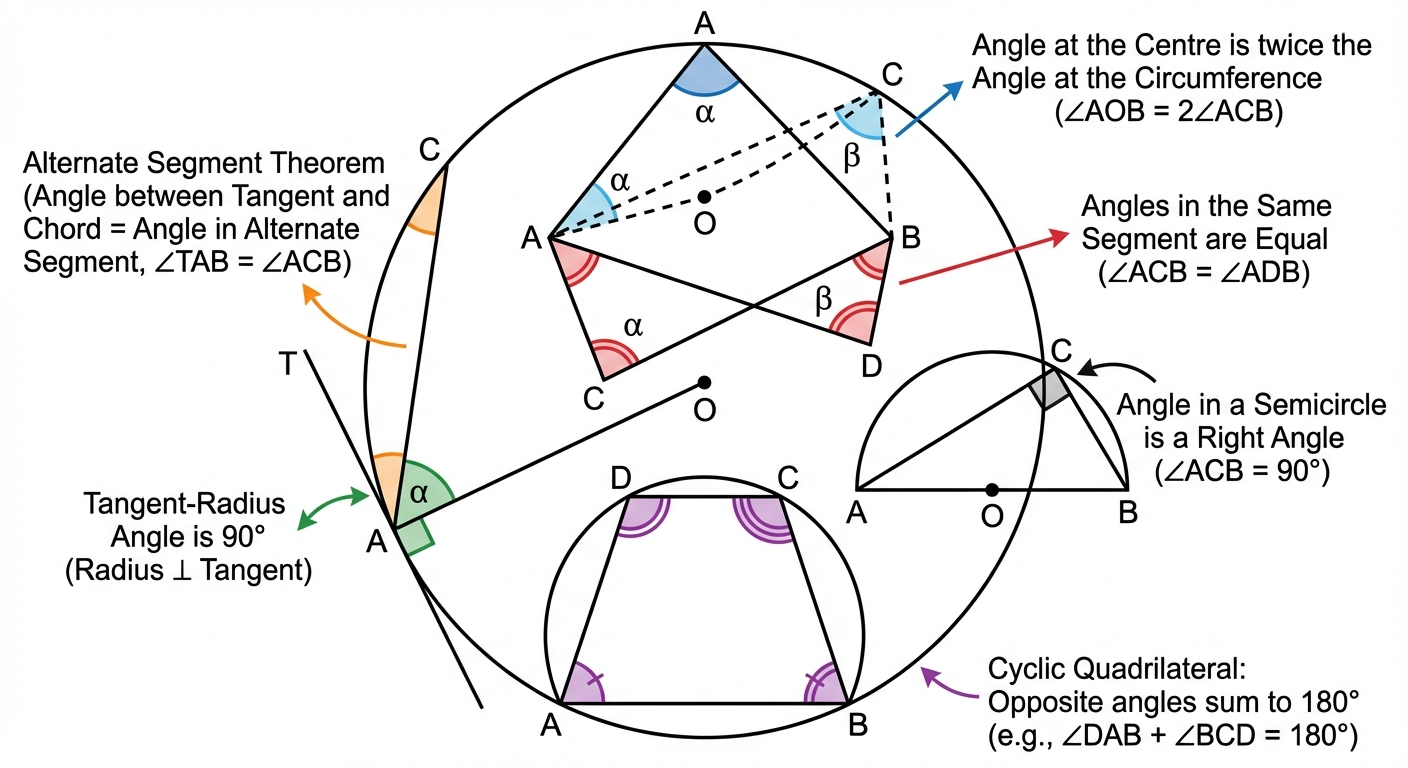
A super simple one is the Angle in a semicircle is . If a triangle's longest side is the diameter of a circle, the angle opposite it is always a perfect right angle. Easy marks! Then we have Cyclic Quadrilaterals. If you have any four-sided shape with all its corners touching the circle's edge, the opposite angles add up to . It's like they're perfectly balanced. If , then the opposite must be .
Now for tangents. A tangent is a line that just skims the edge of a circle. The angle between a tangent and a radius at the point of contact is always . Finally, the boss level: the Alternate Segment Theorem. The angle between a tangent and a chord through the point of contact is equal to the angle in the alternate segment. It's like the angle 'bounces' off the tangent into the opposite part of the circle. Master these rules, and you'll be unstoppable. 💪
Worked example
Worked Example: Finding Unknown Angles Using Multiple Theorems
Let's Solve This Geometry Puzzle! 🧩
In the diagram, O is the centre of the circle. Points A, B, C, and D are on the circumference, forming a cyclic quadrilateral. ECF is a tangent to the circle at point C. Given that and , find the values of (a) , (b) , and (c) .
- 1To find , we use the rule that the angle at the centre is twice the angle at the circumference subtended by the same arc (arc BC). We are given the angle at the centre, , so we can just halve it.
- 2Next, to find , we use the properties of a cyclic quadrilateral (ABCD). Opposite angles in a cyclic quadrilateral sum to . We know , so we can find its opposite angle, .
- 3Finally, to find , we apply the Alternate Segment Theorem. This theorem states that the angle between the tangent (ECF) and a chord (BC) at the point of contact is equal to the angle in the alternate segment. The angle in the alternate segment is , which we found in step 1.
Answer
4. Properties of Similar Shapes and Solids
Alright, let's talk about similarity. Think of it like using a filter on Instagram or Snapchat that enlarges your friend's head – the shape is the same, but the size is different. That's the core idea! Two shapes are mathematically similar if one is a perfect enlargement of the other. This means two things: 1) All corresponding angles are exactly the same (no distortion!), and 2) The ratio of all corresponding side lengths is constant. This magic ratio is called the Length Scale Factor (LSF), which we'll call .
Finding missing lengths is your first mission. If you know the LSF, you can find any corresponding length. Let's say a small photo is 10cm wide and the enlarged version is 30cm wide. The LSF is . So, a 5cm tall object in the original photo will be cm tall in the new one. Easy, right?
Finding missing lengths is your first mission. If you know the LSF, you can find any corresponding length. Let's say a small photo is 10cm wide and the enlarged version is 30cm wide. The LSF is . So, a 5cm tall object in the original photo will be cm tall in the new one. Easy, right?
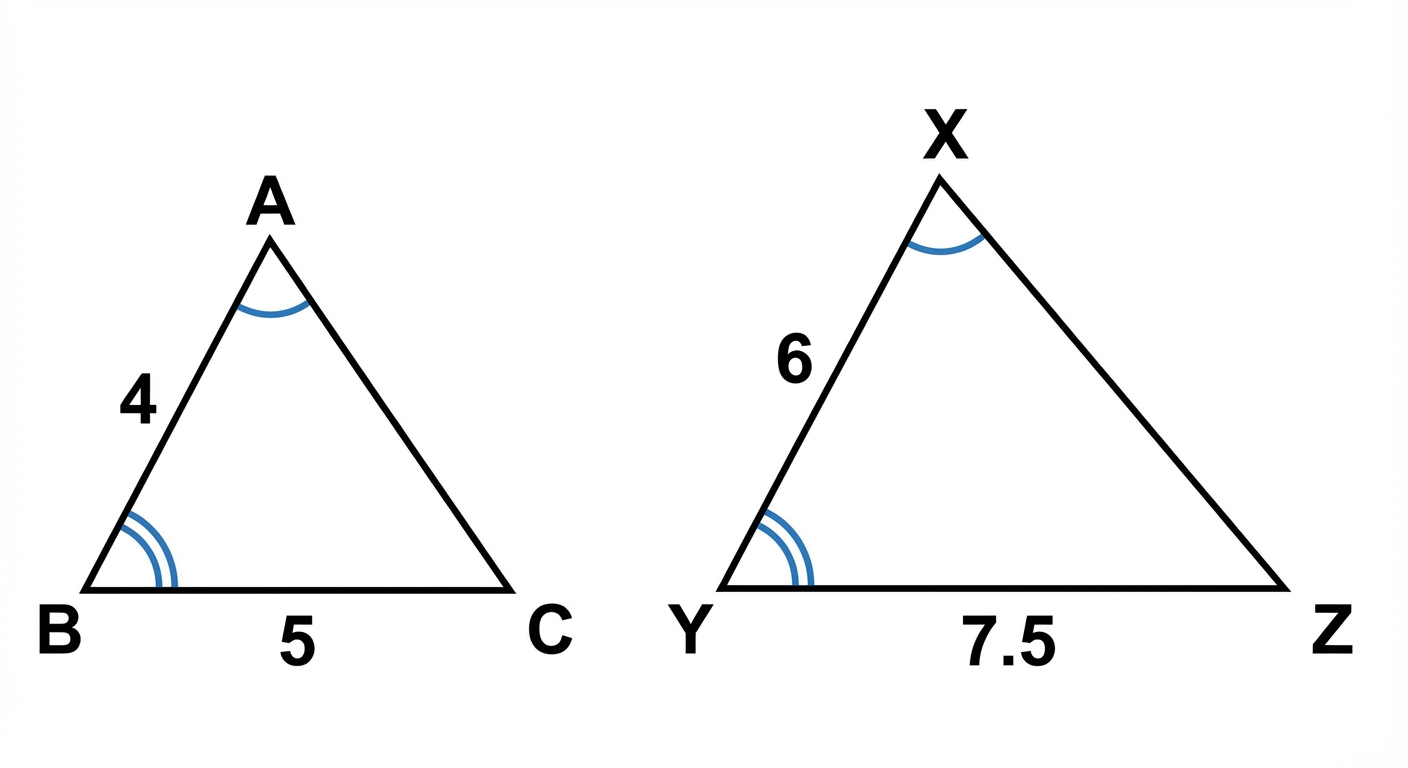
For triangles, we have some slick shortcuts to prove they're similar. You don't need to check everything. Just show one of these three conditions is met:
• AA (Angle-Angle): If two angles of one triangle are equal to two corresponding angles of another, they're similar. The third angle has to be equal anyway (since they all add to ).
• SSS (Side-Side-Side): If the ratios of all three pairs of corresponding sides are the same (i.e., they all have the same LSF), they're similar.
• SAS (Side-Angle-Side): If two pairs of sides have the same ratio, and the angle between those two sides is identical in both triangles, they're similar.
Now for the level-up: Area and Volume. This is where people get tripped up, but it's logical. If your LSF is 2 (you double the sides), the area doesn't just double. Think of a 1x1 square (Area = 1). If you double the sides to 2x2, the new area is 4. The Area Scale Factor (ASF) is the LSF squared! So, . This applies to any 2D shape's area or 3D solid's surface area.
Volume is the same idea, but in 3D. If you have a 1x1x1 cube (Volume = 1) and you double its sides (LSF = 2), you get a 2x2x2 cube with a volume of 8. The Volume Scale Factor (VSF) is the LSF cubed! So, . This is super useful for comparing things like a small coffee to a large one, or a model car to the real thing.
Worked example
Worked Example: Calculating Area and Volume of Similar Solids
From Small Fries to Large Fries 🍟
You have two mathematically similar statues of your favourite gaming character. The smaller statue has a height of 10 cm, a surface area of 240 cm, and a volume of 320 cm. The larger statue has a height of 15 cm. Calculate the surface area and volume of the larger statue.
- 1First thing's first, we need to find the Length Scale Factor (LSF). This is the ratio of the new length to the original length. We have the heights of both statues, which are corresponding lengths.
- 2Now let's find the surface area. We can't just multiply the old area by the LSF. We need to find the Area Scale Factor (ASF) first. Remember, ASF is the LSF squared.
- 3With the ASF, we can now calculate the surface area of the larger statue. We just multiply the original surface area by the ASF.
- 4Time for the volume. Same process, but this time we need the Volume Scale Factor (VSF), which is the LSF cubed.
- 5Finally, multiply the original volume by the VSF to get the volume of the larger, epic-sized statue. And we're done!
Answer
5. Geometrical Constructions and Nets
Alright, let's get into constructions. Think of this as the geometry equivalent of building something epic in Minecraft or designing a custom layout for your room—it’s all about precision. First up, the basics: drawing lines and angles. For your IGCSE, using a ruler for every single straight edge is non-negotiable. No freehanding! It’s the difference between a shaky Snapchat doodle and a crisp, edited Insta post.
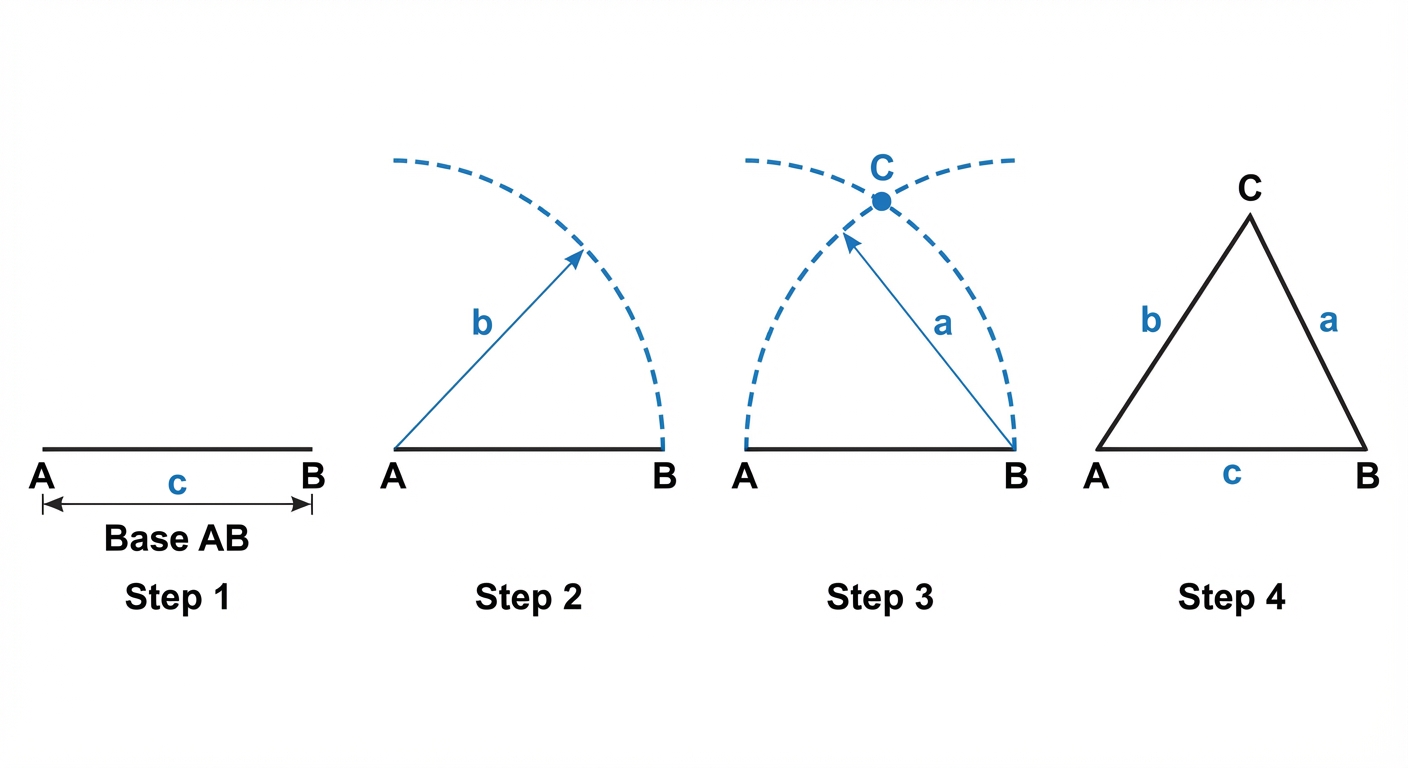
The real boss level here is constructing a triangle when you're only given the lengths of its three sides (we call this SSS: Side-Side-Side). You'll need a ruler and a pair of compasses—that's it. You start by drawing one side as the base. Then, you use your compasses to draw arcs from each end of the base, with the radius of each arc being the length of the other two sides. Where those arcs cross? That's your third point. Boom, triangle! The most important rule: DO NOT ERASE YOUR ARCS! The examiner wants to see them; they're your 'working out' and prove you did it properly.
The real boss level here is constructing a triangle when you're only given the lengths of its three sides (we call this SSS: Side-Side-Side). You'll need a ruler and a pair of compasses—that's it. You start by drawing one side as the base. Then, you use your compasses to draw arcs from each end of the base, with the radius of each arc being the length of the other two sides. Where those arcs cross? That's your third point. Boom, triangle! The most important rule: DO NOT ERASE YOUR ARCS! The examiner wants to see them; they're your 'working out' and prove you did it properly.
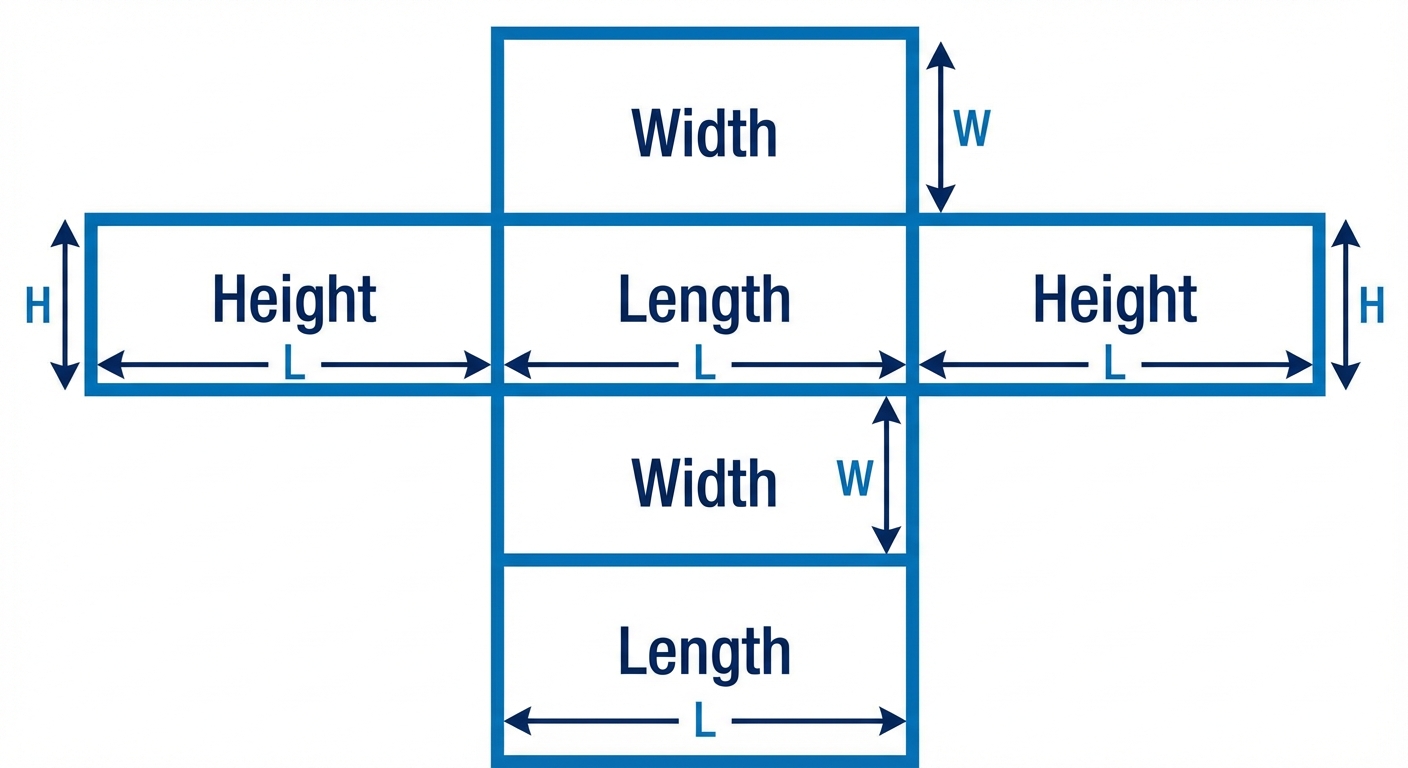
Now let's switch from 2D to 3D. Ever unfolded a box to see how it was made? That flat pattern is called a net. A net is basically the 2D blueprint for a 3D shape. You need to be able to recognize and draw nets for shapes like cubes, cuboids (like a shoebox), prisms (think a Toblerone box), and pyramids. The cool part is using these nets to do calculations. If you have the measurements on the net, you can find the total surface area by just adding up the areas of all the flat faces. It's way easier than trying to visualize it in 3D!
Worked example
Worked Example: Constructing a Triangle (SSS)
Let's Build This Thing! 🛠️
A triangular section for a new skate park ramp is designed with side lengths of 7 m, 6 m, and 4 m. Using a scale of 1 cm to 1 m, construct the triangle accurately using only a ruler and compasses. Leave all construction arcs visible.
- 1First, let's apply the scale. Since 1 cm represents 1 m, our drawing will have side lengths of 7 cm, 6 cm, and 4 cm. Easy peasy.
- 2Let's draw the longest side, 7 cm, as the base of our triangle. Use your ruler to draw a perfectly straight line segment. Label the ends A and B. This is the foundation of our ramp section.Draw line segment AB = 7 cm.
- 3Time for the compasses! We need to draw the 6 cm side. Set your compasses to a radius of exactly 6 cm using your ruler. Place the pointy end on point A and swing a nice, clear arc above the base line.Set compass radius to 6 cm. Draw an arc from point A.
- 4Now for the last side. Readjust your compasses to a radius of 4 cm. Place the pointy end on the other point, B, and swing another arc. Make sure it crosses the first arc you drew.Set compass radius to 4 cm. Draw an arc from point B.
- 5The point where your two arcs intersect is the final vertex of the triangle! Label this point C. Use your ruler to draw straight lines connecting A to C and B to C. And you're done! Don't forget the golden rule: leave those beautiful construction arcs for the examiner to see.Join AC and BC to complete .
Answer
Join AC and BC to complete .
6. Properties of Symmetry in 2D and 3D Shapes
Alright, let's get into symmetry. You see it everywhere, from the design of your favourite artist's album cover to the balanced look of a car. It's all about balance and shapes looking identical after a flip, spin, or slice.
First up is line symmetry in 2D shapes. Think of it like the perfect mirror filter on Instagram. A line of symmetry is a line you can draw through a shape where one half is a perfect reflection of the other.
First up is line symmetry in 2D shapes. Think of it like the perfect mirror filter on Instagram. A line of symmetry is a line you can draw through a shape where one half is a perfect reflection of the other.
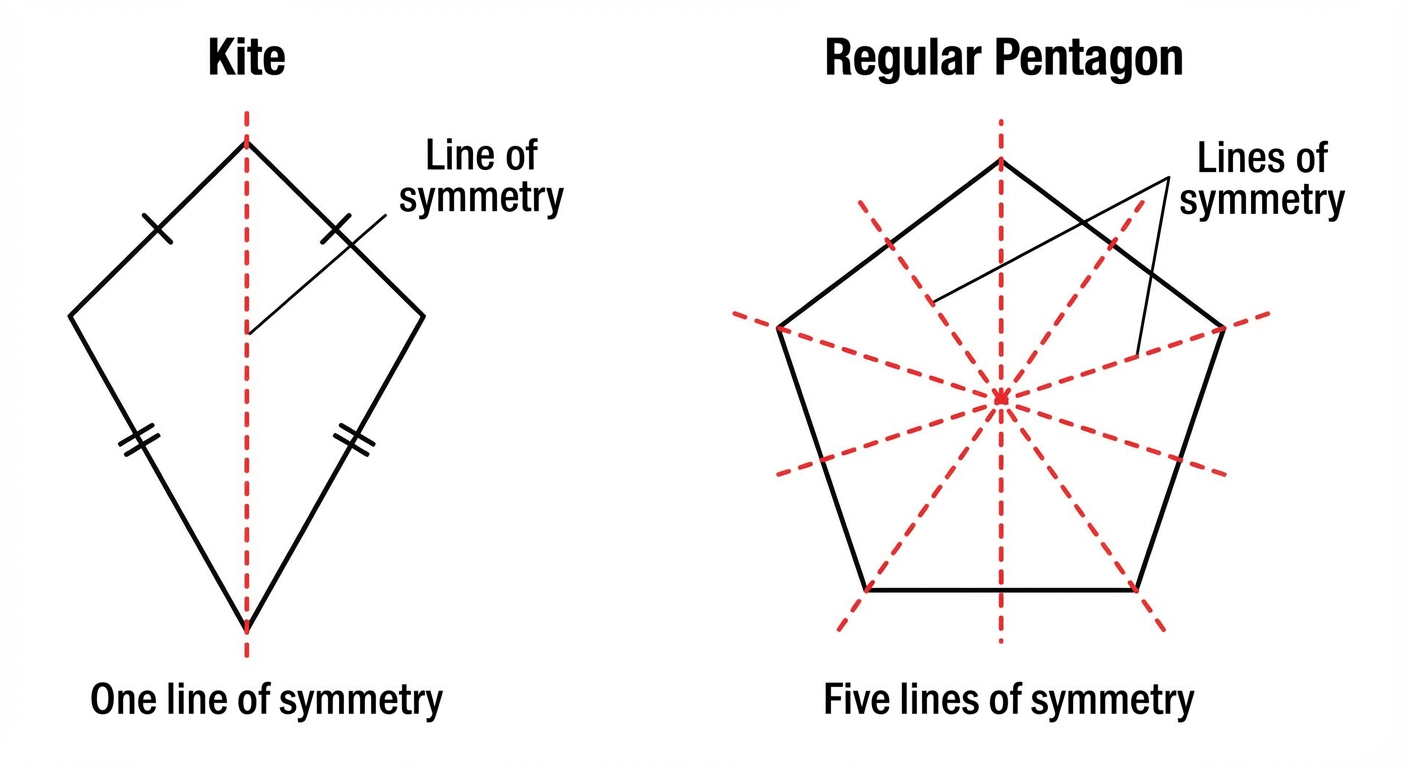
An equilateral triangle has 3 lines of symmetry, a square has 4, and a rectangle has 2. It's all about finding those 'fold lines' where the shape matches up perfectly.
Next, we have rotational symmetry. This is about spinning a shape around a central point and counting how many times it looks exactly the same during a full turn. This number is the order of rotational symmetry. A square has an order of 4 because it looks the same every . A parallelogram has an order of 2. If a shape only looks right after a full spin, its order is 1. Think of a fidget spinner – if it has three arms, it has rotational symmetry of order 3.
Now let's level up to 3D. Instead of lines, we have planes of symmetry. Imagine slicing an apple perfectly down the middle so both halves are identical mirror images. That slice is a plane of symmetry. A cylinder has infinite vertical planes of symmetry passing through its central axis, plus one horizontal one. A cone also has infinite planes of symmetry, all passing through its apex. For a square-based pyramid, there are 4 planes of symmetry.
Next, we have rotational symmetry. This is about spinning a shape around a central point and counting how many times it looks exactly the same during a full turn. This number is the order of rotational symmetry. A square has an order of 4 because it looks the same every . A parallelogram has an order of 2. If a shape only looks right after a full spin, its order is 1. Think of a fidget spinner – if it has three arms, it has rotational symmetry of order 3.
Now let's level up to 3D. Instead of lines, we have planes of symmetry. Imagine slicing an apple perfectly down the middle so both halves are identical mirror images. That slice is a plane of symmetry. A cylinder has infinite vertical planes of symmetry passing through its central axis, plus one horizontal one. A cone also has infinite planes of symmetry, all passing through its apex. For a square-based pyramid, there are 4 planes of symmetry.
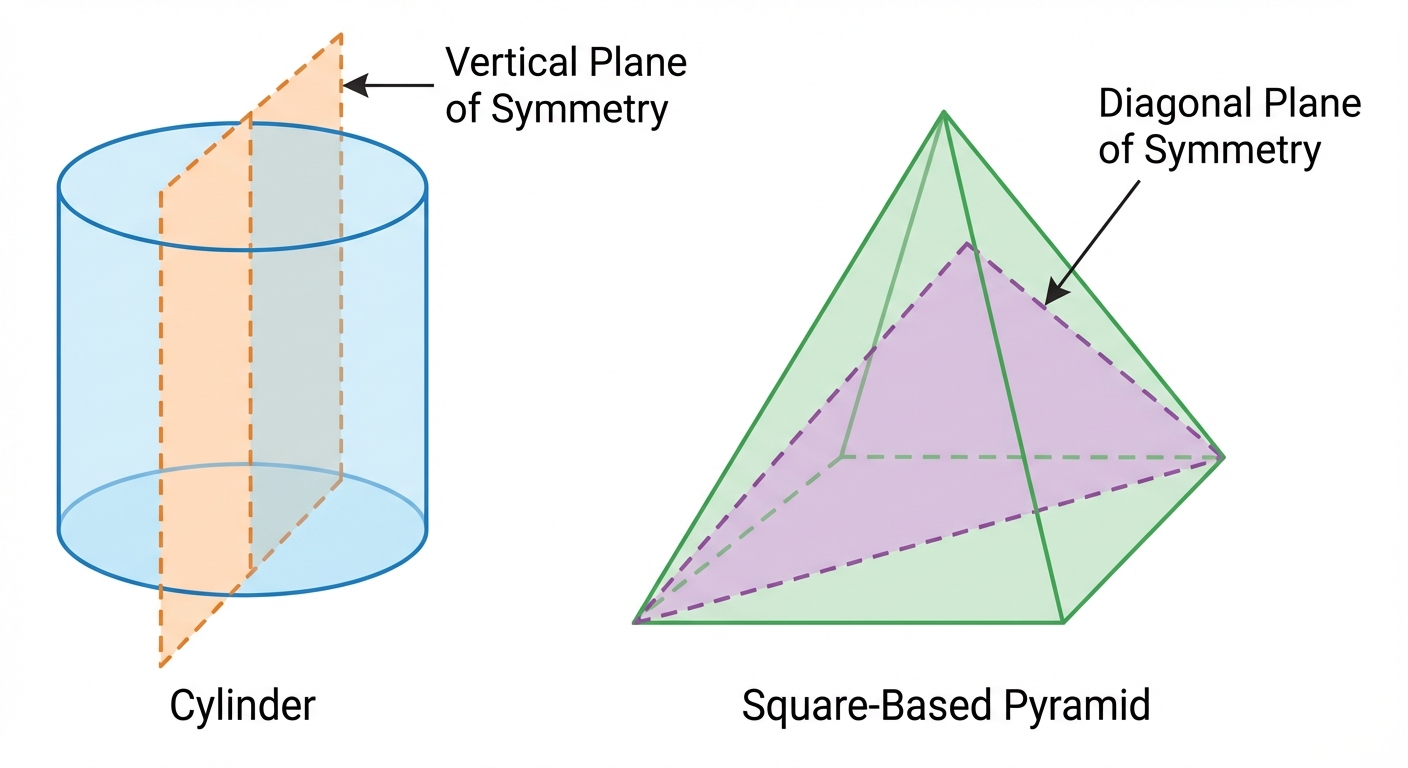
3D shapes also have axes of symmetry – these are the lines you can spin the object around. For a prism with a regular polygon base, the axis running through the center of the bases is an axis of rotational symmetry. It's the secret geometry that makes things in the real world look stable and well-designed.
Worked example
Worked Example: Identifying Symmetry in a Regular Polygon
Let's Break Down this Hexagon's Symmetries 🕵️♀️
A regular hexagon is used as the base for a company logo. For this shape, state:
(a) The number of lines of symmetry.
(b) The order of rotational symmetry.
(a) The number of lines of symmetry.
(b) The order of rotational symmetry.
- 1First, let's find the lines of symmetry. A regular polygon is super balanced. We can draw lines connecting opposite vertices (corners). Let's count how many pairs of opposite vertices there are.There are 3 pairs of opposite vertices, so that's 3 lines of symmetry.
- 2We can also find lines of symmetry by connecting the midpoints of opposite sides. Let's count how many pairs of opposite sides there are.There are 3 pairs of opposite sides, giving us another 3 lines of symmetry.
- 3To get the total number of lines of symmetry for part (a), we just add the two types we found together.
- 4For part (b), we need the order of rotational symmetry. Imagine pinning the hexagon at its exact center and spinning it. We need to count how many times it fits perfectly onto its original outline in one full turn.A regular hexagon has 6 equal sides and 6 equal angles. This means it will fit onto itself 6 times during a full rotation.
- 5Therefore, the order of rotational symmetry is 6. We can also find the smallest angle of rotation by dividing by the order. This tells us how much you have to turn it each time for it to look the same.
Answer
7. Geometrical Terms: Vocabulary You Must Know
Examiners hand out marks for using the right geometrical language when you give reasons. Saying 'Z-angles' instead of 'alternate angles on parallel lines'? That's free marks left on the table. Lock this vocab in. 💯
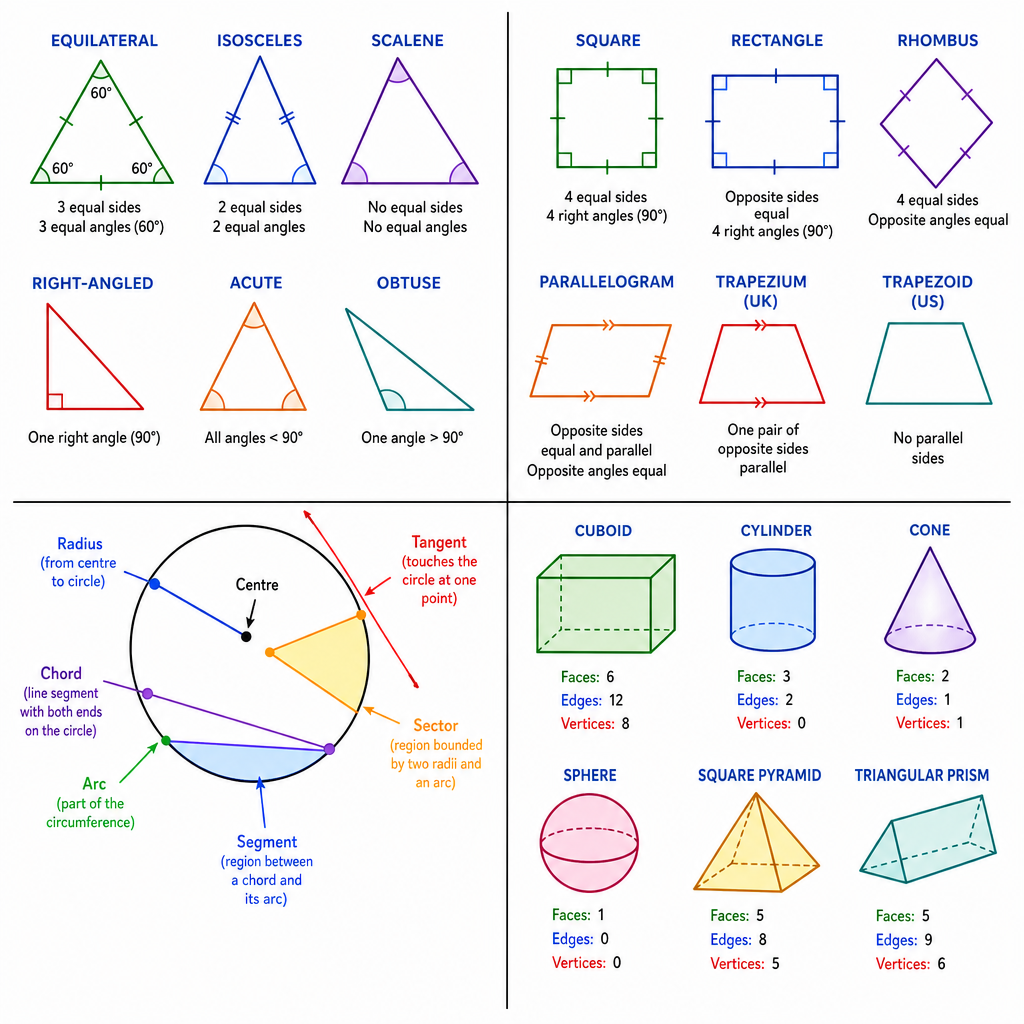
Basic terms: a point has position only; a line has length but no thickness; parallel lines never meet (like railway tracks); perpendicular lines meet at ; a bearing is a three-figure angle clockwise from North (e.g. ); two shapes are similar if they're the same shape different size (like photos at different zoom levels), and congruent if they're literally identical. 📏
Triangles: equilateral (all sides equal, all angles — perfect symmetry king), isosceles (two sides equal, two base angles equal), scalene (no sides equal — chaos), right-angled (one corner).
Quadrilaterals: square, rectangle, rhombus (all sides equal), parallelogram (opposite sides parallel), trapezium (one pair of parallel sides), kite (two pairs of adjacent equal sides).
Polygons: any straight-sided shape. Regular = all sides and angles equal. Irregular = not that. Named by sides: pentagon (5), hexagon (6), heptagon (7), octagon (8), decagon (10).
Circle vocab (memorise): centre, radius, diameter, circumference (the boundary), chord (straight line joining two points on the circle), tangent (touches the circle at one point), arc (part of the circumference — a curved slice), sector (pizza slice from centre), segment (the bit cut off by a chord — like the crust alone). 🍕
Solids: cuboid, cylinder, prism (uniform cross-section all the way through), pyramid, cone, sphere. Every 3D solid has faces (flat surfaces), edges (where faces meet), and vertices (corners).
Basic terms: a point has position only; a line has length but no thickness; parallel lines never meet (like railway tracks); perpendicular lines meet at ; a bearing is a three-figure angle clockwise from North (e.g. ); two shapes are similar if they're the same shape different size (like photos at different zoom levels), and congruent if they're literally identical. 📏
Triangles: equilateral (all sides equal, all angles — perfect symmetry king), isosceles (two sides equal, two base angles equal), scalene (no sides equal — chaos), right-angled (one corner).
Quadrilaterals: square, rectangle, rhombus (all sides equal), parallelogram (opposite sides parallel), trapezium (one pair of parallel sides), kite (two pairs of adjacent equal sides).
Polygons: any straight-sided shape. Regular = all sides and angles equal. Irregular = not that. Named by sides: pentagon (5), hexagon (6), heptagon (7), octagon (8), decagon (10).
Circle vocab (memorise): centre, radius, diameter, circumference (the boundary), chord (straight line joining two points on the circle), tangent (touches the circle at one point), arc (part of the circumference — a curved slice), sector (pizza slice from centre), segment (the bit cut off by a chord — like the crust alone). 🍕
Solids: cuboid, cylinder, prism (uniform cross-section all the way through), pyramid, cone, sphere. Every 3D solid has faces (flat surfaces), edges (where faces meet), and vertices (corners).
Real talk: examiners mark the language as well as the number. 'Angle in a semicircle = 90°' is the correct reason; 'because it's in a circle' isn't. 🎯
Worked example
Worked Example: Identifying Shapes and Circle Parts
A regular octagon is inscribed in a circle of radius cm. (a) State one line of symmetry of the octagon. (b) Name the line joining two adjacent vertices of the octagon. (c) Name the region bounded by that line and the minor arc of the circle between those two vertices.
- 1For (a), a regular -gon has lines of symmetry — so . The centre of a regular polygon is also the centre of its circumscribed circle, so a line from any vertex through the centre is a line of symmetry.A line from a vertex through the centre of the circle.
- 2For (b), a straight line joining two points on the circle is called a chord. Vocab alert. 📚Chord
- 3For (c), the region between a chord and the arc is a segment — NOT a sector (a sector is bounded by two radii and an arc, like a pizza slice). Segment = crust only. 🍕Segment
Answer
Segment
Worked example
Worked Example: Angle at Centre = Twice Angle at Circumference
In a circle with centre , points and are on the circumference. The angle . Point is also on the circumference, on the major arc . Find . 🎯
- 1Theorem: the angle at the centre is exactly twice the angle at the circumference when both are subtended by the same arc. Cheat code activated. 🎮
- 2Sub in and divide.
- 3Write the reason — examiners want the language.
Answer
Worked example
Worked Example: Angles in the Same Segment
Four points , , , lie on a circle (in that order). . Find , giving a reason. 🔵
- 1Theorem: angles in the same segment (both standing on the same chord, both on the same side of that chord) are equal. and both stand on chord and are on the same side — same segment. Same vibe. 💯
- 2Sub in and state the reason.
Answer
Worked example
Worked Example: Cyclic Quadrilateral
is a cyclic quadrilateral (all four vertices lie on a circle). and . Find and . ⭕
- 1Theorem: in a cyclic quadrilateral, opposite angles sum to . So pairs with , and pairs with . Locked in.
- 2For : take the opposite of .
- 3For : take the opposite of . Then write both with reasons.
Answer
Worked example
Worked Example: Alternate Segment Theorem
A tangent meets a circle at point . A chord is drawn, and is another point on the circle in the alternate segment (the one on the other side of from the tangent). The angle between the tangent and the chord is . Find . 🎯
- 1Alternate segment theorem: the angle between a tangent and a chord at the point of contact equals the angle in the alternate segment (subtended by the same chord). Same fire. 🔥
- 2Apply directly.
Answer
Practice this in the app
Unlock the full chapter: practice questions, flashcards, mock papers and notes, free.
Continue revising