Introduction to Trigonometry and Pythagoras' Theorem
Trigonometry Unlocked: From Side-Quest to Main Quest 📐✨
Introduction
1. Introduction
Yo! Welcome to the Trigonometry level-up guide. I know what you're thinking... 'Trig-o-what-now?' It sounds super complicated, but I promise it's not. Think of it as a secret toolkit for solving puzzles with triangles. It's used in everything from designing video games and creating special effects in movies to planning a flight path. By the end of this, you'll be a triangle master. Let's get this bread. 🍞
2. Pythagoras' Theorem: The Relationship Between Sides
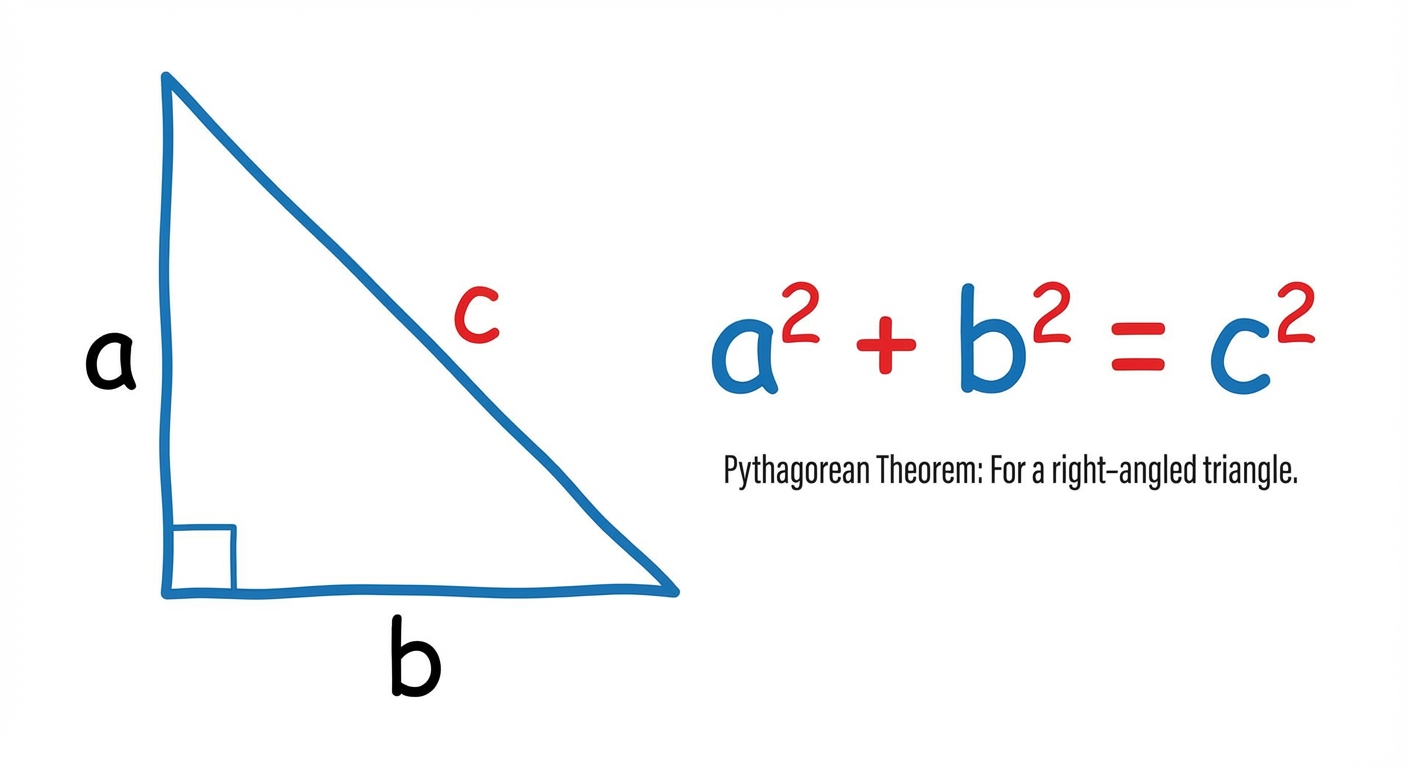
First up, let's talk about the legend himself: Pythagoras. His theorem is your go-to move when you have a right-angled triangle and you know two side lengths, but need the third. The key is to identify the hypotenuse – that's the longest side, always opposite the right angle. The rule is simple: the square of the two shorter sides ( and ) add up to the square of the hypotenuse (). The formula is your new best friend: . Easy, right? It's like a 2-for-1 deal on sides.
Worked example
Worked Example: Finding the Hypotenuse
Worked Example: Finding the Longest Side (Hypotenuse)
A right-angled triangle has shorter sides of 6 cm and 8 cm. Find the length of the hypotenuse.
- 1First, write down Pythagoras' theorem. We have the two shorter sides, and . We need to find .
- 2Sub in the values you know. Square them up.
- 3Now, to get by itself, we need to do the opposite of squaring, which is finding the square root. Get your calculator ready!
Answer
3. Finding a Shorter Side Using Pythagoras' Theorem
Okay, but what if you already have the hypotenuse (the 'final boss' side) and one of the shorter sides? It's like knowing the final score but missing one team's points. You just have to rearrange the formula. Instead of adding, you subtract the square of the short side you know from the square of the hypotenuse. So, it becomes or . Just remember: always start with the longest side when you subtract.
Worked example
Worked Example: Calculating a Shorter Side
Worked Example: Applying Pythagoras' theorem to find a shorter side
You're at a skate park. A ramp is 13 meters long (that's the hypotenuse) and it covers a horizontal distance of 12 meters along the ground. How high is the ramp?
- 1Identify your sides. The ramp itself is the hypotenuse, . The ground distance is a shorter side, . We need to find the height, . We'll use the rearranged formula.
- 2Plug in the numbers and calculate the squares.
- 3Find the square root to get the final answer. The ramp is 5 meters high! 🛹
Answer
4. The Trigonometric Ratios: SOH CAH TOA
Pythagoras is great, but he ghosts you when angles get involved. That's where Trigonometry steps in. For any right-angled triangle, we have three magic ratios. To use them, you need to stand at one of the non-right angles and label the sides from that perspective: Opposite (the side across from you), Adjacent (the side next to you, but not the hypotenuse), and the Hypotenuse (always the longest one).
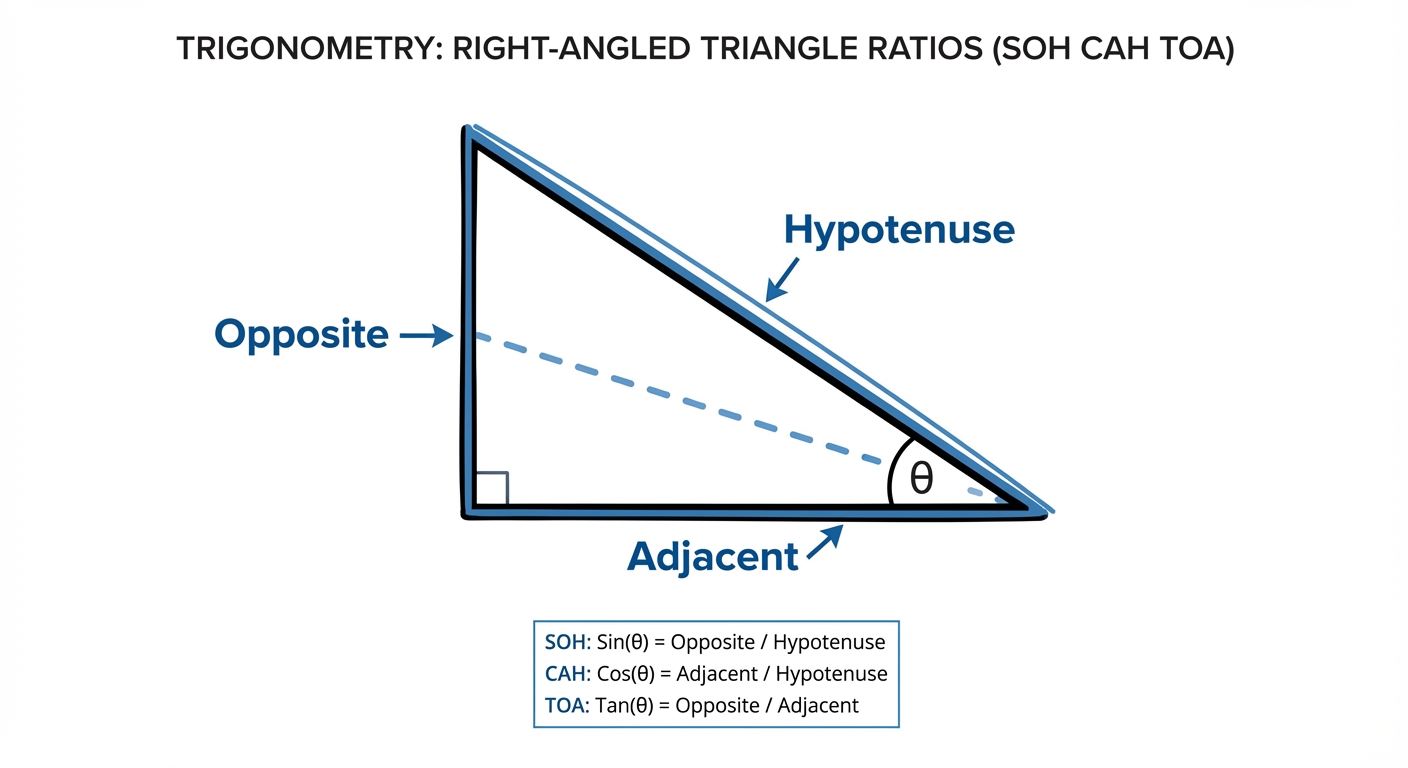
The magic mnemonic to remember the ratios is SOH CAH TOA:
SOH: Sine() = Opposite / Hypotenuse
CAH: Cosine() = Adjacent / Hypotenuse
TOA: Tangent() = Opposite / Adjacent
SOH: Sine() = Opposite / Hypotenuse
CAH: Cosine() = Adjacent / Hypotenuse
TOA: Tangent() = Opposite / Adjacent
Worked example
Worked Example: Identifying Sides and Selecting a Ratio
Worked Example: Identifying Sides with SOH CAH TOA
In a right-angled triangle, angle is . The side opposite angle is 10 cm, and the hypotenuse is 17.4 cm. Which trig ratio would you use to connect these three pieces of information?
- 1Look at what you've got. You have an angle (), the side Opposite it (10 cm), and the Hypotenuse (17.4 cm).Given: Angle, Opposite, Hypotenuse
- 2Now check the mnemonic SOH CAH TOA. Which part uses O and H?SOH stands for Sine = Opposite / Hypotenuse. This is the one!
Answer
SOH stands for Sine = Opposite / Hypotenuse. This is the one!
5. Calculating a Missing Side Using the Sine Ratio
Let's put SOH to work. If you know an angle and the hypotenuse, you can find the opposite side. Or if you know the angle and the opposite side, you can find the hypotenuse. It's all about setting up the equation and solving for the unknown. Think of it like a formula in a game's crafting system: put in two ingredients (angle and one side) to get a new item (the missing side).
Worked example
Worked Example: Applying the Sine Ratio
Worked Example: Using the sine ratio to find a side length
A kite is flying on a 50m string. The string makes an angle of with the ground. How high is the kite above the ground? (Assume the string is a straight line).
- 1Draw a quick sketch! The string is the Hypotenuse (50m). The angle with the ground is . The height of the kite is the side Opposite the angle. We have O, H, and an angle, so we're using SOH. [IMAGE_PLACEHOLDER_3: A simple diagram of a kite, with a straight line string (50m) to the ground, forming a right-angled triangle. The angle on the ground is 40 degrees, and the height 'h' is the opposite side.]
- 2Plug in the values we know. Let the height be .
- 3To get on its own, we multiply both sides by 50. Type into your calculator. Make sure it's in Degrees (DEG) mode!
Answer
6. Using Cosine and Tangent to Find Missing Sides
SOH CAH TOA isn't just about Sine. You can use Cosine (CAH) or Tangent (TOA) in exactly the same way. The trick is to correctly identify which sides you have (Opposite, Adjacent, Hypotenuse) relative to your angle. Got the Adjacent and Hypotenuse? Use Cosine. Have the Opposite and Adjacent? Use Tangent. You've got this! It's like choosing the right filter for your pic – you pick the one that works with what you've got.
Worked example
Worked Example: Applying Trigonometric Ratios for Sides
Worked Example: Using trigonometric ratios to find a side length
You're standing 20 meters away from the base of a tall building. You look up to the top of the building at an angle of . How tall is the building?
- 1Let's label our triangle. The distance from you to the building is the Adjacent side (20m). The height of the building is the Opposite side (what we want to find). The angle is . We have O and A, so it's time for TOA.
- 2Sub in your values, with for the height (Opposite).
- 3Multiply both sides by 20 to solve for . Calculator time!
Answer
7. Finding an Angle Using Inverse Trigonometric Functions
So we can find sides. But what if you have the sides and need to find the angle? Like, you know your part-time job is a 5km walk East and a 2km walk North from home, but what's the angle of that direction? For this, we use the inverse trig functions: , , and . They look like they have an exponent of -1. These functions 'undo' the normal sin, cos, and tan to give you back the angle. If , then . It's like hitting 'undo' or 'rewind' to find out what the original angle was.
Worked example
Worked Example: Calculating an Unknown Angle
Worked Example: Using trigonometric ratios to find an angle
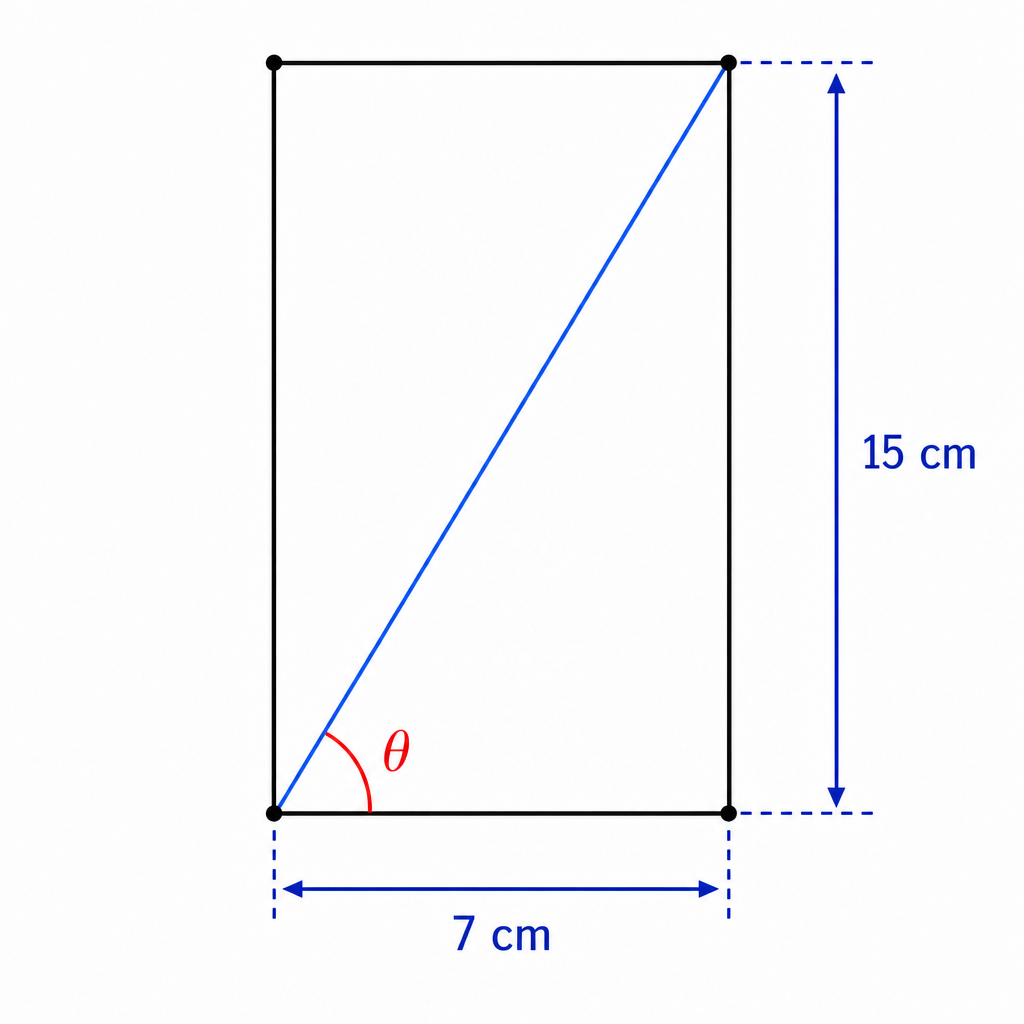
A rectangular phone screen has a width of 7 cm and a height of 15 cm. What angle does the diagonal make with the shorter side (the width)?
- 1Picture the rectangle. The diagonal cuts it into two right-angled triangles. From the corner, the height (15 cm) is the Opposite side and the width (7 cm) is the Adjacent side. We have O and A, so we'll use TOA again. [IMAGE_PLACEHOLDER_4: A rectangle with width 7cm and height 15cm. A diagonal is drawn. An angle θ is marked between the diagonal and the 7cm side.]
- 2Now we need to find the angle . We use the inverse tangent function, which is probably a SHIFT + TAN button on your calculator.
- 3Calculate the value. This gives us the angle in degrees.
Answer
8. Solving Multi-Step Problems in Two Dimensions
This is where it all comes together. Some problems are multi-step, requiring you to use Pythagoras and SOH CAH TOA in the same question. It's like a boss battle with two phases. You might need to use Pythagoras to find a missing side first, and then use that side in a SOH CAH TOA calculation to find an angle, or vice-versa. Don't panic! Just break the problem down. Draw a diagram, label everything you know, and figure out what you need to find in step one. One step at a time. 🎯
Worked example
Worked Example: Solving a 2D Problem
Worked Example: Solving 2D problems using both Pythagoras and trigonometry
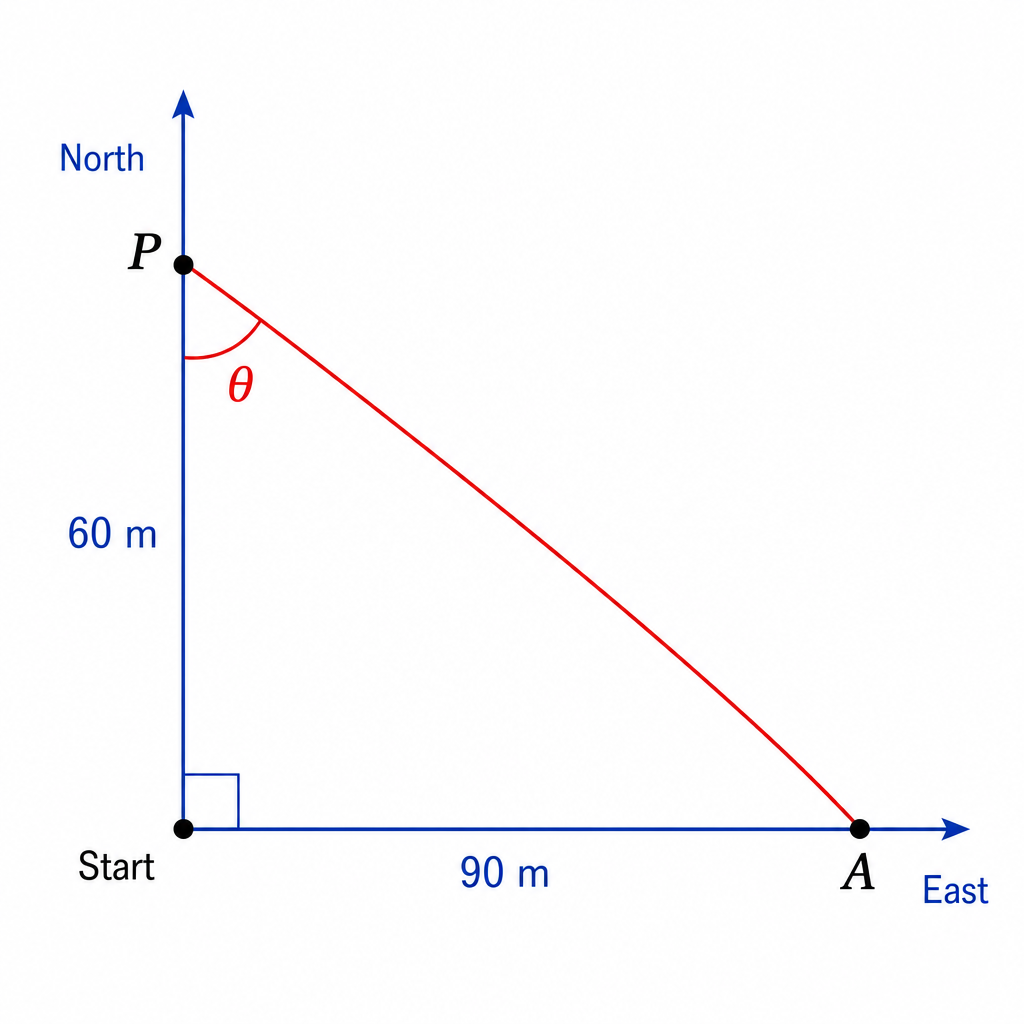
Two friends, A and B, start at the same point. A walks 90m due East. B walks 60m due North. B then turns and walks directly towards A. What is the bearing of A from B's final position? (A bearing is an angle measured clockwise from North).
- 1First, let's find the angle inside the triangle. Let's call B's final position 'P'. We have a right-angled triangle with the distance East (90m) being Opposite to the angle at P, and the distance North (60m) being Adjacent. We can find the angle inside the triangle, let's call it , using TOA. [IMAGE_PLACEHOLDER_5: A diagram showing a starting point, a line going 90m East to point A, and a line going 60m North to point P. A line connects P and A, forming a right-angled triangle. The angle at P inside the triangle is marked θ.]
- 2Okay, now for the bearing. A bearing is measured clockwise from North. From B's position (P), the line going South is . The line to A is less than the line going straight South. Whoops, let me rephrase. The line going East from P is at . The angle we found is between the North-South line and the line to A. The bearing is the angle from the North line, clockwise, to the line pointing to A. The angle from South to A is . So the bearing is .
Answer
9. Angles of Elevation and Depression
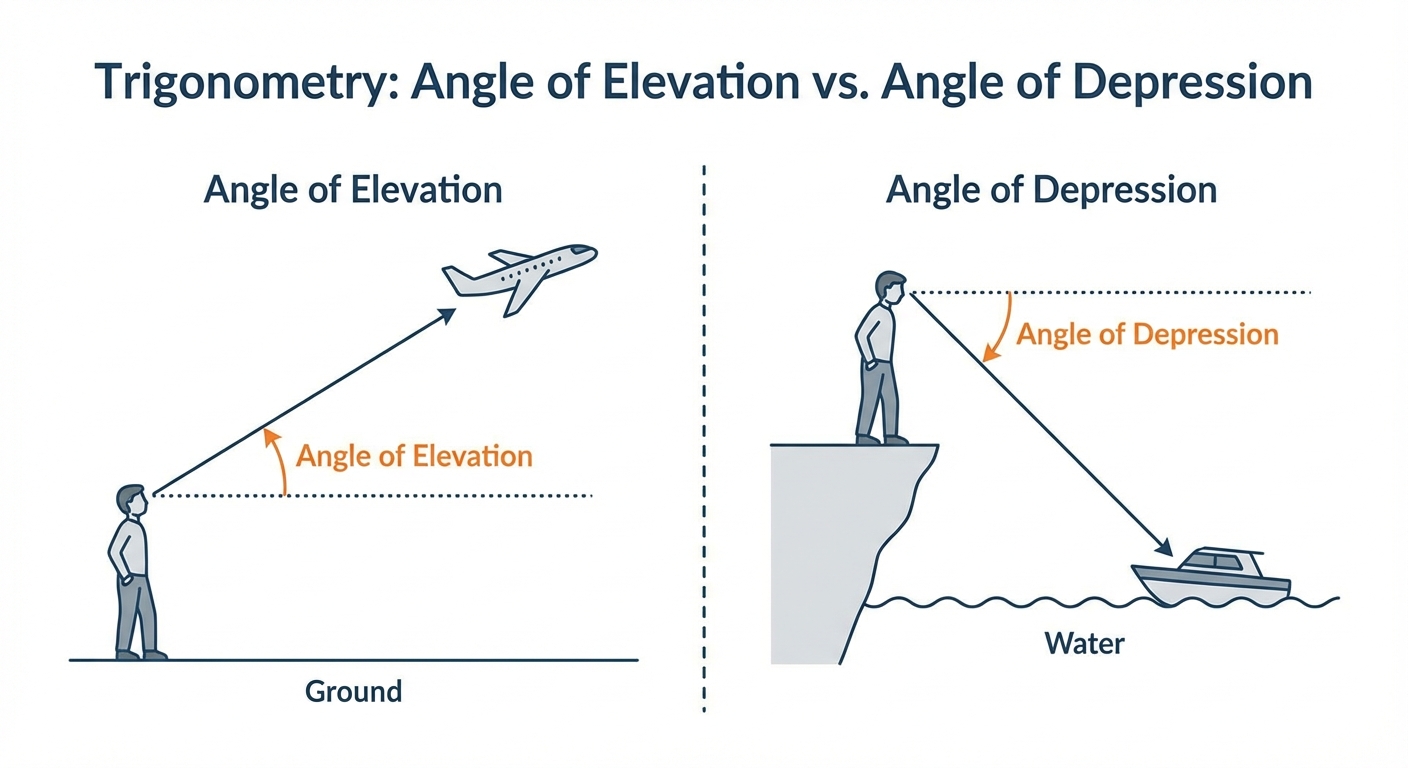
Trig isn't just for textbooks. The angle of elevation is when you look UP at something. Imagine you're on the ground looking up at a drone – the angle between the flat ground and your line of sight is the angle of elevation. The angle of depression is when you look DOWN. Imagine you're on a cliff looking down at a boat – the angle between the horizontal line from your eyes and your line of sight to the boat is the angle of depression. They're basically the same idea, just depends on whether you're looking up or down!
Worked example
Worked Example: Applying the Angle of Elevation
Worked Example: Using Angle of Elevation
From a point 100m from the base of a very tall tree, the angle of elevation to the top of the tree is . What is the height of the tree?
- 1This is a classic TOA problem. The distance from the tree is the Adjacent side (100m). The height of the tree is the Opposite side. The angle of elevation is our .
- 2Plug in the numbers.
- 3Solve for the Height by multiplying.
Answer
10. Pythagoras' Theorem
Alright, let's talk about one of the most legendary theorems in all of math: Pythagoras' Theorem. It sounds super old-school, but it's basically a cheat code for any right-angled triangle. You know, the ones with a perfect 'L' shape corner, marked with a little square. This theorem is your go-to whenever you know the lengths of two sides and need to find the third. Think of it like knowing the horizontal and vertical distance to a spot on a game map and needing to find the direct, straight-line distance to get there faster.
The magic formula is . The key is knowing what 'a', 'b', and 'c' are. 'a' and 'b' are the two shorter sides that make up the right angle. It doesn't matter which you call which. The VIP of this formula is 'c', which is the hypotenuse. The hypotenuse is always the longest side, and you can spot it because it's directly opposite the right angle. It's the diagonal, the shortcut, the one that doesn't touch the little square corner.
The magic formula is . The key is knowing what 'a', 'b', and 'c' are. 'a' and 'b' are the two shorter sides that make up the right angle. It doesn't matter which you call which. The VIP of this formula is 'c', which is the hypotenuse. The hypotenuse is always the longest side, and you can spot it because it's directly opposite the right angle. It's the diagonal, the shortcut, the one that doesn't touch the little square corner.
So, to use the theorem, you just square the two shorter sides, add them together, and that result is equal to the hypotenuse squared. To find the actual length of the hypotenuse, you just take the square root of your answer. Easy peasy. If you need to find a shorter side, you just rearrange the formula: . It’s a super useful tool, from figuring out if a ladder is long enough to planning a path in a video game.
Worked example
Worked Example: Calculating a Missing Hypotenuse
That New TV Screen Size Mystery 📺
You want to buy a new TV, and the box says it's 120 cm wide and 68 cm tall. TV sizes are measured by their diagonal length. What is the actual screen size (the diagonal) to the nearest whole number?
- 1First, let's ID what we're working with. The width and height of the TV form the two shorter sides of a right-angled triangle ('a' and 'b'). The diagonal screen size is the hypotenuse ('c'), which is what we need to find.
- 2Now, let's write down the main formula, our trusty Pythagoras' Theorem.
- 3Time to sub in the numbers we know. We'll plug in the values for the width and height.
- 4Let's get squaring! Calculate the squares of 120 and 68, then add them together to find the value of .
- 5We have , but we need just 'c'. To undo the square, we do the opposite: find the square root. Get your calculator ready!
- 6Finally, calculate the square root and round it to the nearest whole number as the question asks. This is the TV's official screen size!
Answer
11. Trigonometric Ratios in Right-Angled Triangles
Alright, let's dive into one of the most powerful tools in your math toolkit: Trigonometry, or 'trig' for short. Think of it like a cheat code in a video game that lets you figure out any missing side or angle in a right-angled triangle. The whole system is built around one epic mnemonic: SOHCAHTOA. Before we can use it, we need to know the squad players in a right-angled triangle. First, you have the Hypotenuse – it's the longest side, always opposite the right angle. Then, depending on which angle () you're focusing on, you have the Opposite side (the one directly across from the angle) and the Adjacent side (the one next to the angle, but not the hypotenuse).
Now, let's break down the code:
• SOH: Sine of the angle equals Opposite over Hypotenuse. ()
• CAH: Cosine of the angle equals Adjacent over Hypotenuse. ()
• TOA: Tangent of the angle equals Opposite over Adjacent. ()
So, how do you use this? If you know an angle and one side, you can find any other side. Just pick the ratio that connects what you know with what you want to find. If you need to find a missing angle, you work backwards using the inverse functions on your calculator – they look like , , and . Just remember to have your calculator in Degrees (DEG) mode, or you'll get some seriously weird answers. For your IGCSE exams, always give your angle answers correct to one decimal place!
Worked example
Worked Example: Calculating a Missing Side
Let's Build That Skate Ramp! 🛹
You're designing a new skate ramp. The ramp itself will be 3.5 meters long and will make an angle of with the ground. What is the horizontal distance the ramp will cover along the ground? Give your answer correct to one decimal place.
- 1First, let's visualize and label the triangle. The ramp is the Hypotenuse (the longest side). The horizontal distance along the ground is Adjacent to the angle. The height of the ramp would be the Opposite side, but we don't need that here. We know the angle and the hypotenuse, and we want to find the adjacent side. [IMAGE_PLACEHOLDER_2: A diagram of a right-angled triangle representing the skate ramp. The hypotenuse is labeled 3.5m, the angle with the ground is 22 degrees, and the adjacent side is labeled 'x'.]Knowns: Angle = , Hypotenuse = m
Unknown: Adjacent = - 2Now we need to pick our tool from SOHCAHTOA. We have the Adjacent (A) and the Hypotenuse (H). The ratio that connects A and H is CAH. So, we'll be using the cosine ratio.
- 3Let's substitute our values into the formula. The angle is , the Adjacent side is our unknown , and the Hypotenuse is m.
- 4Time to solve for . To get by itself, we need to undo the division by 3.5. We do this by multiplying both sides of the equation by 3.5.
- 5Finally, grab your calculator (make sure it's in DEG mode!). Type in the calculation and round the result to one decimal place as the question asks.
So, the ramp will cover a horizontal distance of 3.2 meters.
Answer
So, the ramp will cover a horizontal distance of 3.2 meters.
So, the ramp will cover a horizontal distance of 3.2 meters.
Practice this in the app
Unlock the full chapter: practice questions, flashcards, mock papers and notes, free.
Continue revising