Introduction to Coordinate Geometry
Coordinate Geometry: Unlocking the Map 🗺️
Introduction
1. Introduction
Alright squad, let's talk coordinate geometry. Sounds intense, right? But honestly, it's just the math behind every map you've used in a video game or seen on Snapchat. It's all about plotting points and drawing lines. Think of it as giving instructions to a character: 'go right 3, up 5'. Once you get the hang of the main formula, , you'll be navigating these graphs like a pro. Let's level up! 🚀
2. The Cartesian Coordinate System
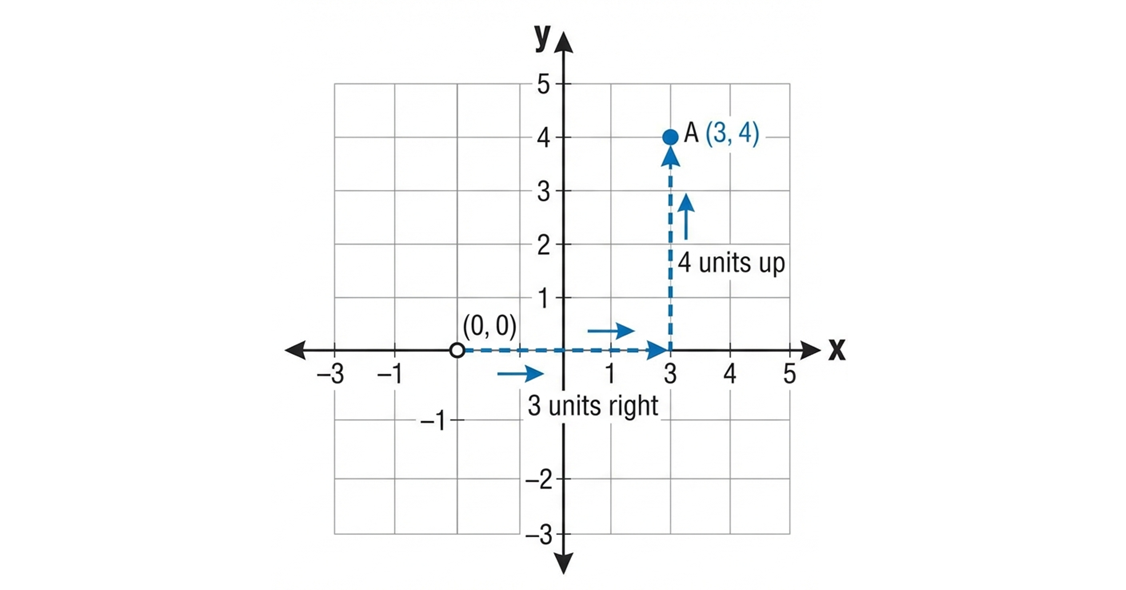
First up, the basics. The graph we use is called a Cartesian grid. It's basically a map with two main roads: the horizontal x-axis and the vertical y-axis. The point where they cross is called the origin, which is at . Any point on this map can be found using coordinates, written as . The first number tells you how far to go right (positive) or left (negative), and the second number tells you how far to go up (positive) or down (negative). Easy peasy.
Worked example
Worked Example: Plotting Points on the Cartesian Plane
Worked Example: Plotting Points
Plot the points and on a grid.
- 1For point : The x-coordinate is 2, so we start at the origin and move 2 units to the right.
- 2The y-coordinate is 5, so from our new x-position, we move 5 units up. Place a dot and label it 'A'.
- 3For point : The x-coordinate is -3, so we start at the origin and move 3 units to the left.
- 4The y-coordinate is 1, so from there, we move 1 unit up. Place a dot and label it 'B'. You've just plotted the points!
Answer
3. Understanding the Gradient of a Line
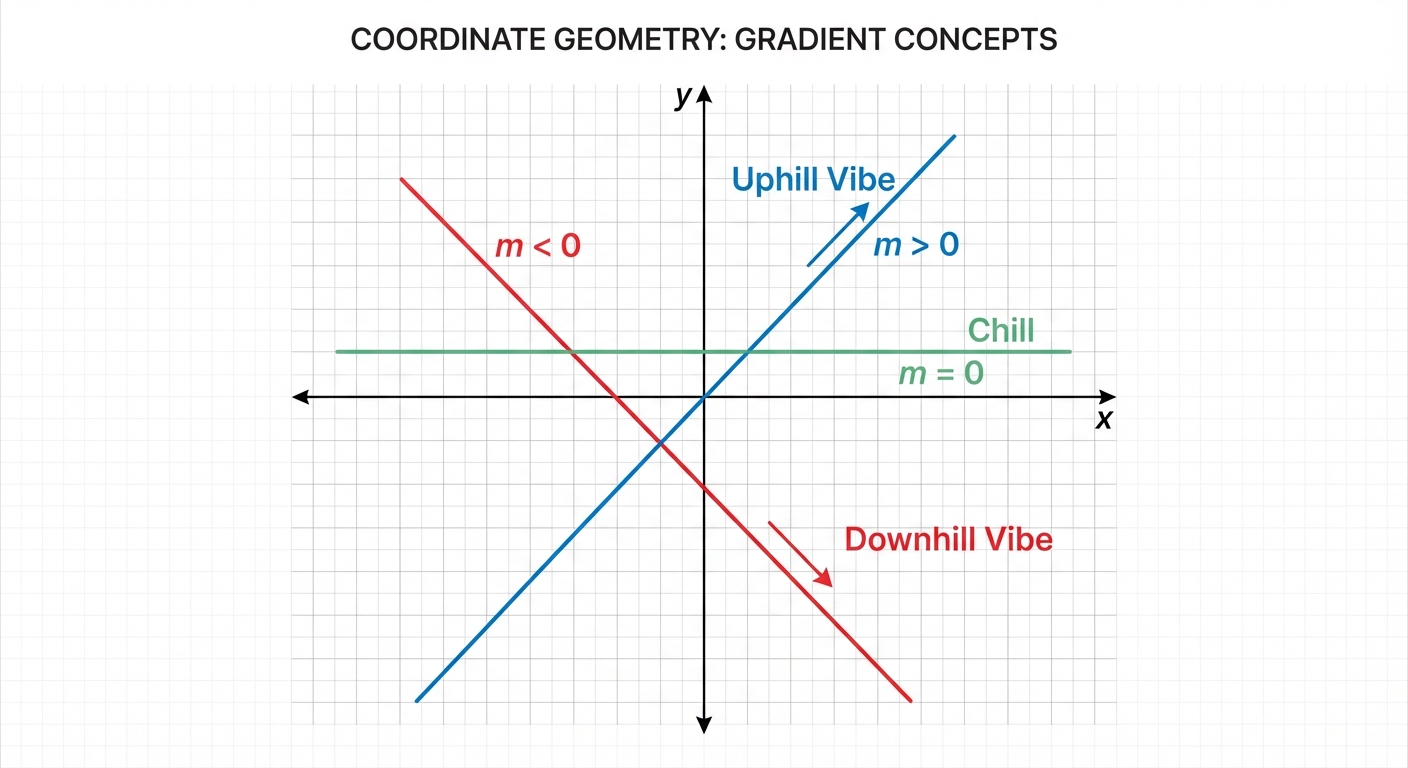
The gradient of a line is just a fancy word for its steepness. Think about a hill. A super steep hill is hard to climb, while a gentle slope is easy. In math, we give this steepness a number, which we call . A positive gradient () goes uphill from left to right. A negative gradient () goes downhill. A flat, horizontal line has a gradient of 0 (no effort!). The classic way to remember it is 'rise over run' – how much the line goes up or down for every step it takes to the right.
Worked example
Worked Example: Calculating Gradient from Two Points
Worked Example: Calculating Gradient from a Grid
Find the gradient of a line that passes through and .
- 1First, let's find the 'rise' (the change in y). We went from a y-value of 2 to 8.Rise =
- 2Next, find the 'run' (the change in x). We went from an x-value of 1 to 4.Run =
- 3Now, we just divide the rise by the run to get our gradient, .
Answer
4. The Equation of a Straight Line: y = mx + c
Okay, this is the cheat code for straight lines: . Seriously, almost everything in this chapter comes back to this equation. We already know is the gradient. The new character here is , which stands for the y-intercept. This is simply the point where the line crosses the vertical y-axis. It's the line's 'starting point' on that axis. If you know a line's gradient () and its y-intercept (), you know the equation for the entire line. It's the line's unique ID.
Worked example
Worked Example: Identifying Gradient and y-intercept
Worked Example: Interpreting y = mx + c
A line has the equation . What is its gradient and y-intercept?
- 1We just need to compare the given equation to the master code, .
- 2The number multiplying the is our gradient, . In this case, it's -3.
- 3The number added or subtracted at the end is our y-intercept, . Here, it's +5.
Answer
5. Determining the Equation of a Line from Two Points
This is a classic exam question, but it's totally doable. Imagine you're given two locations on your game map, say point and point , and you need to find the equation of the straight path between them. It's a two-step mission:
1. Find the Gradient (): First, you need to figure out the steepness of the path. Use the gradient formula: .
2. Find the Y-intercept (): Now that you have , plug it into . Then, pick one of your original points (either A or B, doesn't matter!) and substitute its and values into the equation. The only unknown left will be , so you can solve for it. Once you have and , you can write the final equation. 🎯
1. Find the Gradient (): First, you need to figure out the steepness of the path. Use the gradient formula: .
2. Find the Y-intercept (): Now that you have , plug it into . Then, pick one of your original points (either A or B, doesn't matter!) and substitute its and values into the equation. The only unknown left will be , so you can solve for it. Once you have and , you can write the final equation. 🎯
Worked example
Worked Example: Finding the Equation from Two Points
Worked Example: Determining the Equation of a Line from Given Points
Find the equation of the straight line that passes through the points and .
- 1Step 1 is to find the gradient (). Let's label our points: and . Now use the formula.
- 2Great, we know . Our equation so far is . Now for Step 2: find . Let's pick the point and substitute and into our equation.
- 3Now we just solve for .
- 4We've got our gradient and our y-intercept . Now we write the final equation by putting them into .
Answer
6. Properties of Parallel Lines
What does it mean for two lines to be parallel? Think of train tracks or two people scrolling through TikTok side-by-side. They're going in the exact same direction and will never, ever cross. In coordinate geometry, this means they have the exact same gradient. If line 1 has a gradient of and line 2 has a gradient of , then the lines are parallel if and only if . Their y-intercepts () can be different, which is why they are separate lines, but their steepness is identical.
Worked example
Worked Example: Identifying Parallel Lines Using Gradients
Worked Example: Identifying Parallel Lines
Are the lines and parallel?
- 1First, let's find the gradient of the first line by comparing it to .For , the gradient .
- 2Now, let's find the gradient of the second line.For , the gradient .
- 3We compare the gradients. Since , the gradients are the same.Yes, the lines are parallel.
Answer
Yes, the lines are parallel.
7. Finding the Equation of a Parallel Line Through a Point
This is where it all comes together. You'll be given the equation of a line and a single point that is not on that line. Your mission: find the equation of a new line that is parallel to the first one and goes through your given point. It's like finding a new road that runs parallel to a highway, but goes directly through your town.
1. Steal the Gradient: Look at the original line's equation and find its gradient (). Since your new line is parallel, it will have the exact same .
2. Find the new Y-intercept (): Use the you just found and the coordinates of the new point you were given. Substitute them into and solve for your new .
3. Write the Equation: You've got your and your new . Put them together for the final answer.
1. Steal the Gradient: Look at the original line's equation and find its gradient (). Since your new line is parallel, it will have the exact same .
2. Find the new Y-intercept (): Use the you just found and the coordinates of the new point you were given. Substitute them into and solve for your new .
3. Write the Equation: You've got your and your new . Put them together for the final answer.
Worked example
Worked Example: Finding the Equation of a Parallel Line
Worked Example: Finding the Equation of a Line Parallel to Another Line
Find the equation of the line that is parallel to and passes through the point .
- 1Step 1: Steal the gradient from the given line, . The gradient () is the number in front of .
- 2Our new line will also have a gradient of 3. So its equation is . Now we use the point we were given, , to find our new . Substitute and .
- 3Now, solve for .
- 4We have our gradient and our new y-intercept . Let's write the final equation of our parallel line.
Answer
8. Cartesian Coordinates and Plotting Points
Alright, let's talk coordinates. Think of a graph's grid like a map in a video game or your location tag on Snapchat. To tell someone exactly where something is, you need a precise location, right? That's what Cartesian coordinates are all about. You have two main lines that act as your guide: the horizontal line is the x-axis (think swiping left or right), and the vertical line is the y-axis (like scrolling up or down your feed). Where they cross is the starting point, called the origin, which has the coordinates .
Every single point on the graph has a unique address written as a pair of numbers: . Super important: the order always matters! The first number () tells you how far to go along the x-axis (positive is right, negative is left), and the second number () tells you how far to go up or down the y-axis (positive is up, negative is down). A good way to remember it is 'along the corridor, then up/down the stairs'. You can't do it the other way around!
Every single point on the graph has a unique address written as a pair of numbers: . Super important: the order always matters! The first number () tells you how far to go along the x-axis (positive is right, negative is left), and the second number () tells you how far to go up or down the y-axis (positive is up, negative is down). A good way to remember it is 'along the corridor, then up/down the stairs'. You can't do it the other way around!
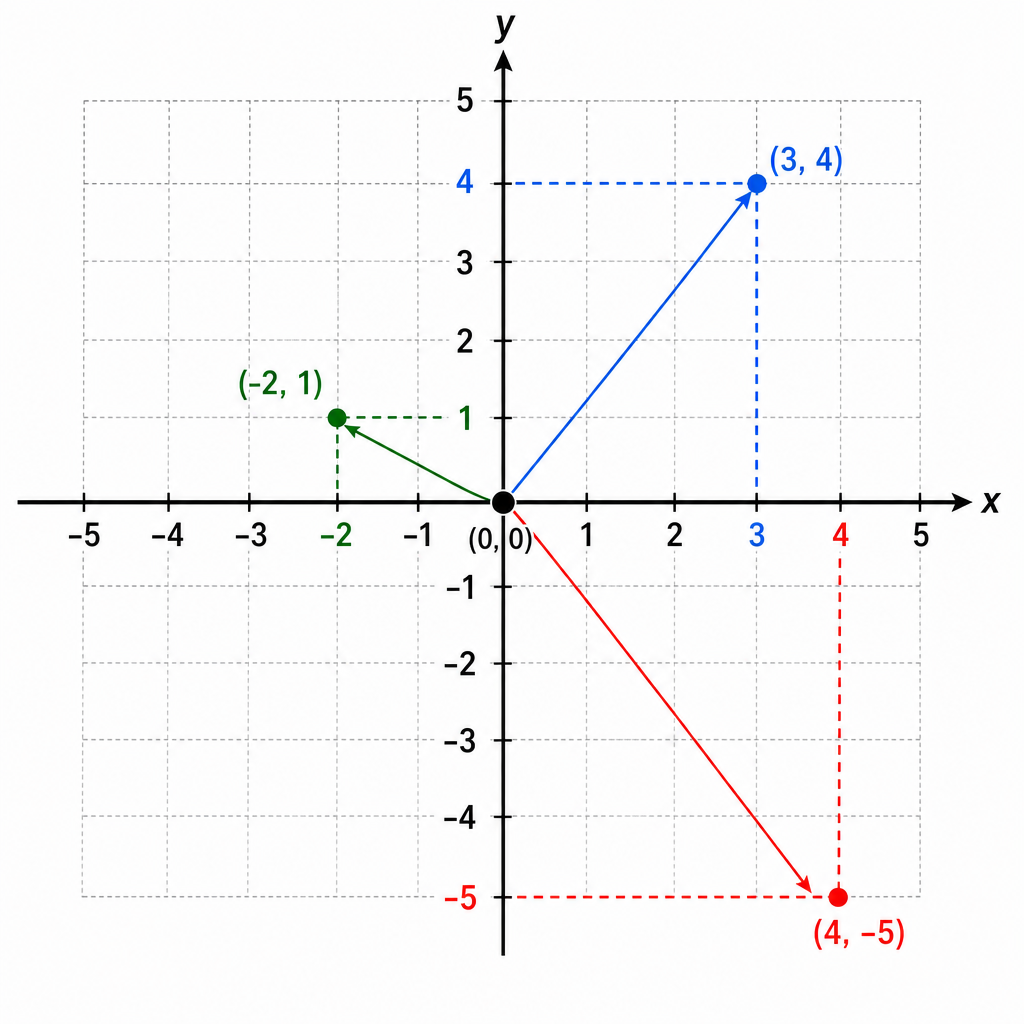
This gets really cool when we use an equation like . This equation is just a rule that links and values. For any you choose, the equation tells you the that goes with it. If you find a few of these pairs, plot them, and connect them, you'll see they form a perfectly straight line. It’s like connecting the dots to reveal a secret pattern.
Worked example
Plotting a Linear Graph from a Table of Values
From Equation to Epic Line Graph 📈
Complete the table of values for the equation and then plot the graph for values from to .
x | -2 | -1 | 0 | 1 | 2 | 3
y | | -3 | | 1 | | 5
x | -2 | -1 | 0 | 1 | 2 | 3
y | | -3 | | 1 | | 5
- 1First, we need to fill in the blanks in our table. We do this by substituting the values into our equation, , one by one. Let's find the value for :
- 2Now we do the same for the other missing values. For :
And for : - 3Awesome! Our table is complete. Now, let's list our coordinates as pairs. Think of them as a squad of points ready to be plotted.
- 4Time to draw the axes. Look at your coordinate values. The values go from -2 to 3, and the values go from -5 to 5. Make sure your axes are long enough to fit all these points comfortably. [IMAGE_PLACEHOLDER_2: A set of empty x and y axes, correctly scaled and labelled from -3 to 4 on the x-axis and -6 to 6 on the y-axis.]
- 5Let's plot these points. For each pair, remember: 'along the corridor, then up/down the stairs'. For , we start at the origin, go 2 units left, and then 5 units down. Mark the spot with a small dot or cross. Repeat for all six points.
- 6The grand finale! Grab a ruler and connect all the points. If you've done it right, they should all line up perfectly. Draw a single, straight line that goes through all of them. Pro tip: extend the line a little bit past your first and last points to show it continues on. [IMAGE_PLACEHOLDER_3: The final graph showing the six points plotted and a straight line drawn through them, with the line labelled y = 2x - 1.]
9. Gradient and the Equation of a Straight Line
Alright, let's break down the equation of a straight line: . It might look a bit formal, but it's basically the secret code for every straight line you'll ever see on a graph. Think of it like a character's stats in a video game.
The most important stat here is the gradient, which we call ''. The gradient is just a fancy word for steepness. Is the line a gentle slope or a super steep hill you'd need a 4x4 to climb? A big value for means a steep line. A small means it's flatter. If your line goes upwards from left to right, the gradient is positive. If it goes downwards (like your phone battery after an hour of TikTok), the gradient is negative.
For your IGCSE Core paper, you'll find the gradient by looking at the line on a grid. We use a simple idea called 'rise over run'. Pick two easy-to-read points on the line. The 'rise' is how many squares you go up or down to get from the first point to the second. The 'run' is how many squares you go across to the right.
The most important stat here is the gradient, which we call ''. The gradient is just a fancy word for steepness. Is the line a gentle slope or a super steep hill you'd need a 4x4 to climb? A big value for means a steep line. A small means it's flatter. If your line goes upwards from left to right, the gradient is positive. If it goes downwards (like your phone battery after an hour of TikTok), the gradient is negative.
For your IGCSE Core paper, you'll find the gradient by looking at the line on a grid. We use a simple idea called 'rise over run'. Pick two easy-to-read points on the line. The 'rise' is how many squares you go up or down to get from the first point to the second. The 'run' is how many squares you go across to the right.
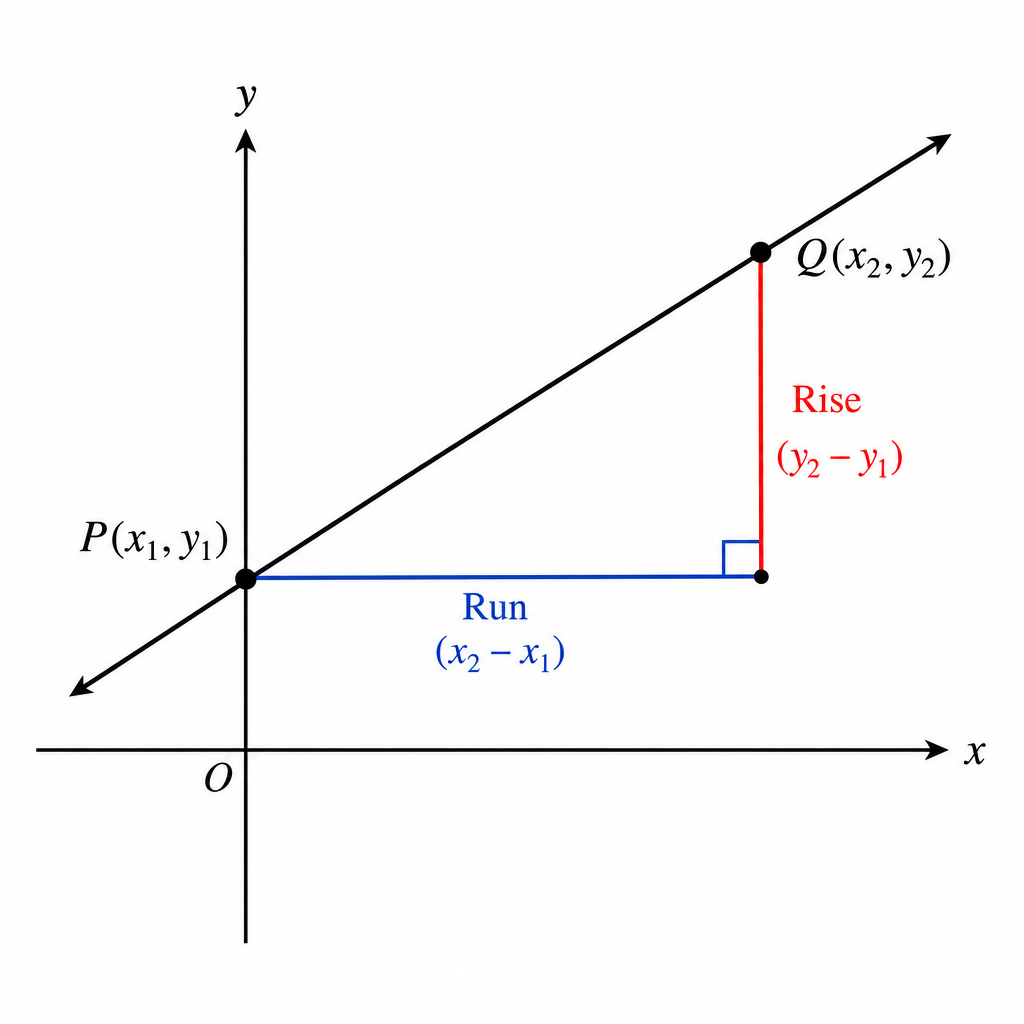
The gradient is just .
The other part of the equation, '', is the y-intercept. This is the chillest part of the formula. It's simply the point where the line crosses the vertical y-axis. It's your starting point. So, to get the full equation, you find the gradient (), find the y-intercept (), and plug them into . Easy peasy.
The other part of the equation, '', is the y-intercept. This is the chillest part of the formula. It's simply the point where the line crosses the vertical y-axis. It's your starting point. So, to get the full equation, you find the gradient (), find the y-intercept (), and plug them into . Easy peasy.
Worked example
Worked Example: Determining the Equation of a Line from a Grid
Let's Cook Up This Equation 🍳
A straight line is drawn on a grid. It passes through the y-axis at the point (0, -2) and also passes through the point (3, 4). Find the equation of the line in the form .
- 1First, let's find the y-intercept, ''. This is the easiest mark you'll ever get! The y-intercept is the point where the line crosses the y-axis, which is always where . The problem tells us it passes through (0, -2).
- 2Next up, we need the gradient, ''. We'll use the 'rise over run' method between the two points we know: (0, -2) and (3, 4). The 'rise' is the change in the y-coordinates.
- 3Now for the 'run', which is the change in the x-coordinates. Remember to go in the same direction as you did for the rise.
- 4We can now calculate the gradient '' by dividing the rise by the run.
- 5Finally, we assemble our equation. We have our gradient and our y-intercept . We just need to substitute these values into the standard equation .
Answer
10. Equations of Parallel Lines
Alright, let's talk about parallel lines. Think of them like the two yellow lines on a road, or the two rails of a train track. They travel in the exact same direction and never, ever meet. It's like you and your bestie walking down the hallway – you're going the same way but on slightly different paths. In coordinate geometry, this 'same direction' idea translates to one simple, crucial rule: parallel lines have the exact same gradient.
Remember the equation of a straight line, ? That '' value is the gradient – it tells us how steep the line is. If two lines are parallel, their '' values are identical. It's that simple! So, if you have a line with the equation , its gradient is 3. Any line parallel to it will also have a gradient of 3. Its equation would look like . The 'something else' is the y-intercept (), which just slides the line up or down the y-axis without changing its steepness.
Remember the equation of a straight line, ? That '' value is the gradient – it tells us how steep the line is. If two lines are parallel, their '' values are identical. It's that simple! So, if you have a line with the equation , its gradient is 3. Any line parallel to it will also have a gradient of 3. Its equation would look like . The 'something else' is the y-intercept (), which just slides the line up or down the y-axis without changing its steepness.
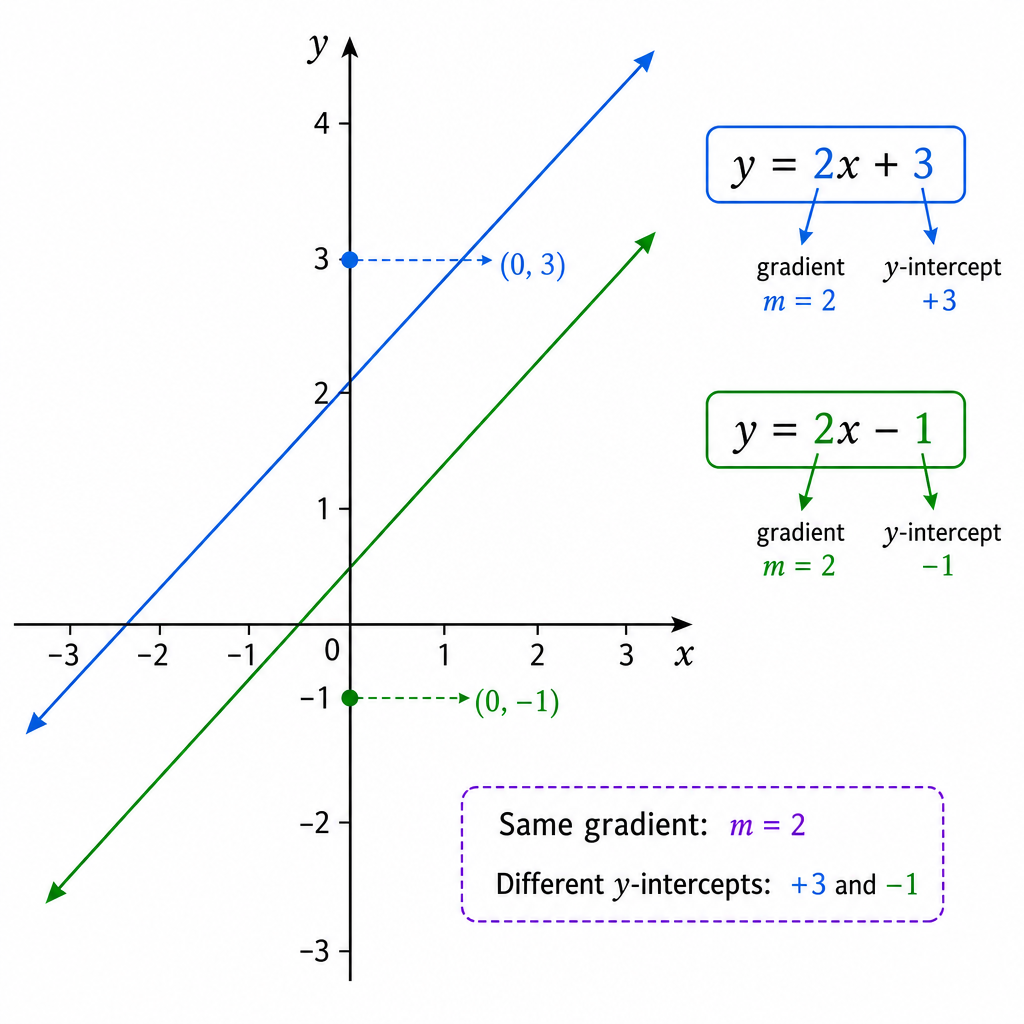
So, how do we find the equation of a new line that's parallel to one we already know? Easy. First, you 'borrow' the gradient () from the original line's equation. Second, you take the point that your new line passes through and substitute the , , and values into . The only thing left to find will be '', the new y-intercept. Solve for , and then you can write the full equation of your new parallel line. You've basically just cloned the line's steepness and moved it to a new location.
Worked example
Worked Example: Finding the Equation of a Parallel Line
Copying the Gradient, Finding the 'c' 🕵️♂️
Find the equation of the line that is parallel to the line and passes through the point .
- 1First, we need the gradient of the line we're given. In the equation , the gradient is the '' value. This is the steepness we need to copy.Original line: .
The gradient () is the number multiplying the .
So, . - 2The golden rule is that parallel lines have equal gradients. So, our new line will have the exact same gradient as the original one.Gradient of our new parallel line is also .
- 3Now we know our new equation looks like . To find the y-intercept, '', we substitute the coordinates of the point we're given, , into this equation. We're basically telling the line where it needs to be.
- 4Time for some quick algebra to solve for . This will pinpoint the exact location of our new line on the graph.
- 5We've got our gradient () and our y-intercept (). Let's assemble them into the final equation. Mission complete!
Answer
Practice this in the app
Unlock the full chapter: practice questions, flashcards, mock papers and notes, free.
Continue revising