Fundamentals of Number: Operations, Fractions, and Percentages
Number Ninja: Master the Basics 🥷
1. Introduction
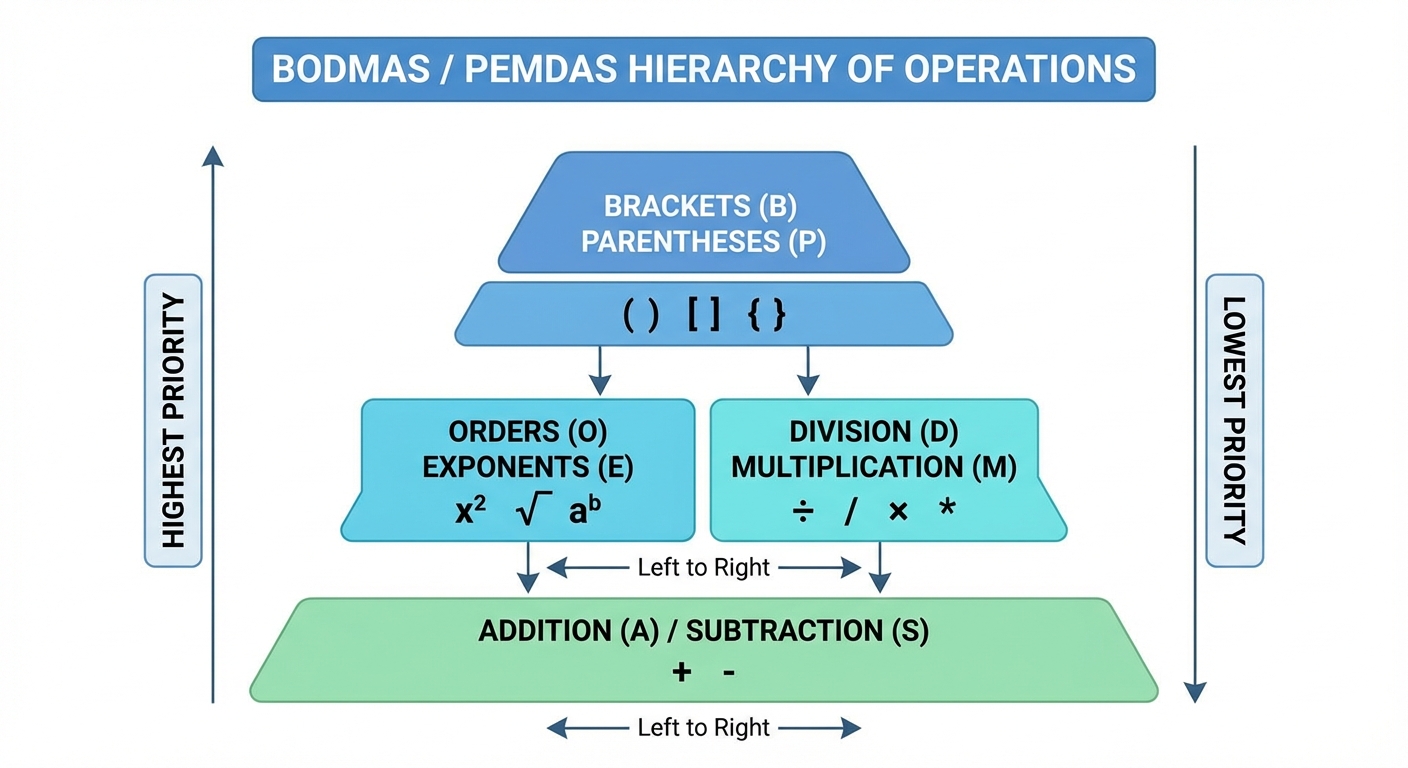
2. Understanding the Order of Operations (BODMAS/PEMDAS)
It stands for:
Brackets
Orders (like powers/indices $x^2$ and square roots $\sqrt{x}$)
Division & Multiplication (these are partners, you do them left-to-right)
Addition & Subtraction (also partners, done left-to-right)
Getting this order wrong is like putting your shoes on before your socks. It just doesn't work. Stick to the rules, and you'll always get the right answer. 🎯
Worked Example: Applying the Order of Operations
Worked Example: Following the BODMAS Code
- 1First up, Brackets. We solve what's inside the $(...)$ first. Inside the brackets, we have an Order ($2^2$), so we do that.$2^2 = 4$
- 2Now we finish the calculation inside the brackets: $3 \times 4$.$10 + (12) \div 6 - 4$
- 3Brackets are done. Next is Division and Multiplication. We have a division: $12 \div 6$.$10 + 2 - 4$
- 4Last up is Addition and Subtraction. We work from left to right. First, $10 + 2$.$12 - 4$
- 5And the final step...$12 - 4 = 8$
3. Calculations with Mixed Numbers, Fractions, and Decimals
Worked Example: Unifying Number Formats in Calculations
Worked Example: Unifying the Number Formats
- 1Let's convert the mixed number to a decimal. We know that $\frac{1}{2}$ is the same as $0.5$.$3\frac{1}{2} = 3 + 0.5 = 3.5$
- 2Now that both numbers are decimals, it's a simple addition problem.$3.5 + 1.75 = 5.25$
- 3So, you used $5.25$ litres of milk. You could also write this as $5\frac{1}{4}$ litres.$Total = 5.25 \text{ litres}$
4. Comparing and Ordering Numbers in Different Formats
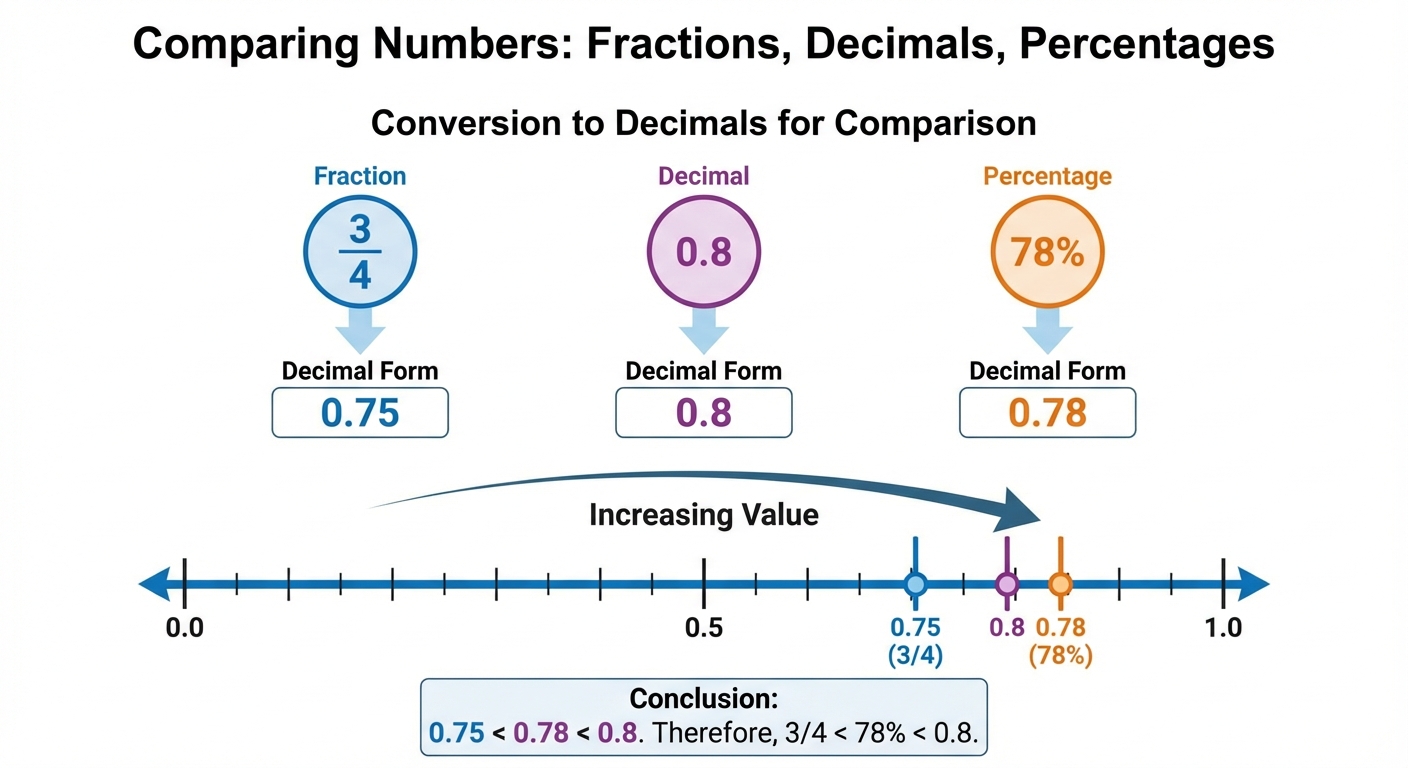
Worked Example: Ranking Different Number Formats
Worked Example: Ranking the Numbers
- 1Let's convert everyone's battery level to a decimal so we can compare them easily.$\text{You: } \frac{4}{5} = 4 \div 5 = 0.80$
- 2Next, convert Sarah's percentage to a decimal by dividing by 100.$\text{Sarah: } 85\% = 85 \div 100 = 0.85$
- 3Ben's is already a decimal, so we don't need to change it. Now we compare the three decimals: $0.80$, $0.85$, and $0.82$.$0.85 > 0.82 > 0.80$
- 4So, Sarah has the most battery. The order from largest to smallest is Sarah ($85\%$), then Ben ($0.82$), then you ($\frac{4}{5}$).$85\% > 0.82 > \frac{4}{5}$
5. Calculating a Percentage of a Quantity
Worked Example: Calculating a Percentage Discount
Worked Example: The Sneaker Discount
- 1We need to calculate $30\%$ of $£120$. First, convert the percentage to a decimal. This is our multiplier.$30\% = 30 \div 100 = 0.30$
- 2Now, multiply this decimal by the total cost of the sneakers.$0.30 \times £120 = £36$
- 3Boom! You save $£36$. The final price would be $£120 - £36 = £84$. Score!$\text{Discount} = £36$
6. Calculating Percentage Increase and Decrease
Worked Example: Calculating a Price Increase
Worked Example: Streaming Subscription Price Change
- 1This is a percentage increase. We start with the original $100\%$ and add the $10\%$ increase.$100\% + 10\% = 110\%$
- 2Convert this new percentage into a decimal multiplier.$110\% = 110 \div 100 = 1.10$
- 3Multiply the original price by this multiplier to find the new price. Remember to round your answer to two decimal places for money.$£9.99 \times 1.10 = £10.989$
- 4Rounding to the nearest penny, the new price is $£10.99$.$\text{New Price} = £10.99$
7. Finding the Percentage Change Between Two Values
$ \text{Percentage Change} = \frac{\text{Change}}{\text{Original}} \times 100 $
The 'Change' is just the difference between the new value and the original value. This one formula works for both increases and decreases!
Worked Example: Calculating Percentage Growth
Worked Example: Follower Growth
- 1First, let's find the 'Change' in followers. This is the new amount minus the original amount.$\text{Change} = 540 - 450 = 90$
- 2Next, we use the percentage change formula. We divide the change (90) by the original number of followers (450).$\frac{90}{450} = 0.2$
- 3Finally, multiply by 100 to turn the decimal into a percentage.$0.2 \times 100 = 20\%$
- 4You had a $20\%$ increase in followers! Time to go viral. ✨$\text{Percentage Increase} = 20\%$
8. Introduction to Reverse Percentages
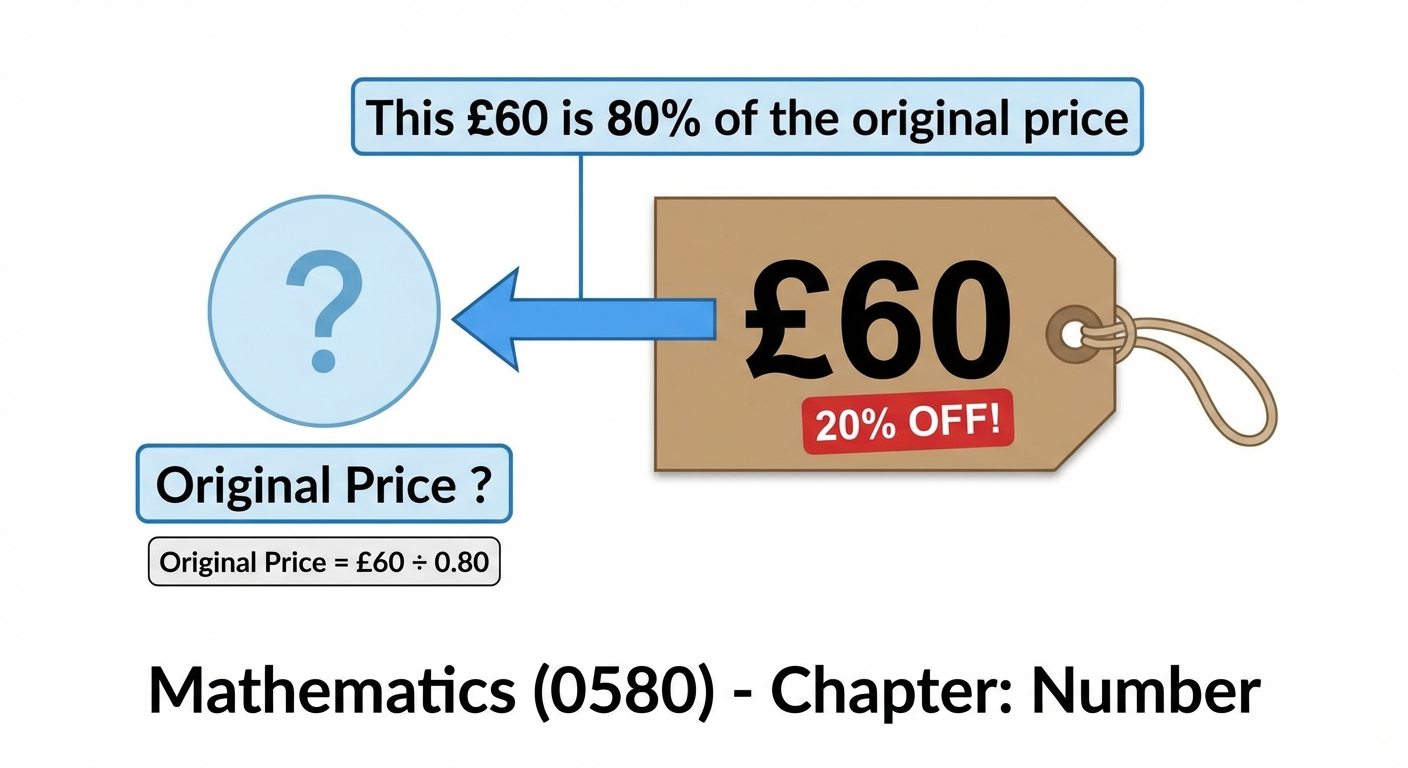
Worked Example: Finding the Original Value
Worked Example: Finding the Original Price
- 1The final price includes the original $100\%$ plus a $10\%$ fee. So, the $£45$ represents $110\%$ of the original price.$100\% + 10\% = 110\%$
- 2We can set up an equation. Let 'P' be the original price. We know that $110\%$ of P is $£45$. Let's write $110\%$ as a decimal.$1.10 \times P = £45$
- 3To find P, we need to do the reverse of multiplying. We divide both sides by 1.10.$P = \frac{£45}{1.10} = £40.90909...$
- 4Rounding to two decimal places for money, the original ticket price was $£40.91$.$\text{Original Price} = £40.91$
9. Calculating Successive Percentage Changes
Worked Example: Applying Successive Discounts
Worked Example: The Double Discount
- 1Let's find the decimal multipliers for both discounts. A $20\%$ discount means you pay $80\%$ ($100\% - 20\%$). A $10\%$ discount means you pay $90\%$ ($100\% - 10\%$).$\text{Multiplier 1} = 0.80 \quad \text{and} \quad \text{Multiplier 2} = 0.90$
- 2Now, apply the first discount to the original price.$£500 \times 0.80 = £400$
- 3This $£400$ is the sale price. Now apply the second discount to this new price.$£400 \times 0.90 = £360$
- 4The final price is $£360$. Alternatively, you could multiply the multipliers together first ($0.8 \times 0.9 = 0.72$) and then multiply by the original price ($£500 \times 0.72 = £360$). Same result, fewer steps!$\text{Final Price} = £360$
10. Introduction to Simple Interest
$ I = P \times R \times T $
Where:
I = Interest earned
P = Principal (the starting amount)
R = Rate (the percentage as a decimal)
T = Time (in years)
It's called 'simple' because the interest you earn doesn't start earning its own interest. It's always calculated on that starting amount.
Worked Example: Calculating Simple Interest Over Time
Worked Example: Savings from a Part-Time Job
- 1Let's identify our P, R, and T from the problem.$P = £800, \quad R = 3\% = 0.03, \quad T = 4 \text{ years}$
- 2Now, we plug these values into the simple interest formula: $I = P \times R \times T$.$I = 800 \times 0.03 \times 4$
- 3Calculate the result.$I = £96$
- 4After 4 years, you will have earned $£96$ in interest. The total amount in your account would be $£800 + £96 = £896$. Not bad for doing nothing!$\text{Interest Earned} = £96$
11. Number Types and Properties
First up, we have Natural Numbers (1, 2, 3...). These are your basic counting numbers, like when you're counting your followers. Add zero and all the negatives, and you get Integers (..., -2, -1, 0, 1, 2,...). Your bank account after a shopping spree? Definitely in the negative integers zone. 😬
Now for the VIPs: Prime Numbers. These are numbers greater than 1 that can only be divided by 1 and themselves (like 2, 3, 5, 7, 11...). They're the building blocks of all other numbers. Speaking of building, we have Square Numbers ($1, 4, 9, 16...$ which are $1^2, 2^2, 3^2, 4^2...$) and Cube Numbers ($1, 8, 27, 64...$ which are $1^3, 2^3, 3^3, 4^3...$). Then there are Factors (numbers that divide into another number perfectly) and Multiples (basically a number's times table). A number's factors are like its core friend group, while its multiples are like its ever-expanding list of followers.
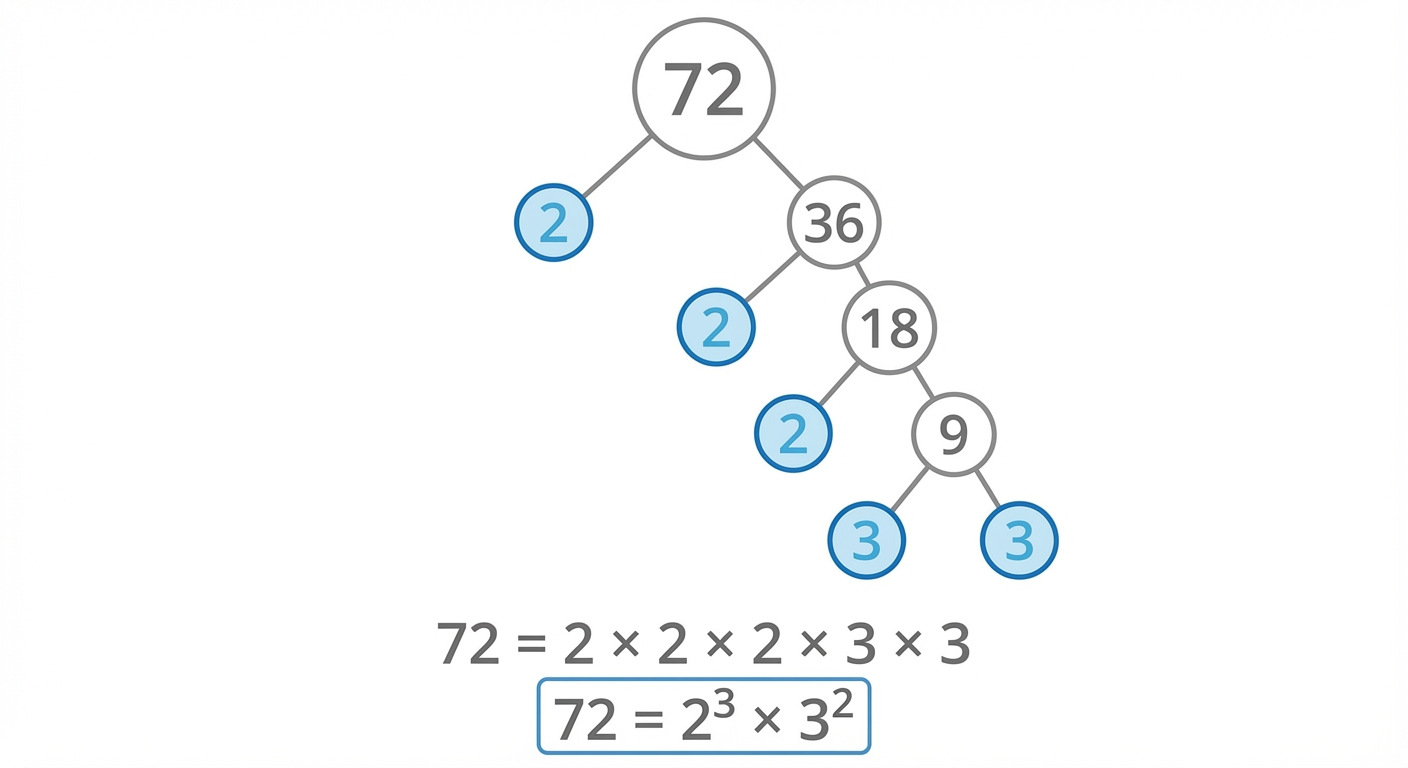
This leads us to two super important ideas: the Highest Common Factor (HCF) and the Lowest Common Multiple (LCM). The HCF is the biggest factor that two numbers share – useful for simplifying fractions or splitting things into equal groups. The LCM is the smallest number that is a multiple of both numbers – perfect for figuring out when two things will happen at the same time. To find these, we often use Prime Factorisation, which is breaking a number down into a product of its prime factors.
Finally, we have Rational Numbers (any number that can be written as a fraction, like $\frac{1}{2}$, 7, or 0.25) and Irrational Numbers (numbers that can't, like $\pi$ or $\sqrt{2}$ – their decimals go on forever without repeating!). And don't forget the Reciprocal, which is just 1 divided by the number. The reciprocal of 5 is $\frac{1}{5}$. It's like flipping the number upside down. Mastering these types will give you a massive power-up for the rest of the course! 💪
Worked Example: Prime Factorisation, HCF, and LCM
Worked Example: The Ultimate Party Plan 🥳
a) What is the greatest number of snack plates you can make?
b) If two separate prize draws happen every 72 seconds and 90 seconds, after how many seconds will they first happen at the same time?
- 1First, let's break down our numbers into their prime factors. This is like finding the basic DNA of 72 and 90. We'll use factor trees to make it visual.$72 = 2 \times 36 = 2 \times 2 \times 18 = 2 \times 2 \times 2 \times 9 = 2^3 \times 3^2$
$90 = 2 \times 45 = 2 \times 3 \times 15 = 2 \times 3 \times 3 \times 5 = 2 \times 3^2 \times 5$ - 2To find the greatest number of snack plates (part a), we need the Highest Common Factor (HCF). We look at the prime factors and multiply the lowest power of each factor that they both share.$\text{Common factors are } 2 \text{ and } 3^2.<br>\text{HCF} = 2^1 \times 3^2 = 2 \times 9 = 18$
So, you can make a maximum of 18 identical snack plates! - 3Now for the prize draws (part b), we need to find when they'll sync up. This means finding the Lowest Common Multiple (LCM). To find the LCM, we multiply the highest power of all the prime factors from both numbers.$\text{Highest power of 2 is } 2^3.<br>\text{Highest power of 3 is } 3^2.<br>\text{Highest power of 5 is } 5^1.<br>\text{LCM} = 2^3 \times 3^2 \times 5 = 8 \times 9 \times 5 = 360$
- 4Let's finalise the answers. The HCF gives us the answer for the snack plates, and the LCM gives us the answer for the prize draws.a) The greatest number of snack plates is 18. Each plate will have $72 \div 18 = 4$ sausage rolls and $90 \div 18 = 5$ spring rolls.
b) The prize draws will happen at the same time after 360 seconds (or 6 minutes).
b) The prize draws will happen at the same time after 360 seconds (or 6 minutes).
12. Powers, Roots, and Indices
For your IGCSE, you basically need to have a playlist of key squares and cubes on repeat in your head. You need to know the squares of all the numbers from 1 to 15 (like $13^2 = 169$) and the cubes of 1, 2, 3, 4, 5, and 10 (like $4^3 = 64$).
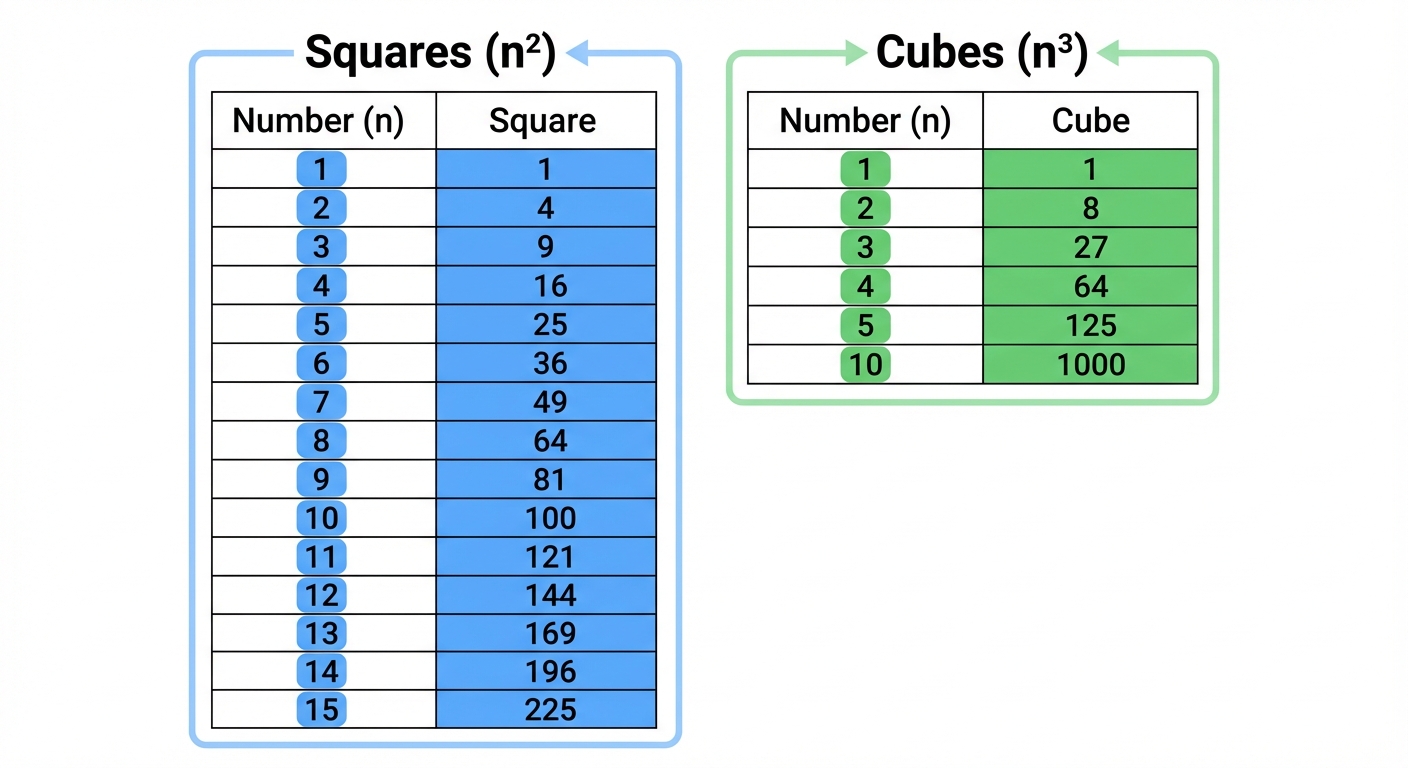
Now, what about roots? Roots are the reverse operation. They're like hitting 'undo' or finding out the original number before it was powered up. The square root ($\sqrt{...}$) asks: 'What number, when multiplied by itself, gives me this number?' So, $\sqrt{144}$ is 12. A cube root ($\sqrt[3]{...}$) asks: 'What number, multiplied by itself twice, gives me this?' So, $\sqrt[3]{27}$ is 3, because $3 \times 3 \times 3 = 27$. The exam will often mix these up in a single question, asking you to calculate something like $5^2 \times \sqrt[3]{8}$. Just stay calm, solve each part separately ($5^2 = 25$ and $\sqrt[3]{8} = 2$), and then do the final operation ($25 \times 2 = 50$). You've got this!
Worked Example: Calculating with Powers and Roots
The Ultimate Calculation Mashup ✨
- 1Okay, let's break this expression down. It looks complicated, but it's just three mini-problems in one. We need to handle the square ($12^2$), the cube root ($\sqrt[3]{125}$), and the square root ($\sqrt{49}$) separately before we combine them.$ (12^2) + (\sqrt[3]{125}) - (\sqrt{49}) $
- 2First up, the square. $12^2$ means $12 \times 12$. This is one of the key squares you need to memorise for the exam!$ 12^2 = 12 \times 12 = 144 $
- 3Next, the cube root. We're looking for the number that, when multiplied by itself three times, gives 125. Since it ends in a 5, the answer is probably 5. Let's check: $5 \times 5 \times 5 = 25 \times 5 = 125$. Perfect. This is another one to lock in your memory.$ \sqrt[3]{125} = 5 $
- 4Last of the mini-problems: the square root. What number times itself equals 49? That's a classic from your times tables.$ \sqrt{49} = 7 $
- 5Now we're on the final level. We just substitute our answers back into the original expression and solve it like a normal calculation. Follow the order of operations.$ 144 + 5 - 7 = 149 - 7 = 142 $
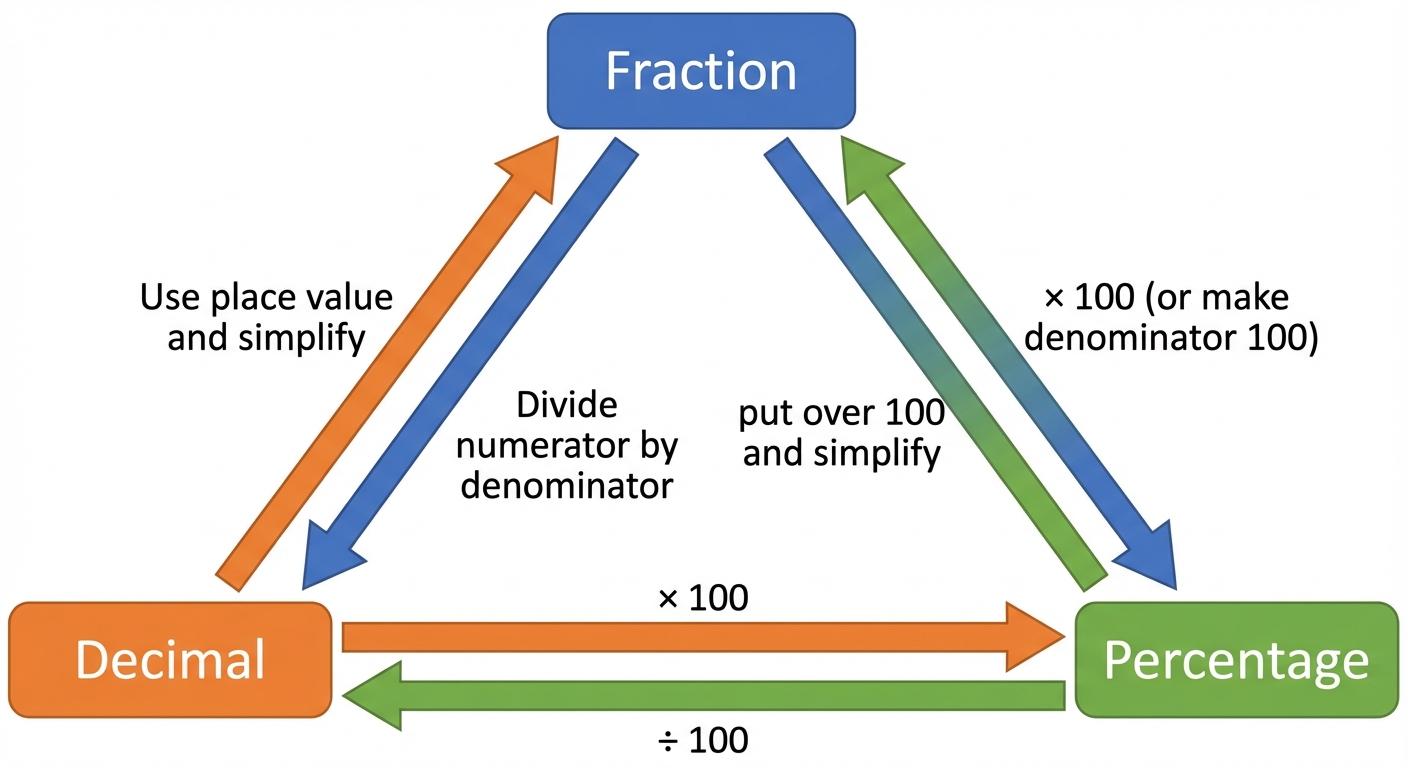
13. Equivalence and Conversion of Fractions, Decimals, and Percentages
The real skill is being able to switch between these forms seamlessly. It's like a quick-change in a video game.
Worked Example: Multi-Step Percentage Decrease
That Sale Price Isn't Gonna Calculate Itself 🛍️
- 1First, let's figure out the initial 15% discount. The easiest way is to convert the percentage to a decimal and multiply it by the original price.$15\% = 0.15 \\ \text{Discount} = 0.15 \times \$80 = \$12$
- 2Now, subtract that discount from the original price to find the first sale price. This is the price before your extra loyalty discount.$\text{Sale Price} = \$80 - \$12 = \$68$
- 3Super important: The next 10% discount is taken from the new sale price ($68), not the original $80. Let's calculate this second discount.$10\% = 0.10 \\ \text{Second Discount} = 0.10 \times \$68 = \$6.80$
- 4Finally, subtract the second discount from the sale price to get the final price you'll pay at the checkout. GG! 🎮$\text{Final Price} = \$68 - \$6.80 = \$61.20$
14. Ordering Quantities by Magnitude
First, the basics: $=$ means 'is equal to' and $≠$ means 'is not equal to'. Simple enough.
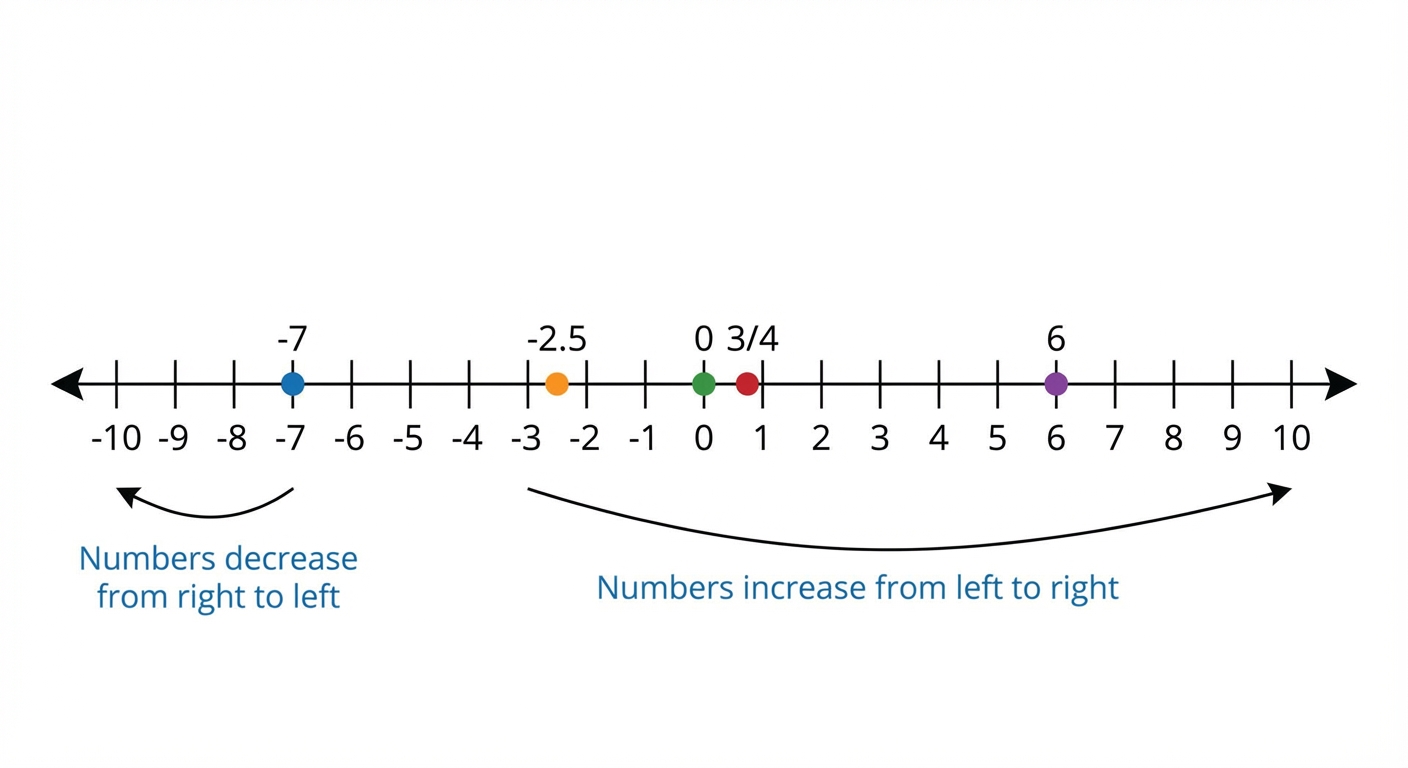
Now for the cool kids, the inequalities. Think of the symbols $>$ (greater than) and $<$ (less than) as a hungry alligator that always wants to eat the bigger number. So, in $10 > 5$, the alligator's mouth is open towards the 10. Easy peasy. The symbols $≥$ (greater than or equal to) and $≤$ (less than or equal to) are just a little extra. For example, to get your driver's license, your age must be $≥ 17$. You can be 17 or older. To get a student discount, you might need to be $≤ 18$, meaning 18 or younger.
Worked Example: Comparing Financial Data
Sorting Out Your Friends' Account Balances 💸
- 1First up, let's list all the financial amounts we need to compare. We have your balance, Sam's, Chloe's, and David's. One of them needs a quick calculation.Your Balance: $£15.50$
Sam's Balance: $-£5$
Chloe's Balance: $\frac{1}{2} \times £20$
David's Balance: $-£5.25$ - 2To make them easy to compare, let's make sure every value is in the same format. The only one that isn't a simple decimal or integer is Chloe's, so let's calculate that.$ \text{Chloe's Balance} = \frac{1}{2} \times 20 = £10 $
- 3Now we have a clean list of decimals and integers. This is much easier to work with!The numbers to order are: $15.50, -5, 10, -5.25$
- 4Let's think about a number line. The negative numbers are the smallest. The more negative a number is, the smaller it is. So, $-5.25$ is smaller than $-5$. Then we have the positive numbers, where $10$ is smaller than $15.50$.Smallest to Largest: $-5.25$, then $-5$, then $10$, then $15.50$
- 5Finally, let's write it out as one continuous inequality, just like the question asks. This shows the final, ranked order of everyone's money.$ -5.25 < -5 < 10 < 15.50 $
15. Standard Form and Calculations
So, how do we get there? Imagine a number like the views on a viral TikTok video: 580,000,000. To put this in standard form, we need to move the decimal point (which is hiding at the end) until there's only one non-zero digit in front of it. We move it 8 spots to the left to get 5.8. Since we moved it 8 places, our power of 10 is 8. So, it becomes $5.8 \times 10^8$. Easy, right? The positive power tells you it's a big number.
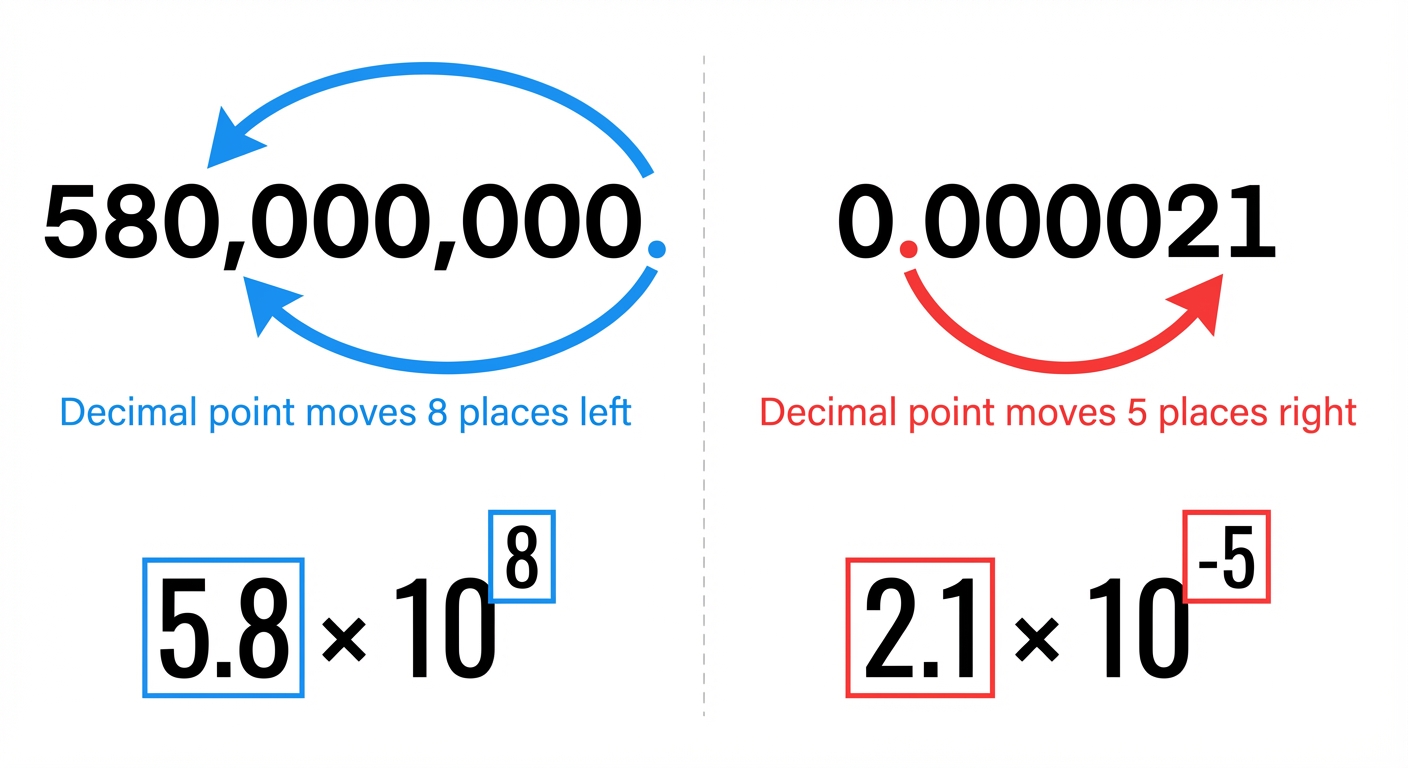
What about tiny numbers, like the diameter of a red blood cell, say 0.0000075 metres? Same idea, but we move the decimal to the right to get 7.5. We moved it 6 spots, but because we started with a tiny decimal, the power is negative. So, it's $7.5 \times 10^{-6}$. The negative power is a dead giveaway that you're dealing with a number smaller than 1.
For your IGCSE Core Paper 3, you'll need to calculate with these. Don't panic! Your calculator is your best friend here. Look for a button that looks like `x10^x`, `EXP`, or `EE`. To multiply $(2 \times 10^5)$ by $(3 \times 10^2)$, you'd just type it in. The calculator handles the magic, which is basically multiplying the main numbers ($2 \times 3 = 6$) and adding the powers ($5 + 2 = 7$) to get $6 \times 10^7$. It's basically a cheat code for handling huge numbers in calculations. 😉
Worked Example: Application of Standard Form
Calculating Your Spotify Stream Time 🎧
- 1First, let's get both our numbers ready for the calculation. The number of streams is already in standard form: $1.5 \times 10^9$. We need to convert the song length, 200 seconds, into standard form. To do this, we move the decimal point two places to the left.$200 = 2.0 \times 10^2$
- 2To find the total time, we need to multiply the number of streams by the length of one stream. Think of it like this: if you play a game for 30 minutes every day for 10 days, you'd multiply $30 \times 10$ to get the total time.$Total \; Time = (Number \; of \; Streams) \times (Length \; of \; Song)$ $Total \; Time = (1.5 \times 10^9) \times (2 \times 10^2)$
- 3Now for the calculation. We multiply the front numbers together ($1.5 \times 2$) and then we add the powers of 10 ($9 + 2$). On Paper 3, you can just plug this straight into your calculator using the `x10^x` or `EXP` button, but it's good to know what's happening behind the scenes!$1.5 \times 2 = 3$ $10^9 \times 10^2 = 10^{9+2} = 10^{11}$
- 4Let's put it all together. Our final answer is the product of the two parts. We check that the front number (3) is between 1 and 10, which it is, so our answer is in correct standard form. That's a lot of listening time!$Total \; Time = 3 \times 10^{11} \; seconds$
16. Limits of Accuracy and Error Intervals
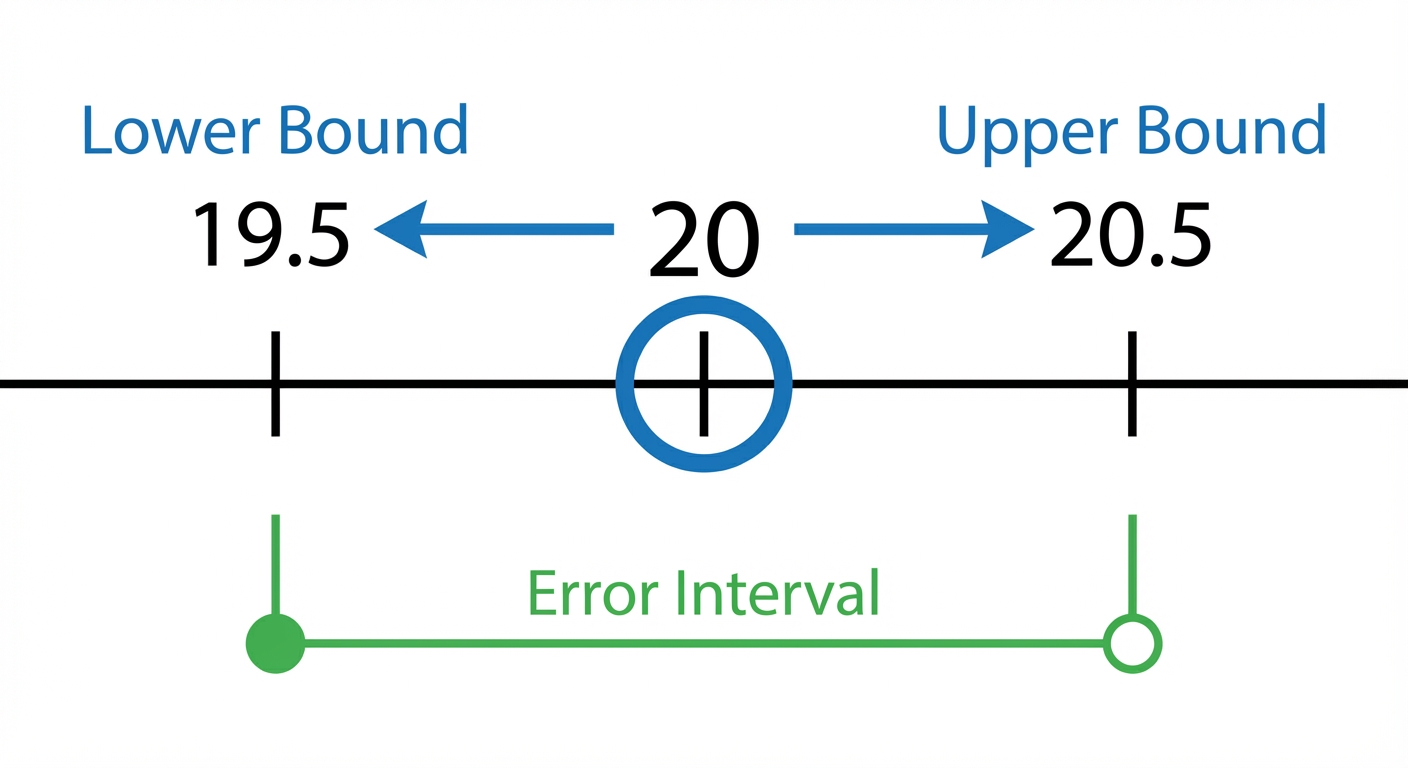
Here’s the simple trick to find it: First, identify the degree of accuracy (e.g., rounded to the nearest 10, nearest whole number, nearest metre). Then, just halve that accuracy value. You subtract this result from your rounded number to find the Lower Bound (the absolute minimum it could have been) and you add it to find the Upper Bound (the value it gets up to, but doesn't quite include). So if your gaming session was 5 hours long (to the nearest hour), the accuracy is 1 hour. Half of that is 0.5 hours. The lower bound is $5 - 0.5 = 4.5$ hours, and the upper bound is $5 + 0.5 = 5.5$ hours. We write this as an error interval: $4.5 \le \text{time} < 5.5$. That 'less than' sign ($<$) for the upper bound is crucial – it's because if the time was exactly 5.5 hours, it would round up to 6! It's the ultimate limit you can't quite reach.
Calculating Bounds for a Measured Length
How Long Was That Drive, REALLY? 🚗
- 1First, let's pull out the key info. We have the measured value and how accurately it was measured. This is our starting point.Measured Value = 25 km
Accuracy = 1 km - 2This is the most important move! To find the 'wiggle room' on either side of 25 km, we take the accuracy (1 km) and chop it in half.$\frac{1}{2} = 0.5 \text{ km}$
- 3To find the Lower Bound (the shortest the trip could possibly be), we subtract our 'wiggle room' value from the measured distance.$25 - 0.5 = 24.5 \text{ km}$
- 4Now for the Upper Bound. We add the 'wiggle room' value to the measured distance. This is the value the actual distance gets right up to, but can't be equal to (or it would round up!).$25 + 0.5 = 25.5 \text{ km}$
- 5Finally, we write this as an error interval using inequalities. We're saying the actual distance, $d$, is greater than or equal to the lower bound, but strictly less than the upper bound. Done! ✅$24.5 \le d < 25.5$
17. Ratio, Proportion, and Rates
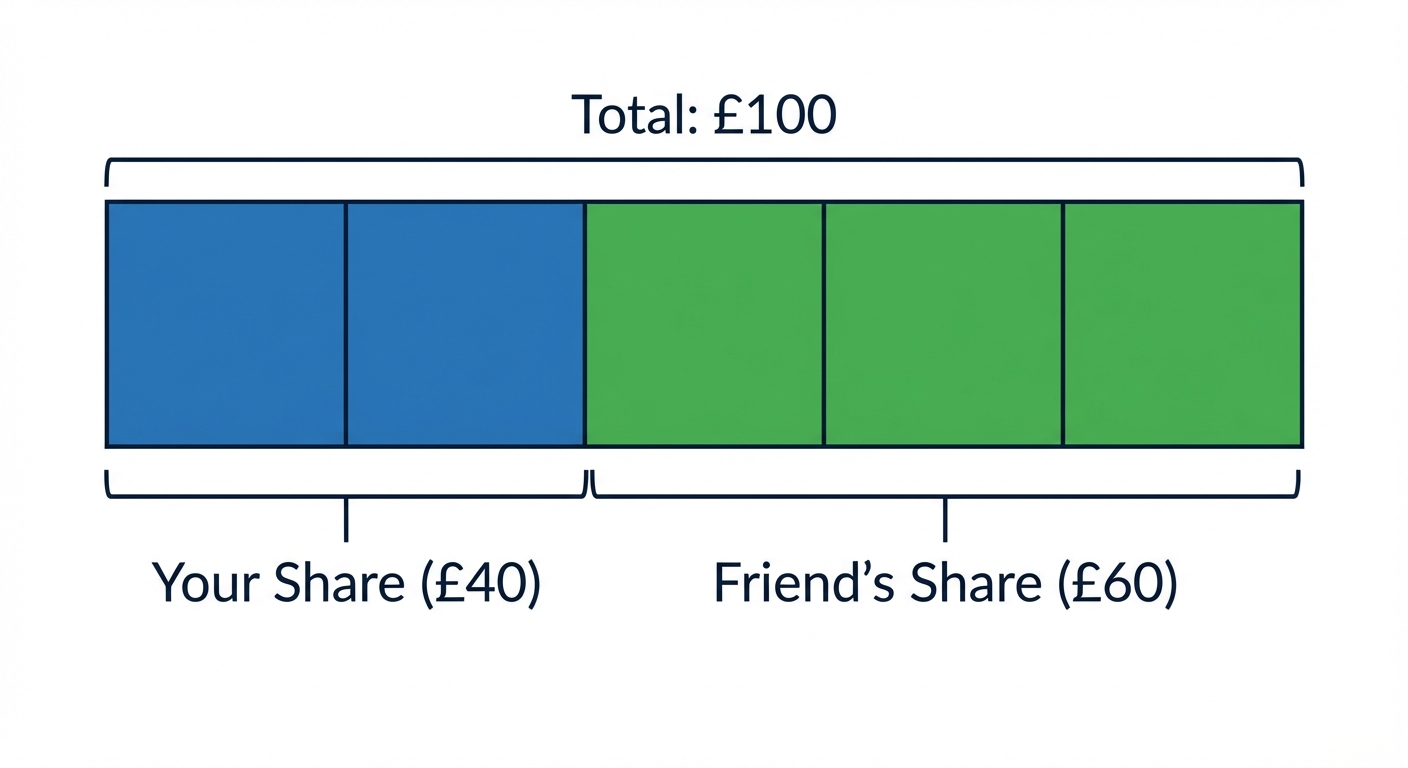
Now, let's get to the good part: dividing stuff up. Let's say you and your friend earn £100 on a joint project and you agree to split it in that 2:3 ratio. How do you do it? First, add the parts of the ratio: $2 + 3 = 5$ total parts. Then, divide the total amount by the number of parts to find what one part is worth: $£100 \div 5 = £20$. So, one part is £20. Your share is 2 parts ($2 \times £20 = £40$) and your friend's is 3 parts ($3 \times £20 = £60$). Easy, right?
Finally, let's talk rates. A rate compares two different types of units. The most common one you'll face is speed, which is a rate that compares distance and time. When you're learning to drive, you're constantly thinking about your speed in km/h or mph. The magic formula you need to tattoo on your brain is: $Average\ Speed = \frac{Total\ Distance}{Total\ Time}$ So, if you travel 150 km in 2 hours, your average speed is $150 \div 2 = 75$ km/h. It’s the same principle for things like download speeds (Megabits per second) or pay rates (Pounds per hour). It's all just about how much of one thing happens per unit of another thing. Master these, and you've got a massive advantage for your exams! 😉
Worked Example: Ratio and Average Speed in Context
Solving a Road Trip Problem 🚗💨
(a) Calculate how much each person pays for petrol.
(b) Calculate the average speed of the car for the trip in km/h.
- 1First, let's tackle part (a), splitting the cost. We need to find the total number of parts in the ratio to figure out what one 'part' of the cost is worth.$Total\ Parts = 3 + 2 + 5 = 10\ parts$
- 2Now, we divide the total cost by the total number of parts to find the value of a single part.$Value\ of\ 1\ part = \frac{Total\ Cost}{Total\ Parts} = \frac{£80}{10} = £8$
- 3Finally for part (a), we multiply the value of one part by each person's number of parts in the ratio to find their individual shares.$Your\ share (3\ parts): 3 \times £8 = £24<br>Liam's\ share (2\ parts): 2 \times £8 = £16<br>Sara's\ share (5\ parts): 5 \times £8 = £40$
- 4On to part (b)! We need to calculate the average speed. Let's start by writing down the formula.$Average\ Speed = \frac{Total\ Distance}{Total\ Time}$
- 5Now we substitute the values given in the problem into our formula. The total distance is 360 km and the total time is 8 hours.$Average\ Speed = \frac{360\ km}{8\ hours}$
- 6Last step! We just do the division to find the final answer. Don't forget the units!$Average\ Speed = 45\ km/h$
18. Practical Calculations with Time and Money
This gets super important when reading timetables for a part-time job or a train to a festival.
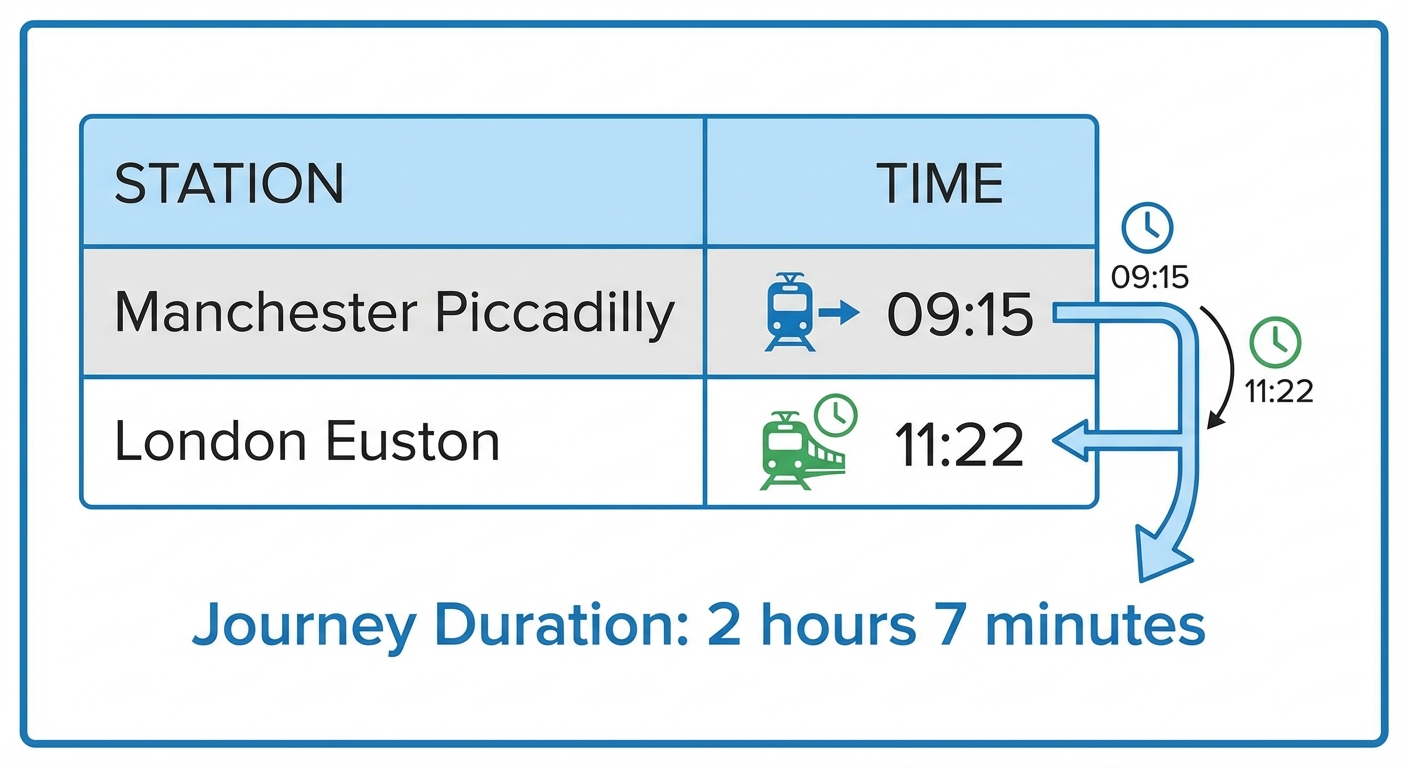
Now for the money part. Let's say you want to buy some merch from a US artist's website. The price is in dollars (\$), but you have pounds (£). You'll need the exchange rate, like $£1 = \$1.25$. To find the price in pounds, you'd divide the dollar price by 1.25. Mastering these calculations means you can plan trips, shop online, and coordinate with anyone, anywhere, without getting your times or your money mixed up. It's practical math for a connected world.
Worked Example: International Travel and Currency Conversion
The Ultimate Glow-Up: From Tokyo to London ✈️💸
Calculate:
a) Her arrival time and date in London (local time).
b) The cost of the souvenir in pounds (£), to 2 decimal places.
- 1First, let's figure out the arrival time in Tokyo's time zone. We do this by adding the flight duration to the departure time.$\text{Departure Time: } 11:30 \text{ (Tuesday)} \\ \text{Add flight duration: } + 14 \text{ hours } 15 \text{ minutes} \\ \text{Calculation: } 11:30 + 14h = 25:30. \text{ Then } 25:30 + 15m = 25:45 \\ \text{Since 24:00 is midnight, } 25:45 \text{ is } 01:45 \text{ the next day.} \\ \text{Arrival time (Tokyo time): } 01:45 \text{ on Wednesday}$
- 2Now we need to adjust for the 9-hour time difference. London is 9 hours behind Tokyo, so we subtract 9 hours from the Tokyo arrival time.$\text{Tokyo arrival time: } 01:45 \text{ (Wednesday)} \\ \text{Subtract time difference: } - 9 \text{ hours} \\ \text{Let's count back: } 01:45 \text{ back 1h 45m is } 00:00 \text{ (start of Wed). We still need to go back } 7h \text{ 15m.} \\ 24:00 \text{ (end of Tue) } - 7 \text{ hours } 15 \text{ minutes} = 16:45 \text{ (Tuesday)} \\ \text{Arrival time (London time): } 16:45 \text{ on Tuesday}$
- 3For the souvenir, we need to convert Japanese Yen (¥) to British Pounds (£). The rate is $£1 = ¥175$. To find how many pounds we get, we divide the amount in yen by the exchange rate.$\text{Cost in } £ = \frac{\text{Cost in } ¥}{\text{Exchange Rate}} \\ \text{Cost in } £ = \frac{2500}{175}$
- 4Finally, we do the division and round the answer to 2 decimal places, because money always has two decimal places for cents or pence.$2500 \div 175 = 14.285714... \\ \text{Rounding to 2 d.p. gives } £14.29 \\ \text{The souvenir cost } £14.29$
19. Set Notation and Venn Diagrams
To visualize how these groups relate, we use Venn diagrams. They're basically just overlapping circles inside a box. The box is our universal set E, and each circle is a specific set, like 'students who have a driver's license' (Set A) and 'students with a part-time job' (Set B).
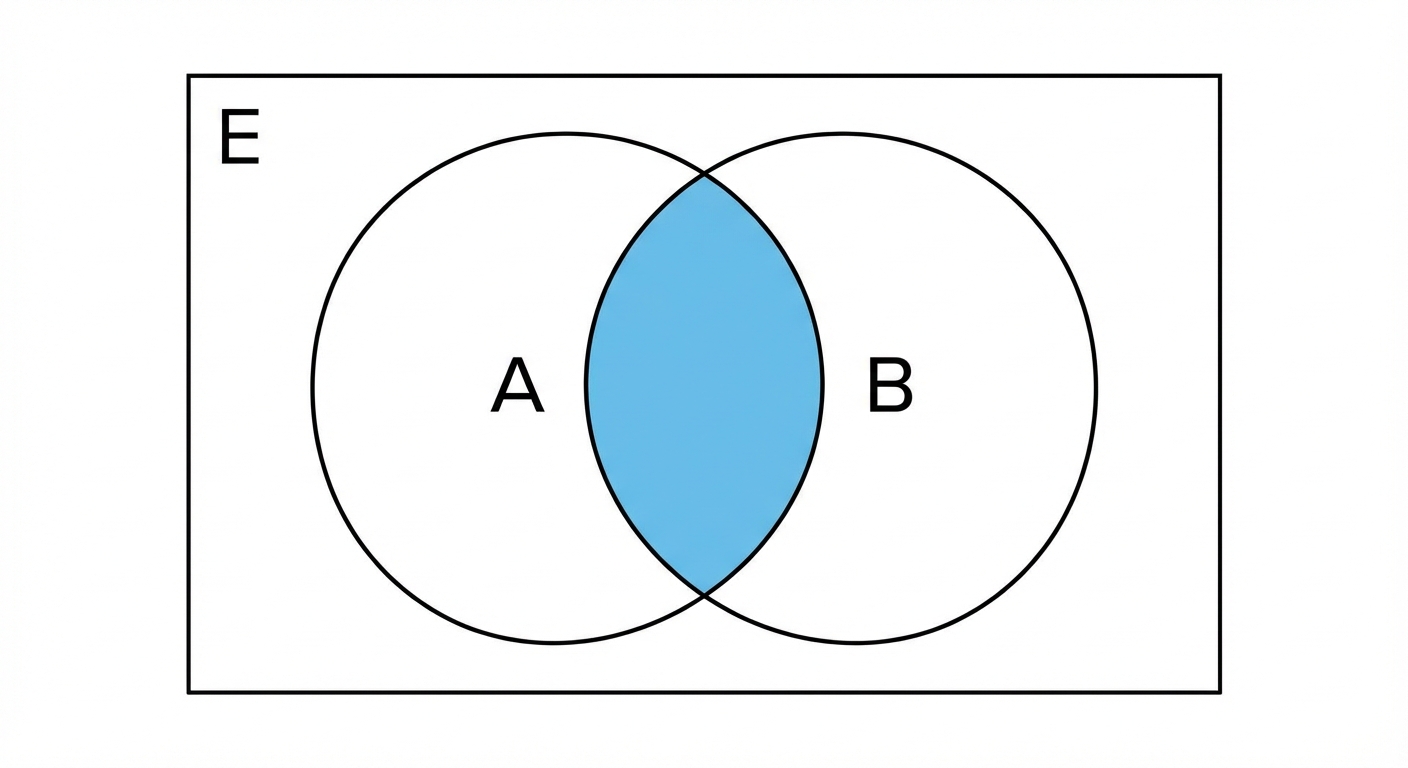
Now for the lingo, which is actually super simple once you get it:
• $n(A)$: This just means 'the number of elements in set A'. So, if 12 of your friends have a driver's license, $n(A) = 12$.
• $A \cap B$: This is the intersection. It's the stuff that's in BOTH sets A AND B. Think of it as the overlap in the circles – the friends who both drive and have a job. The $\cap$ symbol looks like a bridge connecting them.
• $A \cup B$: This is the union. It's everyone who is in set A, OR set B, OR both. It's like merging two group chats – you get everyone from both groups combined.
• $A'$: This is the complement of A. It means everything in the universal set that is NOT in A. If A is people with a job, $A'$ is everyone without one.
Worked Example: Analyzing Student Hobbies
Solving a Real-World Venn Diagram Problem 🎮
- 1First, let's draw the basic Venn diagram. We need a rectangle for our universal set, E, which has 40 students in total. Inside, we'll draw two overlapping circles for our sets, S (Spotify) and N (Netflix).[IMAGE_PLACEHOLDER_2: A blank Venn diagram with two overlapping circles labeled S and N inside a rectangle labeled E.]
- 2The golden rule of Venn diagrams is to always start from the middle! The middle is the intersection, $S \cap N$. The problem tells us that 10 students use both services, so we put '10' in the overlapping section.$ n(S \cap N) = 10 $
- 3Now, let's figure out the 'Spotify only' part. We know the entire Spotify circle, $n(S)$, must have 25 students. Since 10 are already in the overlap, the number of students who only use Spotify is the total minus the overlap.$ \text{Spotify only} = n(S) - n(S \cap N) = 25 - 10 = 15 $
- 4We do the same thing for the 'Netflix only' part. The whole Netflix circle, $n(N)$, has 22 students. Subtract the 10 who are also in the Spotify group to find those who are exclusive to Netflix.$ \text{Netflix only} = n(N) - n(S \cap N) = 22 - 10 = 12 $
- 5Finally, we need to find how many students use neither service. This is the number that goes outside the circles but still inside the box. We add up everyone inside the circles and subtract that total from the universal set, E.$ \text{Total in circles} = 15 (S \text{ only}) + 10 (Both) + 12 (N \text{ only}) = 37 <br> \text{Neither} = n(E) - 37 = 40 - 37 = 3 $
20. Using a Calculator Effectively
Stuff you actually need to know:
• Brackets around fractions. For $\dfrac{8+4}{3}$ type `(8+4)/3`, not `8+4/3`. Without the brackets the calculator does $8 + \tfrac{4}{3}$, which is a completely different number. Same vibe as autocorrect ruining your group chat.
• Use `Ans` to recall your last answer instead of retyping. Typos are the enemy.
• Time entry. $2$ hours $30$ min is $2.5$ on a calculator (because 30 min = half an hour). Or use the degree-minute-second button: `2° 30' 0"`. Never $2.30$ — that's $2$ h $18$ min, totally different.
• Money on the display. If the answer shows $4.8$, that's $\$4.80$. Always 2 d.p. for money. No exceptions. 💰
• Powers and roots. `^` for any power. Shifted root key for cube/nth roots. For $5^{-2}$ wrap the negative: `5^(-2)`.
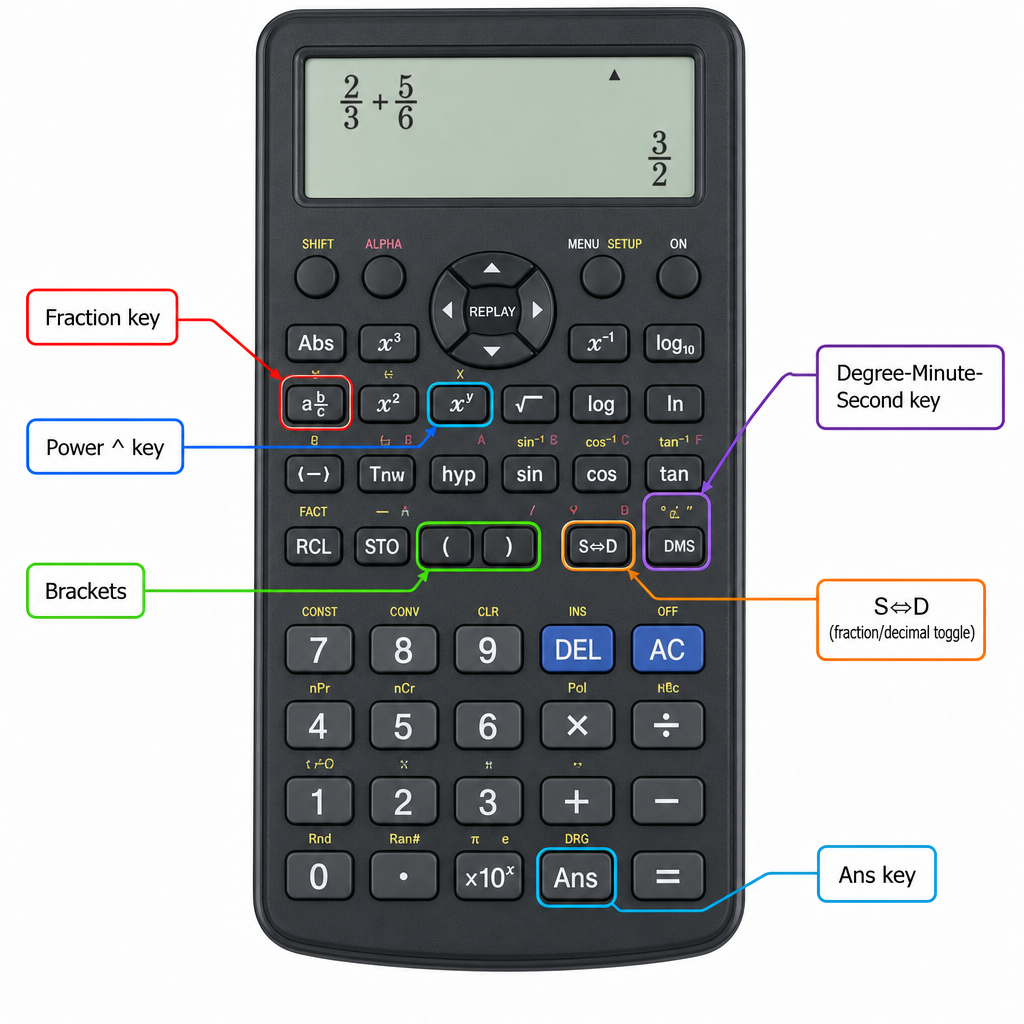
Reading the display: a screen showing `1.234E3` or `1.234×10³` is just standard form (that's $1234$). Don't panic, don't copy the `E` — write it as $1.234 \times 10^{3}$ in your answer. Calculator talk ≠ maths talk. 📱
Worked Example: Calculator Use — Fractions, Time and Brackets
- 1For (a), bracket the numerator — otherwise the calculator thinks you meant $12.5 - \tfrac{3.5}{1.5}$. Different universe.$\frac{12.5 - 3.5}{1.5} = \frac{9}{1.5} = 6$
- 2For (b), subtract times in base 60. $20 - 45$ doesn't work, so borrow 1 hour (= 60 min): $11\!:\!20$ becomes $10\!:\!80$.$10\!:\!80 - 8\!:\!45 = 2\!:\!35$
- 3Now convert $2$ h $35$ min to total minutes.$2 \times 60 + 35 = 120 + 35 = 155 \text{ minutes}$
- 4For (c), bracket the expression under the root. Recognise this as Pythagoras — nice round answer incoming. 😎$\sqrt{15^2 + 8^2} = \sqrt{225 + 64} = \sqrt{289} = 17$
Worked Example: Compound Interest
- 1Lock in the compound interest formula. $P$ = starting amount, $r$ = rate, $n$ = number of years.$A = P \left(1 + \frac{r}{100}\right)^n$
- 2Sub in $P = 2000$, $r = 5$, $n = 3$. Don't round yet — keep the full decimal.$A = 2000 \times (1.05)^3 = 2000 \times 1.157625$
- 3Evaluate and round to 2 d.p. (money = 2 d.p., always).$A = \$2315.25$
- 4For (b), interest is just the extra money — final amount minus what you started with.$\text{Interest} = 2315.25 - 2000 = \$315.25$
Practice this in the app
Unlock the full chapter: practice questions, flashcards, mock papers and notes, free.