Linear Equations, Inequalities, and Simultaneous Equations
Algebra Level Up: From 'IDK' to 'Let's Go!' 🚀
Introduction
1. Introduction
Alright, let's talk Algebra. I know, I know, sometimes it feels like trying to read a secret code. But what if I told you it's actually more like a video game? Once you learn the cheat codes (aka the rules), you can solve any level. We're going to cover everything from solving for that mysterious $x$ to making two equations work together. By the end of this, you'll be the GOAT of algebra. Let's get this bread! 🥖
2. Solving Basic Linear Equations
Okay, first things first. A linear equation is just a puzzle where you have to find the value of a missing piece, usually called $x$. Your mission, should you choose to accept it, is to get $x$ all by itself on one side of the equals sign. To do this, you use inverse operations. Think of it like a 'reverse card' in Uno. If the equation adds 5, you subtract 5 from both sides. If it multiplies by 2, you divide by 2 on both sides. Whatever you do to one side, you must do to the other to keep it balanced. It's all about fairness! ⚖️
Worked example
Worked Example: Application of Linear Equations
Worked Example: Cracking the Code
You work part-time and after your boss adds a £10 bonus, your pay is £40. If you worked for 5 hours, what is your hourly rate ($h$)? The equation is $5h + 10 = 40$.
- 1We want to isolate the term with $h$. The opposite of adding 10 is subtracting 10. So, let's subtract 10 from both sides to keep things balanced.$5h + 10 - 10 = 40 - 10$
$5h = 30$ - 2Now, $h$ is being multiplied by 5. The inverse operation is division. Let's divide both sides by 5 to get $h$ on its own.$\frac{5h}{5} = \frac{30}{5}$
$h = 6$ - 3Boom! You've solved it. Your hourly rate is £6. Not bad!$h = 6$
Answer
$h = 6$
3. Solving Linear Equations with Brackets
Sometimes, equations come with brackets, like this: $3(x + 2) = 15$. Think of the brackets like a party pack. Before you can use what's inside, you have to open it up! This is called expanding the brackets. You multiply the number outside the bracket by everything inside the bracket. Once you've expanded, it just becomes a normal linear equation that you already know how to solve. Easy peasy.
Worked example
Worked Example: Expanding Brackets to Solve Equations
Worked Example: Unpacking the Brackets
Solve the equation $4(x - 5) = 12$.
- 1First, let's expand the brackets. We multiply the 4 by the $x$ and by the $-5$. Don't forget that minus sign!$(4 \times x) + (4 \times -5) = 12$
$4x - 20 = 12$ - 2Now it's a standard two-step equation. Let's get rid of the $-20$ by adding 20 to both sides.$4x - 20 + 20 = 12 + 20$
$4x = 32$ - 3Finally, divide both sides by 4 to get $x$ by itself.$\frac{4x}{4} = \frac{32}{4}$
$x = 8$
Answer
$\frac{4x}{4} = \frac{32}{4}$
$x = 8$
$x = 8$
4. Solving Equations with Variables on Both Sides
Okay, things are getting spicy! Now you've got equations like $5x + 2 = 2x + 11$. The variable $x$ is on both sides of the equals sign. It's like trying to get all your friends into one group selfie – you need to get them all together! The goal is to collect like terms. We want to move all the $x$ terms to one side and all the number terms to the other. Pro tip: I always move the smaller $x$ term to avoid dealing with negatives. It's just a smoother ride.
Worked example
Worked Example: Equations with Variables on Both Sides
Worked Example: The Group Selfie
Solve for $x$ in the equation $7x - 4 = 3x + 16$.
- 1We have $7x$ on the left and $3x$ on the right. The smaller one is $3x$, so let's subtract $3x$ from both sides to get all the $x$'s on the left.$7x - 3x - 4 = 3x - 3x + 16$
$4x - 4 = 16$ - 2Look at that! It's a simple two-step equation now. We know what to do. Add 4 to both sides to isolate the $x$ term.$4x - 4 + 4 = 16 + 4$
$4x = 20$ - 3Last step! Divide by 4 to find out what $x$ is.$\frac{4x}{4} = \frac{20}{4}$
$x = 5$
Answer
$\frac{4x}{4} = \frac{20}{4}$
$x = 5$
$x = 5$
5. Introduction to Linear Inequalities
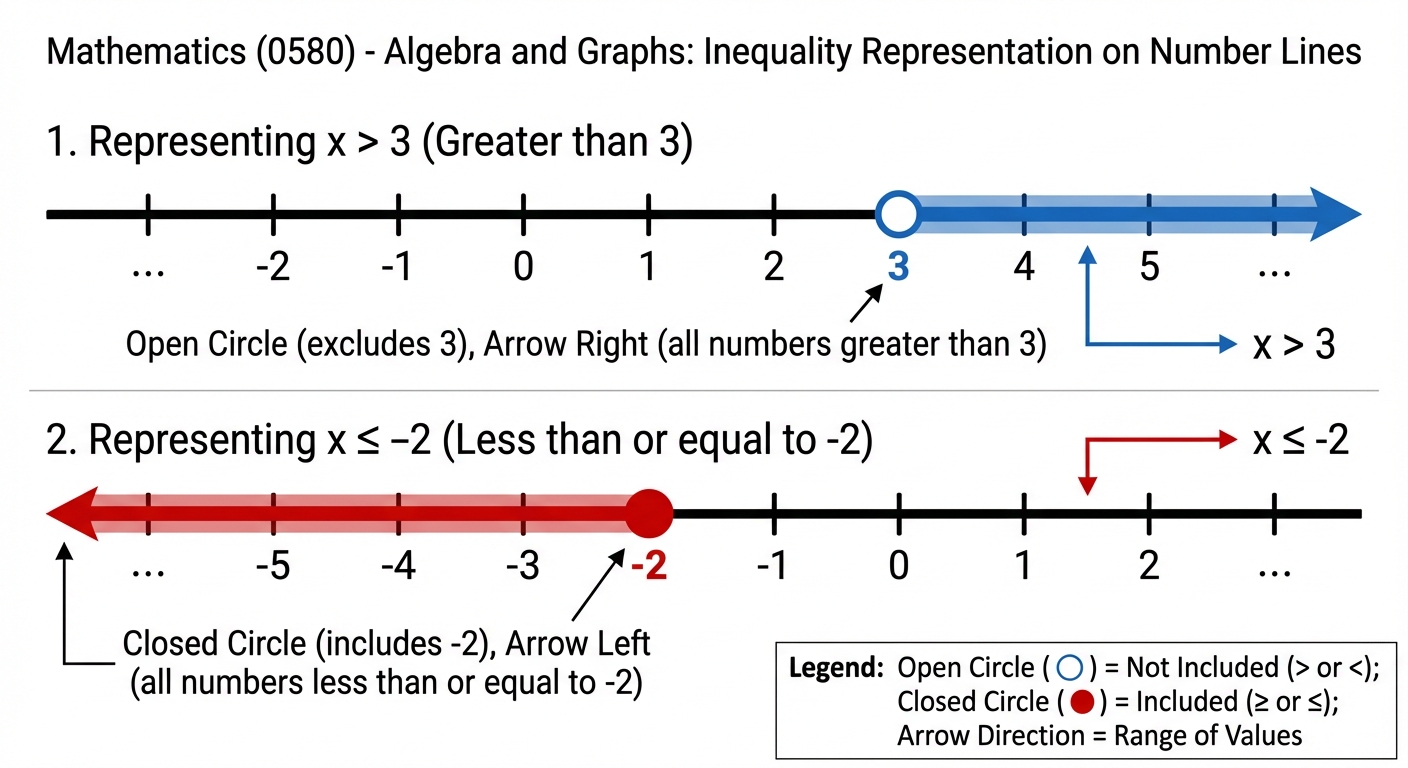
Inequalities are basically equations, but instead of an equals sign ($=$), they use signs like $<$ (less than), $>$ (greater than), $\le$ (less than or equal to), or $\ge$ (greater than or equal to). You solve them in the exact same way as equations. There's just ONE secret rule you have to remember: if you multiply or divide both sides by a negative number, you have to flip the inequality sign. It's like the game world turning upside down!
Worked example
Worked Example: Solving and Representing Inequalities
Worked Example: Solving an Inequality
Solve the inequality $3x - 5 > 10$ and show the result on a number line.
- 1Treat it just like an equation. The inverse of subtracting 5 is adding 5. Let's do that to both sides.$3x - 5 + 5 > 10 + 5$
$3x > 15$ - 2Now, divide both sides by 3. Since 3 is positive, we don't need to flip the sign. Phew!$\frac{3x}{3} > \frac{15}{3}$
$x > 5$ - 3The solution is any number greater than 5. On a number line, you'd draw an open circle at 5 (because it's not 'equal to') and an arrow pointing to the right.Solution: $x > 5$
Answer
Solution: $x > 5$
6. Forming and Solving Equations from Sequences
Remember the nth term? It's the rule that generates a sequence, like $T(n) = 4n + 1$. Here's a cool crossover: what if you have two different sequences and you want to know when they'll have a term with the same value? Maybe one represents your streaming service cost and the other your friend's. You just set their nth term formulas equal to each other! This creates an equation with variables on both sides, and you're already a pro at solving those.
Worked example
Worked Example: Finding Equal Terms in Sequences
Worked Example: Sequence Showdown
The nth term of sequence A is $5n - 2$. The nth term of sequence B is $3n + 8$. Find the value of $n$ for which the terms in both sequences are the same.
- 1To find when the terms are the same, we literally set the two expressions equal to each other. This is the key step!$5n - 2 = 3n + 8$
- 2It's an equation with variables on both sides! Let's subtract the smaller $n$ term, which is $3n$, from both sides.$5n - 3n - 2 = 3n - 3n + 8$
$2n - 2 = 8$ - 3Now it's a simple two-step equation. Add 2 to both sides.$2n = 10$
- 4Finally, divide by 2. This tells us that the 5th term in both sequences will be identical.$n = 5$
Answer
$n = 5$
7. Introduction to Simultaneous Linear Equations
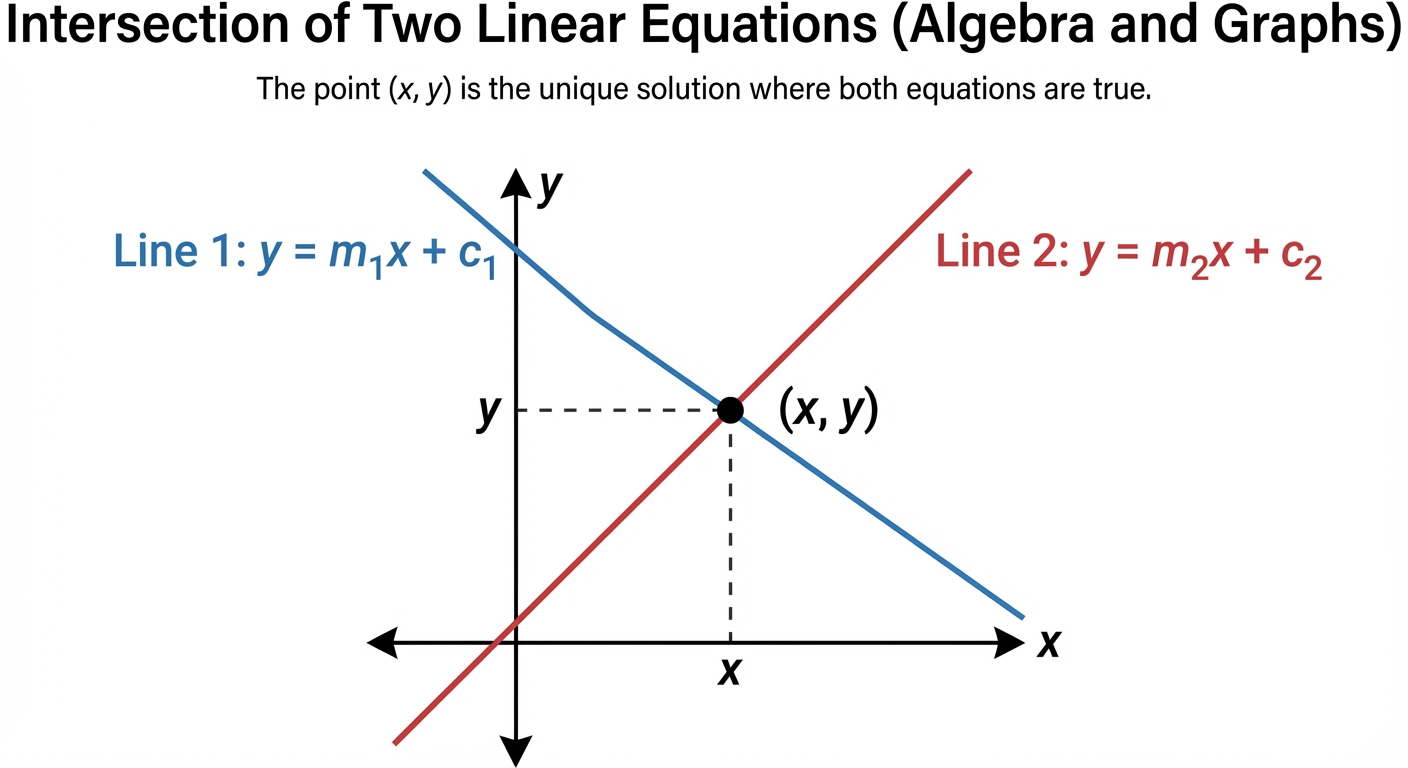
Welcome to the multiplayer level! Simultaneous equations are a pair of equations with two variables, like $x$ and $y$. You can't solve one without the other – they're a team. Think of it like this: you have two clues to a mystery. One clue alone isn't enough, but both together will crack the case. Graphically, the solution is the exact coordinate point $(x, y)$ where the two lines represented by the equations cross.
Worked example
Solving Simultaneous Equations by Substitution
Worked Example: The Mystery Point
Let's say one equation is $y = 2x + 1$ and the other is $x+y=7$. We can use substitution here. The first equation tells us exactly what $y$ is!
- 1We know $y$ is the same as $2x + 1$. So, let's substitute $(2x + 1)$ into the second equation wherever we see $y$.$x + (2x + 1) = 7$
- 2Now we have an equation with only one variable. Let's simplify and solve for $x$.$3x + 1 = 7$
$3x = 6$
$x = 2$ - 3We're halfway there! We know $x=2$. Now substitute this value back into one of the original equations to find $y$. The first one looks easiest.$y = 2(2) + 1$
$y = 4 + 1$
$y = 5$ - 4So the solution is $x=2$ and $y=5$. This is the point $(2, 5)$ where the two lines would meet on a graph.Solution: $(2, 5)$
Answer
Solution: $(2, 5)$
8. Solving Simultaneous Equations by Elimination
The elimination method is the GOAT for solving simultaneous equations. The goal is to add or subtract the two equations in a way that makes one of the variables disappear completely. Poof! Gone. To do this, you need the number in front of the variable you want to eliminate (the coefficient) to be the same in both equations. Sometimes you might have to multiply one or both equations first to make this happen. If the signs of the variables are the same (e.g., both are $+2y$), you subtract. If the signs are different (e.g., one is $+2y$ and the other is $-2y$), you add.
Worked example
Worked Example: Solution by Elimination
Worked Example: Elimination Takedown
Solve these simultaneous equations using elimination:
Equation 1: $3x + y = 11$
Equation 2: $2x - y = 4$
Equation 1: $3x + y = 11$
Equation 2: $2x - y = 4$
- 1Look at the $y$ terms. We have a $+y$ and a $-y$. The coefficients are basically 1 and -1. Since the signs are different, we can ADD the two equations together to eliminate $y$.$(3x + y) + (2x - y) = 11 + 4$
- 2Let's simplify that. The $y - y$ cancels out to zero. That's the elimination!$5x = 15$
- 3Now we have a super simple equation. Just divide by 5 to solve for $x$.$x = \frac{15}{5} = 3$
- 4We found $x=3$. Now substitute this back into either of the original equations to find $y$. Let's use Equation 1.$3(3) + y = 11$
$9 + y = 11$
$y = 11 - 9$
$y = 2$ - 5And we're done! The solution is $x=3$ and $y=2$. You just owned that problem. ✅Solution: $(3, 2)$
Answer
Solution: $(3, 2)$
9. Algebraic Manipulation: Simplifying, Expanding, and Factorising
Think of algebra like your social media feed – sometimes it gets messy and needs a good tidy up. That's exactly what algebraic manipulation is: organising expressions to make them simpler and easier to work with. Let's break down the three core skills you need to master.
First up is collecting like terms. This is just like sorting your Spotify playlists. You put all the pop songs together, all the rap songs together, etc. In algebra, 'like terms' are terms that have the exact same variable part (e.g., $x$, $y^2$, or $ab$). You can add or subtract their coefficients (the numbers out front), but you can't mix different 'genres'. For example, in $8x + 4y - 3x - 6y$, the $x$ terms are a group and the $y$ terms are another. We combine them: $(8x - 3x) + (4y - 6y)$ gives us the simplified answer $5x - 2y$.
Next is expanding brackets. This is like 'unboxing' an expression. The rule is that whatever is on the outside of the bracket must multiply with every single term on the inside. For an expression like $3a(2a - 5b)$, the $3a$ needs to multiply with both $2a$ and $-5b$.
First up is collecting like terms. This is just like sorting your Spotify playlists. You put all the pop songs together, all the rap songs together, etc. In algebra, 'like terms' are terms that have the exact same variable part (e.g., $x$, $y^2$, or $ab$). You can add or subtract their coefficients (the numbers out front), but you can't mix different 'genres'. For example, in $8x + 4y - 3x - 6y$, the $x$ terms are a group and the $y$ terms are another. We combine them: $(8x - 3x) + (4y - 6y)$ gives us the simplified answer $5x - 2y$.
Next is expanding brackets. This is like 'unboxing' an expression. The rule is that whatever is on the outside of the bracket must multiply with every single term on the inside. For an expression like $3a(2a - 5b)$, the $3a$ needs to multiply with both $2a$ and $-5b$.
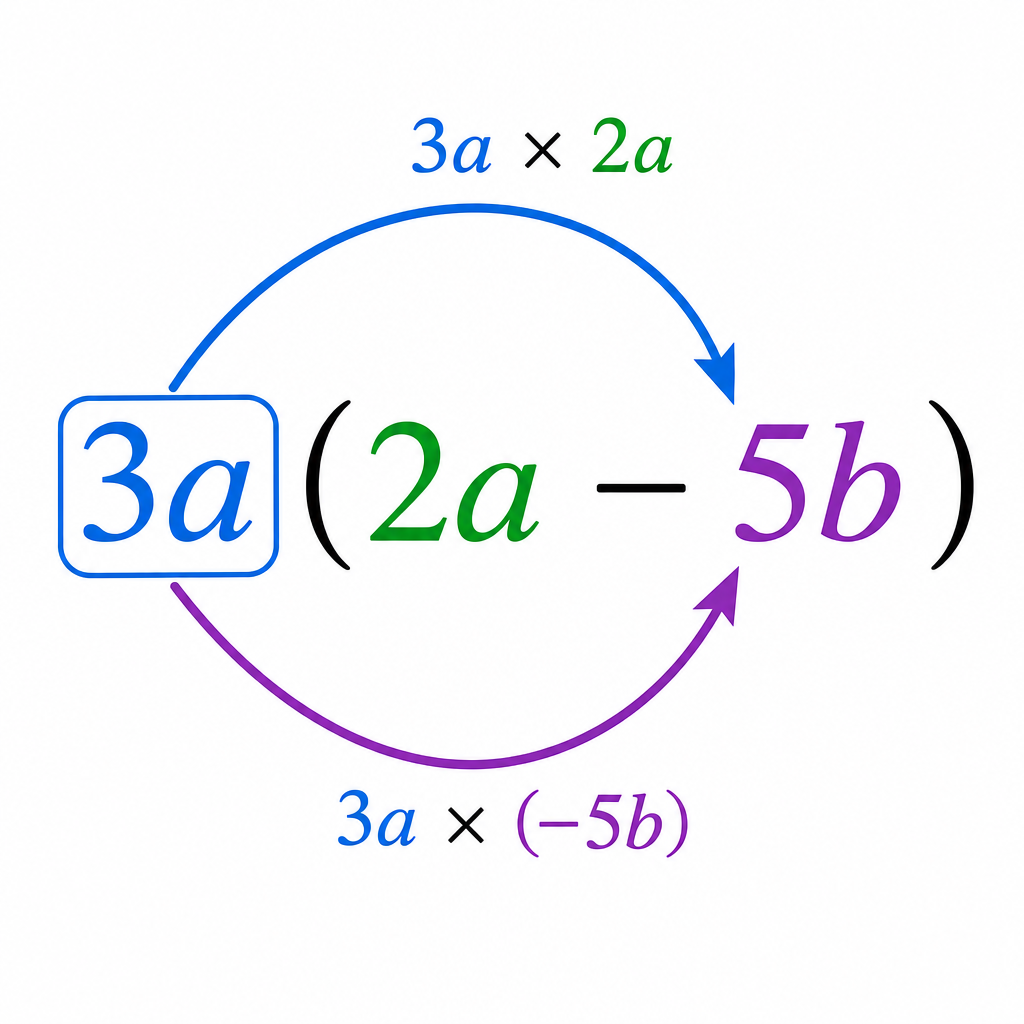
. This gives us $(3a \times 2a) + (3a \times -5b) = 6a^2 - 15ab$. For double brackets like $(x+2)(x-4)$, a great strategy is FOIL: First, Outer, Inner, Last. You multiply the first terms, then the outer terms, then the inner, then the last, and add them all up.
Finally, we have factorising. This is the reverse of expanding – we're putting the expression back into brackets. The key is to find the 'Highest Common Factor' (HCF) that all the terms share. It’s like finding the one thing your entire friend group agrees on. For $9x^2 + 15xy$, what's the biggest number that divides both 9 and 15? It's 3. What's the highest power of a variable they both have? It's $x$. So, our HCF is $3x$. We pull that out to the front and write what's left inside a bracket: $3x(3x + 5y)$. Job done! 👍
Finally, we have factorising. This is the reverse of expanding – we're putting the expression back into brackets. The key is to find the 'Highest Common Factor' (HCF) that all the terms share. It’s like finding the one thing your entire friend group agrees on. For $9x^2 + 15xy$, what's the biggest number that divides both 9 and 15? It's 3. What's the highest power of a variable they both have? It's $x$. So, our HCF is $3x$. We pull that out to the front and write what's left inside a bracket: $3x(3x + 5y)$. Job done! 👍
Worked example
Worked Example: Expanding and Simplifying a Combined Expression
Let's Solve This Thing! 🚀
You're calculating the total cost for a group of friends going to the cinema. The cost is represented by the expression $(3x + 2)(x - 5) + 4(x - 1)$. Simplify this expression fully.
- 1First, we need to expand both sets of brackets separately. Let's start with the double brackets, $(3x+2)(x-5)$, using the FOIL method (First, Outer, Inner, Last).$ (3x \times x) + (3x \times -5) + (2 \times x) + (2 \times -5) $
- 2Now, let's calculate each of those products to get the expanded form of the first part.$ 3x^2 - 15x + 2x - 10 $
- 3Next, we expand the second bracket, $4(x-1)$. Remember, the 4 multiplies with both the $x$ and the $-1$.$ (4 \times x) + (4 \times -1) = 4x - 4 $
- 4Let's combine everything into one long expression. We have the result from the double brackets and the result from the single bracket.$ 3x^2 - 15x + 2x - 10 + 4x - 4 $
- 5Finally, it's time to simplify by collecting all the like terms. We'll group the $x^2$ term, all the $x$ terms, and all the constant numbers.$ 3x^2 + (-15x + 2x + 4x) + (-10 - 4) $
- 6Add and subtract the coefficients of the like terms to get our final, fully simplified answer. Looking much neater!$ 3x^2 - 9x - 14 $
Answer
$ 3x^2 - 9x - 14 $
10. Solving Linear and Simultaneous Equations
Alright, let's talk about solving equations. Think of an equation like a perfectly balanced scale or a fair game lobby – whatever you do to one side, you have to do to the other to keep things equal. First up, we often need to build our own equations from real-life situations. If your streaming service costs £10 a month plus £1.50 for every movie you rent, the total cost ($C$) for $m$ movies is $C = 10 + 1.50m$. See? You just constructed a formula!
Now for the main event: solving for that one unknown variable, usually $x$. This is called solving a linear equation. If you have something like $3x + 4 = 10$, your mission is to get $x$ on its own. You'd use inverse operations – the opposite of adding 4 is subtracting 4, so you do that to both sides. Then the opposite of multiplying by 3 is dividing by 3. It’s like peeling an onion, one layer at a time, to find the core value.
Now for the main event: solving for that one unknown variable, usually $x$. This is called solving a linear equation. If you have something like $3x + 4 = 10$, your mission is to get $x$ on its own. You'd use inverse operations – the opposite of adding 4 is subtracting 4, so you do that to both sides. Then the opposite of multiplying by 3 is dividing by 3. It’s like peeling an onion, one layer at a time, to find the core value.
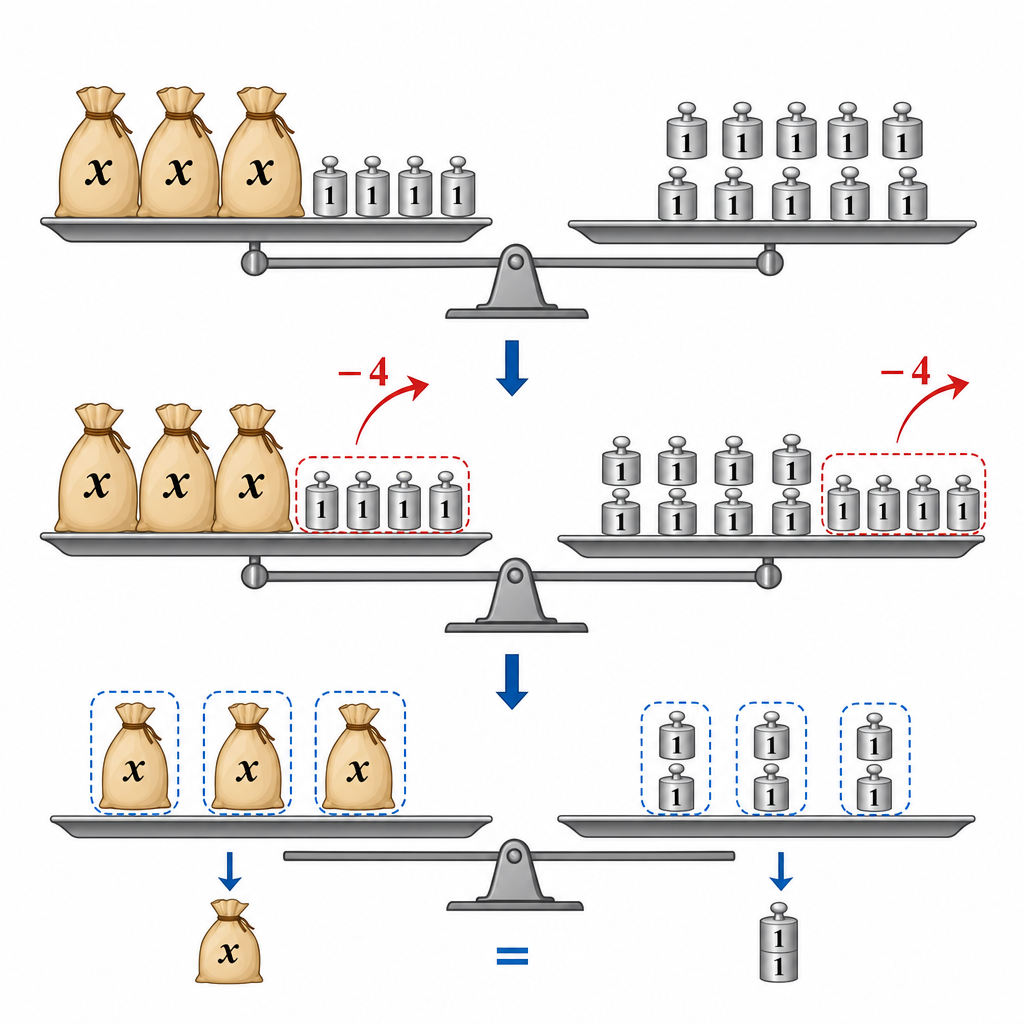
But what if you have two unknowns, like $x$ and $y$? That's where simultaneous equations come in. This is like trying to figure out your friend's location on Snapchat – you need two pieces of info (like which street they're on AND which building) to pinpoint their exact spot. We're finding the one $(x, y)$ coordinate where two lines would cross on a graph. A slick way to solve this is the elimination method, where you line up the equations and add or subtract them to completely eliminate one of the variables, making it a simple one-variable problem to solve first. Finally, rearranging formulas, or changing the subject, uses the exact same balancing skills. If you have $V = IR$ (Ohm's Law in Physics), and you want to find the current ($I$), you just rearrange it to get $I = \frac{V}{R}$. You're just changing your point of view, not the rule itself. It's all about isolating the variable you care about. You got this! 💪
Worked example
Worked Example: Solving Simultaneous Linear Equations
The Case of the Mysterious Milkshake & Fries 🥤🍟
You and your friend go out for food. You buy two milkshakes and one order of fries for a total of £7. Your friend buys one milkshake and one order of fries for £5. Let's find the individual cost of a milkshake ($m$) and an order of fries ($f$).
- 1First, we need to translate the word problem into two algebraic equations. Your order is Equation 1, and your friend's order is Equation 2.$ (1): \quad 2m + f = 7 $ $ (2): \quad m + f = 5 $
- 2We're going to use the elimination method. Notice that both equations have a '$+f$'. If we subtract the second equation from the first one, the '$f$' terms will cancel each other out. Game on.$ (2m + f) - (m + f) = 7 - 5 $
- 3Now, let's simplify that subtraction. $2m - m$ is $m$, and $f - f$ is 0. This leaves us with a super simple equation to find the cost of a milkshake.$ m = 2 $
- 4Boom! A milkshake ($m$) costs £2. Now we can substitute this value back into either of the original equations to find the cost of the fries ($f$). Let's use the simpler one, Equation 2.$ m + f = 5 \implies (2) + f = 5 $
- 5To get '$f$' by itself, we just need to subtract 2 from both sides of the equation. This will give us the final cost for the fries.$ f = 5 - 2 \implies f = 3 $
- 6So there we have it! The mystery is solved. We can write our final answer clearly. You can even double-check it with the first equation: $2(£2) + £3 = £4 + £3 = £7$. Perfect!A milkshake costs £2 and an order of fries costs £3.
Answer
A milkshake costs £2 and an order of fries costs £3.
11. Formulas and Inequalities
Alright, let's dive into one of the most useful skills in algebra: remixing formulas and understanding inequalities. Think of a formula like the secret sauce for a calculation. For example, the formula for your total earnings at a part-time job might be $E = rh$, where $E$ is earnings, $r$ is your hourly rate, and $h$ is the hours you worked. Right now, $E$ is the subject of the formula—it's the main character, the one isolated on one side. But what if you know you need to earn \$100 ($E$) and your rate is \$10 per hour ($r$), and you want to figure out how many hours ($h$) you need to work? You need to make $h$ the new main character. This is called changing the subject. It's just like solving an equation: you use inverse operations to get the new subject alone. If something is added, you subtract it from both sides. If it's multiplied, you divide. Simple as that! We're basically just shuffling the formula to answer a different question.
Now for inequalities. Life isn't always about things being perfectly equal. You need to be at least 16 to get your learner's permit ($age \ge 16$). Your phone battery needs to be less than 100% to keep charging ($battery < 100$). These are inequalities! They use symbols like $<$ (less than), $>$ (greater than), $\le$ (less than or equal to), and $\ge$ (greater than or equal to). The coolest part is showing them visually on a number line.
Now for inequalities. Life isn't always about things being perfectly equal. You need to be at least 16 to get your learner's permit ($age \ge 16$). Your phone battery needs to be less than 100% to keep charging ($battery < 100$). These are inequalities! They use symbols like $<$ (less than), $>$ (greater than), $\le$ (less than or equal to), and $\ge$ (greater than or equal to). The coolest part is showing them visually on a number line.
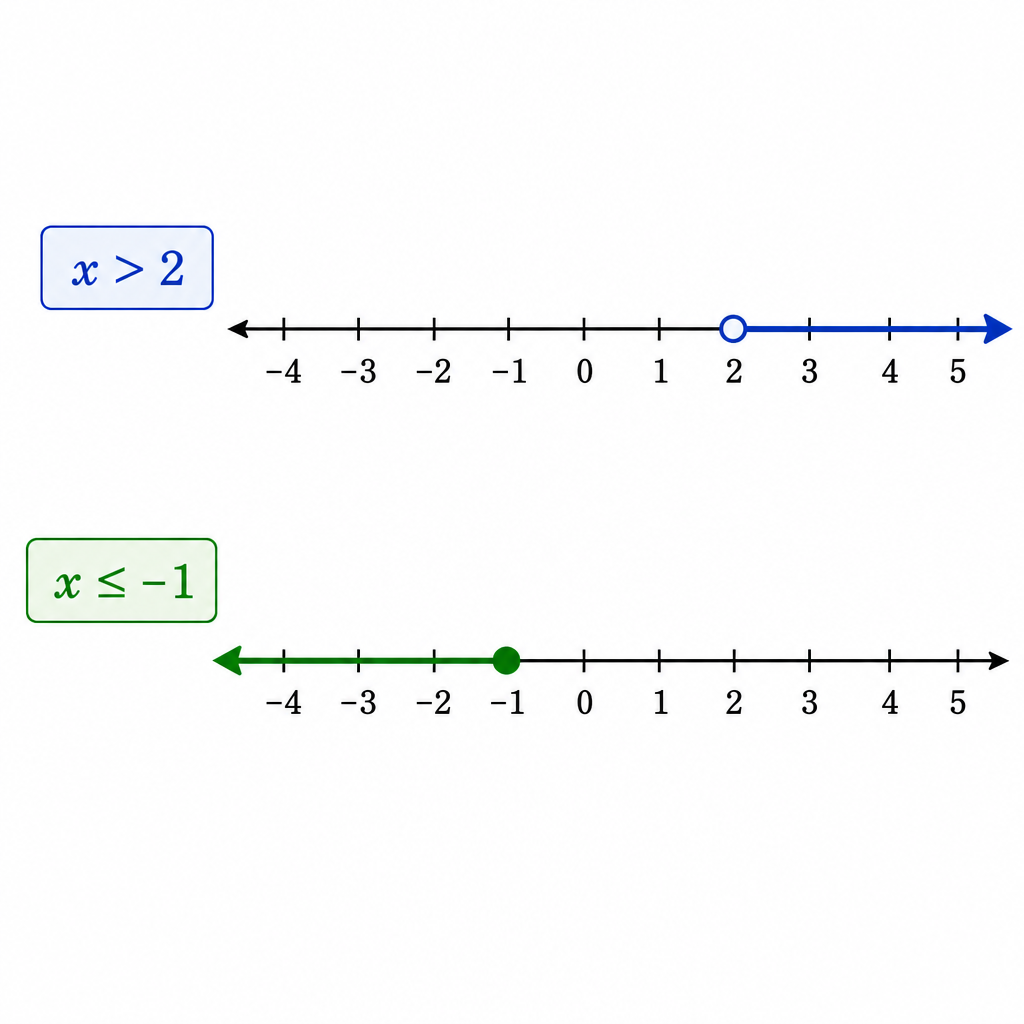
An open circle (o) on the number means that value isn't included (for $<$ and $>$). A closed, filled-in circle (●) means the value is included (for $\le$ and $\ge$). The arrow then points in the direction of all the other possible numbers. It's like setting the rules in a game lobby—these are the levels that are allowed to play.
Worked example
Worked Example: Rearranging a Formula and Representing an Inequality
Saving Up for that New Skin Pack 🎮
You're saving up for a new gaming PC that costs \$950. You already have \$500 saved. You get a part-time job that pays \$15 per hour. The formula for your total savings ($T$) after $h$ hours of work is $T = 500 + 15h$.
a) Rearrange the formula to make $h$ the subject.
b) You need your total savings to be at least \$950 to buy the PC. Write and solve an inequality to find the minimum hours you need to work, and represent the solution on a number line.
a) Rearrange the formula to make $h$ the subject.
b) You need your total savings to be at least \$950 to buy the PC. Write and solve an inequality to find the minimum hours you need to work, and represent the solution on a number line.
- 1First, let's tackle part (a) and change the subject to $h$. Our goal is to get $h$ all by itself on one side of the equals sign. We start with the original formula.$T = 500 + 15h$
- 2The 500 is added to the term with $h$, so we do the inverse: subtract 500 from both sides of the equation. This is like peeling back the first layer.$T - 500 = 15h$
- 3Now, $h$ is being multiplied by 15. The inverse of multiplying is dividing. So, we divide both sides by 15 to finally get $h$ alone. And boom, we've remixed the formula!$\frac{T - 500}{15} = h$
- 4For part (b), we need our total savings $T$ to be at least \$950. The phrase 'at least' means greater than or equal to ($\ge$). So we set up our inequality using the original formula.$500 + 15h \ge 950$
- 5Now, we solve this just like we rearranged the formula. First, subtract 500 from both sides.$15h \ge 450$
- 6Finally, divide by 15 to find the minimum hours you need to work. Then, we draw this on a number line. Since it's $\ge$, we use a closed circle on 30 and draw the arrow to the right, showing all the numbers that are 30 or more.$h \ge 30$
Answer
$h \ge 30$
12. Introduction to Number Sequences
Alright, let's talk sequences. Think of a sequence like the algorithm that decides your TikTok 'For You' page or a playlist on Spotify – it's a list of things (in our case, numbers) that follow a specific rule or pattern. Each number in the sequence is called a term. The most basic skill is just continuing the pattern. If you see 4, 8, 12, 16, ..., you know the next two terms are 20 and 24. That's using the term-to-term rule, which is just the instruction to get from one term to the next (in this case, 'add 4'). Easy, right?
But what if you need to find the 100th term? You don't want to sit there adding 4 ninety-six more times. That's where the position-to-term rule, or the nth term, comes in. It's like a cheat code that lets you find any term in the sequence just by knowing its position, 'n'. For a linear sequence (where the difference between terms is constant), finding the nth term is a system.
But what if you need to find the 100th term? You don't want to sit there adding 4 ninety-six more times. That's where the position-to-term rule, or the nth term, comes in. It's like a cheat code that lets you find any term in the sequence just by knowing its position, 'n'. For a linear sequence (where the difference between terms is constant), finding the nth term is a system.
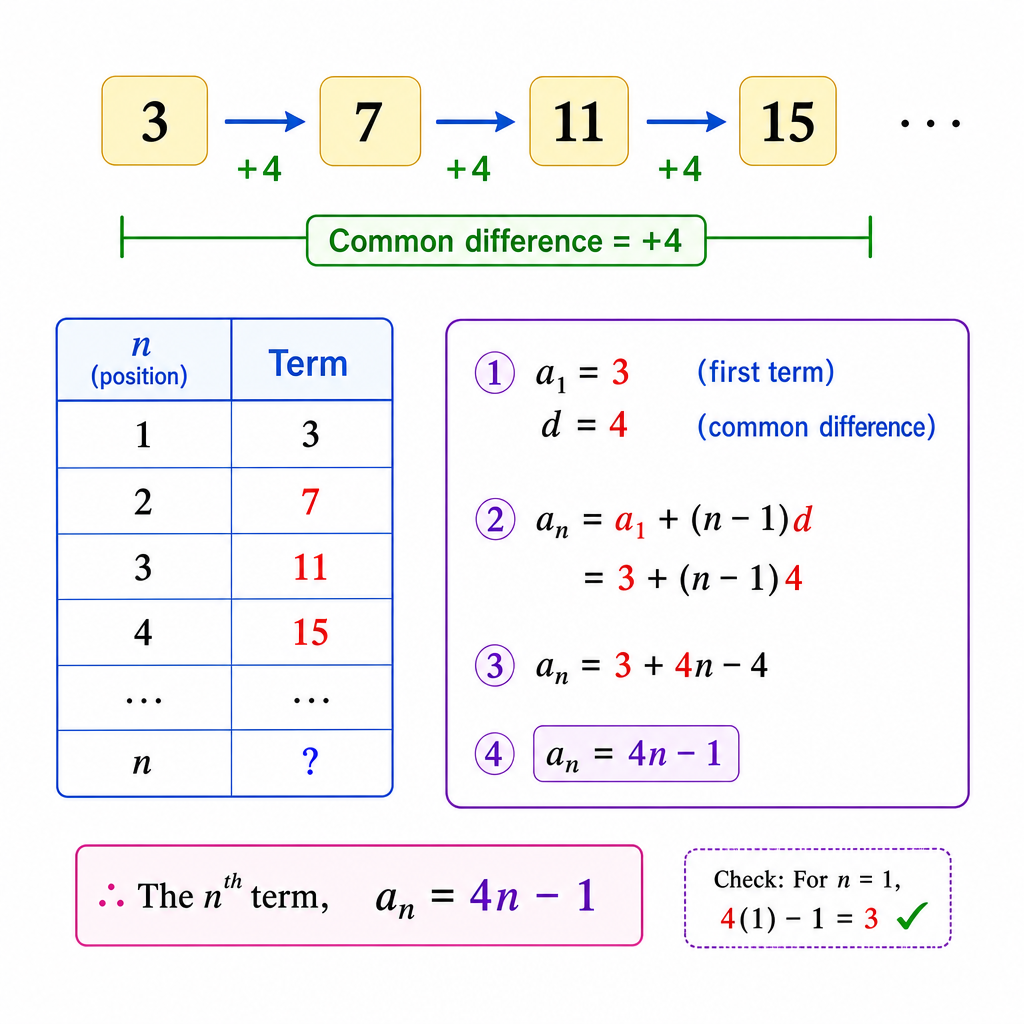
Sometimes, the pattern isn't that simple. In sequences like 1, 4, 9, 16,... (the square numbers, $n^2$), or 2, 5, 10, 17,... ($n^2+1$), the difference between terms changes. These are simple non-linear sequences. If the first difference isn't constant, check the second difference. If that's constant, you're likely dealing with a quadratic ($n^2$) sequence. It's all about being a pattern detective!
Worked example
Worked Example: Finding the nth Term of a Linear Sequence
Let's Find That Formula & Get This Bread 🥖
You're saving up for a new gaming console. You start with $£20. Each week, you add $£8 to your savings. The sequence of your total savings is 20, 28, 36, 44, ...
(a) Find the formula for the nth term of this sequence.
(b) How much money will you have saved after 12 weeks?
(a) Find the formula for the nth term of this sequence.
(b) How much money will you have saved after 12 weeks?
- 1First, let's find the term-to-term rule, which is the common difference. This tells us what the sequence is going up by each time.$28 - 20 = 8$ $36 - 28 = 8$
- 2The common difference is 8. This means the formula for the nth term will start with $8n$, just like the 8 times table.$n^{th} \text{ term} = 8n + \text{...something}$
- 3Now, let's compare our sequence to the 8 times table ($8n$). We need to figure out the 'adjustment' we need to make to get from $8n$ to our actual term.For n=1: $8 \times 1 = 8$. But our first term is 20. We need to add 12. ($8+12=20$)
For n=2: $8 \times 2 = 16$. But our second term is 28. We need to add 12. ($16+12=28$) - 4The adjustment is always '+12'. So we can complete our formula for the nth term. This is the answer for part (a).$n^{th} \text{ term} = 8n + 12$
- 5For part (b), we need to find the savings after 12 weeks. This means we need to find the 12th term. We just substitute $n=12$ into our shiny new formula.$\text{Savings} = 8(12) + 12 = 96 + 12 = 108$
- 6Finally, write down the answer clearly. After 12 weeks, you will have saved £108. You're getting closer to that console! 🎉$\text{Answer: } £108$
Answer
$\text{Answer: } £108$
13. Graphical Representation in Practical Contexts
Alright, let's talk graphs. Forget boring charts you see in textbooks; think of graphs as a visual story. Like watching a Snapchat story unfold, a graph shows you what's happening over time. We're going to focus on two main types: travel graphs and conversion graphs.
First up, travel graphs (or distance-time graphs). These are epic. They can show a whole journey: you walking to your friend's house, stopping to grab a drink, and then running the last bit because you're late. The vertical axis (y-axis) is the distance from the start, and the horizontal axis (x-axis) is time.
First up, travel graphs (or distance-time graphs). These are epic. They can show a whole journey: you walking to your friend's house, stopping to grab a drink, and then running the last bit because you're late. The vertical axis (y-axis) is the distance from the start, and the horizontal axis (x-axis) is time.
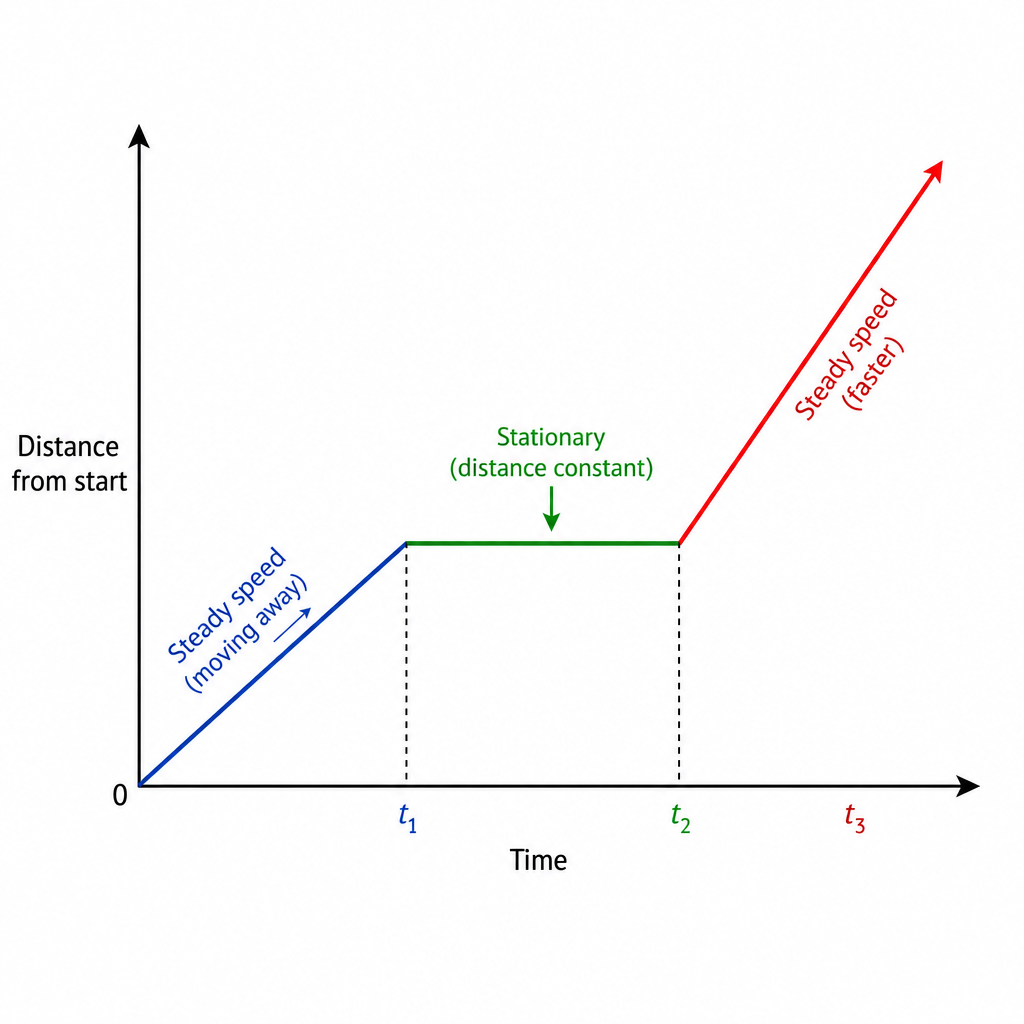
The key thing to understand here is the gradient (the steepness of the line). The gradient is literally the rate of change, which in this case is the speed! A steep line means you're moving fast (like when your Uber driver finally finds your house), a flat line means you're stationary (probably scrolling TikTok while waiting for a bus), and a downward slope means you're heading back home. We calculate it using the formula $Gradient = \frac{\text{change in distance}}{\text{change in time}}$.
Next, conversion graphs. These are your best friend for online shopping or travel. Ever wondered how many US Dollars your Robux are worth, or how many Pounds you need for that new skin priced in Euros? A conversion graph gives you a super quick visual way to switch between units, like currencies (£ to $\$) or temperatures (°C to °F). It's usually a straight line passing through the origin (0,0). You just find the value you have on one axis, trace across to the line, and then trace down (or across) to the other axis to find the converted value. Easy! Drawing these graphs is just as simple: you'll be given some data points (like a table of time vs. distance), and you just have to plot them accurately and connect them with a straight line. It's basically plotting the key moments of the story before you can see the whole picture.
Next, conversion graphs. These are your best friend for online shopping or travel. Ever wondered how many US Dollars your Robux are worth, or how many Pounds you need for that new skin priced in Euros? A conversion graph gives you a super quick visual way to switch between units, like currencies (£ to $\$) or temperatures (°C to °F). It's usually a straight line passing through the origin (0,0). You just find the value you have on one axis, trace across to the line, and then trace down (or across) to the other axis to find the converted value. Easy! Drawing these graphs is just as simple: you'll be given some data points (like a table of time vs. distance), and you just have to plot them accurately and connect them with a straight line. It's basically plotting the key moments of the story before you can see the whole picture.
Worked example
Worked Example: Interpreting a Distance-Time Graph
The Journey to the Gig 🎶
The graph below shows Leo's journey from his home to a concert. The first part is him cycling, then he stops to fix a flat tyre, and finally, his friend gives him a lift in a car.
a) What was Leo's speed in km/h while cycling?
b) How long was he stopped for?
c) What was the car's speed for the final part of the journey?
a) What was Leo's speed in km/h while cycling?
b) How long was he stopped for?
c) What was the car's speed for the final part of the journey?
- 1For part (a), we need to find Leo's cycling speed. Speed is the gradient of the first section of the graph. We'll use the formula $Speed = \frac{\text{change in distance}}{\text{change in time}}$. The first section goes from (0, 0) to (0.5 hours, 10 km).$Speed = \frac{10 - 0 \text{ km}}{0.5 - 0 \text{ h}} = \frac{10}{0.5} = 20 \text{ km/h}$
- 2For part (b), we look for the flat, horizontal part of the graph. This is where the distance from home doesn't change, meaning Leo is stationary. The flat section starts at 0.5 hours and ends at 0.75 hours.$\text{Time stopped} = 0.75 \text{ h} - 0.5 \text{ h} = 0.25 \text{ hours} \text{ (or 15 minutes)}$
- 3For part (c), we need the speed of the car. This is the gradient of the final, steepest section. The section starts at the point (0.75 h, 10 km) and ends at the point (1.25 h, 60 km).$Speed = \frac{60 - 10 \text{ km}}{1.25 - 0.75 \text{ h}} = \frac{50 \text{ km}}{0.5 \text{ h}} = 100 \text{ km/h}$
- 4Let's quickly compare the speeds. The cycling speed was 20 km/h, and the car's speed was 100 km/h. This makes perfect sense – the car section is way steeper on the graph because the speed (the rate of change) is much higher. You got this! 💪
14. Introduction to Algebra: Letters and Substitution
Okay, so algebra looks intimidating but it's actually a shortcut. Instead of writing a rule for just one number, we use a letter to stand in for any number. Same energy as a group chat name — it works for everyone in it.
Three terms to keep straight:
• Expression: a mix of numbers, letters, operations like $3x + 5$. No equals sign. You simplify it or plug numbers in.
• Equation: an expression set equal to something, like $3x + 5 = 20$. You solve these to unlock the letter.
• Formula: a rule connecting variables, like area of a circle $A = \pi r^2$. Plug in to compute.
Substitution means swap-the-letter-for-a-number. If $P = 2l + 2w$ (perimeter of a rectangle) and $l = 7$, $w = 3$, then $P = 2 \times 7 + 2 \times 3 = 14 + 6 = 20$. Easy. ✅
Golden rule: bracket every negative before you substitute. $(-4)^2 = 16$ but $-4^2 = -16$. That bracket is the difference between full marks and zero. 🎯
Three terms to keep straight:
• Expression: a mix of numbers, letters, operations like $3x + 5$. No equals sign. You simplify it or plug numbers in.
• Equation: an expression set equal to something, like $3x + 5 = 20$. You solve these to unlock the letter.
• Formula: a rule connecting variables, like area of a circle $A = \pi r^2$. Plug in to compute.
Substitution means swap-the-letter-for-a-number. If $P = 2l + 2w$ (perimeter of a rectangle) and $l = 7$, $w = 3$, then $P = 2 \times 7 + 2 \times 3 = 14 + 6 = 20$. Easy. ✅
Golden rule: bracket every negative before you substitute. $(-4)^2 = 16$ but $-4^2 = -16$. That bracket is the difference between full marks and zero. 🎯
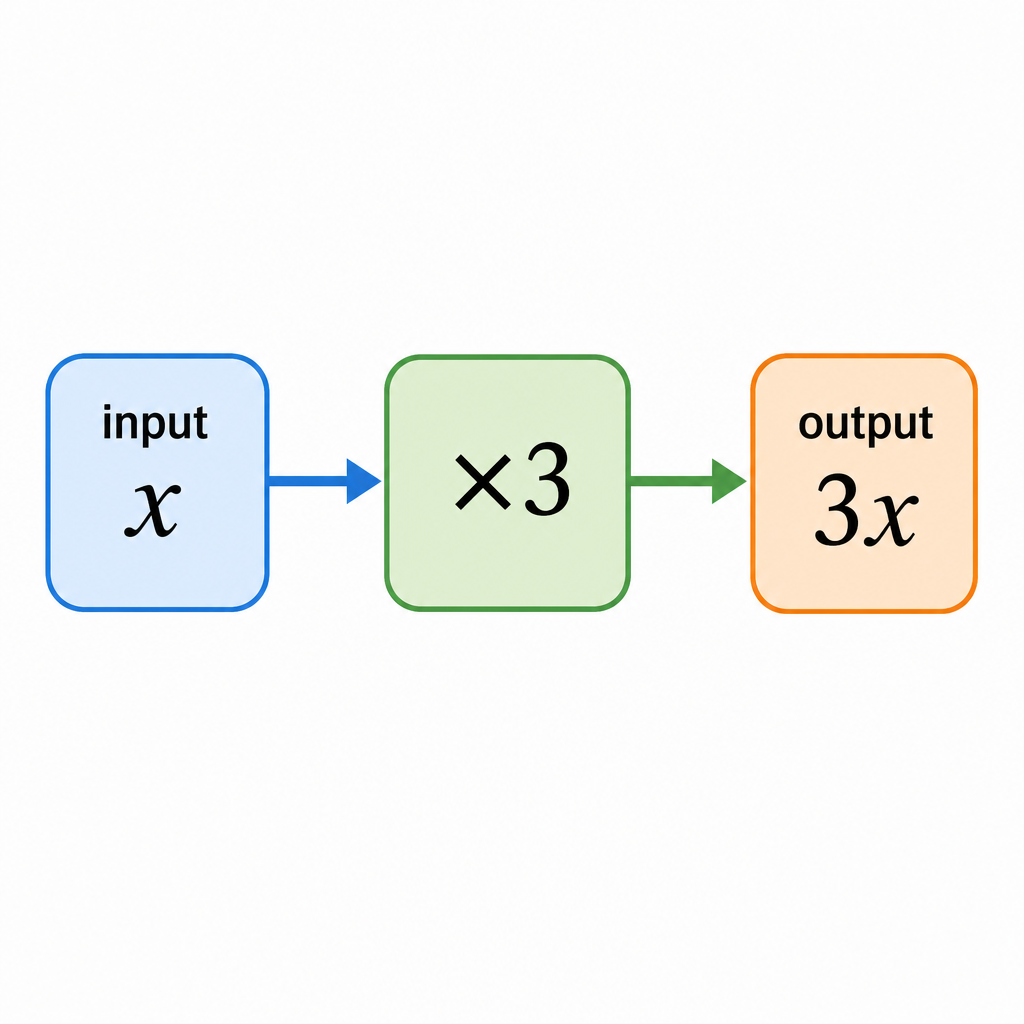
→ [+5 box] → 'output 3x + 5'. Below it, the same flow with x = 4 showing '4' → '12' → '17'. Caption: 'An expression is a rule applied to any input.']
Like terms can be squished together: $3a + 5a = 8a$. Unlike terms can't: $3a + 5b$ stays as is, and so does $3a + 5a^2$ (same letter but different power = different lane). 🛑
Like terms can be squished together: $3a + 5a = 8a$. Unlike terms can't: $3a + 5b$ stays as is, and so does $3a + 5a^2$ (same letter but different power = different lane). 🛑
Worked example
Worked Example: Constructing and Substituting into a Formula
A taxi charges a fixed fee of $\$4$ plus $\$1.20$ per kilometre $k$. (a) Write a formula for the cost $C$ in terms of $k$. (b) Find the cost of a $7$ km trip. (c) If $x = -3$, evaluate $2x^2 - 5$. 🚖
- 1For (a), fixed part is $4$, variable part is $1.20$ per km so $1.20k$. Add them.$C = 4 + 1.20k$
- 2For (b), sub $k = 7$. BODMAS: multiply first.$C = 4 + 1.20 \times 7 = 4 + 8.40 = \$12.40$
- 3For (c), bracket the negative before squaring — this is the whole point of the question.$2 \times (-3)^2 - 5 = 2 \times 9 - 5$
- 4BODMAS: multiply then subtract.$= 18 - 5 = 13$
Answer
$= 18 - 5 = 13$
Worked example
Worked Example: nth Term of a Cubic Sequence
Find the $n$th term of the sequence $1, 8, 27, 64, 125, \ldots$
- 1Stare at the numbers. $1 = 1^3$, $8 = 2^3$, $27 = 3^3$, $64 = 4^3$, $125 = 5^3$. Every term is a cube. 🎲$1 = 1^3,\ 8 = 2^3,\ 27 = 3^3,\ 64 = 4^3,\ 125 = 5^3$
- 2The position number $n$ is literally the thing being cubed. Too easy.$\text{n}^{\text{th}} \text{ term} = n^3$
- 3Sanity check: next term should be $6^3 = 216$. ✅$n = 6 \Rightarrow 6^3 = 216$
Answer
$n = 6 \Rightarrow 6^3 = 216$
15. Reading and Plotting Coordinates
Every point on a graph has an address written as a pair of numbers $(x, y)$. The first number, $x$, tells you how far to go across (right if positive, left if negative). The second number, $y$, tells you how far to go up or down. Always read across before you go up, just like reading the letters before the numbers on a map: 'along the corridor, then up the stairs'. The point $(0, 0)$ where the axes cross is called the origin.
16. The Midpoint of a Line Segment
A line segment is just the straight piece of line joining two points. To find the point exactly halfway between them, the midpoint, you average the two $x$-coordinates and average the two $y$-coordinates. In symbols the midpoint of $(x_1, y_1)$ and $(x_2, y_2)$ is $\left( \dfrac{x_1 + x_2}{2}, \dfrac{y_1 + y_2}{2} \right)$. Think of it as finding the mean of the corners, one direction at a time.
Worked example
Worked Example: Finding a Midpoint
Averaging the Coordinates
A line segment joins the points $A(1, 2)$ and $B(7, 10)$. Find the coordinates of its midpoint.
- 1Average the two $x$-coordinates.$\frac{1 + 7}{2} = \frac{8}{2} = 4$
- 2Average the two $y$-coordinates.$\frac{2 + 10}{2} = \frac{12}{2} = 6$
- 3Put the two averages together as a coordinate pair.$\text{Midpoint} = (4, 6)$
Answer
$\text{Midpoint} = (4, 6)$
17. Where a Line Crosses the Axes
Two special points help you sketch any straight line quickly. The $y$-intercept is where the line crosses the $y$-axis, and there $x = 0$. The $x$-intercept is where the line crosses the $x$-axis, and there $y = 0$. So to find where a line meets the $x$-axis, set $y = 0$ and solve for $x$; to find where it meets the $y$-axis, set $x = 0$ and solve for $y$. Plot those two crossing points, join them with a ruler, and you have drawn the line.
18. Gradient: How Steep is the Line?
The gradient measures how steep a straight line is. It is the change in $y$ divided by the change in $x$ as you move between two points on the line: $m = \dfrac{\text{change in } y}{\text{change in } x} = \dfrac{y_2 - y_1}{x_2 - x_1}$. A positive gradient climbs from left to right, a negative gradient falls, and a bigger number means a steeper slope. A horizontal line has gradient $0$. Just be sure to subtract the coordinates in the same order on the top and the bottom of the fraction.
19. The Equation $y = mx + c$
Every straight-line graph can be written as $y = mx + c$. Here $m$ is the gradient (the steepness) and $c$ is the $y$-intercept (where the line crosses the $y$-axis). Once you know the gradient and the intercept, you can write the equation straight away. If the equation is tangled up, for example $2y = 6x + 8$, rearrange it into $y = mx + c$ form first (here divide everything by $2$ to get $y = 3x + 4$), and then you can read off $m = 3$ and $c = 4$.
Worked example
Worked Example: Equation from Two Points
Gradient First, Then the Intercept
Find the equation of the straight line passing through $(1, 5)$ and $(3, 11)$.
- 1Find the gradient using the change in $y$ over the change in $x$.$m = \frac{11 - 5}{3 - 1} = \frac{6}{2} = 3$
- 2Substitute the gradient and one point into $y = mx + c$ to find $c$. Using $(1, 5)$:$5 = 3(1) + c \implies c = 2$
- 3Write the full equation with your values of $m$ and $c$.$y = 3x + 2$
Answer
$y = 3x + 2$
20. Parallel and Perpendicular Lines
Two lines are parallel when they have exactly the same gradient, so they never meet. Two lines are perpendicular when they cross at a right angle, and their gradients are negative reciprocals: multiply them together and you get $-1$. To find a perpendicular gradient, flip the fraction over and change its sign, so a gradient of $2$ becomes $-\dfrac{1}{2}$, and a gradient of $-\dfrac{1}{3}$ becomes $3$.
Practice this in the app
Unlock the full chapter: practice questions, flashcards, mock papers and notes, free.
Continue revising