Mensuration: Perimeter, Area, and Volume
Mensuration: Level Up Your Shape Game 🎮
Introduction
1. Introduction
Alright, let's talk about Mensuration. Sounds fancy, right? But honestly, it's just the math of measuring stuff. Think about it: you're figuring out if that new desk will fit in your room (area), how much drink your water bottle holds (volume), or the distance you run around a park (perimeter). This isn't just textbook stuff; it's real-world problem-solving. It's like having the ultimate cheat code for figuring out space and size. Let's break it down and make it easy. You've got this! 💪
2. Calculating the Perimeter of Compound Shapes
Perimeter is just a fancy word for the distance around the outside of a 2D shape. Imagine you're walking the boundary of a field for a Snapchat story – the total distance you walk is the perimeter. For simple shapes like rectangles, it's easy. But what about compound shapes? These are just two or more simple shapes stuck together, like an 'L' shape. The trick is to treat it like a video game level: you have to walk along every single edge. The biggest trap is forgetting the inside lines don't count and sometimes you have to figure out missing side lengths. Just add up all the outside lengths. Easy peasy.
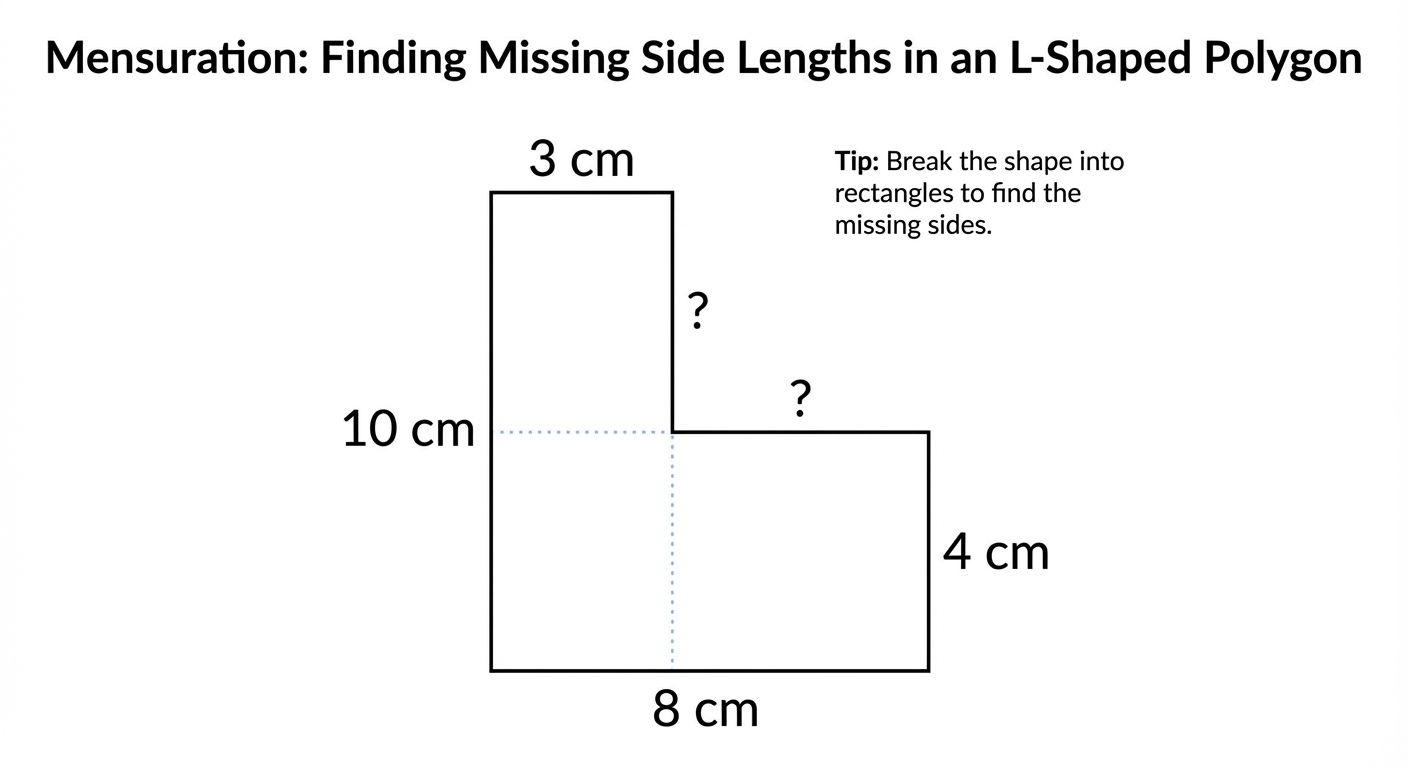
Worked example
Worked Example: Perimeter of an L-Shaped Figure
Worked Example: Fencing a Weirdly-Shaped Garden
You're helping your neighbour build a fence around their L-shaped garden. The side lengths are 10m, 8m, 4m, and 3m. Two sides are not labelled. Find the total length of fencing needed (the perimeter).
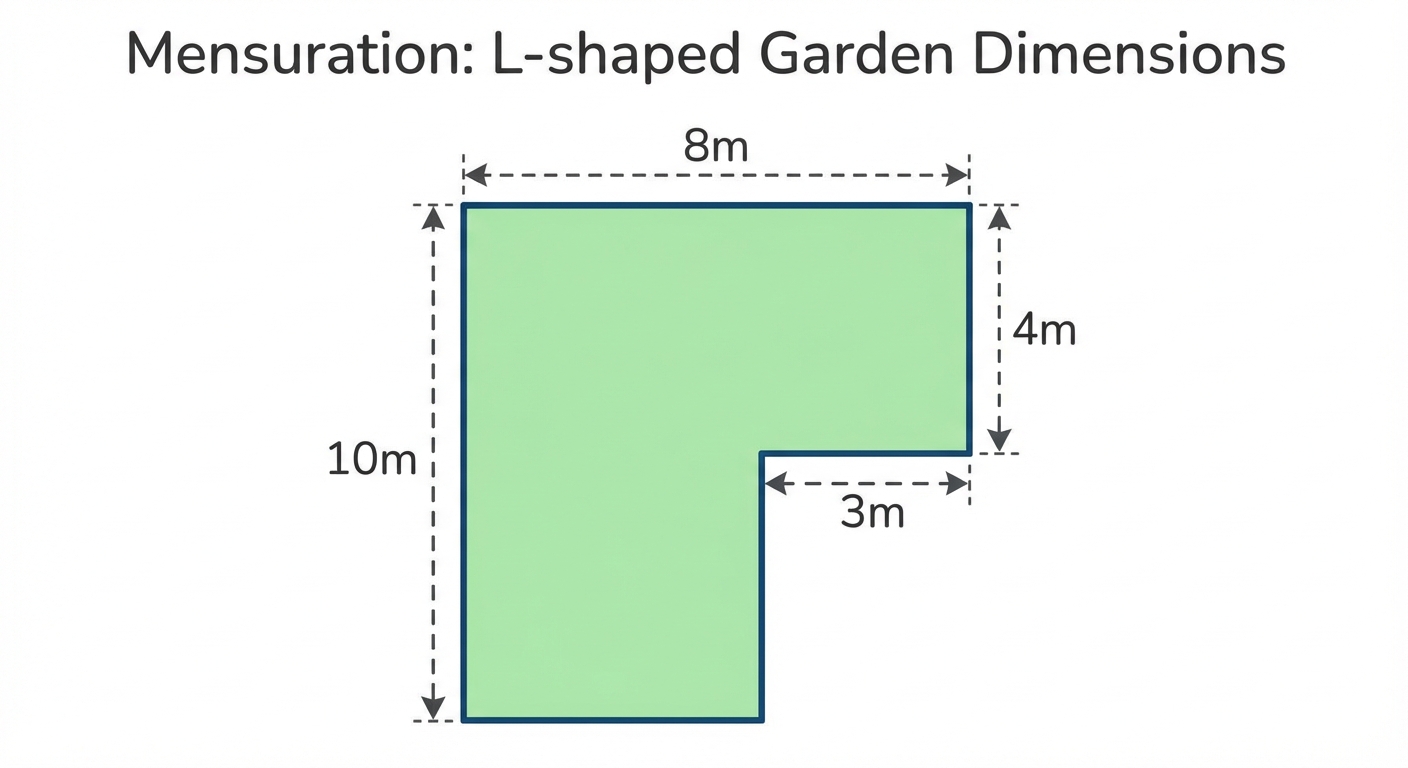
- 1First, we need to find the missing lengths. Let's call the missing horizontal side 'x' and the missing vertical side 'y'. The total width is 8m, and part of it is 3m. So, 'x' must be the difference.$x = 8m - 3m = 5m$
- 2Now for the vertical side 'y'. The total height is 10m, and the shorter vertical part is 4m. So, 'y' is the difference between them.$y = 10m - 4m = 6m$
- 3Now that we have all the outside lengths (10, 8, 4, 3, 6, and 5), we just add them all up like we're totaling a shopping bill. This gives us the total perimeter.$Perimeter = 10 + 8 + 4 + 3 + 6 + 5 = 36m$
Answer
$Perimeter = 10 + 8 + 4 + 3 + 6 + 5 = 36m$
3. Calculating the Area of a Trapezium
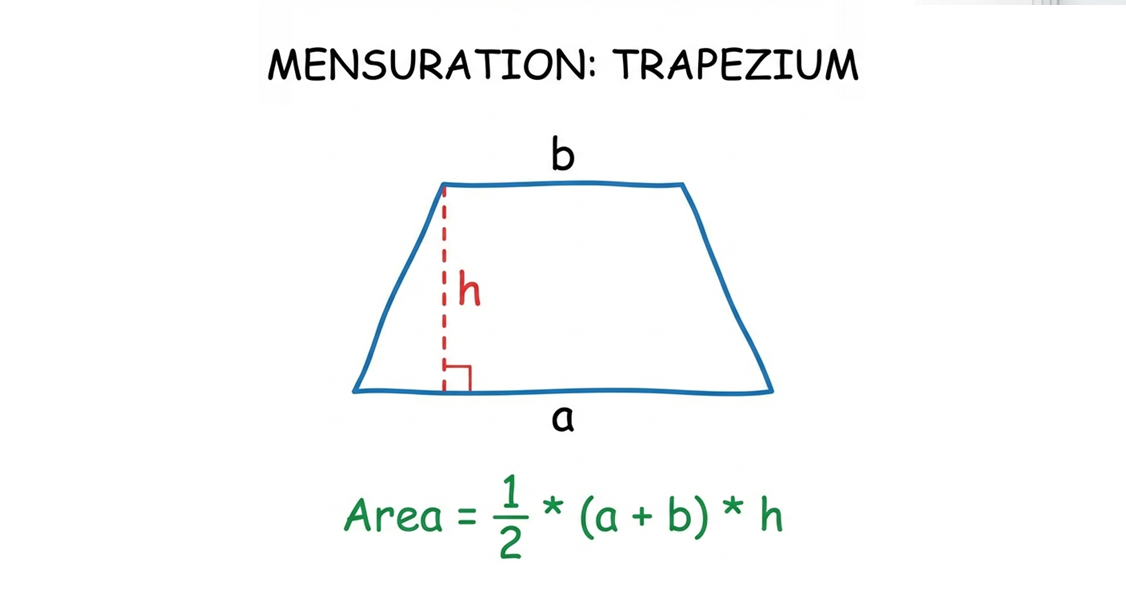
A trapezium can look a bit weird, like a rectangle that got squished on one side. It has one pair of parallel sides. Finding its area might seem tricky, but there's a killer formula for it. You just need to know the lengths of the two parallel sides (let's call them $a$ and $b$) and the perpendicular height ($h$) between them. The height must be the one at a right angle, not the slanted side! The formula is basically 'average the parallel sides and multiply by the height'. That's it. Don't let it intimidate you.
Worked example
Worked Example: Area of a Trapezium
Worked Example: The Pizza Slice Box
A box for a single slice of pizza is shaped like a trapezium. The two parallel sides are 15cm and 8cm. The perpendicular distance between them is 20cm. What is the area of the box lid?
- 1Identify your values. The parallel sides are $a=15$ and $b=8$. The perpendicular height is $h=20$. Now, let's plug these into our trusty formula: $Area = \frac{1}{2}(a+b)h$.$Area = \frac{1}{2}(15 + 8) \times 20$
- 2First, work out the bit in the brackets. It's the sum of the parallel sides.$15 + 8 = 23$
- 3Now, substitute that back into the formula and solve. You can either multiply by 20 then divide by 2, or divide 20 by 2 first. Your call!$Area = \frac{1}{2} \times 23 \times 20 = 23 \times 10 = 230 cm^2$
Answer
$Area = \frac{1}{2} \times 23 \times 20 = 23 \times 10 = 230 cm^2$
4. Calculating the Area of Compound Shapes
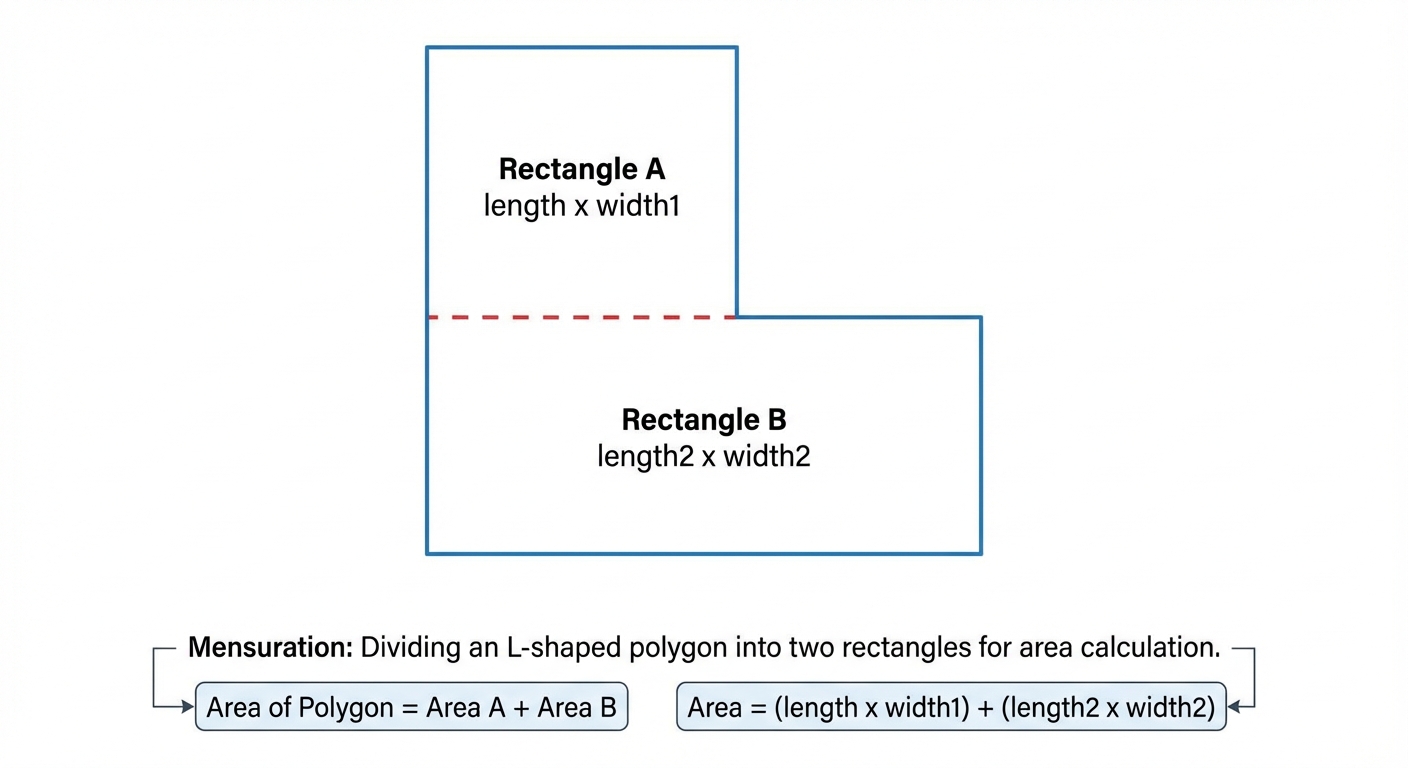
Okay, back to those weird L-shapes or other random polygons. How do you find the area (the space inside)? You can't just multiply two sides. The secret is to be a math ninja and slice the shape into simpler ones you do know, like rectangles and triangles. It's like breaking down a tough boss in a game into smaller, weaker enemies. Calculate the area of each small shape, then just add them all together at the end. Or, sometimes it's easier to imagine a big rectangle and subtract a chunk that's missing. Both ways work! 🎯
Worked example
Worked Example: Area of a Compound Shape
Worked Example: Painting a Feature Wall
You're painting a wall in your room that's shaped like the letter 'L'. The dimensions are the same as the garden from before: long sides are 10m and 8m, short inner sides are 6m and 5m. How many square metres of paint do you need?
- 1Let's use the 'slice and dice' method. We can split the 'L' into two rectangles. Let's make a vertical slice. Rectangle A is the tall, thin part, and Rectangle B is the short, wide part. [IMAGE_PLACEHOLDER_5: The L-shape split vertically into a 10m x 3m rectangle and a 6m x 5m rectangle.]$Rectangle\ A\ dimensions: 10m \times (8m-5m) = 10m \times 3m$ $Rectangle\ B\ dimensions: 5m \times 6m$
- 2Now find the area of each rectangle using the formula $Area = length \times width$.$Area\ of\ A = 10 \times 3 = 30 m^2$ $Area\ of\ B = 5 \times 6 = 30 m^2$
- 3Finally, add the areas of the two parts together to get the total area of the wall.$Total\ Area = Area\ of\ A + Area\ of\ B = 30 + 30 = 60 m^2$
Answer
$Total\ Area = Area\ of\ A + Area\ of\ B = 30 + 30 = 60 m^2$
5. Calculating the Volume of a Cuboid
Let's move to 3D! Volume is all about the space inside a 3D object. Think of it as capacity – how much water can you fit in a fish tank, or how many shoe boxes can you stack in your wardrobe? For a cuboid (a box shape, like your phone), the formula is super simple: $Volume = length \times width \times height$. That's it. Just make sure all your units are the same before you start (e.g., all in cm). The answer will be in cubic units, like $cm^3$ or $m^3$.
Worked example
Worked Example: Volume of a Cuboid
Worked Example: Filling a Fish Tank
You bought a new fish tank. It's a cuboid with a length of 50cm, a width of 20cm, and a height of 30cm. What is its volume in $cm^3$?
- 1We have the length, width, and height. All are in cm, so we're good to go. We just need to multiply them together.$Volume = length \times width \times height$ $Volume = 50cm \times 20cm \times 30cm$
- 2Let's do the multiplication. $50 \times 20 = 1000$. Then multiply that by 30.$Volume = 1000 \times 30 = 30,000 cm^3$
Answer
$Volume = 1000 \times 30 = 30,000 cm^3$
6. Calculating the Volume of Prisms and Cylinders
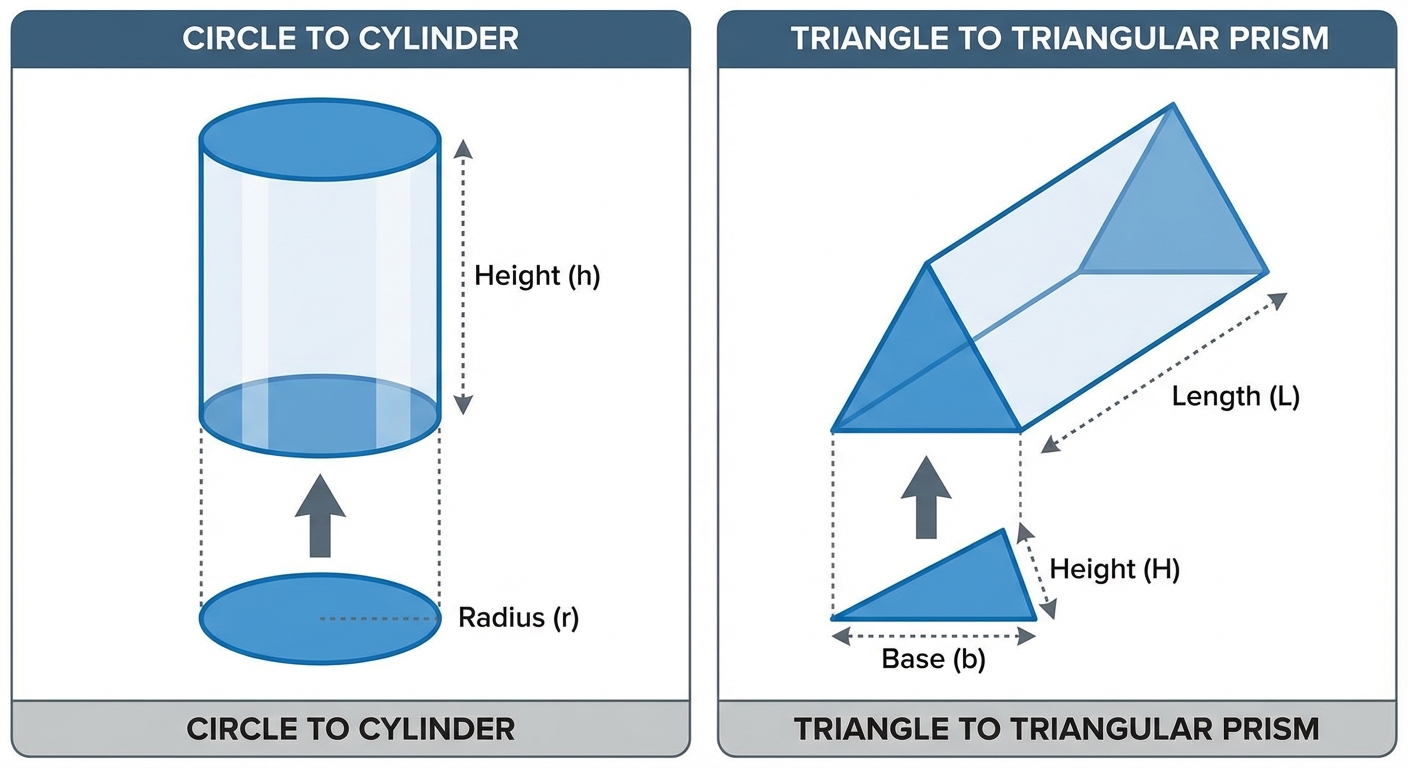
What if your shape isn't a simple box? What about a Toblerone bar (a triangular prism) or a can of Pringles (a cylinder)? These are all prisms. A prism is a 3D shape that has the same 2D shape all the way through it – its cross-section. The rule for the volume of any prism is legendary because it's so simple: $Volume = Area\ of\ Cross\ Section \times Length$. For a cylinder, the cross-section is a circle (Area = $\pi r^2$), so its volume is $\pi r^2 h$. For a triangular prism, the cross-section is a triangle (Area = $\frac{1}{2}bh$), so its volume is $(\frac{1}{2}bh) \times Length$. See the pattern? Find one area, then multiply by how long it is.
Worked example
Worked Example: Volume of a Cylinder
Worked Example: How Much Soda in a Can?
A standard soda can is a cylinder with a radius of 3.2cm and a height of 12cm. What is its volume? (Give your answer to 3 significant figures)
- 1First, we need the area of the cross-section, which is a circle. The formula is $A = \pi r^2$.$Area = \pi \times (3.2)^2 = \pi \times 10.24 \approx 32.17 cm^2$
- 2Now we use the master prism formula: $Volume = Area\ of\ Cross\ Section \times height$. We multiply the area we just found by the height of the can (12cm).$Volume = 32.1699... \times 12 = 386.038... cm^3$
- 3The question asks for the answer to 3 significant figures. We look at the fourth digit (which is 0), so we round down.$Volume \approx 386 cm^3$
Answer
$Volume \approx 386 cm^3$
7. Calculating the Surface Area of 3D Shapes
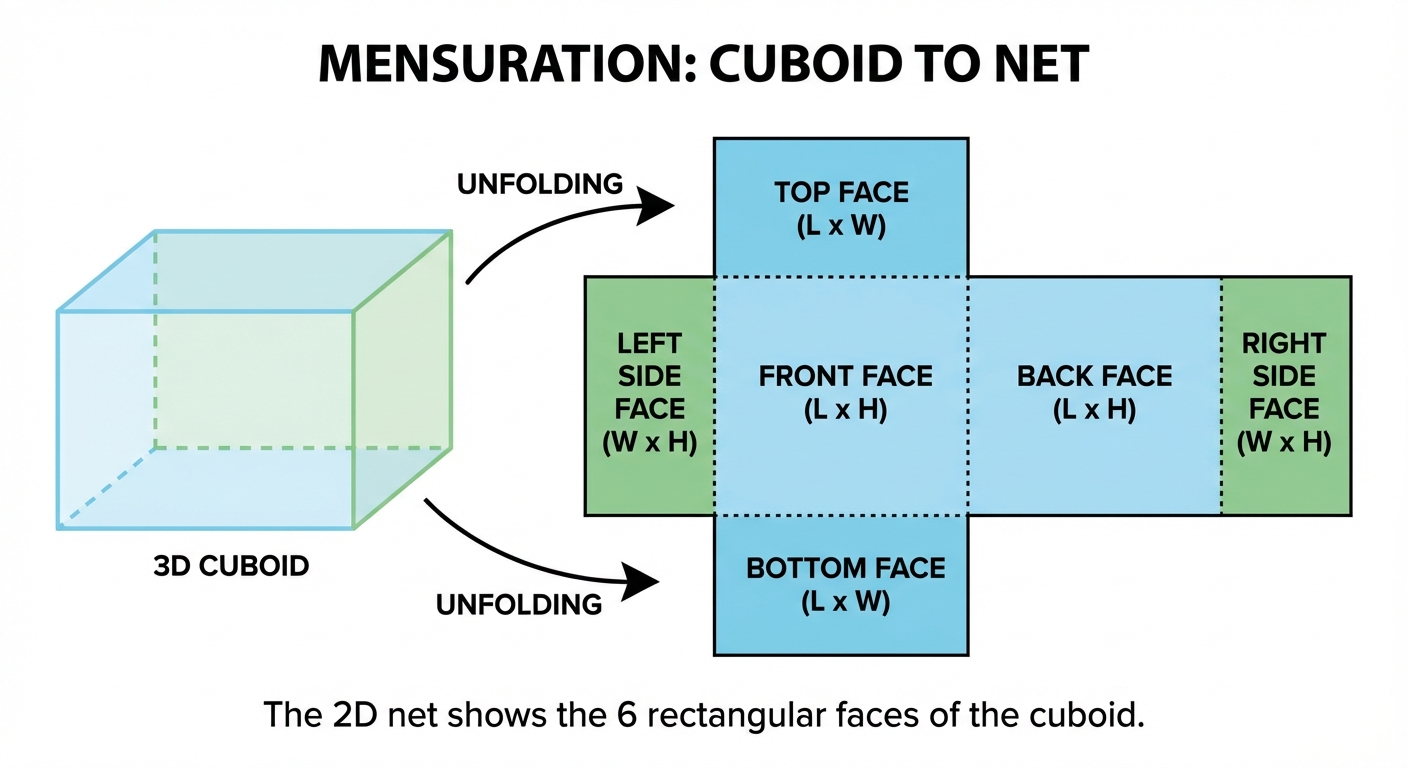
Surface area is the total area of all the faces of a 3D object. Imagine you have to wrap a present. The amount of wrapping paper you need is its surface area. For a cuboid, you have 6 faces (front/back, top/bottom, left/right). You find the area of each face and add them all up. A good shortcut for a cuboid is $SA = 2(lw + lh + wh)$. For a prism or a compound shape, it's best to think of it as 'unfolding' the shape (this is called a 'net') and finding the area of each individual piece before adding them up. Don't miss any faces!
Worked example
Worked Example: Surface Area of a Compound Prism
Worked Example: Painting a Shed (A Compound Prism!)
You need to paint a shed. The main body is a cuboid (4m long, 3m wide, 2m high) and the roof is a triangular prism that sits on top. The triangular ends of the roof have a base of 3m and a height of 1m. You are painting all the walls and the roof, but not the floor. What is the total surface area to be painted?
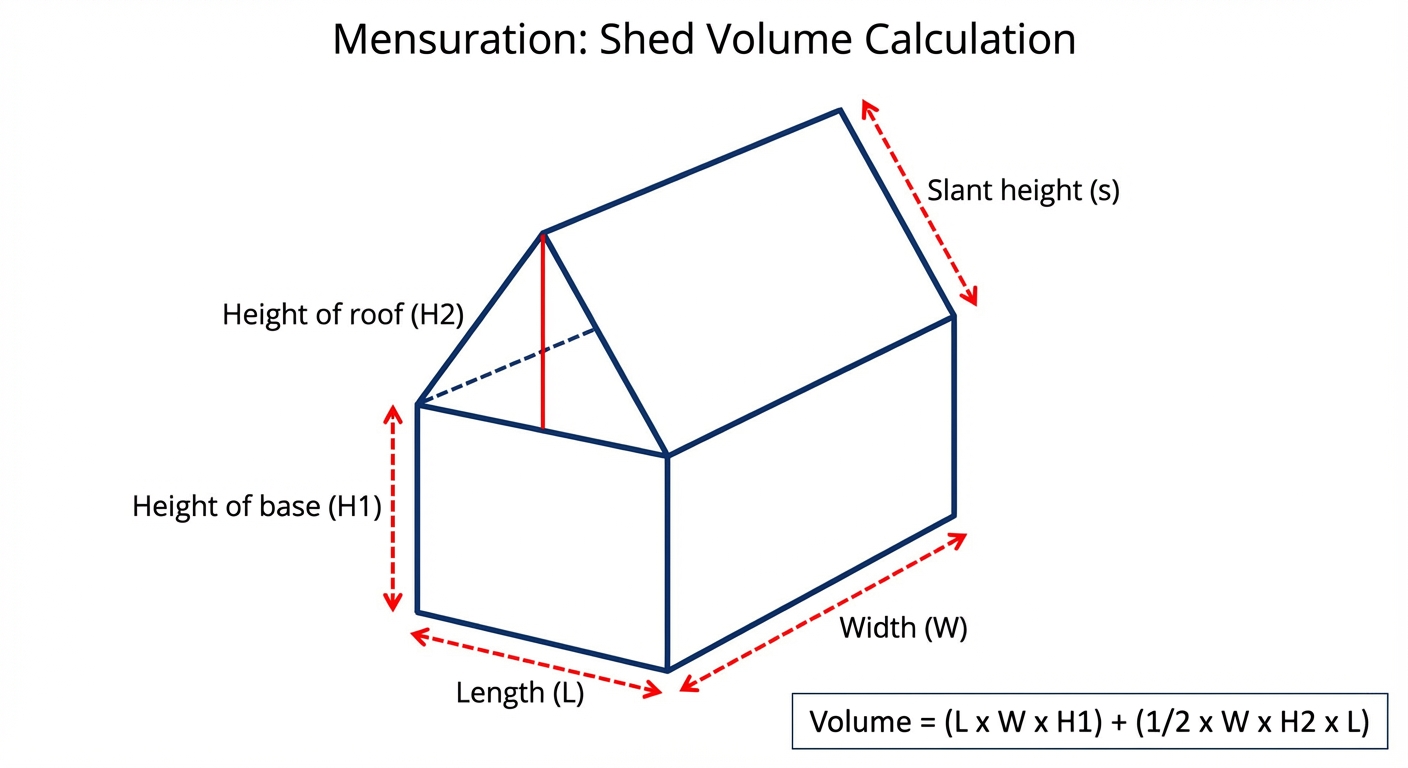
- 1Let's break it down. First, the walls of the cuboid. There are four walls: two are $4m \times 2m$ and two are $3m \times 2m$.$Area_{walls} = (2 \times (4 \times 2)) + (2 \times (3 \times 2)) = 16 + 12 = 28 m^2$
- 2Next, the roof. It has two triangular ends and two rectangular slopes. Let's find the area of the triangles first. Area of one triangle is $\frac{1}{2} \times base \times height$.$Area_{triangles} = 2 \times (\frac{1}{2} \times 3 \times 1) = 3 m^2$
- 3Now for the two rectangular roof slopes. They are both 4m long. We need the slanted edge length of the roof triangle. We can use Pythagoras' theorem on half of the triangle base: $a^2 + b^2 = c^2$. Here, $a=1.5m$ (half of 3m) and $b=1m$.$c = \sqrt{1.5^2 + 1^2} = \sqrt{2.25 + 1} = \sqrt{3.25} \approx 1.80m$ $Area_{slopes} = 2 \times (4m \times 1.80m) = 14.4 m^2$
- 4Finally, add all the parts together: the four walls, the two triangles, and the two roof slopes. We are not painting the floor or the 'ceiling' of the cuboid part (as it's inside the shed).$Total\ Surface\ Area = 28 + 3 + 14.4 = 45.4 m^2$
Answer
$Total\ Surface\ Area = 28 + 3 + 14.4 = 45.4 m^2$
8. Finding Volume by the Displacement Method
This sounds super scientific, but the idea is simple. If you have a container of water and you drop an object in, the water level rises. Why? Because the object displaces (pushes away) a certain amount of water. Here's the cool part: the volume of the water that gets displaced is exactly equal to the volume of the object you dropped in. This is how you can find the volume of irregular objects like a rock or a game controller. You measure the rise in water level in a cylinder or cuboid tank, calculate the volume of that 'slice' of water, and boom – that's the volume of your object. Archimedes would be proud! 👑
Worked example
Worked Example: Volume by Displacement
Worked Example: Finding the Volume of Your Phone
You have a rectangular tank of water that is 20cm long and 10cm wide. The water level is 15cm high. You carefully place your phone (don't actually do this!) into the tank, and the water level rises to 15.5cm. What is the volume of your phone?
- 1First, let's figure out how much the water level rose. This is the key to finding the volume of the displaced water.$Rise\ in\ height = New\ height - Old\ height = 15.5cm - 15cm = 0.5cm$
- 2The volume of the displaced water is a thin cuboid with the same base as the tank (20cm by 10cm) but with a height equal to the rise in water level (0.5cm).$Volume_{displaced} = length \times width \times rise\ in\ height$
- 3Now, just plug in the numbers and calculate. This volume is equal to the volume of the phone.$Volume_{phone} = 20cm \times 10cm \times 0.5cm = 100 cm^3$
Answer
$Volume_{phone} = 20cm \times 10cm \times 0.5cm = 100 cm^3$
9. Perimeter and Area of Polygons
Alright, let's break down perimeter and area. Think of perimeter as the 'walkthrough' of your favourite game level – it's the total distance you travel along the outer edge. For any polygon, you just add up the lengths of all the sides. Simple as that! It's like figuring out how much LED stripping you need to go around your desk; you need the total length.
Area is the space inside that boundary – like how much turf you need for a football pitch in FIFA or the screen space on your phone. For a rectangle, it's just length times width ($A = l \times w$). Easy. Now, a parallelogram is like a rectangle that's been tilted. Don't get tripped up and multiply the two different side lengths! You need the base times the perpendicular height ($A = b \times h$), which is the straight up-and-down height, not the slanted side.
Area is the space inside that boundary – like how much turf you need for a football pitch in FIFA or the screen space on your phone. For a rectangle, it's just length times width ($A = l \times w$). Easy. Now, a parallelogram is like a rectangle that's been tilted. Don't get tripped up and multiply the two different side lengths! You need the base times the perpendicular height ($A = b \times h$), which is the straight up-and-down height, not the slanted side.
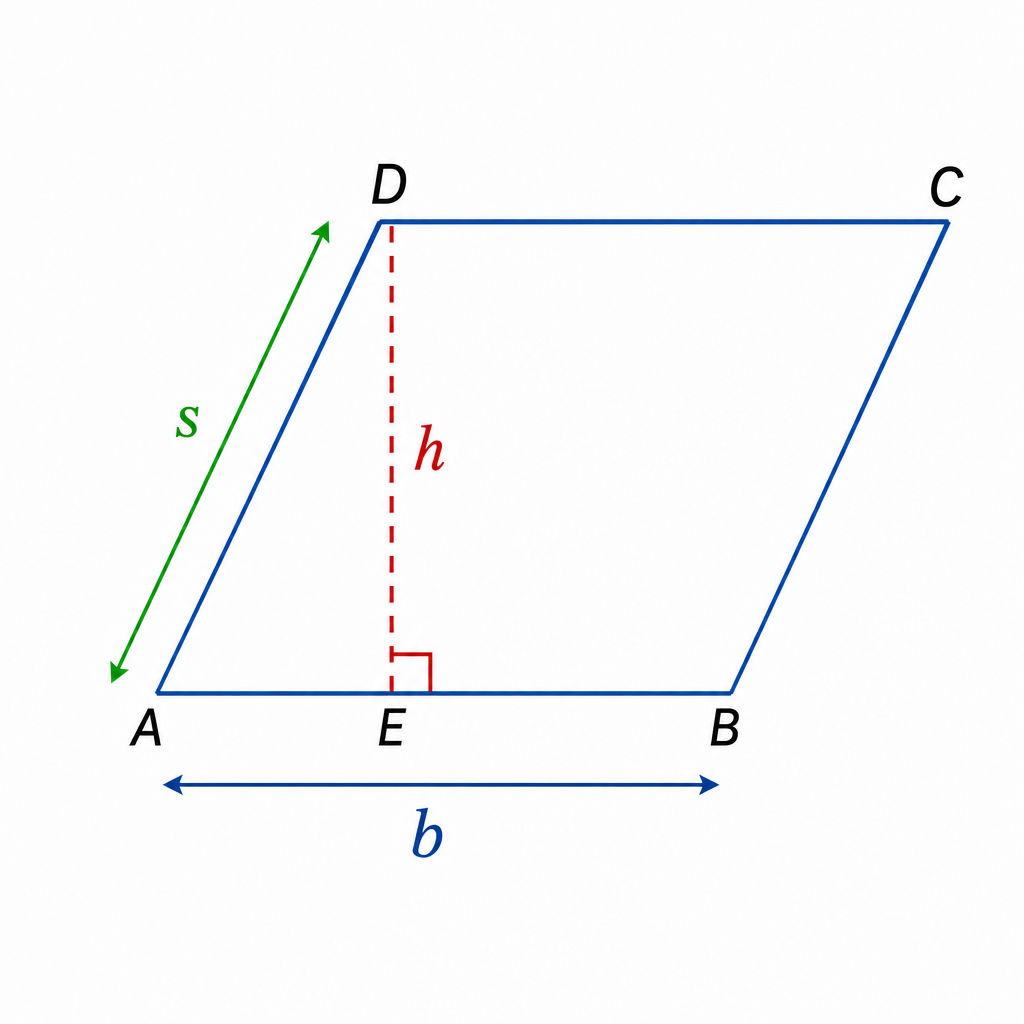
The triangle formula, $A = \frac{1}{2}bh$, is your best friend because they give it to you in the exam! It's basically half a parallelogram. Again, 'h' is the perpendicular height. Finally, the trapezium. It looks a bit weird, but the formula is solid: $A = \frac{1}{2}(a+b)h$. Here, 'a' and 'b' are the two parallel sides. You're basically finding the average length of the parallel sides and multiplying by the height. Master these, and you're golden for this section. 👍
Worked example
Worked Example: Calculating Area of a Compound Shape
The Custom Garden Patio Project 🪴
You're helping design a new patio for a garden. It's made of two sections: a main rectangular area and an attached trapezoidal seating area. The rectangle is $8\text{ m}$ long and $5\text{ m}$ wide. The trapezium shares one of the $5\text{ m}$ sides. Its other parallel side is $3\text{ m}$ long, and its perpendicular height (how far it extends from the rectangle) is $4\text{ m}$. What's the total area of the patio?
- 1First, we need to recognise that the total area is the sum of the area of the rectangle and the area of the trapezium. Let's find each one separately.$A_{total} = A_{rectangle} + A_{trapezium}$
- 2Let's calculate the area of the rectangular part. The formula is $A = \text{length} \times \text{width}$.$A_{rectangle} = 8 \text{ m} \times 5 \text{ m} = 40 \text{ m}^2$
- 3Next, the trapezium. The formula is $A = \frac{1}{2}(a+b)h$. Our parallel sides, 'a' and 'b', are the side attached to the rectangle ($5\text{ m}$) and the outer edge ($3\text{ m}$). The height 'h' is $4\text{ m}$.$A_{trapezium} = \frac{1}{2}(5 + 3) \times 4 = \frac{1}{2}(8) \times 4 = 4 \times 4 = 16 \text{ m}^2$
- 4Finally, add the two areas together to get the total area of the patio. Don't forget the units!$A_{total} = 40 \text{ m}^2 + 16 \text{ m}^2 = 56 \text{ m}^2$
Answer
$A_{total} = 40 \text{ m}^2 + 16 \text{ m}^2 = 56 \text{ m}^2$
10. Surface Area and Volume of 3D Solids
Alright, let's get into the 3D world of mensuration. Think of it like this: volume is the amount of stuff you can fit inside a 3D shape – like how much drink your water bottle holds, or the storage capacity on your gaming console. Surface area is the total area you'd have to wrap if you were giving it as a present – basically, the area of all its outside surfaces combined.
First up, prisms. A prism is any shape that has the same cross-section all the way through. Imagine a Toblerone bar – every slice is the same triangle. A cylinder is just a special prism with a circular cross-section. To find the volume of any prism, it's super simple: find the area of the front face (the cross-section, which we call $A$) and multiply it by its length ($l$). The formula is $V = Al$. So for a cylinder, the cross-section is a circle ($A = \pi r^2$), making the volume $V = \pi r^2 h$.
First up, prisms. A prism is any shape that has the same cross-section all the way through. Imagine a Toblerone bar – every slice is the same triangle. A cylinder is just a special prism with a circular cross-section. To find the volume of any prism, it's super simple: find the area of the front face (the cross-section, which we call $A$) and multiply it by its length ($l$). The formula is $V = Al$. So for a cylinder, the cross-section is a circle ($A = \pi r^2$), making the volume $V = \pi r^2 h$.
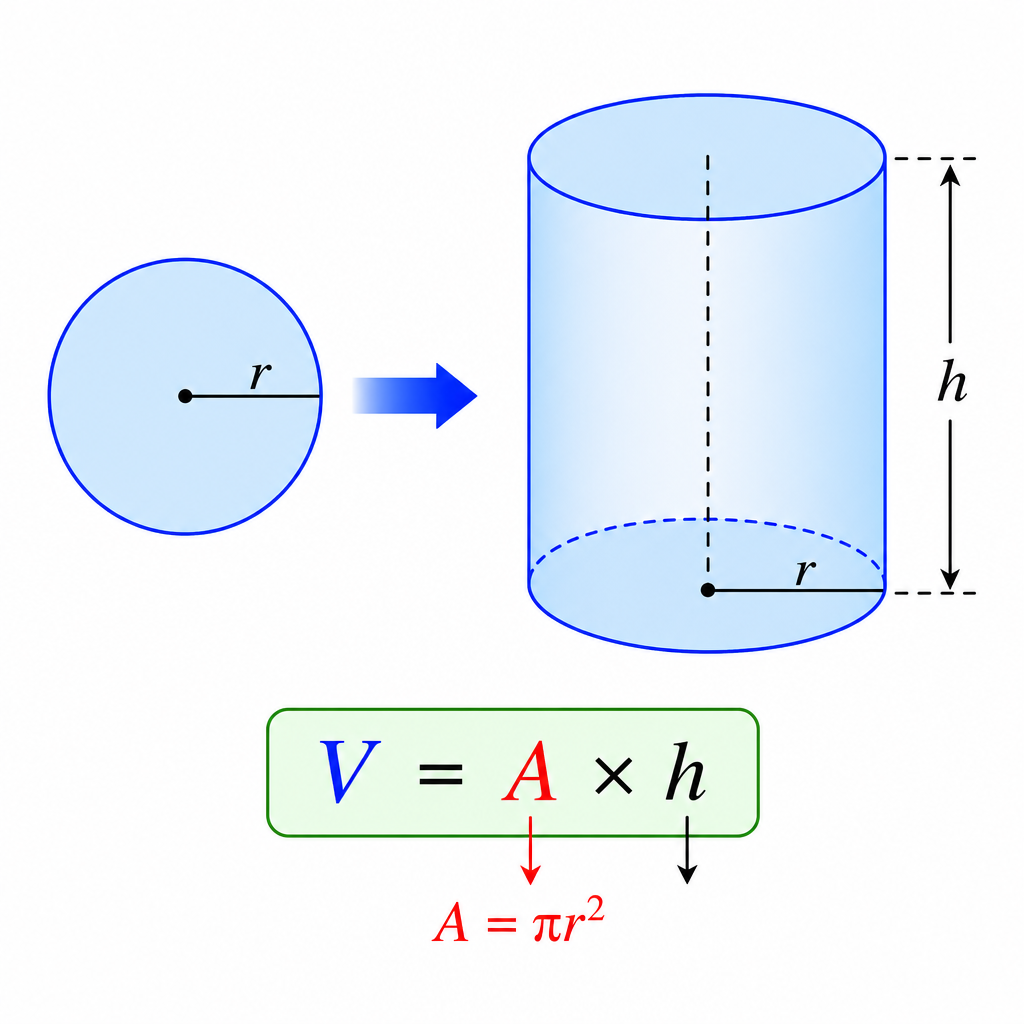
Next, we have pyramids and cones. These are the pointy shapes. Think of the pyramids in Egypt or an ice cream cone. Their volume is exactly one-third of the volume of their 'parent' prism or cylinder. So, a cone's volume is $V = \frac{1}{3}\pi r^2 h$. It's like the universe is giving you a 3-for-1 deal on volume space compared to a cylinder! For surface area, a cone has its circular base ($\pi r^2$) and its curved surface. The formula for the curved bit is $A = \pi rl$, where '$l$' is the slant height – the distance from the tip down the side, not the straight-down height 'h'.
Finally, the sphere. Your go-to for anything perfectly round, like a football or a bubble. The formulas for these are just plug-and-play. The surface area is $A = 4\pi r^2$ (fun fact: that's exactly the area of four circles with the same radius!). The volume is $V = \frac{4}{3}\pi r^3$. The best part? All these key formulas are given to you in the exam! Your job isn't to memorise them, but to be a detective: identify the shape, pick the right formula, and substitute the numbers correctly. Sometimes, they'll ask you to leave your answer 'in terms of $\pi$', which is even easier – just treat $\pi$ like a variable and don't press the $\pi$ button on your calculator. For example, $8 \times \pi$ is just $8\pi$. Easy win! 😉
Worked example
Worked Example: Volume and Surface Area of a Cone
The Cone Paperweight Challenge 🏆
A solid paperweight is shaped like a cone with a radius of $5$ cm and a perpendicular height of $12$ cm. Calculate: a) its volume, and b) its total surface area. Give your answers correct to 3 significant figures.
- 1First, let's identify the formulas we need and any missing info. For volume, we use $V = \frac{1}{3}\pi r^2 h$. For total surface area, it's the base area plus the curved area: $A = \pi r^2 + \pi rl$. We have $r$ and $h$, but we need to find the slant height, $l$, first.$Given: r = 5 \text{ cm}, h = 12 \text{ cm}$
- 2The radius, perpendicular height, and slant height form a right-angled triangle, with $l$ as the hypotenuse. So we can use Pythagoras' theorem ($a^2 + b^2 = c^2$) to find it.$l^2 = r^2 + h^2 \\ l^2 = 5^2 + 12^2 \\ l^2 = 25 + 144 = 169 \\ l = \sqrt{169} = 13 \text{ cm}$
- 3Now we can calculate the volume. We just plug our values for $r$ and $h$ into the volume formula. We'll leave it in terms of $\pi$ for now.$V = \frac{1}{3}\pi r^2 h = \frac{1}{3} \times \pi \times (5^2) \times 12 = \frac{1}{3} \times \pi \times 25 \times 12 = 100\pi \text{ cm}^3$
- 4Next, the total surface area. This is the area of the circular base ($\pi r^2$) plus the curved surface area ($\pi rl$). We'll use the value of $l$ we just found.$A_{total} = \pi r^2 + \pi rl = \pi(5^2) + \pi(5)(13) = 25\pi + 65\pi = 90\pi \text{ cm}^2$
- 5Finally, we'll convert our exact answers into decimals using a calculator and round them to 3 significant figures (s.f.) as requested. Don't forget the units!$Volume = 100\pi \approx 314.159... = 314 \text{ cm}^3 \ (3 \text{ s.f.}) <br> Surface \ Area = 90\pi \approx 282.743... = 283 \text{ cm}^2 \ (3 \text{ s.f.})$
Answer
$Volume = 100\pi \approx 314.159... = 314 \text{ cm}^3 \ (3 \text{ s.f.}) <br> Surface \ Area = 90\pi \approx 282.743... = 283 \text{ cm}^2 \ (3 \text{ s.f.})$
11. Perimeter, Area, and Volume of Compound Shapes and Solids
Alright, let's talk about compound shapes. Think of them like a playlist you've made with all your favourite artists, or a custom build in a video game. They're not totally new shapes; they're just familiar ones like rectangles, triangles, and circles mashed together to make something more complex. The key skill here is what I call 'Divide and Conquer'. You see a weird shape, you break it down into the simple shapes you already know.
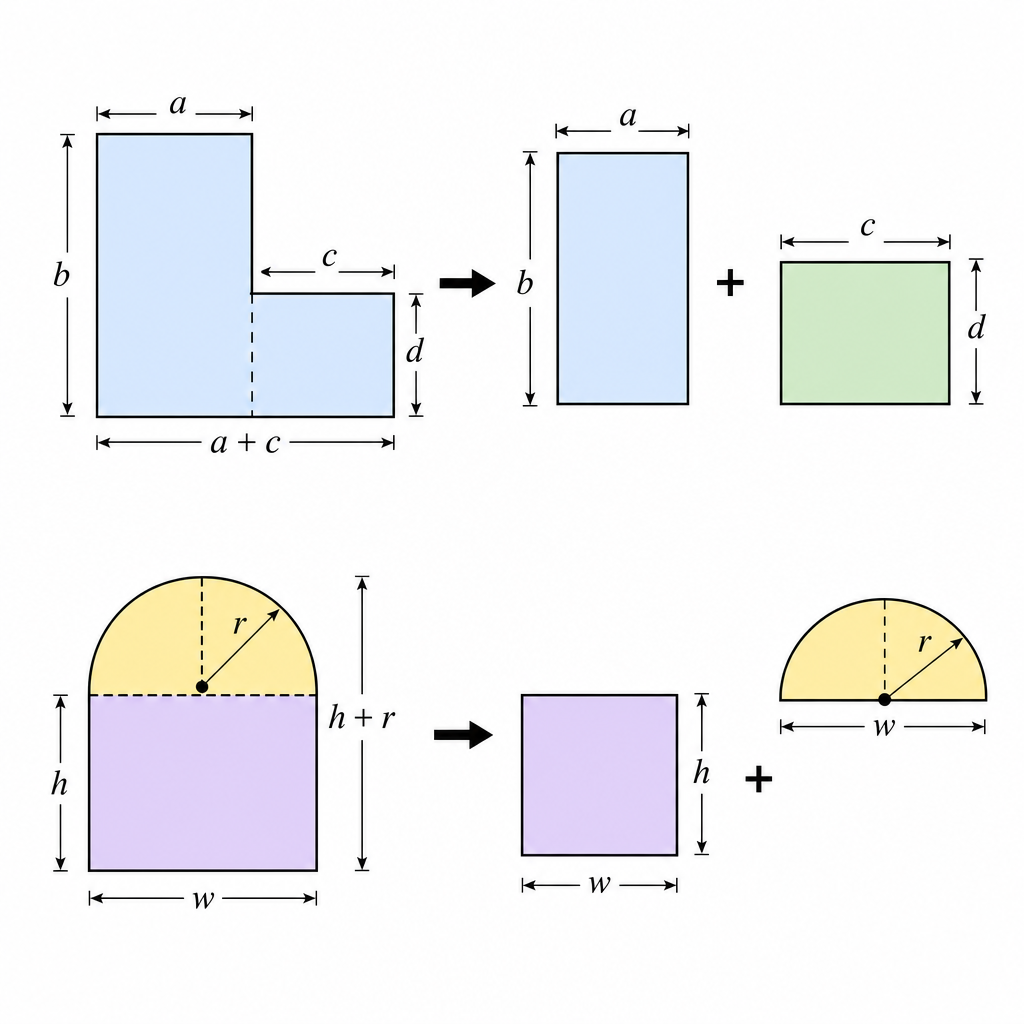
For 2D shapes, finding the area is usually straightforward. You split the shape, find the area of each piece (e.g., a rectangle and a semicircle), and then just add them up. Easy. But the perimeter is where you have to be careful! Perimeter is the distance around the outside edge only. It's like walking the fence line of a property. You don't walk down the middle where you split the shape, right? So, don't just add up the perimeters of the individual shapes; you only add the lengths that are on the exterior of the final compound shape.
Now, let's level up to 3D solids. It's the same idea. That rocket you're designing? That's a cone on top of a cylinder. An ice cream cone? A hemisphere on a cone.
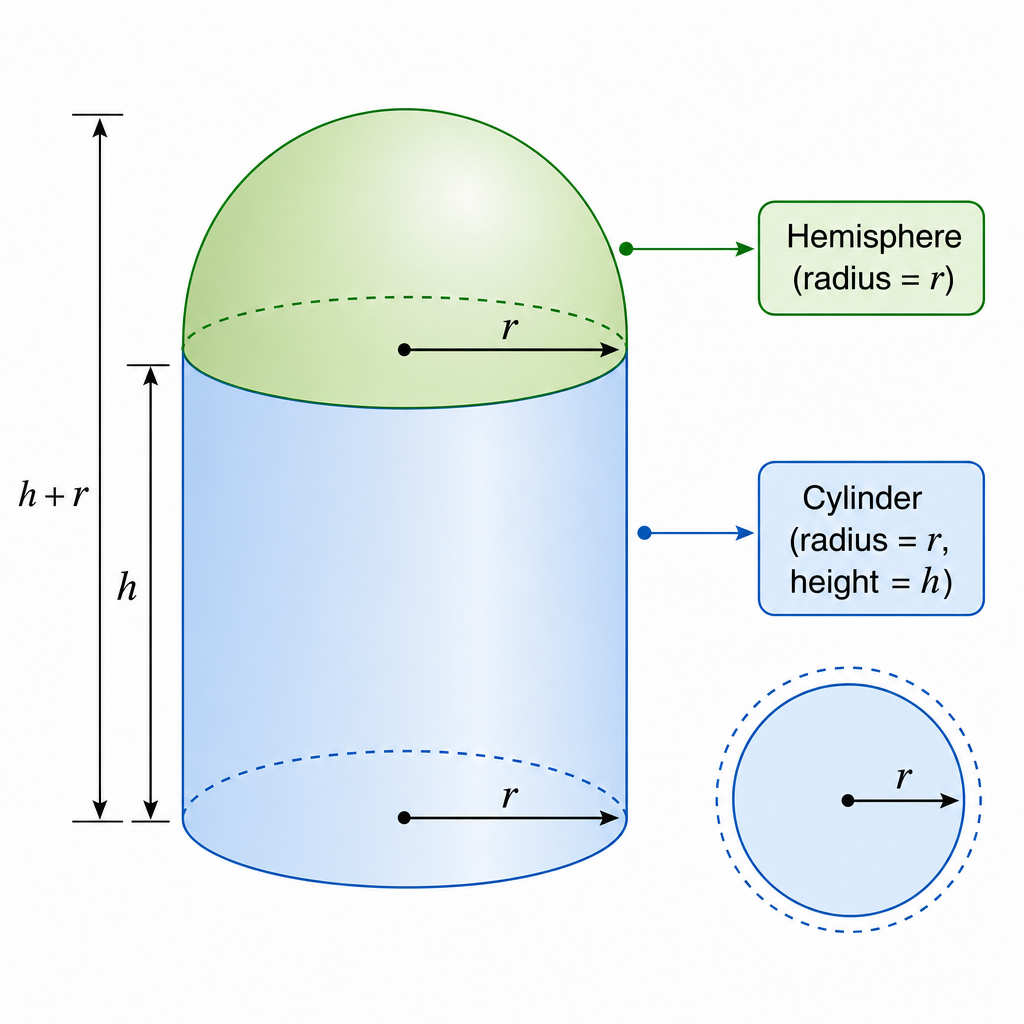
Finding the volume is just like finding the area – you calculate the volume of the simple solids (cone, cylinder, sphere, etc.) and add them together. But surface area is the 3D version of perimeter – it's only the area on the outside. If you have a cone on top of a cylinder, the circular base where they join is hidden. It's not on the surface, so you don't include it in your calculation. You'd find the curved area of the cone, the curved area of the cylinder, and the area of the bottom base, then add those up. Sometimes, the question will ask you to leave your answer 'in terms of $\pi$', which is a gift! It just means you don't press the $\pi$ button on your calculator – you treat it like a variable and write it in your final answer. It's actually less work. You got this! 💪
Worked example
Worked Example: Volume and Surface Area of a Composite Solid
Let's Build a Grain Silo 🚜
A storage silo is shaped like a cylinder with a hemisphere on top. The cylinder has a radius of $r = 3$ m and a height of $h = 10$ m. The hemisphere has the same radius. Calculate: (a) the total volume of the silo, and (b) the total external surface area of the silo. Leave your answers in terms of $\pi$.
- 1First, let's break this down. The silo is a mashup of a cylinder (the main body) and a hemisphere (the dome roof). To find the total volume, we'll calculate the volume of each part and add them. For the surface area, we need the outside parts: the dome roof, the curved walls, and the flat floor.Total Volume = Volume of Cylinder + Volume of Hemisphere
Total Surface Area = Area of Hemisphere Dome + Curved Area of Cylinder + Area of Circular Base - 2Let's calculate the volume. We'll use the formula for a cylinder's volume ($V = \pi r^2 h$) and half the formula for a sphere's volume ($V = \frac{1}{2} \times \frac{4}{3}\pi r^3$).$V_{\text{cylinder}} = \pi \times (3)^2 \times 10 = 90\pi \text{ m}^3$ $V_{\text{hemisphere}} = \frac{1}{2} \times \frac{4}{3}\pi (3)^3 = \frac{2}{3}\pi (27) = 18\pi \text{ m}^3$
- 3Now we add the two volumes together to get the total storage capacity of the silo.$V_{\text{total}} = V_{\text{cylinder}} + V_{\text{hemisphere}} = 90\pi + 18\pi = 108\pi \text{ m}^3$
- 4Time for the surface area. Remember, we only want the external surfaces. That's the area of the hemisphere dome ($A = \frac{1}{2} \times 4\pi r^2$), the curved wall of the cylinder ($A = 2\pi rh$), and the circular base ($A = \pi r^2$).$A_{\text{hemisphere}} = 2\pi (3)^2 = 18\pi \text{ m}^2$ $A_{\text{cylinder\_curved}} = 2\pi (3)(10) = 60\pi \text{ m}^2$ $A_{\text{base}} = \pi (3)^2 = 9\pi \text{ m}^2$
- 5Finally, add up the three separate surface area parts to find the total area you'd need to paint.$A_{\text{total}} = A_{\text{hemisphere}} + A_{\text{cylinder\_curved}} + A_{\text{base}} = 18\pi + 60\pi + 9\pi = 87\pi \text{ m}^2$
Answer
$A_{\text{total}} = A_{\text{hemisphere}} + A_{\text{cylinder\_curved}} + A_{\text{base}} = 18\pi + 60\pi + 9\pi = 87\pi \text{ m}^2$
12. Metric Units and Conversions
Alright, let's talk units. Think of them like different skins for your numbers. Using the right unit is key, just like picking the right character for a mission. In the metric system, everything scales by 10, 100, or 1000, which is super convenient.
For length, we have our classic lineup: millimetres (mm), centimetres (cm), metres (m), and kilometres (km). You know the drill: $10 \text{ mm} = 1 \text{ cm}$, $100 \text{ cm} = 1 \text{ m}$, and $1000 \text{ m} = 1 \text{ km}$. Easy peasy.
But here's where it gets spicy: area and volume. When we convert area units, like from m² to cm², you can't just multiply by 100. That's a rookie mistake! Since area is 2D (length × width), you have to square the conversion factor. So, $1 \text{ m}^2$ is not $100 \text{ cm}^2$. It's actually $1 \text{ m} \times 1 \text{ m}$, which is $100 \text{ cm} \times 100 \text{ cm}$, giving us a whopping $10,000 \text{ cm}^2$. Mind-blowing, right? 🤯
For length, we have our classic lineup: millimetres (mm), centimetres (cm), metres (m), and kilometres (km). You know the drill: $10 \text{ mm} = 1 \text{ cm}$, $100 \text{ cm} = 1 \text{ m}$, and $1000 \text{ m} = 1 \text{ km}$. Easy peasy.
But here's where it gets spicy: area and volume. When we convert area units, like from m² to cm², you can't just multiply by 100. That's a rookie mistake! Since area is 2D (length × width), you have to square the conversion factor. So, $1 \text{ m}^2$ is not $100 \text{ cm}^2$. It's actually $1 \text{ m} \times 1 \text{ m}$, which is $100 \text{ cm} \times 100 \text{ cm}$, giving us a whopping $10,000 \text{ cm}^2$. Mind-blowing, right? 🤯
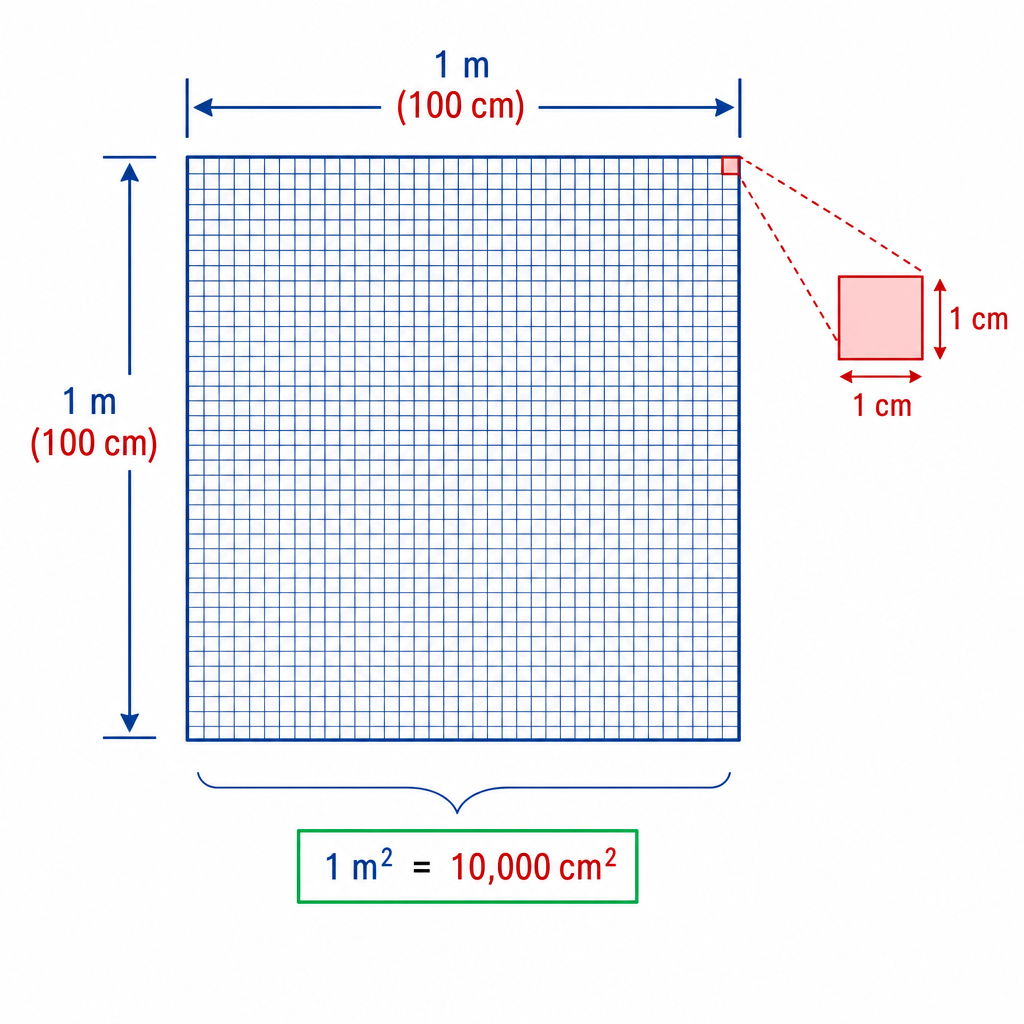
The same logic applies to volume. Volume is 3D, so we cube the conversion factor. To go from m³ to cm³, you'd do $100^3$, which is $1,000,000$! So $1 \text{ m}^3 = 1,000,000 \text{ cm}^3$.
Finally, let's connect volume to capacity (how much something holds, like your water bottle). The magic numbers to remember are: $1 \text{ cm}^3 = 1 \text{ ml}$ and $1000 \text{ cm}^3 = 1 \text{ litre}$. Also, a massive $1 \text{ m}^3$ can hold $1000$ litres of water. This is legit useful for figuring out how much water to put in a new fish tank or a pool. And don't forget mass! $1000 \text{ g} = 1 \text{ kg}$. Mastering these conversions is like finding a cheat code for mensuration problems.
Worked example
Worked Example: Volume and Capacity Conversion
The Fish Tank Problem 🐠
You just got a new fish tank for your room. Its dimensions are $50 \text{ cm}$ long, $30 \text{ cm}$ wide, and $40 \text{ cm}$ high. You need to fill it with water, but the instructions on the water conditioner are in litres. How many litres of water does the tank hold when full?
- 1First up, we need to find the volume of the tank. Since it's a cuboid (a rectangular prism), we use the formula $V = \text{length} \times \text{width} \times \text{height}$. All our units are in cm, so the answer will be in cm³.$V = 50 \text{ cm} \times 30 \text{ cm} \times 40 \text{ cm}$
- 2Let's crunch those numbers to get the volume in cubic centimetres.$V = 60,000 \text{ cm}^3$
- 3Now for the main quest: converting cm³ to litres. This is a key conversion you have to remember. The secret code is that $1000 \text{ cm}^3$ is exactly equal to $1$ litre. So, to convert our volume into litres, we need to divide by 1000.$\text{Capacity in litres} = \frac{60,000}{1000}$
- 4Do the division to get our final answer. Don't forget the units!$\text{Capacity} = 60 \text{ litres}$
Answer
$\text{Capacity} = 60 \text{ litres}$
Practice this in the app
Unlock the full chapter: practice questions, flashcards, mock papers and notes, free.
Continue revising