Geometric Principles: Angles, Parallel Lines, and Polygons
Geometry Glow Up: Angles & Shapes Unlocked 📐✨
Introduction
1. Introduction
Alright, let's talk Geometry. It might seem like a bunch of random rules, but it's literally the blueprint of the world – from the design of your favorite game level to the perfect camera angle for a selfie. We're going to break it down, ditch the confusion, and make you a geometry wizard. Think of this as your cheat sheet to acing those angle problems. You've got this! 💪
2. Angle Properties on a Straight Line and at a Point
Before we dive deep, let's get the basics locked in. Think of a straight line like a perfectly flat road. Any angles that meet on that line will always add up to . It's non-negotiable! This is a super useful rule called 'Angles on a Straight Line'.
Now, imagine you're spinning in a full circle. That's a full . So, any angles that meet at a single point, like the spokes on a wheel, will always add up to . Easy, right? These two rules are your bread and butter for solving more complex problems.
Now, imagine you're spinning in a full circle. That's a full . So, any angles that meet at a single point, like the spokes on a wheel, will always add up to . Easy, right? These two rules are your bread and butter for solving more complex problems.
Worked example
Worked Example: Calculating Angles on a Straight Line
Worked Example: Straight Line Angles
In a diagram, a straight line has two angles on it. One angle is . The other angle is marked as . Find the value of .
- 1We know that angles on a straight line add up to . So, we can set up an equation to find the missing angle .
- 2Now, we just need to solve for by subtracting from both sides. It's like finding out how much of your phone data is left after streaming music all day.
Answer
3. Angle Sum Property of Triangles
Triangles are everywhere, and they have one golden rule: the three interior angles always add up to . No exceptions. It doesn't matter if it's a tiny triangle or a massive one, the total is always .
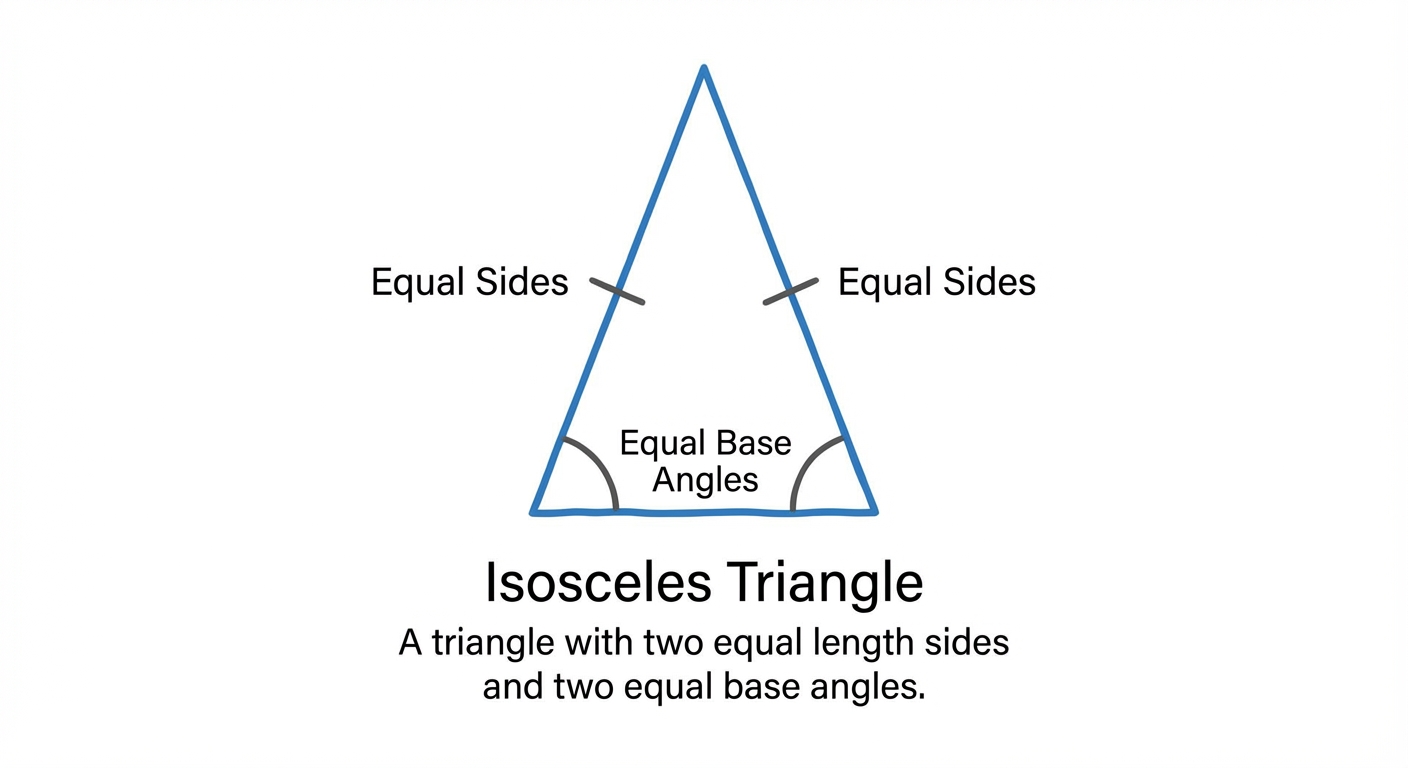
Also, watch out for isosceles triangles. They're the ones with two equal sides. A cool trick is that the two angles at the base of those equal sides are also equal. Think of them as the triangle's matching accessories.
Also, watch out for isosceles triangles. They're the ones with two equal sides. A cool trick is that the two angles at the base of those equal sides are also equal. Think of them as the triangle's matching accessories.
Worked example
Worked Example: Angles in an Isosceles Triangle
Worked Example: Finding Angles in an Isosceles Triangle
An isosceles triangle has one angle at its peak measuring . The other two angles at the base are equal, let's call them . Find the value of .
- 1First, we use the rule that all angles in a triangle add up to . We can subtract the known angle from the total.
- 2This is the total for the two remaining base angles. Since it's an isosceles triangle, these two angles are equal. So, we just divide by 2 to find the value of one of them.
Answer
4. Angles in Parallel Lines: Alternate and Corresponding Angles
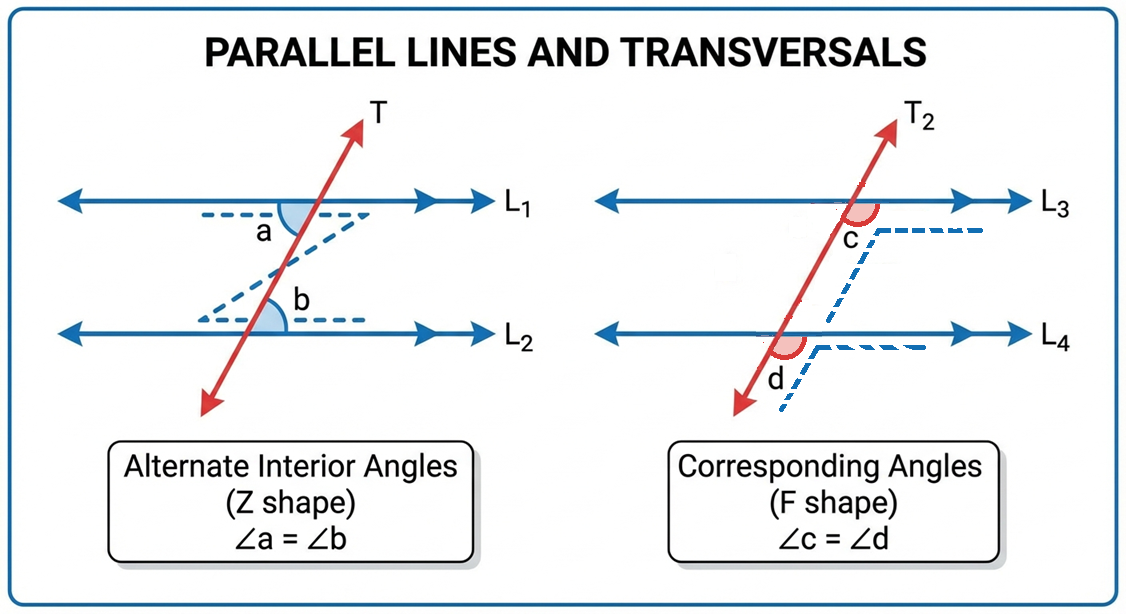
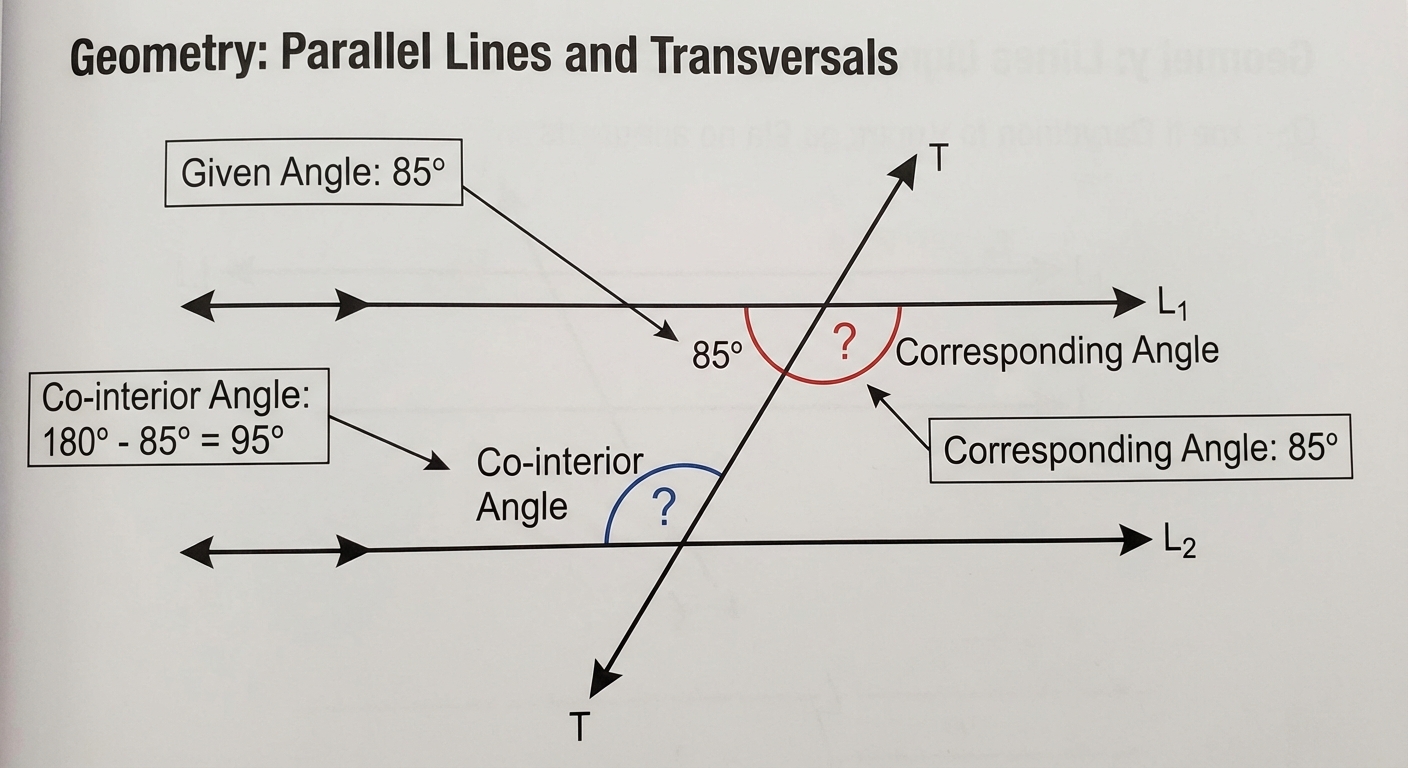
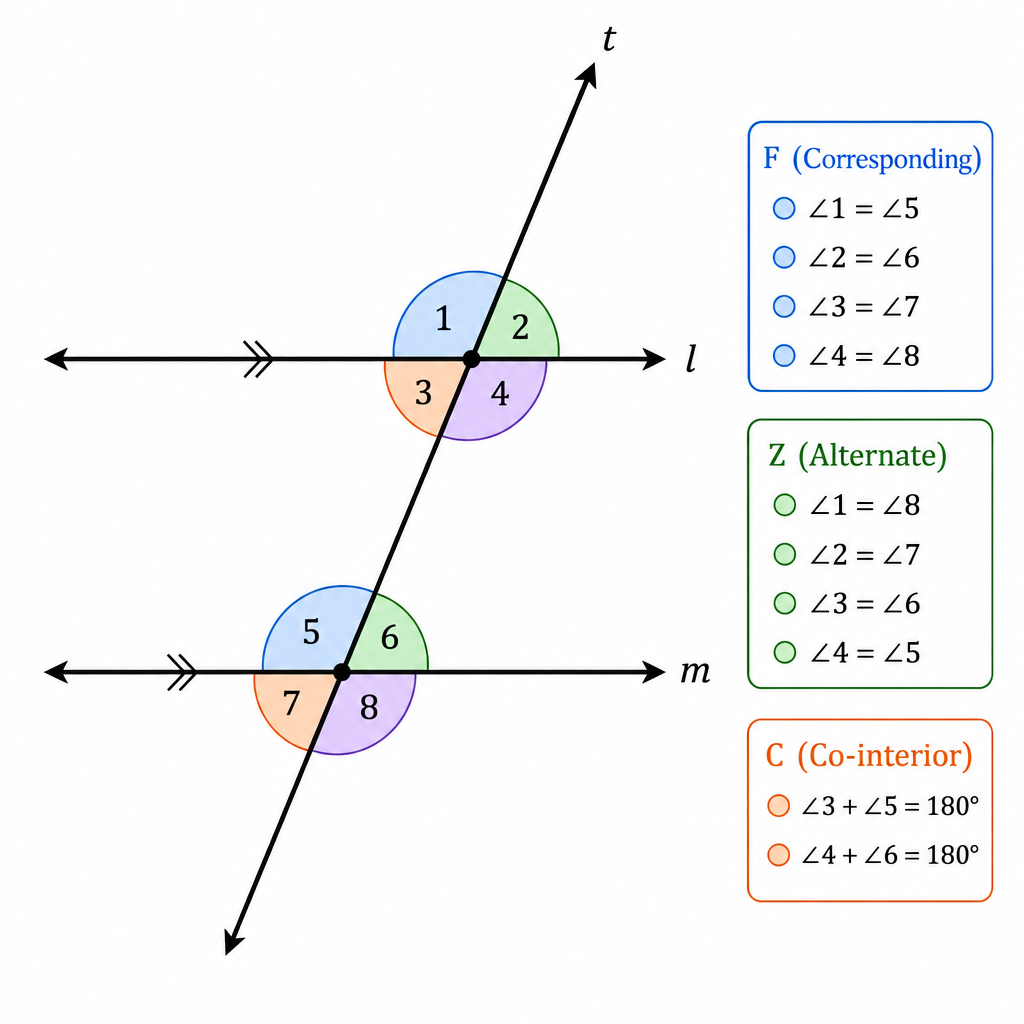
Okay, this is a big one. When you have two parallel lines (think train tracks) cut by another line (called a transversal), you get some special angle relationships. The first one is Alternate Interior Angles. They make a 'Z' shape, and the angles inside the corners of the Z are equal. It can be a regular Z or a backwards Z! The second is Corresponding Angles. They make an 'F' shape, and the angles under the 'arms' of the F are equal. Again, the F can be forwards, backwards, or upside down. Spotting these patterns is like finding an Easter egg in a video game.
Worked example
Worked Example: Calculating Alternate Interior Angles
Worked Example: Spotting the 'Z' (Alternate Angles)
Two parallel lines are intersected by a transversal line. One angle is given as . Find the alternate interior angle, labeled .
- 1Look for the 'Z' shape in the diagram. The angle and the angle are in the opposite corners of the 'Z'.Identify the 'Z' pattern.
- 2The rule for alternate interior angles says they are equal. It's that simple. No complex calculation needed, just geometric reasoning.
Answer
5. Angles in Parallel Lines: Co-interior Angles
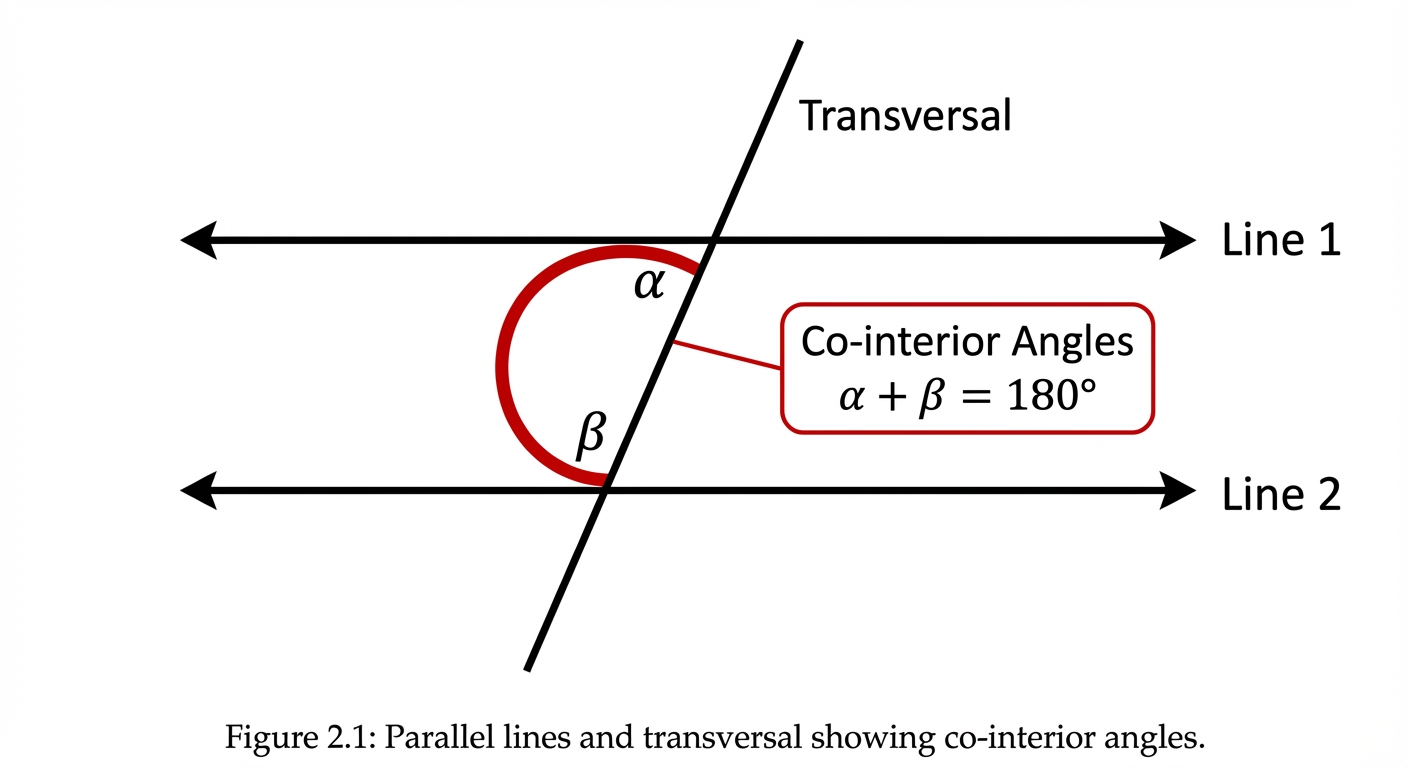
The last major rule for parallel lines involves Co-interior Angles. These are the angles that are 'inside' the parallel lines and on the same side of the transversal. They form a 'C' or 'U' shape. Unlike the Z and F rules, these angles are not equal. Instead, they are supplementary, which is a fancy way of saying they add up to . Think of them as two friends who have to share a budget of \$180. If one spends more, the other has to spend less.
Worked example
Worked Example: Calculating Co-interior Angles
Worked Example: Using the 'C' (Co-interior Angles)
Two parallel lines are cut by a transversal. One of the co-interior angles is . Find the other co-interior angle, labeled .
- 1We've identified that the angles are co-interior because they are inside the parallel lines and on the same side, forming a 'C' shape.Recognize the co-interior relationship.
- 2The rule says co-interior angles add up to . So we subtract the known angle from to find the missing one.
Answer
6. Combined Problems: Parallel Lines and Triangles
This is where you get to show off your skills. Exam questions love to combine parallel lines and triangles. The key is not to panic! Just use the rules one step at a time. You might use a parallel line rule to find an angle, and then that angle helps you find the missing angles inside a triangle. It's like a detective story – each clue you find helps you solve the bigger mystery. Break the problem down, label what you know, and find one angle at a time.
Worked example
Worked Example: Calculating Angles with Parallel Lines and Triangles
Worked Example: Calculating Angles with Parallel Lines and Triangles
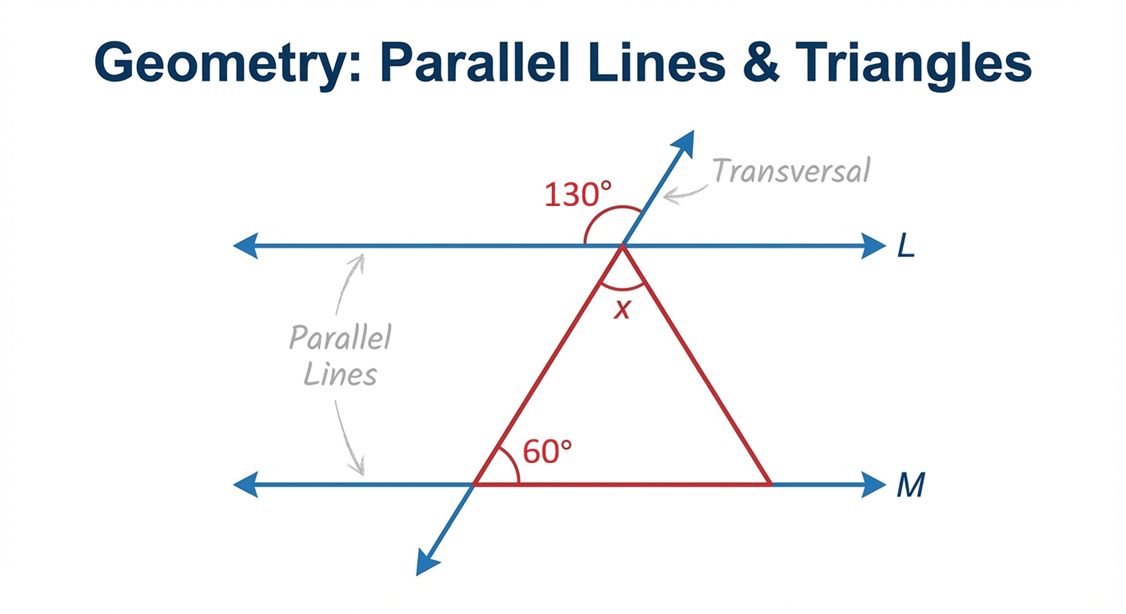
Let's say we have a triangle between two parallel lines. An angle on the straight line outside the triangle is . Another angle is given by an alternate interior 'Z' angle as . Find the third angle, , inside the triangle.
- 1First, find the angle inside the triangle that's on the straight line with the angle. Let's call it Angle A. Angles on a straight line add to .
- 2We are given the second angle is (using the 'Z' rule). Now we have two angles inside the triangle: and . We know all angles in a triangle add up to .
- 3Now, just solve for . Add the known angles together and subtract from .
Answer
7. Sum of Interior Angles in a Polygon
Moving on from triangles and quadrilaterals, let's talk about polygons – shapes with any number of straight sides. There's a super handy formula to find the sum of all the interior angles in any polygon: Sum of angles = , where is the number of sides. A pentagon ( sides)? . A hexagon ( sides)? . This formula is your master key for all polygons.
Worked example
Worked Example: Sum of Interior Angles in a Heptagon
Worked Example: Sum of Angles in a Heptagon
Calculate the sum of the interior angles in a heptagon (a 7-sided polygon).
- 1A heptagon has 7 sides, so . We just need to plug this value into our formula.
- 2Substitute and do the math. Easy peasy.
Answer
8. Properties of Regular Polygons
A regular polygon is the celebrity of the shape world – all its sides are the same length, and all its interior angles are equal. This makes our life way easier. If you want to find the size of just one interior angle in a regular polygon, you first find the total sum using the formula from before, and then you just divide by the number of sides (). So, one interior angle = . This is perfect for problems about floor tiles or designing logos where everything needs to be symmetrical.
Worked example
Worked Example: Calculating an Interior Angle of a Regular Octagon
Worked Example: Angle in a Regular Octagon
Find the size of one interior angle in a regular octagon (8 sides).
- 1First, let's find the total sum of the interior angles for an octagon ().
- 2Since it's a regular octagon, all 8 angles are identical. We just divide the total sum by 8.
Answer
9. Combined Problems: Regular Polygons and Parallel Lines
Ready for the final challenge? This is when a diagram throws a regular polygon and some parallel lines at you. The trick is to use the properties of each shape to your advantage. For example, you might calculate an interior angle of the regular polygon first. This angle might then sit on a transversal line, allowing you to use your Z, F, or C rules to find other angles in the diagram. Always ask yourself: 'What can I figure out about the polygon first? What can I figure out about the parallel lines?' Then see how they connect.
Worked example
Worked Example: Problems with Polygons and Parallel Lines
Worked Example: Polygon and Parallel Line Combo
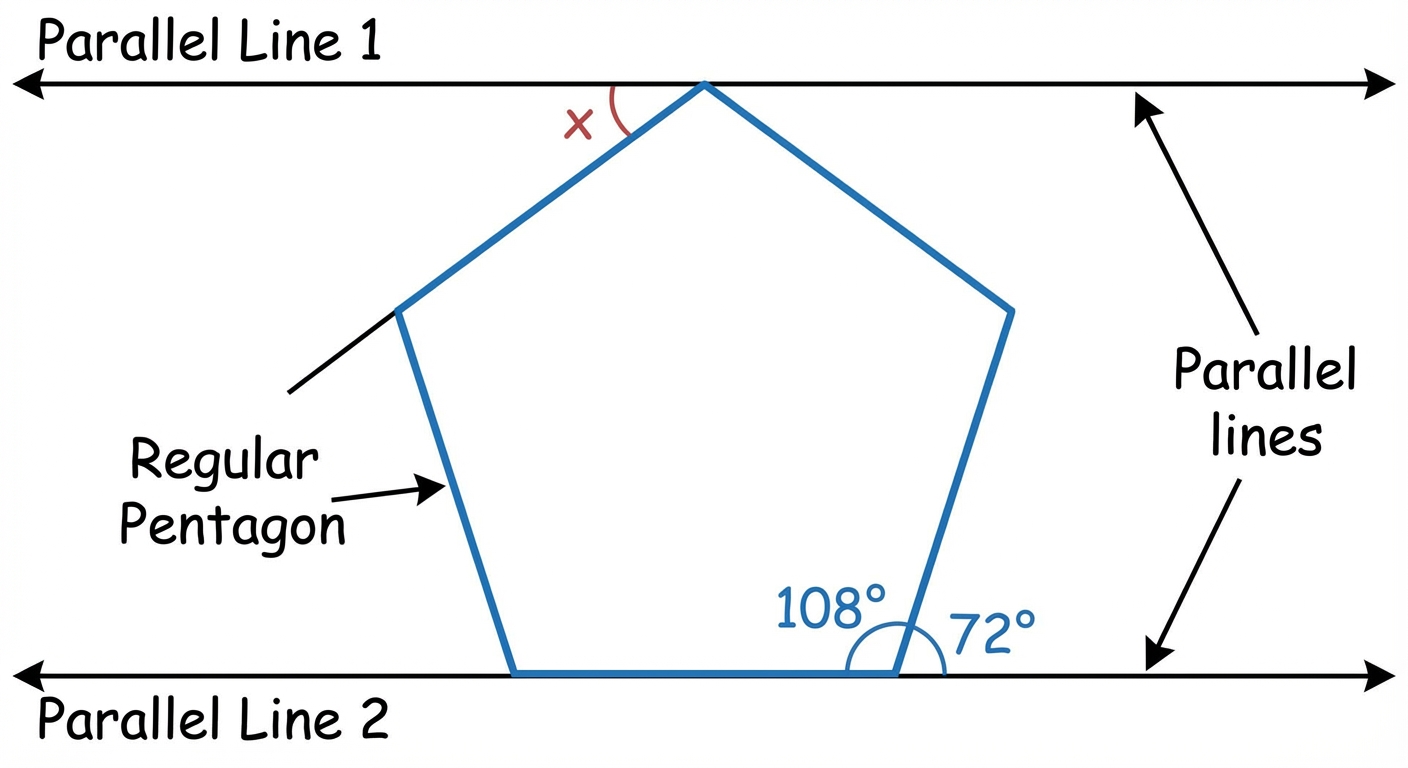
A regular pentagon has one side that lies along a straight line, parallel to another line that touches the top vertex of the pentagon. Find the angle between the top parallel line and the adjacent side of the pentagon.
- 1First, find the size of one interior angle of a regular pentagon ().
- 2The top parallel line passes through the top vertex of the pentagon. Because the pentagon is regular, it is symmetrical about the vertical line through the top vertex, so the two slanted sides meeting at that vertex make equal angles with the top parallel line. Call each of these angles . At the top vertex, three angles lie on the straight top parallel line: angle on one side, the pentagon's interior angle of in the middle, and angle on the other side. These three angles must add up to .
- 3Solve the equation for .
Answer
10. Geometrical Language and Properties
Alright, let's get this geometry vocab sorted. Think of it like learning the lingo for a new game – once you know the terms, everything makes way more sense. We start with the basics: a point is just a dot, and a line goes on forever. Where lines meet, you get a vertex (plural: vertices), which is just a fancy word for a corner.
Now, angles! An acute angle is small and cute (less than ), a right angle is a perfect corner like on a square (), an obtuse angle is a bit chunky (between and ), and a reflex angle is the big one on the outside (over ). Lines can be parallel, like train tracks that never meet, or perpendicular, meeting at a perfect right angle.
Now, angles! An acute angle is small and cute (less than ), a right angle is a perfect corner like on a square (), an obtuse angle is a bit chunky (between and ), and a reflex angle is the big one on the outside (over ). Lines can be parallel, like train tracks that never meet, or perpendicular, meeting at a perfect right angle.
When we join lines to make 2D shapes, we get polygons. Regular polygons are the perfectionists – all sides and angles are equal (like a stop sign, which is a regular octagon). Irregular polygons are more chilled, with different side lengths and angles. You need to know your triangles: equilateral (all sides equal), isosceles (two sides equal), and scalene (all sides different). And your quadrilaterals (4-sided shapes): the familiar square and rectangle, the pushed-over parallelogram and rhombus, the trapezium, and the kite.
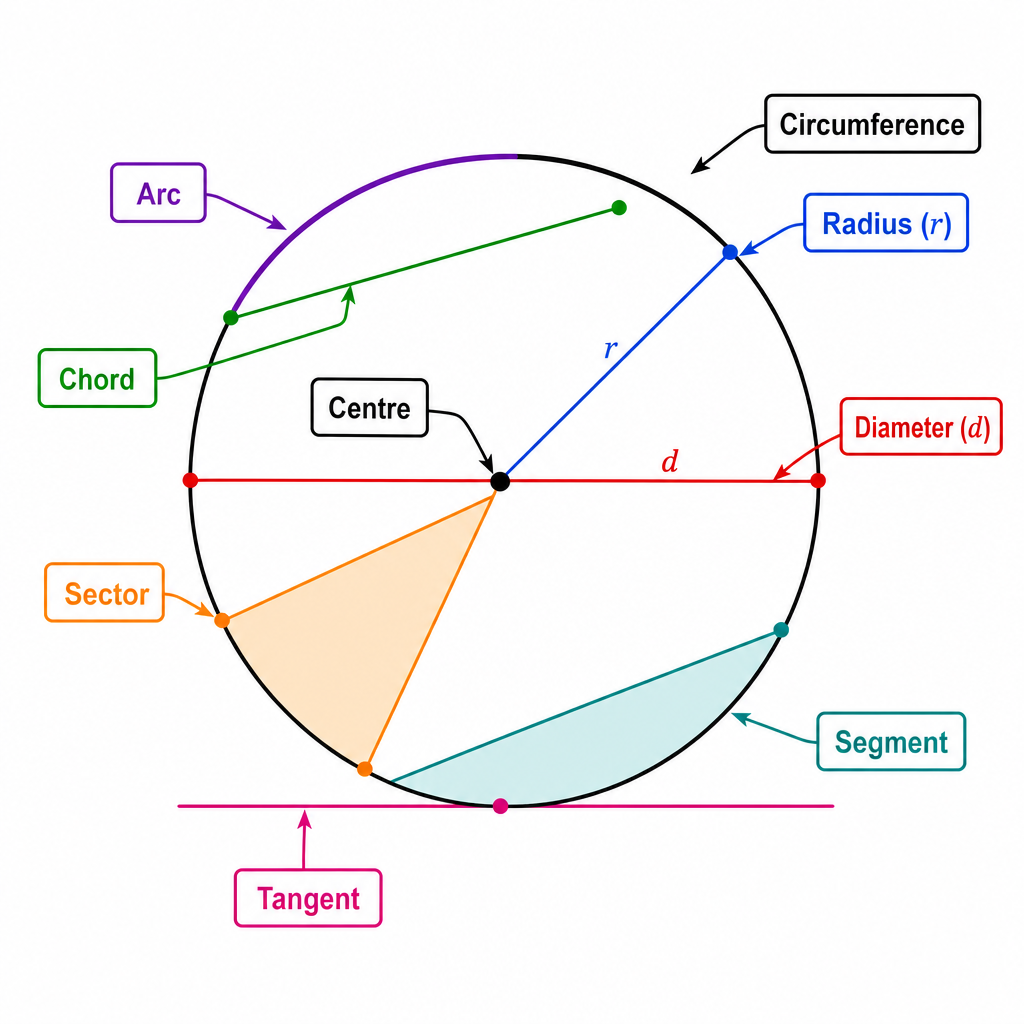
Let's talk circles. The centre is the middle point. The radius goes from the centre to the edge, and the diameter goes all the way across, through the centre. The circumference is the total distance around the outside. A chord is a line connecting two points on the edge, an arc is a piece of the circumference, a tangent is a line that just skims the outside, a sector is your classic pizza slice, and a segment is the crusty bit left when you cut a chord across it.
Finally, let's level up to 3D solids. The flat bits are faces, the lines where they meet are edges, and the corners are vertices. You'll see cubes, cuboids (like your phone), cylinders, cones, pyramids, and spheres. Oh, and two last key terms: congruent shapes are identical twins – same shape, same size. Similar shapes are like using pinch-to-zoom on an image; they're the same shape but different sizes. The amount you've scaled it by is the scale factor.
Worked example
Worked Example: Identifying Shapes and Properties
Let's Decode This Diagram 🕵️♂️
The diagram shows a logo made from several geometric shapes. A circle with centre C has a line segment AB that is a chord. Shape DEFG is a quadrilateral. Line XY is a tangent to the circle at point P.
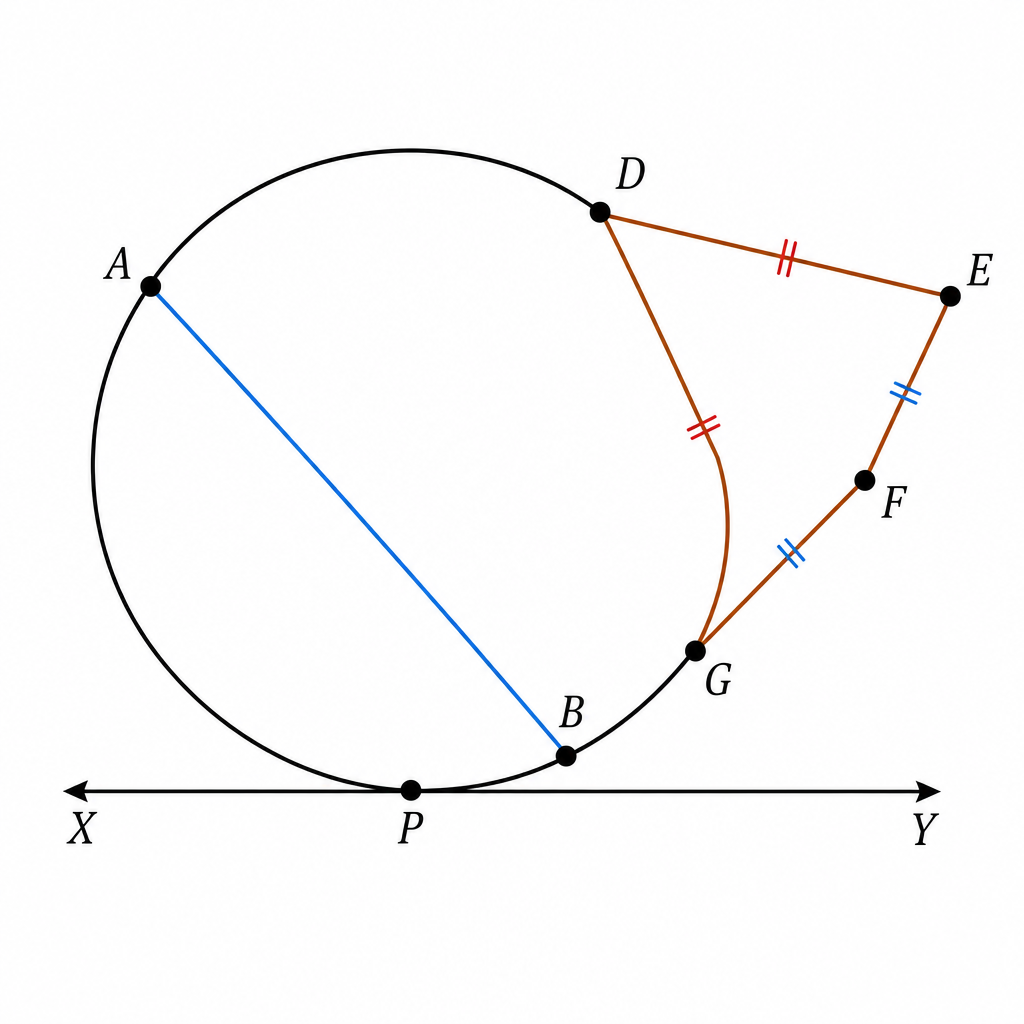
a) Name the quadrilateral DEFG.
b) What is the name of the line segment CA?
c) Identify a pair of perpendicular lines in shape DEFG, assuming it has one line of symmetry through D and F.
d) If we enlarged the whole logo by a scale factor of 3, would the new logo be similar or congruent to the original?
- 1Let's start with part (a). We look at the properties of the quadrilateral DEFG. The problem states that adjacent sides are equal in length ( and ). A quadrilateral with two pairs of equal-length sides that are adjacent to each other is a kite.Shape DEFG is a kite.
- 2For part (b), we need to identify the line segment CA. The point C is the centre of the circle, and the point A is on the circumference. A line segment from the centre to the circumference is called the radius.Line segment CA is the radius.
- 3Now for part (c). A key property of a kite is that its diagonals are perpendicular. The diagonals connect opposite vertices. So, the line segment DF is perpendicular to the line segment EG.The diagonals DF and EG are perpendicular.
- 4Finally, part (d). The question asks what happens when we enlarge the logo. Congruent means identical in size and shape. Similar means the same shape but a different size. Since we're enlarging it by a scale factor, the size changes, but the shape and all its angles stay the same. Therefore, the new logo is similar to the original.The new logo would be similar.
Answer
The new logo would be similar.
11. Geometrical Constructions and Nets
Alright, let's get into constructions. Think of it like being an architect or a game designer, but with a ruler and compasses instead of a computer. First up, the basics: drawing lines and angles. For any straight line, always use a ruler. No freehanding like you're doodling on Snapchat! For angles, your protractor is your best friend.
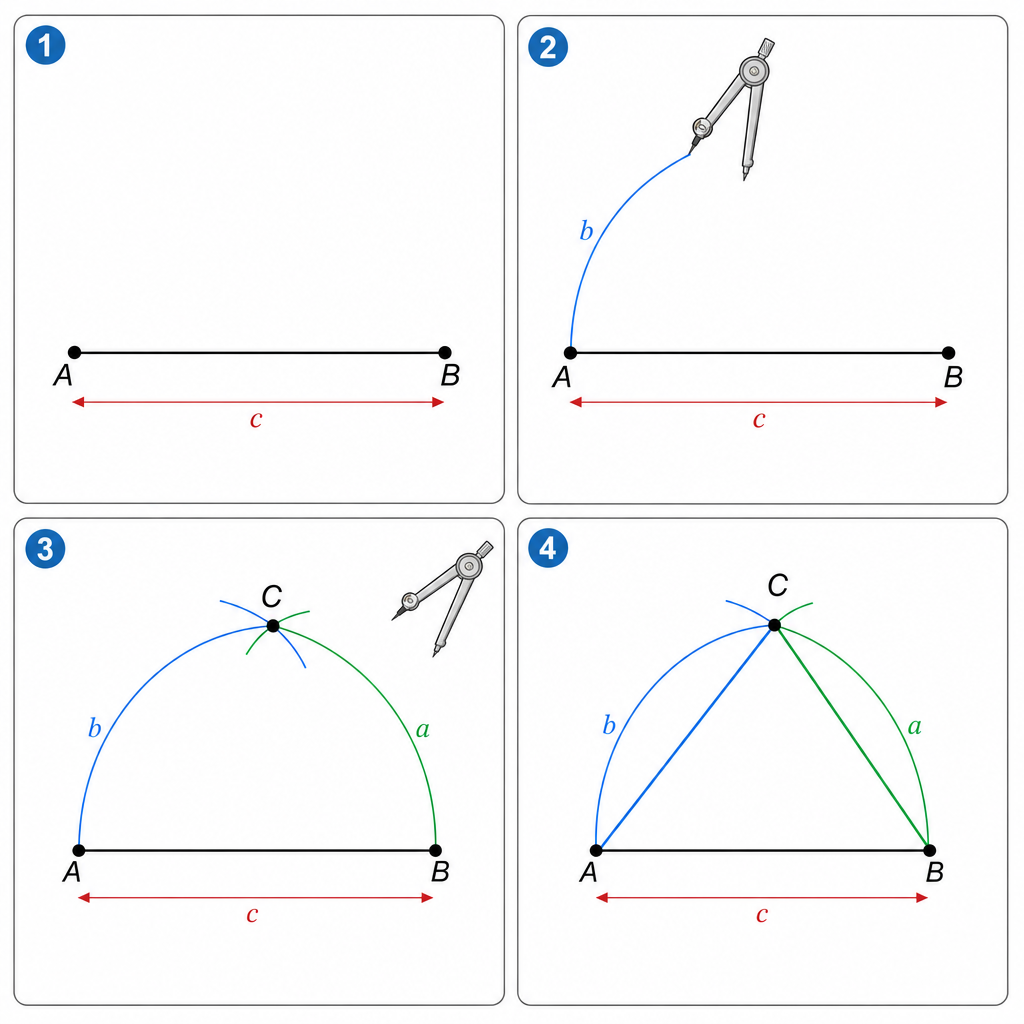
The main event is constructing a triangle when you know all three side lengths (we call this SSS - Side, Side, Side). Imagine you and two friends agree to meet up. You know you're 7km from Friend A and 6km from Friend B, and they are 8km from each other. Where's the meeting spot? That's what we're doing! You'll draw one side as your base line. Then, you set your compasses to the length of the second side, stick the point on one end of your base, and draw an arc. Do the same for the third side from the other end of the base. Boom! Where those arcs cross is your third point. Connect the dots and you have your triangle. The most important rule: never erase your construction arcs! They're like showing your work in an essay; they prove you did it properly.
The main event is constructing a triangle when you know all three side lengths (we call this SSS - Side, Side, Side). Imagine you and two friends agree to meet up. You know you're 7km from Friend A and 6km from Friend B, and they are 8km from each other. Where's the meeting spot? That's what we're doing! You'll draw one side as your base line. Then, you set your compasses to the length of the second side, stick the point on one end of your base, and draw an arc. Do the same for the third side from the other end of the base. Boom! Where those arcs cross is your third point. Connect the dots and you have your triangle. The most important rule: never erase your construction arcs! They're like showing your work in an essay; they prove you did it properly.
Now, let's talk about nets. A net is just a 3D shape unfolded and laid flat. Think about unboxing a new pair of trainers or a console – the cardboard box can be flattened out into its net. You need to be able to look at a net for something like a cube, cuboid, or even a pyramid, and picture how it folds up. Sometimes, you'll be asked to draw one yourself. The cool part is using the net to find things like surface area (just find the area of each flat face and add them all up) or volume. By looking at the net, you can figure out the length, width, and height of the 3D shape and then just plug them into the volume formula. It's like having the blueprint for the final object. 🛠️
Worked example
Worked Example: Triangle Construction and Net Interpretation
Blueprint Challenge: Building a Triangle & Calculating Volume 🏗️
(a) Using a ruler and compasses only, construct triangle where cm, cm, and cm. Leave your construction arcs visible.
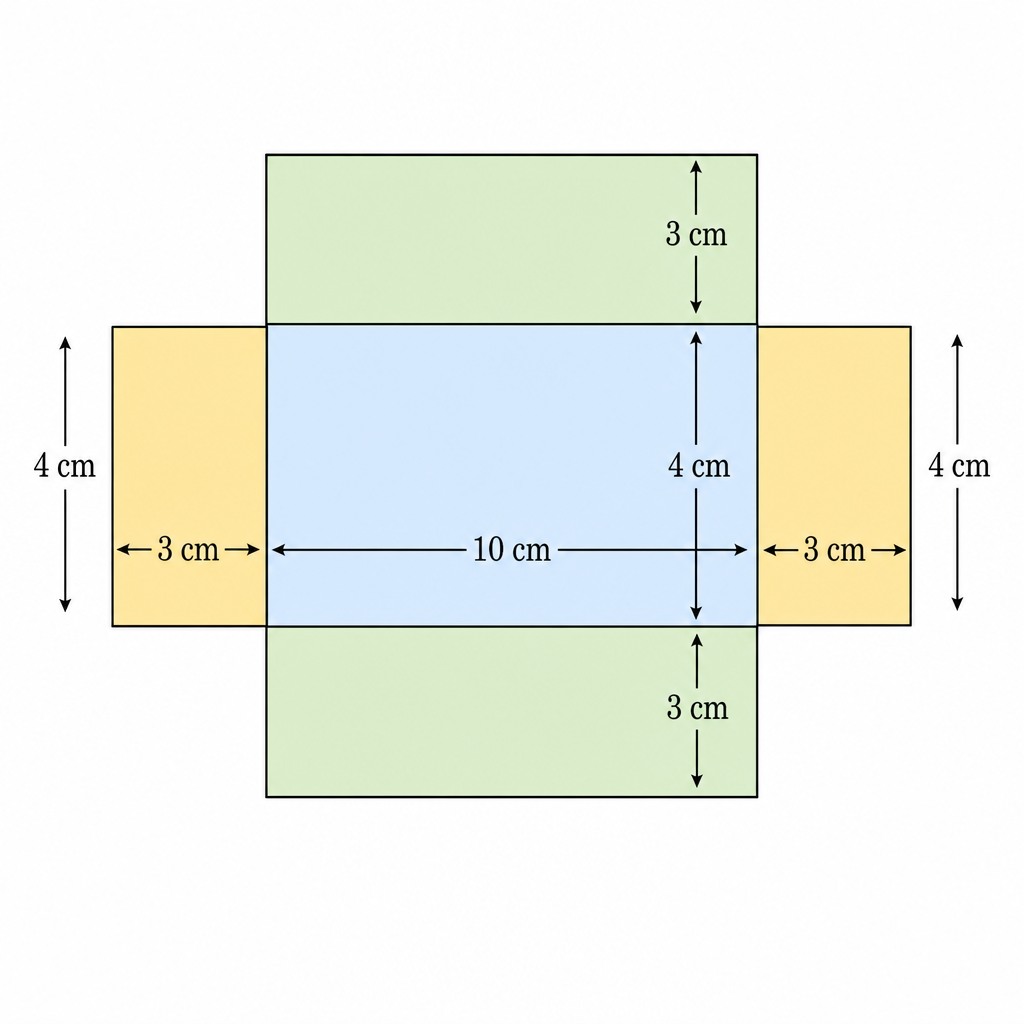
(b) The diagram below shows the net of a cuboid made from cardboard. All measurements are in cm. Calculate the volume of the cuboid.
(b) The diagram below shows the net of a cuboid made from cardboard. All measurements are in cm. Calculate the volume of the cuboid.
- 1For part (a), start by drawing the base line. It's usually easiest to pick the longest side. So, use your ruler to draw the line segment with a length of exactly cm. This is the foundation of our triangle.Draw line cm.
- 2Now, grab your compasses. We need to draw side , which is cm. Set the distance between the compass point and the pencil to cm using your ruler. Place the compass point on and draw a nice, clear arc above the base line.Set compass to 7 cm, draw arc from point P.
- 3Don't put the compasses away yet! For the final side, , we need a length of cm. Adjust your compasses to a cm gap. Now, place the compass point on and draw another arc that crosses the first one you drew. This intersection point is our vertex .Set compass to 6 cm, draw arc from point Q to intersect the first arc.
- 4The final construction step is to connect the dots. Use your ruler to draw straight lines from to the intersection point , and from to . You've now constructed triangle ! Make sure you've left your arcs visible.Join P to R and Q to R with straight lines.
- 5For part (b), we need to interpret the net to find the cuboid's dimensions. Looking at the flat pattern, we can see the main base is cm by cm. The flaps that fold up will form the height. The height of these flaps is cm. So, our dimensions are length = cm, width = cm, and height = cm.Dimensions from net: cm, cm, cm.
- 6Finally, calculate the volume. The formula for the volume of a cuboid is . We just plug in the numbers we found from the net.
Answer
12. Angle Properties and Calculations
Alright, let's break down angle facts. Think of these as the unbreakable laws of geometry, the cheat codes you need to solve any angle puzzle. First up, the basics. Any angles on a straight line always add up to . Imagine doing a 180 on a skateboard – you end up facing the opposite way on the same line. Angles around a single point make a full circle, so they always sum to .
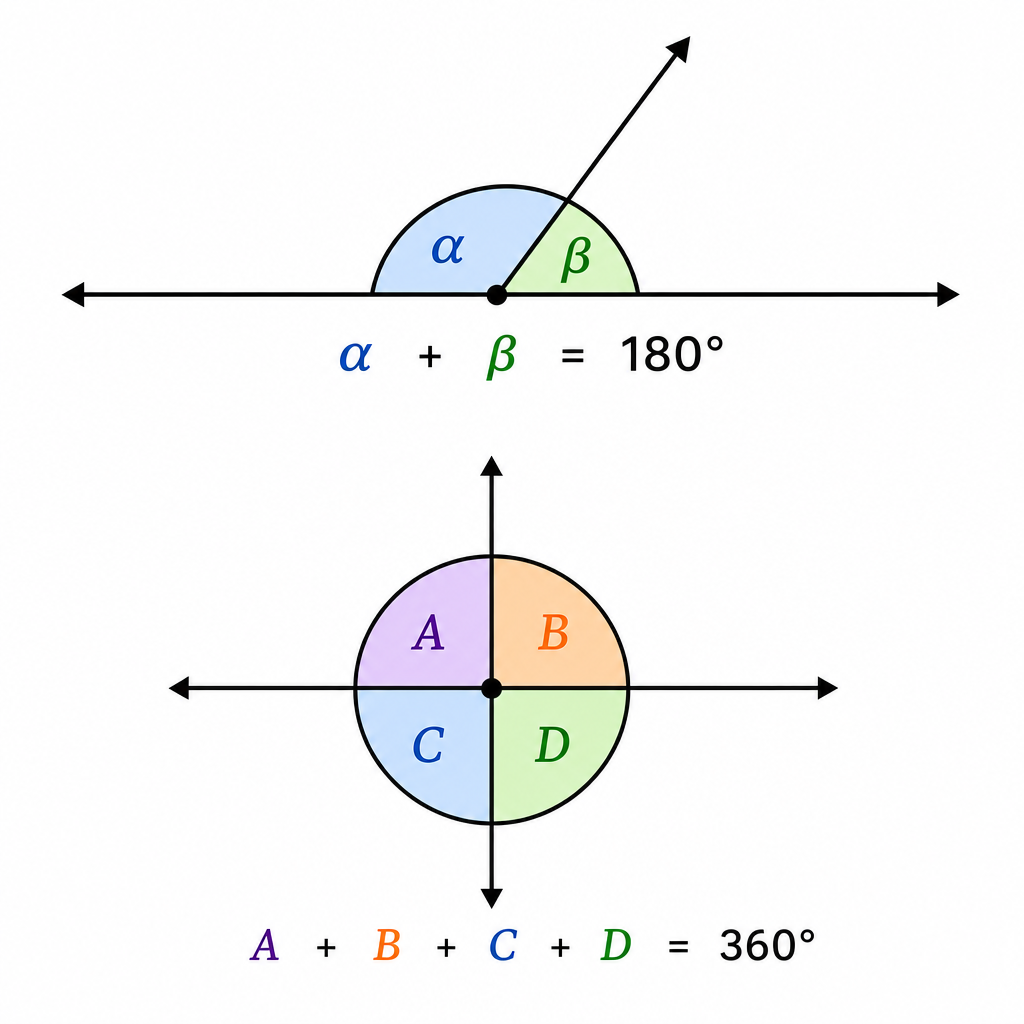
When two straight lines cross, they form an 'X'. The angles directly opposite each other, called vertically opposite angles, are always equal. It's a super handy shortcut!
Now for the main event: parallel lines. These are lines that never meet, like train tracks. When another line (a transversal) cuts across them, it creates a pattern of angles. Look for these letters: F-angles are corresponding angles and are equal. Z-angles are alternate angles and are also equal. C-angles are co-interior angles; they aren't equal, but they are partners in crime that always add up to .
Now for the main event: parallel lines. These are lines that never meet, like train tracks. When another line (a transversal) cuts across them, it creates a pattern of angles. Look for these letters: F-angles are corresponding angles and are equal. Z-angles are alternate angles and are also equal. C-angles are co-interior angles; they aren't equal, but they are partners in crime that always add up to .
Finally, let's talk shapes. The three angles in any triangle always sum to . For any quadrilateral (a four-sided shape), the four angles sum to . For regular polygons (where all sides and angles are equal, like a perfect octagon for a stop sign), there's a simple trick. The exterior angle is just divided by the number of sides (). Once you have that, the interior angle is simply . Remember, in your exam, you can't just write down the answer. You have to give the reason, using the correct geometric term. It's like showing your work in a boss battle – it proves you know what you're doing!
Worked example
Worked Example: Finding Angles in a Compound Figure
Solving the Geometry Puzzle 🧩
In the diagram below, line ABC is parallel to line DE. We are given that and . Your mission is to find the size of angle , which is .
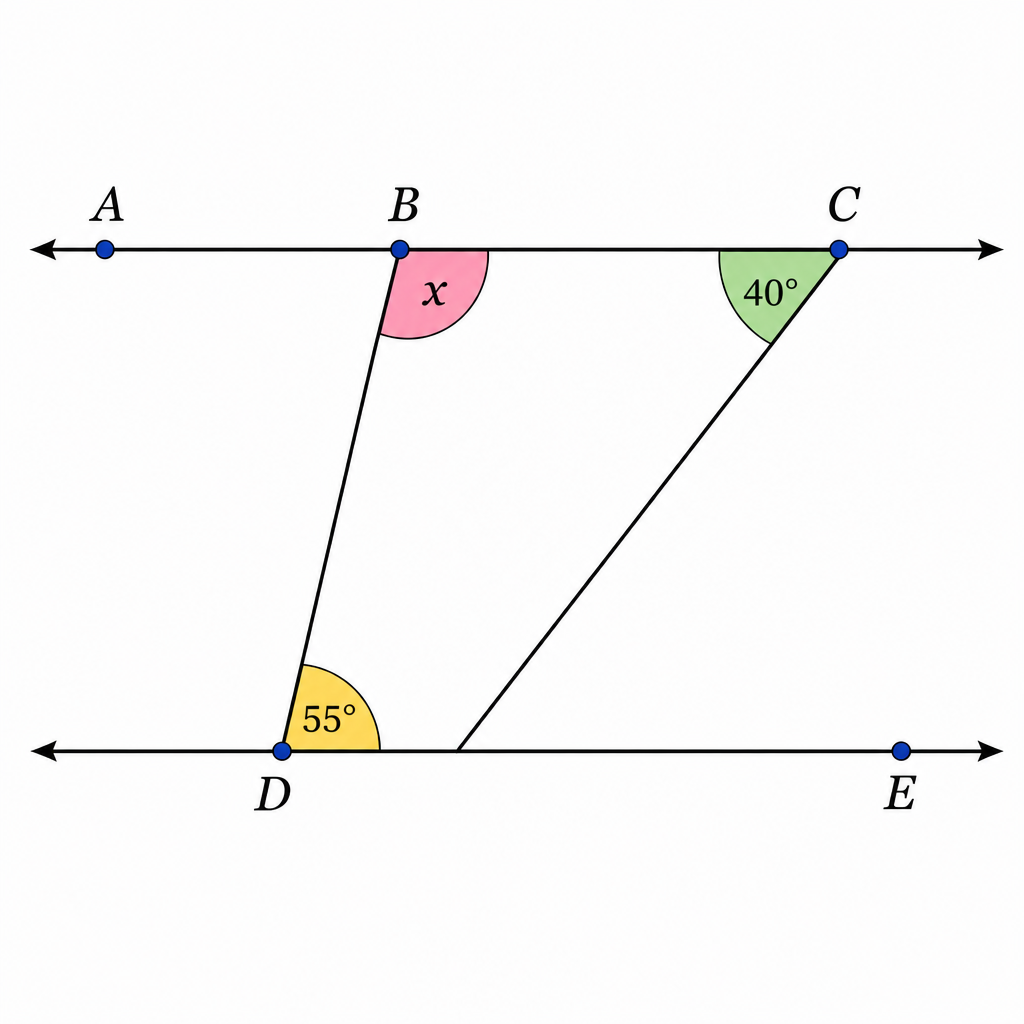
- 1Notice that line segment BD acts as a transversal crossing both parallel lines ABC and DE. The angles (which is ) and form a 'Z' shape (alternate interior angles) with respect to the parallel lines. Alternate interior angles between parallel lines are equal.
- 2The problem states that . Since alternate angles are equal, we can directly find the value of . The information about was extra info to test if you could spot the correct rule!
- 3Finally, we state our answer with the reason. It's crucial to write down the geometric rule you used to get the marks.
Answer
13. Similarity and Basic Circle Theorems
Alright, let's break down similarity and circle theorems. Think of 'similarity' like using a filter on Instagram or Snapchat that scales your face up or down. The photo gets bigger or smaller, but your features stay in the same proportion – your nose doesn't suddenly take up half your face! That's the key idea: similar shapes are the same shape but different sizes. They're basically a perfect 'glow-up' or 'glow-down' of each other.
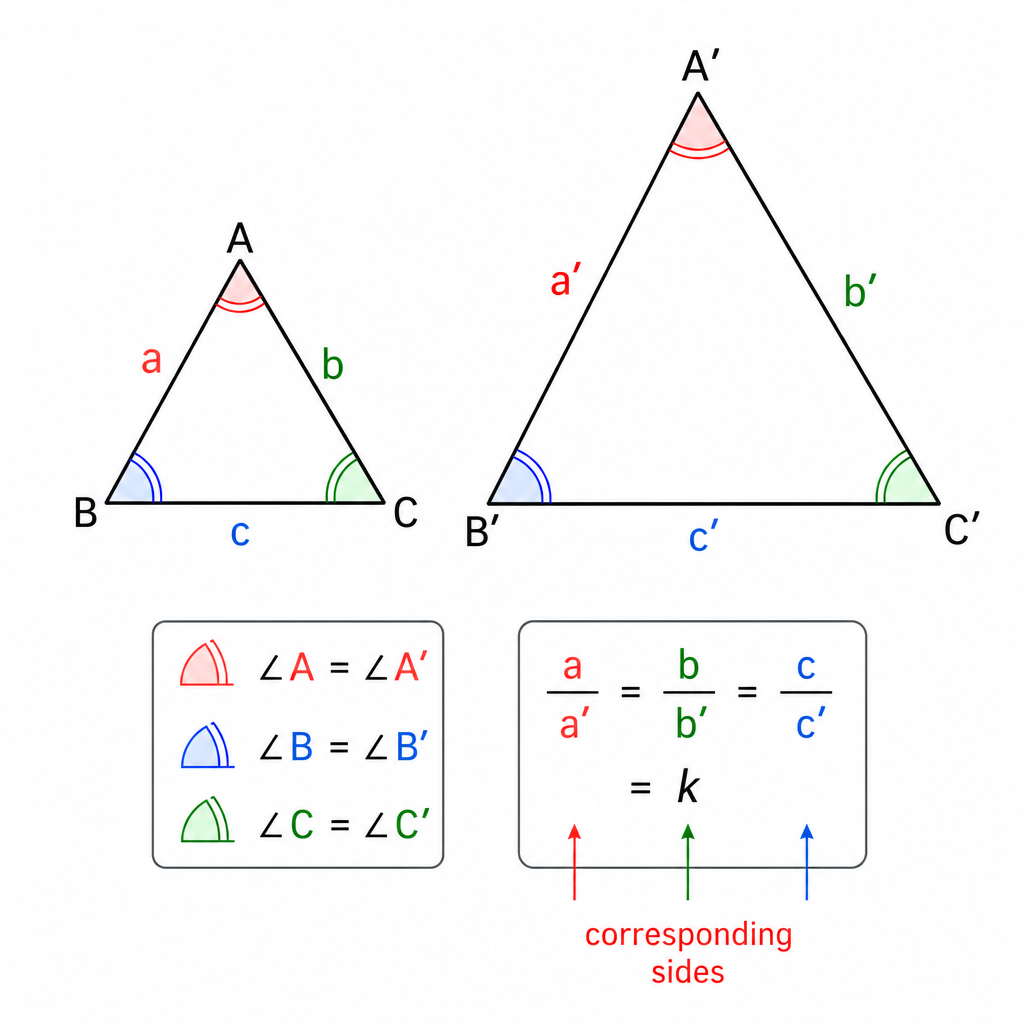
To figure out the size change, we use a scale factor. If you want to find an unknown side length on a bigger shape, you find the scale factor by dividing a side length on the new shape by the corresponding side on the original shape. Then, just multiply the original side you're interested in by that scale factor to find its new length. It's like knowing the price of one song on a streaming service and using that to calculate the cost of a whole album.
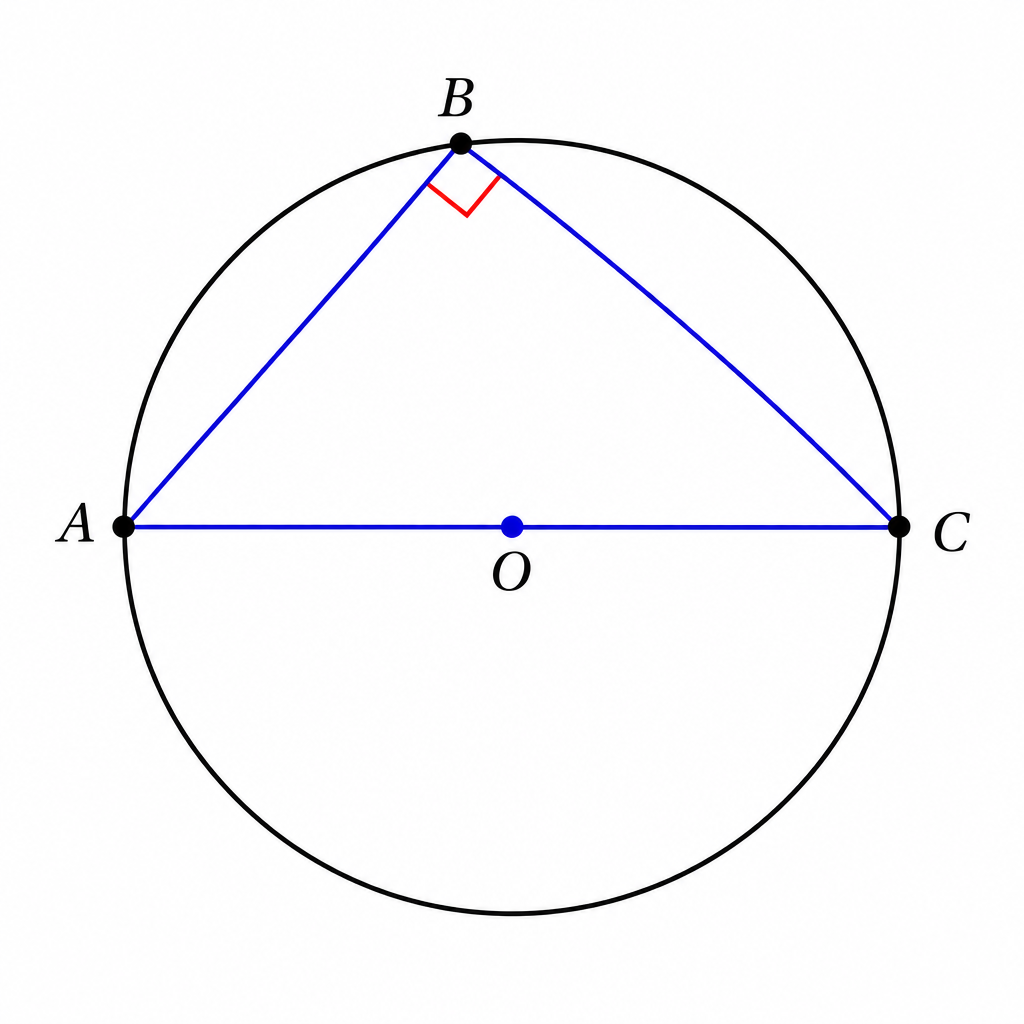
Now for circle theorems – these are like awesome geometry cheat codes. First up: the angle in a semicircle is always 90°. This means if you draw a triangle using the circle's diameter as one of its sides, the corner that touches the edge of the circle will always be a perfect right angle. No exceptions. It’s a guaranteed 90° every single time.
Now for circle theorems – these are like awesome geometry cheat codes. First up: the angle in a semicircle is always 90°. This means if you draw a triangle using the circle's diameter as one of its sides, the corner that touches the edge of the circle will always be a perfect right angle. No exceptions. It’s a guaranteed 90° every single time.
The second rule is about tangents. A tangent is a straight line that just brushes the edge of a circle at one single point. The angle between a tangent and the radius at that meeting point is also always 90°. Imagine a car wheel (the circle) perfectly flat on the road (the tangent) – the spoke (radius) going straight down to the road makes a right angle. These two rules are super handy for finding missing angles without any measuring!
Worked example
Worked Example: Similar Triangles and Circle Theorems
Time to Put the Theory into Practice 🧠
The diagram shows two similar triangles, and , with vertex A in common and BC parallel to DE. We are given cm, cm, and cm. Separately, a circle has a radius of 7 cm. A tangent line touches the circle at point P. What is the length of DE and what is the angle between the tangent and the radius at point P?
- 1First, let's find the length of DE. Since the triangles are similar, the ratio of their corresponding sides is the same. We need to find the scale factor for the enlargement from to . We can find this by comparing the two corresponding sides we know: AD and AB.
- 2Now, plug in the values we know for the corresponding sides AD and AB to calculate the actual scale factor.
- 3Awesome! The bigger triangle is 1.5 times the size of the smaller one. We can now use this scale factor to find the length of the unknown side DE. DE corresponds to BC.
- 4Okay, part two. This is where the circle theorem comes in. The question asks for the angle between the tangent and the radius at the point where they meet.No calculation here, just applying the rule!
- 5Remember the 'cheat code'? The angle between a tangent and a radius at the point of contact is always a right angle. It doesn't matter how big the circle is. So, the angle at point P is 90 degrees.
Answer
14. Bearings: Three-Figure Directions
A bearing is a direction written as an angle. Two rules, no exceptions:
1. Measured clockwise from the North line at your starting point.
2. Always three digits — , not . And , not . (Pad with zeros if needed.)
So = due north, = east, = south, = west. Same four points, fancier notation. 📍
1. Measured clockwise from the North line at your starting point.
2. Always three digits — , not . And , not . (Pad with zeros if needed.)
So = due north, = east, = south, = west. Same four points, fancier notation. 📍
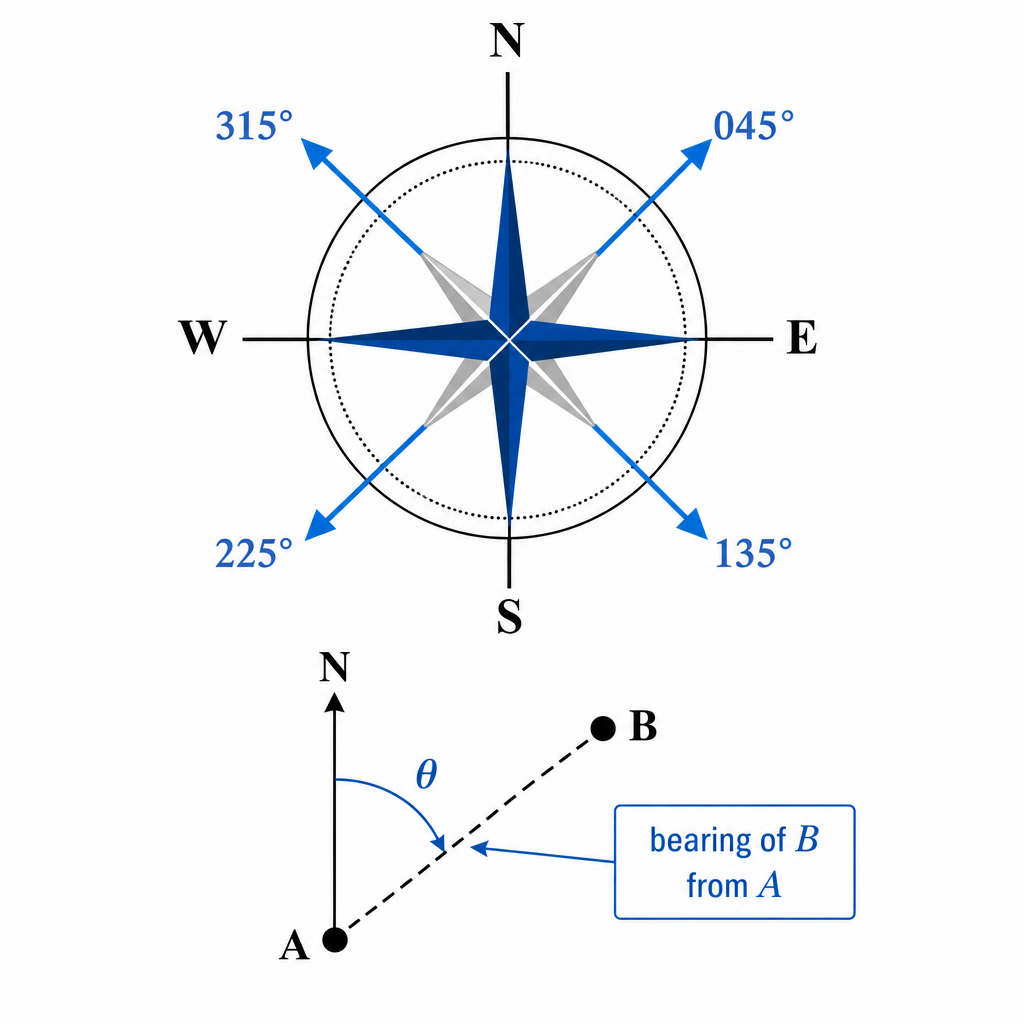
Back-bearings (the trick examiners love): if the bearing of from is less than , the bearing of from is that plus . If it's more than , subtract . Example: bearing of from , so bearing of from . Basically: turn around and look the other way. 🔄
Parsing the question (this trips people up): 'The bearing of from ' means you're standing at , facing north, and turning clockwise until you're looking at . The angle you swept = your bearing. Reread the question if you're unsure which point you're standing at. 👀
Worked example
Worked Example: Bearing and Back-Bearing
A ship sails from port on a bearing of to buoy . (a) State the bearing of from . (b) From the ship turns and sails on a bearing of to harbour . Sketch the journey and state the angle inside the triangle. ⛵
- 1For (a), outbound bearing is under , so add to get the back-bearing.
- 2For (b), at : the incoming leg is on bearing , the outgoing leg on . Both are measured from the same north line at . The interior angle is the difference.
- 3Sanity check — interior angles of a triangle are between and . fits. ✅
Answer
15. Circle Theorem 1: Angle in a Semicircle
When a triangle is drawn inside a circle and one of its sides is a diameter, the angle opposite that diameter is always . Always. It's basically a cheat code. 🎮
Reason phrase to write in your working: 'angle in a semicircle '. Write it exactly like that — examiners love the correct language. 📝
Reason phrase to write in your working: 'angle in a semicircle '. Write it exactly like that — examiners love the correct language. 📝
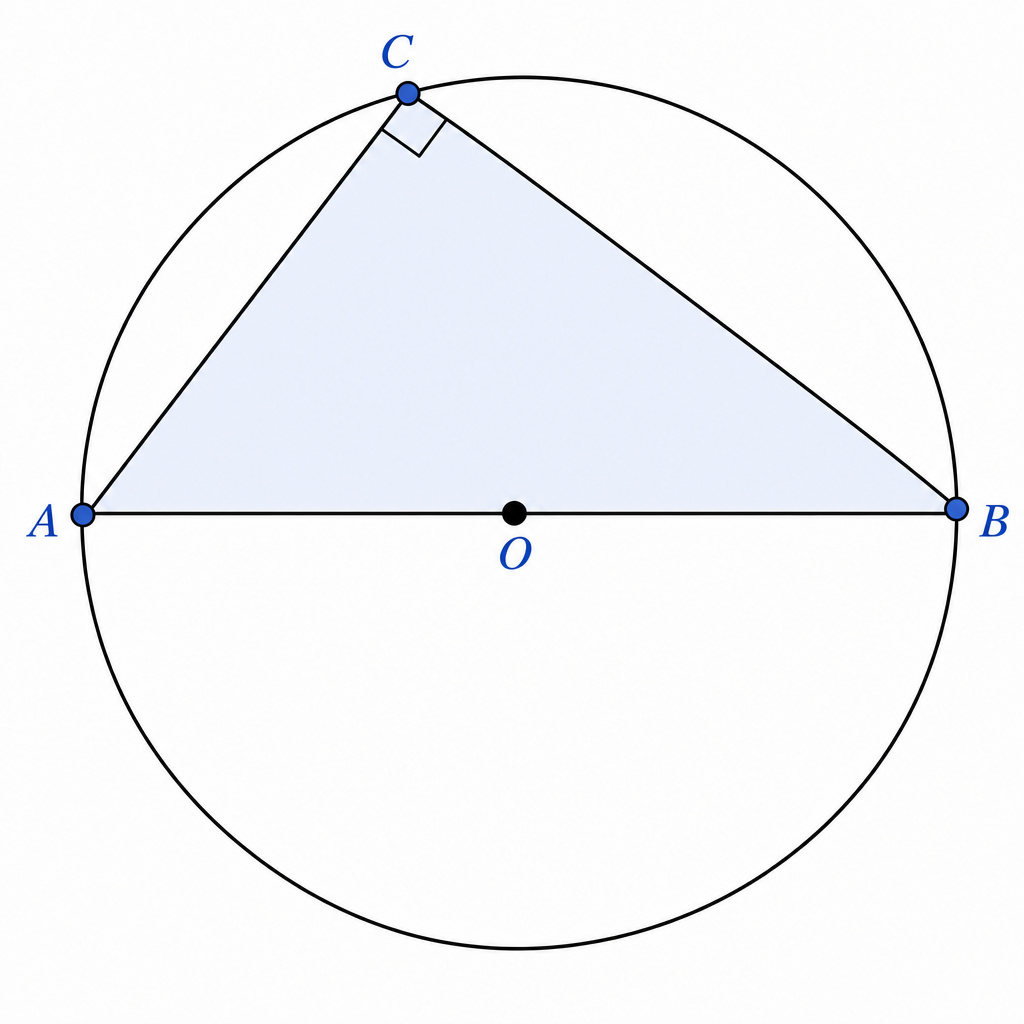
Two things examiners are checking:
• The chord must be a diameter (passes through the centre). Just any chord? Theorem doesn't apply. 🛑
• Once you know one angle is , use 'angles in a triangle sum to ' to find the other two. Simple combo. 🎯
Worked example
Worked Example: Angle in a Semicircle
is a diameter of a circle with centre . is a point on the circumference. . Find and , with a reason for each.
- 1is a diameter, is on the circle → angle at is in a semicircle.
- 2Three angles of triangle sum to . Two are known.
- 3Write the reason for the second answer — the language earns the mark.
Answer
16. Circle Theorem 2: Tangent and Radius
A tangent is a straight line that just kisses the circle at one single point (the point of contact). The theorem: the radius drawn to the point of contact is perpendicular to the tangent. Always at that meeting. Every. Single. Time. 🔥
Reason phrase for your working: 'radius is perpendicular to tangent at the point of contact' (or shorthand: 'tangent radius').
Reason phrase for your working: 'radius is perpendicular to tangent at the point of contact' (or shorthand: 'tangent radius').
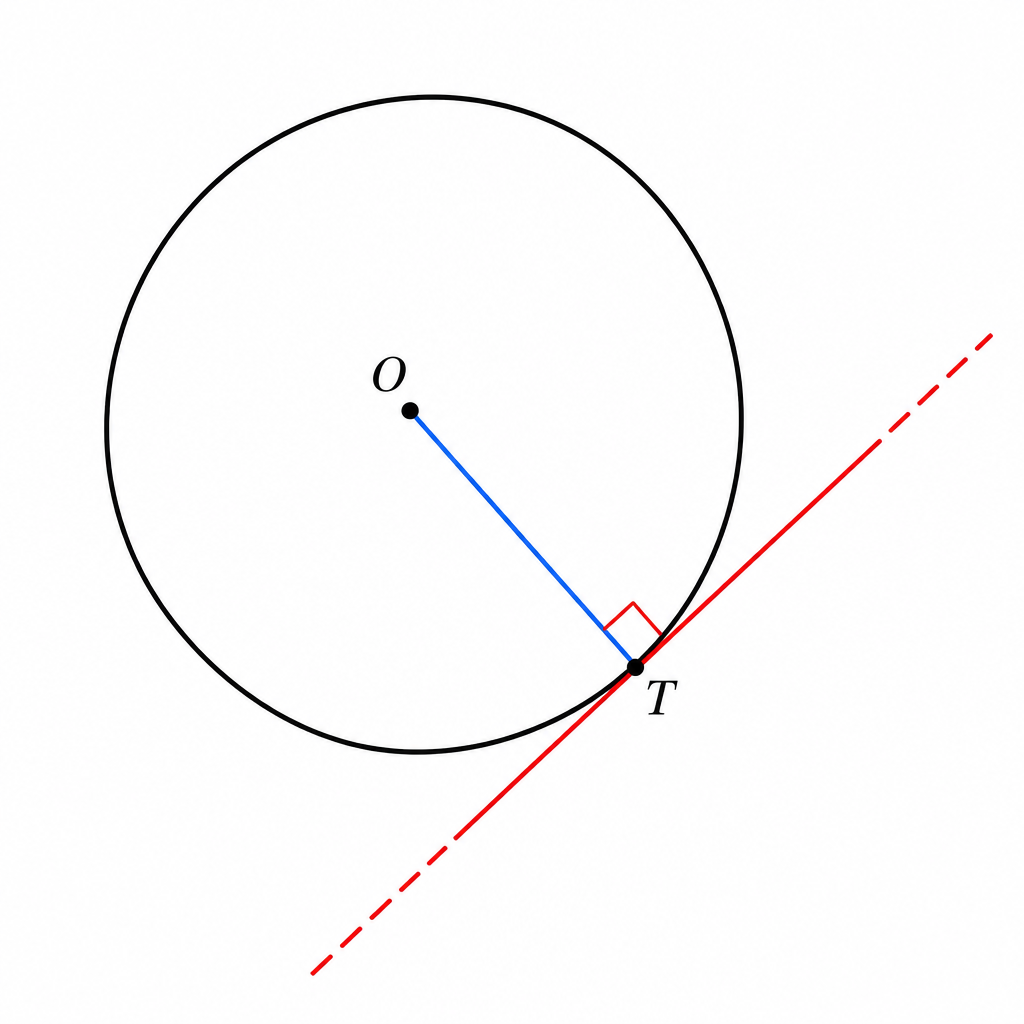
This theorem is almost always combined with Pythagoras — once you have a right angle, you've got a right-angled triangle, which means Pythagoras' theorem just unlocks. If you know the radius and the distance from the external point to the centre, you can find the tangent length. Dynamic duo. 🎯
Worked example
Worked Example: Tangent-Radius with Pythagoras
A circle has centre and radius cm. A tangent from external point touches the circle at . cm. Find the length of the tangent . 📐
- 1Draw the radius . Because is a tangent, — so triangle is right-angled at . 🎯
- 2Apply Pythagoras. is the hypotenuse (opposite the right angle), the other two sides are and .
- 3Rearrange and solve. . Nice round answer. 😎
Answer
Practice this in the app
Unlock the full chapter: practice questions, flashcards, mock papers and notes, free.
Continue revising