Stoichiometry: Formulae, Moles, and Reacting Masses
Mole Master: Count Like a Chemist 🧪
Introduction
1. Introduction
Alright, let's talk stoichiometry. Sounds like a final-boss word, but it's basically chemistry's version of a recipe: how much of this do I mix to get that much of the other thing? Bakers do it with cups, chemists do it with the mole.
Here's the cheat code for the whole chapter: your balance only reads grams, but reactions actually happen in ratios of particles. The mole is the translator between the two. Lock that in and every calculation becomes the same three little steps. This is your fast refresh, not the full textbook: one key formula per idea, one quick worked example, and the exact move the marker wants. Let's count like a chemist! 🧪
Here's the cheat code for the whole chapter: your balance only reads grams, but reactions actually happen in ratios of particles. The mole is the translator between the two. Lock that in and every calculation becomes the same three little steps. This is your fast refresh, not the full textbook: one key formula per idea, one quick worked example, and the exact move the marker wants. Let's count like a chemist! 🧪
2. Writing Chemical Formulae
A formula just says how many atoms of each element are in there. The little number sticks to the symbol right before it, so is two H and one O. For ionic compounds (a metal + a non-metal, or anything with a group like sulfate), the trick is that the whole thing has to be electrically neutral. So you balance the positive and negative charges until they cancel, then write the smallest whole-number ratio.
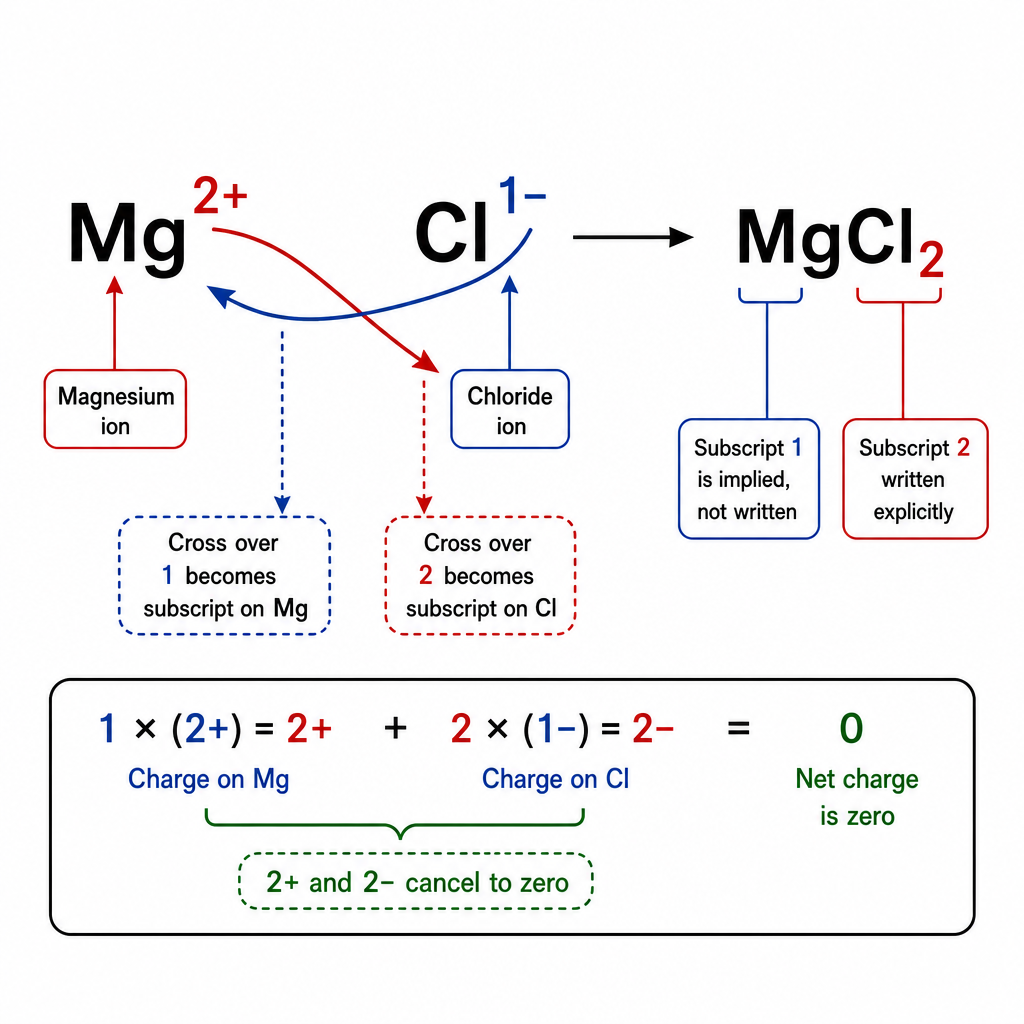
Key idea🔑 Key idea: An ionic formula is the smallest ratio of ions whose charges cancel. If a group like sulfate appears more than once, wrap it in brackets: . 🎯
Worked example
Worked Example: Building Magnesium Chloride
Worked Example: Swap the Charges 🧲
Magnesium forms ions and chlorine forms ions. What's the formula of magnesium chloride?
- 1Line up the charges: magnesium is 2+, chlorine is 1−. They don't cancel one-to-one.
- 2You need two 1− chlorides to balance one 2+ magnesium, so the ratio is 1 : 2.
So the formula is . One magnesium, two chlorines, charges balanced. ✅
---
Answer
3. Empirical and Molecular Formulae
Two flavours of formula, and people mix them up constantly. The molecular formula is the actual atom count in one molecule (ethane = ). The empirical formula is the simplest ratio (ethane = ). Think of a pizza cut into slices: the empirical formula is the "1 cheese : 2 pepperoni per slice" ratio, the molecular formula is the whole pie. To find an empirical formula from masses or percentages, you turn each into moles (divide by ), then divide by the smallest.
Key idea🔑 Key idea: Empirical = simplest ratio, molecular = real count. To get empirical from % or mass: divide each by , then divide by the smallest number. Never compare the percentages directly. 🧮
Worked example
Worked Example: A Carbon-Hydrogen Compound
Worked Example: Percent to Formula 💨
A compound is 85.7% carbon and 14.3% hydrogen by mass. Find its empirical formula. (: C = 12, H = 1.)
- 1Treat the percentages as masses out of 100 g and divide each by its to get moles.
- 2Divide both by the smaller number (7.14).
So the empirical formula is . Clean and simple. 🔥
---
Answer
4. Balancing and Ionic Equations
A balanced equation is just a promise that no atoms vanish: the same number of each element on both sides. You make it balance by changing the big numbers in front only, never the little subscripts (that would change the actual substance). An ionic equation is the stripped-down version: you keep only the ions that actually do something and ditch the spectators who just watch.
Key idea🔑 Key idea: Balance with the big front numbers, never the subscripts. Ionic equations keep only what changes and must balance both atoms and charge. ⚡
Worked example
Worked Example: The Thermite Reaction
Worked Example: Balance It Out 🔥
In the thermite reaction, aluminium reacts with iron(III) oxide to make aluminium oxide and iron. Balance the equation.
- 1Write the correct formulae first, no balancing yet.
- 2Count up: the right side has 2 Al, the left has only 1; the left has 2 Fe, the right has only 1. Put a 2 in front of aluminium and a 2 in front of iron.
Now both sides have 2 Al, 2 Fe, 3 O. Balanced. ✅
---
Answer
5. Relative Atomic Mass
Atoms are way too tiny to weigh one at a time, so chemists compare everything to a carbon-12 atom (set at exactly 12). The relative atomic mass () is the average mass of an element's atoms. It's an average because most elements come as a mix of isotopes (same element, different masses). And it's a weighted average, like working out your grade when the final exam counts for more than homework. That's why chlorine's is 35.5 and not a tidy whole number.
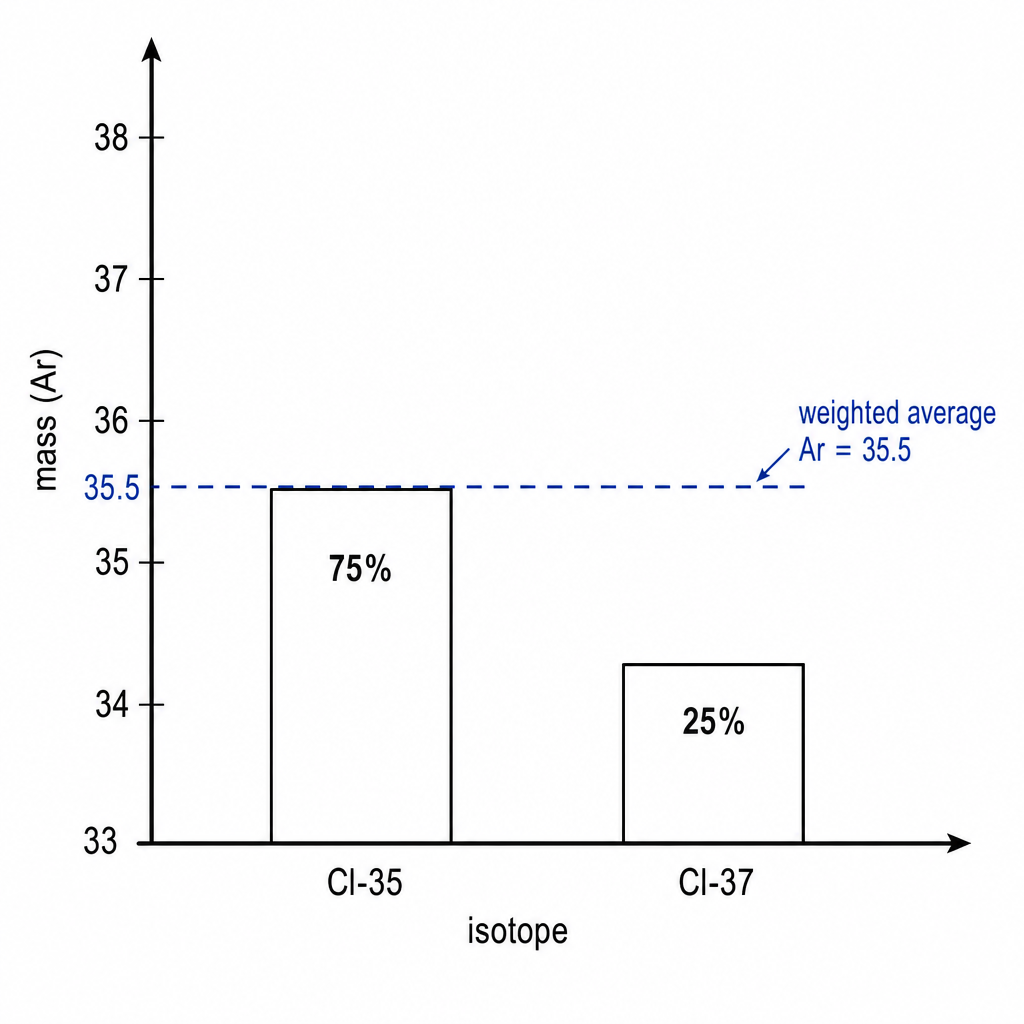
Key idea🔑 Key formula: . Only use a plain average if the isotopes are split 50/50. 🎯
Worked example
Worked Example: The Mass of Chlorine
Worked Example: Weight It Right 🧪
Chlorine is 75% mass-35 atoms and 25% mass-37 atoms. Find its relative atomic mass.
- 1Multiply each isotope mass by its percentage, then add.
- 2Divide by 100.
It lands closer to 35 because there's more of the lighter isotope. Makes sense. ✅
---
Answer
6. Relative Formula Mass
Once you know the of each element, the relative molecular (or formula) mass is just the total mass of all the atoms in the formula. Add them up. The one thing that trips everyone is brackets: a number outside a bracket multiplies everything inside it, so has two oxygens and two hydrogens, not just two oxygens.
Key idea🔑 Key idea: = sum of all the values in the formula. A bracket number multiplies every atom inside the bracket. 🧮
Worked example
Worked Example: Calcium Hydroxide
Worked Example: Mind the Brackets 🚧
Find the relative formula mass of calcium hydroxide, . (: Ca = 40, O = 16, H = 1.)
- 1The 2 outside the bracket doubles both the O and the H. So you've got 1 Ca, 2 O, 2 H.
- 2Add the masses.
So . Forget the bracket and you'd wrongly get 57 or 58. 👀
---
Answer
7. Conservation of Mass
In any reaction, atoms just get rearranged, never created or destroyed. So the total mass of products equals the total mass of reactants. If mass looks like it changed, a gas snuck in or escaped: burning magnesium gets heavier (grabs oxygen from the air), a heated carbonate gets lighter (lets carbon dioxide escape). And because a reaction is fixed, if you scale the amounts up or down, every mass scales by the same factor, so you can answer loads of questions with simple proportion.
Key idea🔑 Key idea: Mass of products = mass of reactants, always. Scale a fixed reaction up or down and every mass scales together. ⚖️
Worked example
Worked Example: Iron Plus Sulfur
Worked Example: Scale It Down 🪙
28 g of iron reacts to form 44 g of iron sulfide. What mass of iron sulfide forms from 7 g of iron?
- 1Compare the iron: 7 g is a quarter of 28 g.
- 2So you make a quarter of the product.
11 g of iron sulfide. No moles needed, just proportion. ✅
---
Answer
8. The Mole and Molar Mass
The mole is just a "dozen" but enormous: one mole is particles (the Avogadro constant), like how "a dozen" always means 12 whether it's eggs or doughnuts. The genius bit: one mole of a substance weighs its relative mass in grams, called the molar mass. So 1 mol of water (18) is 18 g, 1 mol of carbon (12) is 12 g. That's the link between grams on your balance and particles in the reaction.
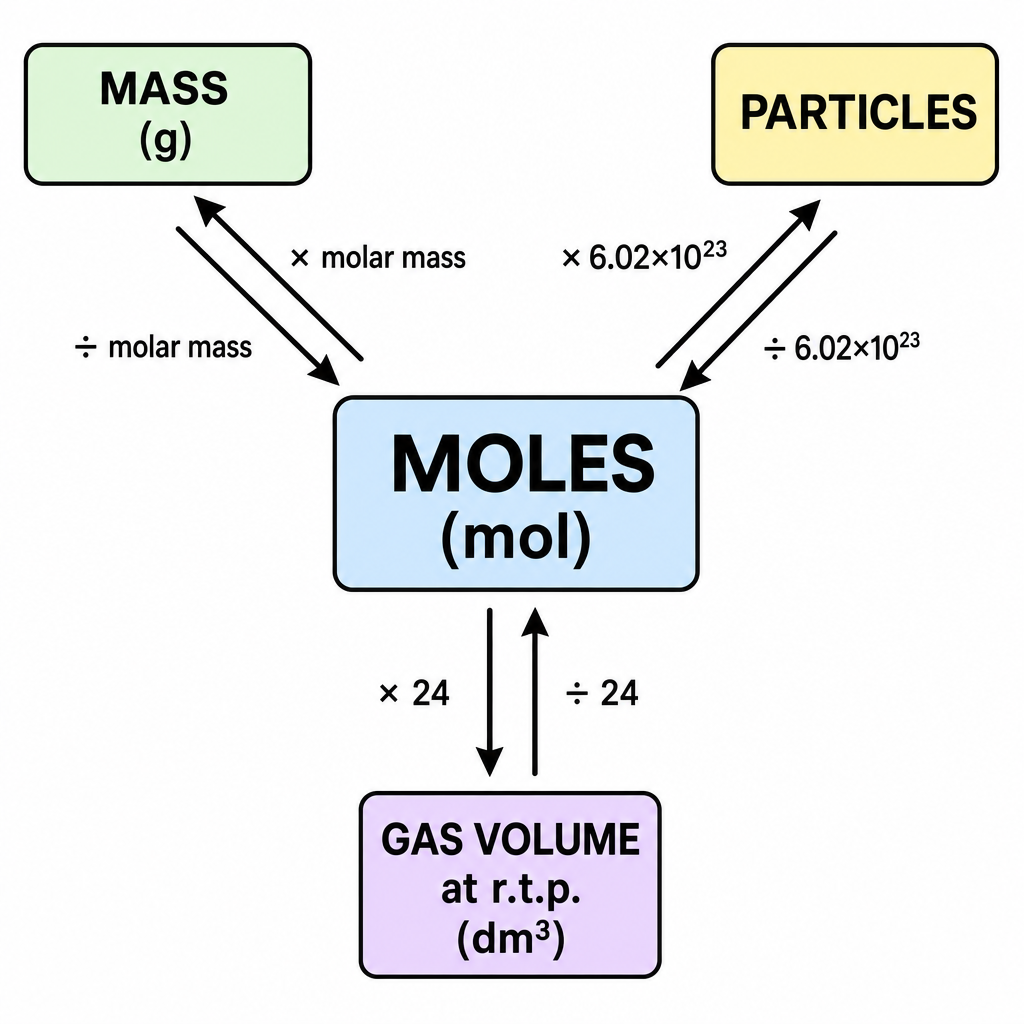
Key idea🔑 Key formula: amount (mol) , and number of particles amount . 🎯
Worked example
Worked Example: Moles and Atoms of Argon
Worked Example: Grams to Particles 🔬
How many moles, and then how many atoms, are in 2.00 g of argon? (, .)
- 1Get to moles: amount = mass ÷ molar mass.
- 2Argon is single atoms, so number of atoms = moles .
Less than a mole, so fewer than atoms. Checks out. 🔬
---
Answer
9. Gas Volumes and Concentration
Two more arrows off the mole map. For gases: at room temperature and pressure (r.t.p.), one mole of any gas takes up the same 24 dm³, so amount = volume ÷ 24. For solutions: concentration = moles ÷ volume (in dm³). The classic trap is units, so always change cm³ to dm³ first (divide by 1000). A reaction calc is still just the three moves: get to moles, cross the equation ratio, leave moles.
Key idea🔑 Key formula: gas volume (dm³) moles at r.t.p.; concentration (mol/dm³) . And . 🧪
Worked example
Worked Example: Carbon Dioxide from a Carbonate
Worked Example: Three Quick Moves 🌋
. What volume of carbon dioxide at r.t.p. comes from 0.5 mol of calcium carbonate? (24 dm³/mol.)
- 1Get to moles: you already have 0.5 mol of . Cross the equation: the ratio is 1 : 1, so you make 0.5 mol of .
- 2Leave moles: turn moles of gas into a volume.
12 dm³ of carbon dioxide. Same three moves every time. ✅
---
Answer
10. Reacting Masses and Yield
This is the payoff. A balanced equation plus the three moves lets you predict exactly how much product you should get: mass of reactant → moles → (cross the ratio) → moles of product → mass of product. Real life never quite hits the predicted maximum, so chemists report a percentage yield (what you actually got ÷ the theoretical max × 100). It can never beat 100%, so if you ever get more, you flipped the fraction.
Key idea🔑 Key formula: percentage yield . Reacting-mass route: mass → ÷ → moles → × ratio → moles → × → mass. 🧮
Worked example
Worked Example: Burning Magnesium
Worked Example: Mass to Mass 🔥
. What mass of magnesium oxide forms from 4.8 g of magnesium? (: Mg = 24, O = 16.)
- 1Get to moles of Mg, then cross the equation ratio.
- 2Leave moles: turn moles of MgO into mass ().
8.0 g of magnesium oxide. Three moves, done. 🎯
---
Answer
Practice this in the app
Unlock the full chapter: practice questions, flashcards, mock papers and notes, free.
Continue revising