Organic Chemistry: Carbon, Families, and Functional Groups
Carbon Crew: Eight Families, One Pattern 🧬
Introduction
1. Introduction
Okay, organic chemistry. It sounds like a whole new subject, but it's basically the chemistry of one element being extra: carbon. Carbon makes four bonds and happily bonds to itself, so it builds chains, branches and rings, which is why there are millions of carbon compounds.
The cheat code: chemists sort them all into families (homologous series), and each family has a functional group (its reactive bit). Learn the group, predict the chemistry. This is your fast refresh, not the full textbook: one key idea per family, one quick worked example, and the exact move the marker wants. Eight families, one pattern. Let's go. 🧬
The cheat code: chemists sort them all into families (homologous series), and each family has a functional group (its reactive bit). Learn the group, predict the chemistry. This is your fast refresh, not the full textbook: one key idea per family, one quick worked example, and the exact move the marker wants. Eight families, one pattern. Let's go. 🧬
2. Formulae and Functional Groups
A functional group is the reactive part of a molecule, and a homologous series is a family that all shares the same one ( for alkenes, for alcohols, for carboxylic acids). Big rule: the functional group decides the chemistry, the chain length decides the physical stuff (like boiling point). So ethanol and butanol react the same way (both have ) but boil at different temperatures.
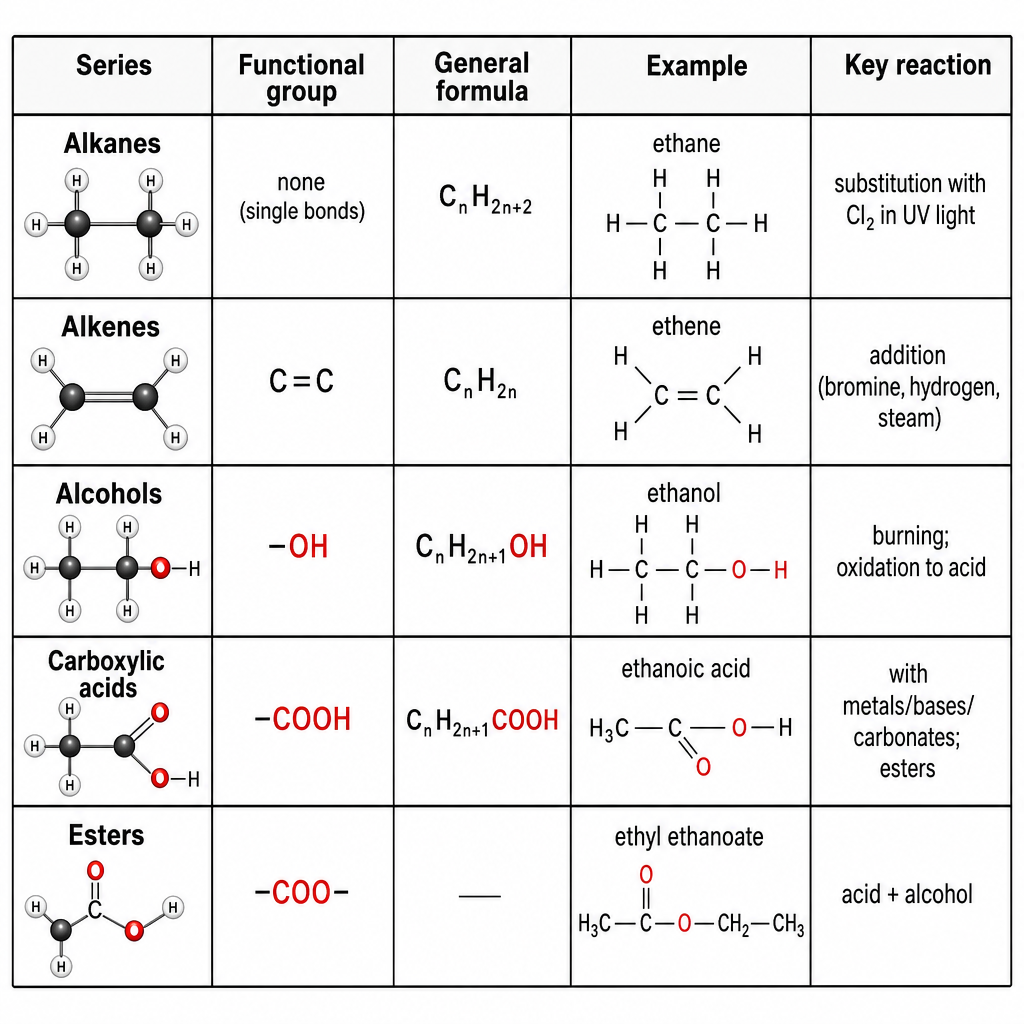
Key idea🔑 Key idea: Same homologous series = same functional group + same general formula + similar chemical properties. Members differ by a unit. Don't say "same boiling point" — that's wrong. 🎯
Worked example
Worked Example: Same Family or Not
Worked Example: Spot the Family 👀
Compound 1 = ethane (alkane), compound 2 = ethene (alkene), compound 3 = ethanol (alcohol), compound 4 = propane (alkane). Which two are in the same homologous series?
- 1Family is decided by the functional group, not by how many carbons.
- 2Ethane and propane are both alkanes (single bonds only). Ethene is an alkene, ethanol is an alcohol.
So the same family is compounds 1 and 4. Don't get baited into pairing ethane and ethene just because both have two carbons. ✅
---
3. Naming Organic Compounds
Every organic name is just a stem (counts the carbons: meth-1, eth-2, prop-3, but-4) plus an ending that names the group: alkane -ane, alkene -ene, alcohol -ol, acid -oic acid. If the group could sit in more than one place, a number (locant) tells you where, like but-2-ene with the double bond on carbon 2.
Key idea🔑 Key idea: Stem = number of carbons, ending = functional group. Ester names are sneaky: the first word is the alcohol, the second word (the -oate) is the acid. 🧠
Worked example
Worked Example: Naming an Alkene
Worked Example: Name That Chain 🔗
An alkene has a four-carbon chain with the double bond between carbons 2 and 3. Name it.
- 1Four carbons → stem but-; it's an alkene → ending -ene.
- 2The double bond starts on carbon 2 → drop a 2 in the middle.
So it's but-2-ene, . Clean. ✅
---
4. Fuels and Fractional Distillation
Petroleum (crude oil) is a mixture of hydrocarbons, and we split it by fractional distillation. It works because longer chains have higher boiling points. The oil is vaporised in a column that's hot at the bottom, cool at the top, so each fraction condenses at its own level. Going down the column: longer chains, higher boiling point, thicker (more viscous), darker, harder to ignite. (Natural gas, by the way, is mostly methane.)
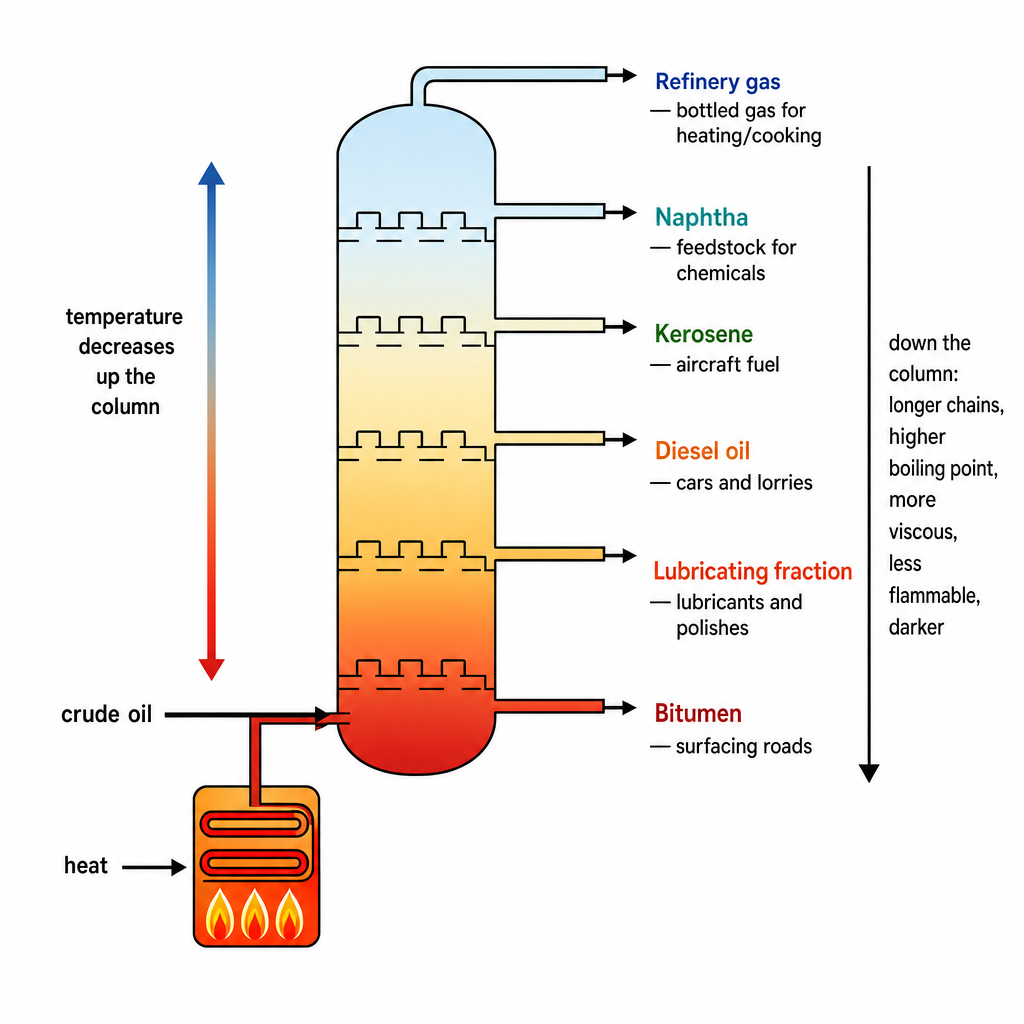
Key idea🔑 Key idea: Fractional distillation separates by boiling point, not by reacting anything. Down the column = bigger molecules, higher boiling point. Bottom = bitumen (roads), top = refinery gas. ⛽
Worked example
Worked Example: Incomplete Combustion
Worked Example: Not Enough Air 💨
Methane burns in a limited supply of oxygen to make carbon monoxide and water. Balance the equation.
- 1Limited oxygen → you get carbon monoxide, CO, not . Start with 2 methane: that's and .
- 2Count oxygen on the right: atoms, so you need .
"Limited oxygen" is your cue to write CO (the toxic gas). ✅
---
Answer
5. Alkanes
Alkanes are saturated hydrocarbons (single bonds only), general formula . They're generally unreactive because they only have strong single bonds and no functional group. The one reaction to know: with chlorine in UV light they do substitution, where a Cl swaps in for an H and you also get HCl.
Key idea🔑 Key idea: Alkanes = saturated, unreactive. Substitution with needs UV light and makes a chloroalkane + HCl (not H₂). 🔆
Worked example
Worked Example: Methane Meets Chlorine
Worked Example: Swap an H 🔁
Methane reacts with chlorine in UV light, swapping one hydrogen. Write the equation and name the product.
- 1Swap one H of for a Cl → (chloromethane). The leftover H joins a Cl → HCl.
- 2Write and check it balances:
Substitution, UV light, and the second product is HCl. Three marks, locked. ✅
---
Answer
6. Alkenes
Alkenes are unsaturated (they have a double bond), general formula . That double bond is the reactive bit, so alkenes do addition reactions: the double bond opens and a small molecule adds across it to give one product. The famous one is the bromine test: an alkene turns orange bromine water colourless, an alkane leaves it orange.
Key idea🔑 Key idea: Alkene = = reactive. Addition gives one product. Bromine water goes orange → colourless with an alkene (that's the unsaturation test). 🧪
Worked example
Worked Example: Ethene Plus Bromine
Worked Example: Decolourise It 🟠➡️⚪
Ethene reacts with bromine. Write the equation and say why it decolourises bromine water but an alkane doesn't.
- 1The double bond opens and one Br adds to each carbon:
- 2The bromine is used up, so the orange colour disappears. An alkane has no double bond, so nothing reacts and it stays orange.
One product, two Br atoms in it. ✅
---
7. Alcohols and Ethanol
Alcohols have the group, general formula . The star is ethanol, made two ways: fermentation (yeast on glucose, ~30 °C, no air — renewable but slow and impure) or catalytic addition of steam to ethene (fast, continuous, pure, but uses non-renewable ethene). Ethanol burns cleanly to and is used as a fuel, a solvent, and in drinks.
Key idea🔑 Key idea: Ethanol = fermentation (renewable, slow, impure) OR steam + ethene (non-renewable, fast, pure). Pick the route that matches what the question wants. 🌱
Worked example
Worked Example: Fermentation
Worked Example: Sugar to Spirits 🧫
Ethanol is made from glucose, , by fermentation. Write the equation and the conditions.
- 1Yeast turns glucose into ethanol and carbon dioxide, one glucose → two ethanol + two CO₂:
- 2Conditions: yeast, about 30 °C, in the absence of air.
Check it: 6 C, 12 H, 6 O on both sides. Balanced. ✅
---
8. Carboxylic Acids and Esters
Carboxylic acids have the group and are weak acids, so they react with metals (→ H₂), bases (→ water) and carbonates (→ CO₂), making ethanoate salts. Ethanoic acid is made by oxidising ethanol (purple manganate(VII) → colourless). And when an acid meets an alcohol with an acid catalyst, you get an ester + water (that's the fruity-smell reaction).
Key idea🔑 Key idea: Carboxylic acid + alcohol → ester + water (acid catalyst). Naming: first word = alcohol, the -oate = acid. So ethyl butanoate = ethanol + butanoic acid. 🧴
Worked example
Worked Example: Naming an Ester
Worked Example: Split the Linkage ✂️
An ester is . Name it.
- 1The bit with the C=O carbon has 4 carbons → from butanoic acid → butanoate.
- 2The bit on the single-bonded oxygen is an ethyl group → from ethanol → ethyl.
So it's ethyl butanoate (not butyl ethanoate — the acid gives the -oate). ✅
---
9. Addition Polymers
A polymer is a giant molecule made from loads of small monomers. In addition polymerisation, alkene monomers (with ) join up: the double bond opens and they link end to end with nothing else made. You show the repeat unit (the monomer with the double bond opened and a bond out each end), like for poly(ethene).
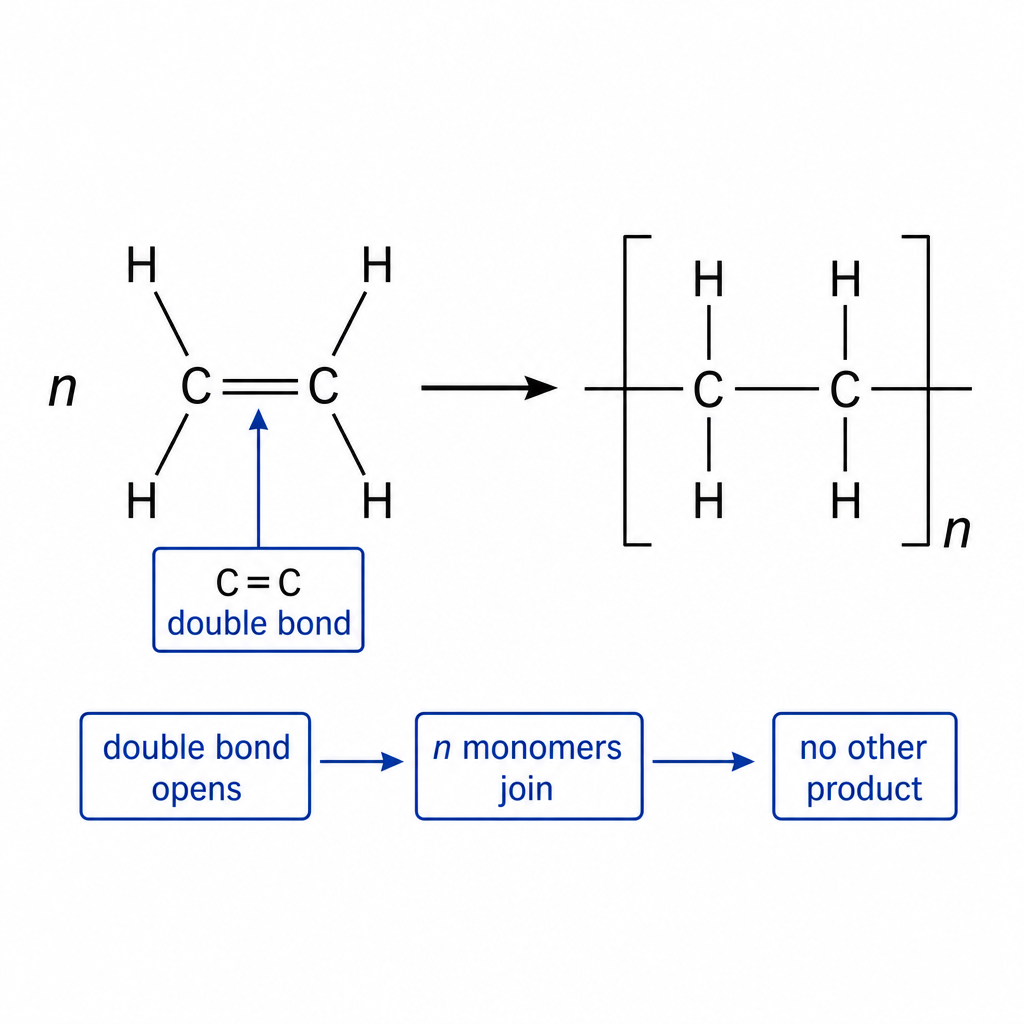
Key idea🔑 Key idea: Addition polymerisation: alkene monomers, double bond opens, no small molecule lost. Number of repeat units . 🔗
Worked example
Worked Example: Counting Repeat Units
Worked Example: Divide It Out ➗
The repeat unit of poly(ethene), , has . One poly(ethene) molecule has . How many repeat units, ?
- 1Number of repeat units = whole-chain mass ÷ repeat-unit mass.
- 2Divide:
So 2500 ethene units joined up to make that molecule. ✅
---
Answer
10. Condensation Polymers
In condensation polymerisation you use two monomers, each with two reactive groups, and you lose a small molecule (water) every time they link. A diol + dicarboxylic acid makes a polyester (ester linkages — PET is one); a diamine + dicarboxylic acid makes a polyamide (amide linkages — nylon, and proteins are natural ones). Addition polymers like poly(ethene) are non-biodegradable; polyesters and polyamides can be broken down because their linkages can be attacked.
Key idea🔑 Key idea: Condensation = two monomers + water lost. Diol + diacid → polyester; diamine + diacid → polyamide. The "di" lets the chain grow at both ends. 💧
Worked example
Worked Example: Building a Polyester
Worked Example: Link and Lose Water 🔗💧
Butane-1,4-diol (two groups) reacts with butanedioic acid (two groups). What linkage joins them, what type of polymer, and what's lost?
- 1An and a join to make an ester linkage, , losing water.
- 2Both monomers have two reactive groups, so the chain grows both ways → condensation polymerisation, making a polyester, with water lost each time.
Diol + diacid = polyester. Done. ✅
---
Practice this in the app
Unlock the full chapter: practice questions, flashcards, mock papers and notes, free.
Continue revising