States of Matter: Particles in Motion
Solid, Liquid, Gas: It's All About the Particles 🧊
Introduction
1. Introduction
Okay, states of matter sounds basic, but it's secretly the cheat code for the whole of chemistry. Everything (and I mean everything) is made of tiny particles that are always moving. Whether something is a solid, a liquid or a gas just depends on how those particles are arranged and how fast they're moving.
Here's the one move that wins marks all chapter: when a question says "explain", don't just say what happens, say it in terms of the particles. "The particles are far apart and moving fast, so…". Do that and you're basically printing marks. This is your fast refresh, not the full textbook: one key idea per topic, one quick worked example, and the exact thing the examiner wants. Let's go. 🧊
Here's the one move that wins marks all chapter: when a question says "explain", don't just say what happens, say it in terms of the particles. "The particles are far apart and moving fast, so…". Do that and you're basically printing marks. This is your fast refresh, not the full textbook: one key idea per topic, one quick worked example, and the exact thing the examiner wants. Let's go. 🧊
2. The Three States
Everything is particles, and the three states are just three different vibes for those particles. Solid: neat rows, touching, only vibrating in place (so it keeps its shape). Liquid: still touching but jumbled up, sliding past each other (so it flows but keeps its volume). Gas: spread far apart, zooming in all directions (so it fills any container and squashes easily).
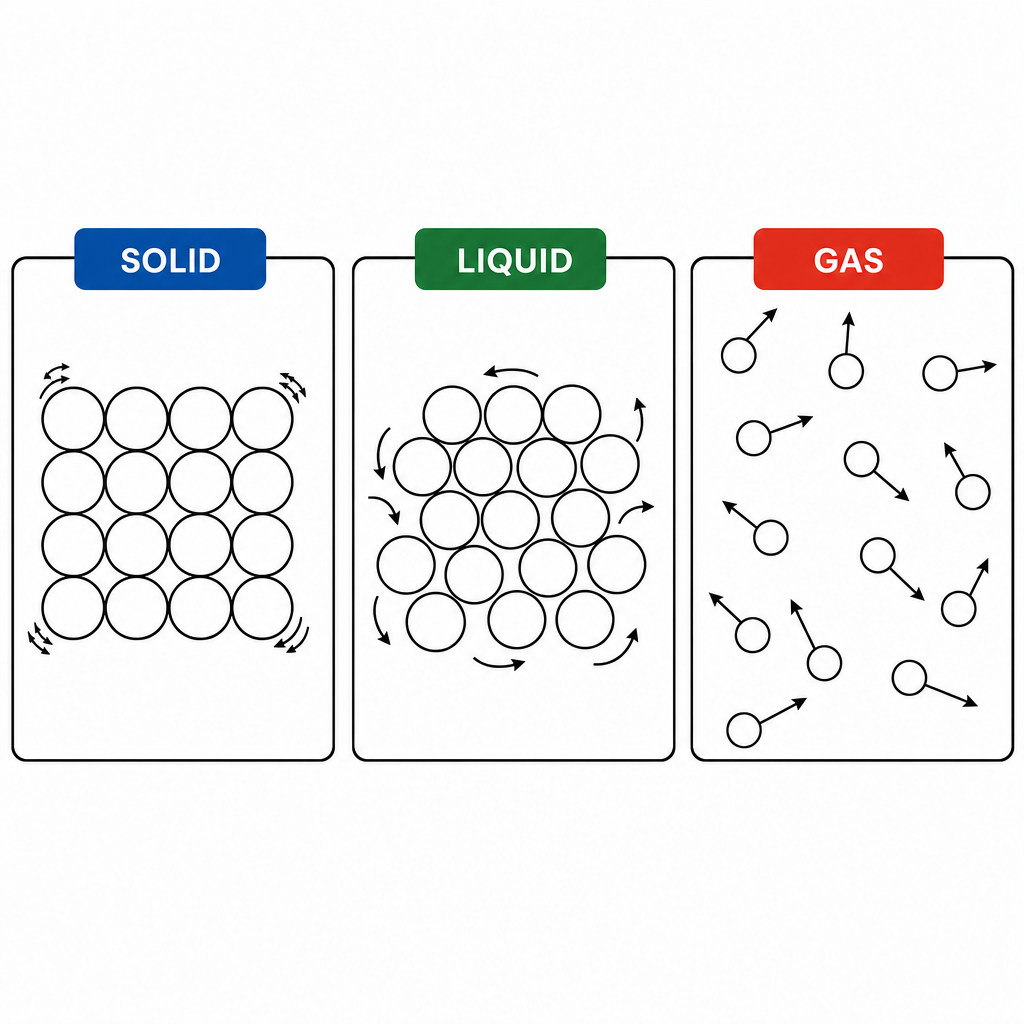
Key idea🔑 Key idea: Solid = regular + vibrate; liquid = random + slide; gas = far apart + fly. For every state give both the arrangement and the movement. 🎯
Worked example
Worked Example: Describe the States
Worked Example: Arrange and Move 🔬
Describe the arrangement and movement of the particles in a solid, a liquid and a gas.
- 1Do the arrangement for each: solid = regular and touching, liquid = random but still touching, gas = random and far apart.
- 2Add the movement for each: solid = vibrate in fixed positions, liquid = move and slide past one another, gas = move quickly in all directions.
So you give arrangement and movement for all three. Leave either one out and the description is incomplete. ✅
---
3. Changes of State
Changing state is just particles gaining or losing energy. Going "up" (solid → liquid → gas) needs energy: melting (solid → liquid) and boiling (liquid → gas). Coming "down" gives energy out: freezing (liquid → solid) and condensation (gas → liquid). Evaporation is liquid → gas too, but only at the surface and below the boiling point. And don't mix up melting with dissolving: melting turns a solid into its own liquid with heat; dissolving mixes a solid into water to make a solution.
Key idea🔑 Key idea: Melting, boiling and evaporating take in energy; freezing and condensation give it out. Melting ≠ dissolving. 🔁
Worked example
Worked Example: Name the Change
Worked Example: What's the Word 📝
Name the change of state in each case: (a) solid → liquid, (b) gas → liquid, (c) a solid turning into a solution in water.
- 1Solid → liquid is melting; gas → liquid is condensing.
- 2A solid going into water to make a solution is dissolving (not melting!).
So the answers are melting, condensing and dissolving. ✅
---
4. Reading State from Temperatures
Every pure substance has a melting point and a boiling point, and they slice the temperature scale into three zones. Below the melting point it's a solid; between the two points it's a liquid; above the boiling point it's a gas. The only trap is negative numbers: a gas like oxygen boils at −183 °C, which is way below room temperature, so it's already a gas at 25 °C.
Key idea🔑 Key idea: Below melting point → solid; between → liquid; above boiling point → gas. Watch out for minus signs! 🌡️
Worked example
Worked Example: Which One's a Gas?
Worked Example: Above the Boil 💨
Four substances have boiling points A = 78 °C, B = −183 °C, C = 59 °C, D = 444 °C. Which is a gas at 25 °C?
- 1A substance is a gas only when the temperature is above its boiling point. Compare each boiling point with 25 °C.
- 2Only B boils below 25 °C (−183 °C is lower than 25 °C), so only B is above its boiling point at room temperature.
So the answer is B. ✅
---
5. Heating and Cooling Curves
Heat a solid steadily and the temperature graph climbs in steps, not a straight line. The slopes are one state warming up; the flat bits (plateaus) are changes of state, where the temperature stays the same even though you keep heating. Why? Because the energy is busy breaking the forces between particles, not speeding them up. A cooling curve is the same thing flipped: it falls, flattens as the gas condenses, falls, then flattens lower down as the liquid freezes.
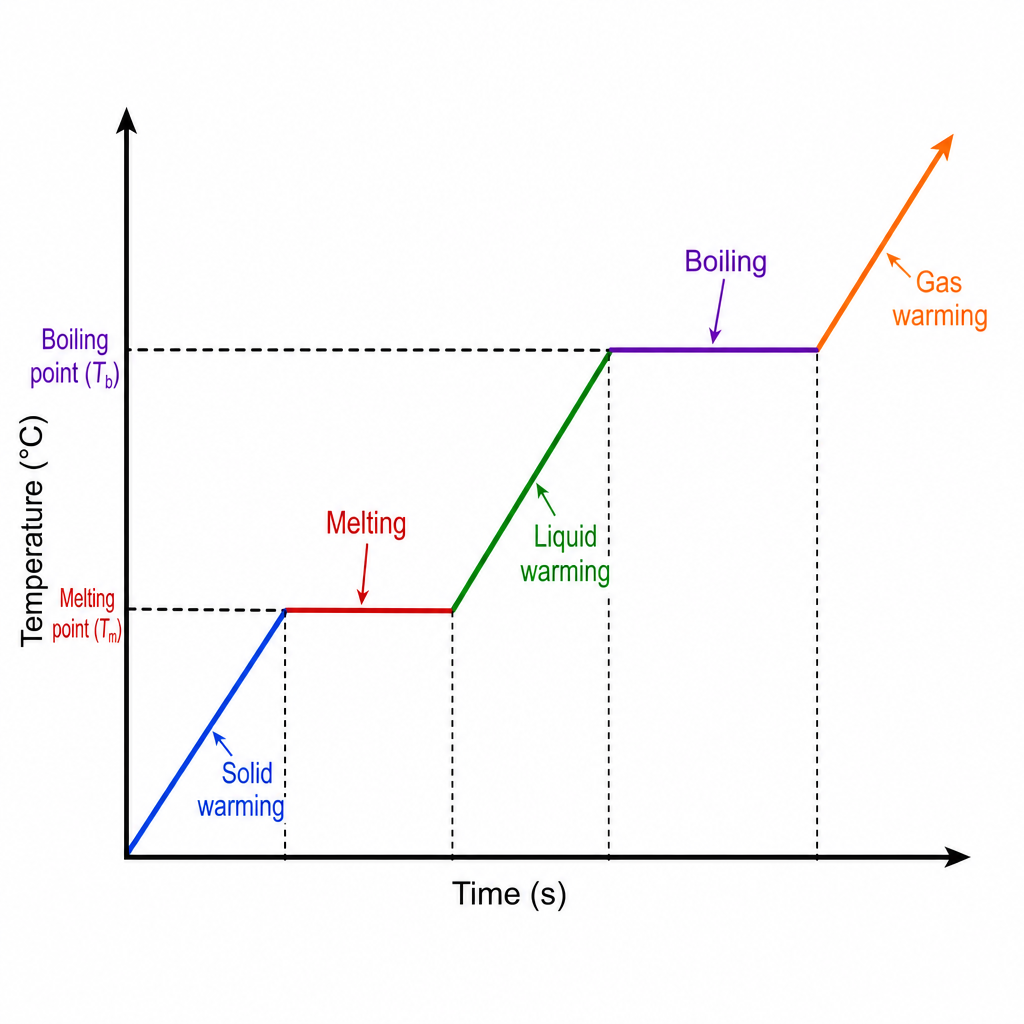
Key idea🔑 Key idea: Flat parts = changes of state at constant temperature, because energy goes into breaking forces, not speeding particles up. On cooling, condensing (higher) comes before freezing (lower). 📈
Worked example
Worked Example: The Cooling Curve
Worked Example: Two Plateaus 🧊
A hot gas is cooled steadily until it becomes a solid. Describe the cooling curve.
- 1Temperature falls, then flattens at a higher plateau as the gas condenses to liquid.
- 2Temperature falls again, then flattens at a lower plateau as the liquid freezes to solid, then falls once more.
So: fall, condensing plateau, fall, lower freezing plateau, fall. Two flat bits, higher one first. ✅
---
6. Squeeze and Heat a Gas
Gases change size because their particles are far apart and free to move. Heat it up → bigger volume (particles move faster and spread out). Drop the pressure → bigger volume (less squeezing, so the particles push outward). Flip it: more pressure squashes a gas smaller. Quick memory hook: anything that lets the particles spread out makes the volume bigger.
Key idea🔑 Key idea: Temperature and volume move the same way; pressure and volume move opposite ways. 🎈
Worked example
Worked Example: Change the Volume
Worked Example: Hotter and Looser 💨
What happens to the volume of a fixed mass of gas when you (a) increase the temperature, and (b) decrease the pressure?
- 1Increase the temperature → particles move faster and spread further apart → volume increases.
- 2Decrease the pressure → less push inward, so particles push outward → volume increases.
So both increasing the temperature and decreasing the pressure make the gas bigger. ✅
---
7. Gas Pressure
A gas pushes on its container because its particles keep smacking into the walls. Loads of tiny hits per second = steady pressure. Heat the gas in a sealed (rigid) container and the particles move faster, so they hit the walls harder and more often → the pressure goes up, and their kinetic energy goes up too. Key tell: if the container can't change size, heating raises the pressure, not the volume.
Key idea🔑 Key idea: Pressure = particles hitting the walls. Hotter → faster particles → harder + more frequent hits → higher pressure (and higher kinetic energy). 💥
Worked example
Worked Example: Heat a Sealed Gas
Worked Example: Pressure Up 🔥
The air sealed in a rigid container is heated. What happens to the pressure and to the kinetic energy of the particles?
- 1The particles gain energy and move faster, so their kinetic energy increases.
- 2Faster particles hit the walls harder and more often, and the container can't expand, so the pressure increases.
So both the pressure and the kinetic energy increase. ✅
---
8. Diffusion
Diffusion is when particles spread from where there's lots of them to where there's fewer, all by themselves, because they're moving randomly. No stirring, no wind needed. That's how a smell crosses a still room. It's fastest in gases (fast, far-apart particles), slower in liquids, and basically zero in solids. Plot twist: even after a gas has spread out evenly, the particles don't stop moving, there's just no net movement in any one direction any more.
Key idea🔑 Key idea: Diffusion = net spreading from high to low concentration by random motion. Fastest in gases. Particles never actually stop. 🌫️
Worked example
Worked Example: The Perfume Test
Worked Example: Smell Travels 👃
A perfume bottle is opened in the corner of a still room, and soon people across the room can smell it. Explain how the scent reaches them.
- 1The room is still, so nothing blows the scent; the scent particles are in constant random motion.
- 2They spread out and mix with the air, moving from high concentration (the bottle) to low concentration (across the room). That's diffusion.
So the scent reaches people by diffusion. ✅
---
9. Light Gases Win the Race
At the same temperature, every gas particle has the same average movement energy. Since lighter particles weigh less, they have to move faster to carry that energy, so lighter molecules diffuse faster. The deciding factor is the relative molecular mass (): the smaller the , the faster the gas spreads. Always actually work out the numbers instead of eyeballing the formula.
Key idea🔑 Key idea: Smaller → faster diffusion. Compare gases by calculating their relative molecular masses. 🏃
Worked example
Worked Example: Fastest Gas
Worked Example: Smallest Mr 💨
Which gas diffuses fastest: methane , ethane , carbon monoxide CO, or sulfur dioxide ? (: H = 1, C = 12, O = 16, S = 32.)
- 1Work out each relative molecular mass.
- 2Lighter = faster, so pick the smallest , which is methane (16).
So methane diffuses fastest. ✅
---
10. The Ammonia–HCl Tube
Classic experiment: cotton wool soaked in ammonia () at one end of a tube, cotton wool giving hydrogen chloride (HCl) at the other. The gases diffuse toward each other and make a white ring of ammonium chloride () where they meet. Ammonia () is lighter than HCl (), so it diffuses faster and travels further, which means the ring shows up nearer the HCl end, not in the middle.
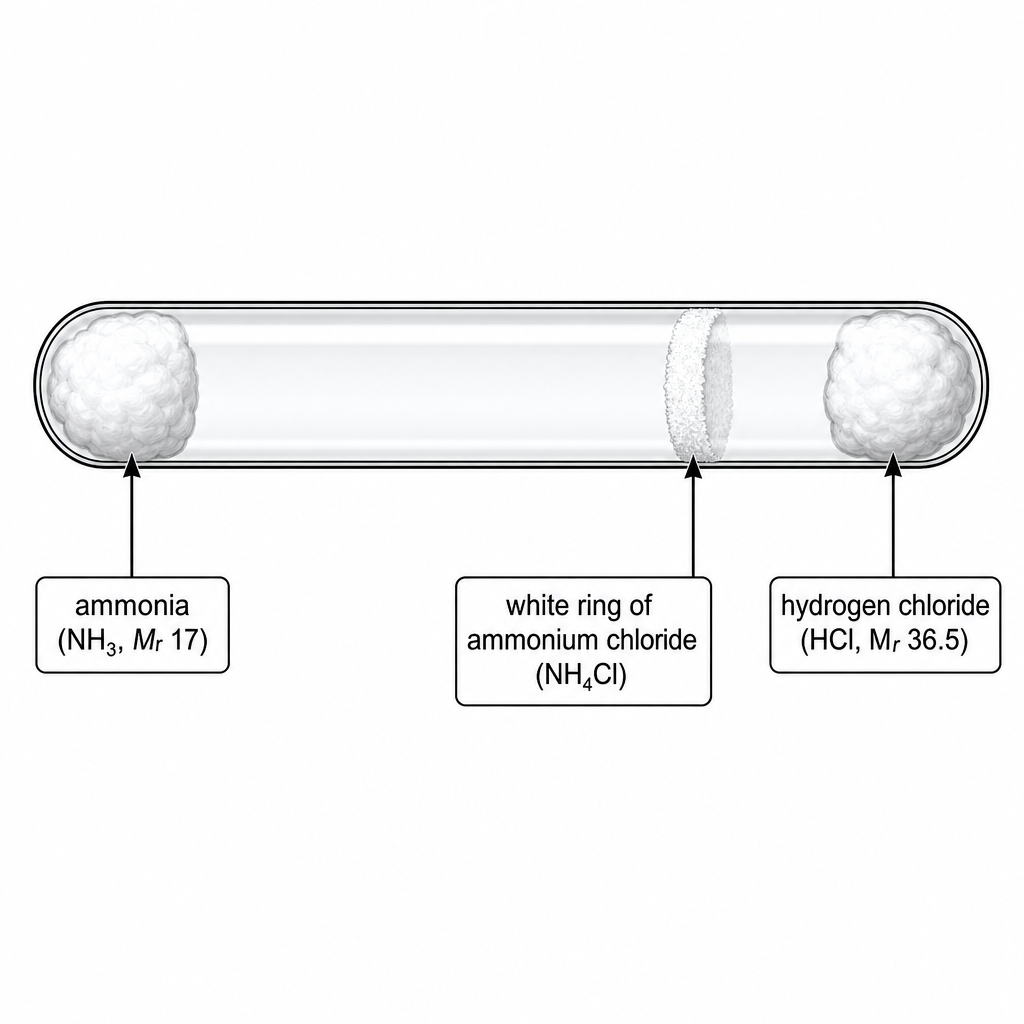
Key idea🔑 Key idea: The ring forms nearer the heavier gas (HCl), because the lighter ammonia diffuses faster and travels further. 💍
Worked example
Worked Example: Where's the Ring?
Worked Example: Nearer the Heavy One ⚖️
Explain why the white ring forms nearer the hydrogen chloride end of the tube.
- 1Lighter molecules diffuse faster, and ammonia () is lighter than hydrogen chloride ().
- 2So the ammonia travels further in the same time, and the gases meet nearer the heavier, slower HCl.
So the ring forms nearer the HCl end because HCl has the greater molecular mass. ✅
---
Practice this in the app
Unlock the full chapter: practice questions, flashcards, mock papers and notes, free.
Continue revising