Chemistry of the Environment: Water, Fertilisers and Air
Save the Planet, Pass the Paper 🌍
Introduction
1. Introduction
Okay, this is the chapter where chemistry meets the real world: the water you drink, the food on your plate, and the air that's slowly cooking the planet. And here's the good bit, it's basically a facts chapter. The marks come from knowing exact colours, exact numbers, a handful of equations, and which source goes with which pollutant.
So this is your fast refresh, not the full textbook: one key idea per topic, one quick worked example, and the exact word the marker wants. Big rule for the whole chapter, keep two things separate, present vs pure (a test for water isn't a test for clean water) and natural vs pollutant (CO₂ is normal air, SO₂ is not). Let's save the planet and pass the paper. 🌍
So this is your fast refresh, not the full textbook: one key idea per topic, one quick worked example, and the exact word the marker wants. Big rule for the whole chapter, keep two things separate, present vs pure (a test for water isn't a test for clean water) and natural vs pollutant (CO₂ is normal air, SO₂ is not). Let's save the planet and pass the paper. 🌍
2. Testing for Water
Two different jobs here. To show water is present, use a chemical colour test: anhydrous copper(II) sulfate goes white → blue, and anhydrous cobalt(II) chloride goes blue → pink. To show water is pure, you can't use colour, you measure its boiling/melting point: pure water boils sharply at exactly 100 °C and melts at 0 °C. Anything dissolved in it pushes the boiling point up and the melting point down, over a range. So "is it water?" and "is it pure water?" are two separate questions with two separate tests.
Key idea🔑 Key idea: Copper(II) sulfate white → blue and cobalt(II) chloride blue → pink prove water is present. A sharp 100 °C boiling / 0 °C melting proves it's pure. 💧
Worked example
Worked Example: Spotting Water
White to Blue 🔵
Anhydrous copper(II) sulfate is used to test for water. What colour change happens when water is added?
- 1Anhydrous copper(II) sulfate starts off white.
- 2Add water and it turns blue.
So the change is white → blue (and it shows water is present, not that it's pure). ✅
---
3. Is the Water Pure?
Colour tests prove water is there, but for pure you check a temperature. Pure water melts at a sharp, fixed 0 °C and boils at a sharp 100 °C. If something's dissolved in it, the melting point drops below 0 °C, the boiling point climbs above 100 °C, and the change smears over a range instead of one clean value. So: sharp and exact = pure; low/high and spread out = impure.
Key idea🔑 Key idea: Pure water melts sharply at 0 °C and boils sharply at 100 °C. An impurity lowers the melting point, raises the boiling point, and spreads each over a range. 🌡️
Worked example
Worked Example: Pure or Not?
Sharp at Zero ❄️
A student measures a water sample's melting point. Which shows it's pure: (A) melts sharply at exactly 0 °C, (B) melts over a range below 0 °C, (C) melts sharply at 100 °C, (D) melts over a range above 0 °C?
- 1Pure water melts sharply at exactly 0 °C (100 °C is the boiling point, so C is out).
- 2Melting over a range means impure, so B and D are out.
So the answer is (A). ✅
---
4. Cleaning Water for Drinking
Turning river water into tap water has a set order. First sedimentation (big bits settle out) and filtration (sand and gravel trap the smaller bits), which remove solids. Then carbon, which removes tastes and odours. Last, chlorination (a little chlorine to kill the harmful microbes). Solids out first, germs killed last. One trap: this makes water safe, not pure, the dissolved ions stay in. That's why labs use distilled water: it contains fewer chemical impurities that could react with or interfere in an experiment. Oh, and the harmful microbes come from sewage; nitrates come from fertilisers.
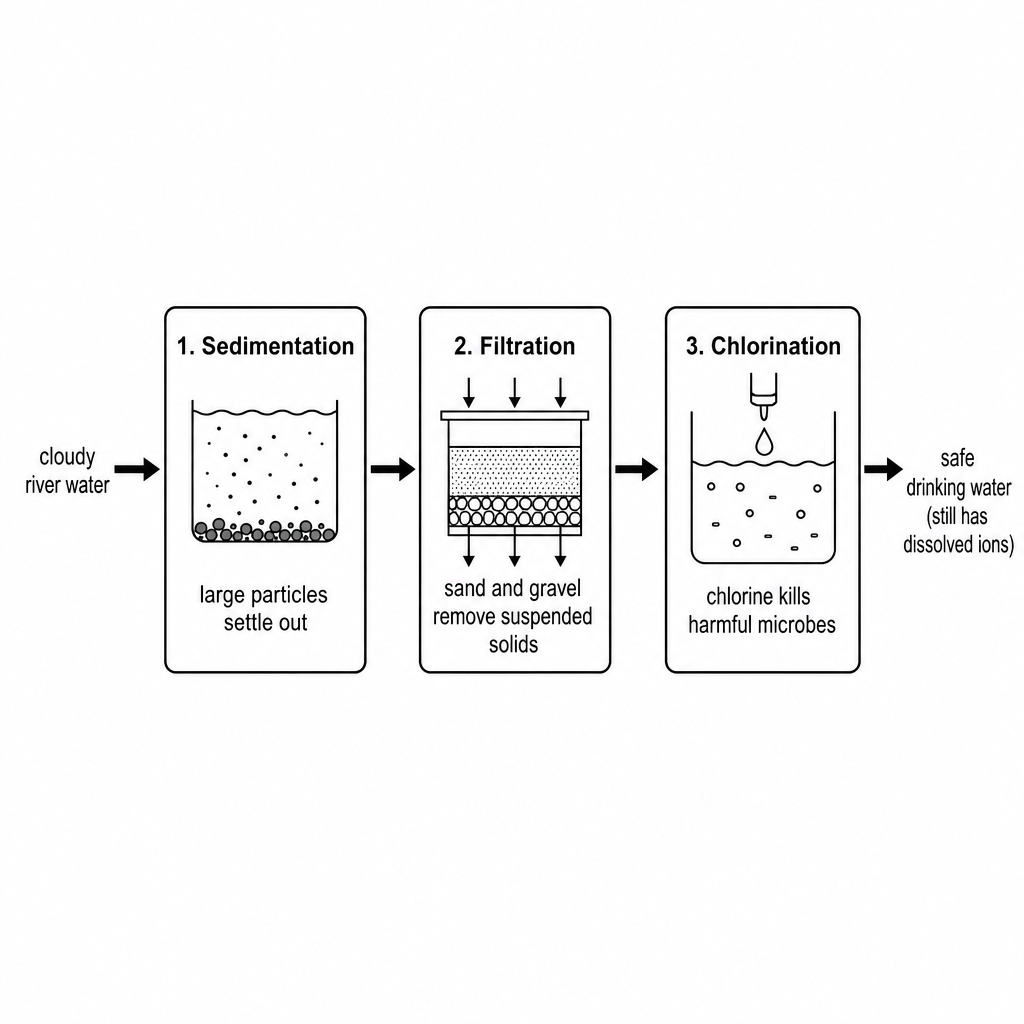
Key idea🔑 Key idea: Water treatment = sedimentation and filtration (solids) → carbon (tastes and odours) → chlorination (microbes). It makes water safe, not pure. Microbes come from sewage. 🚰
Worked example
Worked Example: Source of the Microbes
Blame the Sewage 🦠
River water contains harmful microbes. From sewage, fertilisers, detergents and plastics, which is the source?
- 1Fertilisers add nitrates, detergents add phosphates, plastics are just rubbish, none of these are living germs.
- 2Sewage is waste, and waste carries the microbes.
So the answer is sewage. ✅
---
5. NPK Fertilisers
Plants need three elements from the soil in large amounts: nitrogen (N), phosphorus (P) and potassium (K). An NPK fertiliser supplies all three for improved plant growth, and since one compound rarely has everything, you often mix compounds. The trick in the exam is just reading the formulae: NH₄⁺ or NO₃⁻ gives N, PO₄³⁻ gives P, K⁺ gives K. Tick all three off and you've got your NPK.
Key idea🔑 Key idea: NPK = nitrogen, phosphorus and potassium together, for improved plant growth. Read the ions: NH₄/NO₃ → N, PO₄ → P, K → K. 🌱
Worked example
Worked Example: Which Mix Has N, P and K?
Tick All Three ✔️
Which mixture provides all of N, P, K: (A) ammonium phosphate (NH₄)₃PO₄ + potassium chloride KCl, (B) ammonium phosphate + ammonium nitrate, (C) ammonium phosphate + ammonium chloride, (D) ammonium nitrate + KCl?
- 1Ammonium phosphate (NH₄)₃PO₄ gives N (ammonium) and P (phosphate).
- 2Potassium chloride KCl gives K. Together that's N + P + K.
So the answer is (A) (the others are missing K or P). ✅
---
6. Ammonium Salts and Nitrates
Plants need lots of nitrogen but can't use nitrogen gas from the air, so they take it in through their roots as dissolved ions. The syllabus names two kinds of nitrogen fertiliser: ammonium salts (containing , such as ammonium nitrate, ammonium sulfate and ammonium phosphate) and nitrates (containing , such as potassium nitrate). They're soluble, so they dissolve in soil water. Ammonium salts are made by neutralising an acid with ammonia: . (The ammonia itself comes from the Haber process, which is taught in Chapter 6.)
Key idea🔑 Key idea: Nitrogen fertilisers = ammonium salts () and nitrates (). Ammonia + acid → ammonium salt. 🏭
Worked example
Worked Example: Making Ammonium Sulfate
Two Ammonia, One Acid 🧪
Ammonium sulfate, , is made by reacting ammonia with an acid. Name the acid, write the balanced equation, and say which ion supplies the nitrogen.
- 1The sulfate comes from sulfuric acid. There are two ammonium ions, so you need two ammonia molecules:
- 2Check: N 2 = 2; H 6 + 2 = 8 on the left and 8 on the right; S 1 = 1; O 4 = 4. The nitrogen is supplied by the ammonium ion, .
So: sulfuric acid, , and the ammonium ion. ✅
---
7. What's in Clean Air
Clean, dry air is a fixed mixture, and these numbers are pure free marks: nitrogen 78%, oxygen 21%, argon about 1%, carbon dioxide about 0.04%. Those four are the normal gases. Anything else, sulfur dioxide, carbon monoxide, oxides of nitrogen, is a pollutant and only shows up in polluted air. Classic trap: argon is in clean air, but nitrogen dioxide is not.
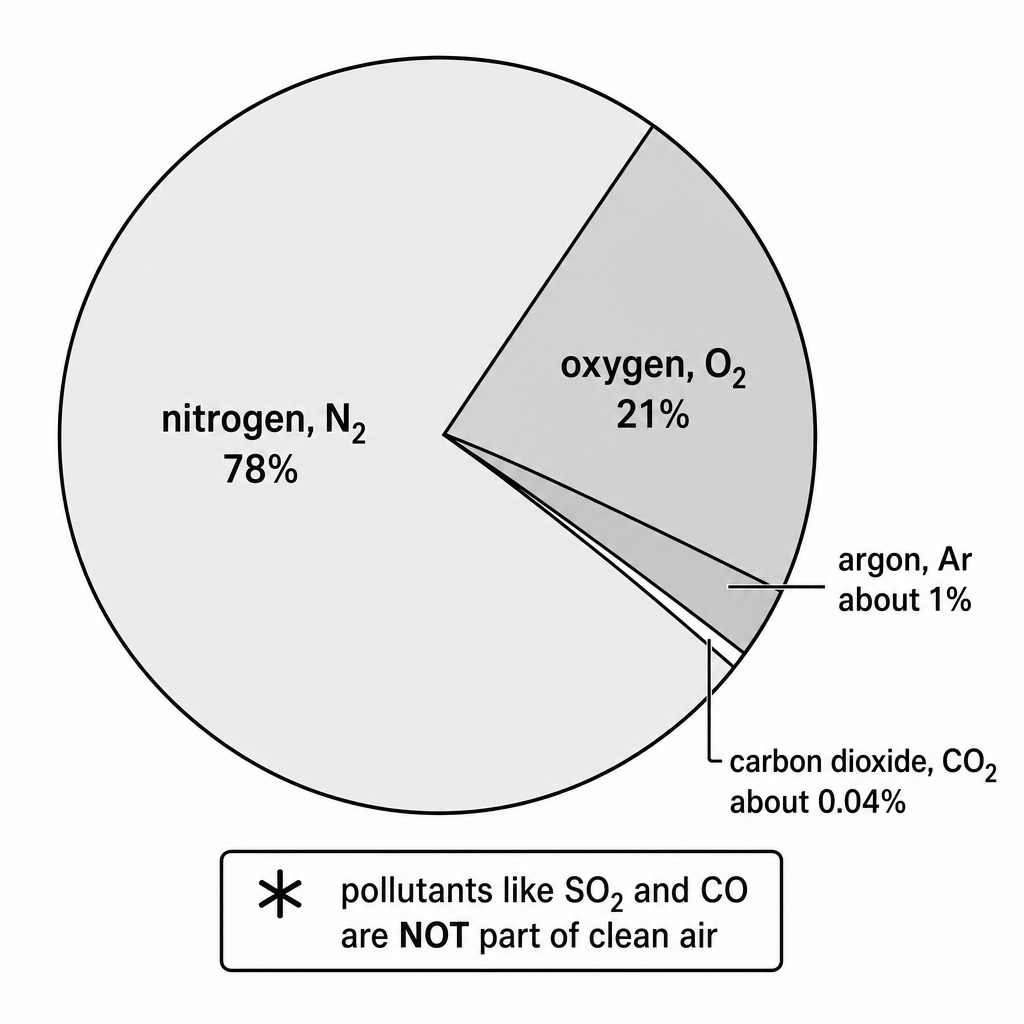
Key idea🔑 Key idea: Clean dry air = N₂ 78%, O₂ 21%, Ar ~1%, CO₂ ~0.04%. Everything else is a pollutant. 🌬️
Worked example
Worked Example: How Much Nitrogen?
Just Say 78 🔢
Using a number only, what is the approximate percentage of nitrogen in clean, dry air?
- 1Nitrogen is the biggest part of clean air.
- 2That's about 78%.
So the answer is 78. ✅
---
8. The Greenhouse Effect
Here's the mechanism in the exact words the marker wants: the Earth's surface gives out thermal energy (infrared), greenhouse gases (CO₂ and CH₄) absorb it, then re-emit it in all directions, including back to the Earth. That means less heat escapes to space, so the planet warms up, that's global warming. Add more greenhouse gas and the trapping gets stronger, which leads to climate change. The two greenhouse gases to name are carbon dioxide (from the complete combustion of carbon-containing fuels) and methane (from the decomposition of vegetation and waste gases from digestion in animals). The four syllabus strategies to reduce climate change: planting trees (they remove CO₂ by photosynthesis), reducing livestock farming (less methane), decreasing the use of fossil fuels (less CO₂), and increasing the use of hydrogen and renewable energy such as wind and solar (no CO₂ when used).
Key idea🔑 Key idea: Greenhouse gases absorb the heat radiated by the Earth and re-emit it back down, so less escapes to space → global warming → climate change. Name CO₂ and CH₄. Fixes: plant trees, less livestock, fewer fossil fuels, more hydrogen and renewables. 🌡️
Worked example
Worked Example: How Greenhouse Gases Warm Us
Absorb and Re-emit ♨️
Which statement is right? (A) they absorb and re-emit thermal energy radiated from the Earth's surface; (B) they absorb energy from the Sun and cool the Earth; (C) they reflect energy into space and cool the surface; (D) they release the Earth's heat into space.
- 1Greenhouse gases trap heat from the Earth and send some back down.
- 2That's option (A). The others all say the Earth cools or the heat escapes, which is backwards.
So the answer is (A). ✅
---
9. Catalytic Converters
Car engines are dirty: incomplete combustion makes toxic carbon monoxide (CO), and the heat makes nitrogen and oxygen from the air join into oxides of nitrogen (NO). A catalytic converter in the exhaust fixes both at once by reacting them together: . The CO gets oxidised to CO₂ and the NO gets reduced to harmless N₂. Two nasties become two much-less-harmful gases. Incomplete combustion also makes particulates (tiny bits of soot), which raise the risk of respiratory problems and cancer. Acid rain comes from sulfur dioxide (burning fossil fuels that contain sulfur compounds) and oxides of nitrogen, and there are three syllabus strategies against it: catalytic converters in vehicles, low-sulfur fuels, and flue gas desulfurisation at power stations, where the waste gases pass through calcium oxide (: a basic oxide removing an acidic one).
Key idea🔑 Key formula: in a catalytic converter. CO oxidised, NO reduced. Acid rain fixes: catalytic converters, low-sulfur fuels, flue gas desulfurisation with CaO. 🚗
Worked example
Worked Example: Inside the Converter
CO + NO → CO₂ + N₂ ⚗️
A catalytic converter removes carbon monoxide and nitrogen oxides. Which equation represents this?
- 1The two pollutants (CO and NO) react together to form harmless gases.
- 2The balanced equation is .
So that's the answer, carbon dioxide and nitrogen come out. ✅
---
10. Photosynthesis
Green plants pull carbon dioxide out of the air using light energy. Word equation: carbon dioxide + water → glucose + oxygen. Symbol equation (learn it balanced): . Big picture: forests are a carbon sink that lowers CO₂, so chopping them down makes the global-warming problem worse. Watch the coefficient, glucose has a 1 in front, not a 6.
Key idea🔑 Key formula: . Photosynthesis removes CO₂ from the air. 🌳
Worked example
Worked Example: Photosynthesis Equation
Carbon Dioxide In, Oxygen Out 🍃
Which word equation correctly represents photosynthesis?
- 1Plants take in carbon dioxide + water.
- 2Using light they make glucose + oxygen.
So it's carbon dioxide + water → glucose + oxygen. ✅
---
Practice this in the app
Unlock the full chapter: practice questions, flashcards, mock papers and notes, free.
Continue revising