Experimental Techniques and Chemical Analysis: Measure, Separate, Identify
Lab Detective: Spot the Ion 🔬
Introduction
1. Introduction
Okay, this is the practical chapter, and the good news is that it runs on a small set of tests you can learn word for word. Know them exactly and the marks follow. The whole game is being a lab detective: pick the right tool, separate the mess, and run the right test to figure out what an unknown actually is.
Here's the cheat code for the entire chapter: every test is the same three beats. You add something → you see something → you say what it means. Nail that triple and the questions answer themselves. This is your fast refresh, not the full textbook: one key idea per topic, one quick worked example, and the exact word the marker wants. Let's go full lab detective! 🔬
Here's the cheat code for the entire chapter: every test is the same three beats. You add something → you see something → you say what it means. Nail that triple and the questions answer themselves. This is your fast refresh, not the full textbook: one key idea per topic, one quick worked example, and the exact word the marker wants. Let's go full lab detective! 🔬
2. Picking the Right Apparatus
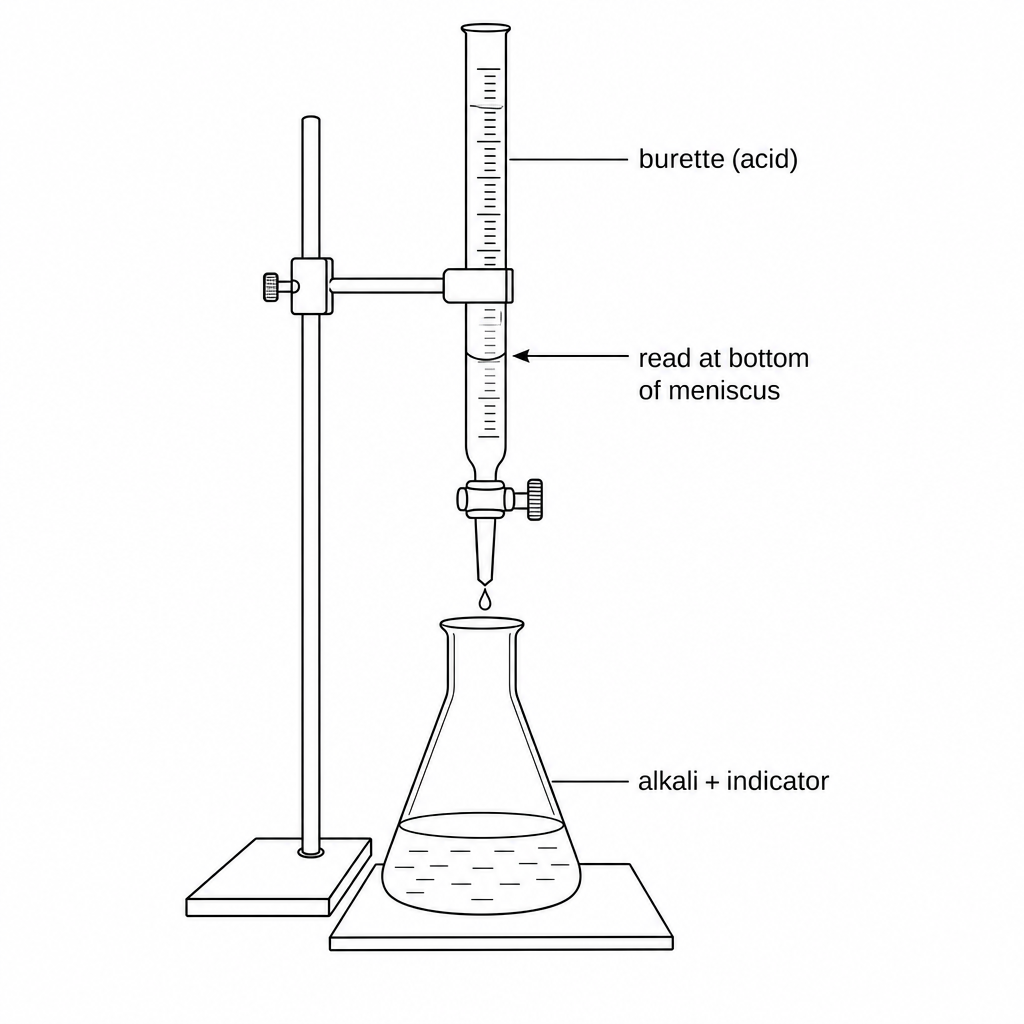
Different tools measure volume with wildly different accuracy, and the exam loves testing it. A measuring cylinder is for rough volumes. A pipette gives one fixed accurate volume (like 25.0 cm³). A burette gives any accurate variable volume to 0.1 cm³ through a tap, which is why it runs the show in titrations. The giveaway is the decimal place: a value like 13.7 cm³ is too precise (and too random) for anything but a burette. Oh, and read the scale with your eye level with the bottom of the meniscus, or you'll get a parallax error.
Key idea🔑 Key idea: Burette = accurate variable volume (0.1 cm³). Pipette = one fixed accurate volume. Measuring cylinder = rough. Finer scale = smaller uncertainty = more accurate. 🎯
Worked example
Worked Example: Which Tool Delivers 13.7 cm³?
Worked Example: Trust the Decimal 🧪
A student needs exactly 13.7 cm³ of a liquid. Burette, balance, conical flask, or pipette?
- 1A balance measures mass (nope) and a conical flask isn't accurately marked (nope). A pipette only gives fixed volumes like 25.0 cm³, and 13.7 isn't fixed (nope).
- 2That leaves the burette: fine scale to 0.1 cm³, plus a tap, so it can deliver any volume.
So the answer is the burette. ✅
---
3. The Lab Vocabulary You Keep Losing Marks On
These six words sound obvious but cost real marks, so learn them in the syllabus wording. Solvent = a substance that dissolves a solute. Solute = a substance that is dissolved in a solvent. Solution = a mixture of one or more solutes dissolved in a solvent. A saturated solution contains the maximum concentration of a solute dissolved in the solvent at a specified temperature. A residue is a substance that remains after evaporation, distillation, filtration or any similar process (so the solid on the filter paper and the salt left in a basin after evaporating are both residues). A filtrate is a liquid or solution that has passed through a filter. Big trap: the filtrate is not pure water, because anything already dissolved stays dissolved and rides straight through.
Key idea🔑 Key idea: Residue = what remains after evaporation, distillation, filtration or similar (e.g. the solid on the paper). Filtrate = liquid that passed through the filter (still has dissolved stuff in it). Saturated = maximum concentration at a specified temperature. 💧
Worked example
Worked Example: Naming the Parts of Filtration
Worked Example: Solid Stays, Liquid Goes 🧴
An insoluble solid in salt solution is filtered. The solid on the paper is X, the liquid below is Y. Name X and Y.
- 1The insoluble solid can't fit through the paper, so it's trapped on top. That's the residue → X is the residue.
- 2The liquid that passes through is the filtrate → Y is the filtrate (it's salt solution, not pure water).
So X = residue, Y = filtrate. ✅
---
4. Titrations and the End-Point
A titration is how you find an unknown concentration: pipette a fixed volume of alkali into a flask, add indicator, then drip acid in from a burette until the colour just flips. That flip is the end-point, and a good indicator gives one sharp change (universal indicator changes gradually, so it isn't used). Methyl orange is red in acid and yellow in alkali, so adding acid to alkali goes yellow → orange at the end-point. Thymolphthalein is blue in alkali and colourless in acid, so it goes blue → colourless. Pro move: repeat it and only average the concordant titres (the ones agreeing within ~0.10 cm³); the first rough run gets binned.
Key idea🔑 Key idea: End-point = one sharp colour change. Methyl orange: red in acid, yellow in alkali, orange at the end-point. Thymolphthalein: blue → colourless. Average only the concordant titres. 🎯
Worked example
Worked Example: The Methyl Orange Flip
Worked Example: Yellow to Orange 🟠
Sodium hydroxide with methyl orange is titrated with hydrochloric acid. What's the colour change at the end-point?
- 1Methyl orange is yellow in alkali, so the flask starts yellow.
- 2As acid neutralises the alkali, the colour flips to orange at the end-point. (Keep adding acid past that and it would go red, the acid colour.)
So the change is yellow → orange. ✅
---
5. The Titration Calculation
This is the Extended payoff, and it's just three moves. Get moles of the solution you know (concentration × volume in dm³). Cross the balanced equation to get moles of the unknown. Divide by the unknown's volume to get its concentration. The one banana skin: change cm³ to dm³ first (divide by 1000), every single time.
Key idea🔑 Key formula: moles = concentration × volume (in dm³); then use the equation ratio; then concentration = moles ÷ volume. And . 🎯
Worked example
Worked Example: Finding an Acid's Concentration
Worked Example: Cross the Ratio 💧
25.0 cm³ of 0.100 mol/dm³ sodium hydroxide is neutralised by 20.0 cm³ of hydrochloric acid. . Find the acid's concentration.
- 1Moles of NaOH: 25.0 cm³ = 0.0250 dm³, so mol. Ratio is 1 : 1, so HCl is also 0.00250 mol.
- 2Concentration of HCl: 20.0 cm³ = 0.0200 dm³, so mol/dm³.
So the acid is 0.125 mol/dm³. ✅
---
6. The R_f Value
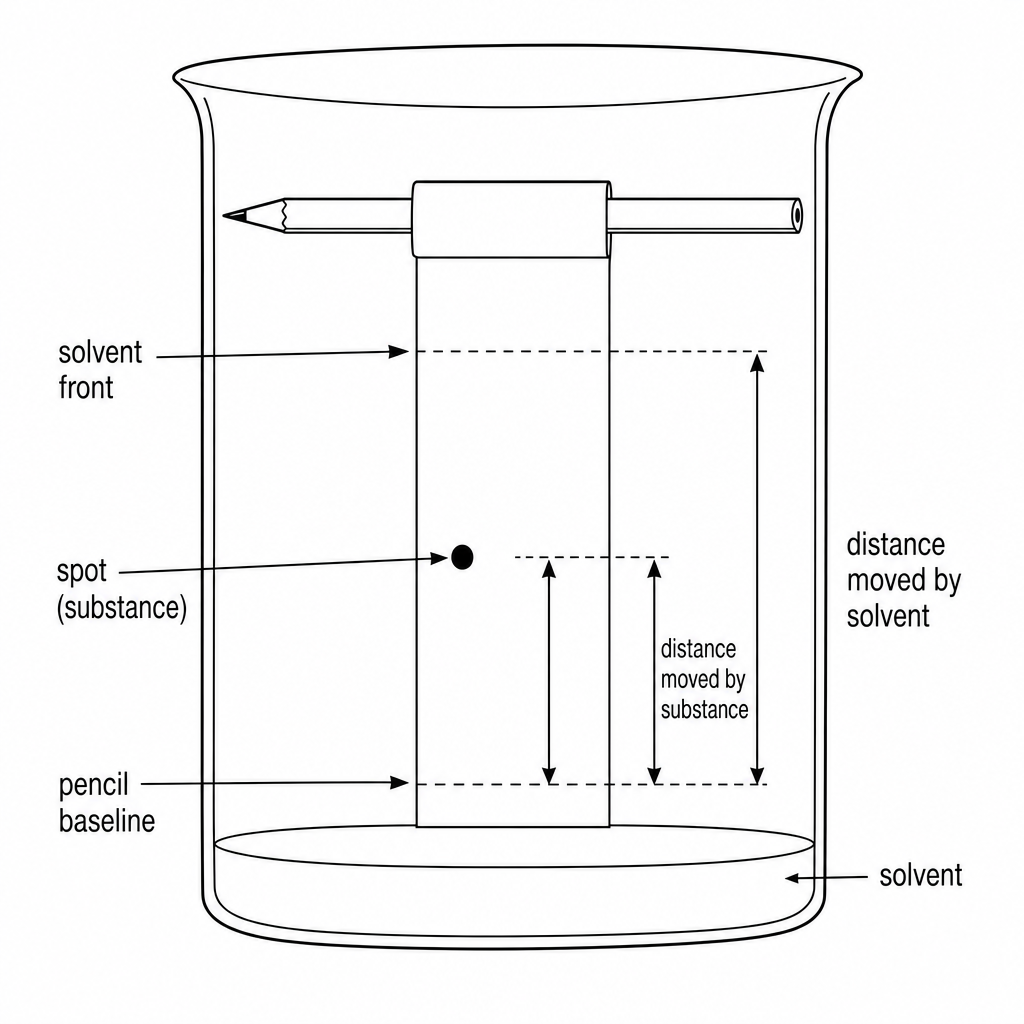
Chromatography spreads out a mixture so you can identify the bits. A spot rises up the paper as the solvent climbs, and the R_f value measures how far it got compared to the solvent: . It's always between 0 and 1 with no units, and the same substance gives the same R_f every time in the same conditions. Colourless stuff (like amino acids and sugars) is invisible, so once the chromatogram is dry you spray it with a locating agent, which reacts to make coloured spots. You don't need the name of a particular locating agent (ninhydrin, for amino acids, is one example).
Key idea🔑 Key formula: , always 0 to 1, no units. Reveal colourless spots with a locating agent. 🧪
Worked example
Worked Example: Calculating R_f
Worked Example: Just Divide 📐
A dye moves 4.5 cm; the solvent front moves 9.0 cm. Find the R_f.
- 1Plug into the formula: .
- 2That's , with no units, and nicely between 0 and 1.
So the R_f is 0.50. ✅
---
7. Reading a Chromatogram
To identify what's in a mixture, run it next to pure reference samples on the same paper in the same conditions. If a spot from the mixture lands at the same height as a reference, they're the same substance (same R_f). Spots that don't line up with anything are different substances. Easy detective work once you line them up.
Key idea🔑 Key idea: A mixture spot = a reference substance if they reach the same height (same R_f) on the same paper. 🎯
Worked example
Worked Example: What's in Mixture M?
Worked Example: Line Up the Spots 🟰
Mixture M runs with pure references X, Y, Z on one paper. M gives two spots: one level with X, one level with Z, none level with Y. What's in M?
- 1Spots at the same height = same substance. M's spots match X and Z.
- 2Nothing lines up with Y, so Y isn't there.
So M contains X and Z. ✅
---
8. Separating Mixtures
Pick the technique by what's mixed. Filtration pulls an insoluble solid out of a liquid (and wash that residue!). Crystallisation gets a dissolved solid back by cooling a saturated solution slowly. Simple distillation pulls pure solvent out of a solution. Fractional distillation splits two mixed liquids by boiling point: the lower-boiling one comes off first, because the fractionating column keeps re-condensing the rest.
Key idea🔑 Key idea: Filter (insoluble solid) · crystallise (dissolved solid, cool slow) · distil (solvent out) · fractionally distil (two liquids; lower b.p. first). 🧪
Worked example
Worked Example: Splitting Ethanol from Water
Worked Example: Low Boiler Wins 🌡️
Ethanol (b.p. 78 °C) and water (b.p. 100 °C) are separated by fractional distillation. Which comes off first, and at what temperature?
- 1Ethanol has the lower boiling point, so it's more volatile and evaporates first.
- 2The thermometer holds around 78 °C while ethanol distils over; it only climbs towards 100 °C once the ethanol's gone.
So ethanol comes off first, at about 78 °C. ✅
---
9. Checking Purity
A pure substance melts (and boils) at one sharp, fixed temperature. An impurity messes that up two ways: it lowers the melting point and raises the boiling point, and it smears each change out over a range instead of a clean single value. So if something melts a bit low and over a range, it's impure. Quote both clues for full marks.
Key idea🔑 Key idea: Pure = sharp fixed melting/boiling point. Impurity lowers melting point, raises boiling point, and spreads each over a range. 🎯
Worked example
Worked Example: Is It Pure?
Worked Example: Below and Spread 📉
A pure solid melts sharply at 135 °C. A sample melts from 128 °C to 133 °C. Pure or impure?
- 1It melts below 135 °C — sign of an impurity.
- 2It melts over a range (128–133 °C), not sharply — second sign.
Both clues agree: it's impure. ✅
---
10. Flame Tests and Ion Tests
The grand finale: identifying ions. A flame test gives each metal ion a signature colour: lithium red, sodium yellow, potassium lilac, calcium orange-red, barium light green, copper(II) blue-green. For cations in solution, add aqueous sodium hydroxide and then aqueous ammonia, a few drops and then in excess. White precipitates: aluminium (dissolves in excess NaOH, not in excess ammonia), zinc (dissolves in excess of both) and calcium (insoluble in excess NaOH; little or no precipitate with ammonia). Green: chromium(III) (dissolves in excess NaOH, not in ammonia) and iron(II) (insoluble, turns brown near the surface on standing). Iron(III) gives red-brown; copper(II) gives light blue, which dissolves in excess ammonia to a dark blue solution. Ammonium gives no precipitate but gives off ammonia on warming with NaOH. So three hydroxides dissolve in excess NaOH (aluminium, zinc, chromium(III)): they are amphoteric. For anions: carbonate fizzes with dilute acid (CO₂ turns limewater milky); acidify with dilute nitric acid (it removes carbonate, which would give a false precipitate), then silver nitrate gives chloride white, bromide cream, iodide yellow, and barium nitrate gives sulfate a white precipitate. Nitrate: warm with NaOH and aluminium foil and ammonia is given off. Sulfite: it turns acidified potassium manganate(VII) from purple to colourless. Gases: ammonia turns damp red litmus blue, CO₂ turns limewater milky, chlorine bleaches damp litmus, hydrogen pops with a lighted splint, oxygen relights a glowing splint, SO₂ turns acidified manganate(VII) purple to colourless. Learn them as add → see → means.
Key idea🔑 Key idea: Flame: Li red, Na yellow, K lilac, Ca orange-red, Ba light green, Cu blue-green. NaOH and aqueous ammonia precipitates name the cation; aluminium, zinc and chromium(III) hydroxides all dissolve in excess NaOH, and only zinc's also dissolves in excess ammonia. 🔥
Worked example
Worked Example: Three Flame Colours
Worked Example: Match the Colour 🌈
X, Y, Z are heated on a clean wire. X is yellow, Y is lilac, Z is blue-green. Name each metal ion.
- 1Yellow = sodium (X), lilac = potassium (Y).
- 2Blue-green = copper(II) (Z).
So X = sodium, Y = potassium, Z = copper. ✅
---
Practice this in the app
Unlock the full chapter: practice questions, flashcards, mock papers and notes, free.
Continue revising