Metals: Reactivity, Rusting and Extraction
Lose the Electrons, Win the Marks ⚙️
Introduction
1. Introduction
Okay, Metals looks like a lot of random facts, but it's basically one idea wearing six different outfits. Here it is: a metal reacts by losing electrons to become a positive ion, and the easier it does that, the more reactive it is. That's the whole chapter's cheat code.
Line the metals up by how easily they lose electrons and you get the reactivity series, the one diagram that secretly answers everything: which metals fizz in acid, which displace which, which rust, and how each one gets pulled out of the ground. This is your fast refresh, not the full textbook: one key idea per topic, one worked example, and the exact move the marker wants. Let's lose some electrons and win some marks. ⚙️
Line the metals up by how easily they lose electrons and you get the reactivity series, the one diagram that secretly answers everything: which metals fizz in acid, which displace which, which rust, and how each one gets pulled out of the ground. This is your fast refresh, not the full textbook: one key idea per topic, one worked example, and the exact move the marker wants. Let's lose some electrons and win some marks. ⚙️
2. Properties of Metals
A metal is basically a grid of positive ions chilling in a "sea" of delocalised electrons that can roam around freely. Almost every metal property comes from that picture. Those free electrons drift when you connect a battery, so metals conduct electricity. And the layers of ions can slide over each other without the whole thing snapping, so metals are malleable (bendy) and ductile (pull into wire). Chemically, the one move metals make is losing electrons to form positive ions, e.g. .
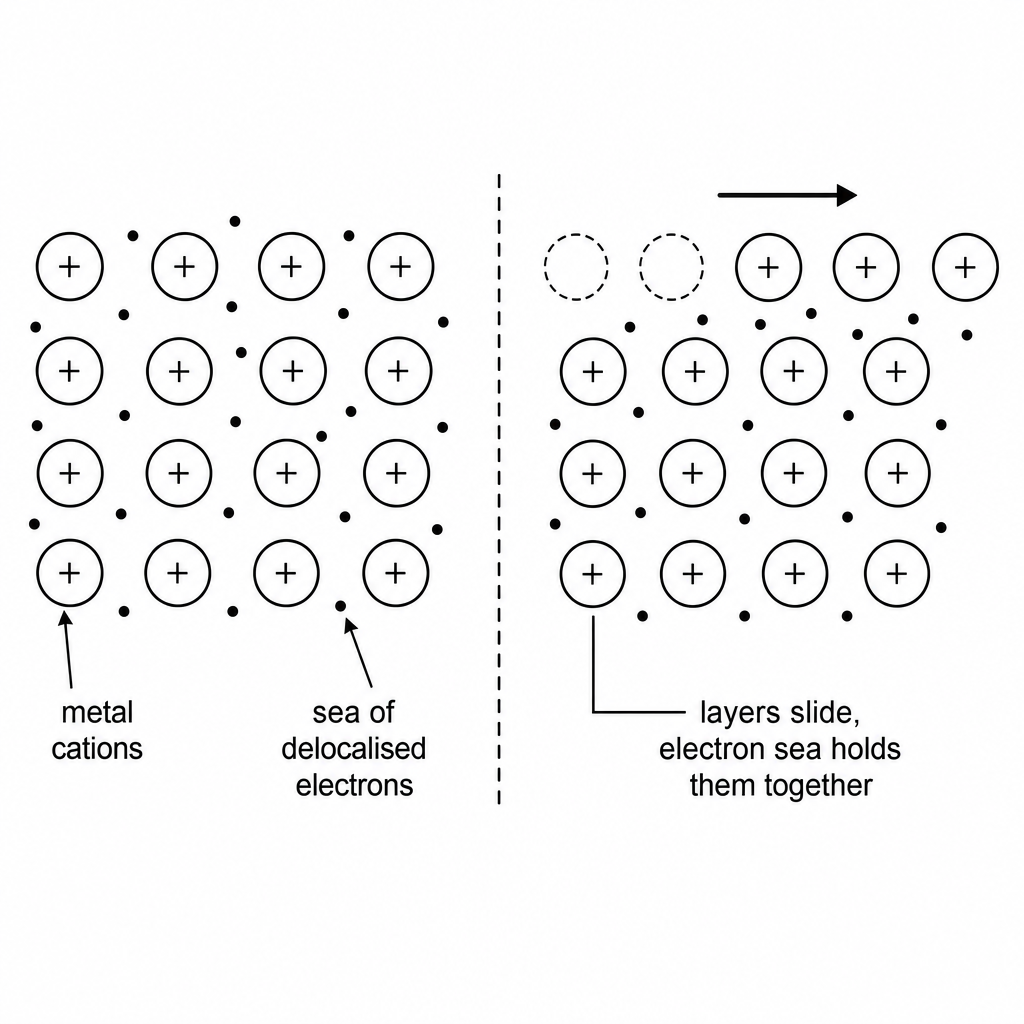
Key idea🔑 Key idea: Metal = positive ions + a sea of free electrons. Free electrons → conducts; sliding layers → bends; and metals react by losing electrons to make + ions. ⚡
Worked example
Worked Example: Why Metals Conduct
Free Electrons Do the Work 🔌
In terms of metallic bonding, why does a metal conduct electricity?
- 1Structure: a metal is a lattice of positive ions surrounded by a sea of delocalised electrons.
- 2Link: connect a voltage and those electrons are free to move through the lattice. Moving electrons = current. So it conducts.
Just remember: it's the electrons that move, not the ions. ✅
---
3. Uses of Metals
The syllabus names four uses of aluminium and copper, each with its own property. Aluminium for the manufacture of aircraft because of its low density; for overhead electrical cables because of its low density and good electrical conductivity; and for food containers because of its resistance to corrosion (a thin oxide layer seals its surface). Copper for electrical wiring because of its good electrical conductivity and ductility (it draws into thin wires). The trick in the exam is to link the property to why it helps the job, not just name it.
Key idea🔑 Key idea: Match property → use. Aluminium: aircraft (low density), overhead cables (low density + conductivity), food containers (corrosion resistance). Copper: wiring (conductivity + ductility). Always say why the property helps. 🎯
Worked example
Worked Example: Aluminium Aircraft
Light and Rust-Proof ✈️
Why is aluminium chosen for aircraft bodies? State the property the syllabus links to this use, and give one further property that helps.
- 1The syllabus property is low density: the aircraft body is light for its size, so the plane uses less fuel.
- 2A further property that helps: aircraft sit out in the weather for years, and aluminium resists corrosion thanks to its oxide layer.
So the syllabus answer for aircraft is low density; corrosion resistance is a bonus (it's the property the syllabus links to food containers). 🔥
---
4. Alloys
An alloy is just a mixture of a metal with other elements. Brass = copper + zinc; stainless steel = iron with other elements such as chromium, nickel and carbon. Stainless steel is used for cutlery because it is hard and resists rusting. Here's the magic: alloys can be harder and stronger than the pure metal. Why? A pure metal has identical atoms in tidy layers that slide over each other (so it's soft). Mix in atoms of a different size and they jam up the layers so they can't slide. Boom, harder.
Key idea🔑 Key idea: An alloy is a mixture, and it's harder because different-sized atoms disrupt the neat layers so they can't slide. Not "stronger bonds", the sliding layers are the whole story. 💪
Worked example
Worked Example: Brass vs Copper
Blocked Layers 🎺
Brass is copper mixed with zinc. Why is brass stronger than pure copper?
- 1Pure copper: same-size atoms in neat layers that slide → soft.
- 2Brass: zinc atoms are a different size, so they stop the layers sliding → stronger and harder.
The marker wants "the layers can't slide", not "stronger bonds". ✅
---
5. The Reactivity Series
This is the spine of the chapter: metals lined up by how easily they lose electrons. Learn it: K, Na, Ca, Mg, Al, (C), Zn, Fe, (H), Cu, Ag, Au. The top three (K, Na, Ca) react with cold water (→ hydroxide + hydrogen). Magnesium barely reacts with cold water but reacts with steam to give magnesium oxide + hydrogen (); that's the steam reaction the syllabus names. Metals above hydrogen react with dilute acids (→ salt + hydrogen): magnesium fast, zinc steadily, iron slowly. The bottom three (Cu, Ag, Au) don't react with dilute acids. So a metal's behaviour with water, steam and acid tells you exactly where it sits.
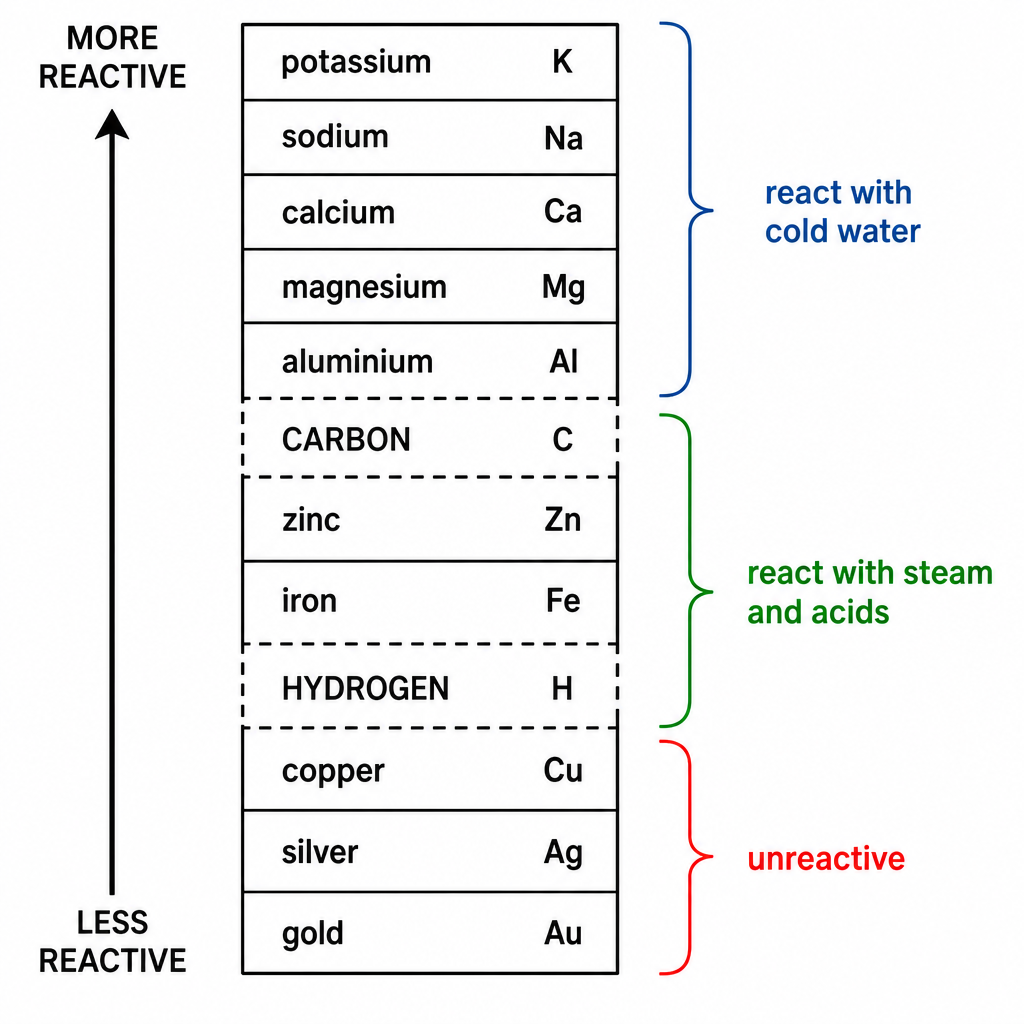
Key idea🔑 Key idea: K Na Ca Mg Al [C] Zn Fe [H] Cu Ag Au. Cold water = K, Na, Ca; magnesium + steam → MgO + H₂; acid = everything above H; no reaction with acid = Cu, Ag, Au. Where a metal reacts pins down its place. 🪜
Worked example
Worked Example: Name That Metal
Steam Yes, Cold Water Barely 🔍
Metal Z reacts with dilute acid, reacts very slowly with cold water but fast with steam. Is it magnesium, gold, potassium or silver?
- 1Reacts with acid → above hydrogen. Cross off gold and silver.
- 2Slow with cold water but fast with steam → a middle metal. Cross off potassium (it's violent with cold water).
Left standing: magnesium. 🎯
---
6. Displacement
If you drop a more reactive metal into a solution of a less reactive metal's salt, the reactive one displaces (kicks out) the other. Zinc is above copper, so zinc displaces copper: . The leftover ion (like sulfate) just watches, so it's a spectator and gets left out of the ionic equation. And the golden rule for ranking metals: if A displaces B, A is more reactive. The catch: ionic equations have to balance charge as well as atoms.
Key idea🔑 Key idea: A more reactive metal displaces a less reactive one from its salt. If A displaces B, A is more reactive. Balance ionic equations for charge and atoms. 🥊
Worked example
Worked Example: Aluminium Displaces Zinc
Balance the Charge ⚖️
Balance the ionic equation .
- 1Electrons lost = electrons gained. Al loses 3, gains 2. Lowest common number = 6.
- 2Use 2 Al (lose 6) and 3 Zn (gain 6):
Charge check: left , right . Balanced. ✅
---
Answer
7. Corrosion and Rusting
Rusting is iron corroding, and it needs both water and oxygen (no water or no air = no rust). The rust itself is hydrated iron(III) oxide. Two ways to stop it: barrier methods (paint, oil, plastic, plating) just block the water and air, but only while they're intact. Sacrificial protection is cleverer: bolt on a more reactive metal (zinc or magnesium) and it loses electrons instead of the iron, so it corrodes and the iron survives even if exposed. Galvanising (zinc coating) does both at once.
Key idea🔑 Key idea: Rust needs water + oxygen. Block it with a barrier, or use a more reactive metal that corrodes instead (sacrificial). Galvanising = barrier + sacrificial. 🛡️
Worked example
Worked Example: Galvanising
Zinc Takes the Hit 🔩
An iron nail is coated in zinc. How does this stop it rusting?
- 1Barrier: while the zinc covers it, water and air can't reach the iron.
- 2Sacrificial: zinc is more reactive than iron, so even if it's scratched, the zinc corrodes first and the iron is safe.
So it's both, and it works because zinc is more reactive than iron. ✅
---
8. Extracting Metals
Metals come from ores (usually joined to oxygen), and extracting them means removing the oxygen (reduction). The whole decision comes down to one comparison: is the metal above or below carbon? Below carbon (Zn, Fe, Cu) → just heat the ore with carbon (cheap). Above carbon (K, Na, Ca, Mg, Al) → carbon can't shift the oxygen, so you need electrolysis (pricey but necessary). Super-unreactive ones like gold are just found as the metal already.
Key idea🔑 Key idea: Below carbon → reduction with carbon (cheap). Above carbon → electrolysis. The comparison is metal vs carbon, not hydrogen. ⛏️
Worked example
Worked Example: Zinc vs Aluminium
Carbon Decides 🔥
Zinc is below carbon, aluminium is above carbon. How is each extracted, and why?
- 1Zinc is below carbon, so carbon can grab its oxygen → reduction with carbon: .
- 2Aluminium is above carbon, so carbon can't → electrolysis.
Compare to carbon, not hydrogen. 🎯
---
9. Iron in the Blast Furnace
Iron comes from hematite (iron(III) oxide). You load iron ore, coke (carbon) and limestone in the top and blast hot air in the bottom. The coke burns to make heat (), that gas reacts with more coke to make the real reducing agent, carbon monoxide (), and the CO strips the oxygen off the ore. The limestone mops up the sandy impurity as slag: it decomposes in the heat (), and the basic calcium oxide reacts with the acidic silicon(IV) oxide (). Molten iron sinks to the bottom and the slag floats on it.
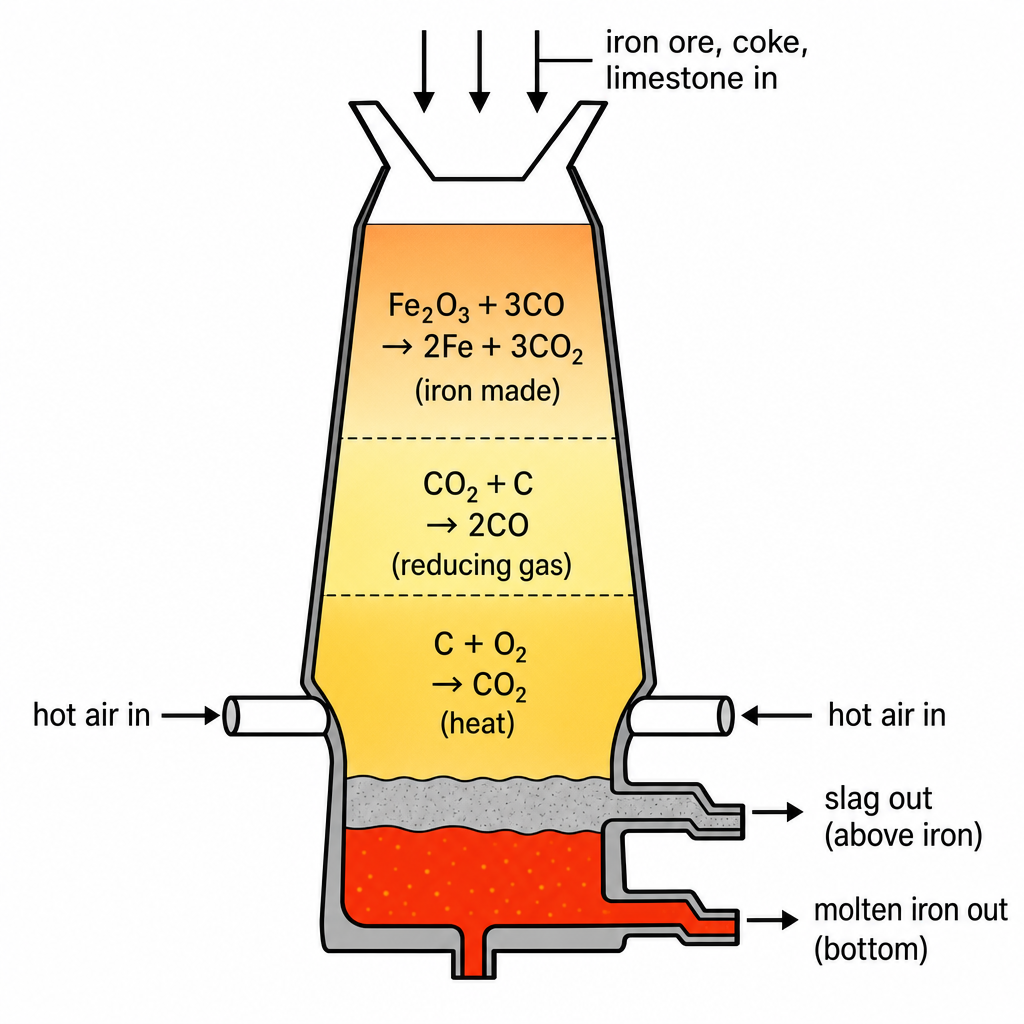
Key idea🔑 Key idea: Coke burns for heat, makes CO, and CO reduces the ore: . Limestone removes sand as slag: , then . 🏭
Worked example
Worked Example: Reducing the Ore
Three CO, Three Oxygens 🧮
Carbon monoxide reduces iron(III) oxide. Write the balanced equation.
- 1has 3 oxygens, so you need 3 CO to carry them off as 3 .
- 2Fe 2=2, C 3=3, O 6=6. Balanced. The reducer is CO, not carbon. ✅
---
Answer
10. Aluminium by Electrolysis
Aluminium is above carbon, so it's electrolysis time. Its ore bauxite is cleaned to aluminium oxide, which is then dissolved in molten cryolite to lower the melting point (saves energy). Electrolyse it with carbon electrodes: aluminium forms at the negative electrode (cathode) and oxygen at the positive electrode (anode). That oxygen burns the carbon anodes away, so they keep getting replaced.
Key idea🔑 Key idea: Cathode: . Anode: . Cryolite lowers the melting point; the oxygen burns the carbon anodes away. ⚡
Worked example
Worked Example: At the Cathode
Gain 3 Electrons 🔋
Write the half-equation at the negative electrode in the electrolysis of aluminium oxide.
- 1ions are positive, so they go to the negative electrode (cathode).
- 2Each one gains 3 electrons to become an aluminium atom:
Gain = cathode (RED-CAT). ✅
---
Answer
Practice this in the app
Unlock the full chapter: practice questions, flashcards, mock papers and notes, free.
Continue revising