Chemical Energetics: Exothermic, Endothermic and ΔH
Energy In, Energy Out 🔥🧊
Introduction
1. Introduction
Okay, energetics. Sounds intense, but it's honestly just chemistry's version of "does this thing heat up or cool down, and by how much?" Light a match, it warms your hand. Crack an ice pack, it goes cold. Same physics, different direction.
Here's the cheat code for the whole chapter: a reaction breaks some bonds and makes new ones, and energy flows in or out depending on which one costs more. Lock that in and the four exam moves (exo or endo? sign of ΔH? draw the diagram? calculate ΔH?) all become the same idea wearing different outfits. This is your fast refresh, not the full textbook: one key point per idea, one quick worked example, and the exact move the marker wants. Let's get into it. 🔥🧊
Here's the cheat code for the whole chapter: a reaction breaks some bonds and makes new ones, and energy flows in or out depending on which one costs more. Lock that in and the four exam moves (exo or endo? sign of ΔH? draw the diagram? calculate ΔH?) all become the same idea wearing different outfits. This is your fast refresh, not the full textbook: one key point per idea, one quick worked example, and the exact move the marker wants. Let's get into it. 🔥🧊
2. Exothermic vs Endothermic
Every reaction either gives energy out or takes energy in. Exothermic = energy goes out to the surroundings, so they warm up (think burning, neutralisation, metal + acid). Endothermic = energy gets pulled in from the surroundings, so they cool down (think thermal decomposition, cold packs). You can't see energy, but you can read the thermometer: temp up = exothermic, temp down = endothermic. The surroundings basically snitch on which way the energy went.
Key idea🔑 Key idea: Surroundings get hotter → energy released → exothermic. Surroundings get colder → energy absorbed → endothermic. 🌡️
Worked example
Worked Example: Exo and the Surroundings
Worked Example: Heat Goes Out 🔥
A reaction is exothermic. What's the sign of ΔH, and what happens to the temperature of the surroundings?
- 1Exothermic = energy given out, so the surroundings gain energy and their temperature increases.
- 2Energy released is recorded as a negative ΔH.
So: ΔH is negative and the surroundings warm up. Learn it as one chain: exothermic → negative ΔH → warmer surroundings. ✅
---
3. The Enthalpy Change ΔH
"Exothermic" only gives the direction. ΔH (measured in kJ/mol) gives the direction and the size. The "Δ" just means "change in". The sign follows the energy of the chemicals: exothermic → ΔH negative (chemicals lost energy), endothermic → ΔH positive (chemicals gained energy). So a value like ΔH = −200 kJ/mol packs two facts: the minus sign says exothermic, and the 200 says how much (200 kJ per mole).
Key idea🔑 Key idea: ΔH negative = exothermic, ΔH positive = endothermic. The sign is the direction, the number is the size (kJ/mol). 📏
Worked example
Worked Example: Reading a ΔH Value
Worked Example: Sign Then Size 🔍
A reaction has ΔH = −200 kJ/mol. Is it exothermic or endothermic, and how much energy is transferred per mole?
- 1Read the sign: negative → it releases energy → exothermic.
- 2Read the size: 200 kJ/mol → 200 kJ released per mole.
Exothermic, releasing 200 kJ per mole. Sign and size answer two different parts. Don't ever read "negative" as "no energy". 🔥
---
4. Endothermic in Action
When something dissolves and the beaker goes cold, that's the classic endothermic move. The dissolving is pulling energy out of the water, so the water cools down. Cold to the touch doesn't mean "cold was made" (nothing makes cold) — it means the process absorbed energy from the surroundings. That's exactly how an instant cold pack works: ammonium nitrate dissolving in water soaks up energy and the bag turns icy.
Key idea🔑 Key idea: A mixture going cold = energy absorbed = endothermic = positive ΔH. Cold ≠ cold released; cold = energy taken in. 🧊
Worked example
Worked Example: The Cold Beaker
Worked Example: Temp Drops 🥶
A solid dissolves in water and the temperature falls from 21 °C to 14 °C. What's happening in terms of energy, and is it exothermic or endothermic?
- 1Temperature falls → the water (surroundings) is losing energy → energy is being absorbed by the dissolving.
- 2Taking energy in = endothermic, and the temperature decreases.
Energy absorbed, temperature down, endothermic. Done. ✅
---
5. Reaction Pathway Diagrams
A reaction pathway diagram puts everything on one graph: energy up the side, "progress of reaction" along the bottom. Three things to spot. Levels: products below reactants = exothermic; above = endothermic. Activation energy (Ea): the curve always climbs a hump first; Ea is the height from the reactants up to the top of the hump. ΔH: the gap between the reactant level and the product level. The classic trap is mixing up the hump (Ea, up to the peak) with the step (ΔH, across to the products). To draw one from values you're given: label the axes, draw a flat reactants line, put the products line lower if ΔH is negative or higher if positive, join them with a smooth curve over one peak above both lines, then draw both arrows starting from the reactants line (to the peak for Ea, to the products for ΔH) and write the values on them. For ΔH = +60 kJ/mol and Ea = 150 kJ/mol with reactants at 0, the products sit at +60 and the peak at +150.
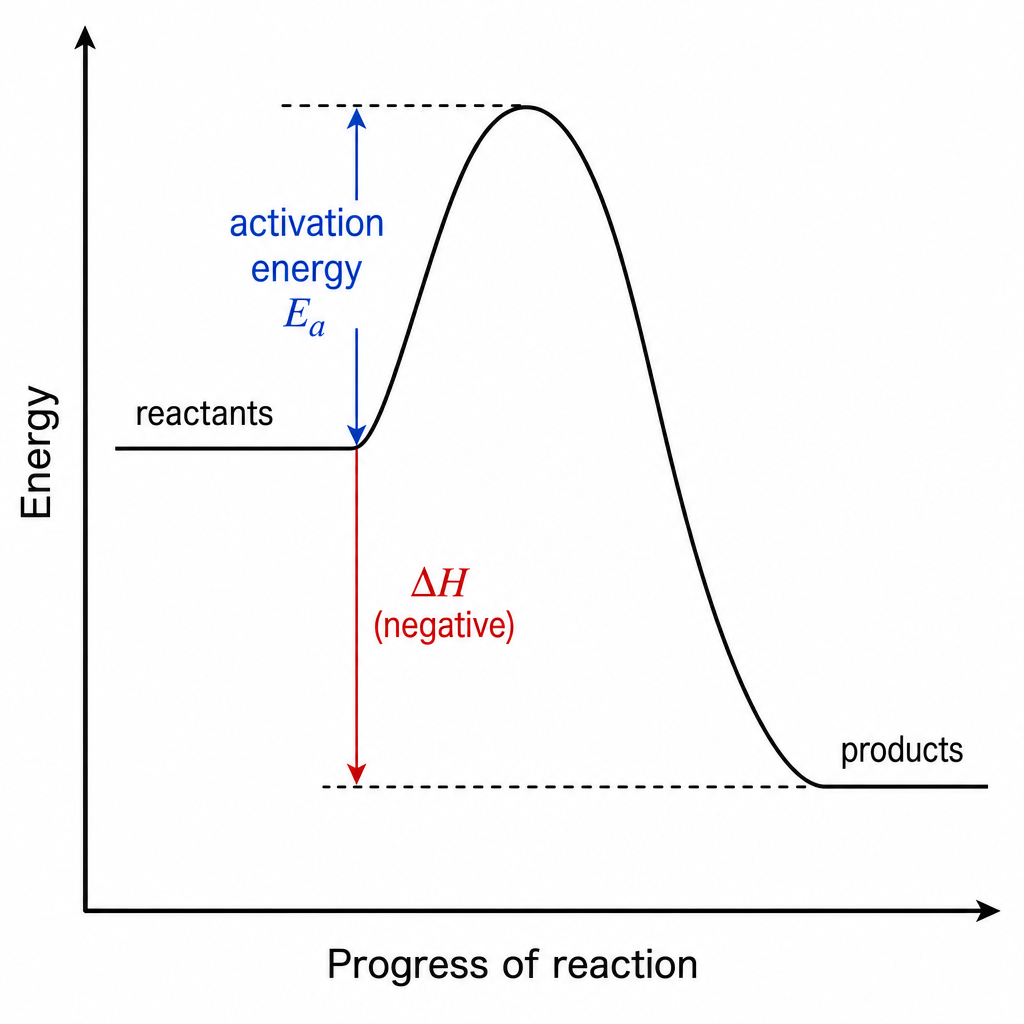
Key idea🔑 Key idea: Products lower than reactants = exothermic; higher = endothermic. Ea = reactants up to the peak; ΔH = reactants across to products. 📈
Worked example
Worked Example: Drawing the Exo Diagram
Worked Example: Down the Hill 🎢
A reaction has a negative ΔH. How should its pathway diagram look, and where do Ea and ΔH go?
- 1Negative ΔH → exothermic → products drawn lower than reactants. The curve rises to a peak first, and Ea is the up-arrow from reactants to the peak.
- 2ΔH is the down-arrow from the reactants down to the lower products — it points down because the products are lower.
Products low, Ea up to the peak, ΔH down to the products. 🎢
---
6. Activation Energy
Petrol and air just sit there until a spark shows up, even though burning releases loads of energy. That's because of the activation energy (Ea): the minimum energy colliding particles need before they can react. It's the hill on the diagram the reaction has to climb before it can roll down to products. A big Ea means a slow reaction at room temperature, because only a few particles have enough energy to get over the top. And knowing whether a reaction is exo or endo doesn't tell you how big Ea is: both kinds have a hump. The only link is that for an endothermic reaction the peak can't be lower than the products.
Key idea🔑 Key idea: Activation energy = the minimum energy particles need to react. High Ea = slow reaction, even if it's exothermic. Exo or endo doesn't tell you the size of Ea (though an endothermic peak must sit above the products). 🧗
Worked example
Worked Example: What Is Ea?
Worked Example: Define It 🎯
State exactly what is meant by the activation energy of a reaction.
- 1Particles must collide and have enough energy to break the old bonds before anything happens.
- 2So: activation energy is the minimum energy that colliding particles must have before a reaction can take place.
Not the energy released, not the product energy, not ΔH — just the energy needed to start. 🎯
---
7. Bonds and Energy
This is the engine behind the whole chapter. Breaking bonds is endothermic (you put energy in to rip atoms apart). Making bonds is exothermic (energy comes out when atoms join up). Whether the whole reaction is exo or endo is just a tug-of-war: if making the new bonds gives out more than breaking the old ones takes in, it's exothermic overall; if breaking costs more than making pays back, it's endothermic.
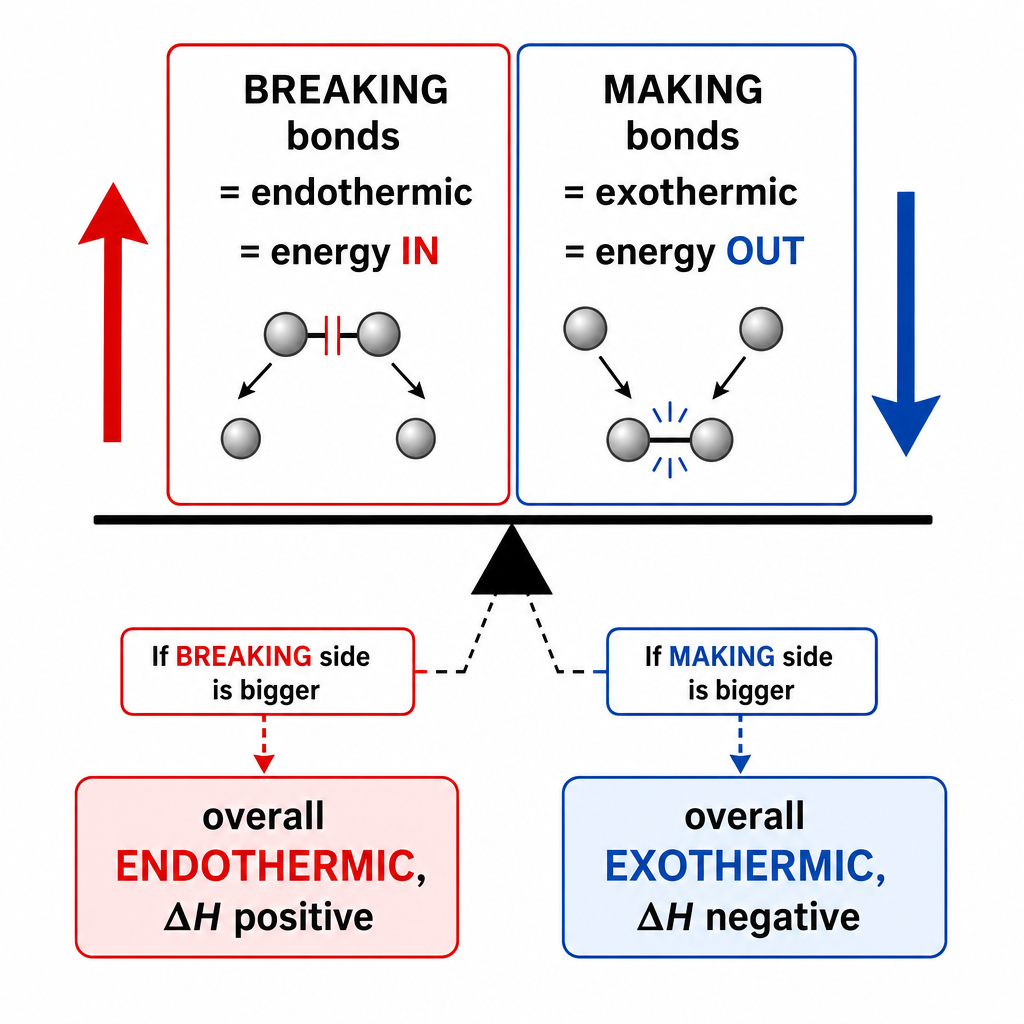
Key idea🔑 Key idea: Breaking bonds = energy in (endothermic). Making bonds = energy out (exothermic). More out than in = exothermic overall. 🔗
Worked example
Worked Example: Why Exothermic?
Worked Example: Make Beats Break ⚖️
In terms of energy taken in and given out by bonds, explain why a reaction is exothermic.
- 1Breaking the reactant bonds takes energy in; making the product bonds gives energy out.
- 2For the reaction to release energy overall, the energy given out making bonds must be greater than the energy taken in breaking bonds.
So exothermic = more energy released forming bonds than taken in breaking them. (And never write "breaking bonds gives out energy" — it always takes energy in.) ⚖️
---
8. Calculating ΔH from Bond Energies
Here's the one actual calculation, and it's just adding and subtracting. A bond energy is the energy to break one mole of that bond. The formula: ΔH = (bonds broken) − (bonds formed). Add up every reactant bond (broken), add up every product bond (formed), subtract. Negative answer = exothermic, positive = endothermic. The only trap is the numbers in front: 2HCl means two H–Cl bonds, so use 2 × the value.
Key idea🔑 Key formula: ΔH = Σ(bonds broken) − Σ(bonds formed). Watch the coefficients — multiply each bond energy by how many of that bond there are. 🧮
Worked example
Worked Example: H₂ + Cl₂
Worked Example: Run the Numbers 🔢
Calculate ΔH for . (H–H = 436, Cl–Cl = 242, H–Cl = 431 kJ/mol.)
- 1Bonds broken: one H–H + one Cl–Cl = . Bonds formed: 2HCl = two H–Cl = .
- 2Subtract: kJ/mol.
Negative → exothermic. ΔH = −184 kJ/mol. 🔢
---
9. Endothermic Bond-Energy Calc
The exact same method handles endothermic reactions: you don't decide exo or endo in advance, the subtraction tells you. If breaking the reactant bonds costs more than making the product bonds pays back, you get a positive number, and a positive ΔH means endothermic. Same four steps, just let the sign fall out at the end. You can also run it backwards to find an unknown bond energy when ΔH is given: rearrange to formed = broken − ΔH, take away the bonds you know, and divide by how many of the unknown bond there are. For (ΔH = −54 kJ/mol; S–F 330, O–H 460, H–F 570): broken = 4 × 330 + 4 × 460 = 3160, so formed = 3160 − (−54) = 3214; take away 4 × 570 = 2280 to leave 934 for the two S=O bonds, so S=O = 467 kJ/mol.
Key idea🔑 Key idea: Don't guess the sign: calculate broken − formed and read it. Positive ΔH = endothermic. Given ΔH, rearrange to find one unknown bond energy. ➕
Worked example
Worked Example: Decomposing HI
Worked Example: Let the Sign Decide 🪙
Calculate ΔH for . (H–I = 299, H–H = 436, I–I = 151 kJ/mol.)
- 1Bonds broken: 2HI = two H–I = . Bonds formed: one H–H + one I–I = .
- 2Subtract: kJ/mol.
Positive → endothermic. ΔH = +11 kJ/mol. The method handed you the sign. ✅
---
10. Reversing a Reaction
Energy is never lost, so running a reaction backwards moves the exact same energy the other way. If the forward reaction is exothermic with ΔH = −x, the reverse is endothermic with ΔH = +x. Same number, opposite sign — it doesn't double and it doesn't go to zero. Respiration (exothermic) and photosynthesis (its reverse, endothermic) are the everyday combo.
Key idea🔑 Key idea: Reverse a reaction → same size of ΔH, opposite sign. −x becomes +x, exo flips to endo. 🔄
Worked example
Worked Example: Going Backwards
Worked Example: Same Size, New Sign ↩️
The forward reaction releases 120 kJ/mol (ΔH = −120 kJ/mol). What's ΔH for the reverse reaction, and is it exothermic or endothermic?
- 1Forward is exothermic, ΔH = −120 kJ/mol. Flip the sign: ΔH = +120 kJ/mol.
- 2Positive → endothermic.
Same number, opposite sign: −120 becomes +120. Not −240, not 0. ↩️
---
Practice this in the app
Unlock the full chapter: practice questions, flashcards, mock papers and notes, free.
Continue revising