Waves: Properties, Light, the EM Spectrum and Sound
Wave Rider: Catch Every Frequency 🌊
Introduction
1. Introduction
Ripples on a pond, your reflection in a mirror, a straw that looks snapped in a glass of water, the rainbow off a CD, the ping of a text, the rumble of thunder after the flash: every one of those is a wave doing its job. This is your five-minute refresh on what waves are, how light reflects and bends, the full electromagnetic family from radio to gamma, and how sound travels. One equation () and a handful of clean diagrams carry most of the marks here. Let's ride it. 🌊
2. Wave Properties and the Wave Equation
A wave transfers energy from one place to another without moving matter along with it — a duck on a pond bobs up and down as ripples pass but doesn't get carried to the far side. In a transverse wave the vibration is at right angles to the travel direction (light, water ripples, seismic S-waves); in a longitudinal wave the vibration is along the travel direction (sound, seismic P-waves). Key features: the wavelength (one full repeat, crest-to-crest), the frequency (waves per second, in hertz), the amplitude (height from the middle to a crest, which sets how much energy), and the wave speed .
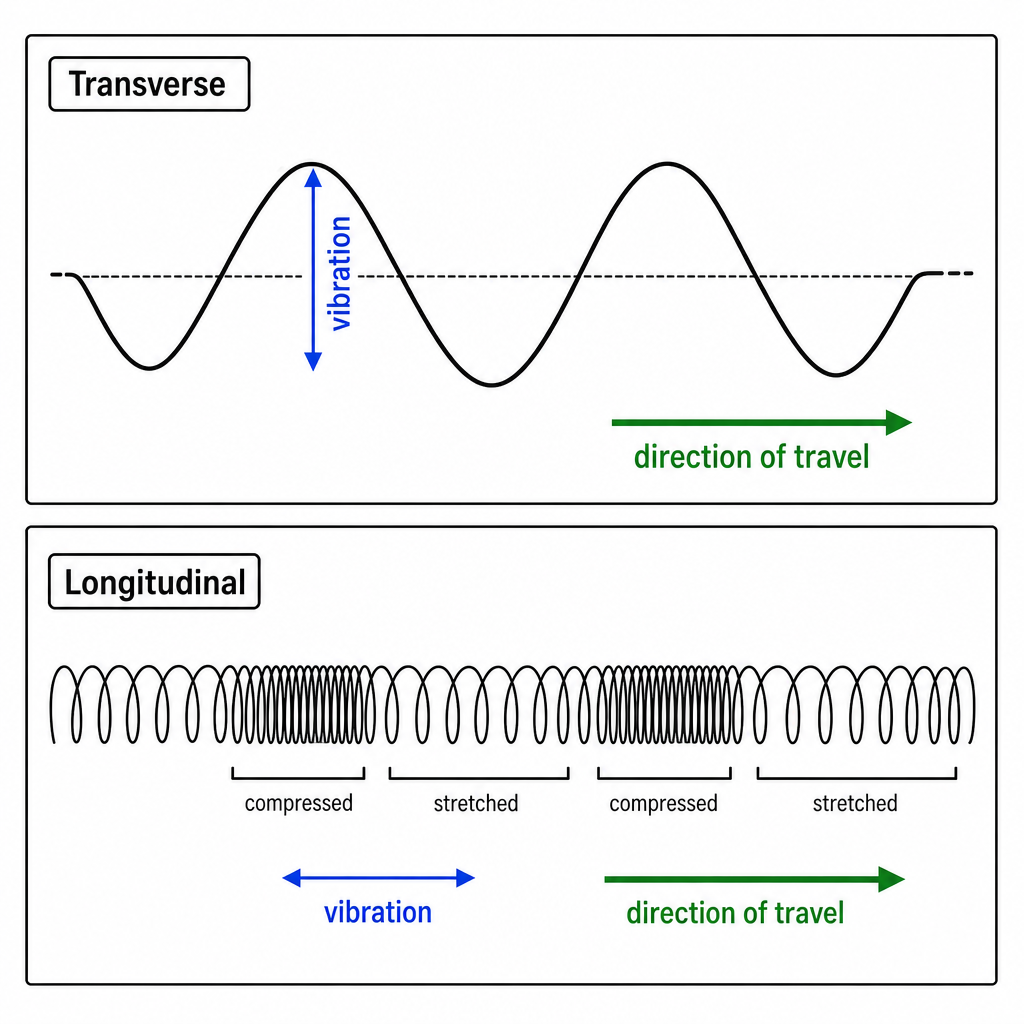
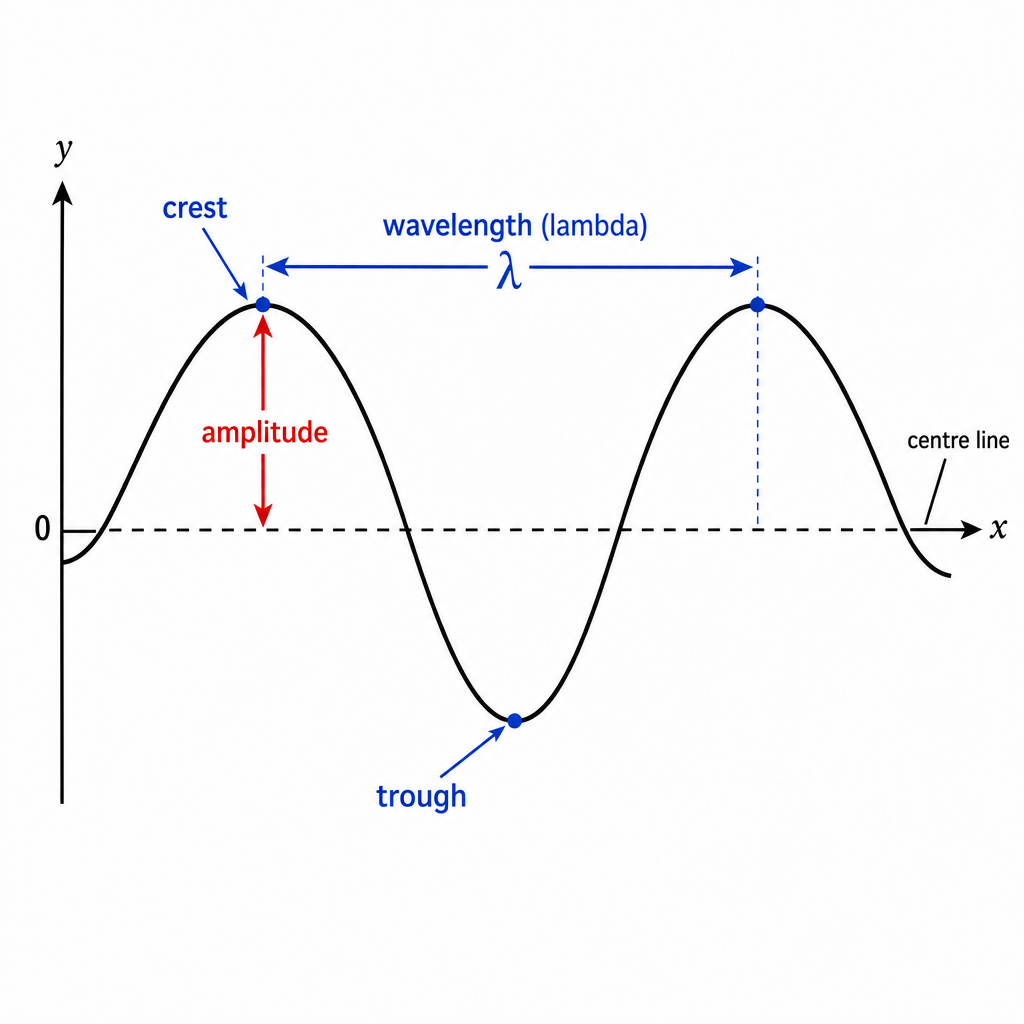
Key idea🔑 Key formula: (speed = frequency × wavelength). Waves carry energy, not matter.
Worked example
Worked Example: Wave Speed from Frequency and Wavelength
Worked Example: v = fλ in Action 🎵
A water wave in a ripple tank has a frequency of Hz and a wavelength of m. Find its speed.
- 1Write the wave equation and list the values.
- 2Substitute and multiply.
- 3Check the units: hertz (per second) × metres = metres per second. ✅ The wave travels at m/s. Same equation rearranges: if you know speed and frequency, .
---
3. Reflection and the Plane Mirror Image
When light hits a plane (flat) mirror it bounces off following the law of reflection: the angle of incidence equals the angle of reflection, both measured from the normal (the line drawn at to the mirror surface). The image you see in a plane mirror is virtual (no light actually reaches it, so it can't be caught on a screen), the same size as the object, upright, and the same distance behind the mirror as the object is in front. It's also laterally inverted (left and right swap), which is why ambulance signs are written back-to-front.
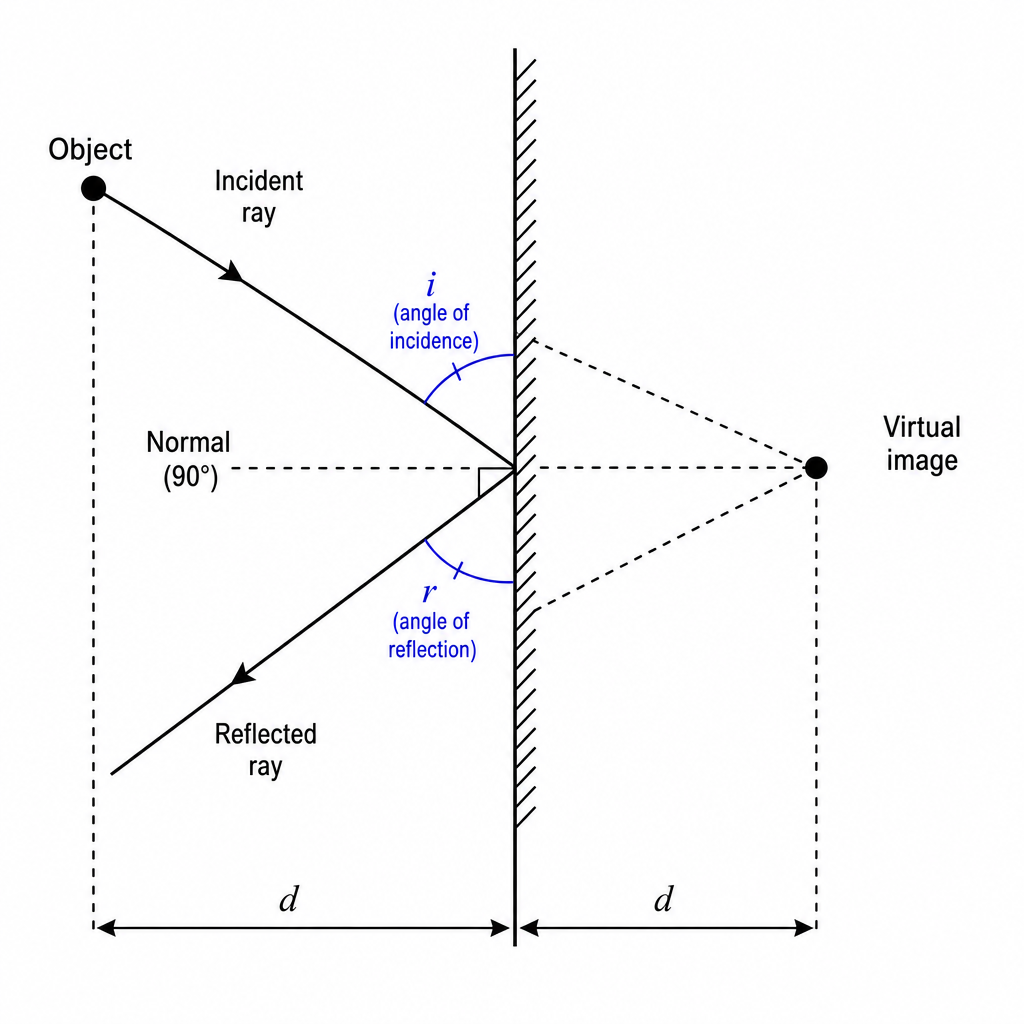
Key idea🔑 Key idea: Angle of incidence = angle of reflection (both from the normal). Plane-mirror image: virtual, same size, upright, same distance behind.
Worked example
Worked Example: Describing a Plane Mirror Image
Worked Example: Name the Image 🪞
You stand m in front of a flat bathroom mirror. State the four characteristics of your image and where it appears to be.
- 1A plane-mirror image is always virtual, same size as you, upright, and laterally inverted. It appears m behind the mirror — the same distance behind as you are in front — so you and your image are m apart.
---
4. Refraction, Critical Angle and Total Internal Reflection
Refraction is the bending of light when it crosses between two materials because its speed changes. Going from air into glass or water (into a slower, denser medium) the ray bends toward the normal; coming back out into air it bends away from the normal. That speed change is why a straw looks bent and why a pool looks shallower than it is. If light inside glass or water hits the surface at a steep enough angle, none escapes — it all reflects back inside. The angle at which this just starts is the critical angle; beyond it you get total internal reflection (TIR), the effect that pipes light down optical fibres and makes the inside of a diamond sparkle.
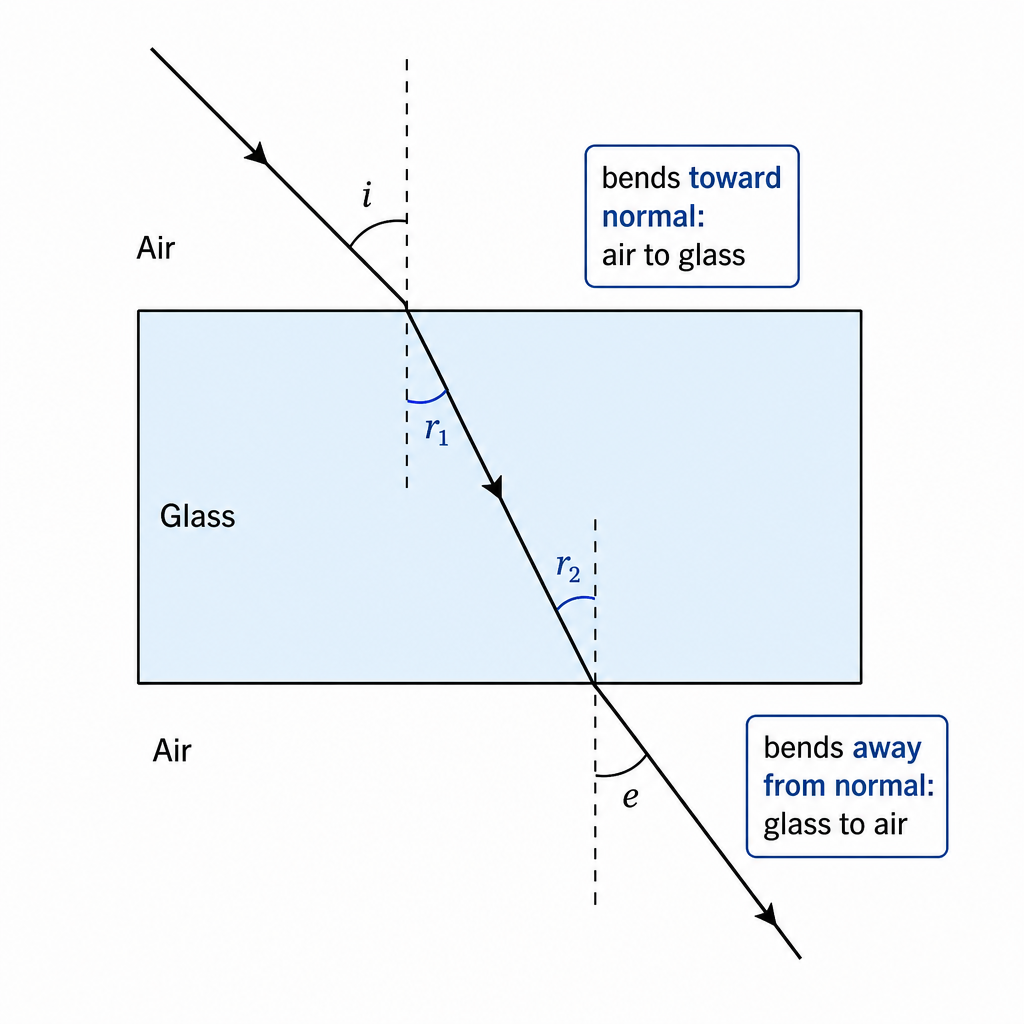
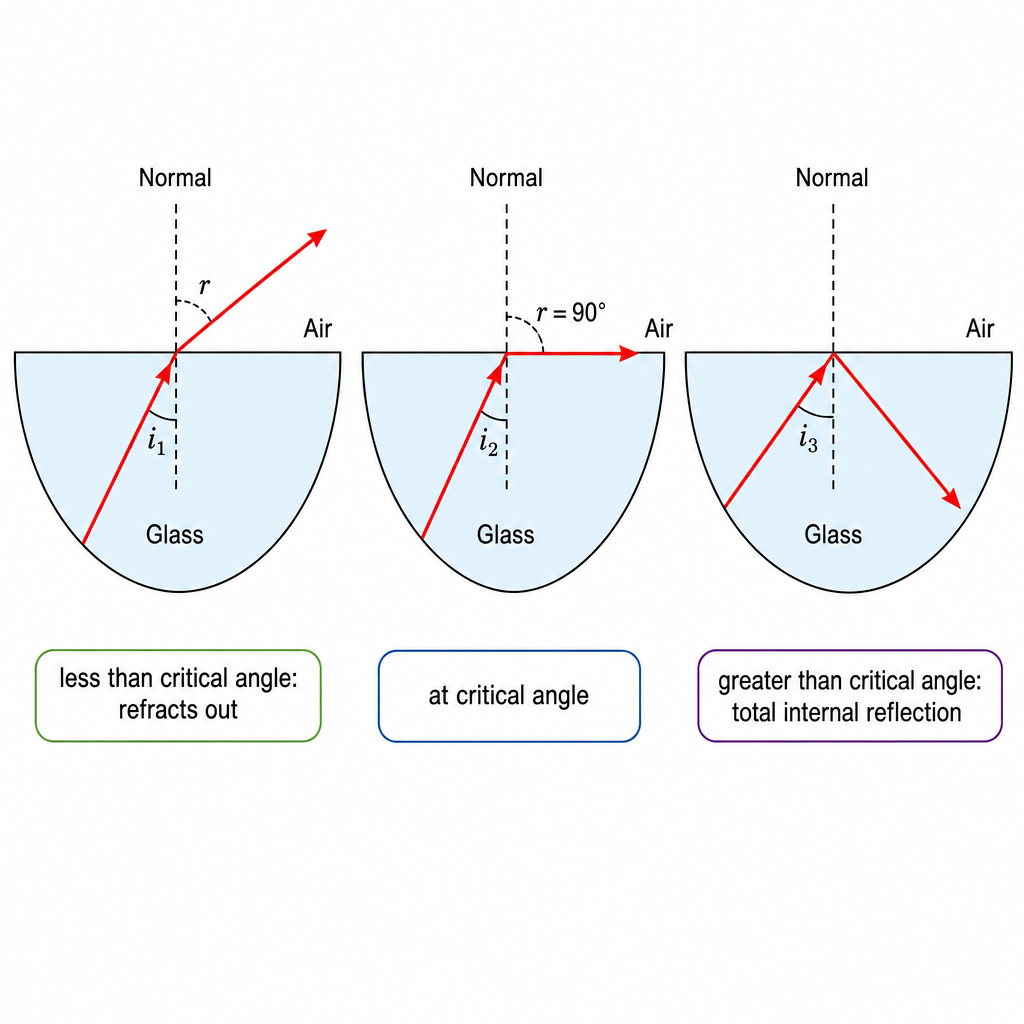
Key idea🔑 Key idea: Light bends toward the normal entering a denser medium, away leaving it. Past the critical angle, light is totally internally reflected.
Worked example
Worked Example: Which Way Does the Ray Bend?
Worked Example: Bend the Beam 🔦
A ray of light travels through air and enters a glass block. State which way it bends, and explain why a swimming pool looks shallower than it really is.
- 1Entering the glass the light slows down, so it bends toward the normal. For the pool: light from the bottom speeds up as it leaves water into air and bends away from the normal, so your eye traces it back along a straighter line and the bottom looks raised — the pool looks shallower than it is.
---
5. Converging and Diverging Lenses, Real Images
A converging (convex) lens bends parallel light inward to meet at the principal focus; a diverging (concave) lens spreads parallel light outward so it seems to come from a focus behind the lens. The distance from the lens to the focus is the focal length. For a converging lens, an object placed beyond the focal point makes a real image — one you can catch on a screen — that is inverted. Put the object beyond twice the focal length and the real image is smaller (like a camera); between and it is larger (like a projector). A virtual image (upright, enlarged, magnifying-glass style) forms when the object is inside the focal length.
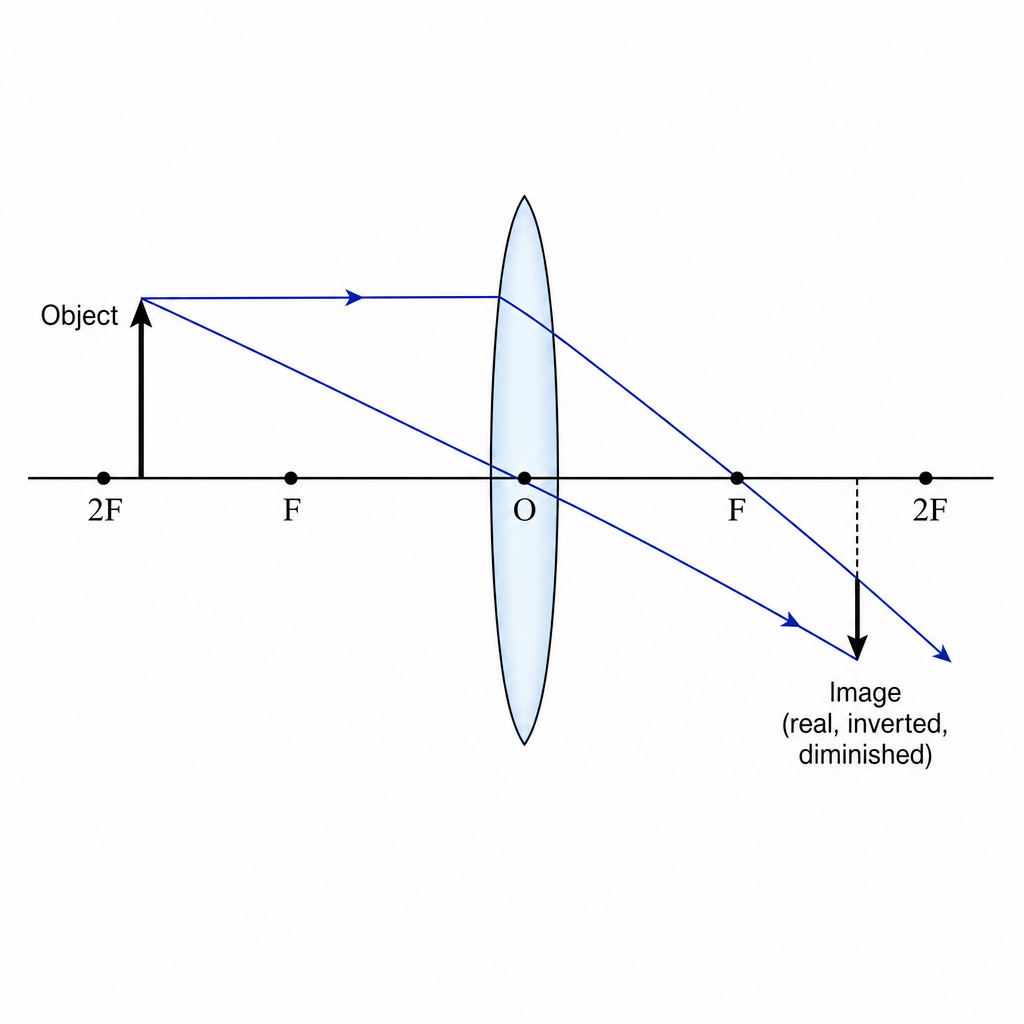
Key idea🔑 Key idea: Converging lens + object beyond → real, inverted, diminished image. Object inside → virtual, upright, enlarged (magnifier).
Worked example
Worked Example: Image from an Object Beyond 2F
Worked Example: Real, Inverted, Smaller 🖼️
- 1Problem. An object is placed beyond from a converging lens. Describe the image.
The two standard rays (one parallel-then-through-, one straight through the centre) cross between and on the far side. The image there is real (can be caught on a screen), inverted, and diminished (smaller than the object). This is exactly how a camera forms a small picture of a distant scene.
---
6. Dispersion of White Light by a Prism
White light is a mixture of all the colours. When it passes through a glass prism each colour slows and bends by a slightly different amount — violet bends most, red bends least — so they fan out into the visible spectrum. This is dispersion. The traditional seven colours, in order, are red, orange, yellow, green, blue, indigo, violet (ROYGBIV): red has the longest wavelength and lowest frequency, violet the shortest wavelength and highest frequency. A rainbow is the same trick done by raindrops instead of a prism. 🌈
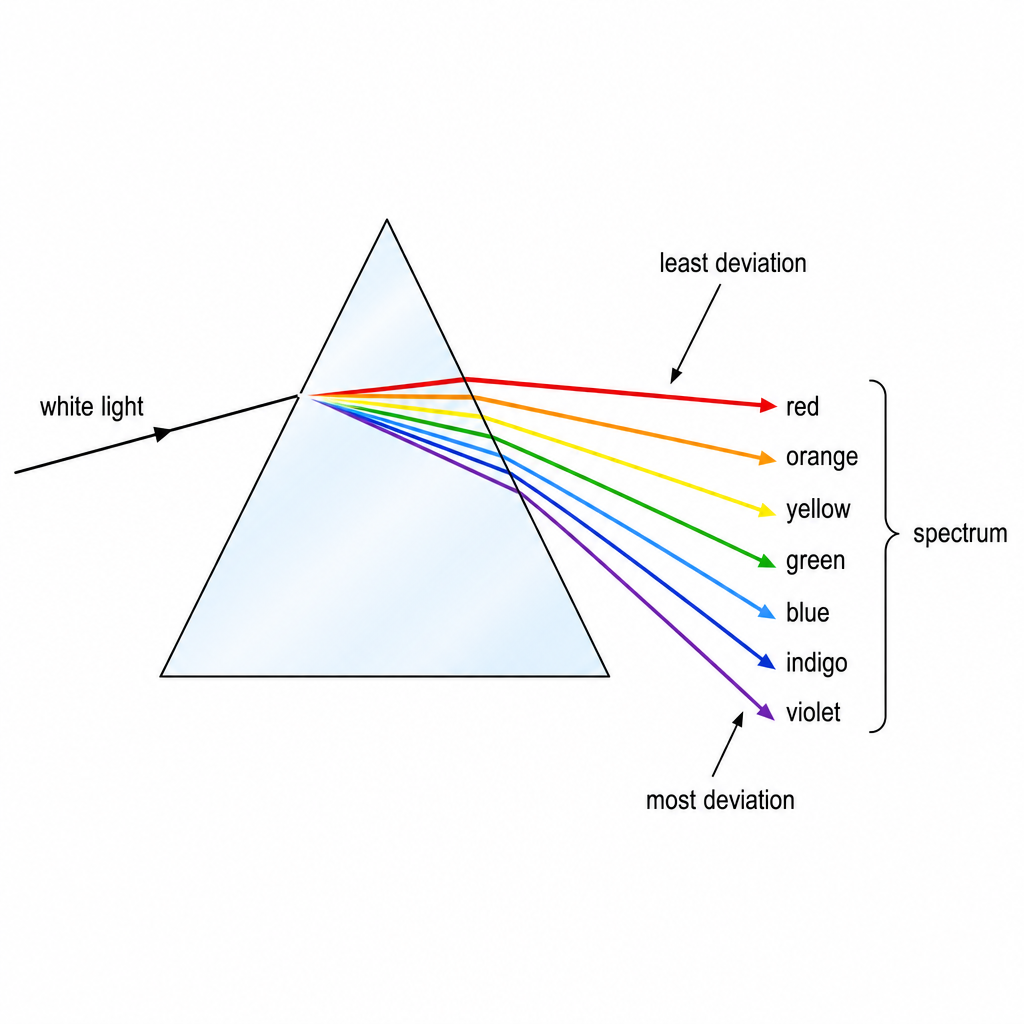
Key idea🔑 Key idea: A prism splits white light into ROYGBIV. Red = longest wavelength / lowest frequency; violet = shortest / highest.
Worked example
Worked Example: Order of the Colours
Worked Example: ROYGBIV vs the Prism 🎨
- 1Problem. After white light passes through a prism, which colour is deflected most, and which has the highest frequency?
Violet is deflected most (it slows and bends the most in glass), and violet also has the highest frequency and shortest wavelength. Red is deflected least and has the lowest frequency. Remember the order red → violet runs from long wavelength to short.
---
7. The Electromagnetic Spectrum: Radio to Gamma
The electromagnetic (EM) spectrum is the whole family of waves, all transverse and all travelling at the same very high speed in a vacuum. In order of increasing frequency (and decreasing wavelength): radio, microwave, infrared, visible, ultraviolet, X-rays, gamma rays. Uses to know: radio (TV and radio broadcasts), microwave (satellite TV, mobile phones, cooking), infrared (remote controls, grills, thermal imaging), visible (sight, photography), ultraviolet (security marks, sterilising water), X-rays (medical and security scans), gamma (sterilising equipment, treating cancer). Higher-frequency bands carry more energy, so they're more dangerous: microwaves heat body cells, UV causes skin cancer and eye damage, X-rays and gamma damage or mutate cells.
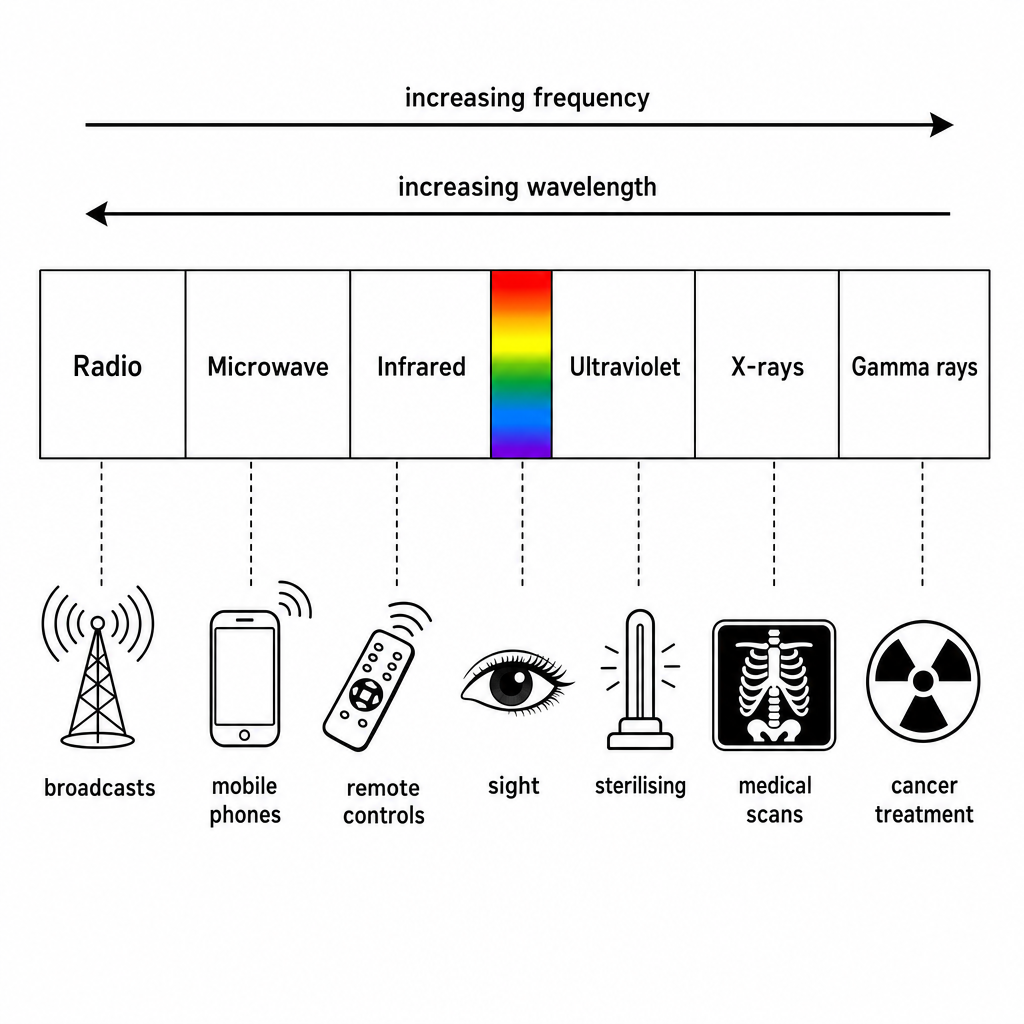
Key idea🔑 Key idea: Order by rising frequency: Radio · Micro · Infrared · Visible · UV · X-ray · Gamma. All travel at the same speed in a vacuum. Higher frequency = more dangerous.
Worked example
Worked Example: Match the Use to the EM Region
Worked Example: Mobile, X-Ray or Microwave? 📱
Name the EM region used for (a) checking a broken bone, (b) a TV remote control, (c) communicating with a satellite, (d) sterilising surgical equipment.
- 1(a) X-rays pass through soft tissue but not bone, so they image the skeleton. (b) Infrared carries the short-range signal from a remote to the TV.
- 2(c) Microwaves pass easily through the atmosphere to satellites and need only a short aerial. (d) Gamma rays carry enough energy to kill bacteria, so they sterilise medical equipment.
- 3Sense-check: the order of energy is radio < micro < IR < visible < UV < X-ray < gamma, so the "kill bacteria" and "see through flesh" jobs land at the high-energy end. ✅
---
8. Sound: Longitudinal, Loudness, Pitch and Echo
Sound is made by a vibrating source (a speaker cone, a guitar string, your vocal cords) and travels as a longitudinal wave through a medium — solid, liquid or gas. It cannot travel through a vacuum, which is why space is silent. Humans hear roughly Hz to Hz; sound above Hz ( kHz) is ultrasound. In air, sound travels at about to m/s. Amplitude sets loudness (bigger amplitude = louder); frequency sets pitch (higher frequency = higher pitch). An echo is simply sound reflected off a hard surface, and timing an echo lets you measure the speed of sound.
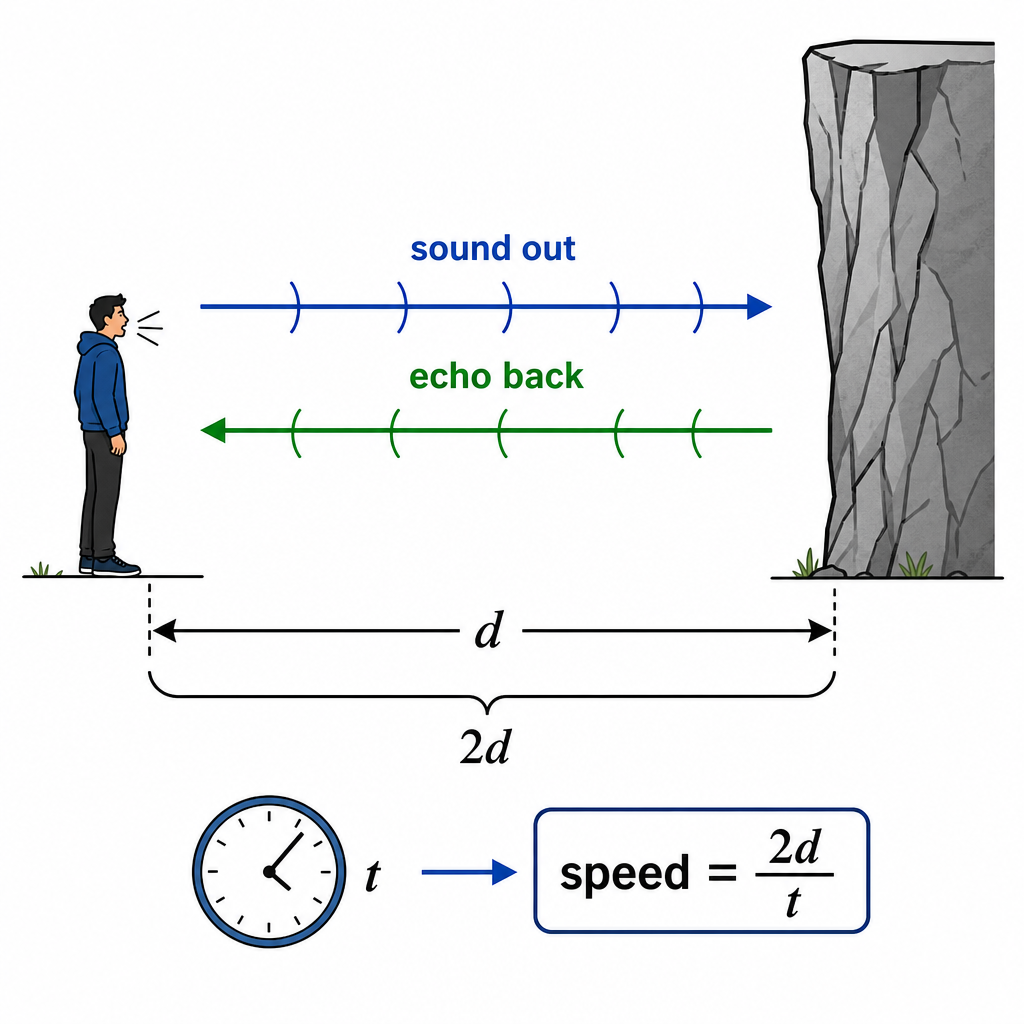
Key idea🔑 Key idea: Sound is longitudinal and needs a medium. Amplitude → loudness; frequency → pitch. Echo = reflected sound; ultrasound is above kHz.
Worked example
Worked Example: Speed of Sound from an Echo
Worked Example: Clap, Time, Calculate 👏
You stand m from a large cliff, clap once, and hear the echo s later. Calculate the speed of sound in air.
- 1The sound travels to the cliff and back, so the total distance is twice the gap.
- 2Use speed = distance ÷ time.
- 3Check: m/s sits right inside the expected – m/s for air. ✅ The catch students miss is forgetting the round trip — using m instead of m halves the answer.
---
Practice this in the app
Unlock the full chapter: practice questions, flashcards, mock papers and notes, free.
Continue revising