Nuclear Physics: Atoms, Radiation and Half-life
Nuclear Navigator: Split the Atom 💥
Introduction
1. Introduction
Smoke detector on your ceiling, a carbon-dated fossil in a museum, a hospital scan that lights up your insides: all of it is nuclear physics quietly at work. This is your five-minute refresh on what's inside an atom, the three types of radiation, balancing decay equations, half-life, and staying safe. Every idea below is one mark-earning sentence away from the exam. Let's split the atom! 💥
2. Inside the Atom: A Tiny Dense Nucleus
An atom is a tiny dense nucleus of protons (charge ) and neutrons (charge ), surrounded by electrons (charge ) orbiting far outside. Almost all the mass sits in the nucleus; almost all the volume is empty space. A neutral atom has equal protons and electrons, so the charges cancel; knock an electron off and you get a positive ion. The evidence is the alpha-scattering experiment: fire alpha particles at thin gold foil and most go straight through (empty space), a few deflect (a concentrated positive charge), and a very few bounce back (that charge is tiny but dense and heavy). That's the nuclear model.
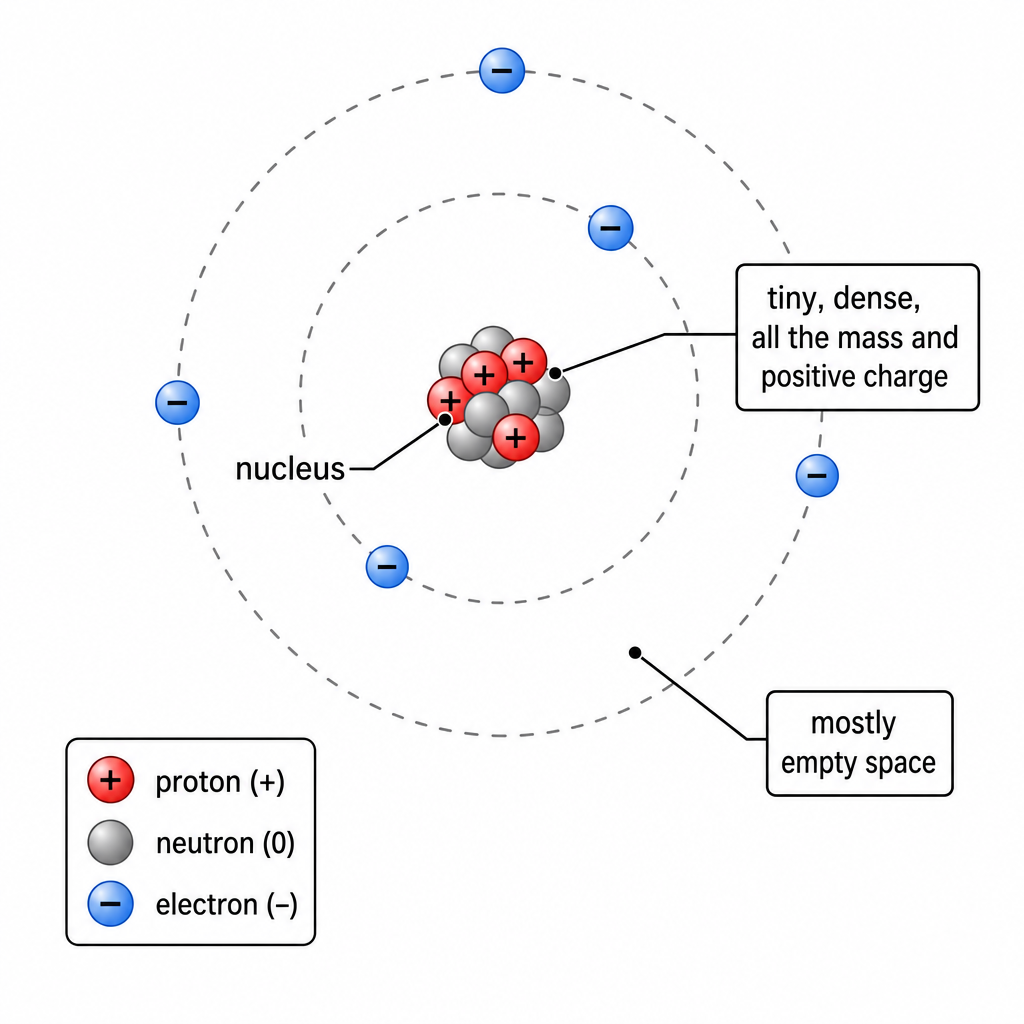
Key idea🔑 Key idea: Atom = tiny dense positive nucleus (protons + neutrons) + orbiting electrons, mostly empty space. Scattering proves it.
Worked example
Worked Example: What Scattering Tells Us
Worked Example: Why a Few Bounce Back 🎯
In the alpha-scattering experiment, why do a tiny number of alpha particles bounce almost straight back?
- 1They have hit something small (only a few come close enough), positive (it repels the positive alpha), and dense and heavy (it can reverse a fast alpha instead of being shoved aside). That something is the nucleus.
---
3. The Nucleus, Isotopes and Nuclide Notation
The nucleus holds protons and neutrons, together called nucleons. We label any nuclide as : the bottom number is the proton number (it fixes which element you have), the top number is the nucleon number (protons + neutrons). The number of neutrons is always . Isotopes are atoms of the same element (same ) with different numbers of neutrons (different ). They behave identically chemically because chemistry depends on electrons, and the electron count equals , which is the same for all isotopes; only the nuclear mass and stability differ.
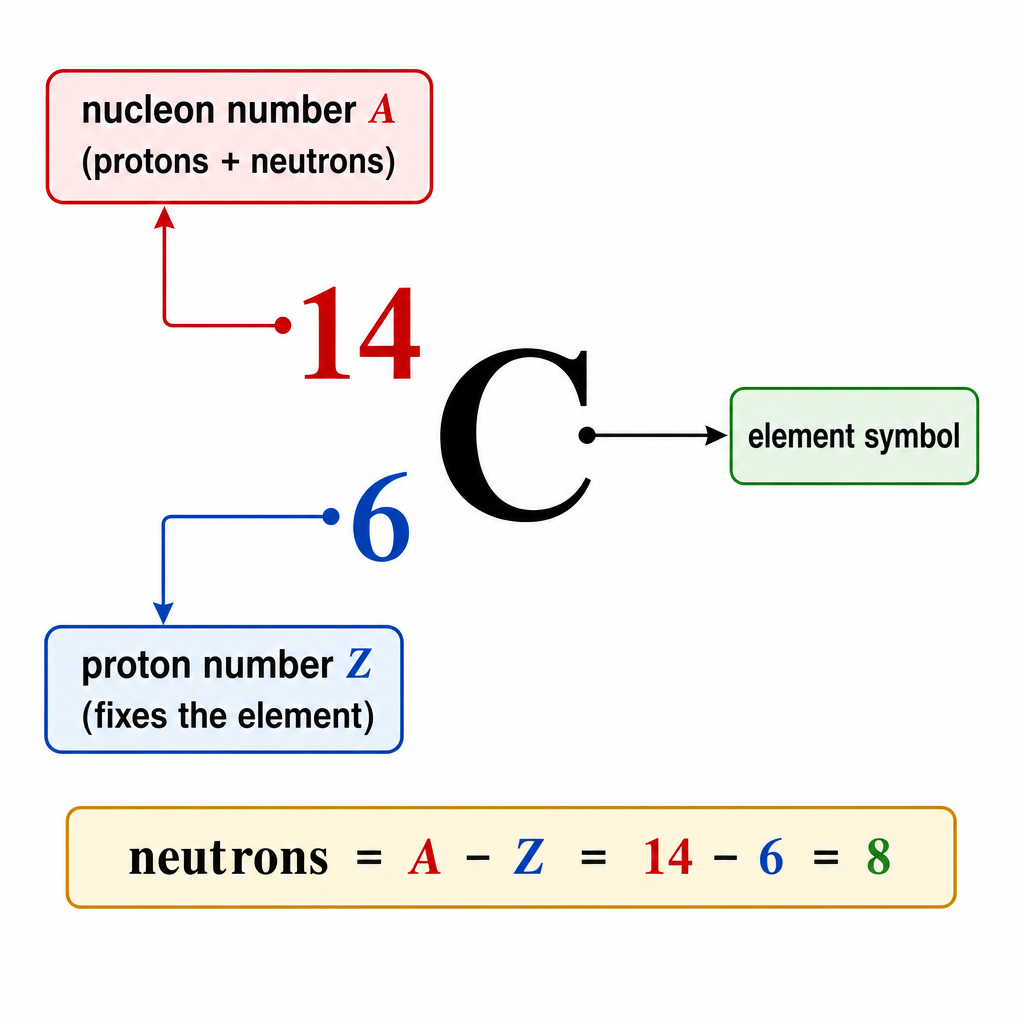
Key idea🔑 Key formula: → protons (bottom), neutrons . Same , different = isotopes.
Worked example
Worked Example: Reading a Nuclide
Worked Example: Counting the Particles 🧮
For , state the number of protons, neutrons, and electrons (neutral atom).
- 1Protons . Neutrons . Neutral atom, so electrons protons .
---
4. Detecting Radioactivity and Background
Some nuclei are unstable and emit radiation; we detect it with a Geiger–Müller tube and counter, which records a count rate. But the detector clicks even with no source nearby: that's background radiation, around us all the time. Most of it is natural (radon gas from rocks, the ground, cosmic rays, food and our own bodies), with a small human-made part (medical X-rays, fallout). So any source reading is really "source + background", and to get the source alone you must subtract the background: corrected count rate measured background. Always measure the background first, with the source removed.
Key idea🔑 Key idea: Corrected count rate = measured − background. Background is mostly natural and always present.
Worked example
Worked Example: Subtracting Background
Worked Example: The Honest Count 🔍
A detector reads counts/min with no source, then counts/min with a source present. What is the count rate due to the source alone?
- 1Subtract the background: counts/min from the source.
---
5. Alpha, Beta and Gamma: Know Your Radiation
Unstable nuclei emit three kinds of radiation. Alpha () is a helium nucleus (2 protons + 2 neutrons, charge ): the most ionising, the least penetrating (stopped by paper or skin). Beta () is a fast electron (charge ): medium ionising, stopped by a few mm of aluminium. Gamma () is a high-energy electromagnetic wave (no charge, no mass): the least ionising, the most penetrating (only reduced by thick lead or concrete). The pattern: more ionising means less penetrating. In electric or magnetic fields, alpha and beta bend in opposite directions (beta bends more, being far lighter); gamma carries no charge so it isn't deflected at all.
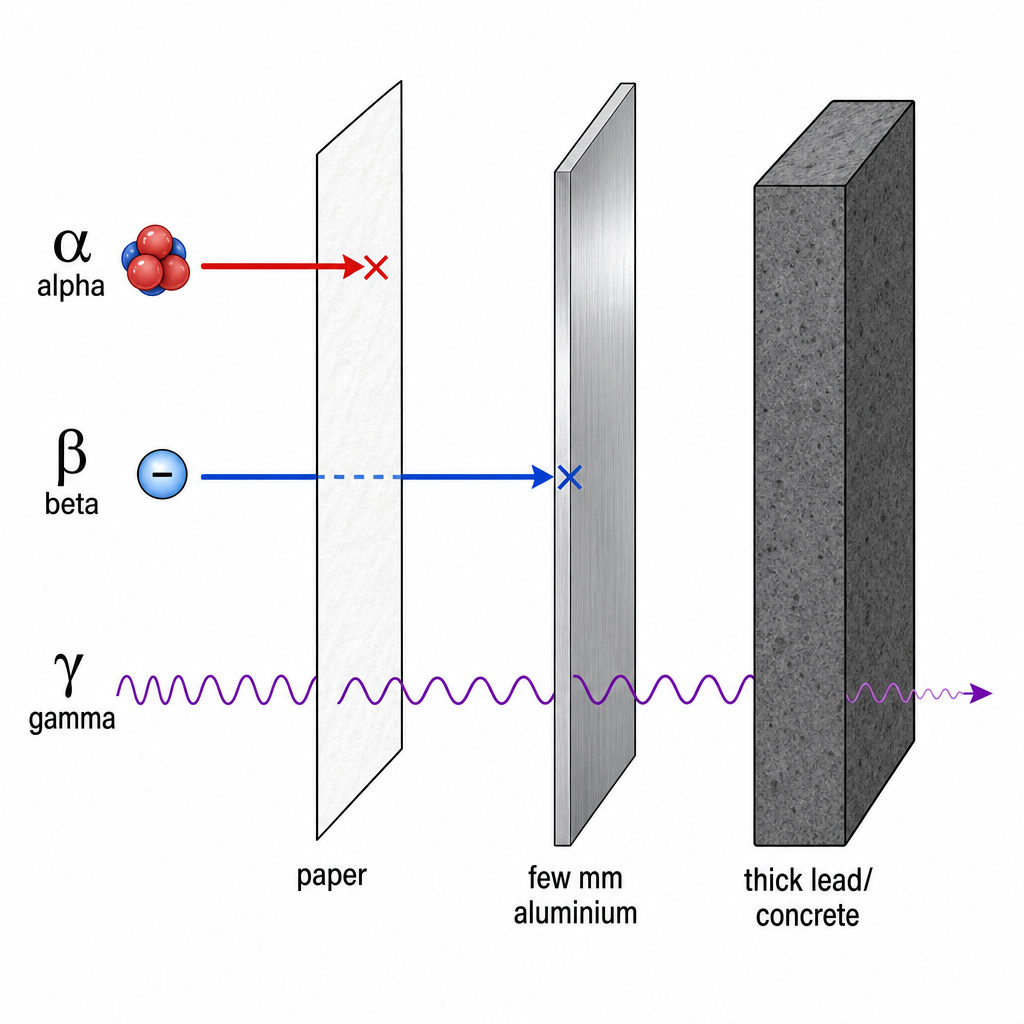
Key idea🔑 Key idea: α = He nucleus (most ionising, stopped by paper); β = fast electron (stopped by aluminium); γ = EM wave (stopped only by thick lead). More ionising → less penetrating.
Worked example
Worked Example: Identifying Radiation by Absorption
Worked Example: What Gets Through? 🧱
A source's corrected count rate is unchanged by paper, drops sharply when a few mm of aluminium is added, and the rest only fades behind thick lead. Which radiations are present?
- 1Paper makes no difference → no alpha (paper would stop alpha). So beta and/or gamma.
- 2Aluminium cuts the count → beta is present (a few mm of aluminium stops beta).
- 3Radiation still gets through the aluminium and only thick lead reduces it → gamma is present too (only gamma penetrates aluminium and needs lead).
- 4Conclusion: the source emits beta and gamma, no alpha. The trick is always to add absorbers in order (paper → aluminium → lead) and watch where the count drops.
---
6. Radioactive Decay Equations
Radioactive decay is spontaneous (happens on its own) and random (you can't predict which nucleus goes next), and nothing you do to the source — heating, cooling, crushing, chemistry — changes it. When a nucleus decays it usually becomes a different element. Track it with a nuclide equation, and obey the golden rule: the top numbers (nucleon numbers) balance on both sides, and the bottom numbers (proton numbers) balance too. Alpha decay throws out , so falls by and falls by . Beta decay turns a neutron into a proton and ejects , so stays the same and rises by .
Key idea🔑 Key formula: Alpha: ^{A}_{Z}\text{X} \rightarrow\, ^{A-4}_{Z-2}\text{Y} +\, ^{4}_{2}\alpha. Beta: ^{A}_{Z}\text{X} \rightarrow\, ^{\;\;A}_{Z+1}\text{Y} +\, ^{\,0}_{-1}\beta. Balance both rows.
Worked example
Worked Example: Completing α and β Decays
Worked Example: Fill in the Daughter ⚛️
(a) Radium-226, , decays by alpha emission. (b) Carbon-14, , decays by beta emission. Write both equations.
- 1Alpha decay: falls by → ; falls by → (radon):
Check: ✓ and ✓.^{226}_{\;88}\text{Ra} \rightarrow\, ^{222}_{\;86}\text{Rn} +\, ^{4}_{2}\alpha. - 2Beta decay: stays ; rises by → (nitrogen):
Check: ✓ and ✓. The beta's bottom number must be so charge balances.
---^{14}_{\;6}\text{C} \rightarrow\, ^{14}_{\;7}\text{N} +\, ^{\,0}_{-1}\beta.
Answer
^{14}_{\;6}\text{C} \rightarrow\, ^{14}_{\;7}\text{N} +\, ^{\,0}_{-1}\beta.
7. Half-life: The Steady Halving
Because decay is random, you can't time a single nucleus, but across billions the same fraction decays in equal times. The half-life is the time for half the unstable nuclei (or for the activity/count rate) to decay. After half-life, half is left; after , a quarter; after , an eighth: the fraction remaining after half-lives is . The amount keeps halving but never reaches zero. Half-life is fixed by the isotope alone, unaffected by temperature, pressure, chemistry, or how much you have.
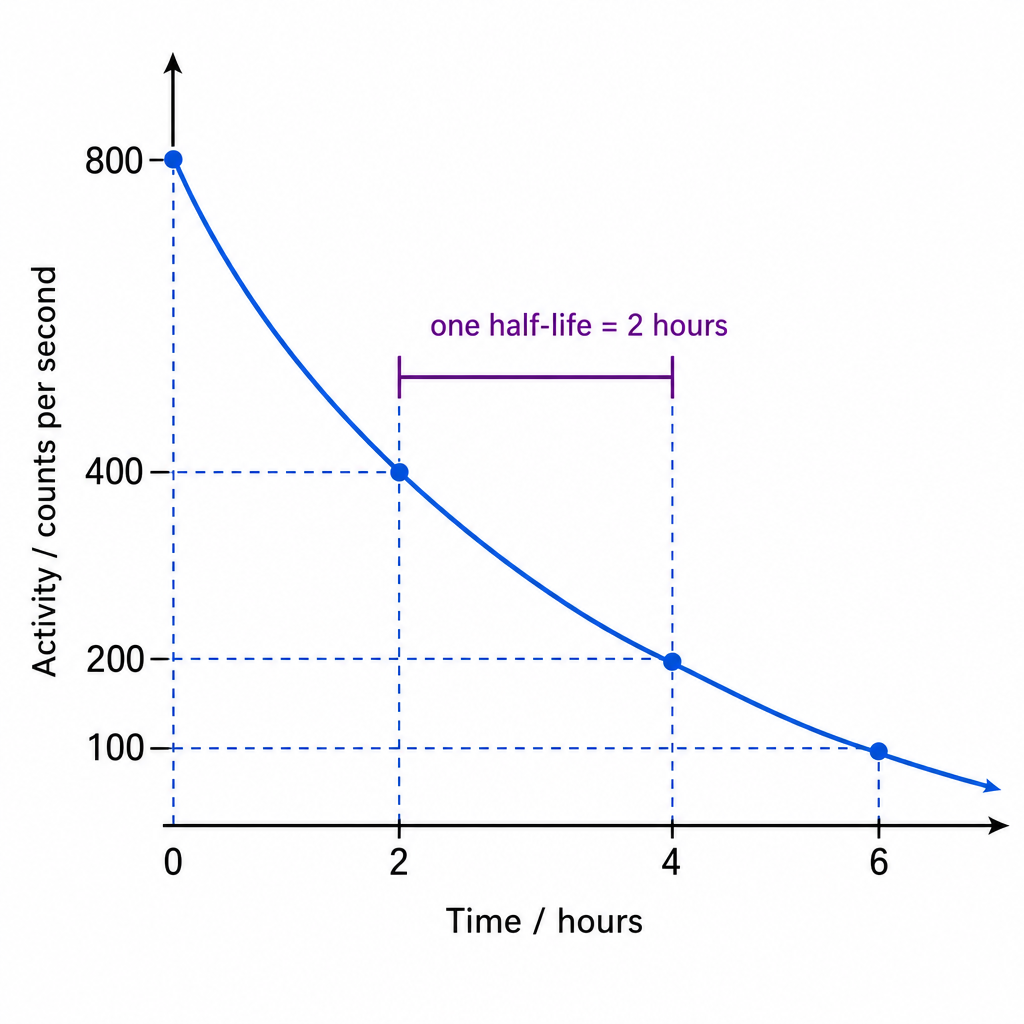
Key idea🔑 Key formula: Fraction left after half-lives . Count the halvings; half-life is fixed by the isotope and never reaches zero.
Worked example
Worked Example: Fraction Remaining After N Half-lives
Worked Example: Keep Halving ✂️
An isotope has a half-life of years. A sample starts with g. How much remains after years?
- 1Number of half-lives: .
- 2Halve the mass three times: g. (Same as .)
- 3g remains after years. Check: three halvings leave an eighth, and g ✓. For a decay-curve version, count the halvings between the start and end activities to get , then half-life .
---
8. Radiation Safety and Uses
Ionising radiation knocks electrons off atoms in living cells, which can kill cells or damage DNA and cause mutations or cancer. Keep your dose low in three ways: reduce the time near the source, increase the distance (handle with tongs, never bare hands), and use shielding (lead or thick concrete). Also: store sources in lead-lined boxes, never point one at people, and wear a film badge. Danger depends on where the source is: outside the body gamma is the bigger hazard (it penetrates deep, while paper-stopped alpha can't get past your skin), but inside the body alpha is by far the most dangerous because it's the most strongly ionising. Controlled, the same radiation is useful: medical tracers, sterilising equipment, treating cancer, smoke detectors, thickness gauging, and carbon dating.
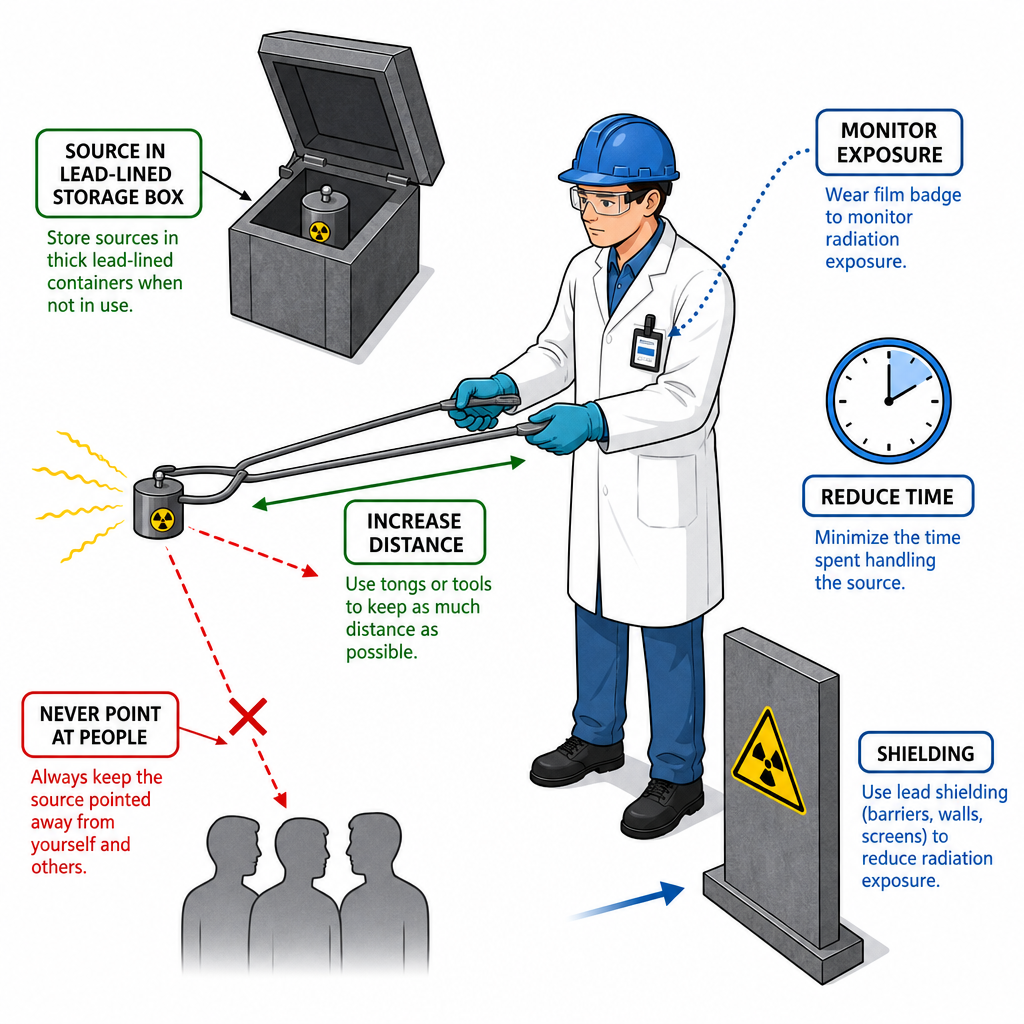
Key idea🔑 Key idea: Reduce dose with less time, more distance, more shielding. Outside the body gamma is worst; inside, alpha is worst.
Worked example
Worked Example: Handling a Source Safely
Worked Example: Three Precautions 🧤
State three precautions for moving a gamma source, and why each helps.
- 1Use tongs / keep your distance (radiation weakens rapidly with distance); work quickly (less time, less dose); keep it in / behind lead shielding (lead absorbs gamma). A film badge tracks your total exposure.
---
Practice this in the app
Unlock the full chapter: practice questions, flashcards, mock papers and notes, free.
Continue revising