"Thermal Physics: Heat, Temperature, and Change of State"
Thermal Tactician: Heat It Up 🔥
Introduction
1. Introduction
Phone toasty after a long gaming session, an ice cube vanishing in a hot drink, a sealed bottle denting itself in a cold car overnight: that's thermal physics in real time. This is your five-minute refresh on the particle model, gas pressure, heat capacity, change of state, and the three flavours of heat transfer. Every idea below is one mark-earning sentence away from the exam. Let's heat it up! 🔥
2. Particles in Constant Motion
Everything is made of tiny particles that never sit still, and the hotter the substance the faster they move. In a solid they vibrate around fixed positions held by strong forces. In a liquid the forces are weaker, so particles slide past each other but stay touching. In a gas they barely interact and fly around fast, filling any container. The temperature on a thermometer is basically how fast the particles move on average, and gas pressure is just countless particles colliding with the container walls.
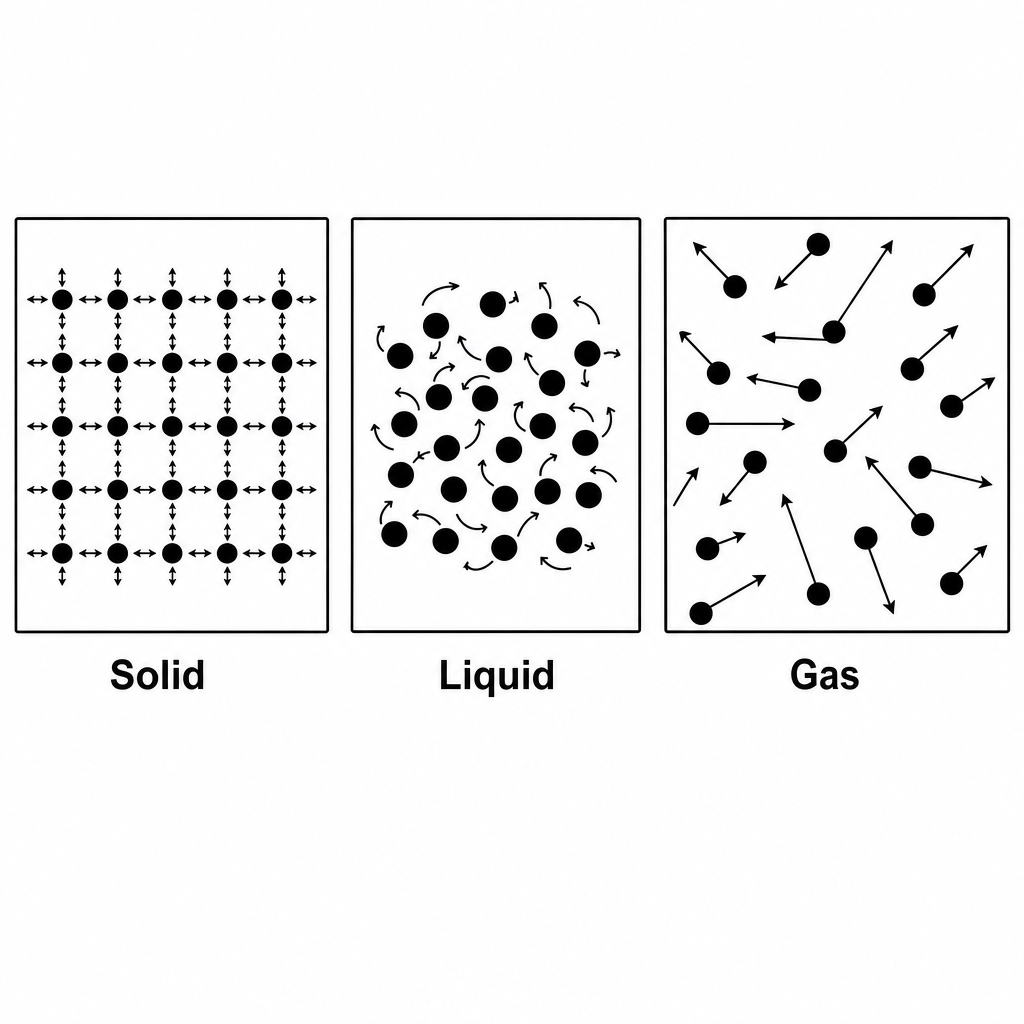
Key idea🔑 Key idea: Hot = fast particles, cold = slow particles. Gas pressure = particle collisions with the walls.
Worked example
Worked Example: Why Smoke Dances in a Beam of Light
Worked Example: Why Smoke Dances 🚬
Smoke particles in a lit glass cell, seen through a microscope, jiggle along random jerky paths. Explain what this shows.
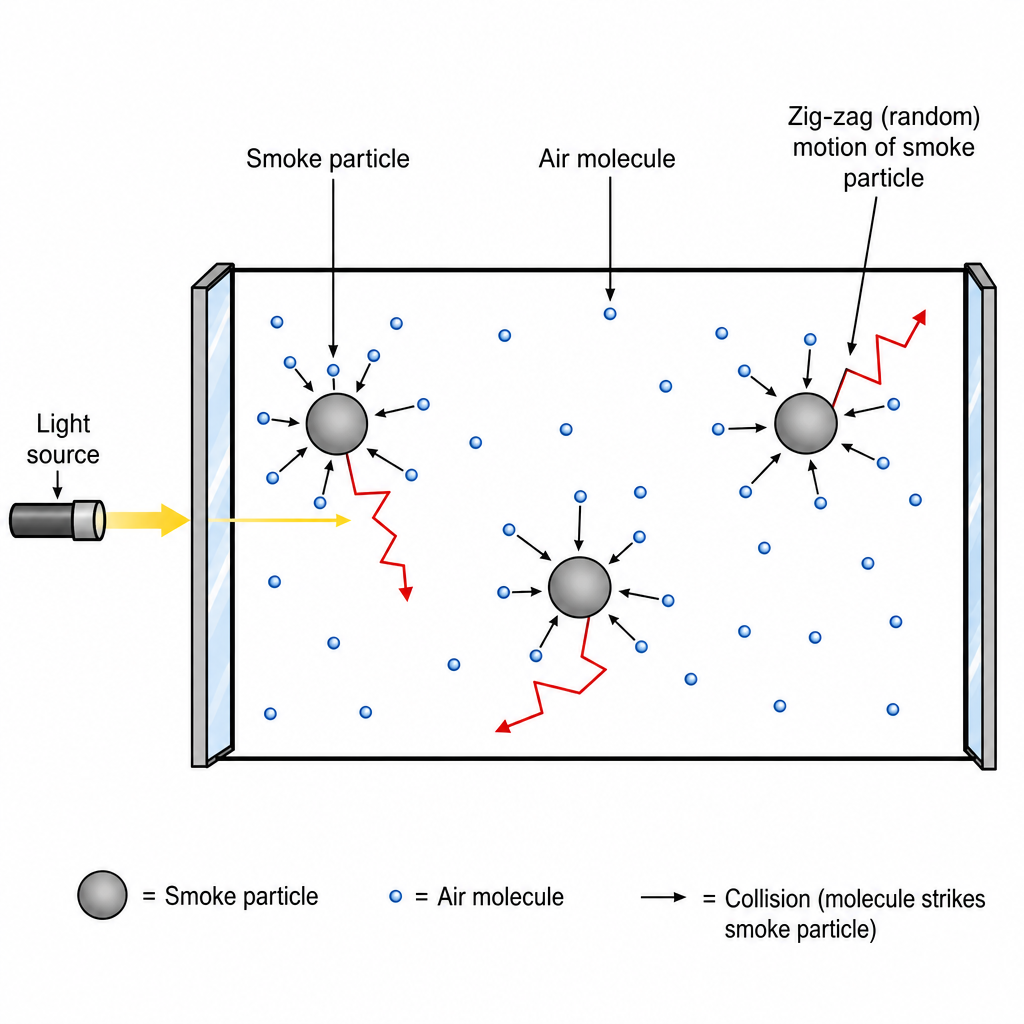
- 1The visible smoke particles are bombarded unevenly by fast-moving invisible air molecules, so they get nudged in random directions. This Brownian motion is direct evidence that air is made of tiny particles in constant random motion.
---
3. How Gas Pressure Changes with Temperature and Volume
A sealed gas has three linked knobs: temperature, volume, pressure. Squeeze it (smaller volume, same temperature) and particles hit the walls more often, so pressure rises. Heat it (higher temperature, same volume) and particles move faster, hitting more often and harder, so pressure rises again. Physicists measure temperature in Kelvin: convert with . Absolute zero is K °C, the coldest possible temperature, where particle motion is at its minimum. ❄️
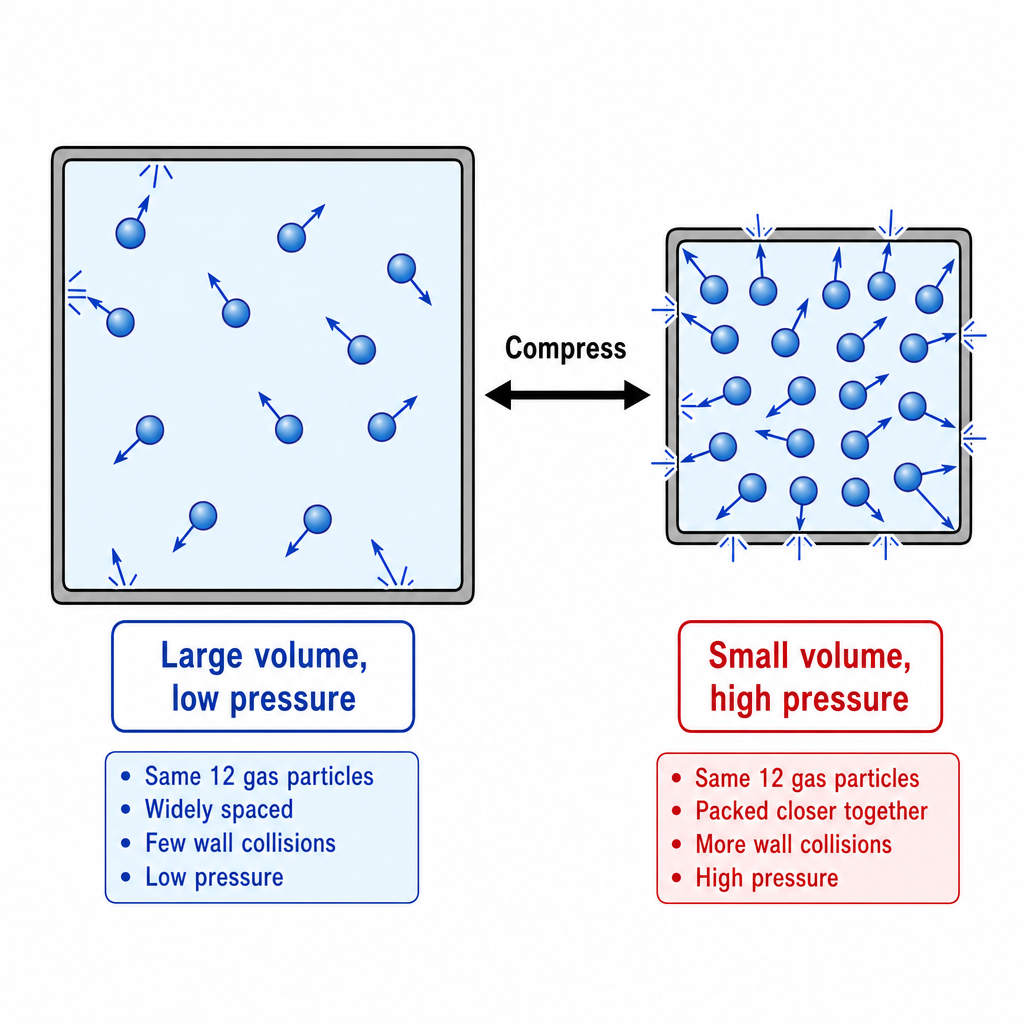
Key idea🔑 Key formula: . Squeeze or heat a sealed gas → more wall collisions → higher pressure.
Worked example
Worked Example: Bike Pump Pressure as You Push Harder
Worked Example: Pump It Up 🚲
With your thumb over a hand pump's outlet, you push the plunger until the trapped air takes up half its volume at constant temperature. What happens to the pressure, and why?
- 1Halving the volume confines the same particles to a smaller space, so each travels a shorter distance between wall collisions.
- 2Shorter trips mean more collisions per second on the same wall area, which means a larger force per unit area.
- 3Pressure therefore rises. Roughly, halving the volume at constant temperature doubles the pressure, which is exactly why the pump gets harder to push the further you compress it.
---
4. Thermal Expansion of Solids, Liquids and Gases
Heat a material and its particles vibrate more, taking up more room, so it expands. The exam-critical ranking is gases > liquids > solids for the same temperature change, and it falls straight out of the bonding: strong fixed bonds in solids, weaker mobile ones in liquids, almost none in gases. That's why bridges have expansion gaps, why power cables are hung with winter slack so they don't snap in summer heat, and why liquid-in-glass thermometers work at all.
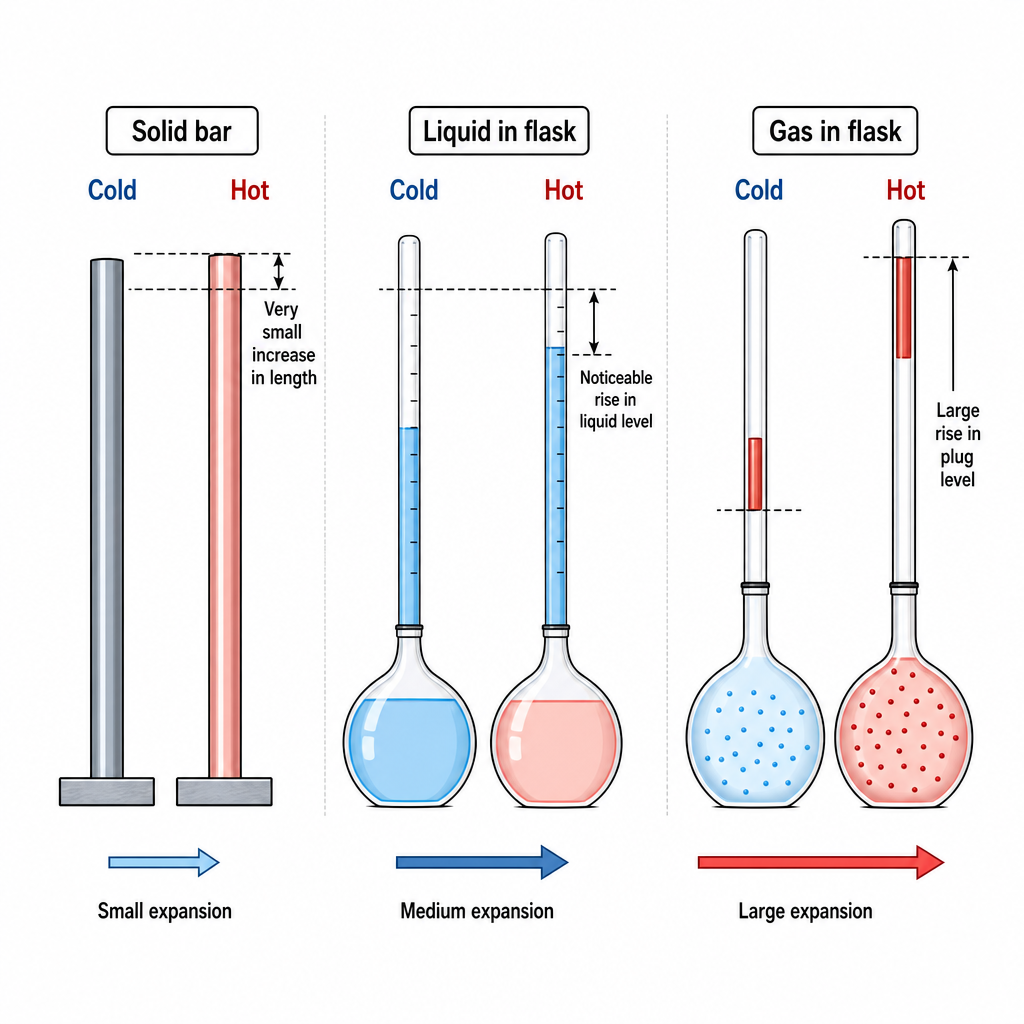
Key idea🔑 Key idea: Expansion ranking is gases > liquids > solids. Weaker bonds → bigger expansion.
Worked example
Worked Example: A Railway Track on a Hot Day
Worked Example: Hot Tracks, Missing Gaps 🚄
Old railway lines were laid as separate steel sections with small gaps. The gaps look wide in winter and almost vanish on a °C afternoon. Explain why the gaps exist and why they appear to shrink.
- 1Steel expands when heated, so each rail lengthens slightly in summer and closes its gap. The gap is left deliberately so the summer expansion has somewhere to go; with no gap the rails would buckle sideways and derail the train.
---
5. Internal Energy and the Temperature Rise
Supply energy to a substance and it goes into the kinetic store of the particles, so they speed up and the temperature rises. How much energy depends on the mass, the temperature change, and a material-specific number, the specific heat capacity :
with in kg, in °C (or K, same size), and in joules. Water's is huge, about J/(kg °C), which is why kettles take a minute to boil and why coastal cities have milder weather. Most metals sit at – J/(kg °C), so a metal pan handle heats almost instantly while the water inside takes its time. ☕
with in kg, in °C (or K, same size), and in joules. Water's is huge, about J/(kg °C), which is why kettles take a minute to boil and why coastal cities have milder weather. Most metals sit at – J/(kg °C), so a metal pan handle heats almost instantly while the water inside takes its time. ☕
Key idea🔑 Key formula: . Water J/(kg °C); metals –.
Worked example
Worked Example: Heating Water in a Kettle
Worked Example: Kettle Energy Math ☕
A kettle holds kg of water at °C. How much energy is needed to bring it to °C? Take J/(kg °C).
- 1Identify the values: kg, °C, J/(kg °C).
- 2Write the equation, then substitute.
- 3Multiply through.
That's only the energy to warm the water to °C. Boiling it away takes far more, because of latent heat.
---
Answer
6. Melting, Boiling and Evaporation
When ice melts at °C or water boils at °C, the temperature stays flat while energy pours in, because that energy breaks bonds between molecules instead of speeding them up. This hidden energy is latent heat. Evaporation is different from boiling: it happens only at the surface and at any temperature, as the fastest surface molecules escape and leave the rest cooler. That's why sweat cools you. Evaporation speeds up with higher temperature, larger surface area, lower humidity, or moving air.
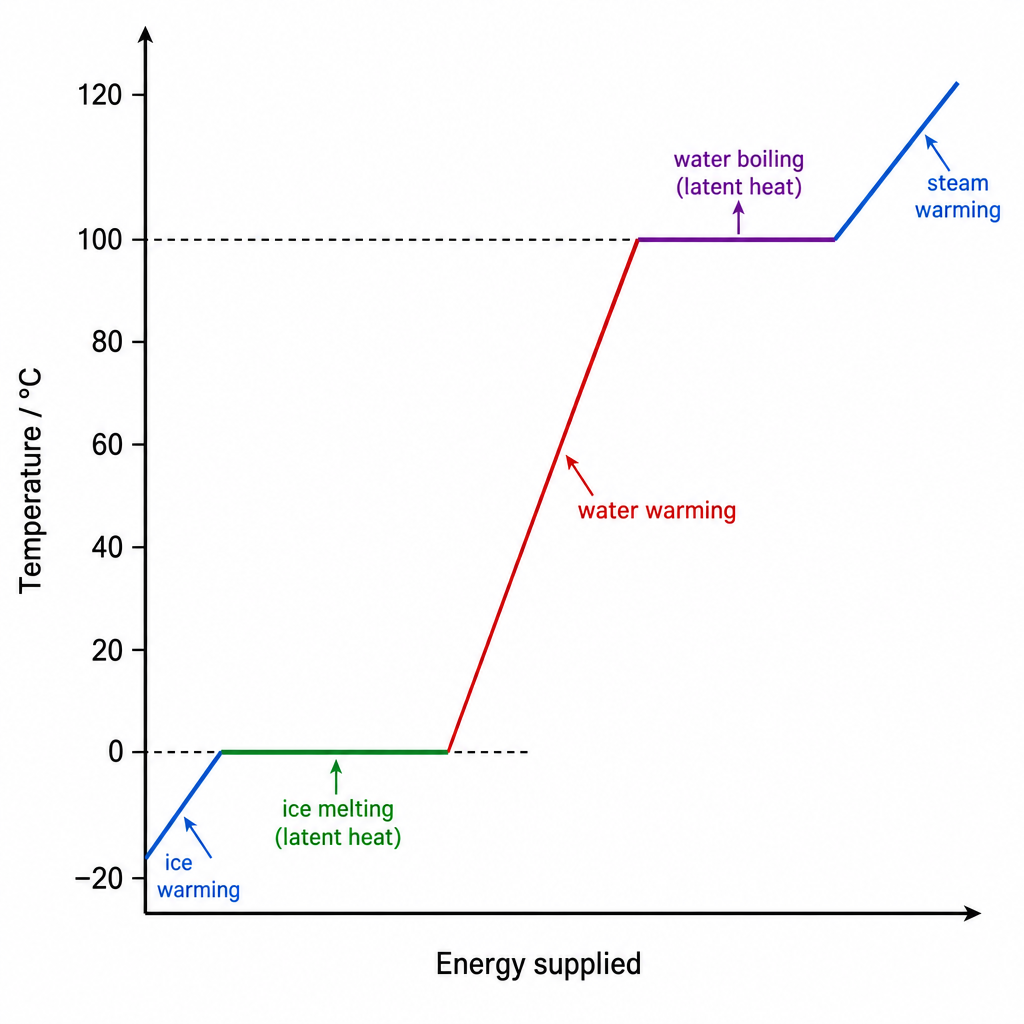
Key idea🔑 Key idea: Latent heat = flat temperature while bonds break. Evaporation cools because the fastest molecules leave.
Worked example
Worked Example: Sweat-Cooling After a Workout
Worked Example: Why Sweat Works 💦
After a hard workout your sweaty skin feels cooler even in still, warm air. Explain why in terms of particles.
- 1Only the fastest water molecules on your skin escape as vapour, leaving slower (cooler) molecules behind, so the average energy and the temperature of the remaining sweat drop and heat flows out of your skin. A fan speeds this up by sweeping the vapour away so more fast molecules can escape.
---
7. Conduction in Metals and Insulators
Conduction is heat moving through a solid without the material itself flowing. Metals (copper, aluminium, steel) are good conductors: a metal pan handle gets dangerously hot in seconds. Non-metals and gases (wood, plastic, air, glass) are poor conductors, called insulators: a wooden spoon stays cool in boiling soup. The classic test fixes a wax-held pin to the cool end of rods of different materials and heats the hot ends equally; the pin on the copper rod drops first, glass much later, wood maybe never. 📍
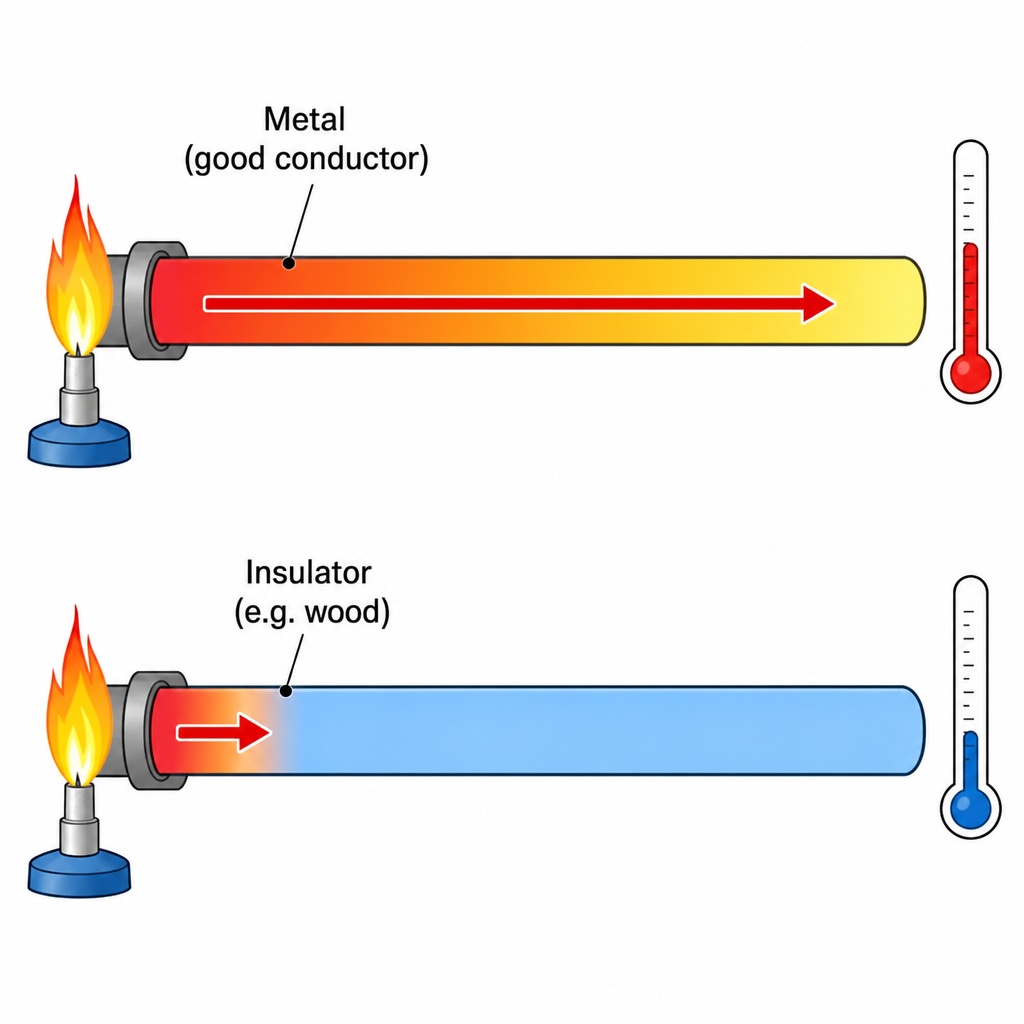
Key idea🔑 Key idea: Metals conduct heat well; non-metals and gases are poor conductors (insulators).
Worked example
Worked Example: Rod Experiment with Wax-Held Pins
Worked Example: Pins Drop When the Wax Melts 📍
Copper, glass, and wood rods are heated at one end, each with a pin stuck to its cool end by candle wax. Predict the order in which the pins fall.
- 1A pin falls when conducted heat melts its wax. Copper conducts fastest so its pin falls first, then glass, then wood (which may not fall at all): copper → glass → wood. Metals conduct far better than non-metals.
---
8. Convection in Liquids and Gases
Convection happens in fluids (liquids and gases). Heat a fluid from below and the warmed part expands, becomes less dense than the cooler fluid above, and floats upward; cooler fluid sinks to replace it, gets heated, and rises in turn. That continuous loop is a convection current, and it's why a radiator warms a whole room, why hot-air balloons rise, and why the air near a ceiling is warmer than the air at the floor. It cannot happen in solids, where particles are locked in place.
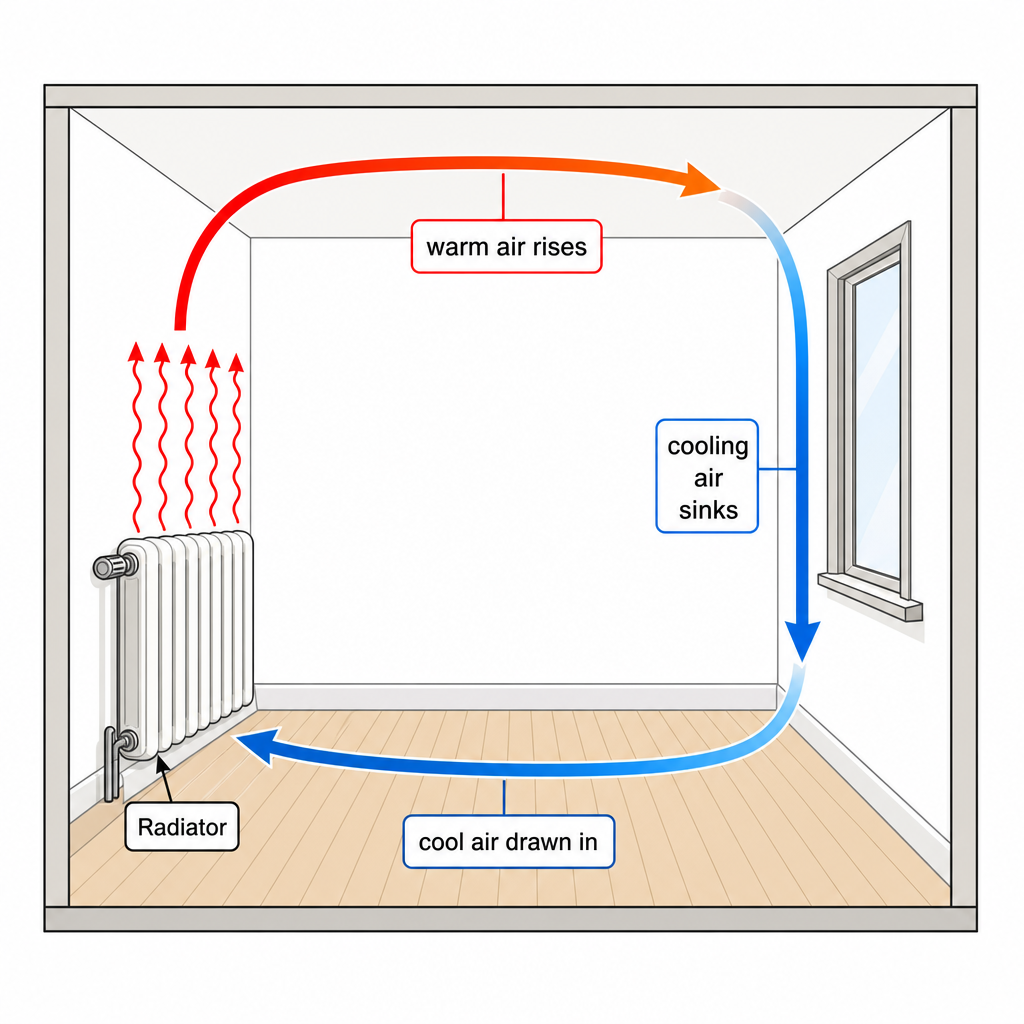
Key idea🔑 Key idea: Warm fluid is less dense and rises; cooler fluid sinks. Only in fluids, never in solids.
Worked example
Worked Example: Why a Radiator Heats the Whole Room
Worked Example: One Hot Box, Whole Room Warm 🛋️
A radiator near the floor of one wall warms the whole room, even the far corners. Explain how convection moves the heat around.
- 1Air by the radiator warms, becomes less dense, and rises to the ceiling; it spreads across, cools, becomes denser, and sinks down the far wall; cool floor-level air is drawn back to the radiator. This circulating loop carries heat to every corner.
---
9. Infrared Radiation and Surface Colour
Thermal radiation is heat travelling as infrared electromagnetic waves, and unlike conduction and convection it needs no material, which is how the Sun's energy crosses empty space. ☀️ Every object emits some, and hotter objects emit more. For the exam: matt black surfaces are the best absorbers and best emitters of infrared; shiny silver surfaces are the worst absorbers and worst emitters (great reflectors instead). That's why a black car bakes in the sun and why marathon runners get silver foil blankets that reflect their body heat back.
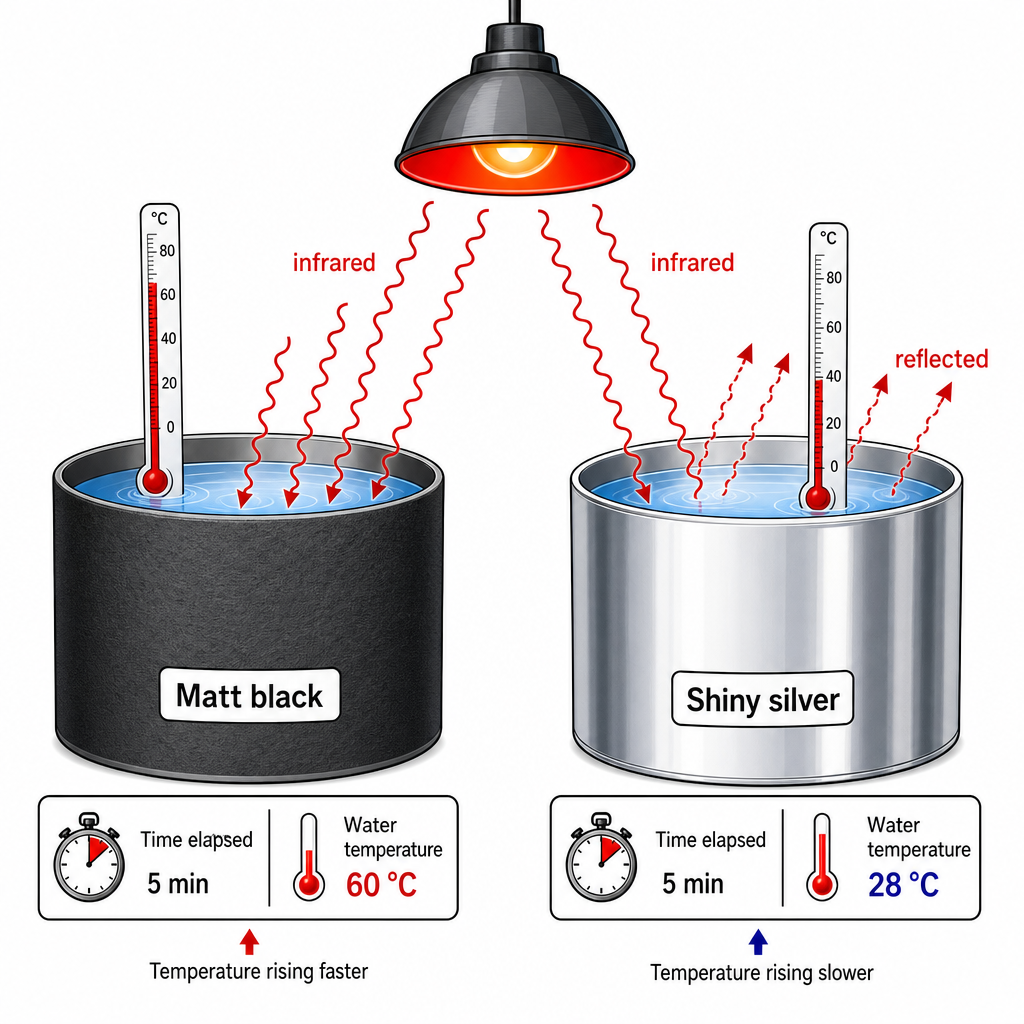
Key idea🔑 Key idea: Matt black = best absorber and emitter. Shiny silver = worst (best reflector). No medium needed.
Worked example
Worked Example: Black Can vs Silver Can in the Sun
Worked Example: The Can Showdown 🥫
Two identical cans of water, one matt black and one shiny silver, sit in direct sunlight for ten minutes. Which water is hotter, and why?
- 1Both receive the same infrared, but the matt black can absorbs almost all of it while the shiny silver can reflects most away. More energy enters the black can per second, so its water ends up hotter. (In reverse, this is why a flask is silvered inside: a poor emitter loses less heat.)
---
10. Everyday Applications: Kettles, Pans, Heating a Room
Most real heating and cooling problems use all three mechanisms at once, and good design either uses a mechanism to move heat or blocks it to keep heat in. The vacuum flask is the cleanest example: the vacuum kills conduction and convection across the gap (no particles), the silvered surfaces are poor emitters so infrared can't cross, and the stopper blocks convection through the top. Loft insulation and double glazing work the same way, trapping a poorly-conducting layer of air or gas.
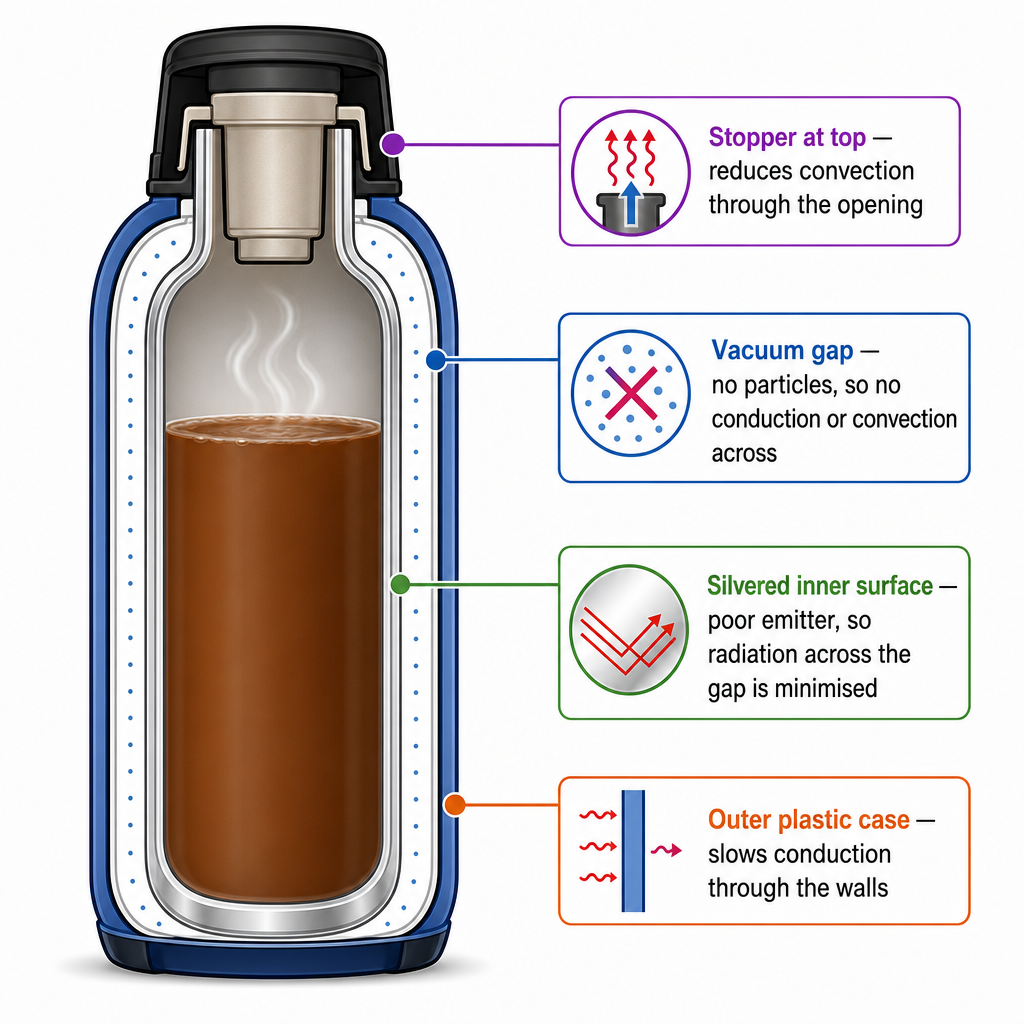
Key idea🔑 Key idea: Block conduction and convection with a vacuum or trapped air; block radiation with silvered surfaces.
Worked example
Worked Example: Why a Vacuum Flask Keeps Coffee Hot
Worked Example: The Anti-Heat Lunchbox 🥤
Hot coffee poured into a vacuum flask in the morning is still hot at lunch. Name the feature that limits each of the three heat-transfer mechanisms.
- 1Conduction. The vacuum between the walls has no particles to conduct across, and the outer plastic case is a poor conductor.
- 2Convection. The vacuum has no fluid to flow, and the tight stopper stops warm air leaving the top.
- 3Radiation. The silvered inner surface is a poor emitter, so the coffee radiates little, and what does leave is mostly reflected back. All three blocked at once means heat escapes very slowly.
---
Practice this in the app
Unlock the full chapter: practice questions, flashcards, mock papers and notes, free.
Continue revising