Motion, Forces and Energy: Speed, Forces, Work and Power
Motion Master: From Standstill to Top Speed 🏎️
Introduction
1. Introduction
Alright, let's talk motion, forces and energy. Every time you check your run pace on a fitness app, feel yourself pressed back into a seat when a car pulls away, or watch a phone slide off a tilted table, you're living this chapter in real time. This is your five-minute refresh on measuring stuff, speed and motion graphs, what a resultant force does, moments, energy, work, power, and pressure. Most marks here come down to one clean equation plus one clear sentence. Let's get moving! 🏎️
2. Measuring Length, Volume and Time
Physics starts with good measurements. Use a ruler for length, a measuring cylinder for liquid volume (read the bottom of the curved surface, the meniscus, at eye level), and a clock or stopwatch for time. The pro move for accuracy is measuring many and dividing: stack 100 sheets of paper and divide the height by 100 to get one sheet's thickness, or time 20 swings of a pendulum and divide by 20 to get one period. This shrinks the effect of your reaction-time and reading errors.
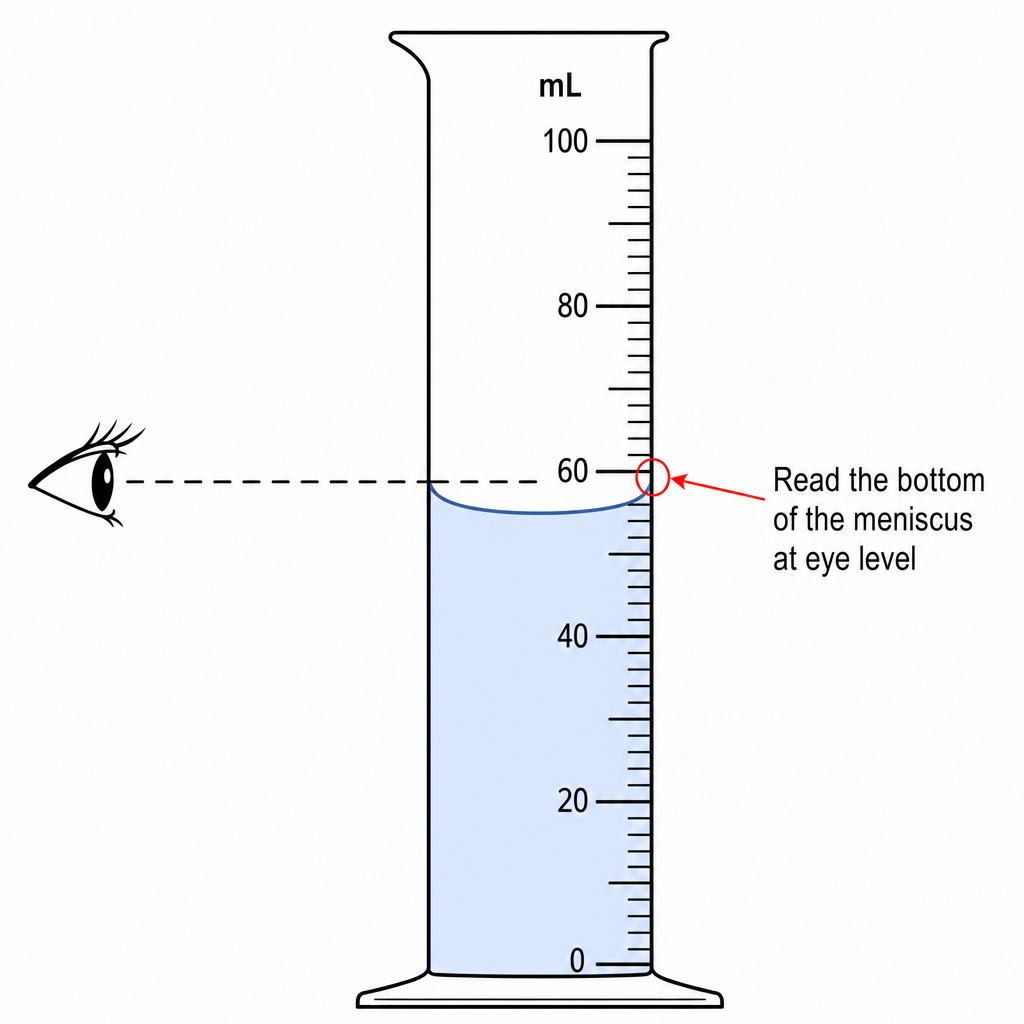
Key idea🔑 Key idea: Measure many and divide for thin or fast things (100 sheets, 20 swings). Read a meniscus at eye level.
Worked example
Worked Example: Thickness of One Sheet of Paper
Worked Example: The 500-Page Trick 📚
A stack of sheets of paper is mm tall. Find the thickness of one sheet, and explain why measuring the whole stack is more accurate than measuring one sheet.
- 1Divide the total height by the number of sheets: mm per sheet. Measuring one sheet directly would be swamped by the ruler's mm reading error; spreading that error over 500 sheets makes it tiny per sheet.
---
3. Speed, Velocity and Acceleration
Speed is how fast you cover ground: , in m/s. For a whole journey, average speed , stops included. Velocity is speed in a given direction. On a distance-time graph the gradient of a straight section is the speed: flat = at rest, steeper = faster. On a speed-time graph a flat line is constant speed, a line sloping up is accelerating and a line sloping down is decelerating, and the area underneath is the distance travelled. Read the axis label every time: flat means at rest on one graph and constant speed on the other. Near Earth, a freely falling object speeds up by about m/s every second: the acceleration of free fall, m/s², is roughly constant. 🪂
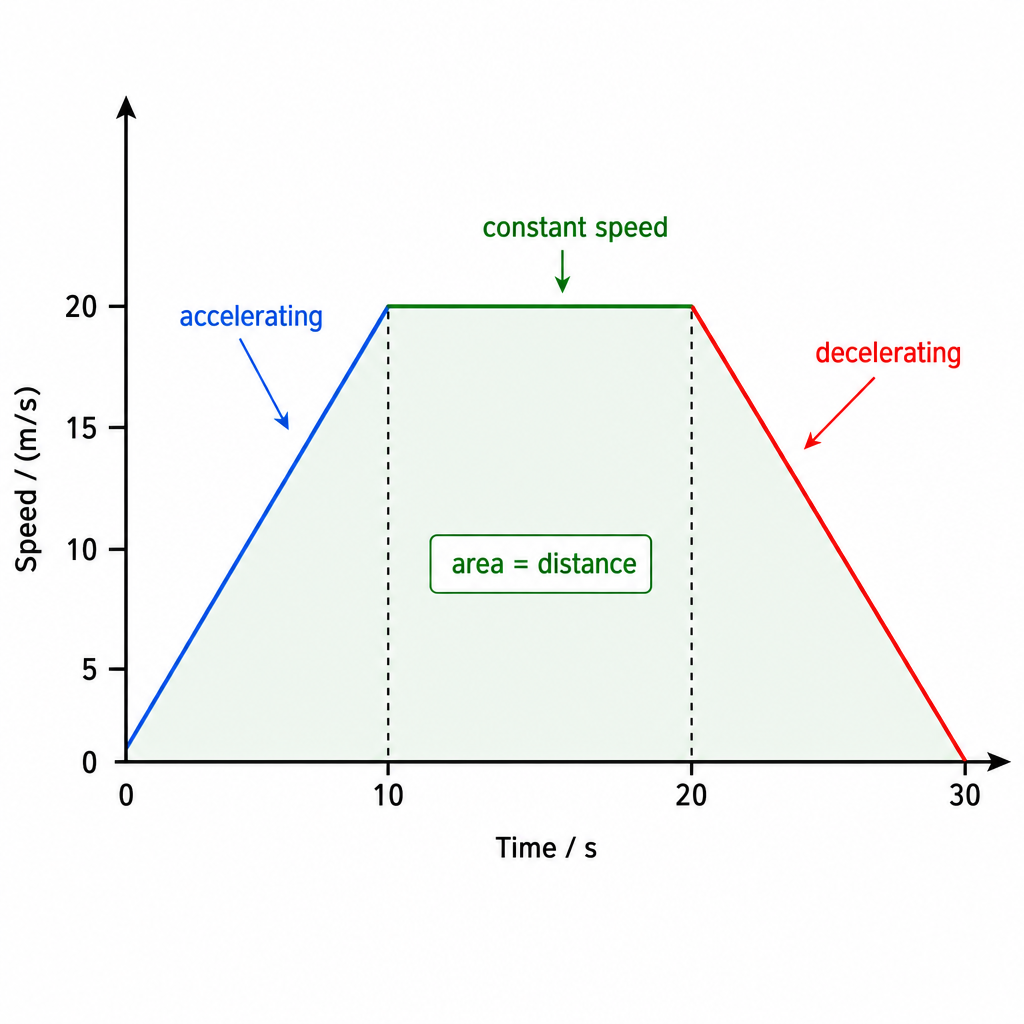
Key idea🔑 Key formula: ; average speed . Distance-time gradient = speed; area under a speed-time graph = distance.
Worked example
Worked Example: Reading a Speed–Time Graph
Worked Example: The Bus Journey 🚌
A bus speeds up steadily from rest to m/s in s, holds m/s for the next s, then brakes steadily to a stop over s. Describe the speed-time graph for each stage, then find the total distance and the average speed for the journey.
- 1Stage 1 is a straight line sloping up from the origin (accelerating). Stage 2 is flat at m/s (constant speed). Stage 3 is a straight line sloping down to zero (decelerating).
- 2Distance is the area under the graph. Triangle: m. Rectangle: m. Triangle: m. Total m.
- 3Average speed m/s. Check the units: for each area, and it is easy to forget the for a triangle.
---
4. Mass, Weight and Gravitational Field Strength
Mass is the amount of matter in something, measured in kilograms, and it's the same everywhere in the universe. Weight is the downward pull of gravity on that mass, a force in newtons: , where is the gravitational field strength, about N/kg on Earth. On the Moon is only about N/kg, so your weight is far less even though your mass hasn't budged. Rearranged, lets you find the field strength from a measured weight. It is the same thing as the acceleration of free fall: N/kg and m/s² are the same number.
Key idea🔑 Key formula: ( N/kg on Earth). Mass (kg) is fixed; weight (N) depends on .
Worked example
Worked Example: Weight on Earth
Worked Example: Stepping on the Scales ⚖️
A student has a mass of kg. Find their weight on Earth, where N/kg.
- 1Apply N. Mass stays kg anywhere; only the weight changes if changes (it would be about N on the Moon).
---
5. Density and Floating
Density is how much mass is packed into a volume: , in kg/m³ or g/cm³. Find a regular solid's volume from its dimensions; find an irregular solid's volume from the water it displaces in a measuring cylinder. The floating rule is simple: an object floats if it is less dense than the liquid, and sinks if it is more dense. Ice floats because it's slightly less dense than water; a steel nail sinks because steel is far denser. A steel ship floats because its hull shape gives it a low average density (lots of trapped air).
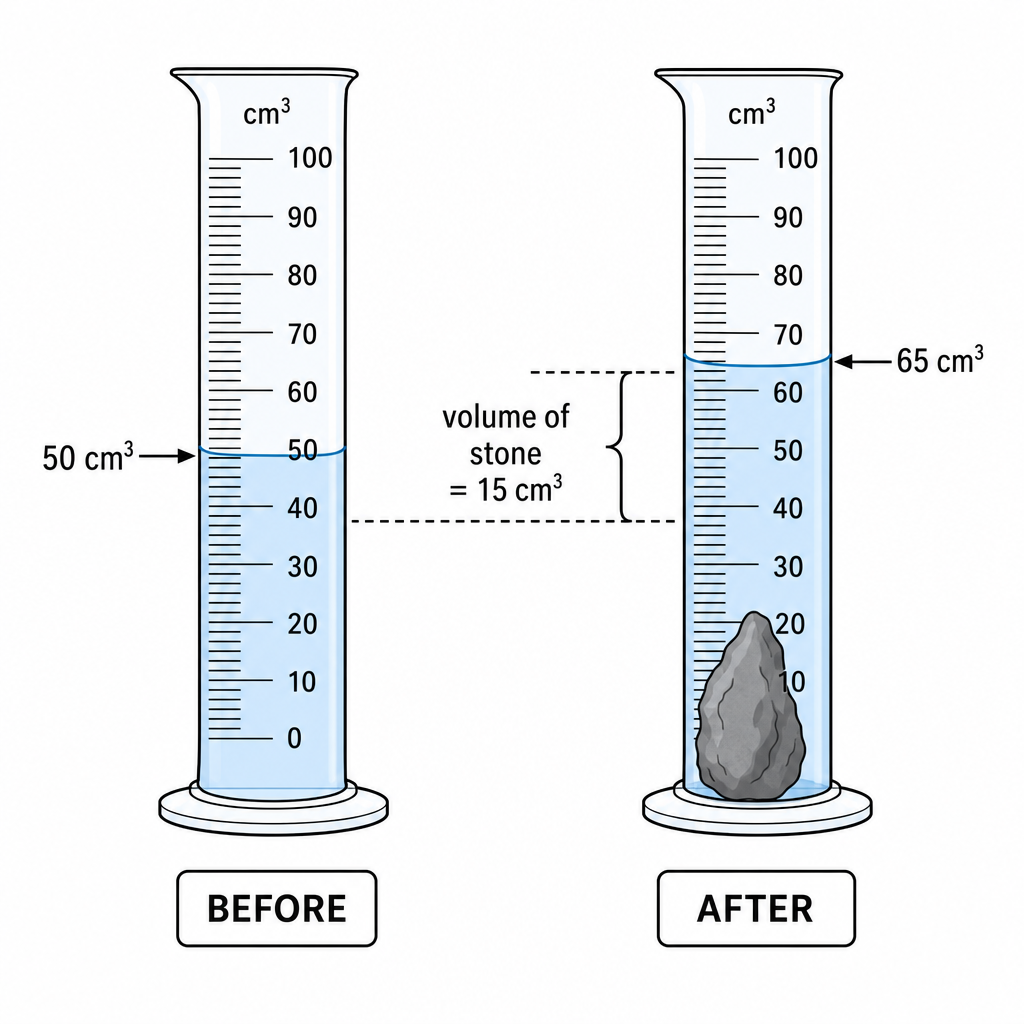
Key idea🔑 Key formula: . Floats if less dense than the liquid, sinks if more dense.
Worked example
Worked Example: Density of a Metal Block
Worked Example: Is It Really Gold? 🪙
A metal block has a mass of g and a volume of cm³. Find its density.
- 1Apply g/cm³. Comparing to known densities (gold is g/cm³) tells you straight away this block is not gold.
---
6. Forces, Resultant Force and Friction
A force (in newtons) can change an object's size or shape, its speed, or its direction. Stretch a spring and plot load against extension: the graph starts as a straight line through the origin, then starts to curve once the spring is loaded past a certain point. For forces along one line, add the forces one way and subtract the forces the other way to get the resultant. A zero resultant means an object at rest stays at rest and a moving object keeps going in a straight line at constant speed. A non-zero resultant changes the velocity: the object speeds up, slows down or changes direction. Solid friction between surfaces impedes motion and produces heating; drag acts on things moving through a liquid or a gas (in air it is called air resistance).
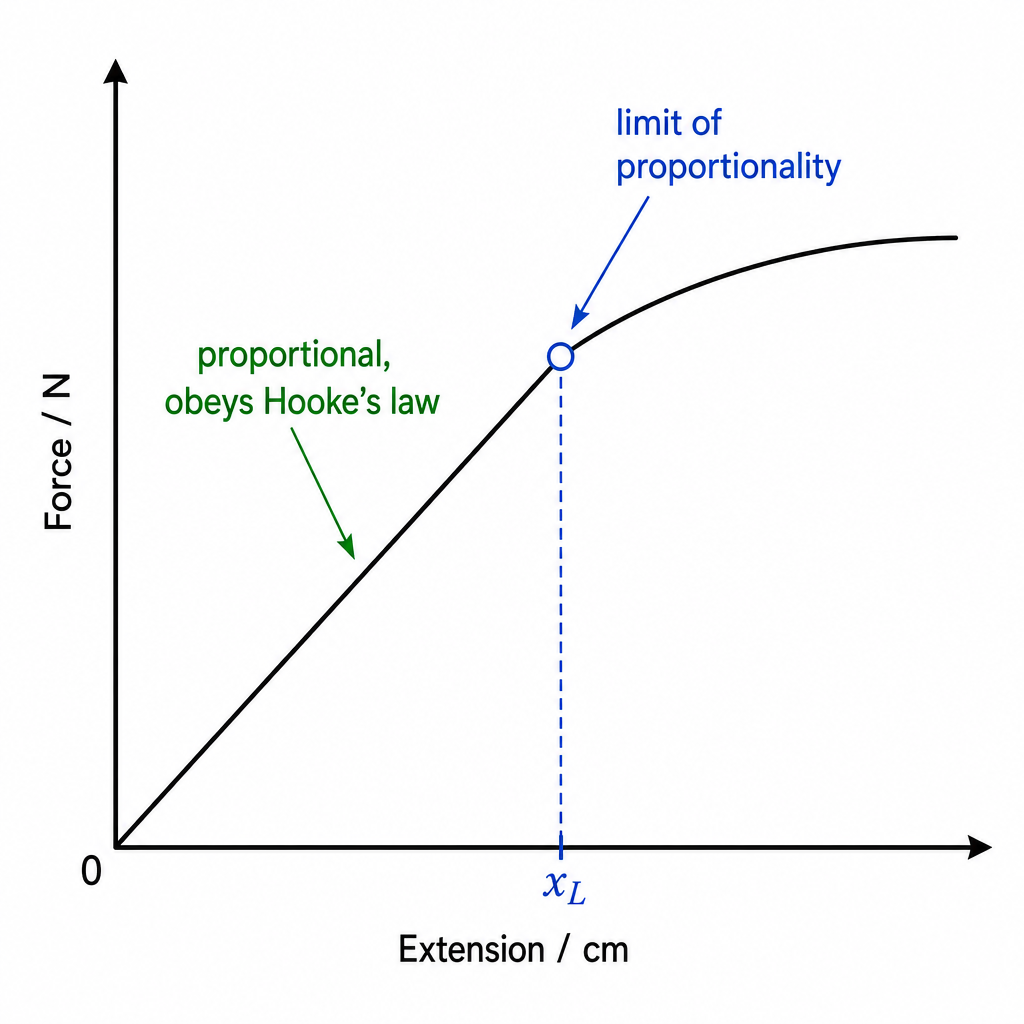
The picture shows that straight-then-curving graph. At Core, describe the bend as the point where the line stops being straight; the names printed on the graph are not needed.
Key idea🔑 Key idea: Resultant zero → at rest or constant speed in a straight line. Resultant not zero → speeds up, slows down or changes direction. Friction impedes motion and heats the surfaces.
Worked example
Worked Example: Forces on a Car
Worked Example: Pulling Away from the Lights 🚗
A car pulls away from traffic lights. The driving force is N forwards, and friction and air resistance add up to N backwards. (a) Find the resultant force. (b) Describe what happens to the car. (c) Later the backward forces have grown to N. Describe the motion now.
- 1The forces act along one line, so subtract: N forwards.
- 2There is a resultant force forwards, so the car speeds up.
- 3Now N. With no resultant force the car keeps moving in a straight line at a constant speed. It does not stop: a moving object needs no resultant force to keep moving.
---
7. Moments and Equilibrium
A moment is the turning effect of a force: , where is the perpendicular distance from the pivot, measured in N m. A long spanner gives a bigger moment for the same push because is larger. When something balances (is in equilibrium), the principle of moments applies: total clockwise moment = total anticlockwise moment about the pivot. That's how a see-saw balances and how you read a beam-balance question.
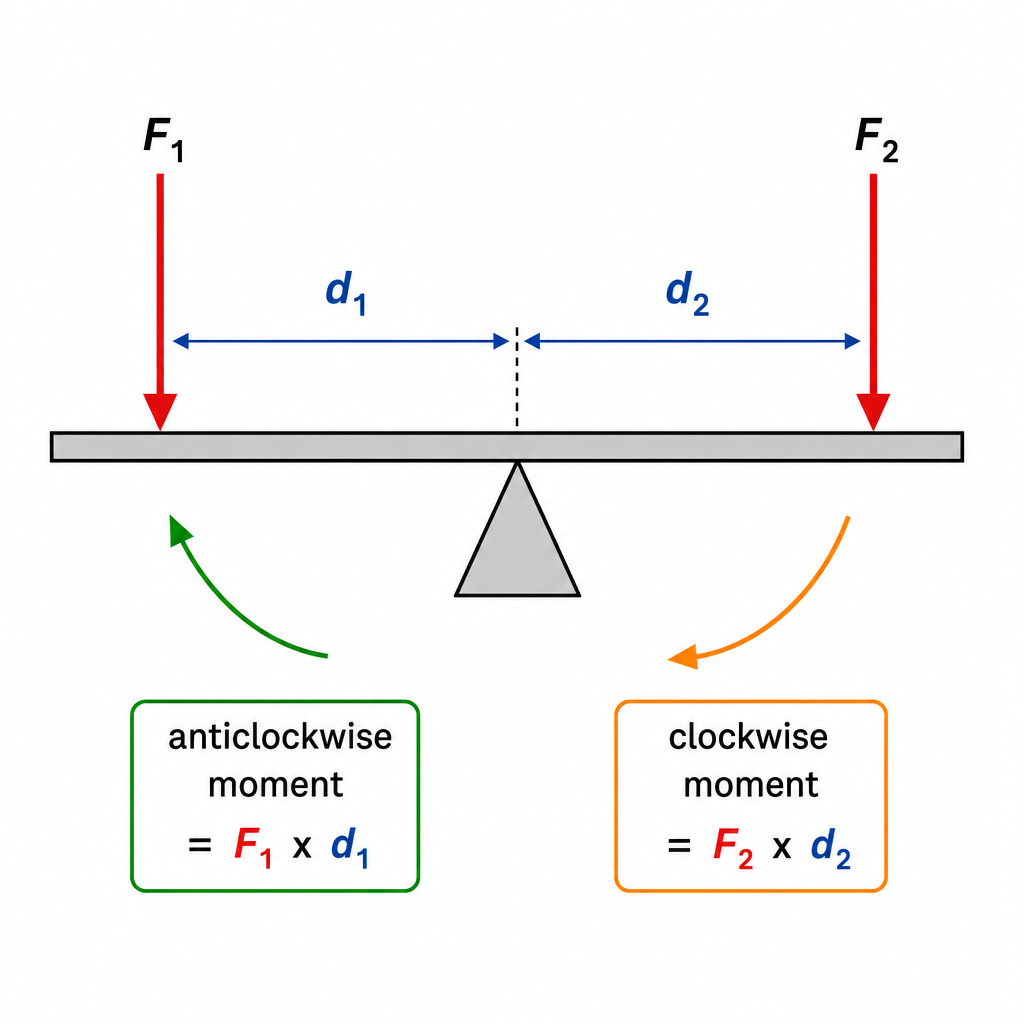
Key idea🔑 Key formula: Moment (perpendicular). Balanced: clockwise moments = anticlockwise moments.
Worked example
Worked Example: Balancing a See-Saw
Worked Example: Where Does the Kid Sit? 🛝
A N child sits m from the pivot of a see-saw. How far from the pivot must a N child sit on the other side to balance it?
- 1Apply the principle of moments (clockwise = anticlockwise): , so m. The heavier child sits closer, exactly as a real see-saw works.
---
8. Centre of Gravity and Stability
The centre of gravity is the single point where an object's whole weight seems to act. An object is stable and resists toppling when it has a low centre of gravity and a wide base. It topples once its centre of gravity passes outside the edge of its base, because the weight then produces a turning moment that tips it over. That's why racing cars are low and wide, why a tall bus is more likely to tip than a sports car, and why you widen your stance on a moving train.
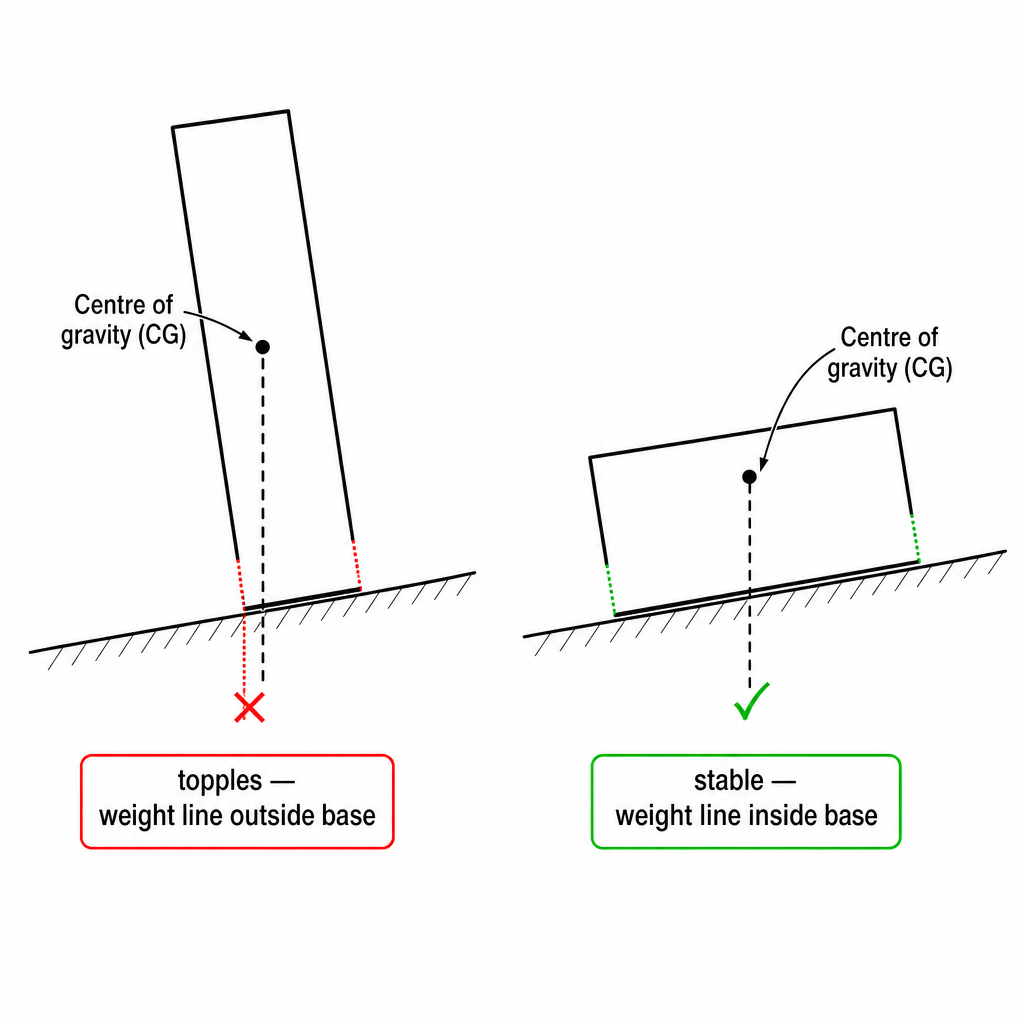
Key idea🔑 Key idea: Low centre of gravity + wide base = stable. Topples when the weight line falls outside the base.
Worked example
Worked Example: Which Box Tips First
Worked Example: Stack 'Em High 📦
Two boxes of equal weight stand on a ramp that is slowly tilted: one is tall and narrow, the other low and wide. Which topples first, and why?
- 1The tall narrow box topples first. Its higher centre of gravity and narrower base mean the vertical line through its centre of gravity passes outside the base at a smaller tilt angle, creating a toppling moment sooner.
---
9. Energy Stores and Conservation
Energy, in joules, sits in seven stores: kinetic (movement), gravitational potential (height), chemical (food, fuel, batteries), elastic (stretched or squashed things), nuclear, electrostatic (between charges) and internal (thermal). It moves between stores by forces (mechanical work), electrical currents, heating and waves. The big rule is conservation of energy: energy is never created or destroyed, only transferred from one store to another. When it seems to vanish (a ball bouncing lower each time), it has gone into the internal store of the surroundings, spread out and wasted. In a simple energy flow diagram, energy in = useful energy out + wasted energy out. A roller-coaster trades gravitational and kinetic energy back and forth all the way round. 🎢
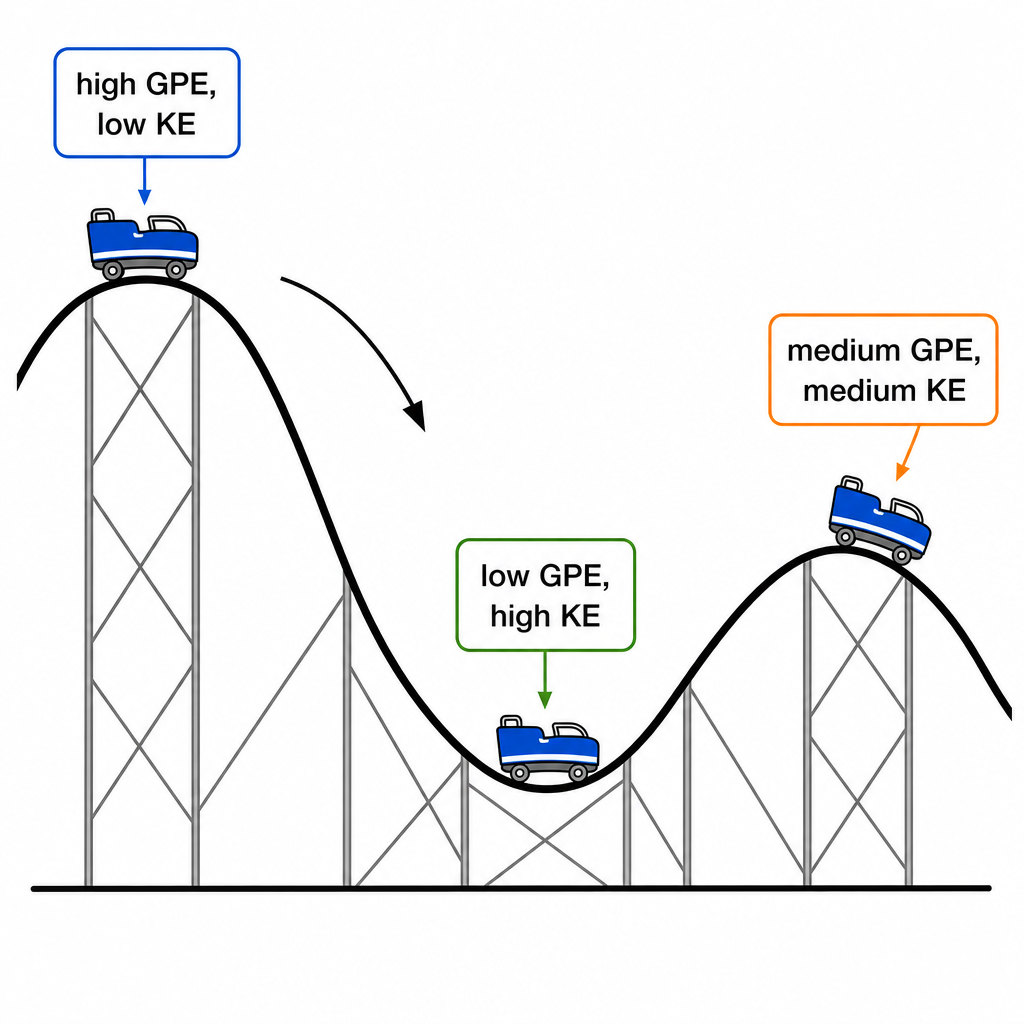
Key idea🔑 Key idea: Energy is transferred between stores, never destroyed. Energy in = useful out + wasted out.
Worked example
Worked Example: Completing a Flow Diagram
Worked Example: Where Did It All Go? ⚽
The motor of a toy crane takes in J of electrical energy. J ends up in the gravitational potential store of the load, J heats the motor, and the rest is given out as sound. (a) How much energy is given out as sound? (b) How much energy is wasted, and where does it end up?
- 1Energy is conserved, so the outputs add up to the input: sound J.
- 2Everything except the lift is wasted: J, which ends up in the internal (thermal) store of the surroundings. Check: J.
---
10. Work Done
Work done is the energy transferred when a force moves something through a distance: , measured in joules (the same unit as energy, because work is energy on the move). The distance must be measured in the direction of the force. Lifting a box transfers energy from your muscles into the box's gravitational store; pushing it along the floor against friction transfers energy that ends up warming the surfaces. No movement means no work done, no matter how hard you push.
Key idea🔑 Key formula: (joules). Work is energy transferred; distance is measured along the force.
Worked example
Worked Example: Lifting a Crate
Worked Example: Up to the Top Shelf 📦
A worker lifts a N crate steadily through a height of m. Calculate the work done against gravity.
- 1The lifting force matches the weight, N, over m: J. That J is exactly the gravitational potential energy the crate has gained on the shelf.
---
11. Energy Resources
Most power stations spin a generator using a turbine. Fossil fuels (coal, oil, gas), biofuels and nuclear fuel heat water in a boiler to make steam that drives the turbine; fossil fuels and nuclear fuel are non-renewable, and burning fuels releases carbon dioxide. Geothermal stations make steam from hot rocks instead. Hydroelectric dams, tidal barrages and waves push turbines or generators directly with moving water, and wind turns a wind turbine (the Sun heats the air unevenly, so it is the source of wind energy). Solar cells turn light straight into electricity with no turbine, while solar panels use infrared to heat water. Judge each resource on five things: renewability, availability, reliability, scale and environmental impact.
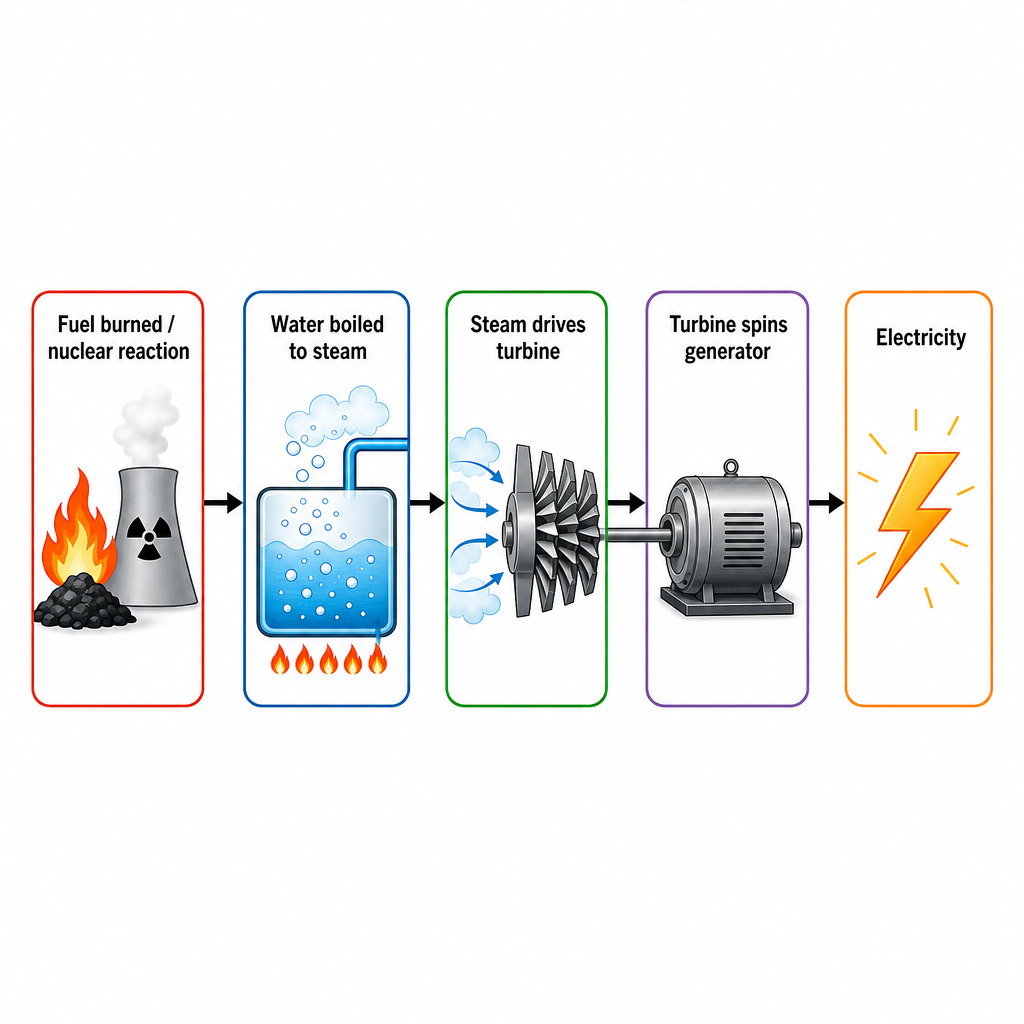
Key idea🔑 Key idea: Turbine spins a generator. Fossil + nuclear are non-renewable; wind/solar/hydro/tidal/geothermal/wave/biofuels are renewable. Compare them on renewability, availability, reliability, scale and environmental impact.
Worked example
Worked Example: Choosing a Resource
Worked Example: Sunny Island, No Grid ☀️
A small, sunny island with no fuel deposits wants reliable daytime electricity with no air pollution. Suggest a suitable energy resource and one drawback.
- 1Solar (photovoltaic) suits a sunny island: no fuel needed, no air pollution, and plenty of daytime sunlight. The main drawback is that it generates nothing at night and little in cloudy weather, so it needs battery storage or a backup supply.
---
12. Power and Efficiency
Power is the rate of transferring energy (or doing work): , measured in watts ( W J/s). A powerful motor does the same job faster. No real machine turns all its input into what you want: some is always wasted, usually by heating the surroundings. Efficiency is about how much of the input becomes useful output, and a more efficient device wastes less. An LED lamp and a filament lamp can give the same light, but the filament lamp takes in far more energy and gets hot, so it is less efficient.
Key idea🔑 Key formula: (watts). A more efficient device wastes less of its input energy.
Worked example
Worked Example: Motor Power and Efficiency
Worked Example: The Hard-Working Hoist 🏗️
A hoist motor does J of useful work in s while taking in J of electrical energy. Find its useful power output and the energy it wastes, and say what a more efficient motor would do differently.
- 1Power output: W.
- 2Energy is conserved, so wasted energy J, mostly heating the motor and its surroundings. A more efficient motor would do the same J of work while taking in less energy, so it would waste less.
---
13. Pressure
Pressure is force spread over an area: , measured in pascals ( Pa N/m²). The same force on a smaller area gives a higher pressure, which is why a sharp drawing pin pierces a board easily and why snowshoes (large area) stop you sinking. In a liquid, the pressure comes from the weight of liquid above. It is greater at greater depth, which is why a dam wall is built thicker at the bottom and water spurts furthest from the lowest hole in a tank. It is also greater in a denser liquid at the same depth: salt water gives more pressure than fresh water.
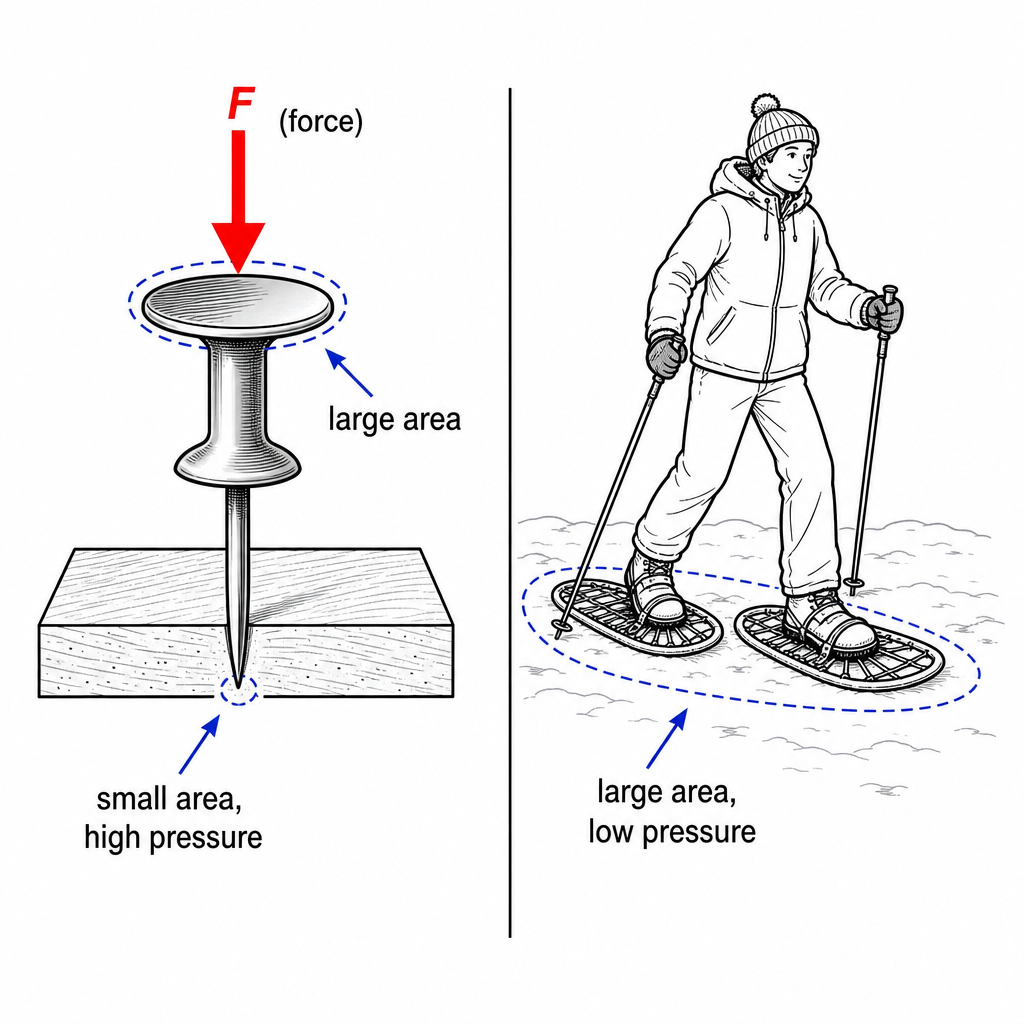
Key idea🔑 Key formula: (pascals). Smaller area → higher pressure. In a liquid, pressure is greater deeper down and in a denser liquid.
Worked example
Worked Example: Pressure Under a Box
Worked Example: Heavy Box, Big Feet 📦
A box pushes down with a force of N over a base area of m². Find the pressure it exerts on the floor.
- 1Apply Pa. Stand the same box on a smaller face and the area drops, so the pressure rises, even though the weight is unchanged.
---
Practice this in the app
Unlock the full chapter: practice questions, flashcards, mock papers and notes, free.
Continue revising