Space Physics: The Earth, the Solar System, Stars and the Expanding Universe
Cosmic Navigator: From Day and Night to the Big Bang 🌌
Introduction
1. Introduction
Sunrise in the east, a full Moon that was a thin crescent last week, a night sky dusted with stars that are really other suns: space physics is the chapter where everyday sights turn into a tour of the whole Universe. This is your five-minute refresh on why we get day and night, what lives in the Solar System and how gravity keeps it in orbit, what the Sun and stars are made of, and how redshift tells us the Universe is still expanding. Every idea below is one mark-earning sentence away from the exam. Let's go cosmic! 🌌
2. Spinning Earth, Orbiting Moon
The Earth spins once on its axis every 24 hours, and that single spin gives us day and night: the half facing the Sun has day, the half turned away has night. Because the Earth turns from west to east, the Sun appears to rise in the east and set in the west. Two more clocks run at the same time: the Earth orbits the Sun once every year (about 365 days), and the Moon orbits the Earth about once a month. As the Moon orbits, we see different lit fractions of it, which is why it cycles through its phases from new to full and back.
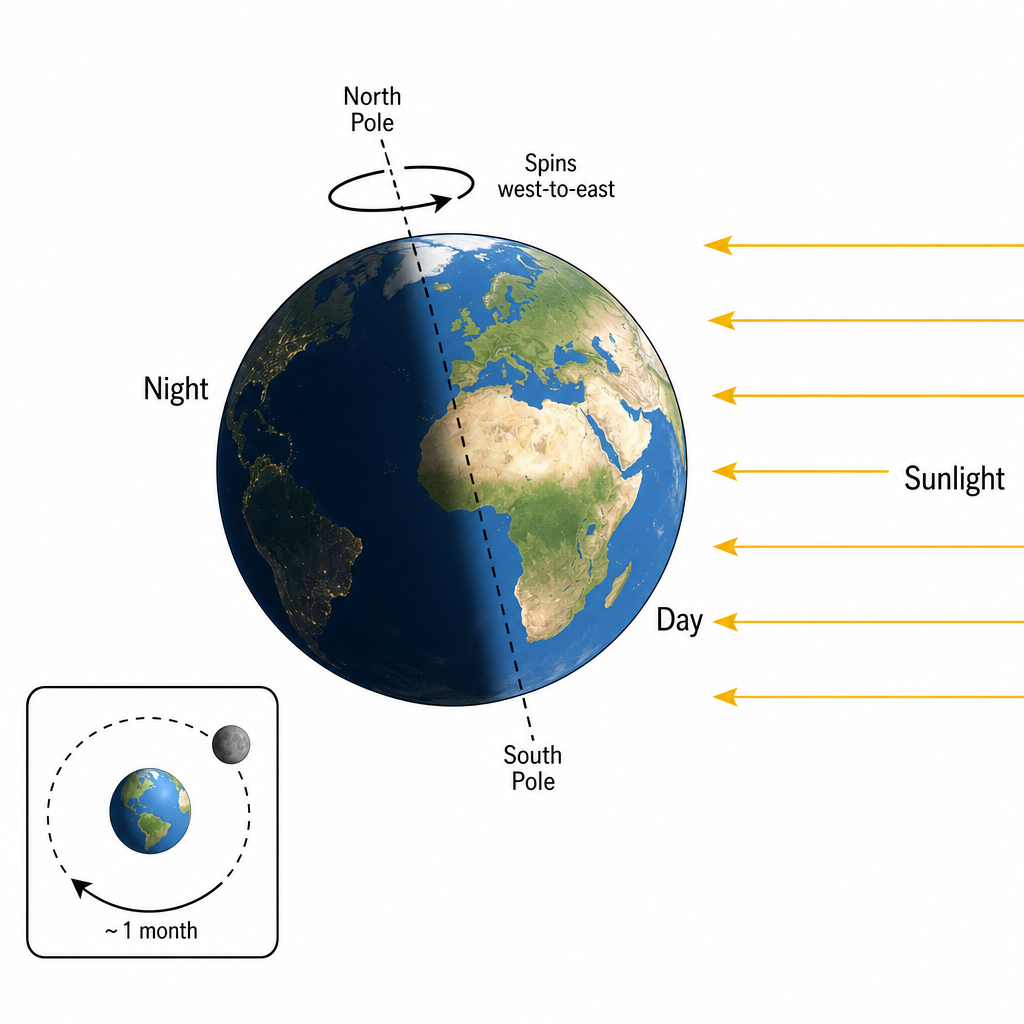
Key idea🔑 Key idea: Earth spins once per 24 h → day and night. Earth orbits the Sun → 1 year. Moon orbits the Earth → about 1 month.
Worked example
Worked Example: Counting Days in a Year
Worked Example: How Many Spins per Lap? 🔄
The Earth spins once every 24 hours and takes about 365 days to orbit the Sun once. Roughly how many complete spins does the Earth make during one orbit?
- 1One spin takes one day, so the number of spins equals the number of days in the orbit: about 365 spins per year. That is why a "year" and a "day" measure two completely different motions, the orbit and the spin.
---
3. A Star, Eight Planets and a Lot of Gravity
The Solar System is one star (the Sun) plus eight planets, their moons, dwarf planets, asteroids and comets, all formed long ago from a slowly collapsing cloud of gas and dust (the accretion model). The four inner planets (Mercury, Venus, Earth, Mars) are small and rocky; the four outer ones (Jupiter, Saturn, Uranus, Neptune) are large gas giants. The Sun's gravity holds everything in orbit, but gravity gets weaker with distance, so planets further out are pulled less, move slower, and take longer to complete an orbit. Comets follow long stretched (elliptical) paths, speeding up as they swing close to the Sun and slowing right down far away.
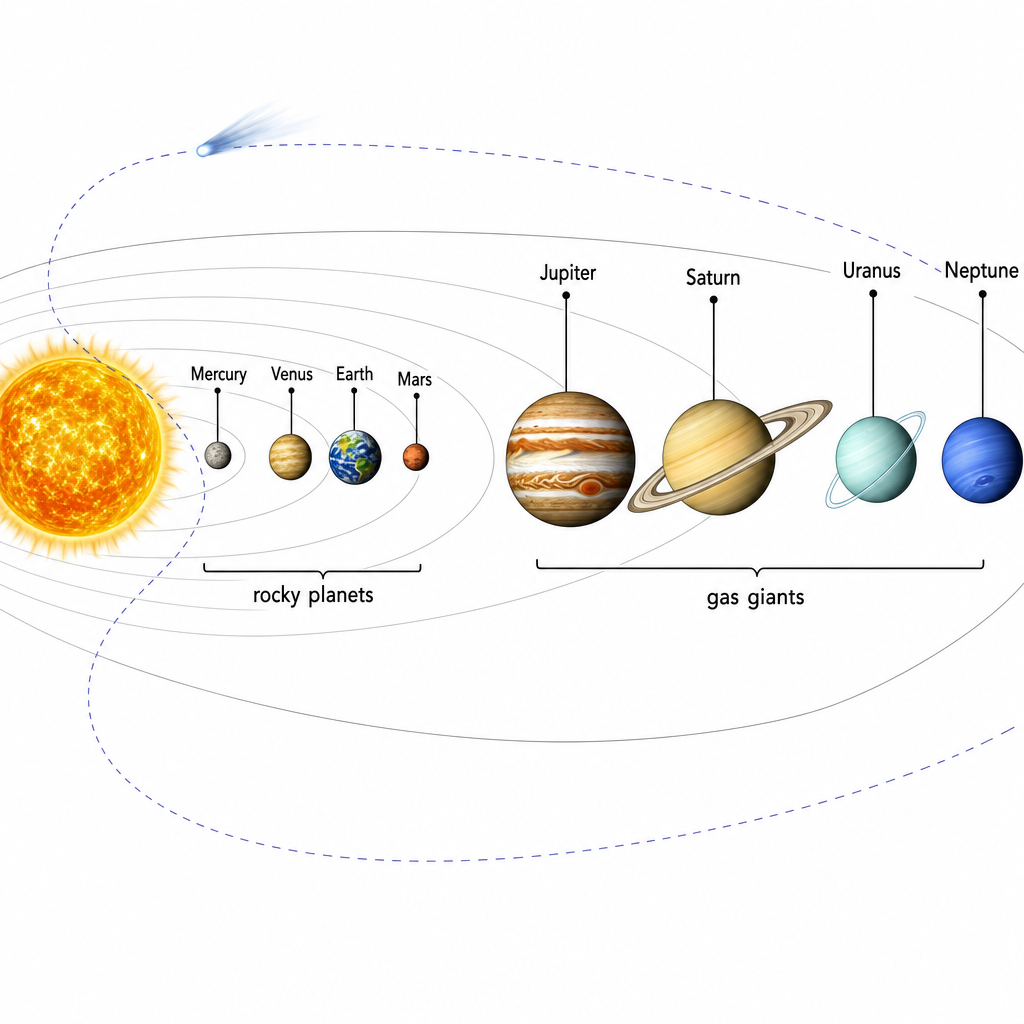
Key idea🔑 Key idea: The Sun's gravity weakens with distance, so outer planets orbit slower and take longer. Inner planets rocky, outer planets gas giants.
Worked example
Worked Example: Why Neptune's Year Is So Long
Worked Example: The Slow Lane of Space 🐌
Earth orbits the Sun in 1 year; Neptune, far out at the edge of the planets, takes about 165 years for one orbit. Explain in terms of gravity and orbit size why Neptune's year is so much longer than Earth's.
- 1Neptune is far from the Sun, so the Sun's gravitational pull on it is much weaker than the pull on the Earth. Weaker pull means Neptune moves around its orbit at a much slower speed.
- 2Neptune's orbit is also a far bigger loop, because it is a much larger circle around the Sun. So Neptune has a longer path to travel and travels it more slowly.
- 3A longer path covered at a slower speed takes far more time, which is why one Neptune "year" is about 165 of our years. The same rule explains every planet: the further out, the longer the year.
---
4. The Sun, the Stars and the Milky Way
The Sun is a medium-sized star made mostly of hydrogen and helium. It shines because nuclear fusion in its core joins hydrogen nuclei into helium, releasing enormous energy that leaves as infrared, visible light and ultraviolet. The Sun is just one of billions of stars in our galaxy, the Milky Way, which is itself one of billions of galaxies in the Universe. Space is so vast that we measure it in light-years: a light-year is the distance light travels in one year, about m. Light from the Sun takes 8 minutes to reach us; light from the next nearest star takes over 4 years. 🌟
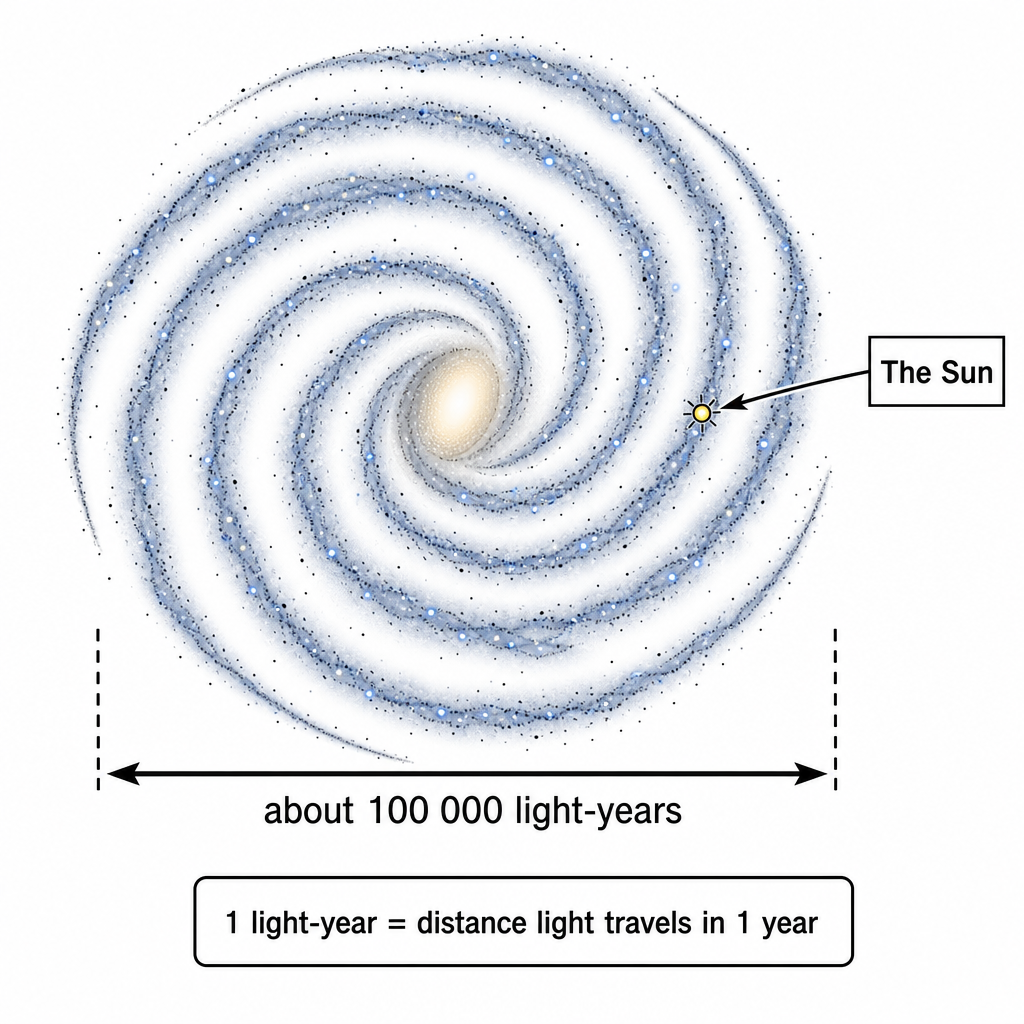
Key idea🔑 Key formula: A light-year is the distance light travels in one year, about m. The Sun is a medium star powered by hydrogen-to-helium fusion.
Worked example
Worked Example: How Far Is a Light-Year?
Worked Example: Light's One-Year Road Trip 🛣️
Light travels at m/s. One year is about seconds. Show that one light-year is roughly m.
- 1A light-year is just a distance, and distance = speed × time. Write the equation with the right values:
- 2Multiply the numbers and add the powers of ten:
- 3So one light-year m, about 9 and a half thousand million million metres. That is why even the nearest star, just over 4 light-years away, is impossibly far to ever reach by rocket: the number is set by light's speed, the fastest thing there is.
---
5. Redshift and the Expanding Universe
When we split the light from a distant galaxy into its spectrum, the pattern of lines is shifted toward the red (longer-wavelength) end. This redshift is the fingerprint of a galaxy moving away from us. The clincher is that the further away a galaxy is, the bigger its redshift, so the most distant galaxies are racing away the fastest. The only sensible explanation is that the whole Universe is expanding, carrying the galaxies apart. Rewind that expansion and everything was once packed together, which is exactly the picture of the Big Bang: the Universe began from a single hot, dense point and has been expanding ever since. Redshift is the key evidence for it. 💥
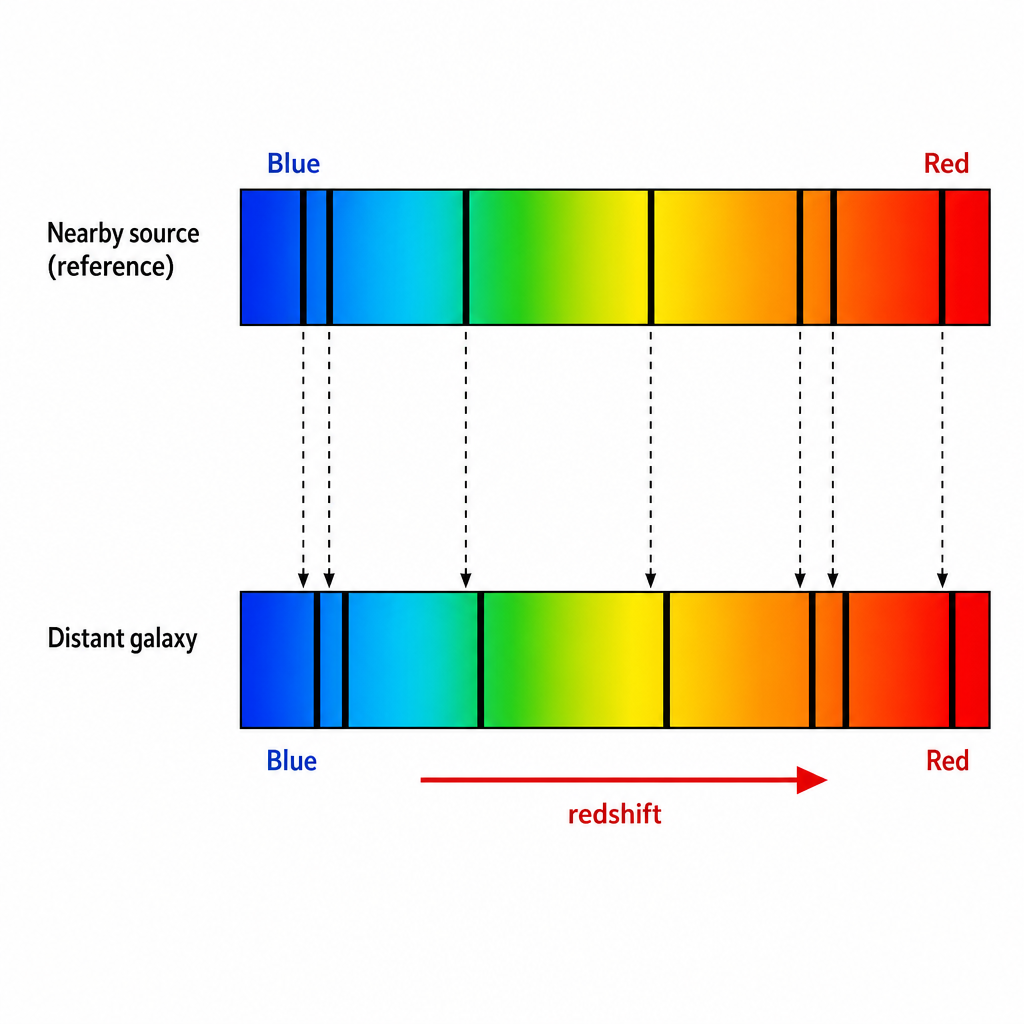
Key idea🔑 Key idea: Redshift means galaxies are moving away; further galaxies show more redshift, so the Universe is expanding. This is the main evidence for the Big Bang.
Worked example
Worked Example: Reading Two Redshifts
Worked Example: Near or Far? 🔭
Galaxy A's light shows a small redshift; galaxy B's light shows a much larger redshift. Which galaxy is further away, and which is moving away faster?
- 1Bigger redshift means both further away and moving away faster, so galaxy B is the more distant one and the faster-receding one. This "further = faster" pattern across all galaxies is exactly what tells us the Universe is expanding.
---
Practice this in the app
Unlock the full chapter: practice questions, flashcards, mock papers and notes, free.
Continue revising