Waves: Light, Sound and the Electromagnetic Spectrum
Wave Rider: Ride the Frequency 🌊
Introduction
1. Introduction
Alright, quick-fire waves. Why does music reach your ears, how does Wi-Fi carry a video, why does a straw look snapped at the waterline, why do sunglasses cut glare, why does a microwave cook from the inside-out myth? Same toolkit every time: a vibration carrying energy, and a few rules about how it bends, bounces and spreads.
This is your fast refresh, not the full textbook. One key formula per concept, one quick worked example, and the exact sentence the marker wants. Skim it the night before, lock in and , walk in calm. Let's ride the frequency! 🌊
This is your fast refresh, not the full textbook. One key formula per concept, one quick worked example, and the exact sentence the marker wants. Skim it the night before, lock in and , walk in calm. Let's ride the frequency! 🌊
2. Wave Properties and the Wave Equation
A wave is a vibration that carries energy from place to place without carrying the matter along: a cork on the sea bobs up and down while the wave travels past it. In a transverse wave the vibration is at right angles to the direction of travel (light, water ripples); in a longitudinal wave it is along the direction of travel (sound). The repeating shape gives you the toolkit words: wavelength (one full cycle), amplitude (size of the swing), frequency (cycles per second, in Hz). Send a wave through a narrow gap and it spreads out the other side: diffraction, strongest when the gap is about the same size as .
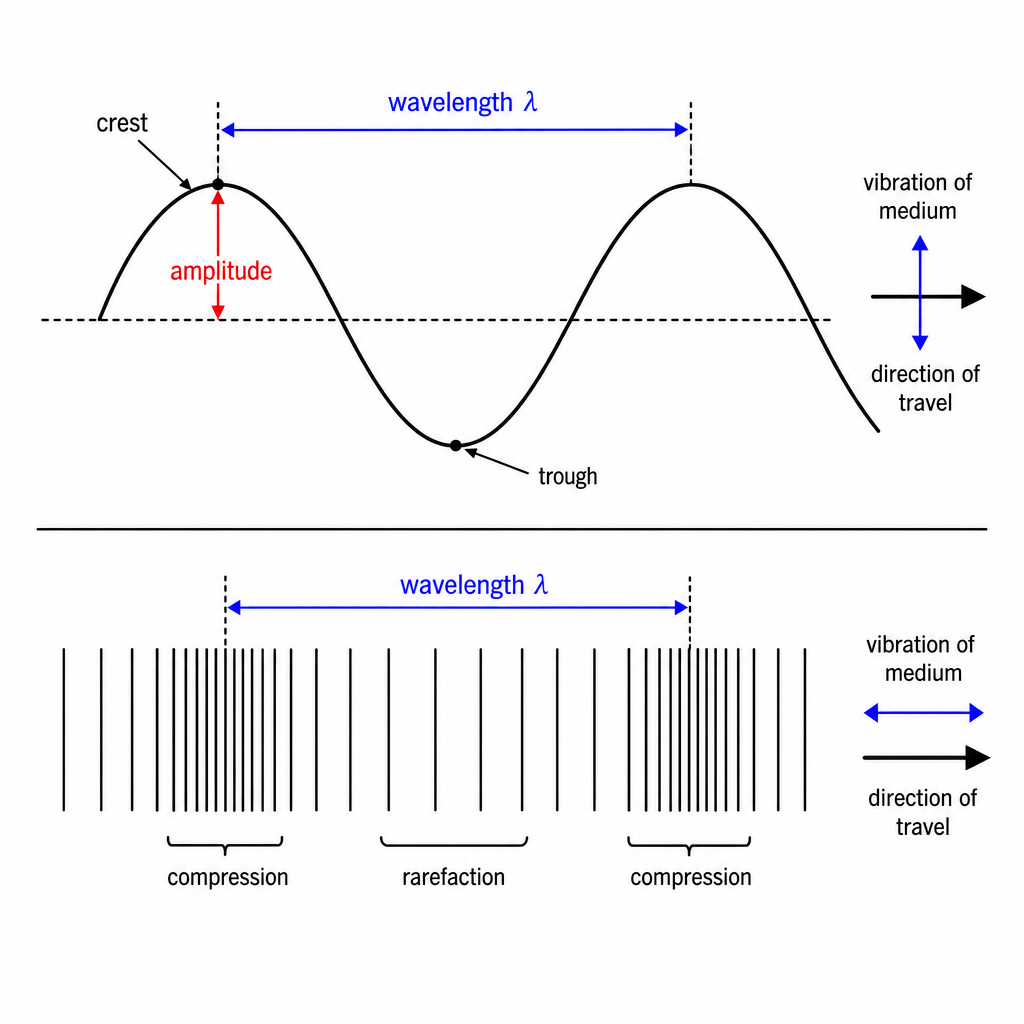
Key idea🔑 Key formula: — wave speed = frequency × wavelength. Units: in m/s, in Hz, in m. Diffraction spreads most when gap ≈ .
Worked example
Worked Example: Wave Speed from Frequency and Wavelength
Worked Example: v = fλ in Action 🎵
Ripples on a pond have a wavelength of m and you count crests passing a post every second. Find the wave speed.
- 1"Five crests per second" is the frequency: Hz. Wavelength m.
- 2Apply the wave equation:
Sanity check: a couple of metres per second is a believable pond-ripple speed. Note the same equation runs for any wave: plug MHz and m/s for an FM radio wave and you get m, the length of the aerial it needs.
---
Answer
3. Reflection of Light
Light bounces off a surface following one rule: the angle of incidence equals the angle of reflection, both measured from the normal (the line at to the surface), not from the surface itself. A plane mirror makes an image that is the same size as the object, the same distance behind the mirror as the object is in front, upright, laterally inverted (left-right swapped), and virtual — it only seems to come from behind the glass; no light actually gathers there.
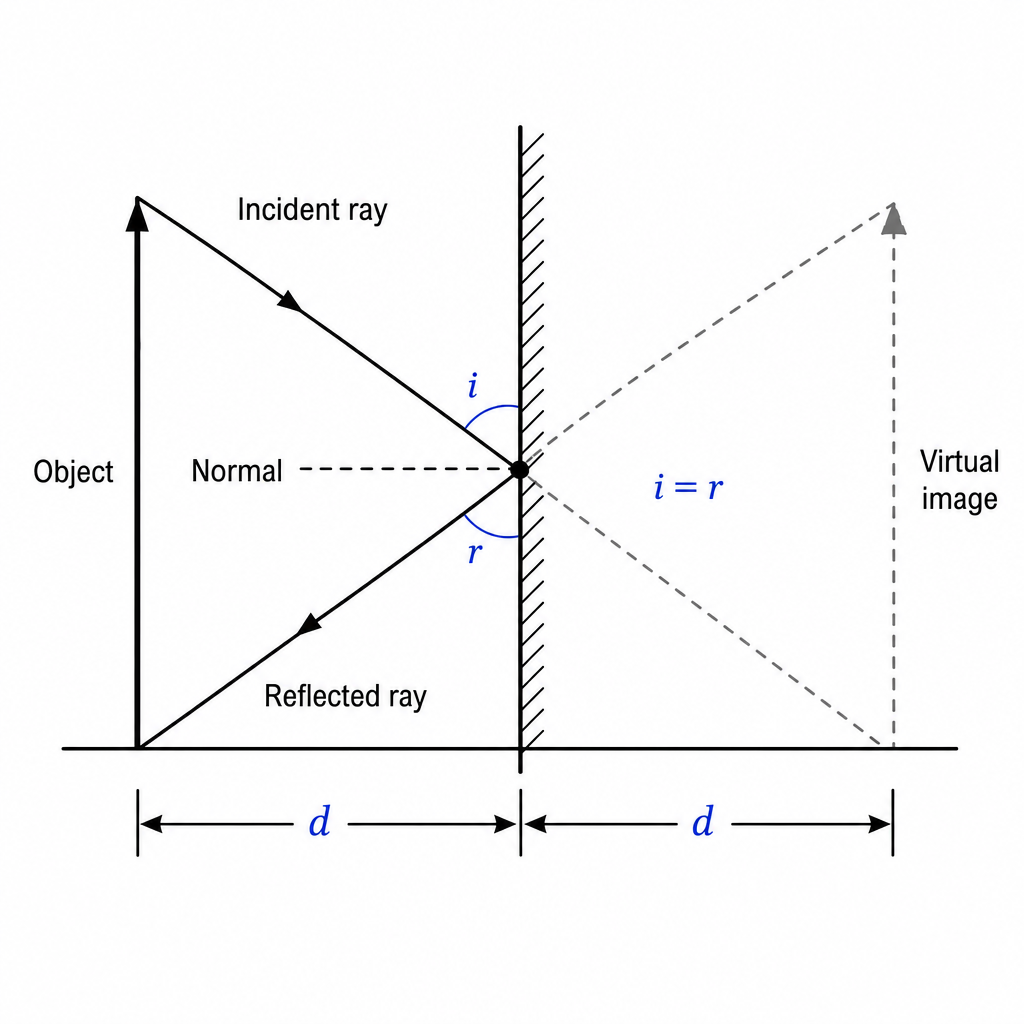
Key idea🔑 Key idea: Angle of incidence = angle of reflection (both from the normal). Plane-mirror image: same size, same distance behind, upright, virtual.
Worked example
Worked Example: Reflected Ray from a Mirror
Worked Example: Draw the Bounce ✏️
A ray hits a plane mirror making with the mirror surface. What is the angle of reflection, measured from the normal?
- 1The normal is to the surface, so the angle of incidence from the normal is . Reflection equals incidence, so the angle of reflection is also . Always convert "angle to the surface" into "angle to the normal" first.
---
4. Refraction and Total Internal Reflection
Light changes speed when it crosses into a new material, and that speed change bends it: entering a denser medium (air → glass) it slows and bends toward the normal; leaving it bends away. The refractive index measures how much: , also equal to the ratio of the wave speeds. Push the angle inside the dense medium big enough and the refracted ray can't escape at all: beyond the critical angle all the light reflects back inside. That's total internal reflection (TIR), and it's how optical fibres pipe internet light around bends without leaking.
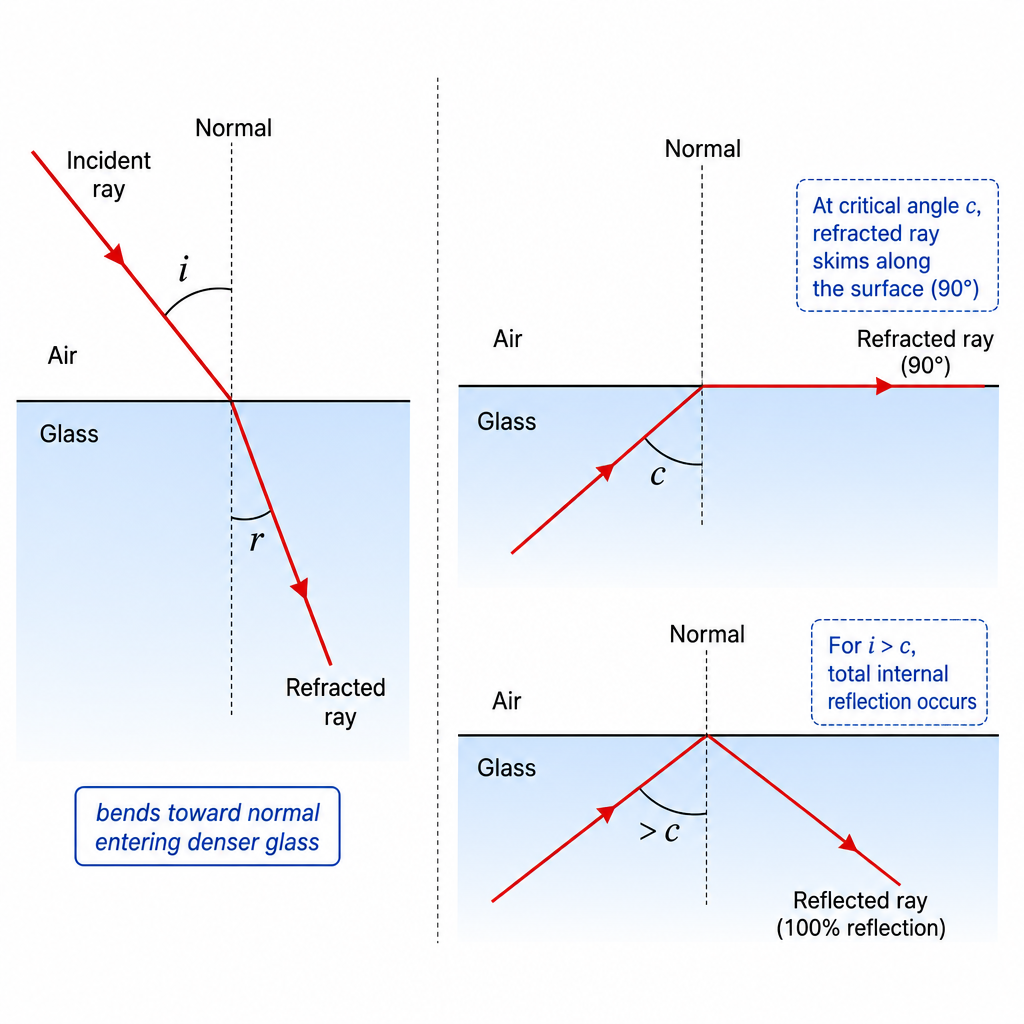
Key idea🔑 Key formulas: and . Bigger = slower light = smaller critical angle. TIR needs the ray inside the denser medium and angle > .
Worked example
Worked Example: Critical Angle of Glass
Worked Example: When Light Stops Escaping 🚫
A glass has refractive index . Find its critical angle, and state what happens to a ray inside the glass that meets the surface at .
- 1Use :
- 2The ray meets the surface at , which is greater than the critical angle of , so it cannot refract out: it undergoes total internal reflection and bounces back into the glass. This is exactly the condition exploited inside an optical fibre, where light hits the wall well above at every bounce.
---
5. Thin Lenses
A converging (convex) lens bends parallel rays inward to meet at the principal focus, a distance (the focal length) from the lens; a diverging (concave) lens spreads them out. To find the image of an object, draw two standard rays: one parallel to the axis (refracts through the focus) and one straight through the centre (undeviated). Where they cross is a real image (you can catch it on a screen, it's inverted). If the object is inside the focal length the rays come out diverging and only appear to meet behind the lens: that's a virtual, upright, enlarged image, the magnifying-glass effect.
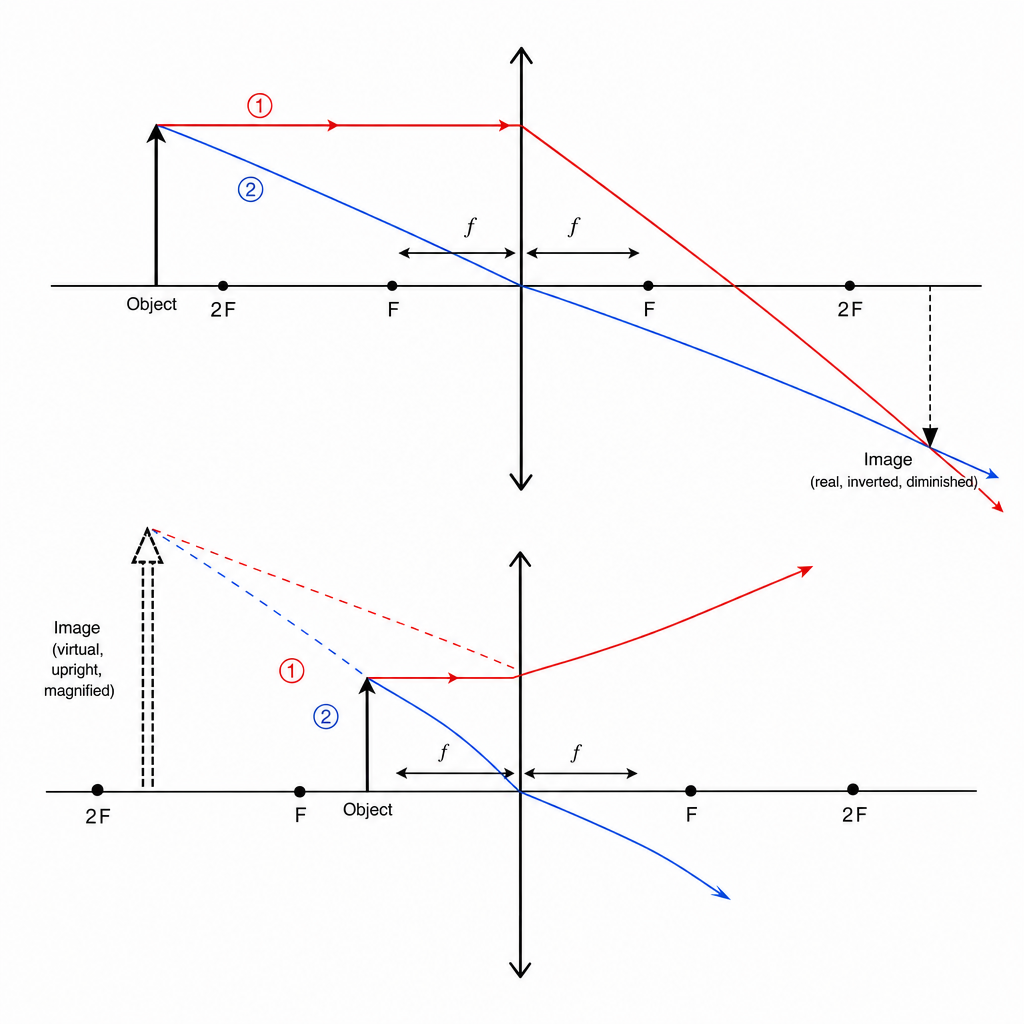
Key idea🔑 Key idea: Real image = rays actually cross (inverted, catchable on a screen). Virtual image = back-projected rays meet (upright, can't be projected). Object inside on a converging lens → magnifier.
Worked example
Worked Example: Reading a Lens Ray Diagram
Worked Example: Real, Inverted, Smaller 🖼️
An object stands beyond twice the focal length () of a converging lens. Describe the image: real or virtual, upright or inverted, enlarged or diminished?
- 1Drawing the parallel ray (through far focus) and the centre ray, they cross on the far side between and . Because the rays genuinely cross, the image is real and inverted, and because it forms closer to the lens than the object, it is diminished (smaller). This is exactly how a camera lens images a distant scene onto a small sensor.
---
6. Dispersion of Light
White light is a mix of all colours, and a glass prism refracts each colour by a slightly different amount (violet bends most, red least, because the glass's refractive index is slightly higher for shorter wavelengths). The colours fan out into the visible spectrum: red, orange, yellow, green, blue, indigo, violet — increasing in frequency and decreasing in wavelength from red to violet. Light of a single frequency is monochromatic (like a laser) and cannot be split further by a prism.
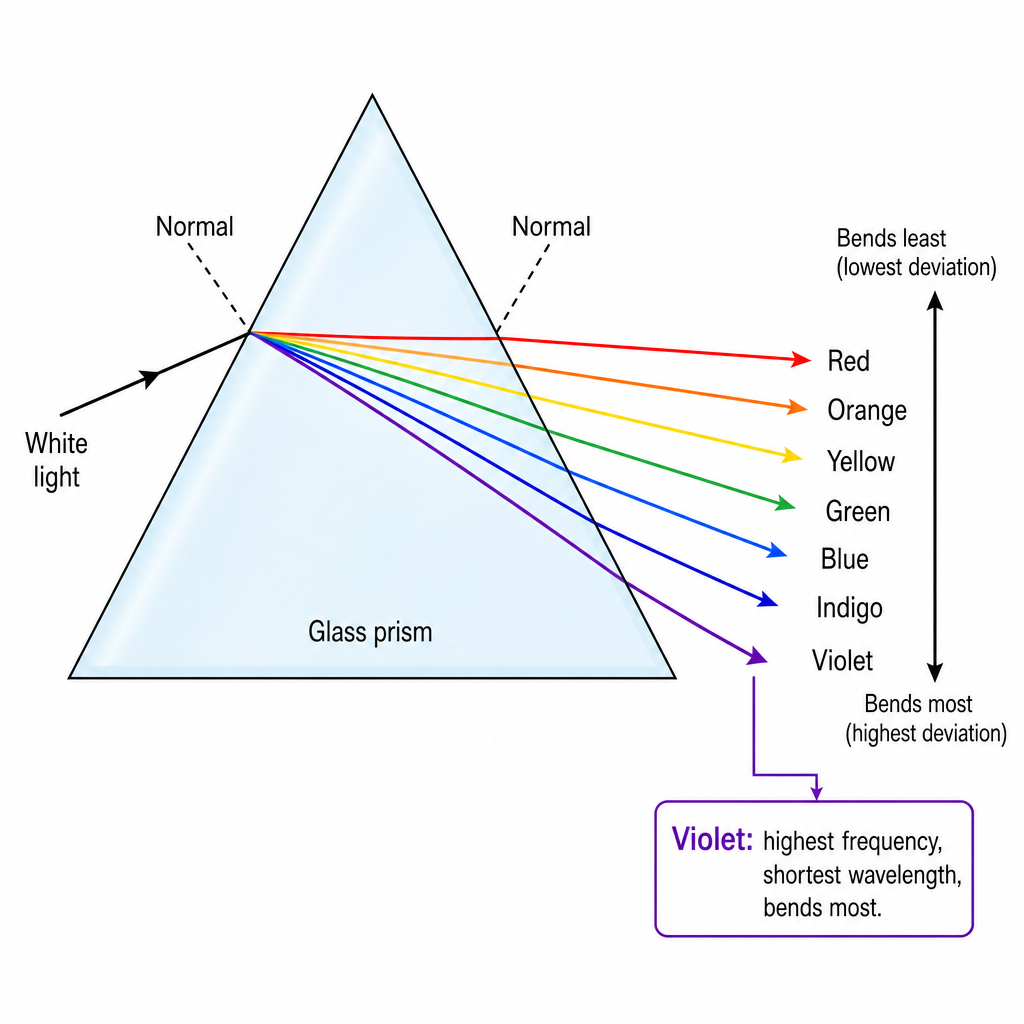
Key idea🔑 Key idea: Prism splits white light because differs per colour. Order by increasing frequency: red → violet. Monochromatic light (one frequency) does not disperse.
Worked example
Worked Example: Why a Red Laser Won't Split
Worked Example: The One-Colour Test 🔴
White light through a prism makes a spectrum, but a red laser beam through the same prism comes out as a single red spot (just shifted). Why?
- 1Dispersion needs more than one frequency to fan apart. A red laser is monochromatic — one single frequency — so the prism refracts all of it by the same amount. It bends (refracts) but it cannot spread into a spectrum because there are no other colours present to separate.
---
7. The Electromagnetic Spectrum
All electromagnetic (EM) waves are transverse and travel through a vacuum at the same speed, m/s (the speed of light). They differ only in frequency and wavelength, running from low-frequency long-wavelength radio up to high-frequency short-wavelength gamma: radio → microwave → infrared → visible → ultraviolet → X-rays → gamma. Each region has uses (radio/TV, microwave cooking and satellite/phone links, infrared remotes and heating, visible sight, UV sterilising, X-ray imaging, gamma sterilising) and high-frequency exposure carries dangers (UV skin damage, X-ray/gamma cell mutation).
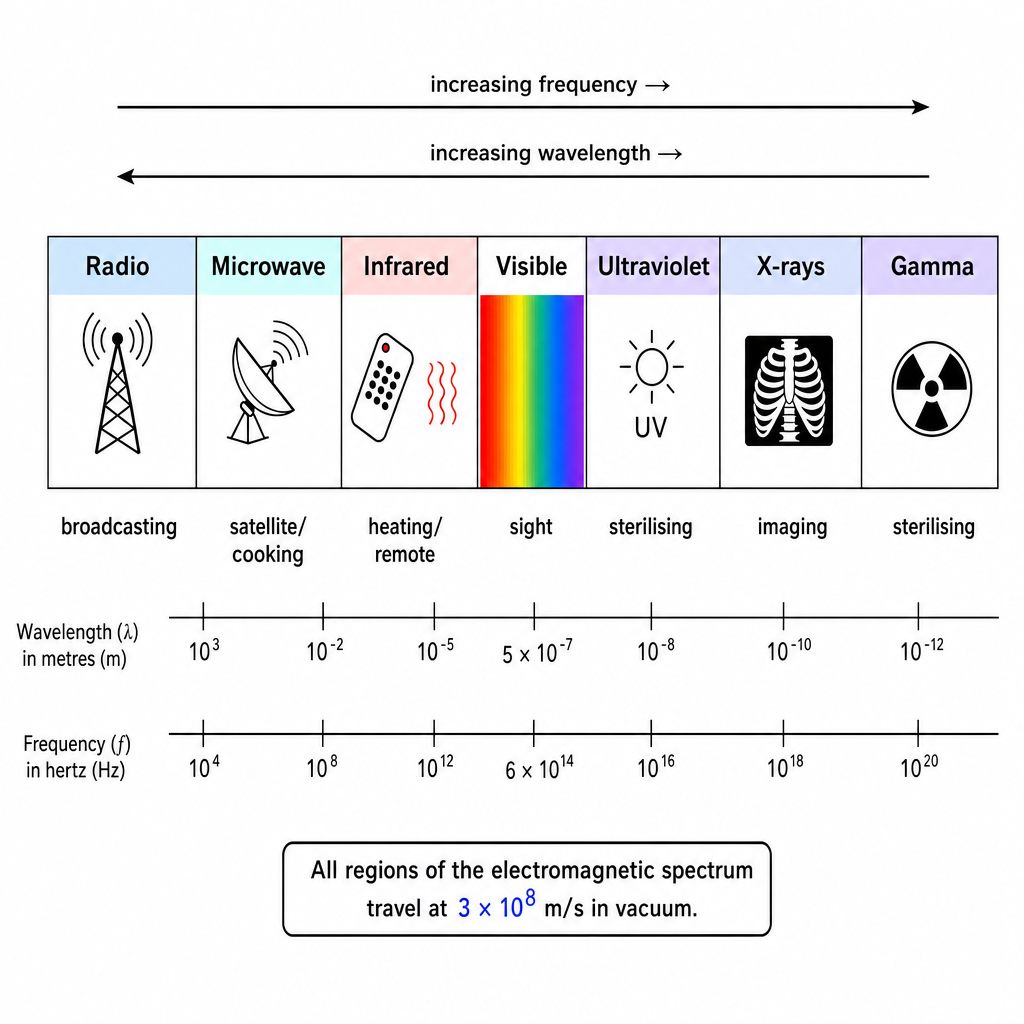
Key idea🔑 Key idea: Order (low→high frequency): radio, microwave, infrared, visible, UV, X-ray, gamma. All travel at m/s in a vacuum. Higher frequency = more energy = more dangerous.
Worked example
Worked Example: Match the Region to the Use
Worked Example: Mobile, X-Ray or Microwave? 📱
Name the EM region used for (a) checking a broken bone, (b) a TV remote control, (c) communicating with a satellite.
- 1(a) X-rays pass through soft tissue but not bone, so they image the skeleton. (b) Infrared carries the short-range remote signal. (c) Microwaves pass cleanly through the atmosphere and are used for satellite and mobile-phone links. Match by remembering the order and each band's everyday job.
---
8. Sound Waves
Sound is a longitudinal wave made by a vibrating source pushing the particles of a medium into compressions (squashed together) and rarefactions (spread apart). It needs a medium, so it cannot travel through a vacuum, and it travels faster in solids than liquids, and faster in liquids than gases (≈ – m/s in air) because tightly-bonded particles pass the vibration on quicker. Amplitude sets loudness, frequency sets pitch; the human audible range is about Hz to Hz, and anything above kHz is ultrasound (used in sonar, scanning and cleaning). An echo is simply reflected sound.
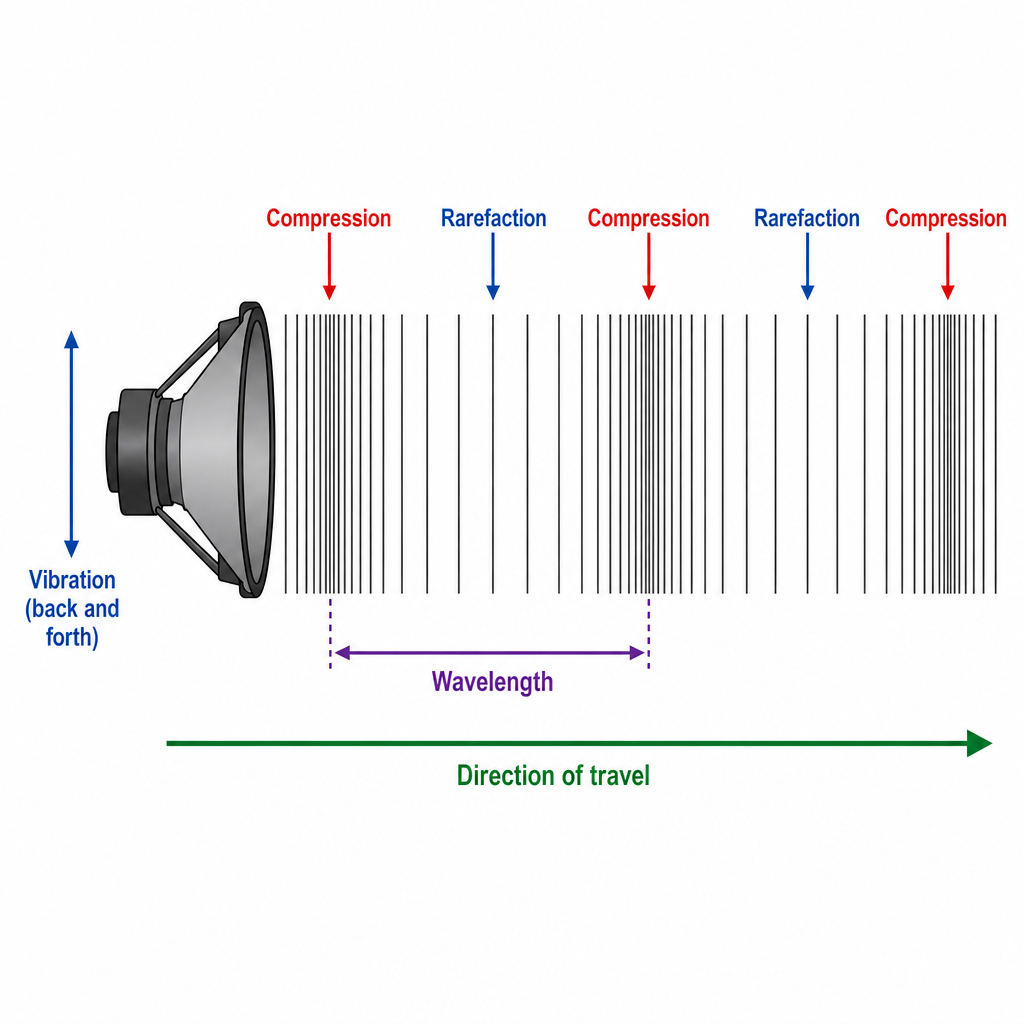
Key idea🔑 Key idea: Sound = longitudinal, needs a medium, speed: solids > liquids > gases. Amplitude → loudness, frequency → pitch. Audible Hz– kHz; ultrasound > kHz. Echo = reflected sound.
Worked example
Worked Example: Sonar Depth of the Sea Floor
Worked Example: Ping the Ocean 🐳
A ship sends an ultrasound pulse straight down and hears the echo s later. Sound travels at m/s in seawater. How deep is the sea floor?
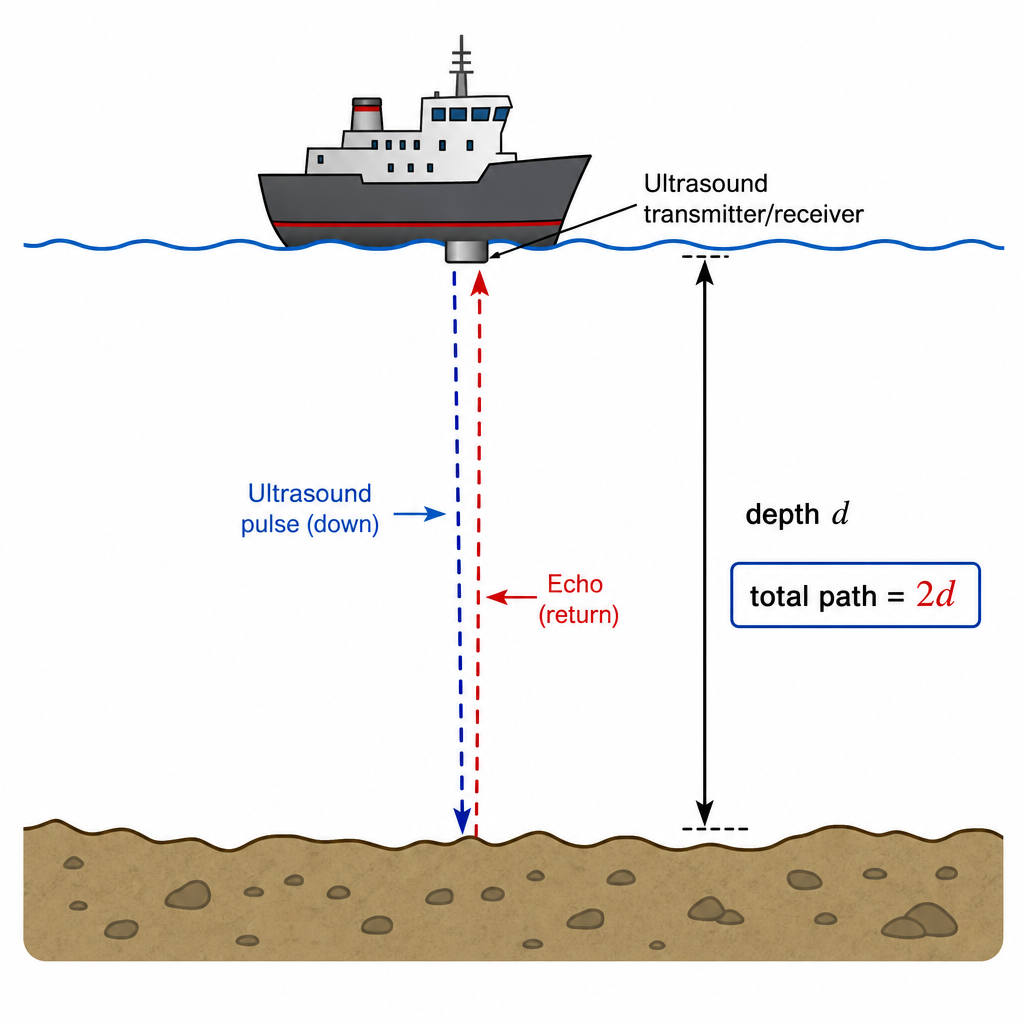
- 1The pulse travels down and back, so the distance covered is . Use distance = speed × time:
- 2Halve it for the one-way depth:
Sanity check: the classic trap is forgetting the factor of two — the echo records a round trip. Always halve. The same "halve the round trip" logic finds the speed of sound from a clap echo off a distant wall.
---
Answer
Practice this in the app
Unlock the full chapter: practice questions, flashcards, mock papers and notes, free.
Continue revising