Thermal Physics: Heat, Temperature, and Change of State
Thermal Tactician: Heat It Up 🔥
Introduction
1. Introduction
Alright, quick-fire thermal physics. Why does a phone get toasty mid-game, why does an ice cube vanish in a hot drink, why does a sealed bottle bulge in a parked car? Same answer every time: tiny particles, always moving, swapping energy.
This is your fast refresh, not the full textbook. One key formula per concept, one quick worked example, and the exact sentence the marker wants. Skim it the night before, lock in the formulas, walk in calm. Let's heat it up! 🔥
This is your fast refresh, not the full textbook. One key formula per concept, one quick worked example, and the exact sentence the marker wants. Skim it the night before, lock in the formulas, walk in calm. Let's heat it up! 🔥
2. Particles in Constant Motion
Everything is made of particles that never sit still, and the hotter it is, the faster they move. In a solid they vibrate in fixed positions, in a liquid they slide past each other while staying in contact, in a gas they fly apart and fill the container. Gas pressure is just countless particles smashing into the walls.
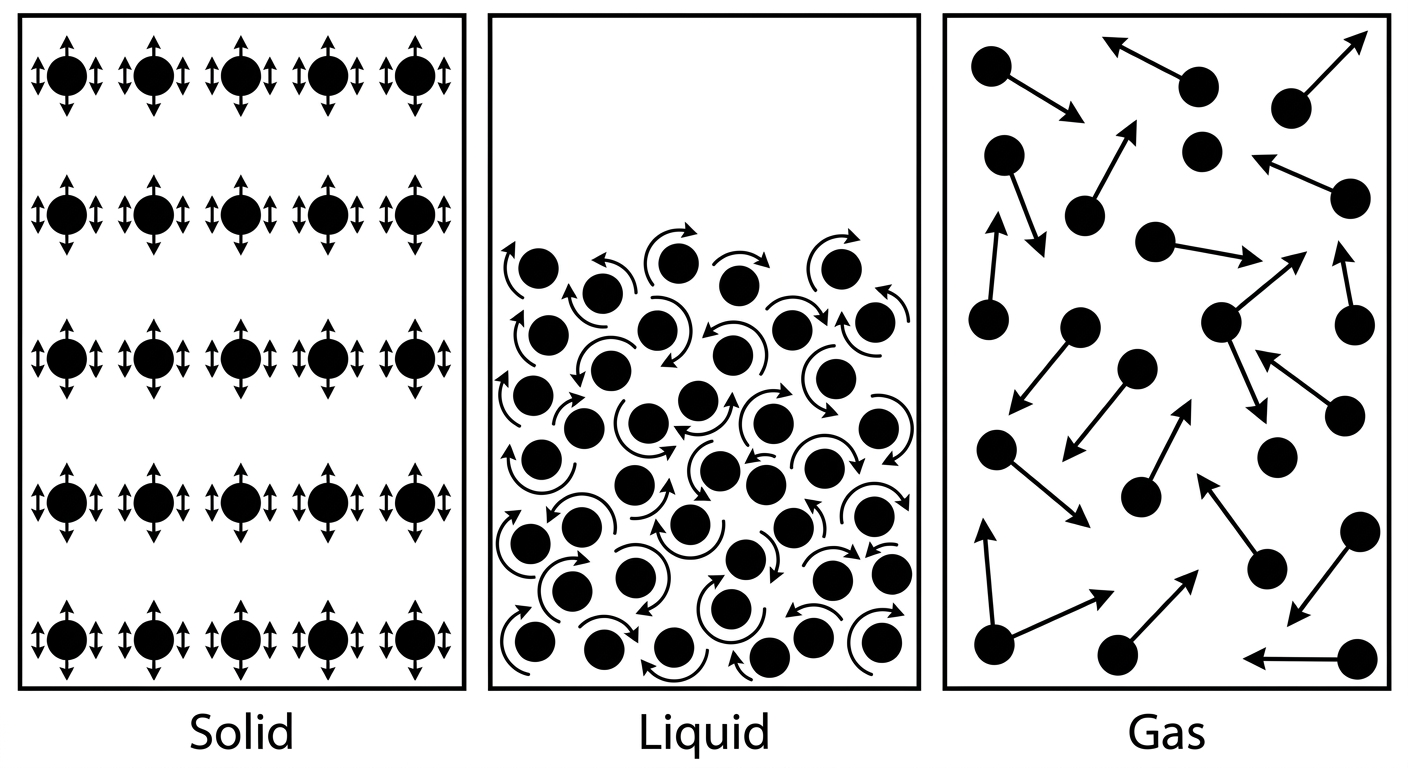
Key idea🔑 Key idea: Temperature (in Kelvin) measures the average kinetic energy of the particles. Hotter = faster particles = more collisions, harder collisions. 🎯
Worked example
Worked Example: Why Smoke Dances in a Light Beam
Worked Example: Brownian Bounce 🔬
You shine a bright light through a glass cell of smoky air and watch through a microscope. The smoke specks jiggle in random, jerky paths. Explain what's happening at the particle level.
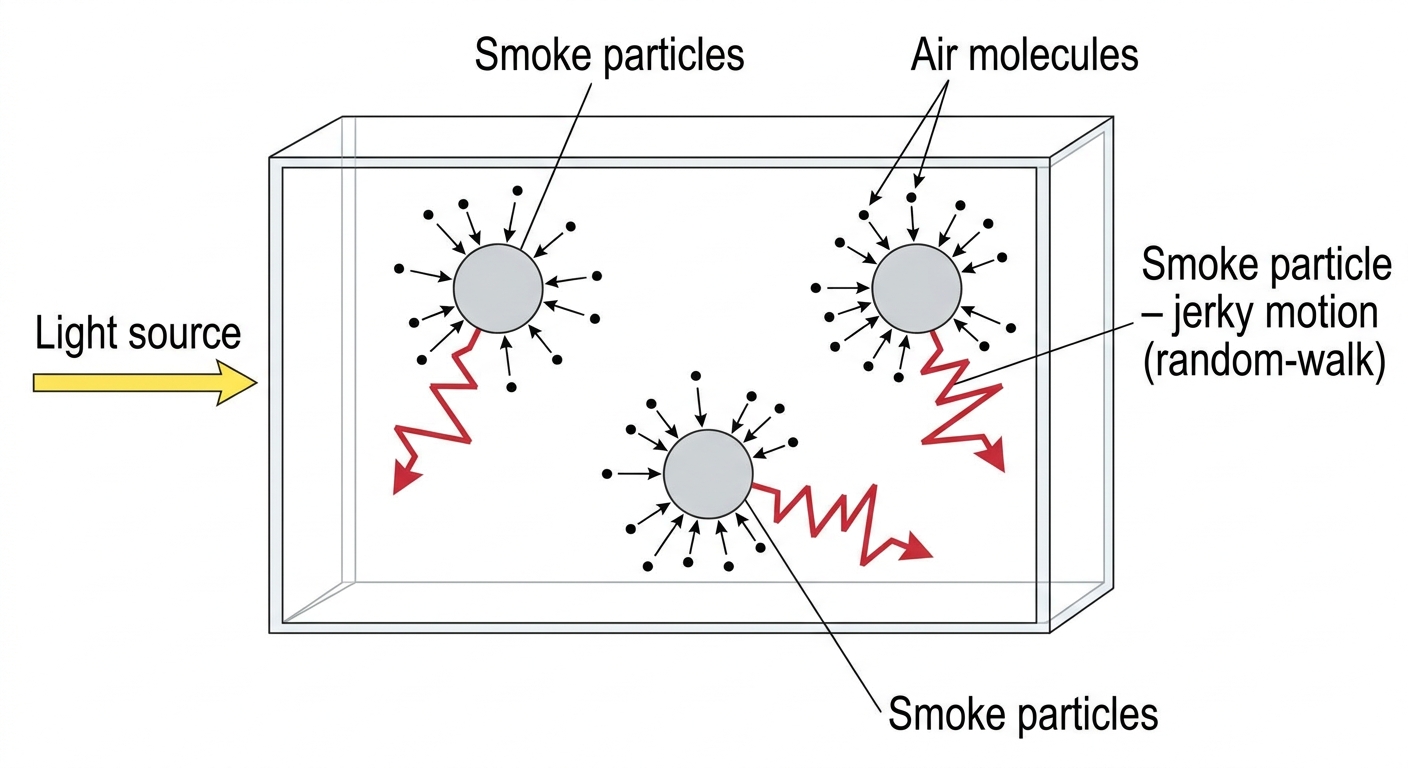
- 1The smoke specks are big enough to reflect light and be seen. The air molecules around them are far too small to see, but they're moving fast in every direction.
- 2At any instant slightly more air molecules hit one side of a speck than the other, so it gets a random nudge. A moment later the imbalance flips. That jerky path is Brownian motion: direct evidence that air is made of tiny, fast-moving particles.
---
3. Gas Laws and Absolute Temperature
Squeeze a fixed amount of gas into a smaller space at constant temperature and the pressure climbs: fewer places to bounce means more wall hits per second. That's Boyle's Law. For any temperature ratio you must work in Kelvin, which starts at absolute zero (the coldest possible, where particle motion is minimum).
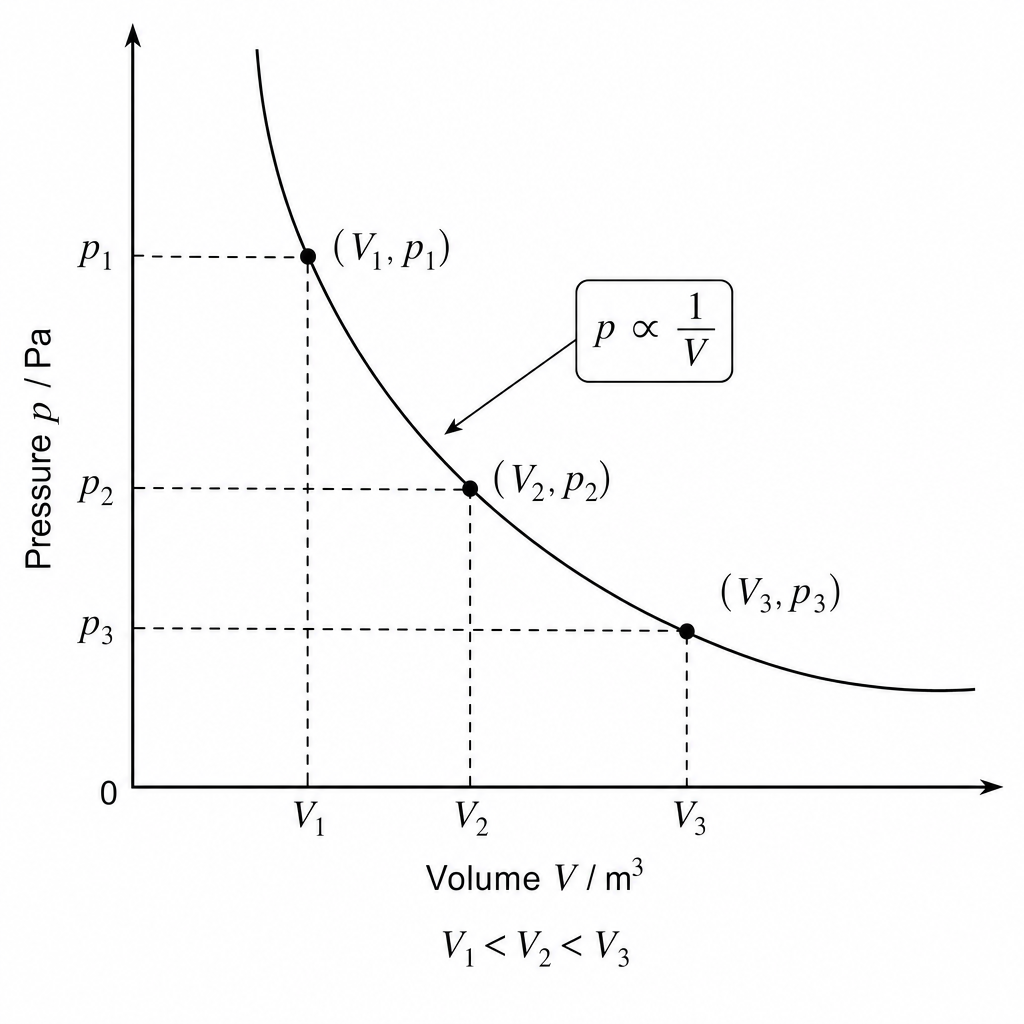
Key idea🔑 Key formulas: at fixed (so ), and . So 0 °C = 273 K and absolute zero (0 K) = °C.
Worked example
Worked Example: Pressure of a Squeezed Syringe
Worked Example: Press, Predict, Done 💉
You seal a syringe holding cm³ of air at Pa, then push the plunger to cm³ keeping the temperature steady. New pressure?
- 1Temperature is constant, so Boyle's Law applies: . Volumes can stay in cm³ as long as both use the same unit.
- 2Rearrange and substitute:
Squeeze the volume to a third, the pressure triples. That's why a bike pump fights back the more you compress it.
---
Answer
4. Thermal Expansion
Heat a material and its particles vibrate harder, so they take up more room. The exam-critical fact is the ranking: gases ≫ liquids > solids for expansion per degree, because solids have strong fixed bonds, liquids weaker ones, gases almost none. That's why bridges have expansion joints and power cables sag in summer.
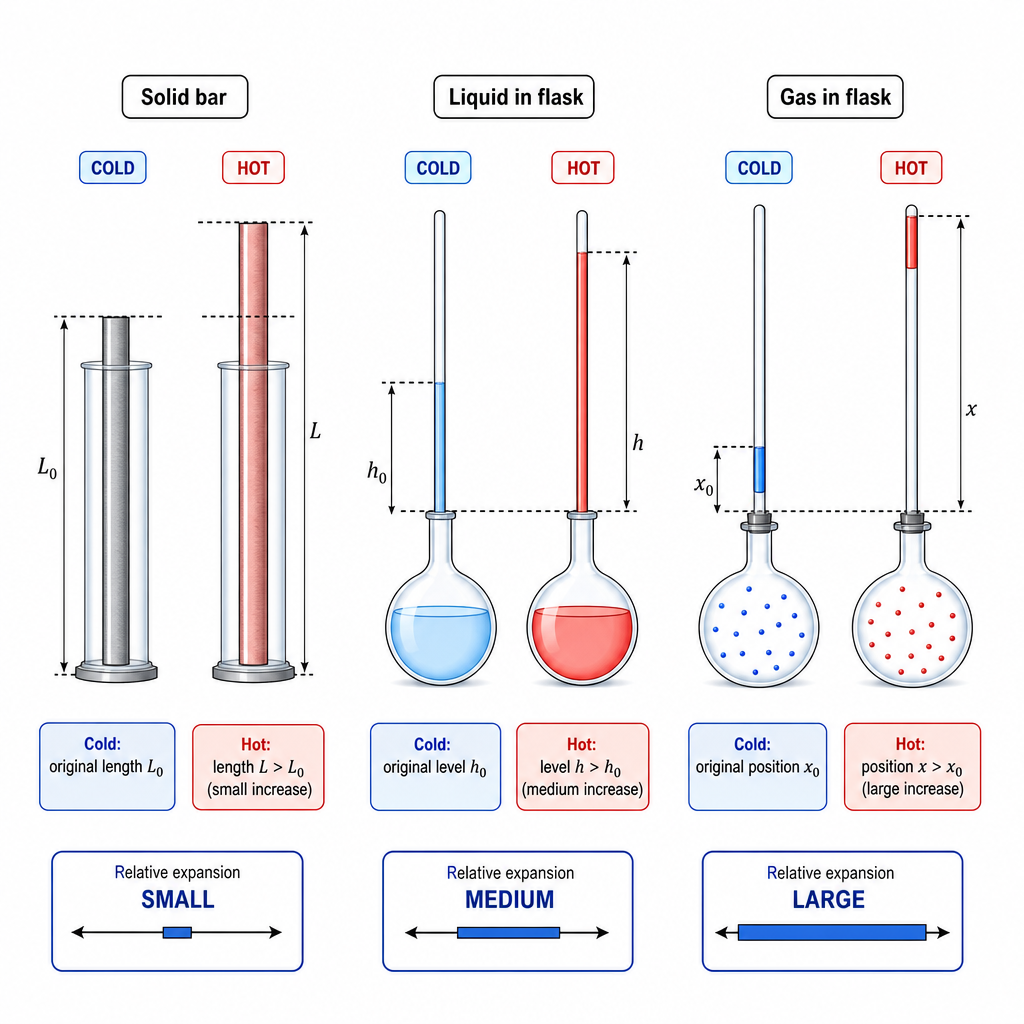
Key idea🔑 Key idea: Expansion ranking is bonding strength in reverse: weakest bonds expand most. Order: gases ≫ liquids > solids.
Worked example
Worked Example: Power Cables on a Hot Afternoon
Worked Example: Droopy Wires 🔌
Engineers hang overhead cables slightly loose between pylons. On a freezing morning the cable is taut; on a °C afternoon it sags. Why is the slack deliberate?
- 1Heating the metal makes its particles vibrate more, so the cable lengthens. Installed taut in winter, the summer expansion would have nowhere to go and could snap the cable or pull the pylons in. The winter slack gives the expansion somewhere to go, exactly like a bridge expansion joint.
---
5. Specific Heat Capacity
Some things heat up easily, others soak up loads of energy first. Specific heat capacity is the energy to raise one kilogram by one degree. Water's is huge (≈ J/(kg °C)), which is why kettles take a minute and why the sea keeps coastal weather mild. Most metals sit around to , so a metal pan heats almost instantly.
Key idea🔑 Key formula: — energy to change temperature with no phase change. in kg, in °C or K (same size), in joules.
Worked example
Worked Example: How Many Joules to Boil Tea
Worked Example: Kettle Math ☕
A kettle holds kg of water at °C. How much energy raises it to °C? Take J/(kg °C).
- 1Identify the values: kg, °C, .
- 2Apply :
That's only the energy to reach °C. Actually boiling it all away needs far more (that's latent heat, next).
---
Answer
6. Melting, Boiling and Evaporation
At a phase change the temperature stays flat while you keep adding energy: that energy breaks bonds between particles instead of speeding them up. The energy to change state at constant temperature is latent heat. Evaporation is different from boiling: it happens only at the surface, at any temperature, and the fastest molecules escaping leaves the rest cooler (that's why sweat cools you).
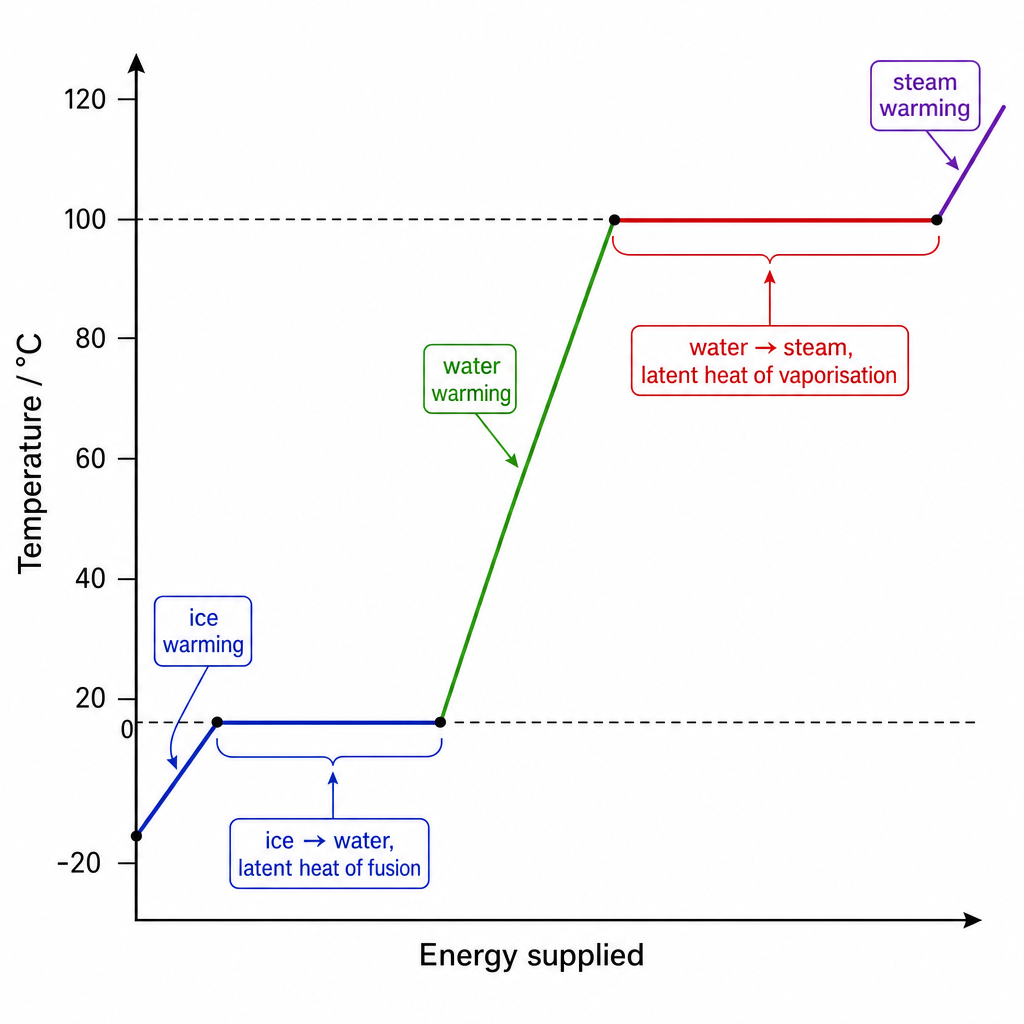
Key idea🔑 Key idea: Flat sections on a heating curve = phase changes (latent heat). Boiling is throughout the liquid at one temperature; evaporation is surface-only at any temperature and cools what's left.
Worked example
Worked Example: Why Sweat Cools You
Worked Example: The Body's Aircon 💦
After a workout, sweat evaporating off your skin makes you feel colder. Explain in terms of particles and energy.
- 1The fastest-moving water molecules on the surface escape as vapour. That drops the average kinetic energy of the molecules left behind, so the remaining sweat is cooler and pulls heat out of your skin. A breeze sweeps the vapour away so more fast molecules can escape, keeping the cooling going.
---
7. Conduction
Conduction is heat moving through a material without the material flowing along. In insulators (wood, plastic) particles just vibrate and bump their neighbours: slow. Metals have a bonus path: a sea of free electrons that race from the hot end and dump energy further along, which is why a metal handle burns your fingers while a wooden spoon stays cool. ⚡
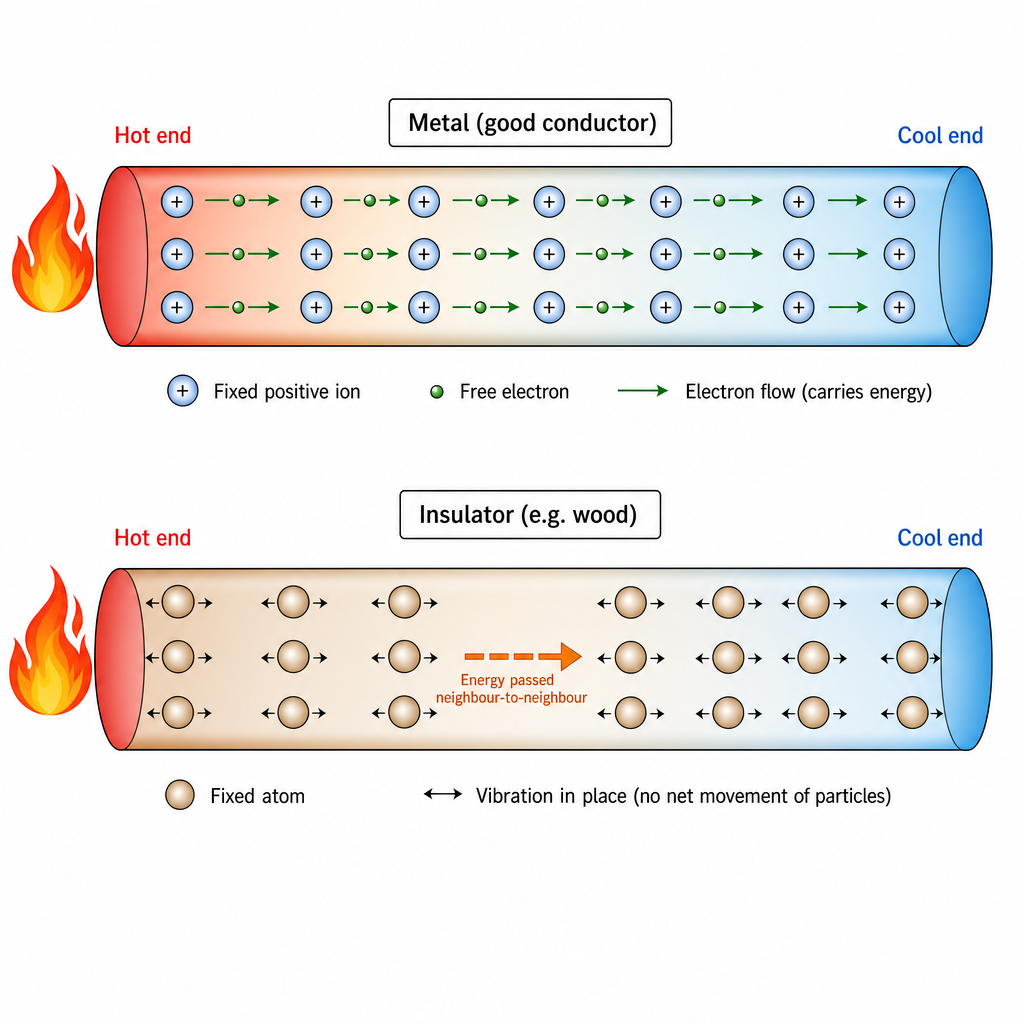
Key idea🔑 Key idea: Metals beat non-metals because they conduct by free electrons as well as lattice vibrations. Air conducts poorly (particles far apart), which is why trapped air insulates.
Worked example
Worked Example: The Three-Rod Race
Worked Example: Spot the Winner 🥇
Copper, glass, and wood rods are heated at one end, each with a pin stuck to the cold end by wax. Which pin falls first, which last?
- 1A pin falls when its wax melts. Copper has many free electrons and conducts fastest, so its pin falls first. Glass (a non-metal) is far slower, and wood is slower still, so the order is copper → glass → wood. Metals win because of free electrons.
---
8. Convection
Convection happens in fluids (liquids and gases). Warm fluid expands, becomes less dense, and floats up; cooler fluid sinks in to replace it and the loop is a convection current. It carries heat by moving the fluid itself, which is why a floor-level radiator warms a whole room and why it can't happen in solids.
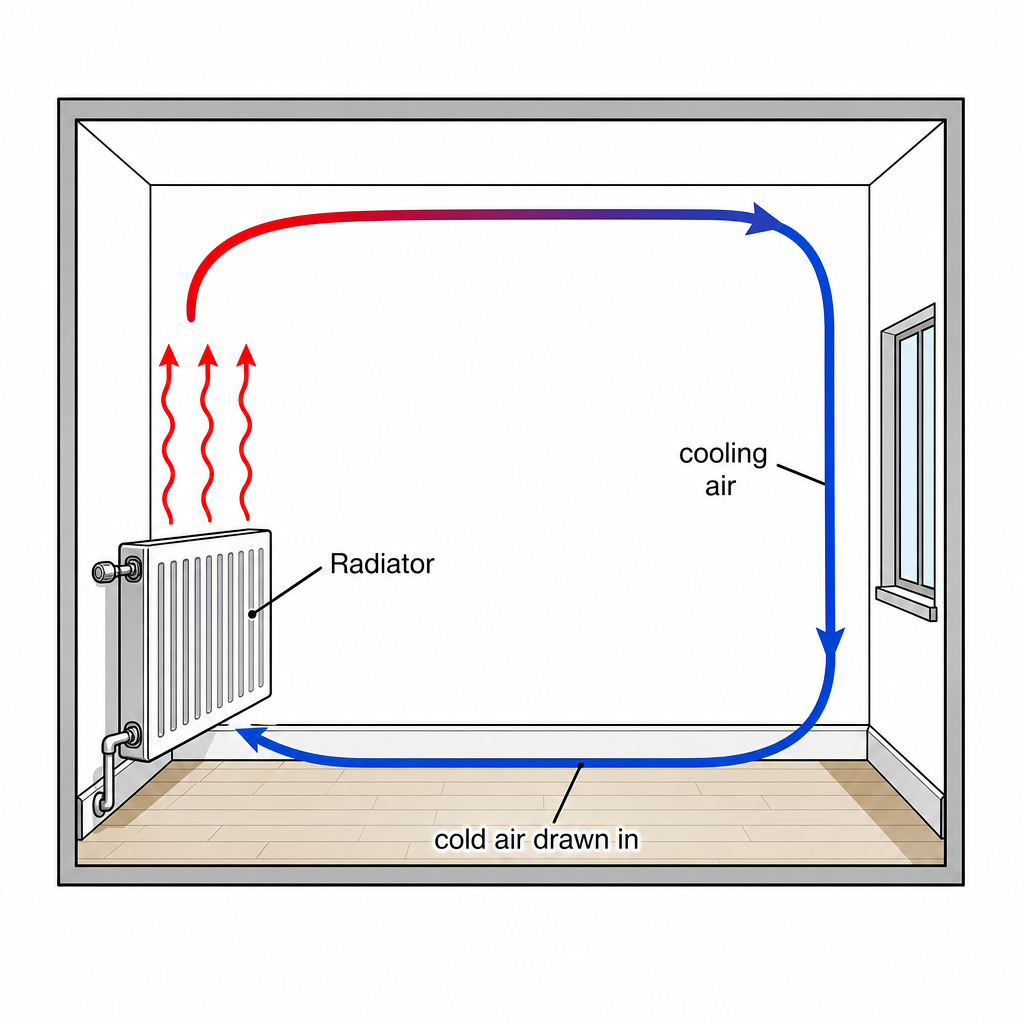
Key idea🔑 Key idea: Convection = heat carried by the fluid moving. Driven by density: warm rises, cool sinks. Fluids only; never solids or a vacuum.
Worked example
Worked Example: Coloured Dye in a Beaker
Worked Example: Watch the Current Form 🎨
A purple crystal sits in the bottom corner of a beaker of cold water with a flame under that corner. What do you see, and why?
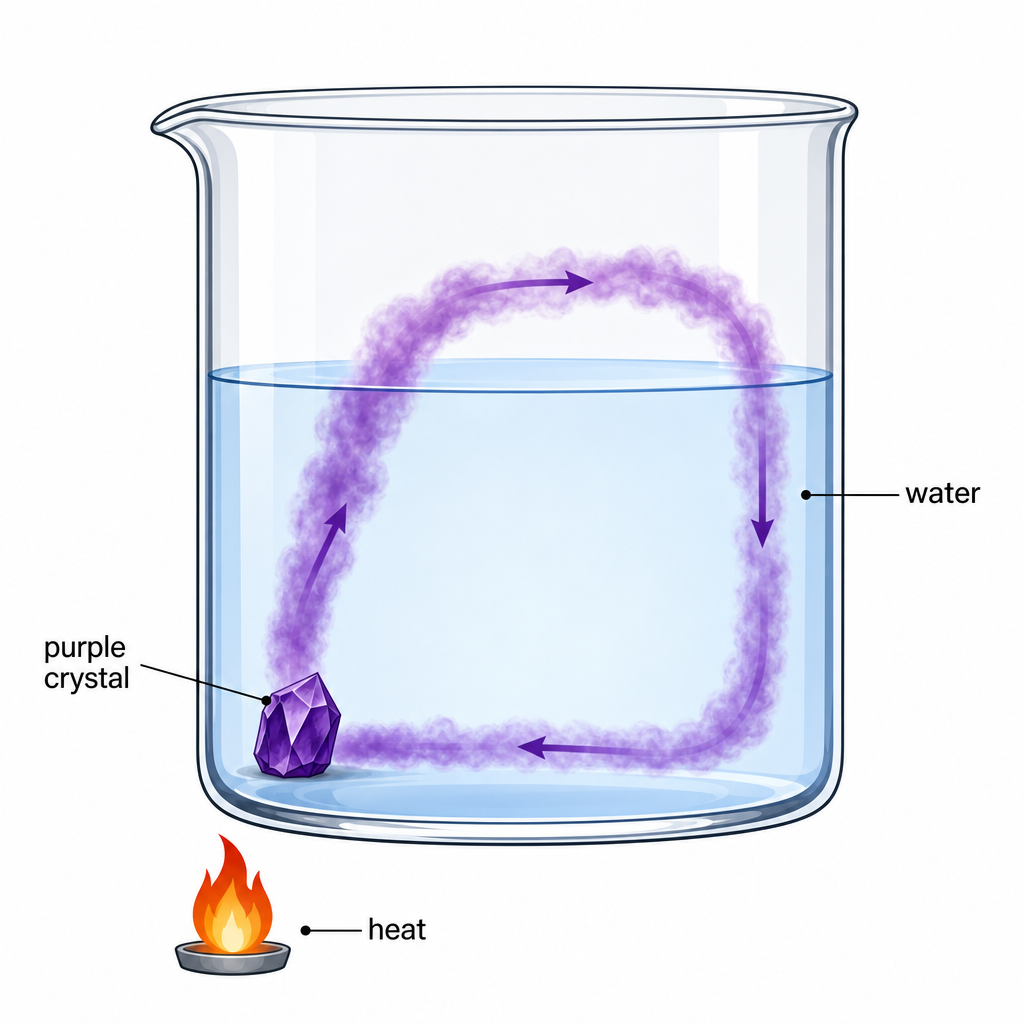
- 1Water by the flame warms, expands, becomes less dense, and rises, carrying purple dye up so the current is visible. It cools at the top, sinks down the far side, and flows back along the bottom: a closed convection loop.
---
9. Thermal Radiation
Thermal radiation is heat travelling as infrared waves. Unlike conduction and convection it needs no material, so it crosses a vacuum, which is how the Sun's energy reaches Earth. Every object above absolute zero emits it, and the hotter the object the more it emits. Earth's temperature stays roughly steady because it emits as much as it absorbs.
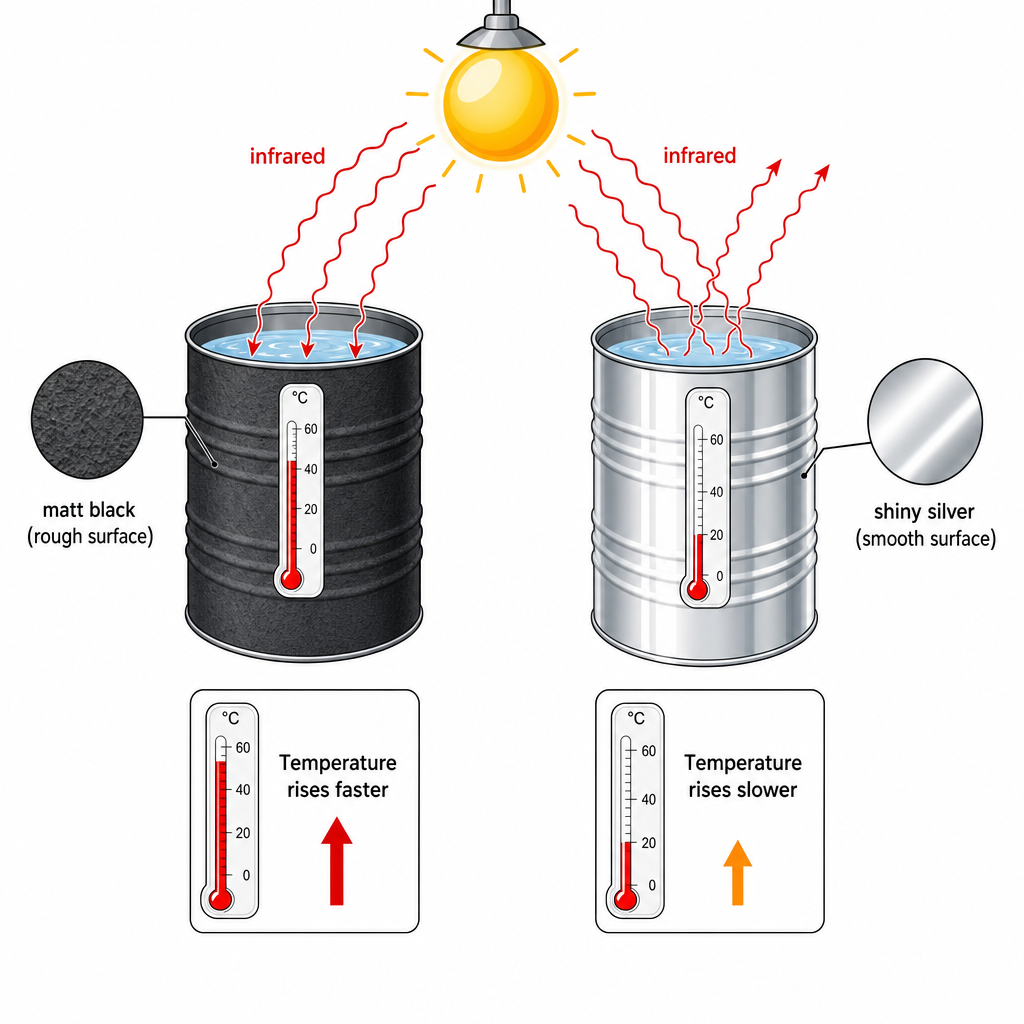
Key idea🔑 Key idea: Matt black = best absorber AND best emitter. Shiny silver = worst absorber AND worst emitter (best reflector). Same surface, same property both ways.
Worked example
Worked Example: Black Mug vs Silver Mug
Worked Example: Mug Material Matters ☕
Hot tea goes into a matt-black mug and a shiny-silver mug at the same temperature. Which holds heat better after ten minutes?
- 1Matt black is an excellent emitter, so the black mug radiates heat to the room fast and cools quicker. Shiny silver is a poor emitter, so the silver mug stays hotter. (Same reason a thermos is silvered inside.)
---
10. Putting Heat Transfer Together
Most real heat problems involve all three mechanisms at once, and the skill is spotting how a design uses or blocks each one. The vacuum flask is the cleanest example: the vacuum kills conduction and convection (no particles across the gap), the silvered walls block radiation (poor emitters, good reflectors), and the stopper blocks convection out of the top.
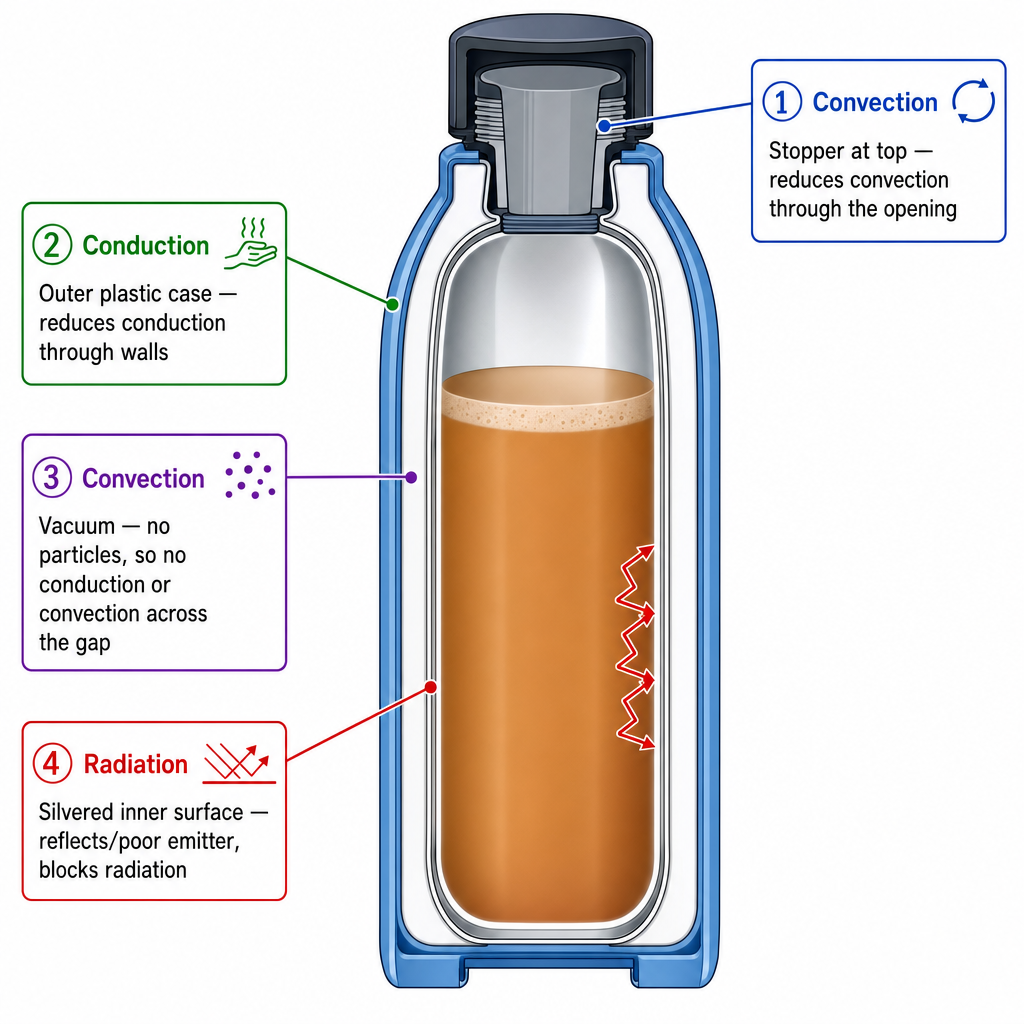
Key idea🔑 Key idea: Vacuum flask blocks all three: vacuum (conduction + convection), silvering (radiation), stopper (convection out the top).
Worked example
Worked Example: Why a Car Heats Up in the Sun
Worked Example: The Parked-Car Sauna 🚗
A black car in summer sun with the windows up can pass °C inside. Use all three mechanisms to explain why.
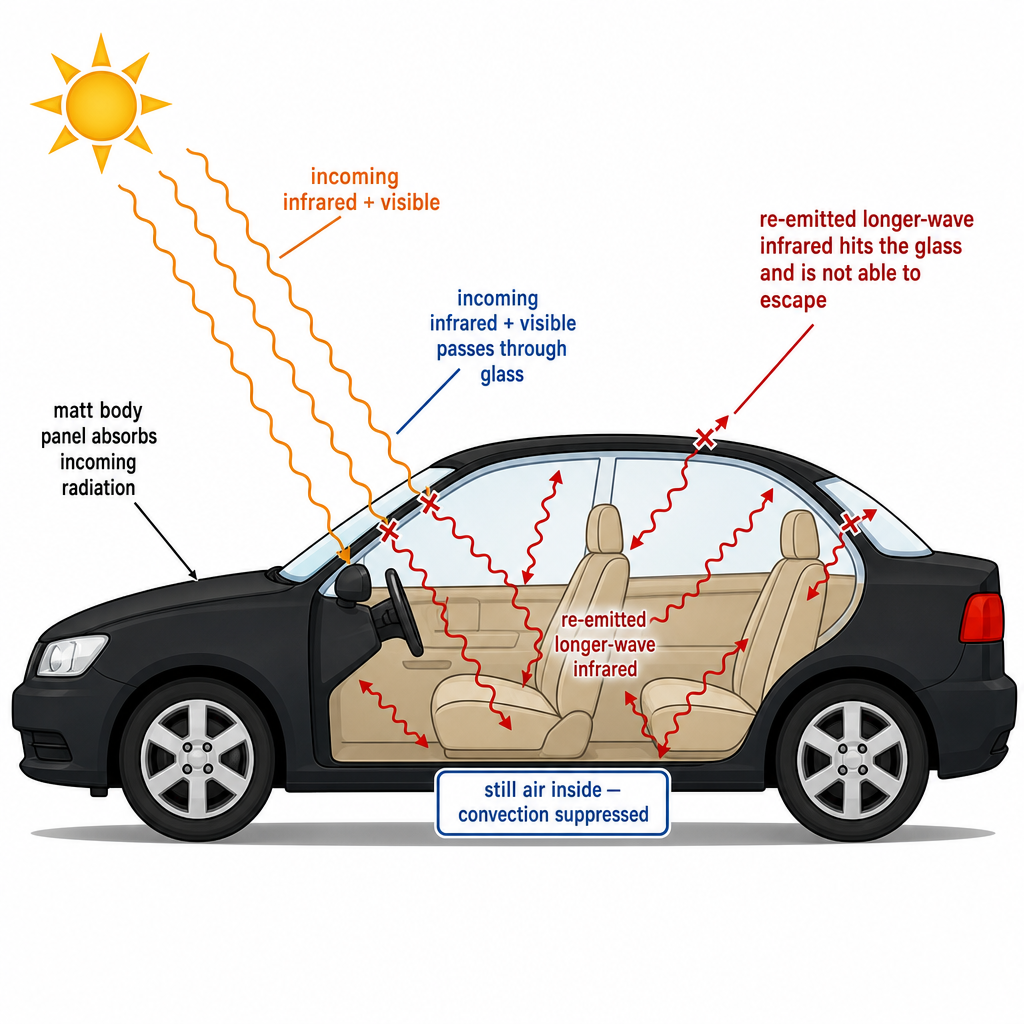
- 1Radiation in: sunlight passes through the glass and is absorbed by the dark interior. Radiation trapped: the cooler interior re-emits longer-wave infrared that glass won't let back out (greenhouse effect). Convection stalled: with windows shut the hot air can't be swapped for cooler outside air.
- 2Energy comes in by radiation far faster than slow conduction through the body lets it leave, so the interior climbs well above the outside air. Cracking a window lets convection vent the heat and drops the temperature fast.
---
Practice this in the app
Unlock the full chapter: practice questions, flashcards, mock papers and notes, free.
Continue revising