Space Physics: Orbits, Stars and the Expanding Universe
Cosmic Navigator: From the Moon to the Big Bang 🚀
Introduction
1. Introduction
Yo! Quick-fire space physics. Why do we get day and night, why does the Moon never fall on us, why are summer and winter a thing, and how do we know the Universe started with a bang? Same toolkit every time: things go round in orbits, gravity does the pulling, and light carries the evidence across billions of years.
This is your fast refresh, not the full textbook. One key formula per concept, one quick worked example, and the exact sentence the marker wants. Skim it the night before, lock in `v = 2πr/T` and `v = H₀d`, walk in calm. Let's launch! 🚀
This is your fast refresh, not the full textbook. One key formula per concept, one quick worked example, and the exact sentence the marker wants. Skim it the night before, lock in `v = 2πr/T` and `v = H₀d`, walk in calm. Let's launch! 🚀
2. The Earth, the Moon and Orbital Speed
The Earth spins once a day (giving day and night) and orbits the Sun once a year, with its axis tilted, which is what gives us seasons. The Moon orbits the Earth roughly once a month, and the changing slice of its sunlit half that we see is the cycle of phases. Anything in a circular orbit moves at a steady speed set by how big the orbit is and how long one lap takes.
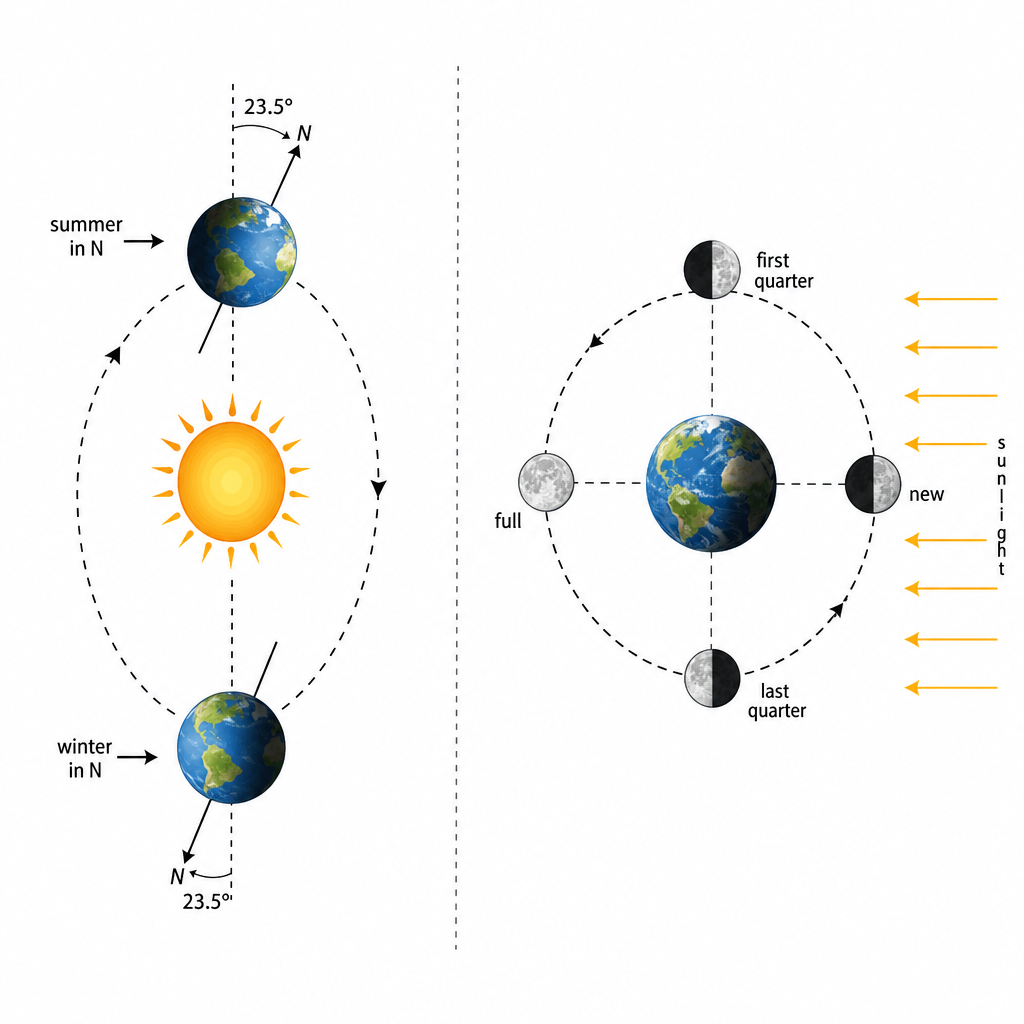
Key idea🔑 Key formula: orbital speed — circumference of the orbit () divided by the time for one lap (). Keep in metres and in seconds for m/s. 🎯
Worked example
Worked Example: How Fast Is the Moon Moving?
Worked Example: 1 km/s in Space 🛰️
The Moon orbits the Earth at a radius of m, taking days for one lap. Find its orbital speed.
- 1Convert the period to seconds: s. Always work in seconds before using the formula.
- 2Apply :
The Moon looks like it's drifting lazily across the sky, but it's actually screaming around us at about a kilometre every second. It doesn't fall on us because that sideways motion keeps "missing" the Earth as gravity bends its path into a circle.
---
Answer
3. The Solar System and Orbits
Our Solar System is one star (the Sun) plus eight planets, their moons, plus asteroids and comets, all held in orbit by the Sun's gravity. The four inner planets are small and rocky; the four outer ones are large and gassy. Orbits are slightly elliptical (squashed circles), not perfect circles, so a planet (or a comet) speeds up when it is closer to the Sun and slows down when it is farther away. The closer a planet's orbit, the stronger the Sun's pull and the faster it must travel.
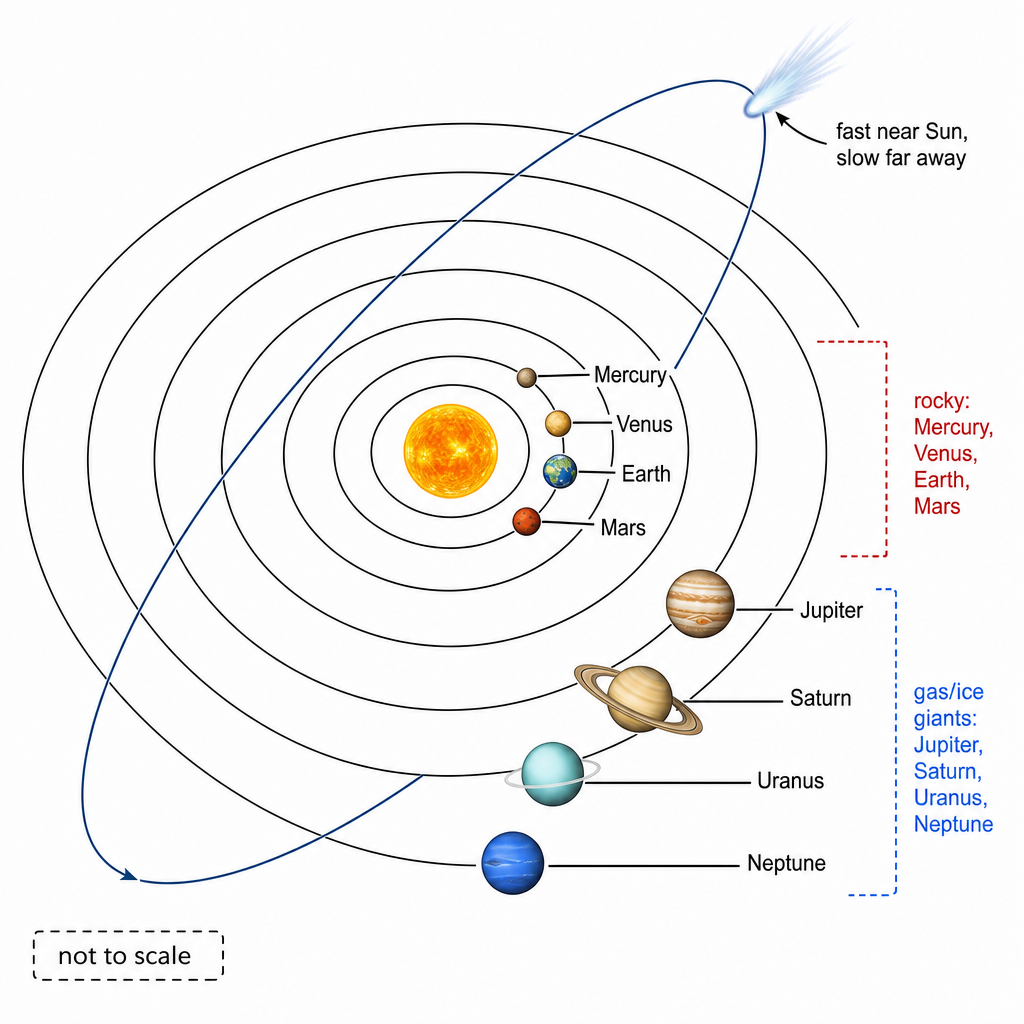
Key idea🔑 Key idea: orbits are ellipses; a body moves fastest at its closest point to the Sun and slowest at its farthest. Inner planets orbit faster than outer ones.
Worked example
Worked Example: Mars vs Jupiter — Which Orbits Faster?
Worked Example: Closer = Faster 🪐
Mars orbits closer to the Sun than Jupiter. Without any numbers, state which planet has the greater orbital speed and why.
- 1Mars is closer, so the Sun's gravitational pull on it is stronger, and a stronger pull is needed to bend a faster body into orbit, so Mars orbits faster than Jupiter. The rule to remember: closer to the Sun always means a higher orbital speed.
---
4. The Sun, Stars and the Life Cycle
The Sun is an average-sized star powered by nuclear fusion of hydrogen into helium in its core, releasing the energy that lights and warms the Solar System. Stars are grouped into galaxies (ours is the Milky Way), and distances are so vast we measure them in light-years (the distance light travels in one year). A star forms from a cloud of gas and dust (a nebula) pulled together by gravity, lives a long stable life, then dies. How it dies depends on its mass: a star like the Sun swells to a red giant then shrinks to a white dwarf; a much heavier star becomes a red supergiant, explodes as a supernova, and leaves a neutron star or black hole.
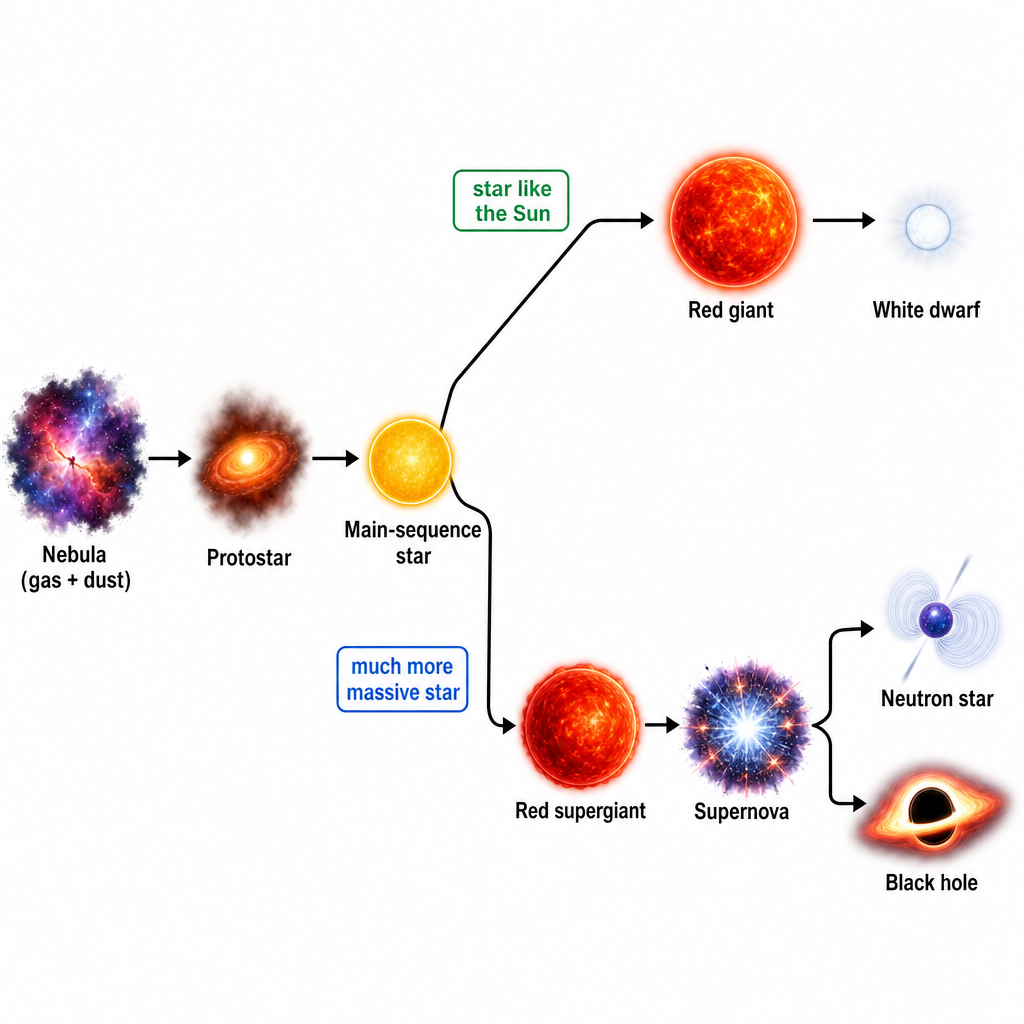
Key idea🔑 Key idea: the Sun fuses hydrogen → helium. A star's death depends on its mass: Sun-like → red giant → white dwarf; massive → red supergiant → supernova → neutron star or black hole.
Worked example
Worked Example: Order a Star's Life Cycle
Worked Example: Supergiant to Supernova 💥
Put these stages of a massive star (much heavier than the Sun) in order: supernova, nebula, red supergiant, main-sequence star, black hole.
- 1Follow the lower (massive-star) path: nebula → main-sequence star → red supergiant → supernova → black hole. The trick for full marks is to read the word "massive": a Sun-mass star would end as a white dwarf instead, so the mass tells you which branch to take.
---
5. The Expanding Universe and Hubble's Law
Light from distant galaxies is stretched to longer (redder) wavelengths: redshift. The further away a galaxy is, the bigger its redshift, which means the faster it is moving away from us. That is Hubble's law, and it tells us the whole Universe is expanding from an initial hot, dense state: the Big Bang. The faint microwave glow filling all of space (cosmic microwave background radiation, CMBR) is the leftover heat of that beginning. Running the expansion backwards with the Hubble constant even estimates the age of the Universe as about .
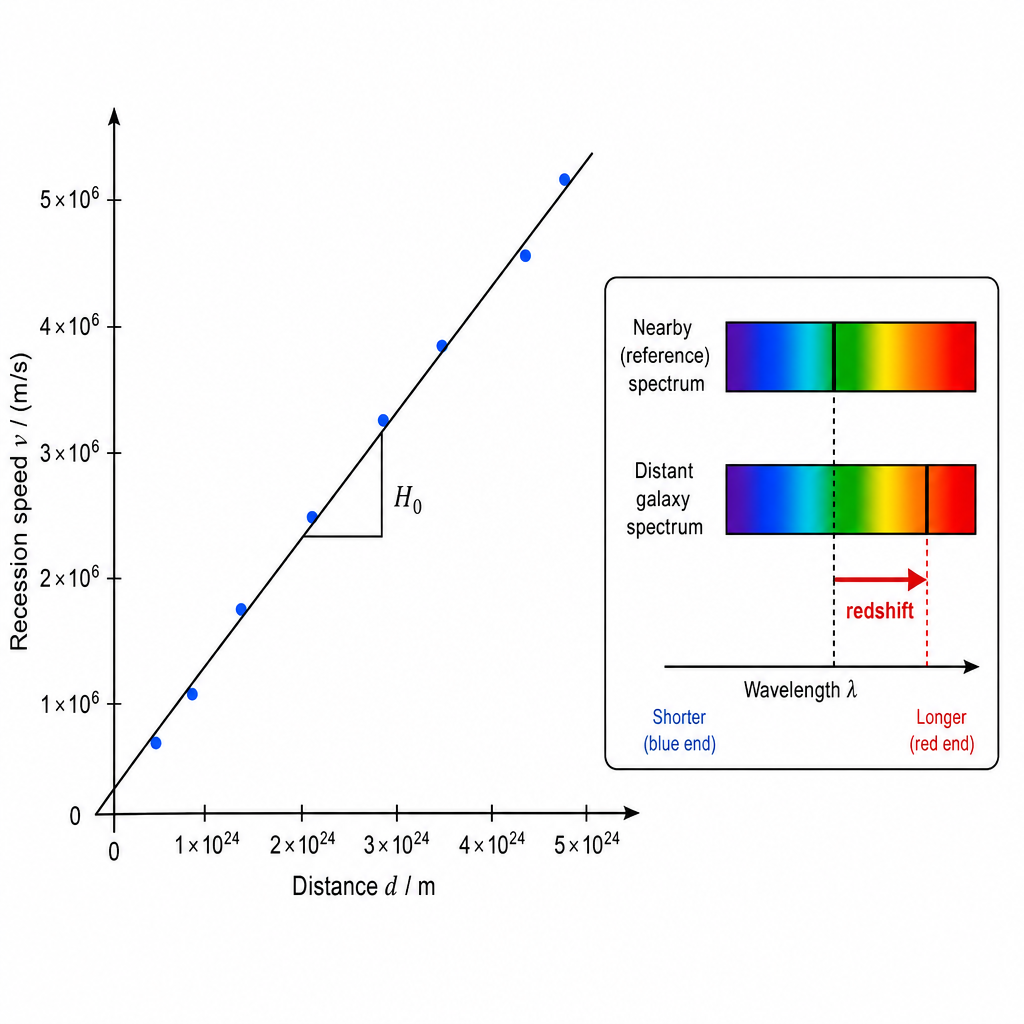
Key idea🔑 Key formula: Hubble's law — recession speed equals the Hubble constant times distance. Redshift is the evidence; the CMBR confirms the Big Bang; age of Universe .
Worked example
Worked Example: How Fast Is That Galaxy Receding?
Worked Example: Plug Into v = H₀d 🧮
A galaxy is m away. Taking the Hubble constant as s, find how fast it is moving away from us.
- 1State Hubble's law and substitute. Units already match (metres and per-second), so no conversion is needed:
- 2Sanity-check the size: that's about of the speed of light ( m/s), which is huge but believable for a galaxy this far away. The further out you look, the faster things recede, which is exactly why a bigger distance means a bigger redshift.
---
Practice this in the app
Unlock the full chapter: practice questions, flashcards, mock papers and notes, free.
Continue revising