Motion, Forces and Energy: Measurement, Dynamics, and Power
Motion Master: Make the Numbers Move 🏎️
Introduction
1. Introduction
Alright, the big one. Why does a sprinter need a few seconds to hit top speed, why does a heavier trolley accelerate less for the same push, why do crumple zones save lives, and why do your ears hurt at the deep end of a pool? Same chapter, all of it: measurement, forces, motion graphs, momentum, energy, and pressure.
This is your fast refresh, not the full textbook. One key formula per concept, one quick worked example, and the exact phrase the marker wants. Lock the formulas, read the graphs, walk in calm. Let's make the numbers move! 🏎️
This is your fast refresh, not the full textbook. One key formula per concept, one quick worked example, and the exact phrase the marker wants. Lock the formulas, read the graphs, walk in calm. Let's make the numbers move! 🏎️
2. Measurement and Scalars vs Vectors
You measure length with a ruler, volume by displacement in a measuring cylinder, and short times with a stopwatch (timing many swings of a pendulum, then dividing, beats timing one). A scalar has size only (mass, time, speed, energy); a vector has size and direction (force, velocity, acceleration, momentum). Two forces at an angle combine into a single resultant you find by scale drawing or, when they're perpendicular, by Pythagoras.
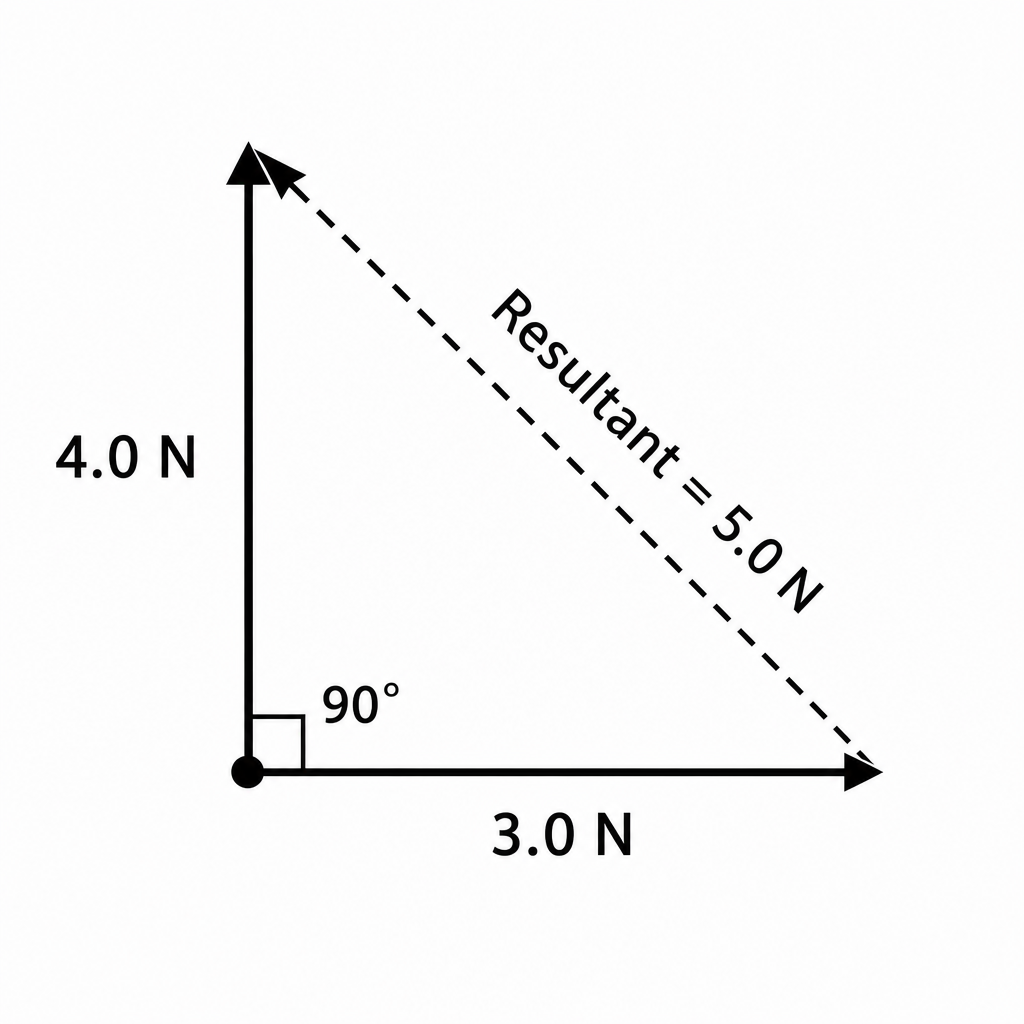
Key idea🔑 Key idea: Scalar = size only; vector = size + direction. Perpendicular vectors combine by ; use a scale diagram for other angles.
Worked example
Worked Example: Two Pushes at a Right Angle
Worked Example: When Forces Meet at 90° ➕
A box is pushed with N east and N north at the same time. Find the size of the resultant force.
- 1The forces are perpendicular, so use Pythagoras: N. (Direction would come from , but the question only asked for the size.)
---
3. Speed, Velocity and Acceleration
Speed is distance per time; velocity is speed in a stated direction. Acceleration is how fast velocity changes: . The exam loves speed-time graphs: the gradient is the acceleration and the area under the line is the distance travelled. A flat line means steady speed, a downward slope means deceleration. Near Earth, free-falling objects accelerate at m/s² until air resistance grows to match weight, giving constant terminal velocity.
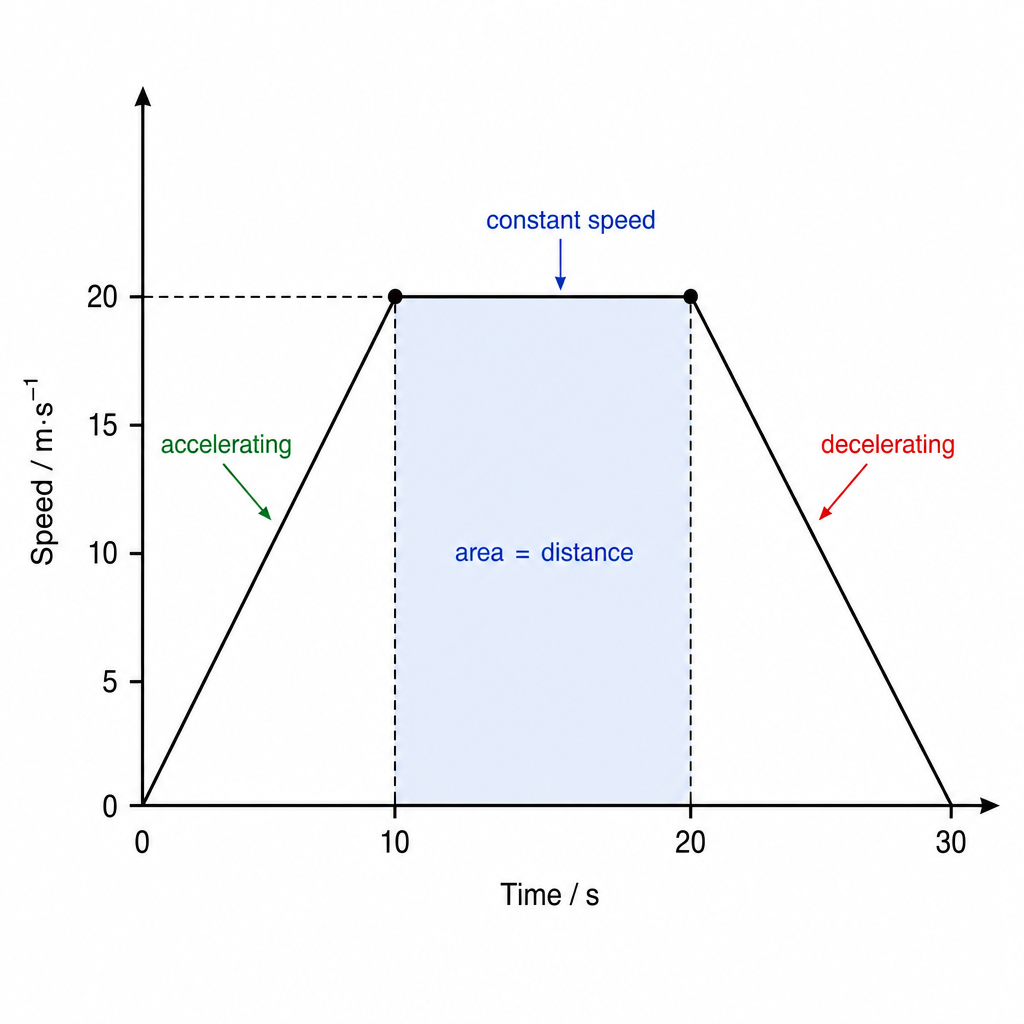
Key idea🔑 Key formulas: . On a speed-time graph: gradient = acceleration, area = distance. Free-fall acceleration m/s².
Worked example
Worked Example: Acceleration from a Graph Gradient
Worked Example: Read the Slope, Get the Marks 📈
A car speeds up from m/s to m/s in s. Find its acceleration, then the distance covered in that time.
- 1Acceleration is the gradient:
- 2Distance is the area under the speed-time line: a rectangle ( m) plus a triangle ( m).
Reading both the gradient and the area off one graph is the single most common Motion exam move. 📈
---
Answer
4. Mass, Weight and Gravitational Field Strength
Mass (kg) is the amount of matter and never changes. Weight (N) is the gravitational pull on that mass: , where is the gravitational field strength (≈ N/kg on Earth, less on the Moon). An astronaut in orbit isn't beyond gravity at all; they fall freely with their ship, so they feel weightless. Mass also measures inertia: the bigger the mass, the harder it is to start, stop, or turn.
Key idea🔑 Key formula: . Mass is constant everywhere; weight changes with . On Earth N/kg, on the Moon about N/kg.
Worked example
Worked Example: Your Weight on Mars
Worked Example: Pack Lighter, Mars Pulls Softer 🪐
A rover has a mass of kg. Find its weight on Earth ( N/kg) and on Mars ( N/kg).
- 1Apply twice: Earth N kN; Mars N. Same mass, smaller field, smaller weight.
---
5. Density and Floating
Density is mass packed into volume: (units kg/m³ or g/cm³). It decides floating: an object floats on a fluid if its density is less than the fluid's, and one liquid floats on another the same way (oil on water, water on syrup). Water is kg/m³ ( g/cm³), a handy reference. Find an irregular solid's volume by the rise in water level when you drop it in.
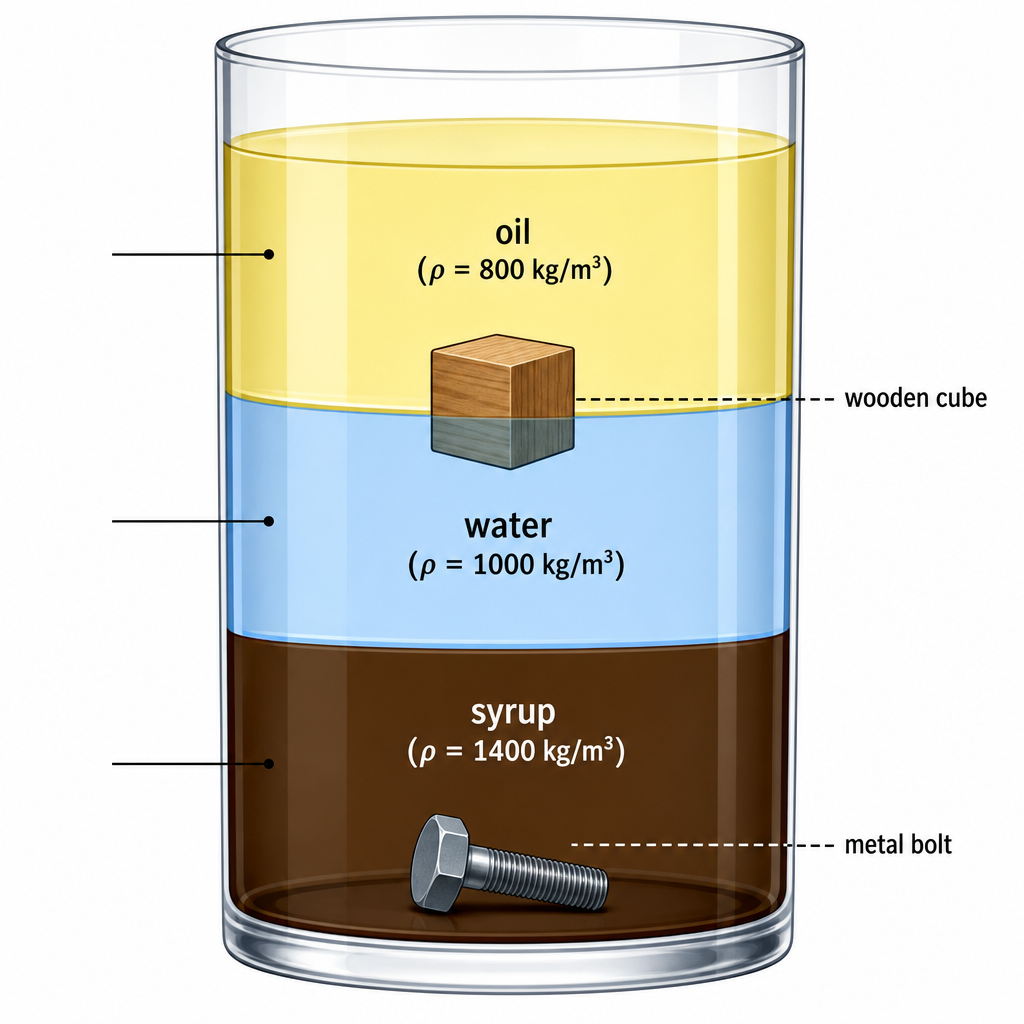
Key idea🔑 Key formula: . Less dense floats on more dense. Water kg/m³ g/cm³.
Worked example
Worked Example: Will the Block Float?
Worked Example: The Three-Layer Test 🧪
A plastic block has mass g and volume cm³. Will it float on water?
- 1Density g/cm³. That's less than water's g/cm³, so it floats.
---
6. Forces, Hooke's Law and Newton's Second Law
A resultant (unbalanced) force changes motion; balanced forces leave it unchanged (Newton's first law). Newton's second law puts a number on it: . A spring obeys Hooke's Law, extension proportional to load, , up to its limit of proportionality. When the resultant force keeps pointing toward a centre, the object moves in a circle at constant speed but changing direction, so it's still accelerating (think a ball on a string, or a car rounding a bend).
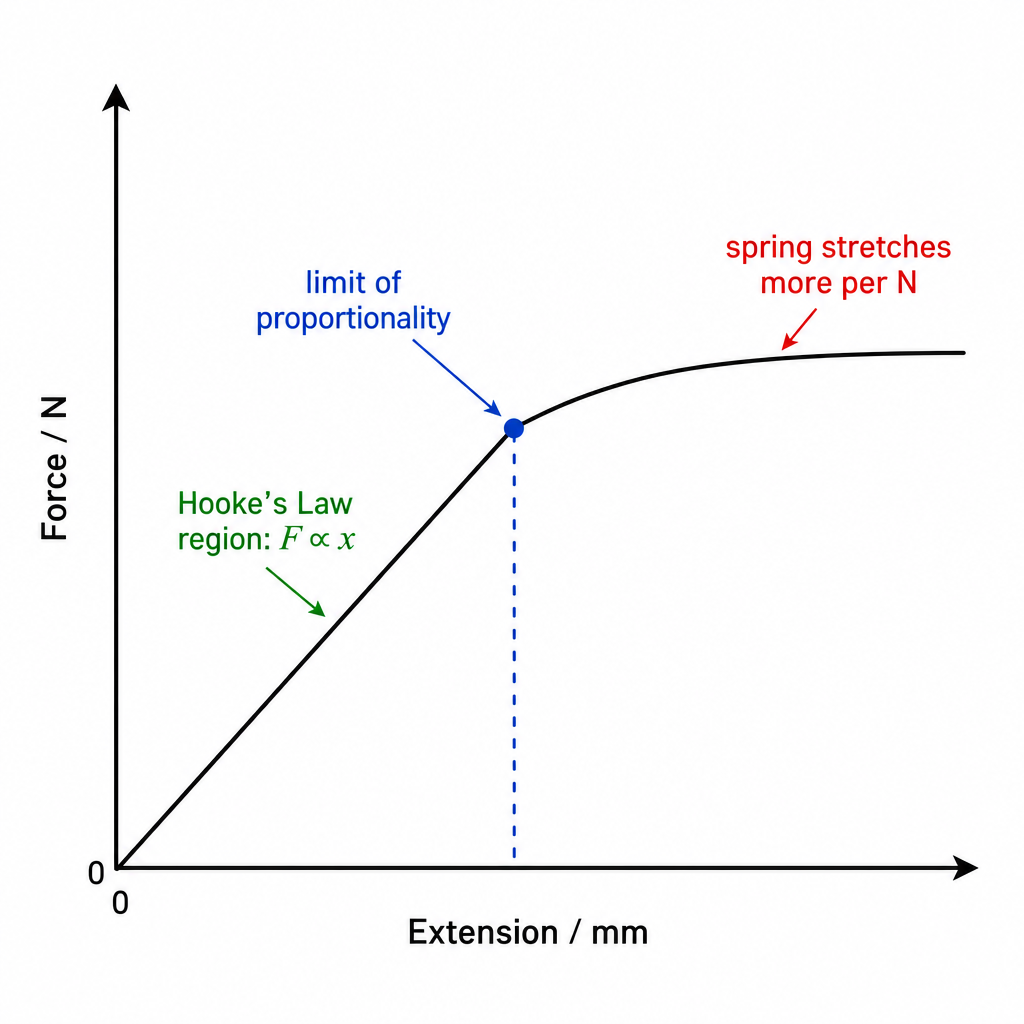
Key idea🔑 Key formulas: (resultant force, mass, acceleration) and (spring force, spring constant, extension within the limit). Circular motion needs a centre-pointing resultant force.
Worked example
Worked Example: Push a Trolley, Get a Number
Worked Example: F = ma in Action 🛒
A kg trolley is pushed with N forward against N of friction. Find its acceleration.
- 1First the resultant force: N forward. Friction always opposes motion, so you subtract it.
- 2Now Newton's second law, rearranged for acceleration:
The golden habit: find the resultant force first, then divide by mass. Skip the resultant and you lose the marks. 🌀
---
Answer
7. Moments and Equilibrium
A moment is a turning effect: , force times the perpendicular distance from the pivot (units N·m). For an object that isn't turning, the principle of moments says total clockwise moments equal total anticlockwise moments about any pivot. Full equilibrium needs two conditions at once: no resultant force and no resultant moment. This is how see-saws, cranes, and spanners are analysed.
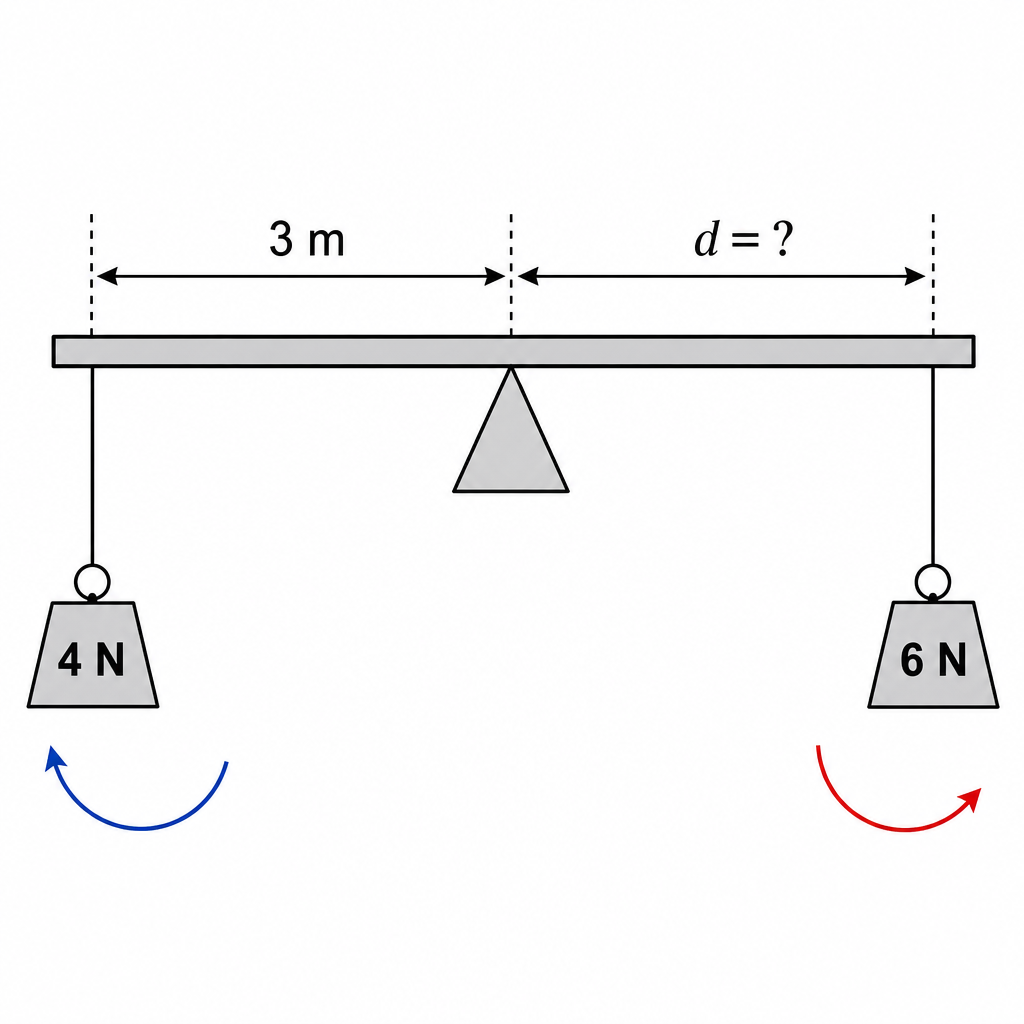
Key idea🔑 Key formula: Moment . Balanced: clockwise moments anticlockwise moments. Equilibrium needs zero resultant force and zero resultant moment.
Worked example
Worked Example: Find the Missing Distance
Worked Example: Balance the Beam 🧮
A N weight sits m left of a pivot. Where must a N weight hang on the right to balance the beam?
- 1Apply the principle of moments, anticlockwise = clockwise: , so m from the pivot.
---
8. Centre of Gravity and Stability
The centre of gravity is the single point where an object's whole weight seems to act. An object is stable when this point sits low and over a wide base, and it tips over only when its centre of gravity passes outside the base. That's why racing cars are low and wide and a tall thin glass topples easily. You find the centre of gravity of a flat card by hanging it from two points and marking the plumb-line each time; the lines cross at the centre of gravity.
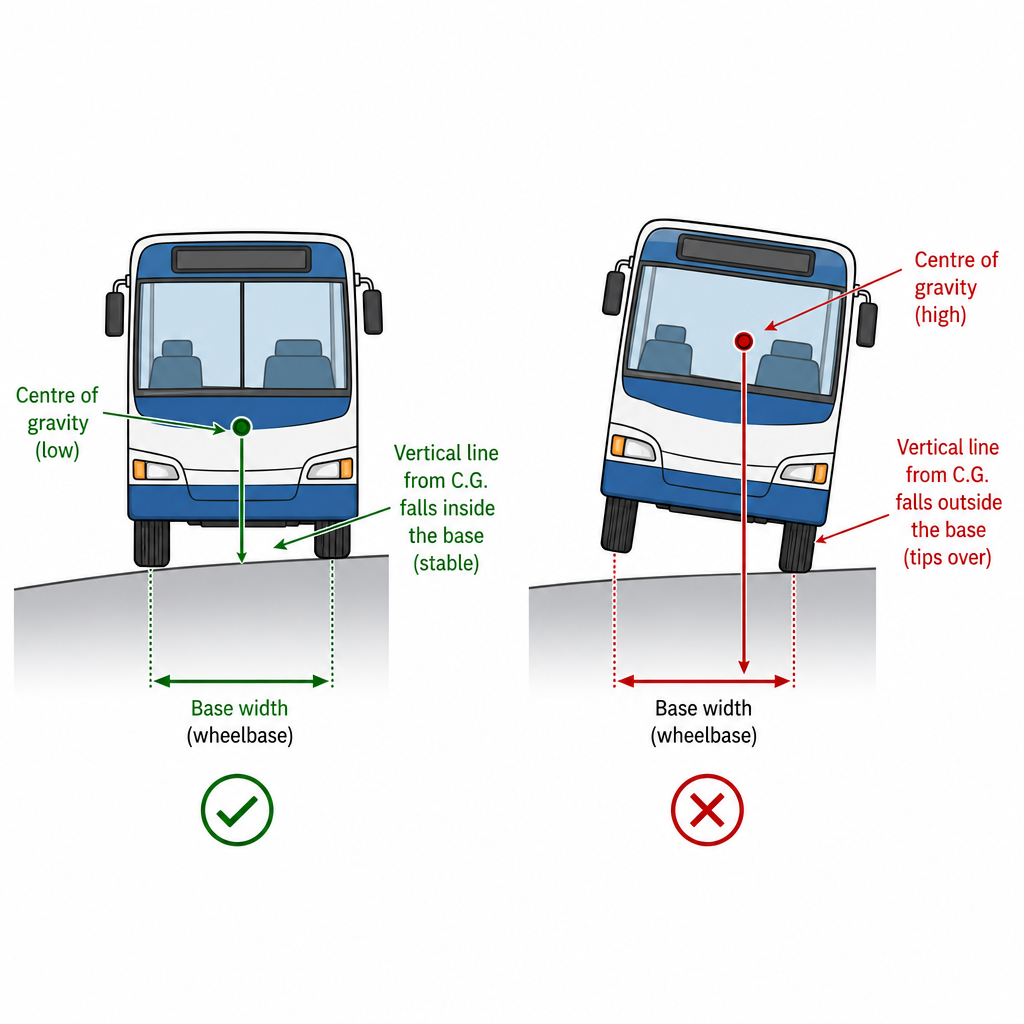
Key idea🔑 Key idea: Low centre of gravity + wide base = stable. It topples once the line of action of the weight falls outside the base.
Worked example
Worked Example: The Plumb-Line Trick
Worked Example: Locate the Centre of Gravity 🟨
Describe how to find the centre of gravity of an irregular flat card.
- 1Hang the card freely from a pin near one edge and hang a plumb-line from the same pin; mark the vertical line on the card. Repeat from a second point. The centre of gravity is where the two lines cross, because a hanging object always settles with its centre of gravity directly below the pivot.
---
9. Momentum and Impulse
Momentum is mass in motion: (units kg·m/s), a vector. In any collision with no outside forces, total momentum is conserved: the total before equals the total after. Impulse is the change in momentum, , and it explains safety design: a crumple zone or airbag makes a collision last longer, so for the same momentum change the force is smaller. Same physics behind bending your knees when you land.
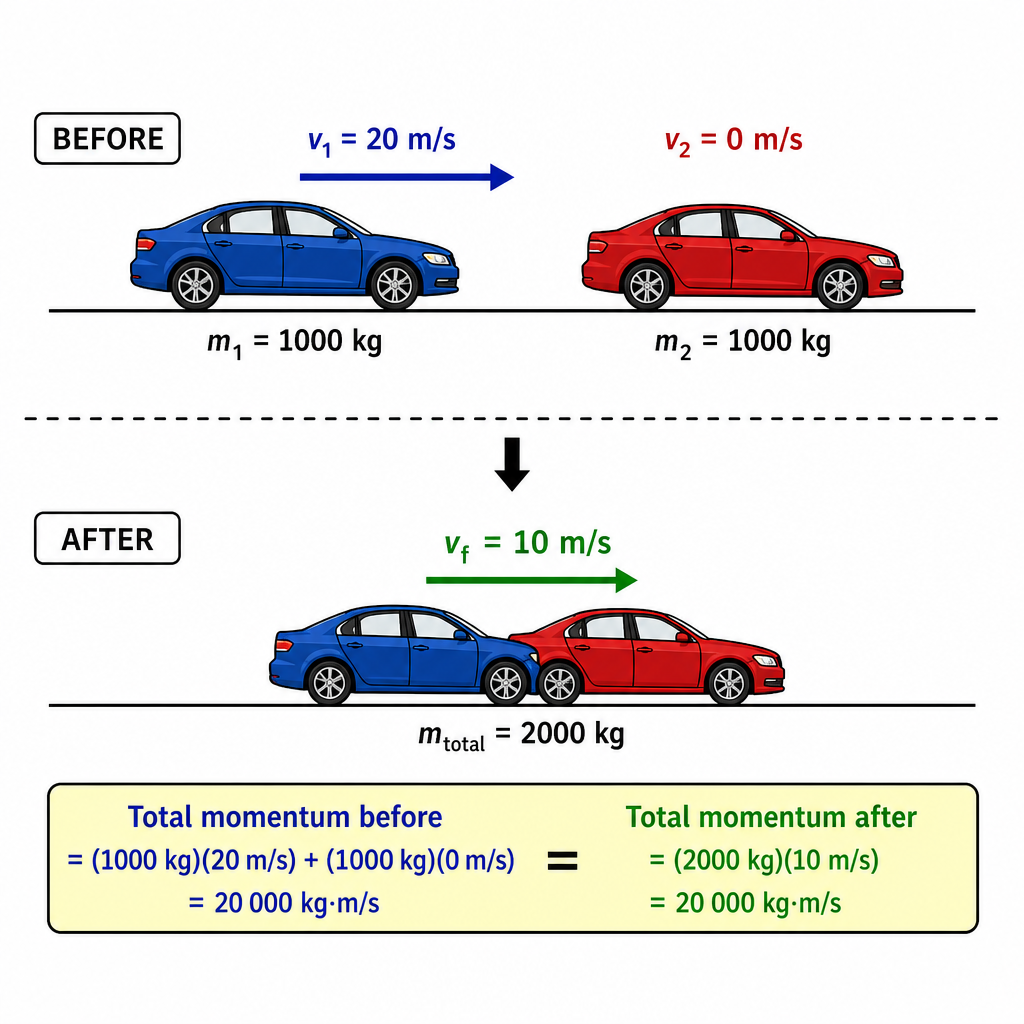
Key idea🔑 Key formulas: ; total momentum conserved in collisions. Impulse : longer impact time smaller force.
Worked example
Worked Example: Sticky Crash, Same Total p
Worked Example: Conservation in a Collision 💥
A kg car at m/s hits a stationary kg car and they lock together. Find their common speed afterwards.
- 1Momentum before: kg·m/s.
- 2After, the combined kg moves at , and momentum is conserved:
Double the moving mass, half the speed: total momentum unchanged. 💥
---
Answer
10. Energy Stores, Conservation and Sankey Diagrams
Energy is stored (kinetic, gravitational, elastic, chemical, nuclear, thermal) and transferred between stores, never created or destroyed: that's conservation of energy. Two formulas dominate: kinetic energy and change in gravitational PE . A falling object swaps PE for KE; ignoring air resistance, every joule of PE lost becomes KE. Sankey diagrams draw the flow as arrows whose width shows how much energy goes to useful output versus wasted heat.
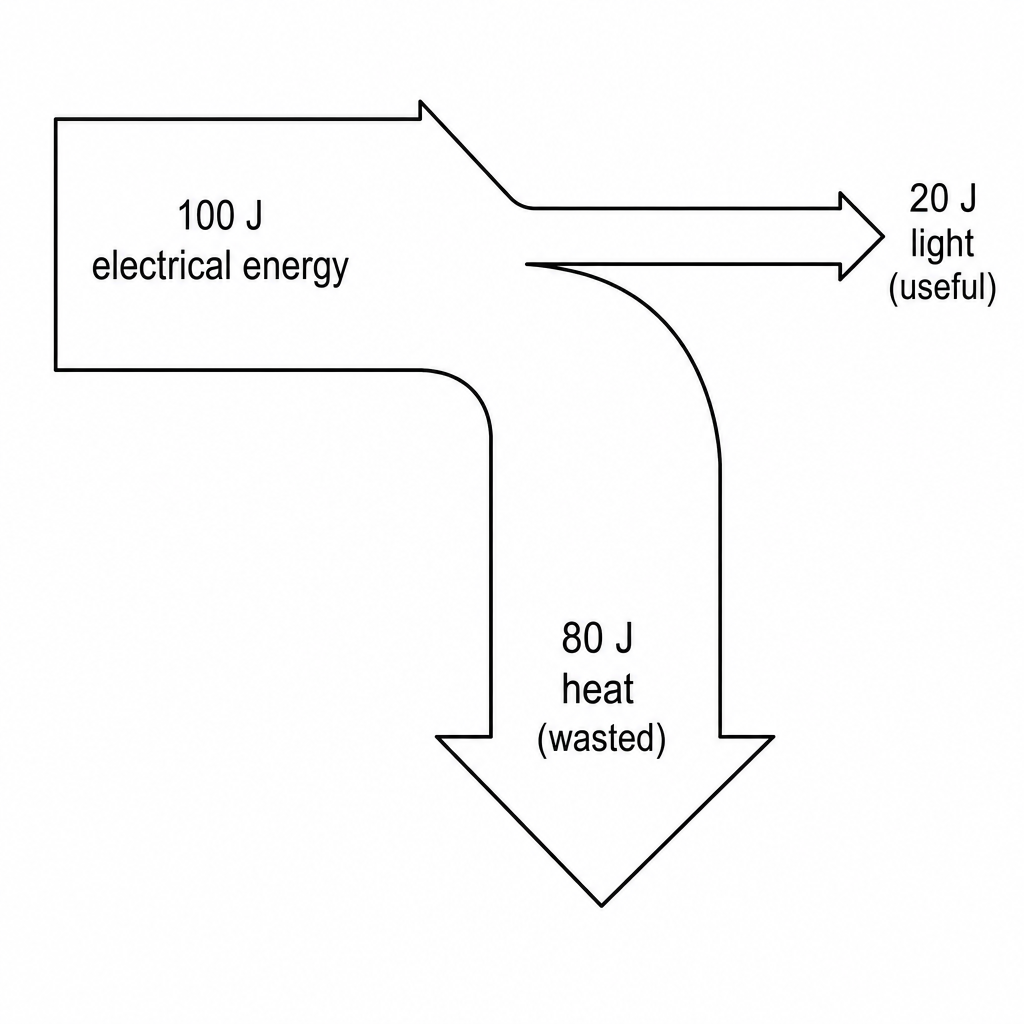
Key idea🔑 Key formulas: and . Energy is conserved: PE lost KE gained (no air resistance). Sankey widths energy.
Worked example
Worked Example: Drop a Ball, Predict the Speed
Worked Example: GPE Becomes KE 🏀
A kg ball is dropped from m. Find its speed just before it lands (take N/kg, ignore air resistance).
- 1All the gravitational PE becomes kinetic energy: J.
- 2Set J and solve for :
Notice the mass cancels out of the final speed: every object falls to the same speed from the same height (no air resistance). 🏀
---
Answer
11. Work Done
Work done is energy transferred by a force: , force times the distance moved in the direction of the force (units: joules, the same unit as energy). Lift a box and you do work against gravity that becomes gravitational PE; push a crate across a floor and your work becomes heat in the friction. No movement means no work, however hard you strain.
Key idea🔑 Key formula: (force × distance moved in the force's direction). Work done = energy transferred, measured in joules.
Worked example
Worked Example: Loading the Top Shelf
Worked Example: Pay the Joule 📦
You lift a N box through a height of m onto a shelf. How much work do you do, and where does that energy go?
- 1J. That energy is now stored as the box's extra gravitational PE.
---
12. Energy Resources
We generate electricity from renewables (solar, wind, hydro, geothermal, tidal, biomass) and non-renewables (coal, oil, gas, nuclear). Most trace back to the Sun: fossil fuels are ancient stored sunlight, wind and waves are driven by solar heating; the exceptions are nuclear, geothermal, and tidal (the Moon's pull). The Sun's own energy comes from nuclear fusion of hydrogen into helium. Exam answers weigh reliability, cost, and pollution against each other.
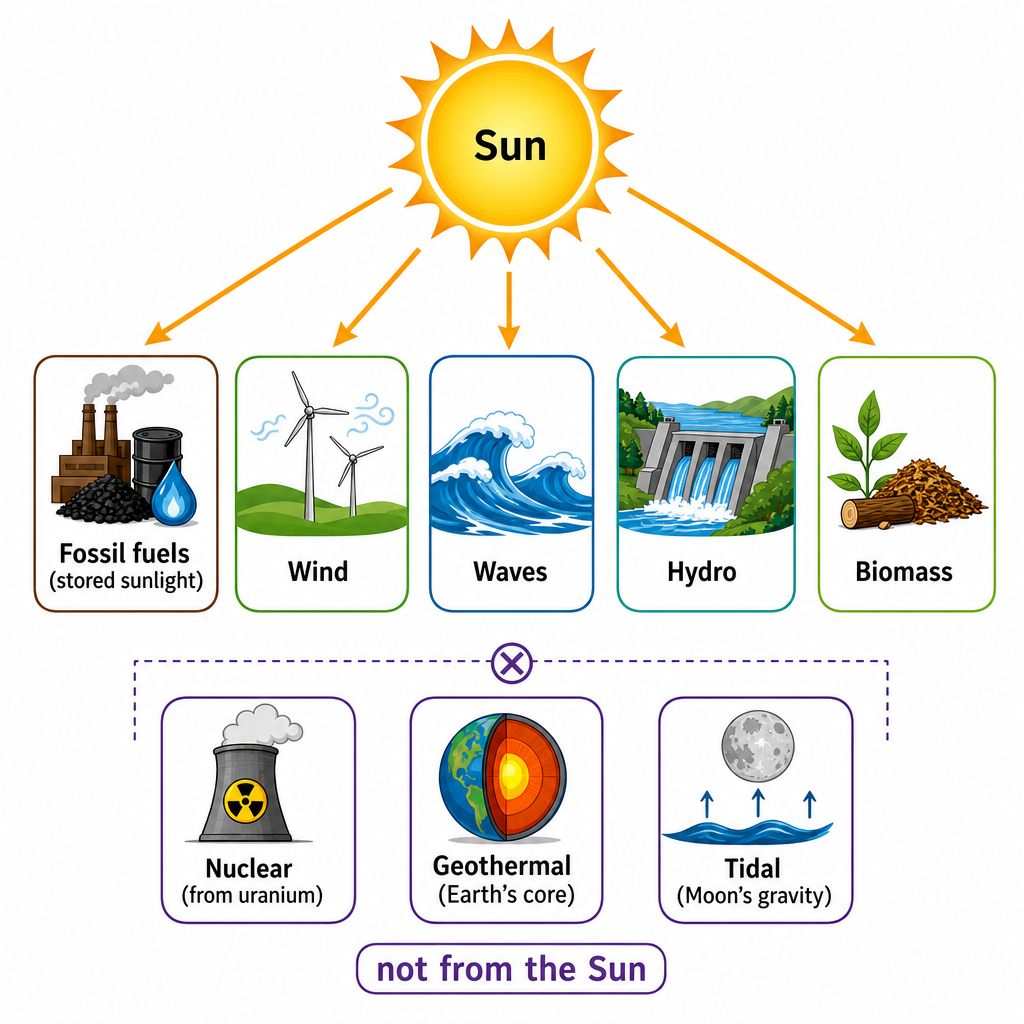
Key idea🔑 Key idea: Renewable vs non-renewable. Most resources trace to the Sun; nuclear, geothermal, and tidal don't. The Sun is powered by hydrogen fusion.
Worked example
Worked Example: Which Power Station Wastes Less?
Worked Example: Compare the Efficiency ♻️
Station A turns of its fuel energy into electricity; Station B turns . For every MJ of fuel, how much useful electrical energy does each give, and which wastes less?
- 1A gives MJ; B gives MJ. Station A delivers more useful energy per unit of fuel, so it wastes less.
---
13. Power and Efficiency
Power is how fast energy is transferred (or work is done): , measured in watts (1 W = 1 J/s). Efficiency is the fraction of input energy that comes out useful: . No real machine reaches because some energy always ends up as wasted heat (friction, sound). A more powerful motor does the same job faster; a more efficient one wastes less doing it.
Key idea🔑 Key formulas: (watts). Efficiency , always under .
Worked example
Worked Example: How Much Hits the Hook?
Worked Example: Motor Efficiency 🪝
An electric motor takes in J of electrical energy and lifts a load, giving it J of gravitational PE. Find its efficiency.
- 1Efficiency . The missing J became heat and sound.
---
14. Pressure
Pressure is force spread over area: (units: pascals, Pa N/m²). A sharp knife or a stiletto heel concentrates force on a tiny area for huge pressure; a snowshoe spreads it out for tiny pressure. In a fluid, pressure increases with depth: . That's why a dam is thicker at the bottom and why your ears hurt as you dive deeper, with atmospheric pressure pushing on top of the water's.
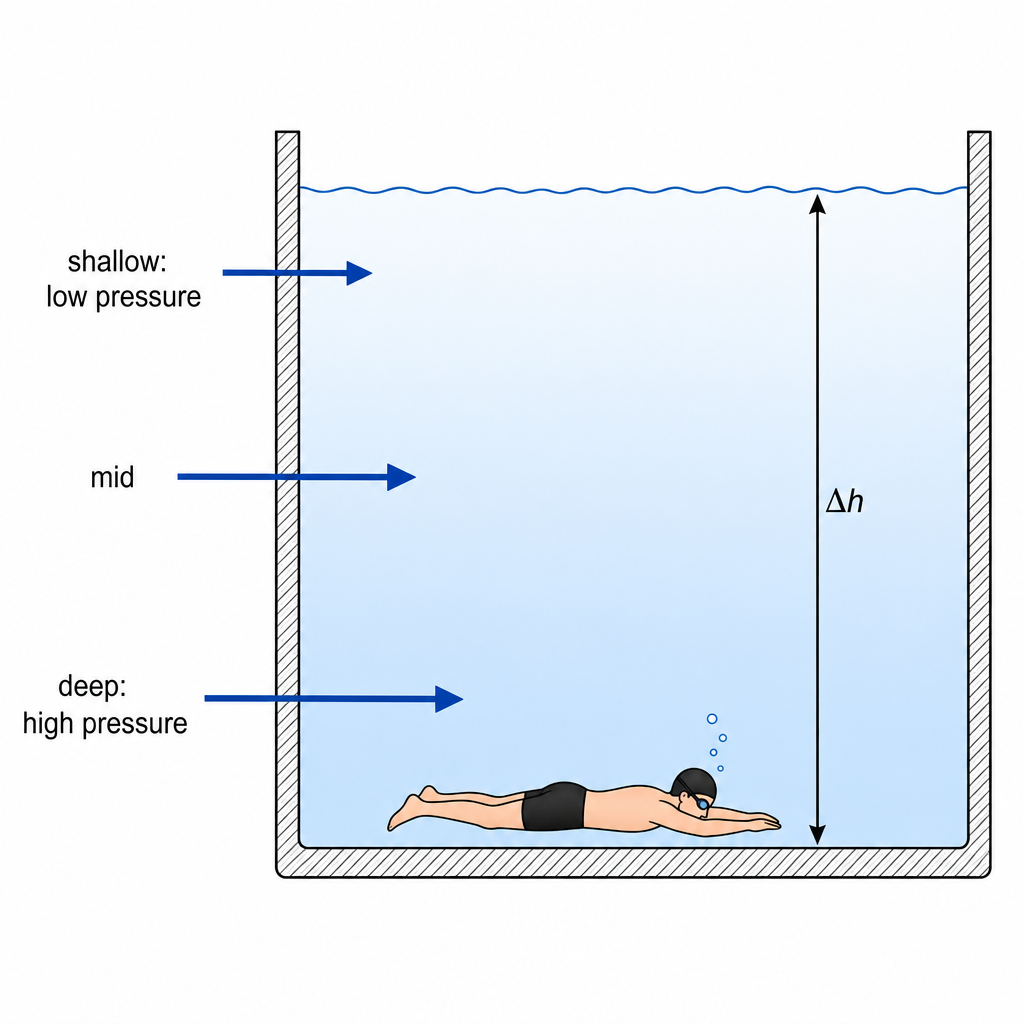
Key idea🔑 Key formulas: (pascals). In a fluid, pressure rises with depth: . Small area big pressure.
Worked example
Worked Example: Pressure at the Deep End
Worked Example: Deep-End Squeeze 🏊♂️
Find the extra water pressure on a swimmer m below the surface. Take kg/m³ and N/kg.
- 1Use Pa kPa. That's on top of atmospheric pressure, which is why the deep end squeezes your ears.
---
Practice this in the app
Unlock the full chapter: practice questions, flashcards, mock papers and notes, free.
Continue revising